Category Archives: Romania

MTV Generation vs. Corruption in Romania, 2004

Matt Welch has an update on Romania in the 17 July 2004 edition of Canada’s National Post, under the headline “Rapping the Commies Away: A New MTV Generation in Romania Tries to Drive out Corruption”:

This scuffling country of 23 million, long the redheaded stepchild of New Europe, received an unexpected and welcome jolt to its system this June, when a wave of youthful revulsion at government corruption rocked the ruling Social Democratic Party (PSD) in local elections, possibly paving the way for what could be Romania’s most important political development since pro-government miners literally clubbed the anti-Communist revolution into near-submission 14 long years ago.

Septuagenarian President Ion Iliescu may finally be driven from politics in this November’s national elections. Iliescu, an old Communist hack who once doled out punishment against sympathizers with the crushed Hungarian rebellion of 1956 and eventually rose to the Romanian Party’s Central Committee, manoeuvred his way into the presidency in December, 1989, won elections in 1990 and 1992, called in the miners to assault his political opponents in 1990 and 1991, stayed in opposition from 1996 to 2000, and regained the presidency four years ago.

Under his watch, the country has staggered down the path of economic and political reforms, flirted with noxious nationalism and successfully bargained itself into a post-Sept. 11 NATO while managing to become regionally synonymous with the word “corruption.”

Now, blue Romania is in open revolt against Iliescu’s mafia-style “Local Barons,” driving the fat-cat ex-Reds from the city halls of large municipalities like Cluj and the capital, Bucharest, while openly mocking the ruling technocrats’ ham-handed attempts at manipulating the media….

In the absence of quality media, news in the Romanian sticks travels by word of mouth, and retail politics takes on a surrealistic hue — when I was in the south-central Romanian village of Visina Noua during the second round of the elections, word travelled that the increasingly desperate incumbent PSD mayor was offering anyone who would vote for him a useful gift — a free coffin. (He’s a coffin-maker … and he won.)

In the big cities, by comparison, competitive newspapers describe the mechanics of corruption in pretty impressive detail, which the kids can then routinely cite. People generally know that the government attempts to influence newspapers and television by being one of the country’s largest advertisers (spending millions on hyping such crucial monopolist services as the Romanian international airport’s control tower); they know that Local Barons (such as the odious and recently defeated Bacua mayor Dumitru Sechelariu) threaten to “execute” journalists who uncover their dirty laundry; and they know specific cases of state assets being pilfered and/or stripped.

It’s no wonder they’re fed up with the generations that were raised under Communism.

Meanwhile, former Romanian intelligence official Ion Mihai Pacepa, writing in National Review Online on 20 July 2004, says Iliescu has now swung around to become an important U.S. ally.

Soon after the 1989 revolutionary wave changed the face of Europe, Vaclav Havel and Lech Walesa headed for Washington to express their gratitude for the long and painful efforts made by the U.S. to bring Communism to its knees. Romania’s new leader, Ion Iliescu, went to Moscow, where on April 5, 1991, he signed a treaty with Mikhail Gorbachev stating that in the future Romania would not belong to any military alliance that could be “detrimental to the Soviet Union.”

But all that had changed by 23 November 2002 when President Bush announced in Bucharest Romania’s invitation to join NATO.

Leave a comment

Filed under Romania

Ceausescu’s Mother of All Palaces

Andrei Codrescu, in The Hole in the Flag (Avon Books, 1991) cites the belief in Bucharest that architects were among the greatest criminals of Ceausescu’s rule.

Early the next day, on January 3 [1990], we went to interview the chief architect of Bucharest. He was one of the men responsible for implementing Ceausescu’s policy of sistematizare, including the destruction of Damieni [and other rural villages and relocation of villagers into urban blocks of apartments]. That this man was still in place was amazing in itself, but that he was still in charge was even more amazing. A guard in front of the building asked us where we were going. We told him. “The devil,” he said, “is going to fry that man in a piss pot. He’s under arrest up there.”

As it turned out, he wasn’t really under arrest but was really in charge. Or partly under arrest and partly in charge. No one knew for sure. The ministry building–the chief architect has ministerial rank–was a pretty turn-of-the century Victorian house. The two soldiers guarding the inner entrance barely glanced at our passports. There was little sense here of the emergency gripping the media or the front buildings. And yet it was here, more than anywhere else, that the evil of Ceausescu’s dream was made manifest. Dozens of historical monuments, churches, and architectural treasures had been demolished to make room for Ceausescu’s self-glorifying monuments. Gone was the beautiful Vacaresti Monastery, where I had once looked at icons, with its twin Byzantine towers, shady porticoes, and long galleries. Gone also were many old mysteries of my student years where I’d hidden to write poetry and dream. An old city is a sort of wilderness. Destroying it is the same as destroying a forest, an ecological crime. Ceausescu’s forest of apartment blocks, which stands over the ghosts of my youth, is regarded by many as the most ambitious construction project in Europe. But the presidential palace, built over the three layers of secret tunnels, is the regime’s most grimly symbolic building. Its floor space is more than 400,000 square feet and thirteen stories. There are great chandeliers over the immense marble staircase. The central area for receptions is as big as a football field, 240 feet long and 90 feet wide, with tower ceilings covered in gold leaf or pink gypsum. The five-ton chandelier over the main staircase consumes more electricity than two Romanian villages. At the time when average people’s apartments were required to use sixty-watt bulbs, the palace devoured eighty-five thousand watts. The marble columns are hand-carved. It is three times the size of Versailles and bigger than the Pentagon. Fifty thousand people lost their homes, so that the site for it could be cleared when construction began in 1984. Its cost has run to more than a billion dollars, and whole industries were set up to feed the palace’s demands for marble and lumber. Construction accidents claimed twenty lives. And yet … the palace is only two thirds finished! The reason is that the Ceausescus inspected the building every week and ordered rooms, staircases, and decorations already built to be destroyed and started again. Like insane minotaurs at the center of an ever-growing maze, the couple tried to put traps and walls between them and their fate. The roof had to be built and rebuilt several times and was never finished.

Their story is reminiscent of the legend of Master Manole, the builder of Neagoe Basarab’s Castle on the Arges in the 16th century. That edifice, the ruins of which can still be seen in forbidding starkness over the Arges River, could not be made to stand no matter how hard its builders worked. Every time their work seemed finished, the building collapsed. One night Master Builder Manole had a dream that the only way to finish the building was to build someone alive into the wall. The three builders decided that the first of their wives to come with lunch next day would be sacrificed to the castle. The two older men told their wives to stay home, but young Manole didn’t. His beautiful young wife came and was immured in the castle wall. To this day, say local legends, you can hear her crying and lamenting on certain nights, not understanding how her husband could have been so cruel to her. One can say that symbolically the Romanian nation was likewise nearly sacrificed on Master Builder Ceausescu’s orders.

After we arrived in Bucharest in 1983, and before the weather got too cold, we used to take long walks along the major boulevards exploring the fascinating architecture of the older parts of the city and the depressing architecture of the newer parts. I remember one day wandering into Rahova Street and seeing block after block of complete rubble. When we asked about it, people blamed it on the 1977 earthquake. We had no idea it was destined to become this.

The U.S. ambassador to Romania at the time was a North Carolinian Baptist named David Funderburk, who had studied Romanian at UCLA and the University of Washington and had spent a Fulbright year in Romania in 1971-72. He was a Jesse Helms protegé, anathema to me ideologically. But after six months in Romania, I decided that a mollycoddled thug like Ceausescu really deserved a U.S. ambassador like Funderburk, who didn’t take him seriously. I heard a story from someone at the U.S. embassy that Funderburk had once had his driver fly the Confederate battle flag on his diplomatic limo during a drive out of Bucharest, just to confuse the Securitate outposts who monitored all diplomatic excursions into the countryside. The U.S. embassy also seems to have had some ties to Bible smugglers, one family of whom was expelled in 1984.

When we crossed the Hungarian border into Romania in 1983, the customs officials specifically asked us if we had any weapons, typewriters, or Bibles. The only contraband we had was a small electronic typewriter, which didn’t have to be registered with the police (maybe because they didn’t recognize it as a typewriter), and a copy of Orwell’s 1984 (“banned in Romania”!) which was passed around the foreigner community during our year there. It proved a better guide to the local political culture than anything else we had read at the time.

Leave a comment

Filed under Romania

An Assembly Line at the Rumor Mill

Andrei Codrescu, in The Hole in the Flag (Avon Books, 1991) describes his trip out of Bucharest shortly after the fall of Ceausescu.

As we reached the outskirts ot the city, we saw immense lines tor milk, bread, and newspapers. People stood in the numbing cold, talking, moving their hands, pounding the ground to keep warm. They were dressed in long gray coats with lambskin hats pulled over their ears. Some wore several sweaters, and the women looked like onions with a half dozen skirts wrapped around them, as well as elaborate layers of kerchiefs around their heads. I remembered being a child in those lines, endlessly fascinated by the ceaseless chatter of the adults, gathering news tidbits for my mother, little bits of salacious gossip for my friends, even rare words I didn’t understand, which I put in a little notebook I had, called “Strange Words I Heard in Line.” These were the working people of Bucharest, of Romania. They had stood in line for forty-five years patiently waiting for the barest necessities. A revolution was going on, but the lines were still long–the same as the week before, the year before, the previous decade…. Are there, I wonder, people on this earth, whole countries, whole continents perhaps, doomed forever to the lines of misery, anticipation, and scarcity? As the world I know in America grows more satiated, more colorful, more overstimulated, these lines get longer, more desperate, the people in them more drab … and there is less at the counter when, after aeons of standing, they arrive, hands outstretched, the sweaty money they hold worthless after all that time…. Still, there is a difference between these lines and those of my childhood. No one is listening, waiting to report people’s discontents…. At least I hope so. Every word people speak now would have been considered treason only moments ago. And what of those people whose jobs had been to listen and to report? Do they feel shame, or embarrassment, or fear? They certainly haven’t disappeared; they are doubtlessly still in the line, listening. (After all, they, too, have families they have to feed.) Full of unusable information, would they eventually disintegrate? Publicly confess? Get religion? I had the fleeting vision of a revolution that works on the honor system: Bad people arrest themselves.

Throughout my childhood I believed that one had to lower one’s voice whenever speaking seriously. A normal tone of voice, possible to overhear, was reserved exclusively for trivia. One would use several tones in the course of a conversation, even within a single sentence. For instance, my mother would send me to stand in line for bread. As she handed me the ration book, she would say in a normal voice, “Get two loaves and five rolls,” and then, lowering her voice, “if there are enough coupons,” and then, lowering her voice even more, “and find out what people are saying.” This last phrase was well understood. We stood in breadlines not iust for bread but also for the news. The breadline was our newspaper since the actual newspapers printed nothing but lies. Rumors, innuendos, and mishearing made the rounds faster than print anyway.

Romania in 1984 was definitely an information-deprived society, where everything officially confirmed was considered a lie and everything officially denied was considered the truth. One restaurant near Piata Unirii that we passed every day–I believe it was the Budapesta–was reputed to have served human liver to its patrons for lack of any other meat. I found out later that the same rumor had persisted for a decade or more. There would have been no use officially denying it. That would only confirm the rumor.

Here’s an old joke about the ubiquitous food queues.

Ceausescu had heard there were food shortages and wanted to fly around in his helicopter to see for himself if the stories were true. He didn’t have to travel far to see a long line of people standing in the cold.

“What are these people waiting for?” he asked.

“For eggs, Comrade Ceausescu.”

“Then have a truckload of eggs delivered there immediately! My people shouldn’t have to stand in line for eggs!”

“And what are those people waiting for?” he asked, pointing in another direction.

“For milk, Comrade Ceausescu.”

“Then have a truckload of milk delivered there immediately! My people shouldn’t have to stand in line for milk!”

“And what are those poor people waiting for?” he asked, noticing another very long queue.

“For meat, Comrade Ceausescu.”

“Well, in that case, have a truckload of chairs delivered there immediately! My people shouldn’t have to stand in line for meat!”

That is one of the few jokes I heard in Romania that isn’t in the wonderful collection entitled You Call This Living? A Collection of East European Political Jokes, by C. Banc [= ‘joke’ in Romanian] and Alan Dundes (U. Georgia Press, 1990).

Leave a comment

Filed under Romania

A Romanian Exile Returns to Bucharest, 1989

Andrei Codrescu, in The Hole in the Flag (Avon Books, 1991) describes his return to Bucharest days after the fall of Ceausescu.

The Inter-Continental Hotel in Bucharest is the modern-day equivalent of Dracula’s castle on the Arges River, a fortress built to resist cannon. It can be seen from almost anywhere, just like Ceausescu’s palace. Its facade was scarred by fresh bullet holes from top to bottom. It looked like a giant with measles. The older buildings on University Square all around it were also pockmarked every few inches as if someone had been firing precision rounds in a kind of mad game. Hundreds of windows were broken; parts of roofs were seared. University Square was a solid sheet of uneven, thick ice, blackened here and there by the grime of cars trying desperately to cross. There was an overpowering smell of wax in the air from the hundreds of candles burning at makeshift shrines under small Christmas trees.

The entrance to the lobby of the Inter-Con was a madhouse of reporters, cameramen, doormen, men in suits, and swarms of Gypsy children with paper flowers on sticks who all but put their quick little hands in your pockets. Their lively faces, caroling and begging, gave a festive air to the whole place…. I felt as if I were at a crossroads. I was tempted to leave my suitcases and walk away. I imagined renting a room somewhere in Bucharest with a view of Cismigiu Lake. I had enough American dollars to live modestly for the rest of my life. I could change my name once more and tell nosy neighbors that I was a provincial literature teacher from a remote Transylvania burg who had come to the capital for “culture.” I would establish a new life, consisting of regular visits to a small cafe and long evening walks by the lake. I would dress in an old-fashioned coat and tails from the last century and die a few years hence, a figure of mystery. I’d had this fantasy in many forms before–becoming a gas station attendant in a small town in Utah, for instance–but here it nearly became real. I wasn’t sure, though, whether such a change of identity was yet possible in Romania. But the revolution would prove itself only if it succeeded in reestablishing the possibility of anonymity for its citizens, a great gift in a country where sticking one’s nose in others’ business had been the order of day and night. In spite of the cold, there was an indefinite familiar smell to the street, not the diesel smell of Budapest, but something older: crushed linden flowers and smoke. Under the ice and snow were the idle footsteps of my old walks, the fallen leaves of adolescent autumns, the shadows of complicated Byzantine porticoes…. I had the momentary illusion that all I had to do was to start walking, that my footsteps would find the shadow of my old footsteps, and that if I followed my old path, I would somehow cancel time and be nineteen years old again. Suppose that there is a moment in the midst of a revolution when it is possible to transcend time. There is something in the Romanian psyche that keeps searching for that moment. There is a man in a story by Mircea Eliade, the great Romanian religious scholar and novelist, who leaves an enchanted garden only to discover that thirty years have passed. Conversely, leaving the garden of my exile, I might discover that thirty years had not passed. Exiles–and Eliade was most consciously an exile–do not believe in chronological time. We hold the places of our youth unchanged in our minds and stay secretly young that way. On the other hand, what if age catches up with us when we return? What if death, a patient creature that never strays far from one’s birthplace, waits for us just behind the old pantry door? I felt my hair beginning to turn white, my back begin to bend under the question mark of old age … and in Bucharest today the possibility of death was not at all remote.

Alas, I was also a foreigner and soon had proof of it. Porters, doormen, and bellboys, unmindful of my reveries, swarmed all over me.

I well remember the landmark Inter-Con during our 1983-84 year in Ceausescu’s Romania–it was very near both the university and the U.S. embassy–but I don’t remember going in there very often. The last time I entered the premises, it was to meet another foreigner in the coffee shop and change money under the table, buying about 4500 lei for US$100 that my wife had earned teaching at the American School. (The official rate was less than 10 lei to US$1.) My own stipend of 4500 lei per month (plus free rent) was quite adequate for our needs and allowed us enough to take a train trip to another city about one weekend a month. The only reason we had to buy more lei was for a longer springtime trip to Maramures.

I would collect my stipend at the foreign liaison office at the law school. Foreign dormitory students in front of me in line might collect 2000 lei, then have to repay various charges amounting to several hundred lei. The largest denomination was 100 lei (to make smuggling less efficient), and we were enjoined to count our money on the spot to keep the clerks honest. I always felt a bit guilty holding up the line while counting my 45 bills, then stuffing them into my least-pickable front pockets for the long walk back to our apartment bloc on Bulevardul Pionerilor (‘of the [Young] Pioneers’, now Tineretului ‘of the Youth’)–between the crematorium and the abattoir, across from the Park of Youth.

Leave a comment

Filed under Romania

Workers of the World, We Apologize!

Andrei Codrescu, in The Hole in the Flag (Avon Books, 1991) quotes this apology from a banner in Moscow’s Red Square on 1 May 1989, just before he begins his introduction entitled “An Apology for History”–a couple paragraphs of which follow.

A gentle scholar of religions named Ioan P. Coulianou was murdered on May 21, 1991, in Chicago. It was a brutal and mysterious murder. He was found in a locked bathroom stall at the Divinity School of Chicago shot in the head. No money or valuables were taken. Someone had shot him over the top of the next stall. It was a professional execution. Coulianou, an erudite and multilingual man, wrote books about ancient religions and rituals. But he also cared about what might happen to our poor, sad country and wrote articles about it for Italian newspapers. He was critical, as many others including myself, were, of the neo-Communist government in power in Romania, critical about the survival of the vicious Securitate, critical about the resurgence of fascism and race-hatred. Were these criticisms sufficient to cause his death?

The day before Professor Coulianou was murdered, someone telephoned my family and many of my business associates and told them that I had committed suicide. At that time, this book had been circulating in galleys among reviewers and was scheduled for imminent publication. I was out of the country at the time and I was unable to deny the rumor immediately. It spread like wild fire. It was eerie trying to convince people that I wasn’t dead. And I wasn’t sure if the rumor was a warning or a cover in case I was really going to be dead. During the Ceausescu era this kind of calculated disinformation campaign was common. I cancelled the Chicago portion of my book tour.

Leave a comment

Filed under Romania

Romania’s "Big Dig" Turns 20

Transitions Online translates a recent story from Evenimentul Zilei [‘The Daily Happening’?].

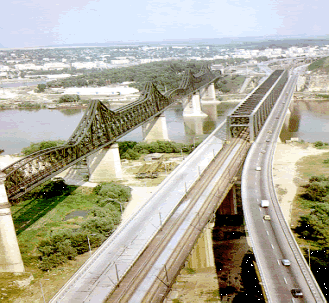
On 26 May, Romania marked the 20th anniversary of the inauguration of the Danube-Black Sea canal. A dream of the then-communist authorities, the canal became a symbol of the nightmare of communist repression, at least during the first part of its construction between 1949 and 1951. After a break of 25 years, [former Romanian dictator] Nicolae Ceausescu resumed the construction process. It took another eight years of work–a huge national labor project followed by years of glorification of what the communists called “the Blue Thoroughfare,” and it was celebrated again and again during communist national festivities in the “Song of Romania.”

The construction of “the dustless road” [as the canal was called in a novel by Romanian writer Petru Dumitriu, an proponent of the social realism movement in the 1950s] required studies by more than 1,000 experts in construction and more than 33,500 execution reports. During its construction, 300 million cubic meters of soil were excavated, and some 3.6 million cubic meters of concrete were used. The result was a navigable canal 64.4 kilometers long with two, 310-meter-long double locks at each end.

Built on the backs of the country’s political detainees, with blood, effort, and maybe too much sacrifice, the Danube-Black Sea canal remains the biggest project ever carried out in Romania. But 20 years after it was opened, the canal works at only 40 percent of its capacity.

The idea for a canal linking the Danube River with the Black Sea reportedly originated in a Soviet “suggestion,” when Stalin sent a stern order to Gheorghe Gheorghiu-Dej [the Romanian communist leader until 1965] to liquidate the opposition in Romania. “I will give you the technical equipment, and you can solve two problems at the same time: You get rid of the kulaks and the landed gentry and irrigate Dobrogea [the territory between the lower Danube River and the Black Sea],” Stalin is said to have told the Romanian communist leader sometime in the late 1940s in Moscow….

Construction on the canal officially started on 15 July 1949. The labor force came from three sources: paid workers, forced labor, and military conscripts. The political detainees were euphemistically called “forces from the Interior Ministry.” […]

Ceausescu had the idea of resuming construction after a 1972 visit to Antwerp, Belgium, and a 1973 trip to Amsterdam and Rotterdam, where he learned about a project called “the Canal of Europe,” which aimed to link the Rhine with the Danube–a 3,500 kilometer, transcontinental river route….

On 26 May 1984, with tens of thousands of people lining the two sides, Nicolae Ceausescu inaugurated the canal in festive style. The project at the time was estimated to be worth 10 trillion lei [approximately 3.3 billion average monthly salaries in Romania at the time]….

The canal today links the Danube with the Black Sea and can be used in both directions. With the opening to traffic in 1992 of the Main-Danube canal in Germany, a direct link between the Black Sea and the North Sea (through the ports of Constanta and Rotterdam) was established. It has a capacity of 10 million tons of traffic a year.

On 26 May 1984, Mr. and Mrs. Far Outliers were close to finishing a grim but fascinating year in Romania. We took a day trip by train from Bucharest to Constanta and back in the spring of 1984, crossing the Danube bridge and looking for the traces of the shortcut canal that so many Romanian dissidents spent their last years digging. The train was jam-packed, with people standing a handspan away from our heads blowing smoke into our hair. I finally tried to open a window. What an uproar that caused! Real springtime air on uncovered heads was deemed far more deadly than cigarette smoke in our lungs. In Constanta, we visited an impressive (but empty) mosque and the history museum, had lunch at a faded rococo casino, and were forbidden to take photos of the picturesque Port Tomis, lest it betray secrets to the U.S. (or Turkish?) navy.

Halfway Down the Danube has more.

Leave a comment

Filed under Romania

Bulgarian Wrestlers versus Democrats

I regret having to dump a tub of icewater over our (or at least my) enthusiasm for the “Black Sea Mafia” in Japanese sumo, but a “differently informed” perspective on the origins of these wrestlers needs to be considered. The following passage begins the chapter titled, “Wrestlers versus Democrats,” in Robert D. Kaplan’s book Eastward to Tartary: Travels in the Balkans, the Middle East, and the Caucasus (Vintage, 2000).

Within twenty-four hours of crossing into Bulgaria by train from Romania, I had begun hearing two words over and over again: wrestlers and groupings, with an emphasis on Multigroup, the Orion Group, and the Tron Group. “They run the country,” I was told, or at the least were as palpable a presence in people’s lives as the elected government. In early May 1998, a few weeks after I left Bulgaria, Anna Zarkova, a local journalist who had exposed these groups in her articles for the daily Trud, was doused with sulfuric acid hurled at her face at a bus stop. Zarkova, the mother of two children, lost her left ear and the sight in one eye as a result of the attack. For this reason, I cannot name the private citizens who gave me the following information without endangering their lives.

In the Communist era, Bulgaria had a great Olympic wrestling tradition. When the regime favorites lost their subsidies, many of them went into racketeering–with the help of their friends from the security services–and amassed tremendous wealth during the power vacuum that followed the regime’s collapse. A close friend, a Bulgarian woman in her mid-twenties who specializes in human-rights cases, told me:

“The wrestlers are all big and tough, with cell phones, fancy cars, Versace suits, and young girls on their arms. All their girlfriends look alike: thin, with blond hair and vacuous expressions, and adorned with gold. At a restaurant where a meal cost more than most Bulgarians make in a month, I heard one of these girls repeat over and over to her wrestler boyfriend, ‘This is so cheap. I can’t believe how cheap this is….’ The wrestlers and their girls go to expensive nightclubs with loud music, where go-go dancers sing cheesy lyrics, like ‘I love shopska [peasant’s] salad.’ We all know that our cars will be stolen if they are not ‘insured’ with one of the wrestlers’ insurance companies. Another name for the wrestlers is the moutras–the ‘scary faces.’ We are all repulsed by their behavior, but we have to deal with them. This is a country where people have put their life savings into sugar and flour because of inflation [and where the monthly salary is $140], yet there is a criminal class with stolen Audis and Mercedes.”

I saw the wrestlers frequently in Sofia. A late-model high-performance car would screech to a halt, muscular men in fashionable clothes would emerge with cell phones, wearing enough cologne to be noticeable from fifteen feet away. The boss would occasionally have two beautiful women with him, one on each arm. It was both frightening and pathetic. Their expensive homes, on the slopes of Mount Vitosha, above the haze of pollution that hovers over Sofia, were surrounded by two-story-high brick walls and punctuated with satellite dishes. Nearby sprawled a vast Gypsy settlement of muddy shacks, growling dogs milling about.

Leave a comment

Filed under Romania, sumo

The Vanishing Breed of Transylvanian German Writers

On 11 February 2004, the Culture section (premium content by subscription only) of Transitions Online carried a feature by Anca Paduraru of Deutsche Welle Radio’s English service about a Transylvanian German writer who has stayed in Romania.

BUCHAREST, Romania–“The commotion of summer 1990 inspired me. Then, ethnic Germans left Romania for Germany in droves, and I was left on the railway station platform helpless and perplexed to witness it.”

Eginald Schlattner, 70, is talking about the experience that prompted him to write two novels in his retirement, bringing him success in the German-speaking world and both recognition and notoriety in his native Romania.

The fall of communism produced at least one unhappy result in Romania: After some 800 years of living together with Romanians and other nationalities in this East European country, ethnic Germans began returning to their ancestral homes.

Statistics tell the story. In the last communist-era census, taken in 1977, 350,000 Germans were recorded in Romania. By 1992, their population had dropped by two-thirds. By 2002, it stood at 60,000–just 0.3 percent of the country’s 22 million people.

“It was indeed an exodus lethalis [deadly exodus], this final exit of Germans from Romania, which produced the last twitches we see in Schlattner’s books,” says George Gutu, a professor of German literature at the University of Bucharest.

Helping Schlattner’s success was the controversy surrounding the subject matter of his novels and his alleged part in sending five of his fellow Romanian-Germans to communist prisons.

Schlattner’s authorial debut, five years ago when he was 65, was Der gekoepfte Hahn (The Beheaded Rooster). His second book, Rote Handschuhe (Red Gloves), came out two years later. They have been reprinted several times and reached the best-seller lists of German-language books. The Beheaded Rooster appeared in Romanian translation in 2001, and Red Gloves is being readied for publication in Romania.

Schlattner says his first book “looks at only one day in our history to describe the situation of the Saxons [Germans] here and their pledge to Hitler.” That day was 23 August 1944, when Romania switched camps to join the Allies.

The second novel, which Schlattner says is autobiographical, “shows the two years of my imprisonment in Stalin City [Brasov]. In this one, I put all my cards on the table and explained what happened during those never-ending police interrogations. I was very tough on myself.” …

LOST LANGUAGE

… Germans in Romania lived in a context that allowed them to preserve their identity, Schlattner says. “As I told [German Interior Minister] Otto Schily, … Romania never forbade us from speaking our language, not even during the last eight months of the war it fought against Germany. So much so that at 12, my only Romanian words were, ‘I don’t know Romanian.’ ”

Schlattner’s praise of Romania for its ongoing publication of ABC books in 12 languages for the minorities within its borders does little to assuage Gutu, who is also head of the association of professors of German literature in Romania. While Gutu acknowledges that the demise of a form of literature is inevitable in the absence of a population to support it, he argues that Romanian and German cultural leaders do little to preserve German-language teaching in Romania.

Once, German-language literature in Romania was placed alongside works from East and West Germany, Austria and Switzerland. Its reputation was boosted by the less-extreme treatment meted out to Germans in Romania compared with those in Czechoslovakia or Poland, millions of whom who were expelled after the Second World War.

But now the community structure has been disrupted in Romania, and German-language teachers are scarce.

“Germany directs its efforts and funding only to the German-language schools for the Germans still living in Transylvania and completely disregards the demand for learning the language coming from Romanian children and their parents outside the Carpathian arch,” Gutu says.

Marina Neacsu, cultural projects coordinator at the Goethe Institute in Bucharest, which is funded by the German state, agrees. She says the government has no specific plans to support the editing of books in the German language.

In 2003, though, Romanian authorities gave 16.6 billion lei ($520,000) to the German community, says Ovidiu Gant, undersecretary of state in the Ministry of Public Information. As part of an across-the-board increase in funding to minority groups, the community’s state support more than doubled over the previous year.

In addition, according to Lucian Pricop, a programs coordinator at the Ministry of Culture, more than 1 billion lei ($31,000) has been spent to edit 14 German-language books, support the cultural supplements to the Carpaten Rundschau (Carpathian Observer) and Banater Zeitung (Banat News) magazines, and help public libraries acquire German literature.

Yet Gutu says Romanian and German authorities are ignoring the demand from Romanian parents who realize that Germany is Europe’s economic powerhouse and see knowledge of the German language as indispensable to their children’s professional success.

As for the future of German literature in Romania, Gutu sees none. “As much as I would wish to be wrong, a literature needs a population base to thrive, and 60,000 people are too few and bound to be less.”

Schlattner shares that skepticism.

The local Lutheran bishop, Schlattner says, “is just here to perform burials. This is what we have come to: a deserted house, emptier than the holy stable of Bethlehem. But that one was soon to be filled up with living beings and gifts as the news of Christ’s birth spread into the world. Our stable is not going to witness that.”

Leave a comment

Filed under Romania

Romania’s Unsettled Szeklers

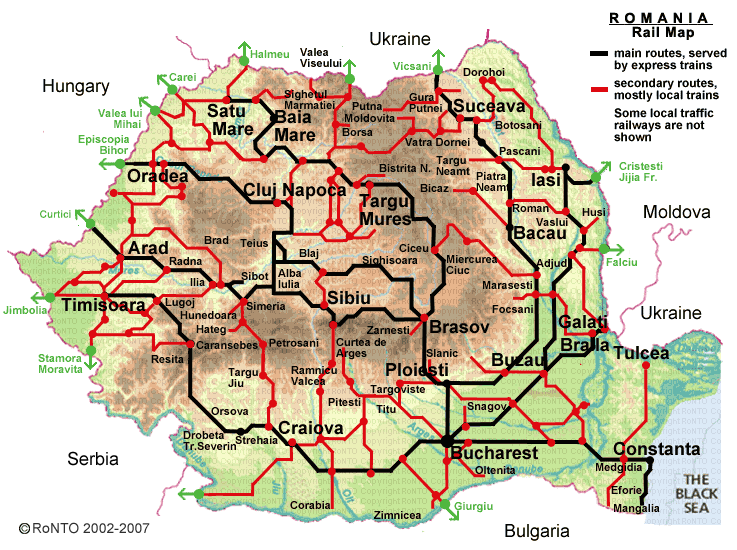
In its compilation of news for the week of 20-26 January 2004, Transitions Online reports that the Szeklers, a minority within the Hungarian minority in Romania (see map), are making another push for autonomy. (Access to TOL archives is by subscription only.)

It may have no chance of success, but the call for a Hungarian autonomous region reveals how deep the rifts now are between Romania’s Hungarians as well as with Romanians….

The document appears not to have the slightest chance of becoming a bill, let alone law, as the majority of even Democratic Alliance of Hungarians from Romania (UDMR) parliamentarians have clearly stated that they do not back the idea. The proposal will be sent to the Romanian parliament in early February….

Territorial autonomy for the Hungarian minority has, in the past year, become one of the most disputed issues in Romanian society. And the demands seem to be becoming more and more radical with each passing day….

Szekler is another name for the East Transylvanian Hungarians. Originally, the Szeklers were a Turkish group, brought in by Hungary’s kings around 1200 to guard Transylvania’s eastern borders.

Over the centuries, they lost their language and almost all their traditions. Even their names are now pure Hungarian. But, to this day, they carry their separate origin as a badge of pride….

According to the 2002 census, there are 1,434,377 ethnic Hungarians in Romania (6.6 percent of the population). This makes them the country’s largest ethnic minority according to official figures. Almost 99% of them live in the western reaches and center of the country, in Transylvania, and the regions of Crisana, Maramures, and Banat.

Other sizeable minorities are the Roma (officially 535,250, although most estimates are at least twice that figure), Ukrainians (61,091), and Germans (60,080).

Hungarians are the majority population in two of Romania’s 41 counties, more than a third of the population in another two, and in another two account for over 20 percent.

2 Comments

Filed under Romania

Szekely Armenians, Armeno-Kipchaks, Zipsers, and Other Odd Minorities in Eastern Europe

Language hat has a fact-, factoid-, and fun-filled comment thread in response to a post about a fine poem “A Dish of Peaches in Cluj” by Maria Benet on alembic. Here’s a sample:

“Csangos, the Hungarian minority in Romanian Moldavia, usually have Romanian names for their villages, so you have Saboani for Szabofalva (Tailor Village) or Faroani for “Forrofalva” (Boiling Village), but these are rarely on any map since the mere existence of the Csangos is still a controversial theme in Romania.” …

“You know the Redneck Hillbilly family characters who occasionally appear on the Simpsons? Imagine them speaking Hungarian, eating raw bacon and potatoes, drinking quarts of wood alcohol, and chewing coffee beans. Székelys.” …

“Ah, the Zipsers! I presume they came from Spisz / Spis / Zips / Szepes, one of my favorite multilingual Eastern European place names.” …

“The Armenians entered in the late 1600 via the Ukraine and Volynia. There were already communities of them around the black sea but the Jelali Revolts in eastern Turkey around 1610 caused a flood of Anatolian Armenians to flee to the Ukraine, and thence to Moldavia (There are still some in Iasi and Suceava).” …

“Radio Erevan [call-in] jokes … –Can bedbugs make a revolution? –In principle, yes, for in their veins flows the blood of peasants and workers.”

Leave a comment

Filed under Romania, Turkey