Category Archives: Romania

Romanian Synonymy: Romanian and French

The following synonym sets are formed from Romanian and French components.

  • călătorie ~ voiaj ‘trip’
  • întrecere ~ concurs/competiţie ‘competition’
  • convorbire ~ conversaţie/discuţie ‘conversation, discussion’
  • însufleţire/înflăcărare ~ entuziam ‘inspiration, enthusiasm’
  • cleveteală/bârfeală ~ calomnie ‘gossip, slander’
  • indignare ~ revoltă ‘revolt’
  • dovadă ~ argument ‘evidence, argument’
  • putere/tărie ~ forţă ‘power, force’
  • a înfăptui/îndeplini ~ a realiza ‘to fulfill, realize’
  • a zugrăvi/înfăţişa ~ a reda/descrie ‘to depict, render’
  • a contrazice ~ a combate/obiecta ‘to contradict, object’
  • a înapoia ~ a restitui ‘to give back, make restitution’
  • a pregăti ~ a prepara ‘to prepare’
  • a întrece ~ a depăşi ‘to overtake’
  • a înştiinţa ~ a comunica/anunţa ‘to inform, announce’

SOURCE: Section 3.1.5.7 in “Formation of Synonyms” Probleme de sinonimie, by Onufrie Vinţeler (Bucureşti: Editură Sţiinţifică şi Encliclopedică, 1983) [my translation].

In sharp contrast to the mostly rural, earthy Slavic borrowings examined earlier, these adoptions from French seem to reflect usage by cosmopolitan, high-society types, thus conforming to one of the earliest assumptions about why speakers of one language borrow words from another: because the lending language has more prestige. However, note that the Romanian equivalents of French Bon voyage and Bon appétit are Drum bun and Poftă bună, respectively, where the nouns are in both cases of Slavic origin.

Leave a comment

Filed under France, language, Romania

Romanian Synonymy: Latin and Slavic

Romanian synonym sets formed from Latin and Slavic components.

Nouns (Latin ~ Slavic ‘English gloss’):

  • lac ~ iezer ‘lake’
  • cale ~ drum ‘road’
  • călare ~ potecă ‘path’
  • pulbure ~ praf ‘dust’
  • nea ~ zăpadă ‘snow’
  • timp ~ vreme ‘time’
  • secure ~ topor ‘axe’
  • piuă ~ dârstă ‘mortar, fulling vat’
  • mâncare ~ hrană ‘food’
  • stup ~ ulei (regional) ‘beehive’
  • scoarţă ~ coajă ‘bark, crust’
  • vită ~ dobitoc ‘cow, ox, cattle’
  • fiară ~ dihanie ‘beast, monster’
  • vacă ~ ialoviţă (obsolete) ‘cow’
  • corp ~ trup ‘body’
  • cap ~ glavă (obs.) ‘head’
  • faţă ~ obraz ‘face’
  • popor ~ norod ‘people’
  • şerb ~ sclav, rob ‘serf’
  • spaimă ~ groază ‘fear’
  • tristeţe ~ jale ‘sorrow’
  • ştire ~ veste ‘news’
  • ceartă ~ svadă ‘quarrel’

Adjectives (Latin ~ Slavic ‘English gloss’):

  • deşert ~ gol ‘empty, barren’
  • roşu ~ rumen ‘red, ruddy’
  • umed ~ jilav ‘damp, moist’
  • sănătos ~ citov (obs.) ‘healthy’

Verbs (Latin ~ Slavic ‘English gloss’):

  • a lucra ~ a munci/trudi ‘to work, labor’
  • a treiera ~ a îmblăti (regional) ‘to thresh’
  • a săpa ~ a prăşi ‘to dig, weed’
  • a înnegri ~ a cerni ‘to blacken’
  • a păcătui ~ a greşi ‘to sin, err’
  • a se deprinde/învăţa ~ a se obişnui ‘to get used to’
  • a vindeca ~ a lecui ‘to cure’

SOURCE: “Synonymy and dialects” (4.1.1.4) in Probleme de sinonimie, by Onufrie Vinţeler (Bucureşti: Editură Sţiinţifică şi Encliclopedică, 1983) [my translation].

The nature of the borrowings that gave rise to these synonym sets suggests to me intermixed language communities with high degrees of bilingualism, and not contact between old and new technologies at a linguistic frontier, as was typical during the expansion of colonial languages across the globe.

UPDATE: There are also synonym sets of purely Slavic origin, but some of the alternates are rare, regional, or even obsolete:

  • nămol ~ tină ‘mud, silt’
  • mlacă ~ mlaştină ~ mocirlă ‘marsh, swamp, mud’
  • stog ~ claie ~ căpită ‘hayrick, shock (of hair)’
  • coteţ ~ cocină ‘sty, kennel’
  • război ~ stative ‘loom’
  • cobiliţă ~ coromâslă ‘carrying pole’
  • cârpă ~ zdreanţă ~ otreapă ‘rag’
  • lele ~ nană ‘auntie’ (term of address for older women)
  • doică ~ mancă ‘wetnurse’
  • a osteni ~ a obosi ‘to tire’

Leave a comment

Filed under language, Romania

Romanian Synonymy: Horse Traders and Maize

Regional synonyms constitute a “pair” of two or more words identical in sense, known and used by a group in at least one locality at a given moment in time [emphasis in original]. Thus, with regard to regional synonymy as well, the degree to which we accept words as synonyms depends on how they fit in time and place.

Sever Pop (cf. 1929) used to note that, within the territory of Romania, the following terms can be found to denote the concept of ‘horse trader’: barâşnic, craşcadău, cupeţ, factor, fleşer, geambaş, gheşeftar, ghiambabău, gârgez, făznar, hendler, herghelier, hâmbluitor, liverant, mecler, năstrăpaş, negustor, peţer, pilar, potlogar, precupeţ, precupitor, semsar, sfârnar, sfârnăroiu, şmecher, ţânzar, ţigan, tuşer. No one doubts that all the terms listed denote the same concept. The question that arises is the following: can each and every one of these words be considered synonyms? According to some definitions, still in circulation, all words that express the same notion are considered synonyms. Glancing over the list of words above, we observe that only the word negustor, which is the general term, and to a certain degree the word geambaş, are more widely known and can be considered synonyms; the rest are known only in more or less restricted areas. For the great majority of Romanians, words like barâşnic, gârgez, hendler, mecler, tuşer, and so forth do not mean anything; they are just as unintelligible as any others in a foreign language. Of course, in many places negustor can be a synonym of făznar, and geambaş with herghelier [‘herder’], and so on, but this only happens in certain places and not across the whole territory where Romanian is spoken.

These examples prove once again that for two or more words to be considered synonyms it is not sufficient that they express the same notion. And in cases of regional synonymy, the notion of synonym must be localized and made concrete.

Situations like those discussed above are very common in Romanian; they may be found on almost every linguistic map but are not mentioned except sporadically. So, for example, Marius Sala (1958), after analyzing the distribution of terms for ‘maize’, established that porumb is synonymous with păpuşoi [cf. păpuşă ‘doll, puppet’], cucuruz [usu. ‘corncob’; Russian кукурузы, South Slavic kukuruz], mălai [usu. ‘cornmeal’]. All of these words are fairly widely distributed (cf. map 900 in the Atlas of Romanian Linguistics). At present, porumb, being the general, literary term, is synonymous with păpuşoi, cucuruz, mălai in those areas where the latter are used. But the question arises whether păpuşoi, cucuruz, and mălai can be considered synonymous with each other. In the first place, at their points of intersection, they can be completely synonymous, except in cases where certain semantic differences intervene. Second, because of their wide usage, even in literature by great writers, we can admit that they form a set of synonyms at the level of literary language, if not everywhere, at least widely enough. But what do we do with the term tenchi, borrowed from Magyar and recorded at just one locale on the same map? In every other zone, tenchi is a foreign word, and therefore cannot be synonymous with the other words that denote ‘maize’. (Tenchi may eventually become synonymous with porumb or with mălai to the extent that the latter are known and used in the locality where tenchi was recorded.)

SOURCE: “Synonymy and dialects” (4.1.1.4) in Probleme de sinonimie, by Onufrie Vinţeler (Bucureşti: Editură Sţiinţifică şi Encliclopedică, 1983) [my translation].

I don’t have any problem with considering terms in different languages to be synonyms. That’s what translationese, calques, and 直訳 are all about.

UPDATE: In response to Language Hat, I need to clarify that when I accept “synonyms” across separate languages, I’m thinking of communities where nearly everyone speaks at least two languages, and where people switch between them as frequently and as easily as they or others might switch between dialects of the same language. I’ve spent some time in such communities. In fact, my first published paper in graduate school after returning from fieldwork in a New Guinea village whose unique language I had been sent to describe was not a paper just about the new , undocumented language but one on “multilingualism and language mixture” among the people of that village. People borrowed and calqued all the time, and even recreated for my benefit “pure” equivalents (rarely used by anyone else) in their own language by calquing backwards out of either the local church lingua franca, whose usage has since faded to the point that young people are no longer likely to recognize the source of those words; or else Tok Pisin, which supplies nearly every community in New Guinea an extra set of very general synonyms for specific words in their own languages. Romanians did much the same a few centuries ago when they borrowed a load of new vocabulary from French, then creating Romanianized shapes for many of the words. Those pairs became synonyms. Sometimes the synonyms carved up semantic space in complementary fashion, and sometimes one form gave way to the other.

I plan to translate several more chunks from Vinţeler’s chapter on borrowings and synonymy. He compiled a lot of good examples.

Leave a comment

Filed under language, Romania

A Far Outlier Favorite Blogpost for the Year

I only recently discovered the fascinating blog Dumneazu, which follows threads of food, family, friends, and folklore wherever they lead across time and space, with plenty of photos from past and present. Its author is one of my favorite commenters on Language Hat. The Dumneazu blogpost on The Dwarf Jewish Theater of Maramures has got to be among the most far-outlying I’ve read all year. Here’s a taste.

There is an extensive wikipedia entry on the Ovitz Family. On arrival, the family members were selected by Dr. Jozef Mengele for genetic experiments. Thus it was that the Ovitz family, which in May 1944 arrived in Auschwitz together – seven dwarfs and the rest of their normal-sized family members – many of whom might have been murdered immediately had they arrived on their own, were not only spared the gas chambers, but were accorded special conditions which helped facilitate their survival. What’s more, they were able to convince the Nazis that their trusted family assistant and coachman Shimon Slomowitz, his wife and six children, as well as two additional neighbors from Rozavlea with no special connections to the family, were also relatives, and as such were allowed to join the Ovitz group. Incredibaly, the Ovitz’ were one of the only families to enter Auschwitz and survive intact, along with most of the other Maramures Jews whom they falsely claimed as relatives – thus attracting the protective umbrella of Mengele’s expermientation.

After the war, the Ovitz family settled in Haifa in the newly established state of Israel, where they called themselves the Seven Dwarfs of Auschwitz and began touring. Their bittersweet cabaret was an enormous success. When they retired they had enough money to buy two cinemas, a café and a large flat where they lived together. the last surviving member of the family troupe, Perla Ovitz, died in 2001 in Haifa after revealing her amazing story to Israeli journalists Koren and Negev. “If I was a healthy Jewish girl, one meter seventy tall, I would have been gassed like the hundreds of thousands of other Jews in my country. So if I ever wondered why I was born a dwarf, my answer would have to be that my handicap, my deformity, was God’s only way to keep me alive.”

I’m a little puzzled by the blogname Dumneazu. When you google it, Google asks whether you might have meant Dumnezeu, lit. ‘Lord God’. Perhaps it’s a dialectal variant.

Whatever it may be, it provides me a good excuse to disquire a bit about Romanian deferential pronouns. The nondeferential second person singular, of course, is the familiar tu. The polite second person singular is dumneavoastră (often abbreviated d-vă), lit. ‘your (plural) lordship’. The “officious” second person singular is dumneata (d-ta), lit. ‘your (singular) lordship’. (The officious second person is the one they taught us at the Defense Language Institute in Monterey—presumably suitable for interrogating people from a position of authority.) There’s even a set of polite third person equivalents: dumnealui (d-lui) ‘his lordship’ and dumneaei (d-ei) ‘her ladyship’.

UPDATE: The blogger himself clarifies the mystery in the comments:

The name Dumneazu is a dialect variant – it is actually the nickname of a friend of mine who is the lead fiddler – the primas – of a Gypsy band in Transylvania. Everybody in the band does exactly what he tells them to do, hence the nickname. In the Transylvanian dialect that they use in Maramures, and even stronger in Moldavia, the -e sounds often get elided into -ye sounds. Pe mine becomes pe minye, etc. In the Boyash (Rudari who speak Romanian, having lost Romani) gypsy dialect of Romanian spoken in Hungary and Croatia the interesting written (mostly used for song lyrics) form – mnye – is used.

Leave a comment

Filed under Israel, language, Romania

Dracula vs. the Transylvanian Germans

In the winter of 1459 Dracula organized one of his most devastating raids on Transylvanian soil, with the clear intention of trying to seize Dan III and his supporters. [The Drăculeşti and the Dăneşti were two factions contending for the crown of Wallachia.] Advancing along the valley of the Prahova River, he delivered his first blows in the vicinity of Braşov [German Kronstadt], where he burned villages, forts, and towns, burned the crops to deprive the population of food, and killed men, women, and children as he progressed. He focused his attention on the exposed Braşovian suburbs, especially the Spenghi and Prund areas, which were located outside the walls of the fortress. This was the Romanian section of town, where Dan III and his dissident boyars resided. Under cover of darkness Dracula’s men burst across the lightly fortified wooden palisade surrounding the section. He then proceeded to burn the whole suburb, including the old chapel of Saint Jacob, built in 1342, located at the foot of Tîmpa Hill; it was never restored. He took as many captives as he could find and impaled them “lengthwise and crosswise,” according to Beheim’s narrative. Their bodies were strung on Tîmpa Hill above the chapel. Dracula meanwhile was seated at a table having his meal; he seemed to enjoy the gruesome scenario of his butchers cutting off the limbs of many of his victims. Beheim tells us the additional detail that the prince “dipped his bread in the blood of the victims,” since “watching human blood flow gave him courage.” The stage was thus set for Dracula’s later reputation as a blood drinker or vampire, and his subsequent fictional reincarnation as Count Dracula. As we will see, this episode at Tîmpa Hill did more to damage Dracula’s reputation than any other act in his whole career. On this occasion Dracula also displayed the perverted black humor that is attributed to him in Russian narratives. A boyar attending the Braşov festivity, apparently unable to endure any longer the smell of coagulating blood, had the misfortune to hold up his nose and express a gesture of revulsion. Dracula immediately ordered an unusually long stake prepared for the would-be victim and presented it to him with the cynical remark: “You live up there yonder, where the stench cannot reach you.” The boyar was immediately impaled….

But these raids and accompanying atrocities against the Germans of Transylvania during the years 1457 and 1460 were to have a long-range impact that reached far beyond the borders of Romanian countries. Those German Catholic monks who were fortunate enough to escape from their monasteries, which had been reduced to ashes, brought with them to the west what in essence became the first Dracula “horror stories.” Thus, Dracula in his own lifetime became a subject of horror literature. At the monastery of Saint Gall in Switzerland, at Lambach near Salzburg, and at the Melk Abbey on the Danube River in Lower Austria — all Benedictine houses — these refugees related their harrowing escapes to the other monks. These stories were copied down, mostly by scribes, and in turn used at the opportune moment as propaganda against the prince by the Hungarian chancellery. Among the refugees who had fled Dracula’s terror was a Bernardine lay brother who is simply referred to as “Brother Jacob.” He was to become the chief informant to the Swabian minnesinger Michael Beheim. Among the later German texts that included Beheim’s account, one printed at Strassburg in 1500 was prefaced by a woodcut showing Dracula seated at a table surrounded by rows of impaled cadavers. This image suggests clearly that the bloodthirsty Count Dracula of fiction and movies was born from the loins of the bloody practitioner of terror in Transylania.

SOURCE: Dracula, Prince of Many Faces: His Life and His Times, by Radu R. Florescu and Raymond T. McNally (Back Bay, 1989), pp. 120, 123-124

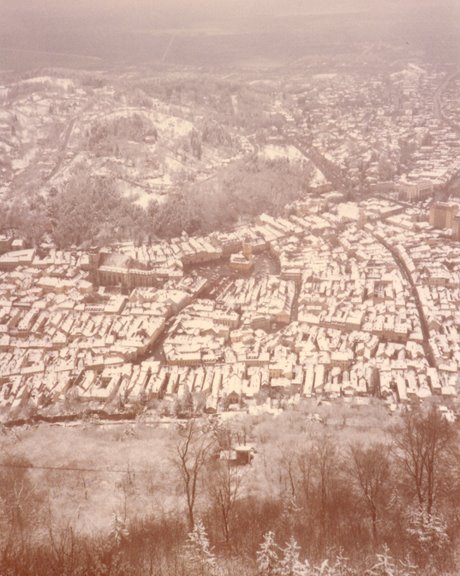
Photo: Fresh snow on the town square of old Braşov, viewed from Mt. Tâmpa, 29 April 1984. The Council House is in the plaza, with the Black Church to its left.

Leave a comment

Filed under Romania

San Juan Capistrano, Defender of Belgrade, 1456

Saint John of Capistrano … was an extraordinary survivor of an earlier period of Medieval crusading (the likes of which was not seen again in Europe until the siege of Vienna in 1683). John of Capistrano, whose imposing bust still adorns the main facade of Saint Stephen’s Dom in Vienna, certainly looked the part of a Peter the Hermit, the crusading leader of the eleventh century. Small of stature, with an emaciated frame, hollow cheeks, deep-set eyes, and parched skin, he had the countenance and stature of a mystic as he gathered the faithful around him in the city of Györ in Hungary and preached the crusade to the common man in Latin. No one understood his exact words, but the tone of the message was unmistakable as he thundered: “God wills it that we chase the Turks out of Europe and for whosoever follows me, I will obtain plenary indulgence for him and his family.” It was more a matter of heart than rational thinking that induced a ragtag army of some 8,000 inexperienced and poorly equipped peasants, lower burghers, students, and clergymen to follow John on his southeastward march. They had gathered all the crude weapons they could assemble: slings, cudgels, scythes, pitchforks, stakes, and other farm implements. It was, however, their determination and fanaticism that proved more than a match for the holy war proclaimed by the sultan and the tried military talent of the Turks and janissaries. The generals and the diplomats who attended John’s demagogic harangue at Györ — Hunyadi, his son László, János Vitéz, Vlad Dracula, even Pope Calixtus III‘s legate, Juan Cardinal de Carvajal — were not impressed by what they regarded as a “mob.” In the end, though, these leaders found they had underestimated the power of faith to move men.

At a meeting summoned by Hunyadi at Hunedoara on January 13, 1456 [three years after the fall of Constantinople], basic strategies for the impending campaign were laid out and assignments to the military leaders given with little reference to John of Capistrano’s crusaders, who worked essentially as an independent force. Dracula, with an army composed mostly of Romanian mercenaries, was instructed by Hunyadi to stay at Sibiu and watch the Transylvanian passes. In addition, his young protégé was given to understand that he could proceed with the offensive against Vladislav II at whatever time he would deem appropriate, thus to relieve pressure at Belgrade by compelling the Turks to keep a body of troops on the Danube. In essence, Dracula’s mission was part of the overall strategy in protecting the eastern flank of the Belgrade defensive operation. In turn, Dracula’s cousin Stephen of Moldavia, also in Hunyadi’s entourage, was waiting for an opportunity to overthrow the other Turkish vassal, Petru III Aaron. By June 1456, in the words of the historian János Thuróczi “as the grain began to ripen, a vast army, accompanied by 300 siege guns and 27 enormous cannons, followed by the fleet on the Danube, moved northward, capturing on the way a number of Serbian cities that had maintained a precarious autonomy under Turkish rule. Hunyadi sent the customary diplomatic appeals to the west by means of his intermediary János Vitéz; as usual, there was no response.

The greatest achievement of John Hunyadi and John of Capistrano, unlikely allies that they were, was breaking through the ring of Turkish land forces, as well as the chains of Turkish flotillas that blocked access to the city, to effect a juncture with the city’s defenders. On July 21, having finally penetrated the outer defenses and moats, Mehmed gave orders for a final assault. In desperation, the sultan tried to arouse enthusiasm in his troops by joining the melée in person, only to be wounded in the thigh for his pains. Though the Turkish army had penetrated the city, it was unable to capture the fortress on the hill, defended by 16,000 men evenly divided between John of Capistrano’s crusaders and Hunyadi’s professionals. For Mehmed, who lost as many as 24,000 of his best soldiers and whose sailors colored the blue Danube red, it was a disastrous defeat. The relief of Belgrade was described as a “miracle” by Bernhard von Kraiburg, chancellor of the archbishop of Salzburg, in which “8,000 simple people” had defeated a vastly overwhelming Turkish force. In retreating toward Sofia, the ailing sultan was so angry that he wounded a number of his generals with his own sword and later had them executed. When the successful defense of Belgrade was reported to Rome, Eugenius IV called it “the happiest event of my life”; believing that a miracle had truly occurred, the pope made preparations for the beatification of John of Capistrano.

SOURCE: Dracula, Prince of Many Faces: His Life and His Times, by Radu R. Florescu and Raymond T. McNally (Back Bay, 1989), pp. 79-80

Before the year was out, Hunyadi, Capistrano, and many others had died of the plague. (Photo, October 1984: The bottom panel on the painted monastery at Moldoviţa in Suceava County, Romania, depicts a Byzantine victory at Constantinople. It must date from 1453 or earlier.)

Leave a comment

Filed under Romania

The Real Dracula’s Contemporaries

The real Dracula, who ruled the territories that now constitute Romania, was born in 1431, the year that Joan of Arc was burned as a witch at the stake in Rouen, France. He died in 1476, two years before Spain was united as a kingdom under the rule of Isabella of Castile and Ferdinand of Aragon. He was very much the by-product of the Europe of his day — the Renaissance, essentially a period of transition….

It was in the age of Dracula that the notion was introduced of Balkan crusading, the efforts of the lands on the fringes of the Ottoman conquest, the borderlands of Europe, to resist the power of Islam in the name of the cross. It represented a struggle in defense of Europe quite as significant as the Spanish resistance to the Moors, which had preceded it….

One of the more tragic aspects of the Turkish onslaught on Europe was the western powers’ reluctance to defend the frontiers of their culture in eastern Europe. This extraordinary failure of moral fortitude was not intelligible in the fifteenth century, since French ruling families had originally consolidated the Polish and Hungarian states; Venetians, Pisans, Genoese, and Spaniards ruled in the eastern Mediterranean and Aegean seas; and countless western adventurers occupied a string of threatened colonies along the disputed eastern coast and on the islands near what are now Yugoslavia and Greece.

The pretexts for the fifteenth-century failure of the west to respond to successive crusading appeals were no different from those that had awakened such deep emotional response during the heyday of the crusades, in the age of faith. Charles VII, king of France, the oldest daughter of the Catholic church and foremost crusading power, had just emerged from one of the most crucial conflicts in his country’s history, the Hundred Years’ War. He and his soon-to-be successor, Louis XI, “the Spider King,” who had a predilection for hanging young boys from the branches of trees and placing his enemies in cages to consolidate royal power, had just liberated their country from the English. The French kings were also busy fighting the dukes of Burgundy for supremacy in the French state. The semiroyal dukes of Burgundy were in fact the only rulers within the actual territories of what is now France who for a time remained true to the crusading tradition. Their generous participation in Dracula’s father‘s crusade in 1446 atoned somewhat for the ineffectiveness of their cousins in Paris.

England was to be no more closely drawn than France into fighting the Muslims; the traditions of Richard the Lionhearted were entirely forgotten. Two rival families there were locked in a desperate struggle for survival, the Wars of the Roses (1455–1485). (The white rose was the symbol of the followers of the Duke of York and the red rose represented the House of Lancaster.) This last of England’s feudal wars dragged on throughout Dracula’s lifetime. The only Englishmen connected in any way to our plot were individual soldiers of fortune who enrolled as volunteers in various crusading armies. (One of these veterans, John Tiptoft, Earl of Worcester, later used the impalement technique that he had learned in eastern Europe to kill his Lancastrian enemies. He was executed for his crimes.) …

Of the lands of the future Kingdom of Spain, only Aragon faces eastward. In particular, the Catalans of Barcelona, an important Mediterranean port, were concerned by the Turkish menace, because it threatened ancient commercial routes and their appetite for eastern expansion. Even before Dracula’s time, an effective group of military adventurers had been formed, the famous Catalan Company, to defend the Byzantine emperors against all their enemies, though in effect the Catalans fought for themselves. The Aragonese wished, through Balkan crusading, to forge commercial and political contacts with the Aegean, the Adriatic, and the Black Sea. The ambitions of the Aragonese king, Alfonso V, are best exemplified by the decision of his bastard son Ferrante to make Naples — closer to the eastern theater of war — the center of his power. Ferrante managed to perpetuate his rule through the use of terror: having killed most of his political opponents, he had his victims mummified and placed in the royal museum, where they were shown to his guests.

Fifteenth-century Italy was the headquarters of the Renaissance. Although Niccolo Machiavelli was not born until 1469, the amoral principles he would set out in The Prince (1517) were being applied well ahead of publication. There was certainly little evidence then of Italian patriotism among the warring republics and city-states of northern Italy, and less evidence of crusading spirit, though the straits of Otranto, at the heel of the peninsula, separate Italy from the Balkans by only some thirty miles….

It was the pontificate (1458–1464) of Enea Silvio de’ Piccolomini, the future Pope Pius II, that most closely coincided with Dracula’s reign. Piccolomini began his career as a libertine not devoid of literary talent and changed his ways only when he became a priest in 1446. He was enough of a medievalist to understand the threat inherent in the Ottoman expansion. From 1459 onward the Pope repeatedly appealed to the Christian powers to join in a common crusade, and he raised the monies to subsidize such a concerted movement. Indeed, Pius II, although a “Europeanist,” saw the Ottoman menace not merely as a danger for eastern Europe but for Christianity itself. Dracula alone responded to his call.

SOURCE: Dracula, Prince of Many Faces: His Life and His Times, by Radu R. Florescu and Raymond T. McNally (Back Bay, 1989), pp. 13, 15, 20-21, 23-24

UPDATE: This book is certainly filling in a lot of gaps in my heretofore rather superficial Draculalogy, as well as my understanding of Romanian medieval history more generally. Although I had encountered during my Fulbright year there in 1983-84 many of the famous names in Romanian history—like Ştefan cel Mare, Mircea cel Bătrân, Vlad Dracul, and Dracula—I had not realized that Mircea the Elder (1386-1418), Vlad Dracul (r. 1436-1442), and Vlad Dracula (r. 1448, 1456-1462, 1476) were Father, Son, and the Unholy Impaler; nor that Vlad Dracul acquired his epithet from being named to the crusading Order of the Dragon (not Devil) by the Holy Roman Emperor, in whose court at Nuremberg he served as page; nor that Vlad the Impaler impaled almost as many Transylvanian Germans as he did Turks; nor that the Impaler may have been born in Sighişoara (pictured above, from our visit in 1984), but held court at Târgovişte, on the Wallachian side of the Carpathians and upriver from Bucharest.

Leave a comment

Filed under Romania, Spain

Is China Debating Regime Change in NK?

The Australian on 16 October ran a report from The Sunday Times suggesting that China is contemplating regime change in North Korea in the wake of the latest nuclear test.

THE Chinese are openly debating “regime change” in Pyongyang after last week’s nuclear test by their confrontational neighbour….

The Chinese Government has been ultra-cautious in its reaction. However, since Monday, Foreign Ministry officials have started to make a point of distinguishing between the North Korean people and their Government in conversations with diplomats.

Ahead of yesterday’s Security Council vote, some in Beijing argued against heavy sanctions on North Korea for fear that these would destroy what remains of a pro-Chinese “reformist” faction inside the Democratic People’s Republic of Korea.

“In today’s DPRK Government, there are two factions, sinophile and royalist,” one Chinese analyst wrote online. “The objective of the sinophiles is reform, Chinese-style, and then to bring down Kim Jong-il’s royal family. That’s why Kim is against reform. He’s not stupid.”

More than one Chinese academic agreed that China yearned for an uprising similar to the one that swept away the Romanian dictator Nicolae Ceausescu in 1989 and replaced him with communist reformers and generals. The Chinese made an intense political study of the Romanian revolution and even questioned president Ion Iliescu, who took over, about how it was done and what roles were played by the KGB and by Russia.

Mr Kim, for his part, ordered North Korean leaders to watch videos of the swift and chaotic trial and execution of Ceausescu and his wife, Elena, the vice-prime minister, as a salutary exercise.

The balance of risk between reform and chaos dominated arguments within China’s ruling elite. The Chinese have also permitted an astonishing range of vituperative internet comment about an ally with which Beijing maintains a treaty of friendship and co-operation. Academic Wu Jianguo published an article in a Singapore newspaper – available online in China – bluntly saying: “I suggest China should make an end of Kim’s Government.”

Anne Applebaum in today’s Washington Post argues that North Korea is primarily China’s problem. I think the Romania angle is worth considering, but I regard nearly everything said for public consumption about North Korea as propaganda talking points rather than serious analysis.

Leave a comment

Filed under China, Korea, Romania

The Fate of Bulgaria’s Jews during the Holocaust

Bulgaria illustrates the influence of prudent realpolitik at the highest levels of decision making and the absence of the impact of loss. Additionally, the Bulgarian Orthodox Church protested even the earliest introduction of anti-Jewish legislation….

Prudent realpolitik nevertheless was evident in the Bulgarian governmental decision to propitiate Nazi Germany in the hopes of immediate gain. And these hopes were realized. On February 15, 1940, the German-educated and strongly Germanophile Bogdan Filov was appointed premier by King Boris III, replacing the earlier moderately pro-Western Georgi Kyoseivanov…. Between August and December, the Law for the Defense of the Nation was prepared in the National Assembly and officially promulgated on January 23, 1941. The law defined precisely who was a Jew and proceeded to limit Jewish participation in the professions, property ownership, and even places of residence. During this period, the Germans interceded on behalf of Bulgarians in Vienna on September 7, 1940, at which time the Bulgarians received southern Dobrudja from Romania. In March 1941, Bulgaria … assumed control of Thrace and Macedonia. As Nissan Oren comments: “In the main, the Law for the Protection of the Nation was to pave the way for the fast developing rapprochement with Germany and solidify Bulgaria’s position within the Axis.”

King Boris III, virtually the absolute authority since 1934, actually suggested the Law of the Defense of the Nation, remarking that such legislation had been imposed in Romania, Hungary, “and even France.” … Thus, with Nazi Germany in the political and military ascendancy throughout Europe, Bulgaria, a small, militarily insignificant country, demanded a prudent realpolitik in its foreign policy, lest it be overwhelmed by the much stronger European great power. In that event, the plight of the Jews would be far worse than the mild application of the Law of the Defense of the Nation. The territorial rewards were ample and the safeguards were significant…. Later in the war, in March 1943 after the massive German defeat at Stalingrad, Boris responded positively to the plight of the Jews, effectively preventing their deportation.

How did this state of affairs come about? More precisely, in addition to the diminishing threat of Nazi Germany and a required corresponding change in prudent realpolitik, what were the domestic circumstances that allowed Boris to essentially thwart Hitler’s intention to eradicate Bulgarian Jewry?

The Bulgarian National Assembly is said to have been influential in mustering a protest against the deportations that led to their postponement and ultimate cancellation…. Boris was obviously influenced by this protest from a substantial portion of his own party’s deputies. But even more important, and consistent with the demands of prudent realpolitik, the king “needed as much support as possible. He had to convince the Germans that his decision to stop or delay deportation was the result of a series of strong protests that … could not be ignored.”

At the same time, recent scholarship has shifted to an emphasis on one member of the National Assembly in particular, its vice chairman, Dimitar Peshev. It was he who organized the petition signed by one third of the government’s own party members. When he heard of a roundup of Jews in his own electoral district, the town of Kyustendil, he acted….

Nevertheless, … this is not the whole story…. When Bulgarians in Kyustendil heard of the arrests, they quickly made plans to send forty of their number to the National Assembly in Sofia. After deliberation, they chose only four, all non-Jews, to plead the case of their Jewish townspeople. Although Peshev had already heard of the arrests through other avenues, he was heartened by the concern of his non-Jewish constituents. Thus, in addition to the basic decency of the man and his supporters in the National Assembly, we must consider the milieu that made it possible. Why, in contrast to France and Romania, not to mention Germany, was Bulgaria so free of anti-Semitism that it could yield Peshev’s success?

One answer, of course, is the absence of territorial loss and its accompanying refugee influx. Without the large numbers of refugees of like ethnoreligious identity, sympathy can actually be extended to others of a different identity, who, through no fault of their own, are subject to deportation and probably death.

In the end, Bulgaria’s 45,000 Jews were not deported and survived the war, although Bulgaria had earlier deported 11,393 Jews from Thrace and Macedonia to Poland, where almost all perished. The demand for the earlier deportation was agreed to on 2 February 1943, before the news of the crushing German defeat at Stalingrad had been widely disseminated.

SOURCE: The Killing Trap: Genocide in the Twentieth Century, by Manus I. Midlarsky (Cambridge U. Press, 2005), pp. 326-330

Leave a comment

Filed under Romania

The Romanian Holocaust Begins: June 1941

Iaşi [= Jassy, rhymes with Josh] was the location of the first large-scale massacre of the Romanian Holocaust. In addition to its anti-Semitic traditions of over a century, because of its proximity to the Soviet fronter, “it became the focus of many of the anti-Semitic measures that accompanied plans to join Germany’s invasion of the USSR.” The terms “Jew” and “Communist” were virtually interchangeable, as in the order by Ion Antonescu, the Romanian head of state, to compile lists of “all Jews, Communist agents, or sympathizers in each region.” Worse was Order No. 4147, issued at about the same time, which demanded the expulsion of all Jews between the ages of eighteen and sixty from northeastern Moldavia (the Iaşi region) in expectation of fighting there. The presence of large numbers of Jews in the region was anathema to both the German and Romanian officials. Fully half of Iaşi’s population of 100,000 was Jewish. In cooperation with the German Gestapo and the SD (the intelligence arm of the SS), the Romanian Secretariat of the Secret Intelligence Service (SSI) prepared the expulsions. At the same time, former Iron Guardists (also called legionaries because of the virtually equivalent organizational name of Legion of the Archangel St. Michael) were informed of the impending expulsions and likelihood of a pogrom.

A raid against Iaşi by the Soviet air force provided the spark for the pogrom. Damage was minor but rumors spread that the entire Jewish population of Iaşi was in league with the Red Army. Further rumors of Iaşi natives flying Soviet aircraft fanned the flames still further. On June 20th, four days after the beginning of Operation Barbarossa, the pogrom began in earnest. It lasted over a week, until June 29. Although it is difficult to gain accurate estimates of the number of Jews killed, the minimum is probably around 900, with a more forthright testimony from a witness estimating the number of dead at 3,000–4,000.

But worse was yet to come. Several thousand Jews had been interned in police stations and special camps as “dangers” to Romanian security. At the end of June, these Jews were loaded onto death trains to be transported out of the region. The cars were decorated with signs stating that inside were “Communist Jews” or “killers of German and Romanian soldiers.” Several destinations were chosen and ultimately few survived the densely packed, poorly ventilated cars. No food or water was allowed. Jews, who frantically jumped from train cars to drink at a river crossing were shot or forcibly drowned. Those who survived were forced to hand over their valuables in a pattern of voracious looting that would be characteristic of the entire Holocaust, and of other genocides as well. Of 2,530 Jews who were transported in the first train, some 1,400 died. Of 1,902 Jews who boarded the second train, 1,194 died.

Iaşi was only the first of many massacres of Jews that were to take place in nearby Bessarabia and Bukovina, territories that had been transferred to Soviet control in 1940, but were now under German and Romanian authority. Mihai Antonescu, a relative of Ion Antonescu and deputy premier, supported the forced “migration” of Jews from Bessarabia and Bukovina. The attitude of “blame” for the loss of these territories in 1940 was to characterize much of Romanian Jewish policy. Frequent massacres occurred immediately after the German invasion. During July alone, Raul Hilberg estimates that more than 10,000 Jews were murdered by the Romanian and German military, as well as the native Ukrainian peasantry. These massacres were to be followed by mass deportations to work camps in Ukraine and ultimately death camps in Poland. At first, the Germans resisted the massive relocation of Jews from northern Bessarabia into German military-controlled districts. The number of Jews in each of these attempted transports was in the tens of thousands. The Germans conjured up the specter of more than half a million Jews to be added to the many indigenous Ukrainian Jews now being murdered by Einsatzgruppe D with only 600 men. Consequently, the German legation informed Mihai Antonescu that the Jews were to be eliminated in “a slow and systematic manner.”

Jews were now interned in transit camps throughout Bessarabia. In October, deportations to Ukraine began. During the first months of the war, it is estimated that at least 65,000 Jews from Bessarabia and Bukovina were killed in mass murders, in the transit camps and during deportation. If we add the number of Jews deported who died in southwestern Ukraine (called Transnistria by the Romanians), the number reaches approximately 130,000. If we add to this the number of native Ukrainian Jews in Odessa and elsewhere killed by the Romanian and German authorities, the number reaches approximately 250,000 murdered under Romanian jurisdiction. According to Raul Hilberg, “no country, besides Germany, was involved in massacres of Jews on such a scale.”

SOURCE: The Killing Trap: Genocide in the Twentieth Century, by Manus I. Midlarsky (Cambridge U. Press, 2005), pp. 205-207

Leave a comment

Filed under Romania