Category Archives: China

China Train Trips: Hard-class to Hangzhou

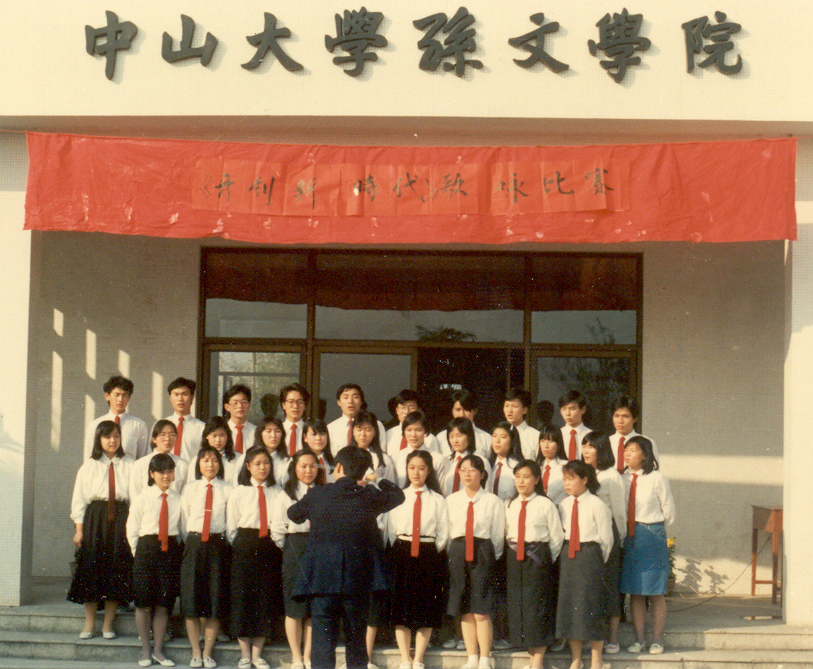
Nineteen years ago this month, the Far Outliers were very much looking forward to some Chinese New Year vacation travel after a semester teaching English at newly established Sunwen College in Zhongshan City, China. The school was very much worried about the prospect of our traveling alone and wanted to get two students to accompany us. But we felt that would be a terrible imposition on both the students and ourselves, and we felt confident that we could negotiate the Chinese train system. After all, I had spent a lot of my childhood traveling on Japanese trains. How much harder could it be in China?

Somebody may have helped us buy the train tickets from Guangzhou to Hangzhou. We booked hard-class sleeper berths because we were being paid exclusively—and not very lavishly—in renminbi (‘people’s currency’), which was not yet convertible in those days. We hoarded our dwindling supply of dollar savings acessible via credit card, but nevertheless came back to the U.S. flat broke, despite getting substantially more renminbi during our second semester teaching there. The latter at least enabled us to afford a trip to Beijing and Xian before leaving China that summer.

Hard-class sleeping compartments had four berths facing each other across a narrow walkway. I was on a top berth and my wife shared a lower berth with our two-year-old daughter. There was another young child in our compartment who spent a lot of time playing with a pear, alternately holding it with his unwashed hands, dropping it on the grime-caked floor, and taking bites out of it. By Chinese standards, our daughter’s habit of thumb-sucking was just as unsanitary, but we always made sure to travel with a clean washcloth, rinsed in boiled water, and she soon learned to ask “Suck this thumb?” and get a thumb-wipe before indulging in one of her favorite contemplative activities at the time: sucking her thumb and twiddling her belly button. (As a babe in arms, she used to like to reach in and twiddle her mom’s nipple while sucking her thumb.)

By dinner time, the train was winding its way through mountain valleys beside terraced rice paddies. Vendors came down the aisles selling meals in styrofoam boxes, and about the same time we began to notice a lot of styrofoam scattered along the fields beside the tracks. After we had all eaten, we found out where it came from, as janitors worked their way down the aisles sweeping all before them with pairs of handheld brooms. At the end of each railcar, they would open a window and chuck all the rubbish out, then move on to the next car. They also seemed entirely to ignore the toilets, whose floors were awash in urine-tainted water.

We arrived in Hangzhou—so serene compared to bustling Guangzhou—early the next morning, a bit too early to check into the exquisite, Austrian-run Shangri-la Hotel Hangzhou on the north shore of West Lake. So we dawdled over bowls of hot jook (congee, 粥) in the warm hotel restaurant before checking into our rooms, where we found chocolates on the pillow and were offered complimentary glasses of warm glühwein. That stay was worth the precious dollars we spent on it. Over the next few days, we visited some of the scenic spots, bicycled around the lake, and sampled the famous Longjing (龍井 or 龙井 Dragon Well) tea grown in the nearby hills. What a welcome respite those days were.

Leave a comment

Filed under China, travel

The Iron Rooster Reaches Lhasa

The AEI‘s online magazine American.com reports that one can now ride the iron rooster all the way from the Forbidden City to the Potala and back.

The extraordinary technological challenges to building a rail line from scratch in Tibet are consid­erably easier to overcome, especially for a powerful centralized regime like China’s, than the legal and political challenges to improving a key rail connec­tion (like Boston–Washington) in the world’s most advanced economy. Also, at this point in history, the Chinese clearly value public infrastructure more than Americans.

The new western railroad creates a bittersweet reality. It will transform Tibet from a thinly populated nation with a largely nomadic population and exotic, remote tourist destinations into a more common and accessible place. For many Tibetans, especially adaptable youth, opportunities will multiply; the loss of a unique history will seem less troublesome to them than it is to the isolated, older population.

The Lamaist State of Tibet is already a memory. Chinese soldiers invaded in 1950, and Tibet became part of the PRC a year later. After an unsuccess­ful rebellion, the Dalai Lama went into exile in India in 1959, and it is clear that the Chinese will not tolerate the re-emergence of a the­ocracy—especially since the government has endowed the west with so much strategic impor­tance. In 1979, Deng Xiaoping declared that China should get on with development. “I don’t care,” Deng said, “whether the cat is black or white, as long as it can catch mice.”

Whether Tibetans will fare better under the Chinese government than they did under the Lamaist theocracy remains to be seen. The outlook for traditionalists is bleak, but for most Tibetans, the chances for a better future are enhanced by the construction of the rail line to Lhasa.

via RealClearPolitics

The author of the article takes the opportunity to bash the U.S. government for not investing enough in physical infrastructure, while lauding the PRC government for doing so. I suspect few Chinese citizens who live far from the coastal cities would share that view. They would likely be thrilled to have the equivalent of the Eisenhower Interstate Highway System instead.

Leave a comment

Filed under China, economics

Two Chinese Views on Mongol Writing, 1237

Peng Daya:
As regards their matters of administration, they write with wooden twigs. Their writing looks like frightened snakes and writhing earthworms; it looks like the magical writing in the Books of Heaven; their characters look like the wu, fan, Gong[?] and chi of musical notation. They are closely related to the characters of the Uighurs.

Xu Ting:
I, Ting, have concerned myself with this. The Tartars originally had no writing. Today, however, they use three different kinds.

For written communication in the Tartar lands proper they always use small pieces of wood, three or four inches in length on which they make incisions in the four corners. If for instance ten horses are to be sent, they make ten notches. As a rule they only cut the required number. Their customs are pure and their thoughts honest. Hence also their language is without ambiguity. According to their laws, liars are punished by death. Thus nobody dares to betray. Even if they had no writing, they would still be capable of founding an independent state. These small pieces of wood are the same as the wooden tablets of antiquity.

For their written correspondence with the Uighurs they utilise the Uighur system of writing. Chinqai is the master of this. The Uighur system of writing has only 21 letters. The others are formed by adding something on one or the other side of the letter.

For written correspondence with the conquered Chinese states, with the Kitan and the Jurchen, they make use exclusively of Chinese writing. Chucai [Ch’u-ts’ai] is the master of this. But apart from this, before the date at the end of the letter, Chinqai in his own hand writes in Uighur letters the words: ‘To be sent to NN’. This is presumably a security measure that is directed only at Chucai. Hence every piece of writing has to be marked with such a confirmation in Uighur; without it it has no official validity. This is obviously a measure to make sure that all correspondence passes through Chinqai’s hands, in order to ensure mutual control.

In the city schools in Yanjing it is mainly the Uighur writing that is taught along with translation into the Tartar language. No sooner have the pupils learnt to translate, than they begin to function as interpreters and then in company with Tartars go on violent rampages, where without inhibitions they begin to act as masters of punishment or favour and extort bribes, goods, services, and foodstuffs.

The systems of writing that the Kitan and the Jurchen originally possessed are never used by the Tartars.

Heida Shilüe (Brief Account of the Black Tartars),” in Other Routes: 1500 Years of African and Asian Travel Writing, edited by Tabish Khair, Martin Leer, Justin D. Edwards, and Hanna Ziadesh (Indiana U. Press, 2005), pp. 109-111

2 Comments

Filed under China, language, Mongolia

A Contrarian Take on the Six-Party Talks

On Christmas Eve, the Wall Street Journal‘s Opinion Journal ran a short stocking stuffer of an op-ed by literary contrarian B. R. Myers, who wrote his dissertation on North Korean literature (reviewed here).

No country today is as misunderstood as North Korea. Journalists still refer to it as a Stalinist or communist state, when in fact it espouses a race-based nationalism such as the West last confronted during the Pacific War. Pyongyang’s propaganda touts the moral superiority of the Korean race, condemns South Korea for allowing miscegenation, and stresses the need to defend the Dear Leader with kyeolsa, or dare-to-die spirit–the Korean version of the Japanese kamikaze slogan kesshi [決死]. The six-party talks are therefore less likely to replicate the successes of Cold War détente than the negotiating failures of the 1930s. According to early reports from Beijing, the North Korean delegation appears more confident than ever. It has clearly been emboldened not only by its accession to the nuclear club, but by the awareness that Seoul will continue providing food and financial support no matter what happens….

The ideological landscape of the peninsula defeats the reasoning that led to the six-party talks in the first place. North Korea is not a communist country with ideological and sentimental reasons to listen to China and Russia; it is a virulently nationalist state that distrusts all the other parties at the table. And though the rhetoric of a “concerted front” against North Korea has proved to be just that, it has sufficed to heighten South Korea’s sense of solidarity with the North. This will continue to mean plenty of aid money for Kim Jong Il with which to build weapons. The U.S. has urged Beijing to bring more pressure to bear on the North. But if America can do nothing with its own ally, it can hardly expect the Chinese to do more with theirs.

via The Marmot’s Hole

UPDATE: B. R. Myers responds to comments over at The Marmot’s Hole.

Leave a comment

Filed under China, Japan, Korea, nationalism, Russia, U.S.

A Korean Worker’s Take on Korea, Japan, & China

Four or five years ago I was asked by one work site manager to make the “direct commute” (as we day laborers say) to a job that I had originally obtained through the Center. I did this for about ten days running. Two Koreans, one about fifty and the other in his mid twenties, were working there, and they would chat with me in their broken Japanese during rest periods and the noon break. I couldn’t figure out their relationship. That they were not parent and child was obvious I enough. I decided that they were two men of differing ages who just happened to be getting work, illegally (or so I surmised), with the same firm. That peculiar rule in Korean society of deference by the junior party to the senior (something I learned from my reading), which would have applied had they been acquaintances from the same village and come to work in Japan together, was not in effect between them. If the older man were indeed fifty, he would have been just a couple of years older than I, yet he had a commanding presence that made him seem for all the world like my father. When I got to talking with him, I realized that he was a fervent patriot. Somehow I was not surprised. He said his name was Shin.

“We go ahead of Japan. This I am sure. Less than ten years.” These are the kinds of things he liked to say. The younger Korean appeared to be uninterested in talk of this sort and simply wolfed down his boxed lunch. For ten days I teamed up with this Korean duo and took orders along with them from the site manager. The older Korean assumed the role of team leader and told us what to do. He was far more proficient at Japanese than his young compatriot, and it was possible to carry on an extensive conversation with him.

“I am not man who works like this. I was company president. Do you understand? My company closed. I was forced to come to Japan and earn money.” As he spoke, Kim, the younger Korean, would look on with an ironic smile without really listening. (He rarely spoke a word; indeed, it’s possible that he understood no Japanese.) Kim did not have the face of an educated person—that much was certain.

“I have three children,” Shin said. “Oldest one in college. ——— University. You know it?” When I shook my head, he continued, “Good school. He join elite. Give orders. We three here take orders. This is difficult thing.”

Shin may have had a problem with Japanese at the level of nuance, not being able to inflect his emotions correctly, but his very direct and open manner of expressing his desire to advance in the world definitely got my attention.

Shin asked me how old I was and learned that I was a bachelor and living alone. “You have no family at your age?” he proclaimed haughtily. “That shameful! You should not tell it to others. I feel sorry for you.”

Sometimes I would get into arguments with Shin.

“Japan not apologize for things they did to us. This no good. One day maybe we attack Japan. But we not do to you what you do to us. We are moral people. We are most moral and most superior people in Asia. This I am sure.” …

“Japan number one in Asia now, Korea number two. some day Korea number one.” The hierarchy featured in these pronouncements appeared to have nothing to do with morality, however, and everything to do with economic and political power in the global pecking order.

“That’s not true at all,” I countered. “China’s number one in Asia now, if you ask me.

Shin immediately shook his head. “No, very wrong—very wrong!” he snapped, curling his lips in contempt of China. “Look at Chinese. They fall behind. Long ago they were teacher. Now they are backward country. Their income less than one tenth of Koreans. That country is lowest country. It is dirty country.” …

And so I learned that not only was Shin a stalwart anticommunist, he also had no love, as I’d heard most Koreans had, for China, the country that Korea once recognized as its master.

SOURCE: A Man with No Talents: Memoirs of a Tokyo Day Laborer, by Ōyama Shirō, trans. by Edward Fowler (Cornell U. Press, 2005), pp. 92-95

Leave a comment

Filed under China, Japan, Korea, labor

On Leaders Forged (or Not) in Manchuria

It is extremely difficult to try to generalize, but I think that we must consider this issue—including the problem of war responsibility—in a multilayered manner. I myself think that at present this is a theme for future research, not a time at which we can offer generalizations. Thus, let me just say a few words about the directions subsequent research might take and how we can try to place Manzhouguo in world history.

Although I have written about it in a number of articles, I think we need to reassess once more the meaning of Manzhouguo in postwar Asia. The legitimacy of the Chinese Communist Party derives at least one of its bases in the fact that it won the anti-Japanese war which began with the Manchurian Incident. In this way, the fact that some Japanese argue for the legitimacy of Manzhouguo thus denies the very legitimacy of the Chinese Communist Party. This dispute is unproductive, with a strong probability of the two sides following parallel tracks semipermanently.

Let me focus for a moment, though, on the importance of Manzhouguo on the Korean peninsula in postwar East Asia. First, in the Republic of Korea there were a number of men who were educated in Manzhouguo—such as Pak Chŏng-hŭi (1917-79) and Ch’oe Kyu-ha (b. 1919) who graduated from the Daidō Academy—and acquired power in postwar Korea. [Aikido had a curious prominence in its curriculum.—J.] In this instance, Manzhouguo served as a supply base for human talent. We certainly cannot say this was always the case, for the debate continues over what the “pro-Japan faction” in Korea was. I have only introduced a very limited number of such men in my own work, but in fact there were a large number of them.

In North Korea as well, Kim Il-sŏng (1912-94) derived one of the bases of his legitimacy in the victory against Japan in Manchuria, and this legacy continues for North Korea today. There are pros and cons, but the postwar in East Asia cannot be understood without Manzhouguo.

By the same token, as concerns wartime and postwar Japan, Tōjō Hideki (1884-1948) came to amass such great power by virtue of the unification of the military police (kenpei) and the regular police in Manzhouguo. It was the first case he confronted as commanding officer of the Guandong Army’s military police, when he was awakened to his administrative skills. Until that point, he had always been treated rather coldly in Japan, but in the process of his acquisition of power thereafter, the administrative experience tying him to the military police in Manchuria was to have critical importance.

Kishi Nobusuke spent only three years in Manchuria, but the money and personnel he put together at that time was to have a huge impact on postwar politics. Together with such men as Shiina Etsusaburō (1898-1979), Nemoto Ryūtarō (b. 1907), Hirashima Toshio (b. 1891), these mainstays of the Liberal Democratic Party all had Manchurian experience. At the time of the revision of the Japan-U.S. Security Treaty (Anpo) in 1960, Kishi made a trip to Southeast Asia before visiting the United States. The reason for this, in Kishi’s words, was that, for Japan to cross swords as equals with the United States, it was best for it to assume a position as the leader of Asia. Only then, as he put it, would Japan be on an equal standing with the United States and thus be in a position to have the Anpo Treaty revised.

In reply to a question from an interviewer, Kishi noted: “My present feeling that Japan must become the leader of Asia is no different from the consciousness I had when I went to Manzhouguo. This has not changed in the least even in the postwar era. If indeed I possess a kind of pan-Asianism, then my present sense of things is completely linked to the time when I traveled to Manzhouguo.” Thus, his Manzhouguo experience—including the money he amassed—played an extremely important role in his career. Although a well known story, Kishi told a fellow bureaucrat upon returning to Japan: “It’s best to use money after filtering it.” The effectively plutocratic essence of the Liberal Democratic Party as it has come down to us now may then be said to trace its roots back to Manchuria….

The generation of Japanese prime ministers from Yoshida Shigeru (1878-1967), who was consul-general in Fengtian, and Kishi down to Fukuda Takeo (1905-95) and Ōhira Masayoshi (1910-80) all had Asian experience. When he was serving as a secretary in the Ministry of Foreign Affairs, Fukuda spent over two years in Nanjing as an advisor on economic affairs to the government of the Republic of China. Ōhira worked in the Asian Development Board in Zhangjiakou and the liaison section of the Mengjiang regime.

Through the years of Fukuda and Ōhira, it was people who knew Asia as a tactile experience who served as prime ministers. Thereafter, Japanese policy toward Asia became thoroughly clumsy and unskilled. To be sure, the early men had stood on the side of the rulers, but they understood, as if it was experience acquired through their skin, about the vastness of the Asian mainland, the atmosphere prevailing there, and the enormity of the population. This also meant that they understood its formidable character. The prime ministers who followed them, however, lacked as a sense of touch this spatial understanding of Asia and China, and the influence exerted by this absence of experience on Japanese policy vis-à-vis Asia has been immense. In particular, from Hosokawa Morihiro (b. 1938) to the Koizumi Jun’ichirō (b. 1942) now, the continued blur of Japan’s Asian policy is, I believe, linked to a lack of Asian experience. I would even go so far as to say that there is no remedy for this lack of sensibility.

I by no means want to leave the impression that their role in colonial rule was a good thing, but the fact that the policies of Japanese political figures, including diplomatic officials, toward Asia has now entered a dangerous stage is, in my view, heavily influenced by the lack of experience—including that acquired in Manzhouguo—gained through the senses and not simply having seen the place but having lived there. This will remain a problem for the future. I would argue for the need for men and women who wish to become politicians to spend two or three years wandering about various sites in Asia.

SOURCE: Manchuria under Japanese Dominion, by Yamamuro Shin’ichi, trans. by Joshua A. Fogel (U. Penn. Press, 2006), pp. 238-239

And the same goes for would-be leaders from other parts of the globe. Well, I can’t quote any more from this book. I have to send it on to my brother who just finished teaching a course on East Asia.

Leave a comment

Filed under China, Japan, Korea

Manchuria as Japanese and International Refuge

When we consider the political space of Japanese modernity, Manchuria seems to possess distinctive significance. It is important to remember when considering Japanese modernity that with the exception of only a very small number of people, such as the actress Okada Yoshiko (1903-92) who defected to the Soviet Union in 1938, and the translator and dramatist Sano Seki (1905-66), scarcely any Japanese took refuge abroad. The issue itself of why there were so few Japanese refugees is important, I believe, in understanding the history of Japanese modernity. In modern Japanese history, Manchuria appears to be something of a space for taking quasi-refuge.

The [South Manchurian Railway], too, provided a site accepting of large numbers of leftist converts. In this sense, it was the only asylum in modern Japan. A moment ago, I mentioned a certain image of Manchuria that was invested with ideals and in which was sought that which could not be realized in Japan. I think Shiba Ryōtarō (1923-96), the famed historical novelist, was no different in this regard. He was drawn to Mongolia out of a yearning for the wilderness of Manchuria and Mongolia. It bore the sense for him of an asylum to which one might escape from the space Japan blockaded. This phenomenon was not limited to men, for looking at the memoirs of Japanese women as well we see some who went to Manchuria because they could not develop personally in Japan. For example, there were a certain number of women who had dreams of developing into teachers or who wanted to teach people of other ethnicities.

In this sense, we have two polar images of Manchuria in tandem: the extremely dark image of a Manchuria as a hellish abyss and that of Manchuria as a site for asylum. Whichever extreme would emerge would depend on the person, and the image of Manchuria, then, was inevitably rent asunder. Although this is a bit of personal experience, I became quite close to Professor Matsuda Michio (1908-98). When I was writing Kimera: Manshukoku no shōzō (Chimera, a portrait of Manzhouguo, published in 1993 [the volume herein translated—JAF]), he once said to me: “It’s strange that you’re using your energy on such a thing as this. As far as we’re concemed, it’d be just fine to forget Manzhouguo altogether. It’s bizarre that such a thing ever existed.” I have never forgotten these strong words of his to me. For people who lived through it, Manchuria remained an object to be rejected but which continued nonetheless. I think that this is one of the reasons that evaluations offered by postwar scholarship on Manzhouguo has been split in bipolar fashion….

One additional issue is the existential importance of Manchuria for the Jewish people. Shanghai was the most important Jewish place of asylum in Asia, but second to it was Manchuria. Of course, once the Tripartite Alliance was signed among Japan, Germany, and Italy, they were to be expelled from Manchuria, too, but such schemes as the “Fugu Plan” conceived of a harmony of the six ethnicities—the five initially conjured up and the Jews—and military officers such as Yasue Norihiro (1888-1950) and Inuzuka Koreshige (1890-1965) were actively trying to realize it. “Fugu” or blowfish carried the meaning that, although this kind of fish is delectable, if it disagrees with you, its poison can be especially strong. If Jewish capital could be well used, this scheme envisioned, then it could be of great value. In the sense of using such a plan to control the Jews in the United States, this tactic was an extremely calculated political ploy.

Reading through the memoirs of people who actually lived in Manzhouguo, it appears that places such as Harbin were relatively easy for Jews and White Russians to live in. We know a bit about what happened to White Russian men who graduated from Kenkoku University. We thus need research which will examine what Manzhouguo, or the Kenkoku University, may have meant for White Russians. For not only Jews, but Muslims who had escaped from Central Asia as well, Manzhouguo provided a kind of asylum, as I describe it in my recent book, Shisō kadai to shite no Ajia (Asia as an intellectual task, published 2001), an important site where people who had escaped Soviet oppression could live. It is an undeniable irony of world history that, for people who escaped from Europe, Russia, and Central Asia, Manchuria bore importance as a space for survival. There were many more who traveled through Manchuria en route to the United States, and we need studies which examine this phenomenon.

Needless to say, there is as well the issue of how Manzhouguo tried to use the Jews and Muslims. Research on ethnic groups in Manzhouguo to this point has examined only the “five ethnicities,” but we need to insert into our vision the flows of such world-historical peoples as the Jews and Muslims and consider the place of Manzhouguo in their migrations. We are collecting material in this area now. There is even a recent book about Poles in Manchuria, published in Poland, describing who was there and what they did.

SOURCE: Manchuria under Japanese Dominion, by Yamamuro Shin’ichi, trans. by Joshua A. Fogel (U. Penn. Press, 2006), pp. 233-234, 237-238

Leave a comment

Filed under China, Japan, migration

Japanese Army Drug Lords of Manchuria

Furumi Tadayuki (1900-83), who served as assistant director-general for administrative affairs in Manzhouguo, once said: “Manzhouguo is an immense installation created by a top secret fund of the Guandong Army.” The Japanese army was able to engage in extensive activities, such as intelligence gathering, throughout Asia, because it had sufficient funds which Manzhouguo siphoned off. This practice cast a huge shadow over postwar Japanese politics, beginning right with Prime Minister Kishi Nobusuke (1896-1987). The basic source for the monetary fund was opium. This was the problem which Gotō Shinpei worked hardest on in Taiwan; by making the sale of opium a monopoly, Gotō tried gradually to reduce the quantity of it available. He took the same approach in Manzhouguo, and although it was said to have been well regulated in Manzhouguo, this was in fact not the case. Opium production provided the richest source for such a slush fund. It was not only produced in Manchuria, but steadily flowed into Manzhouguo via Turkey, India, and Shanghai. The opium produced colosgal profits which became the financial source for Japan’s military schemes. The very fact that Amakasu Masahiko (1890-1945) gained such power in Manchuria was due to this money. While Kishi was a mere bureaucrat, Amakasu had at his disposal a slush fund of some ten million yen—which would come to ninety billion yen (roughly $800 million) today—for his special operations. This is difficult to prove on the basis of documents, the only corroboration being oral testimony, but younger scholars are now examining materials in such places as the Public Record Office in Great Britain on the remittance of opium, and this issue will probably be cleared up in the not-too-distant future.

SOURCE: Manchuria under Japanese Dominion, by Yamamuro Shin’ichi, trans. by Joshua A. Fogel (U. Penn. Press, 2006), pp. 231-232

Leave a comment

Filed under China, Japan, opium

Reshaping China’s Coal Industry

SURELY NO NATION ON EARTH has as many coal miners or coal mines as China. In 1996, 5 million Chinese mined coal, virtually all of them underground. At the same time in the United States, about 90,000 miners were digging about the same amount of coal. The reason for the disparity, of course, is that Chinese mines rely much more on cheap labor than on costly machines. In addition to its many large mines, China has tens of thousands of tiny mines that each employ just a handful of miners.* The small mines are vastly more deadly than the big mines, which are themselves quite dangerous. In 1991, a particularly bad year, 10,000 Chinese coal miners died in accidents. By comparison, the number of Americans killed in coal mining in 1992, a bad year for the U.S. industry, was fifty-one.

*In 1998, China had about 75,000 mines employing an average of thirteen miners each. These small mines have a death rate seven times higher than the large ones.

… As they are in the United States and other coal-producing nations, the small inefficient mines are shutting down in favor of larger ones. In China, though, the scale of the disruption is mind-boggling: Beijing claims to have closed down 30,000 small mines just since 1998. Although the true number is surely less, there are undeniably painful reforms underway that have already thrown perhaps a million Chinese coal miners out of work.* These sweeping changes reflect the fundamental shift in Beijing’s economic philosophy over the years: In a move more reminiscent of J. P. Morgan than Mao Zedong, the Communist government is now openly urging coal companies to merge into larger and larger enterprises, and to form “cartels” to limit overproduction and improve profitability.

*According to widespread reports, many communities have defied Beijing and quietly reopened their small mines; as a result, several officially “closed” mines have suffered deadly mining accidents in recent years. However, reports that miners are being laid off in huge numbers, including at large state-run mines, are more credible. Between 1992 and 1995, reportedly 883,000 coal miners (more than ten times the total U.S. coal mining workforce) were laid off, and there are plans to lay off nearly 800,000 more.

SOURCE: Coal: A Human History, by Barbara Freese (Penguin, 2003), pp. 207-208, 221-222

Leave a comment

Filed under China, industry

What Giraffes Can Tell Us about Zeitgeist

The December 2006 issue of the Journal of World History (Project Muse subscription required) contains an extraordinary article about the effects of a particular exotic creature in three different times and places.

Renaissance Europe

By the Renaissance, people looked at exotic animals with new eyes. In general there was a great desire for new visual experiences; people took an enormous joy in looking at the unexpected, the monsters, prodigies, and the freaks. Even though people refuse to give a farthing to “a lame beggar,” as William Shakespeare put it, “they will lay out ten to see a dead Indian” or a “painted fish.” The emphasis was on the marvelous. When suddenly seeing something that surpassed the expected in beauty, diversity, or abundance, the mind was overwhelmed. People were first astonished, then delighted, and finally excited. Clearly there was something highly addictive in this mixture of emotions. It piqued people’s curiosity, and once they had seen a little, they wanted to see more. Obviously, in terms of height and sheer impact, there was no more marvelous, or more curious, animal than a giraffe….

The giraffe situation improved dramatically in 1486 when a real example of the species was presented to Lorenzo il Magnifico by Al Ashraf Kait-Bey, the Mamluk sultan of Egypt. The Florentines were on good terms with all Muslim rulers, but above all with the Turks because they were at war with the Venetians—Florence’s main Italian rival—and because the Turks favored the Florentines as trading partners in the eastern Mediterranean. Yet this particular giraffe came from Egypt, and this for a particular reason. Since 1467, the Mamluks had been in open revolt against the Turks who occupied their country. The giraffe was an attempt to establish good diplomatic relations with the Florentines in order to make them intervene on their behalf in the inter-Muslim conflict. As far as the Mamluks were concerned, the giraffe played much the same role in their foreign policy as pandas did in the foreign policy of China in the 1970s.

Bourbon France

In 1827, after an interval of some 350 years, another giraffe appeared in Europe, this time in Paris. This giraffe was also a gift from the ruler of Egypt, and it too was a pawn in a diplomatic game. As always, the giraffe produced a lot of excitement wherever it went. Reacting to the tall and composite creature, the French too came to reveal just how they thought about the extra-European world, and this at a time when the country was about to embark on its first imperialist venture. Only three years later, fighting a cruel and genocidal war, France invaded and occupied Algeria. The question is what, if anything, the animal can tell us about these subsequent events….

Making sense of these reactions, it is clear that the giraffe appeared just at the intersection of several interpretative possibilities. Most ordinary Frenchmen reacted much the way ordinary people always have—with wide-open eyes and slack jaws. What was unprecedented, however, was the degree to which this spontaneous curiosity was commercially driven. In the course of the eighteenth century, a mass market was for the first time created in consumer goods, clothes, and knickknacks, and, to fuel demand, this market constantly required new fads and fashions. In the summer of 1827 the giraffe played this part. It was turned into a product that people did not see as much as consume. Like contemporary celebrities, you came closer to it, and experienced it more fully, by means of the merchandise associated with it. Yet, as with all commercial fads, the public’s interest in the giraffe was fickle, and before long they turned to other attractions. Three years after her arrival in Paris, Honoré de Balzac noted, the giraffe was visited only by “retarded provincials, bored nannies and simple and naïve fellows.”

Ming China

The Chinese are interesting for our purposes both for what they could do and for what they did not do. Their overseas explorations preceded those of the Europeans, their convoys were far larger, and, before the middle of the fifteenth century, they ventured farther afield. Then the expeditions suddenly stopped. In a series of increasingly draconian decrees, overseas travel was restricted and eventually outlawed completely. The question is why. Again we have a giraffe to help our analysis along. A giraffe arrived in Beijing in 1414, not long before the first of the antiexpansionist decrees was promulgated….

The animal, when it arrived, was treated as a sign of the benevolence of heaven, and as such it had to be interpreted by scholars before its meaning could become clear. Fortunately Chinese literati were highly skilled at interpreting signs. From the earliest times, scholars had spent much of their time reading the cracks in tortoise shells or the patterns formed by yarrow stems, and a set of imperial astronomers was constantly at hand watching the night sky for omens. Unusual sightings were immediately identified as portents and vested with huge political significance. Whatever happened was quickly interpreted in terms of the established canon. Hence Chinese scholars were never all that surprised.

The giraffe, when it appeared, was treated as such a sign. Checking with their encyclopedias, the scholars determined that it must be a unicorn, a mythological creature that traditionally was said to have a “horn in its head made out of flesh,” “the body of a deer, the tail of an ox, and the hooves of a horse,” and to be of such a gentle disposition that “it only ate grass and never hurt a living being.” As they saw it, this description fitted well enough with the beast standing before them—giraffes, after all, do have horns, a curiously composite body, and a gentle nature. When the Chinese literati, in addition, learnt that the animal in the Somali language was known as girin [now pronounced geri], that settled the matter. To Chinese ears, girin sounded very much like qilin, the Chinese name of the unicorn. [In modern Mandarin, the q is pronounced much like English ch, but in earlier times–and in regional varieties of Chinese–the q would sound more like English k. Sino-Japanese also preserves the k sound in Kirin.–J.]

SOURCE: Erik Ringmar, “Audience for a Giraffe: European Expansionism and the Quest for the Exotic,” Journal of World History 17 (2006): 375-397 (footnotes omitted)

Leave a comment

Filed under China