Category Archives: Asia

Narratives of the Rise vs. Narratives of the Fall

From: Break Through: From the Death of Environmentalism to the Politics of Possibility, by Ted Nordhaus & Michael Shellenberger (Houghton Mifflin, 2007), pp. 150-151:

There is a very different story [than that in Jared Diamond’s Collapse] that can be told about human history, one that embraces our agency, and that is the story of constant human overcoming. Whereas the tragic story imagines that humans have fallen, the narrative of overcoming imagines that we have risen.

Consider how much our ancestors – human and nonhuman – overcame for us to become what we are today. For beginners, they were prey. Given how quickly and efficiently humans are driving the extinction of nonhuman animal species, the notion that our ancestors were food seems preposterous. And yet, understanding that we evolved from being prey goes a long way toward understanding some of the feelings and motivations that drive us into suicidal wars and equally suicidal ecological collapses.

Against the happy accounts of harmonious premodern human societies at one with Nature, there is the reality that life was exceedingly short and difficult. Of course, life could also be wonderful and joyous. But it was hunger not obesity, oppression not depression, and violence not loneliness that were primary concerns.

Just as the past offers plenty of stories of humankind’s failure, it also offers plenty of stories of human overcoming. Indeed, we can only speak of past collapses because we have survived them. There are billions more people on earth than there were when the tiny societies of the Anasazi in the American Southwest and the Norse in Greenland collapsed in the twelfth and fifteenth centuries, respectively. That there are nearly seven billion of us alive today is a sign of our success, not failure.

Perhaps the most powerful indictment of environmentalism is that environmentalists so often consider our long life spans and large numbers terrible tragedies rather than extraordinary achievements. The narrative of overpopulation voiced almost entirely by some of the richest humans ever to roam the earth is utterly lacking in gratitude for the astonishing labors of our ancestors.

Of course, none of this is to say that human civilizations won’t collapse again in the future. They almost certainly will. Indeed, some already are collapsing. But to focus on these collapses is to miss the larger picture of rising prosperity and longer life spans. Not only have we survived, we’ve thrived. Today more and more of us are “free at last” – free to say what we want to say, love whom we want to love, and live within a far larger universe of possibilities than any other generation of humans on earth.

At the very moment that we humans are close to overcoming hunger and ancient diseases like polio and malaria, we face ecological crises of our own making, ones that could trigger drought, hunger, and the resurgence of ancient diseases.

The narrative of overcoming helps us to imagine and thus create a brighter future. Human societies will continue to stumble. Many will fall. But we have overcome starvation, disease, deprivation, oppression, and war. We can overcome ecological crises.

Leave a comment

Filed under Africa, Asia, Australia, Canada, Europe, Latin America, U.S.

Kissinger on Asia as the Next Europe

Henry Kissinger outlines Three Revolutions that present new challenges to the old model of state-based power politics.

These transformations take place against the backdrop of a third trend, a shift in the center of gravity of international affairs from the Atlantic to the Pacific and Indian Oceans. Paradoxically, this redistribution of power is to a part of the world where nations still possess the characteristics of traditional European states. The major states of Asia — China, Japan, India and, in time, possibly Indonesia — view each other the way participants in the European balance of power did, as inherent competitors even when they occasionally participate in cooperative ventures.

In the past, such shifts in the structure of power generally led to war, as happened with the emergence of Germany in the late 19th century. Today the rise of China is assigned such a role in much alarmist commentary. True, the Sino-American relationship will inevitably contain classical geopolitical and competitive elements. These must not be neglected. But there are countervailing elements. Economic and financial globalization, environmental and energy imperatives, and the destructive power of modern weapons all impose a major effort at global cooperation, especially between the United States and China. An adversarial relationship would leave both countries in the position of Europe after the two world wars, when other societies achieved the preeminence the nations of Europe sought through self-destructive conflict with each other.

No previous generation has had to deal with different revolutions occurring simultaneously in separate parts of the world. The quest for a single, all-inclusive remedy is chimerical. In a world in which the sole superpower is a proponent of the prerogatives of the traditional nation-state, where Europe is stuck in halfway status, where the Middle East does not fit the nation-state model and faces a religiously motivated revolution, and where the nations of South and East Asia still practice the balance of power, what is the nature of the international order that can accommodate these different perspectives?

Leave a comment

Filed under Asia, economics, Europe, nationalism, U.S.

Overview of Southern Immigration

The latest issue of Southern Culture (vol. 13, no. 4, pp. 24-44; Project Muse subscription required) contains an article by Carl L. Bankston entitled New People in the New South: An Overview of Southern Immigration (voluntary immigrants only; not slaves). Here are a few excerpts that caught my eye.

Old South

In 1850 Louisiana had the largest concentration of immigrants in the South, about 75,000 people and approximately one-quarter of Louisiana’s free population. New Orleans, the largest port in the South and the second largest in the nation after New York, was a natural point of entry for people from other countries. Between 1820 and 1860, over half a million immigrants arrived in Louisiana. Given Louisiana’s French history and the large French-speaking population in the state during the nineteenth century, it is easy to assume that France would be the place of origin for most of the state’s foreign-born residents. Many immigrants to Louisiana were, in fact, from France. About 15,000 people in Louisiana in 1850, or one out of five immigrants in the state, gave France as their birthplace. The largest immigrant group in Louisiana, though, came from Ireland. An estimated 26,580 Louisianans, or nearly 38 percent of the state’s immigrants, were born in Ireland in 1850. The Irish are generally described as having arrived in Louisiana in two waves. Those known as the “Old Irish” came primarily from the northern part of Ireland between 1803 and 1830. These earlier immigrants became part of the middle classes of New Orleans. The “New Irish,” consisting mainly of peasants, left their homes because of poverty and famine, particularly after the potato blight, which hit Ireland about 1845 and lasted into the following decade, leaving Ireland devastated. They settled in the area known as the City of Lafayette, which was later incorporated into New Orleans and is still identified as the Irish Channel. The New Irish provided much of New Orleans’s low-paying manual labor.

Germans made up the second largest immigrant nationality in antebellum Louisiana. Over 20,000 people in the state in 1850, or 28 percent of all immigrants, had been born in Germany. Germans first arrived at the port of New Orleans when Louisiana was a French colony. Many settled just north of New Orleans in the Parishes of St. John and St. Charles, in an area known as the Côte des Allemands, or German Coast. A second wave of peasant German workers followed the first wave of German settlers between 1820 and 1850.

New South

As a consequence of geographic access, Texas’s main immigrant population is Hispanic or Latino, yet Texas also has a substantial Asian minority (see Table 1), attributable to some extent to the general rise in Asian migration around the United States and to the booming economy in Texas cities such as Houston. In 2000 the Vietnamese were Texas’s single largest Asian immigrant group, accounting for one out of every four foreign-born Asian Texans, and the state had the second largest Vietnamese population in the United States, after California, with 12 percent of all Vietnamese in the United States.

The case of the Vietnamese illustrates the importance of Texas as a point of access even for members of these more distant national-origin groups. Initial U.S. government resettlement efforts in 1975 had planted Vietnamese communities in the cities of Dallas and Houston. Additional Vietnamese Americans were drawn to Texas by the existing ethnic communities, combined with the availability of jobs in that state. Shrimping became something of an ethnic specialty for Vietnamese Americans along the Gulf Coast of Texas and other states….

As a world center, Atlanta has attracted a diverse Asian population. The largest grouping of Atlanta’s Asians in 2000 consisted of people from the South Asian subcontinent, with just under 36,000 Asian Indians, over 1,000 Bangladeshis, and well over 3,000 Pakistanis. At that time, Atlanta was also home to nearly 25,000 Vietnamese, close to 22,000 Koreans, and just under 21,500 Chinese. Largely members of an educated work force, the South Asian migrants were drawn to this international-airport-hub city by its professional, white-collar opportunities in professional, scientific, and technical industries, which in 2000 employed one in five of the Asian Indians in the metropolis.

As in Texas, the Vietnamese first came to Atlanta as part of government resettlement efforts, and the initial Vietnamese communities provided bases for secondary migration from other parts of the country while Vietnamese job seekers looked for work. They found it in the blue-collar sector, with nearly one-third of Atlanta Vietnamese occupied in the city’s manufacturing industry in 2000. Koreans, as in New York and Los Angeles, became the small shopkeepers of Greater Atlanta, with about 22 percent of Koreans in retail trade. Chinese, like the South Asians, had often come with educational credentials to seek jobs in professional, scientific, and technical fields, which held 17 percent of the area’s Chinese workers. Other Chinese migrants tended to go in to restaurant and related work, as accommodations and food services held 16 percent of the city’s Chinese workers. A diversified metropolitan economy with global connections had pulled in workers from all over the world into a mosaic of national-origin specializations.

2 Comments

Filed under Asia, France, Germany, Ireland, migration, South Asia, U.S., Vietnam

Hans Rosling on Global Trends Since the 1960s

Dr. Hans Rosling, cofounder of the Swedish branch of Doctors Without Borders, has a fascinating video presentation about how much the world—especially Asia—has changed since the days of Mao and Nehru, when many of today’s world leaders (and my generation of baby boomers) formed their increasingly obsolete impressions of global trends.

What sets Rosling apart isn’t just his apt observations of broad social and economic trends, but the stunning way he presents them. Guaranteed: You’ve never seen data presented like this. By any logic, a presentation that tracks global health and poverty trends should be, in a word: boring. But in Rosling’s hands, data sings. Trends come to life. And the big picture — usually hazy at best — snaps into sharp focus.

via Belmont Club

Leave a comment

Filed under Africa, Asia

Northeast Asian Maritime Trade Networks, 800-1000

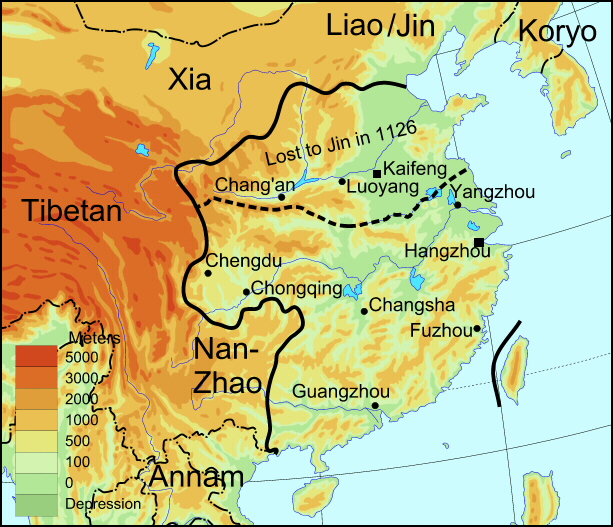
Maritime trade in East Asia began to flourish in the seventh and eighth centuries C.E. It was jump-started by Persian and Arab merchants, who traveled to and settled in ports as far from home as Guangzhou (Canton) in southern China. Later, commerce spread eastward and northward along the coast to Quanzhou, Fuzhou, Mingzhou (Ningbo), and finally Hangzhou, where merchants could gain access to the Chinese interior via the Grand Canal. Foreign trade thus became integrated to a certain extent with China’s domestic economy. Although pioneered by Arabs and Persians, this route soon fell under the domination of ethnic Chinese. Meanwhile, Korean merchants established their own trade networks connecting the west coast of Silla with Laizhou, Haizhou, and other ports in north China and entering the canal system through the mouth of the Huai River. In the early ninth century, semiautonomous communities of Korean traders were scattered along much of the north China littoral.

These northern routes were further extended to Japan under the direction of the Korean tycoon Chang Pogo. Chang himself is said to have visited Kyushu in 824 and met with the governor of Chikuzen, although the validity of this account has been questioned. In any case Chang, acting by authorization of the king of Silla, was in charge of maritime defenses at the Ch’ŏnghae garrison on Wan Island by the late 820s or early 830s. It is probably no coincidence that the first Japanese record of “Silla merchants” in Hakata dates from 831.

However, Korean domination of the Hakata trade was short-lived, to say the least. Merchants from Tang make their first known appearance in Hakata in 842, and soon thereafter they completely replace their counterparts from Silla. Chinese merchants bypassed the Korean coastal route entirely, traveling directly across the East China Sea from locations such as Fuzhou and Mingzhou. These same ports continued to supply the bulk of foreign merchants visiting Japan after the demise of Tang (in 907), when they fell under the control, respectively, of the Wu Yue kingdom and then (after 978) the Song empire.

SOURCE: Gateway to Japan: Hakata in War and Peace, 500–1300, by Bruce L. Batten (U. Hawai‘i Press, 2006), pp. 111-112

Leave a comment

Filed under Asia, China, Japan, Korea

Debunking the Self-Esteem Industry

The latest issue of New York Magazine reports on new research that not only debunks the self-esteem mania that prevails in Western educational theory, but suggests why the constant criticism that prevails in much Asian teaching and learning seems to get better results.

Since the 1969 publication of The Psychology of Self-Esteem, in which Nathaniel Branden opined that self-esteem was the single most important facet of a person, the belief that one must do whatever he can to achieve positive self-esteem has become a movement with broad societal effects. Anything potentially damaging to kids’ self-esteem was axed. Competitions were frowned upon. Soccer coaches stopped counting goals and handed out trophies to everyone. Teachers threw out their red pencils. Criticism was replaced with ubiquitous, even undeserved, praise.

[Carol] Dweck and [Lisa] Blackwell’s work is part of a larger academic challenge to one of the self-esteem movement’s key tenets: that praise, self-esteem, and performance rise and fall together. From 1970 to 2000, there were over 15,000 scholarly articles written on self-esteem and its relationship to everything—from sex to career advancement. But results were often contradictory or inconclusive. So in 2003 the Association for Psychological Science asked Dr. Roy Baumeister, then a leading proponent of self-esteem, to review this literature. His team concluded that self-esteem was polluted with flawed science. Only 200 of those 15,000 studies met their rigorous standards.

After reviewing those 200 studies, Baumeister concluded that having high self-esteem didn’t improve grades or career achievement. It didn’t even reduce alcohol usage. And it especially did not lower violence of any sort. (Highly aggressive, violent people happen to think very highly of themselves, debunking the theory that people are aggressive to make up for low self-esteem.) At the time, Baumeister was quoted as saying that his findings were “the biggest disappointment of my career.”

Now he’s on Dweck’s side of the argument, and his work is going in a similar direction: He will soon publish an article showing that for college students on the verge of failing in class, esteem-building praise causes their grades to sink further. Baumeister has come to believe the continued appeal of self-esteem is largely tied to parents’ pride in their children’s achievements: It’s so strong that “when they praise their kids, it’s not that far from praising themselves.”…

Psychologist Wulf-Uwe Meyer, a pioneer in the field, conducted a series of studies where children watched other students receive praise. According to Meyer’s findings, by the age of 12, children believe that earning praise from a teacher is not a sign you did well—it’s actually a sign you lack ability and the teacher thinks you need extra encouragement. And teens, Meyer found, discounted praise to such an extent that they believed it’s a teacher’s criticism—not praise at all—that really conveys a positive belief in a student’s aptitude.

In the opinion of cognitive scientist Daniel T. Willingham, a teacher who praises a child may be unwittingly sending the message that the student reached the limit of his innate ability, while a teacher who criticizes a pupil conveys the message that he can improve his performance even further.

via Arts & Letters Daily

Leave a comment

Filed under Asia, education, U.S.