Author Archives: Joel

Joel's avatar

About Joel

Executive Editor, Journals Dept. University of Hawai‘i Press

Morobe Field Diary, August 1976: A Visit to Gitua

Dear Residents,

I have a mind to visit you and compare villages, notes, and diseases before heading for Mosbi. G. wrote and said you were thinking of a panel discussion for us three [fieldworkers] on our language work. I’m a little uncertain how it would work….

The visit might be around the end of the month, after which I’ll head back thru Lae, pick up my materials and get set for Mosbi by the 16th.

The doldrums have hit my fieldwork and a fever has laid me low the past couple of days. Everyone in the village is getting it. It doesn’t seem bad enough to be malaria but it’s no fun.

The [M.V.] Sago goes to town tomorrow. Fishing has been terrible lately. [The 48-hour vivax malaria hit hard shortly after the boat left the next day, so I took a treatment dose of chloroquine but had to wait a week before getting into town.]

Let me know if your plans make mine possible. Did J. pay you a visit?

Tako [‘okay, enough’ = Tok Pisin em tasol]


[Later]

Just got back from a trip to P.’s village. It’s a bloody resort. In fact, only 10 miles down the coast there is a resort (at Sialum) where Europeans come for a weekend from time to time. The beaches are sandy, there’s no jungle, not too much rain, beautiful coral reefs offshore, wide, clear, cold rivers nearby, an airstrip–everything great for a resort but detrimental to easy livelihood for the village dwellers. The flat stony ground can’t be near as fertile as the bushy slopes of Siboma; the reefs hinder access to the ocean by canoe (and there are indeed few canoes in Gitua); coconuts are the only likely cash crop; and the place is so windy (from lack of forest or ground contour windbreaks) that small gardens are frequently protected by [manmade] windbreaks. But there is plenty of room to walk about so you don’t get the feeling of ‘living at the bottom of a well’ (P.’s phrase) as you do in Siboma.

The geology is spectacular. The village is on the north coast and the coastline is terraced from the collision of the Australian plate with the one to its north. It makes the ground very rocky and full of limestone (which may make the rivers so blue) instead of volcanic soil as most of the coastline is (when it is not swamp). This collision is what causes the numerous minor tremors that occur all along the north coast and the periodic large ones as a recent one in West Irian near Djayapura.

P.’s language is unbelievable. Its lexicon is practically Proto-Oceanic itself with very few sound changes. A. picked Siboma for its conservativeness but Gitua outdoes it. P. wants to surprise A. with it when he goes through Auckland on the way back.

J.S. & I flew out there in a 9-passenger, twin-engine plane as far as Sialum and then transferred to a 4-seat, single-engine for the 10 mi hop to Gitua. We flew along the marshy coast on the southern side of the Huon Peninsula at about 2-3000 ft, turned inland and climbed to 7000 to go over the mountain-tops (10,000 ft on the way back to get over clouds as well), then descended fairly quickly when we came out on the north coast.

We brought taste treats to the [fieldworker family] like salami, steaks, fresh vegetables, bread & cheese & butter and beer. They were overjoyed. We also took betel nut, pepper catkins & lime. I was made much of when I chewed and complimented on my Tok Pisin by people in the village.

Leave a comment

Filed under malaria, Papua New Guinea

"It often takes a lack of education to be able to express things clearly"

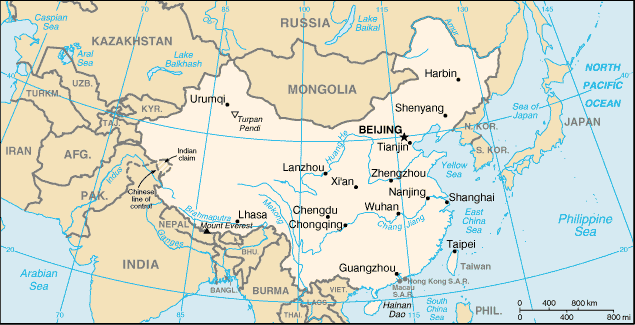
Ian Buruma was visiting the island of Hainan in China in May 1998 when news arrived that General Suharto had been forced to step down as leader of Indonesia, partly as a result of massive student demonstrations.

“This is very important news for all Asian people,” said the keen young reporter for a local paper in Hainan. He was greatly excited, unusual in China when it comes to foreign news. We were sitting at the editorial office of a literary magazine. Most of the editors were there, as were some of the main writers. A young secretary passed around paper plates containing bananas and grapes. I was asked for my “foreign” view.

I could only repeat what I had read in the papers in Hong Kong. I said the Indonesian students had been inspired by the example of Tiananmen. This was received with nervous looks and polite laughter. One or two people scraped the floor with their feet. What did I think of the possibility of democratic change in China? It was not a question I relished, for I did not like to hold forth, in my imperfect Chinese, to people who knew the problems of their country better than I ever would. Still, I had to say something. So I said I saw no reason why Chinese could not handle a democracy if the Koreans, the Filipinos, the Taiwanese, the Japanese, and now, one hoped, the Indonesians could.

The usual discussion–usual among Chinese intellectuals, that is–about the peculiarities of Chinese culture ensued. It would take a long time for democracy to develop in China. China was too big. China was too poor. China was too complicated. Chinese history was too long. Chinese people needed to be more educated. They had little idea of democratic rights. If democracy came too suddenly, there might be chaos. And so on. The keen young reporter then asked me whether I could comment on a particularly “sensitive topic.” What about June 4, 1989, the Beijing Massacre? But one of the editors, the most senior person in the room, swiftly intervened, pointing out that I was a “distinguished foreign guest,” who had traveled far, so perhaps I could offer them some insights into the wider world outside China.

Later that same day, I went out on my own for a snack. Opposite my hotel was a half-finished concrete shell of a building. Much of Haikou, the main city of Hainan, was like that. The building boom of the early 1990s had come to a sudden halt, victim of the Asian financial crisis. Parts of Haikou looked as though they had been bombed. A kitchen had been improvised in one of the rooms of the half-finished building. Next door a jerry-built “beauty parlor” was a front for a brothel. A young man, his shirtless back shiny with sweat, was tossing noodles about in a large pot. After some diffidence, he wiped his hands on his trousers and came over for a chat. We were joined by two of his friends and a girl in a filmy evening gown, who worked at another “beauty parlor.” They stared at me and said nothing.

The cook had come down from a village in Sichuan with his sister, who was helping him run the food stall. But he was in debt to the businessman who paid his wages. That was the trouble with the economic reforms, he said. The rich bosses now controlled everything. I nodded, and slowly ate my noodles with garlic and squid. The chef then shifted in his seat and emptied his nose, by first blocking one nostril and snorting in a short, sharp burst, then repeating the procedure with the other nostril. His manners were far from elegant. But he was no fool. “You know,” he suddenly said, “in your country the individual has the right to control his own life. Not here in China. Everything is controlled from above. The Communist Party has complete power. That is why we have no rights here.”

The intellectuals at the literary magazine might well have shared the cook’s view. In fact, some almost certainly did. But one of the oddities in contemporary China is that it often takes a lack of education to be able to express things clearly. Or, to put it differently, it is those who live near the bottom of society who feel the lack of individual rights most keenly. That is why they generally get to the point more quickly.

SOURCE: Bad Elements: Chinese Rebels from Los Angeles to Beijing, by Ian Buruma (Vintage, 2001), pp. 232-233

Leave a comment

Filed under China, Indonesia

Initiatives by Moderate Muslims in Indonesia

The East-West Wire of Honolulu’s East-West Center ran the following story last week while I was away.

MODERATE MUSLIMS IN INDONESIA USE IRAQ WAR PROTESTS, CIVIC EDUCATION TO UNDERCUT SUPPORT FOR ISLAMIC EXTREMISTS

HONOLULU (March 10) — Muslim moderates in Indonesia prevented Islamic extremists from using the Iraq war to gain support by focusing anti-war rallies on peace, a leading U.S. scholar of Islam and civil society said Tuesday at an East-West Center program. They have also helped contain extremism by initiating civic education in Muslim universities.

By organizing mass anti-war rallies like those seen in the United States in the 1960s, moderates “seized the (Iraq) issue from the extremists,” said Robert Hefner, an anthology professor and associate director of Boston University’s Institute on Culture, Religion and World Affairs. “Iraq, to my astonishment, had little impact. The moderates reasserted themselves.”

Hefner just returned from Indonesia, where he examined communications between the United States and Islamic communities. Since the Sept. 11 attacks on the United States and the Bali bombing, moderate Muslims have mobilized radio programming and other networks to help Indonesians understand issues that might be used by extremists and terrorists to build support, he said.

“The moderate Muslims know there is a crisis, a struggle for hearts and souls, and they are looking for political and cultural tools to combat extremism,” he said.

After the Suharto regime collapsed in 1998, the moderates initiated the largest civic education program in Asia and in all the Muslim world. The course is required at all Muslim universities, reaching 18 percent of the country’s university students, and is funded by the United States through the Asia Foundation and by other international governments and agencies. Muslim educators have also started introducing the course into the upper grades at pesantren, Indonesia’s religious schools.

The course, using textbooks written at Muslim universities, looks at how democracy, plurality and human rights are compatible and vital components of Islam. Classes have triggered much student interest, Hefner said.

Hefner noted that Indonesians take great interest in the political process — 93 percent of voters cast ballots in the 1999 elections and a high turnout is expected at this year’s elections as well.

Such efforts are indeed praiseworthy, but this report, like so many purely academic reports, seems utterly to ignore how ineffective the moderates were in preventing the horrendous outbreaks of violence throughout the country–from Aceh to Maluku to East Timor to West Papua–much of it stoked by the brutal Indonesian military and inflamed by well-armed, hardcore extremists from the Laskar Jihad, which reached a crescendo in 1999-2000, well before the Iraq invasion, before 11 September 2001, and even before the U.S. presidential election in 2000.

The Jaringan Islam Liberal (Liberal Islam Network) needs all the support we can give it.

Leave a comment

Filed under Indonesia

The Vanishing Breed of Transylvanian German Writers

On 11 February 2004, the Culture section (premium content by subscription only) of Transitions Online carried a feature by Anca Paduraru of Deutsche Welle Radio’s English service about a Transylvanian German writer who has stayed in Romania.

BUCHAREST, Romania–“The commotion of summer 1990 inspired me. Then, ethnic Germans left Romania for Germany in droves, and I was left on the railway station platform helpless and perplexed to witness it.”

Eginald Schlattner, 70, is talking about the experience that prompted him to write two novels in his retirement, bringing him success in the German-speaking world and both recognition and notoriety in his native Romania.

The fall of communism produced at least one unhappy result in Romania: After some 800 years of living together with Romanians and other nationalities in this East European country, ethnic Germans began returning to their ancestral homes.

Statistics tell the story. In the last communist-era census, taken in 1977, 350,000 Germans were recorded in Romania. By 1992, their population had dropped by two-thirds. By 2002, it stood at 60,000–just 0.3 percent of the country’s 22 million people.

“It was indeed an exodus lethalis [deadly exodus], this final exit of Germans from Romania, which produced the last twitches we see in Schlattner’s books,” says George Gutu, a professor of German literature at the University of Bucharest.

Helping Schlattner’s success was the controversy surrounding the subject matter of his novels and his alleged part in sending five of his fellow Romanian-Germans to communist prisons.

Schlattner’s authorial debut, five years ago when he was 65, was Der gekoepfte Hahn (The Beheaded Rooster). His second book, Rote Handschuhe (Red Gloves), came out two years later. They have been reprinted several times and reached the best-seller lists of German-language books. The Beheaded Rooster appeared in Romanian translation in 2001, and Red Gloves is being readied for publication in Romania.

Schlattner says his first book “looks at only one day in our history to describe the situation of the Saxons [Germans] here and their pledge to Hitler.” That day was 23 August 1944, when Romania switched camps to join the Allies.

The second novel, which Schlattner says is autobiographical, “shows the two years of my imprisonment in Stalin City [Brasov]. In this one, I put all my cards on the table and explained what happened during those never-ending police interrogations. I was very tough on myself.” …

LOST LANGUAGE

… Germans in Romania lived in a context that allowed them to preserve their identity, Schlattner says. “As I told [German Interior Minister] Otto Schily, … Romania never forbade us from speaking our language, not even during the last eight months of the war it fought against Germany. So much so that at 12, my only Romanian words were, ‘I don’t know Romanian.’ ”

Schlattner’s praise of Romania for its ongoing publication of ABC books in 12 languages for the minorities within its borders does little to assuage Gutu, who is also head of the association of professors of German literature in Romania. While Gutu acknowledges that the demise of a form of literature is inevitable in the absence of a population to support it, he argues that Romanian and German cultural leaders do little to preserve German-language teaching in Romania.

Once, German-language literature in Romania was placed alongside works from East and West Germany, Austria and Switzerland. Its reputation was boosted by the less-extreme treatment meted out to Germans in Romania compared with those in Czechoslovakia or Poland, millions of whom who were expelled after the Second World War.

But now the community structure has been disrupted in Romania, and German-language teachers are scarce.

“Germany directs its efforts and funding only to the German-language schools for the Germans still living in Transylvania and completely disregards the demand for learning the language coming from Romanian children and their parents outside the Carpathian arch,” Gutu says.

Marina Neacsu, cultural projects coordinator at the Goethe Institute in Bucharest, which is funded by the German state, agrees. She says the government has no specific plans to support the editing of books in the German language.

In 2003, though, Romanian authorities gave 16.6 billion lei ($520,000) to the German community, says Ovidiu Gant, undersecretary of state in the Ministry of Public Information. As part of an across-the-board increase in funding to minority groups, the community’s state support more than doubled over the previous year.

In addition, according to Lucian Pricop, a programs coordinator at the Ministry of Culture, more than 1 billion lei ($31,000) has been spent to edit 14 German-language books, support the cultural supplements to the Carpaten Rundschau (Carpathian Observer) and Banater Zeitung (Banat News) magazines, and help public libraries acquire German literature.

Yet Gutu says Romanian and German authorities are ignoring the demand from Romanian parents who realize that Germany is Europe’s economic powerhouse and see knowledge of the German language as indispensable to their children’s professional success.

As for the future of German literature in Romania, Gutu sees none. “As much as I would wish to be wrong, a literature needs a population base to thrive, and 60,000 people are too few and bound to be less.”

Schlattner shares that skepticism.

The local Lutheran bishop, Schlattner says, “is just here to perform burials. This is what we have come to: a deserted house, emptier than the holy stable of Bethlehem. But that one was soon to be filled up with living beings and gifts as the news of Christ’s birth spread into the world. Our stable is not going to witness that.”

Leave a comment

Filed under Romania

Morobe Field Diary, August 1976: Deaf Villagers and Home Sign

Dear S,

By the grace of good saint Quinine the Deaf, I have found myself in a village of about 150 people, 4 of whom are deaf. Since your morbid interest in the subject is well known I thought you might be interested. I am also wondering if there might be any questions I could answer or look into on the subject while I’m here.

(There is also a full-fledged crazy who wanders around in a blanket exposing himself from time to time and calmly enduring abuse when he comes where he is not wanted. And then of course there’s that odd foreigner so addicted to books & paper who actually jumps at the chance to do physical labor in between his alchemizing. In a community of only 25 houses the ratio of oddities to normal people is almost as high as that of L.A.)

All of the deaf are men between the ages of about 30 and 45. One, my roommate, is profoundly deaf and his father too was apparently deaf. The two of them used to communicate in sign I hear tell. Now though, the son of my hosts is the only one fluent in his home sign and the only one who communicates with him extensively with much effectiveness. I am probably the second most familiar with his signs and I am so often in the the dark that, if it wasn’t my job to spend a good deal of my time listening to unintelligible conversation like a dog under the table hoping a juicy scrap will be thrown my way, then I would probably give up in despair like most of the village and pay him little heed.

The other three deaf men more recently lost their hearing and people still shout at them from time to time. There is no sense of community among the deaf people and no attempt to develop a home sign of their own. The three more recently deaf can still speak (in a monotone and often too softly) so the ones that suffer the most frustration are the ones who want to communicate with them, particularly the spouse of one of them. Since clearing forest, building canoes and houses and catching fish are not tasks requiring good hearing, except when done cooperatively, all of their lives are less unproductive than increasingly solitary.

Though those three are fairly well acculturated and share pretty much the same reality as the other people in the village (except for one who won’t forsake Pidgin when communicating with me–usually to trade betel nut for tobacco. He irritated me till I found out the reason whereupon my knee jerked and my heart bled but he still irritates me.), but I have recently come to realize that one of the troubles I have in following the really deaf guy is that he makes reference to worlds I do not expect. It hit me rather forcefully one day when he was telling war stories (many probably came from his father or perhaps from people who have signed to him since they match what others tell me about the mountains of food & tobacco of the American troops, etc.; others he got from a trip to the Lae Military Barracks where his manucommunicant worked). He, in the midst of describing weapons of various sorts, described one sort of pliers-like contraption which he indicated was used to snip off people’s noses, ears, and pinch out their eyes (sorry, gentle reader, if thy sensibilities are offended). I looked rather puzzled and asked who. He described their skin color as being, after searching around for some time to find an example of the color, purple! Combining that with another story of a flying submarine I can only conclude that he is a bit too credulous of the comics he looks at (he’s an avid reader but absolutely illiterate) or of whatever movies he’s seen.

I’ve also just come to realize that he has a reputation (well deserved) for thieving. He has been pilfering my stuff shamelessly.

NEW GUINEA COASTAL VILLAGE HOME SIGNS

RAIN – arms raised pointing back over shoulder, fingers spread and hands fall repeatedly in unison facing back as if rain falling on shoulders (never falls on face).

WIND – hands rotate in front of face clockwise blowing air toward face & chest.

EAT – fingers in letter O touch lips as teeth champ several times.

BISKITS (flat, unleavened, hard ship biskits) – B-hand pulled away from mouth as teeth clamp together.

PEPPER PLANT (eaten with betel nut) – single finger (index) pulled away from mouth or dipped into palm of left hand as if dipping into lime powder (culturally transparent) (the dipping into ‘lime’ and putting finger toward mouth also indicates lime itself).

BEATING SAGO – both hands held together as if holding a golfclub (actually a sago beater) and pounded up & down (culturally transparent)

SLEEP, NIGHT, 24 hr period – head inclines toward palm of hand which acts as pillow. Three nites would be SLEEP – 1 – SLEEP – 2 – SLEEP 3

DAY, SUN, TIME OF DAY – pointing at place sun comes up, the hand follows the arc of the sun until the appropriate location is reached. As far as I know, orientation is always to actual sunrise & sunset, not to conventionalized location in relation to body.

STUDENT – writing with index finger on open palm of left hand. (‘School’ in the local language is, roughly translated, ‘house paper’.)

In addition, this congenitally deaf fellow can pronounce two words which, significantly I suspect, both involve labials.

mou ‘none, no’ [mou] (I’m not sure how much actual nasalization)

bamo ‘a lot’ [ba-a] (the [a] ends up creaky voiced and long; it is almost always rather long when hearers say it)

Many signs are commonly used or known, especially those pertaining to work, like line-fishing, beating sago palm and betel nut paraphernalia. But I have never seen any Siboma use an action like his INTENSIFIER. On the other hand his numbers match the Siboma numerical metaphors.

5 = nimateula (‘half hand’) = ENUMERATION + HAND

10 = nimabesua (‘both hands’) = ENUMERATION + BOTH-HANDS-TOGETHER

20 = tamota te (‘one man’) = ENUMERATION + HANDS-AND-FEET-TOGETHER

Let me know if there are any particular signs you are interested in.

Em tasol,

P.S. MORE NEW GUINEA VILLAGE HOME SIGNS

KAUNSIL – indicates badge on chest (which kaunsil never wears)

DEAD – palms facing front, arms slitely bent at sides, bead thrown back turned to one side, eyes closed

WHITES – salute

SAILOR – round hat on head indicated

JPNSE – big head/helmet

CHINESE – flatnose

REEF, ISLAND – circle drawn horizontally at chest level from above

HOUSE – palms parallel or straight w/ fingers making roof

OLD – beard

AFRAID – draws arms into chest and withdraws to one side

REFERENTS-PEOPLE – indicated by house [location] or outstanding physical trait

INTENSIFIER – turns face to one side, drawing shoulder up to chin, and closing eyes. Maintained for about 1 sec or more.

PUNISHMENT, INCARCERATION – one wrist over the other in front of chest as if hands tied, both wrists facing down, hands in fists

CHURCH – hands clasped, fingers interlaced, in front of neck

POLICE – arms come up to chest as if marching

LINE FISHING – arms bent at elbow before chest, raised alternately as when pulling in a handline

M.V. SAGO (the village diesel-powered fishing boat) – hands rotate back & forth an imaginary steering wheel

(M.V. SAGO, LINE FISHING & POLICE are a near-minimal trio: all have alternate arm movement but different end points and orientation)

Leave a comment

Filed under Papua New Guinea

Imprisoned in a "Democracy Cell"

The book I took along to read on my trip is so absorbing that I fear I shan’t be able to resist quoting numerous passages from it. In the introduction, Ian Buruma describes the role of walls erected to fortify China against the outside world. He describes first the role of the Great Wall in keeping barbarians at bay. Then he sketches a very different kind of wall, the “democracy wall” that sprang up during the thaw after Mao Zedong’s death in 1976, upon which Wei Jingsheng posted under his own name the famous essay on the Fifth Modernization. Mao’s eventual successor Deng Xiaoping “had announced four modernizations: in agriculture, science, technology, and national defense. Wei added democracy, without which, he wrote, ‘the four others are nothing more than a newfangled lie.'”

There is also a third wall, fictional, the wall of a prison cell. It was described by a brilliant novelist, Han Shaogong. Like many Chinese intellectuals, Han was forced to “go down” to a remote rural area after the Cultural Revolution. He spent the 1970s tilling the fields in a small Hunanese village. Out of this experience came an extraordinary novel, Maqiao Dictionary, which is a kind of spoof anthropological dissection of village life through the language of its people. Each chapter is inspired by a slang expression. One of these is “democracy cell.”

The story is told by a local gambler, whom Han springs from jail by paying his fine. Dressed in rags, his hair matted with lice, the gambler stinks so badly that Han makes him take a bath before hearing his story. Refreshed, the man starts to whine. He had been really unlucky this time.

Unlucky?

Yes, this time he had experienced the worst: a democracy cell.

A democracy cell?

Well, says the man, it’s like this: In most prisons, every cell has a boss and a hierarchy of henchmen. The boss gets to eat the best food and the best spot to sleep, and when he wishes to peep at the female prisoners through a tiny window in the wall, his cellmates must prop him up, sometimes for hours, until they buckle under the strain. But, hard though it may be, at least there is order. Every man gets his food. You have time to wash your face and to piss. You might even get some rest. Such an arrangement is better than a democracy cell. Democracy is what you get when there is no cell boss. The men fight one another like savages. They all want to be boss. Unity breaks down. Gangs go to war: Cantonese against Sichuanese, northeasterners against Shanghainese. There is no chance of getting sleep. You can’t wash. You get lousy in no time, people are injured, and sometimes even killed.

This vignette of rural prison life is a perfect illustration of a common Chinese attitude toward democracy, or indeed political freedom. Many Chinese–and not just the rulers–associate democracy with violence and disorder. Only a big boss can make sure the common people get their food and rest. Only the equivalent of an emperor can keep the walled kingdom together. Without him, the Chinese empire will fall apart: region will fight region, and warlord will fight warlord. These assumptions rest on thousands of years of authoritarian rule, beginning with the first Qin emperor and his cursed Great Wall. And they are faithfully repeated by many in the West who presume to understand China….

“That Western-style stuff.” It is a recurring theme in China, and other autocracies outside the Western world, the assumption that only Europeans and Americans should have the benefit of democratic institutions. It is of course a theme running through European colonial history, too. But if China has a history of despots ruling over the great Chinese empire, it also has a history of schisms and disorder and disunity, of rebellions, and of brave, mad, and foolhardy men and women who defied the orthodoxy of their given rulers. Of course rebels are not necessarily democrats. But dismissing democracy as “Western-style stuff” would consign 1 billion Chinese to political subservience forever. That is why I approach the Chinese-speaking world in this book through the rebels, the dissidents, the awkward squad that resists authoritarianism. What is their idea of freedom? Or of China? What does dissidence mean in a Chinese society? What makes people try, against all odds, to defy their rulers? What chance do they have of succeeding? Will those virtual walls that make China the largest remaining dictatorship on earth every come down?

SOURCE: Bad Elements: Chinese Rebels from Los Angeles to Beijing, by Ian Buruma (Vintage, 2001), pp. xvii-xix

Leave a comment

Filed under China

Travel Break: Back March 15

Leave a comment

Filed under blogging

A Chronology of West New Guinea (West Papua) since 1945

The conflict between the Dutch and the Indonesions over the disposition of Netherlands New Guinea followed the Indonesian revolution of 1945-9. The Round Table Conference Agreement (1949) had left that part of the former Netherlands East Indies under Dutch occupation, as a concession to Netherlands nationalist feeling; in the succeeding decade the Netherlands devoted considerable attention to developing the area as an example of constructive colonial effort. The Indonesions, however, considered ‘West Irian’ an essential part of their state, and as the nationalist temper rose during the 1950s increasing emphasis was placed on forcing its concession.

In 1957 Dutch residents were expelled from Indonesia and the Netherlands-owned property was nationalized, and in 1961 military harassment of the colony began. The US entered the dispute as a mediator favourable to the Indonesion side, as a result partly to this, and partly of pressure by Dutch businessmen anxious to restore relations with Indonesia, the Netherlands agreed in August 1962 to relinquish control. After interim UN rule, West Irian was handed over to the Indonesians in May 1963, on the understanding that in 1969 the Irianese would be allowed to chose whether they wished to continue under Indonesian rule. Mismanagement, economic stringency, and the contempt with which Indonesians tended to regard the local Papuan population led to a series of uprisings under both Sukarno and Suharto. However, all non-Papuan parties to the dispute were agreed that the territory should remain in Indonesian hands, no international objections were raised when the 1969 ‘act of free choice’ was made a purely symbolic one.

1. The West New Guinea question resulted from the demands during the 1920s and 1930s of ultra colonial Dutch groupings to have the area declared as a separate Netherlands crown colony.

2. After the outbreak of the Indonesian revolution in 1945 it were especially the Eurasian group–now suffering Republican attacks and seeing their earlier superior social status being demolished–supported by conservative politicians again agitated for West New Guinea to be put aside as their new fatherland under the protection of the Dutch crown.

3. On 20 December 1946 the Netherlands parliament passed an amended Dutch-Indonesian agreement (Linggajati) in which West New Guinea was accorded a special political status. This clause was again included in the Renville agreement of 17 January 1948.

4. In order to avert for the West New Guinea question to cause the derailment of the Round Table negotiations, as a compromise the matter was shelved to further negotiations in 1950, and on 27 December 1949 the Netherlands transferred its sovereignty to Republic of United States of Indonesia.

5. During 1950 Dutch-Indonesian relations gradually deteriorated causing various meetings about West New Guinea to fail; and on 17 March 1951 the Dutch government decided to ‘freeze’ the issue.

6. After the failure of the Eurasian experiment the Netherlands government in 1951 directed its attention to the socio-economic development of the Papuan population and to guide Papuan nationalism towards to achievement of self government and finally independence.

7. Indonesia put the question to the United Nations, but during 10 December 1954 UN Assembly meeting failed to achieve the two-third quorum.

8. By 1956 the Dutch position regarding West New Guinea had grown irrevocably stubborn causing parliament to have the area enshrined in the constitution as part of the Netherlands kingdom.

9. By 1960 it is clear that the vast majority of Papuan leaders rejected to join the Indonesian Republic and instead called for the establishment of an independent Papuan state. A this time, however, the eventuality of this had become rather dim as the Netherlands had been unable to secure military support from the USA and Australia in the case of a threatened full-fledged Indonesian invasion.

10. Originally Australia was absolutely opposed to an Indonesian take over of West New Guinea. For example in March 1947 Dr. Burton, the head the Australian Department of Foreign Affairs, made a strong plea in the Netherlands embassy in Canberra for West New Guinea to be kept out of Indonesian hands. Similarly the succeeding Menzies government in February 1950 emphasised that West New Guinea was of same vital strategic interest to Australia as Papua-New Guinea.

11. Australian attempts to secure American agreement of military help in the view of war with Indonesia received the same vague responses as the Dutch have been given in Washington. As a result in January 1959 Prime Minister Menzies told Dutch ambassador Lovink that it was impossible for Australia to ally itself militarily with the Netherlands.

12. The USA only grudgingly tolerated continued Dutch control of West New Guinea. Washington took a neutral stand in Dutch-Indonesian dispute and never openly supported the Dutch position. American policy was solely concentrated on keeping Indonesia out of Communist hands and showed no interest in the human rights of the Papuan people. So in 1961 President Kennedy abandoned the American policy of ‘neutrality’ regarding West New Guinea forcing in 1963 the Netherlands to hand over the territory to Indonesia via an United Nations commission. In Washington the right of Papuans of self-determination had ended up in the wastepaper basket.

13. April 1962 Indonesians launch Operation Mandala under command of Benny Murdani and General Suharto. 1419 commandos dropped into West Papua. Most captured or killed.

14. Increasing US support for Indonesian position after US $450 million low-interest loan in 1960 to Indonesia from USSR. Indonesians playing US and USSR off against each other.

15. New York Agreement between Indonesia and Dutch (no Papuan representation) allows for United Nations Temporary Executive Authority to administer WNG from 1 October 1962 to 1 May 1963. Control then to go to Indonesia with change of sovereignty confirmed by ill-defined ‘Act of Free Choice’ within five years.

16. ‘Act of Free Choice‘ carried out in 1969 with 1025 hand picked and savagely coerced representatives voting unanimously for incorporation. Outcome accepted by UN as both Holland and Indonesia agree to process.

17. Large-scale uprisings throughout country against Indonesian rule. Put down by Indonesian military although widespread protests continue, for instance in Manokwari in the mid-1960s; Baliem Valley in mid-1970s and around Jayapura and border area in mid-1980s. [See map.] These result in many thousands of deaths and over 10,000 refugees in PNG. Organisasi Papua Merdeka (OPM) formed gaining mass support for an independent future. Sporadic ongoing guerilla campaign commences.

18. Australian Council for Overseas Aid (ACFOA) report released in April 1995 detailing killings of villagers and a priest by ABRI [Indonesian government and armed forces] soldiers in the Freeport Mine operations area. Partially in response to expansion of the mine’s concession area from 10,000 hectares to 2.5 million.

19. Seven young European scientists kidnapped on 8 January 1996 by OPM Central Command under Kelly Kwalik. Held until May 9 when rescued by Kopassus troops.

20. July 6 1998 Biak Island massacre occurs when ABRI troops attack hundreds of unarmed Morning Star flag raisers demanding independence. Reportedly 20 killed and 141 injured in original attack, some 139 others, mostly women and children taken on board Indonesian naval frigates and reportedly killed at sea, many grave atrocities reported. No independent investigation into these events.

21. February 23-25 2000 Kongres Rakyat Papua, or Congress held in Jayapura where thousands of Papuans gather to discuss future. Plans made for a Musyawarah Besar (MuBes), or ‘large consultation’ later in year. President Wahid gives A$172,000 and his support as long as independence not declared. Name changed from Irian Jaya to Papua.

22. May-June 2000 MuBes held in Jayapura and attended by some 20,000 Papuans from across the country and social spectrum. 31 member leadership Presidium elected with Chief Theys Eluay emerging as Chairman and acknowledged leader.

23. Law No 21/2001 passed on Special Autonomy for Papua Province aimed at dealing with separatists’ grievances through increased local Papuan control over society and economic resources. Opposed by many Papuans who feel that Autonomy has been forced upon them. Widespread demands for independence continue.

24. Vice-President Megawati Sukarnoputri takes control of West Papua ‘issue’ after widespread criticism of Wahid for encouraging separatists. Military crackdown commences with banning of Morning Star flag, arrest and harassment of Papuan leaders. Assassination of Chief Theys on 10 November 2001 by Kopassus soldiers.

25. August 31 2002 Two Americans and one Indonesian killed and eight Americans injured in attack on a school teachers picnic near Tembagapura, support town for the Freeport Mine. OPM initially blamed by Indonesian military, although TNI remains suspect. FBI investigations continuing.

26. Presidential Instruction No1/2003 on the establishment of West and Central Irian Jaya Provinces, in addition to Papua Province. This decree contradicts the previous Autonomy law and has invoked fear and uncertainty amongst Papuans.

27. December 2003 Timbul Silaen, former police chief in East Timor during the UN sponsored referendum in 1999, is appointed as the new police chief for Papua. Eurico Guterres (who worked with Salaen in East Timor) announces plans to establish a branch of his pro-integration Red and White Defender Front militia in Papua. He has been convicted of crimes against humanity but is free pending an appeal.

28. January 2004 rumors abound about the declaration of a ‘State of Emergency’ to deal with separatists. Fears of an Aceh style military operation to destabilize Papua in the context of Indonesian presidential and parliamentary elections.

29. March 4 2004 U.S. officials believe local army commanders ordered the ambush that killed two American teachers near a gold mine in a case that has held up resumption of normal US-Indonesian military ties, two American officials told The Associated Press. “It’s no longer a question of who did it…. It’s only a question of how high up this went within the chain of command”. The officals say little doubt remains about who was responsible for the attack on vehicles driving down a road to a gold mine operated by New Orleans-based Freeport-McMoRan Copper & Gold.

SOURCES: C.L.M. Penders. 2002. The West New Guinea Debacle (Crawford House/KITLV Press/U. Hawai‘i Press) [reviewed (pdf) in The Contemporary Pacific]; Jim Elmslie. 2002. Irian Jaya Under the Gun (Crawford House/U. Hawai‘i Press).

Chronology compiled by A. L. Crawford, Crawford House Publishing Aust. Pty Ltd., ABN 31 102 847 656, 14 Dryandra Drive, PO Box 50, Belair, SA5052 Australia; Tel: + 61 8 8370 3555; Fax: + 61 8 8370 3566; Email: tonycraw@bigpond.net.au

Leave a comment

Filed under Indonesia, Netherlands, Papua New Guinea, U.S.

Virtual Vietnam Archive

Students, scholars, and researchers can now access nearly 1 million pages of Vietnam War related research materials through the Virtual Vietnam Archive. This free online resource is a part of the Vietnam Archive at Texas Tech University and currently includes the full text of more 80,000 documents, 60,000 photos and slides, hundreds of interviews with veterans and other participants (to include streaming audio and transcripts), other streaming audio and video recordings, and much more. The documents include official government and military records to include presidential office materials, unit and operation after action reports, unit rosters, staff journals and morning reports, personal letters, diaries, and many other materials. We add nearly 20,000 pages of new material online each month and expect this will increase significantly in the near future when we acquire some new digital scanning equipment. The Virtual Vietnam Archive is the most potent, dynamic, and easily accessible research tool available regarding the Vietnam War. To access these free online resources, just visit our website and select Virtual Vietnam Archive.

The Virtual Vietnam Archive is funded through the Institute of Museum and Library Services.

SOURCE: Stephen Maxner, Archivist, Associate Director, The Vietnam Archive, Texas Tech University, Special Collections Library Room 108, Lubbock, TX 79409-1041; Phone: 806-742-9010; Fax: 806-742-0496; Email: steve.maxner@ttu.edu

Leave a comment

Filed under Vietnam

Saint Patrick’s Battalion in the U.S.-Mexican War

Geitner Simmons of Regions of Mind has a fascinating post on Saint Patrick’s Battalion in the U.S.-Mexican War of 1846-1848. Many of the “San Patricios” were U.S. Army deserters who fought–fiercely and desperately–against their former comrades. Geitner quotes from an extended review of the book Shamrock and Sword: The Saint Patrick’s Battalion in the U.S.-Mexican War, by Robert Ryal Miller, which contains a fuller account.

Leave a comment

Filed under U.S., war