Author Archives: Joel

Joel's avatar

About Joel

Executive Editor, Journals Dept. University of Hawai‘i Press

Better Pacific-to-Europe Overland Routes Planned

The BBC recently reported on plans for a direct China to Europe rail-link using new narrow gauge tracks through Kazakhstan. The new line would be much faster than the Trans-Siberian link.

The Kazakh rail chief told the BBC work would shortly begin on the first part of a 3,000 kilometre train line to link China to Iran and the Caspian Sea.

It is hoped the time cargo from Pacific Ocean ports takes to reach western Europe will eventually be cut by half.

The current time freight takes on the same journey is 50 days by sea, or 15 days using the Trans-Siberian railway.

“It will definitely be faster than the Trans-Siberian railway,” the head of Kazakhstan’s national railways, Yerlan Atamkulov said.

“If today on the Trans-Siberian railway freight takes 15-16 days, then on the Kazakhstan transit railway, it will take eight days.”

Kazakh and Russian railways use broad gauge tracks while Europe and China use international narrow gauge tracks.

Kazakhstan intends to build a new narrow-gauge railway line straight across its vast territory to the Caspian Sea, eliminating the time and cost needed to transfer goods from narrower to wider trains at the Chinese border….

Earlier this week, 23 Asian nations, including both Kazakhstan and China, signed an agreement in Shanghai to build an international highway network across Asia linking Tokyo with Istanbul in another grand scheme to improve transport links across Asia.

Asahi.com maps the route of the “Asia Highway”: Tokyo – Fukuoka – Seoul – Pyongyang – Beijing – Hanoi – Bangkok – Yangon (Rangoon) – New Delhi – Islamabad – Kabul – Tehran – Istanbul.

It’s all about the freight!

via huixing no nikki

Leave a comment

Filed under China, Iran

Ethnicity, Peasants, and Tribes in Vietnam

Vietnam is a multi-ethnic state composed of fifty-four officially recognized ethnic groups. It is unique among Southeast Asian countries, but similar to China, in that its ethnic minorities constitute only a relatively small fraction of the national population but occupy a vast part of the national territory, giving them a strategic importance greatly disproportionate to their numbers. The Vietnamese minorities, even those in the Central Highlands, also primarily occupy sensitive borders. The minorities are thus an extremely important component of Vietnamese society and ethnic relations are a matter of intense concern to the ruling Communist Party and the state.

Vietnam’s ethnic minorities make up only 14 per cent of the national population. The lowland Vietnamese, who are officially designated as Kinh, form the vast majority … almost 66 million [in 1999] …

All of Vietnam’s ethnic groups live in the uplands with the exception of the Kinh, Hoa (ethnic Chinese), Khmer (Cambodians), and Cham [who speak Austronesian languages apparently most closely related that spoken in Aceh, Indonesia]….

From a political standpoint, perhaps the most significant distinction between groups is whether they have tribal or peasant forms of social organization. Shifting cultivators, … who are often collectively referred to by the French term ‘montagnards’, and the H’Mong and Dao of the northern mountains, display a tribal form of organization. Tribal society is relatively egalitarian and highly individualistic with leadership based on personal achievement rather than holding of a formal status. The Muong, Tay and Thai of the northern uplands were formerly organized as rank-stratified chiefdoms with people divided into nobles and commoners. Today, like the Cham and Khmer of the south they are peasant societies, as are the Kinh. Their social organization is hierarchical with centralized and institutionalized leadership. Of course, since 1954, all these groups have been integrated into the Vietnamese nation-state and their traditional forms of socio-political organizations largely supplanted by state administrative organs. But, at the local level, behaviour is still strongly shaped by traditional cultural institutions and values. These patterns have strongly influenced the extent to which different ethnic groups have been integrated into the socialist nation-state. Peasant societies were readily integrated into the nation-state by a simple substitution of administrative elites in which communist cadre took the place of traditional mandarins or local nobility. Integration of tribally organized groups has proved to be more difficult, reflecting the fact that leadership of such societies is charismatic rather than based on ascribed status or bureaucratic position, making it difficult for the state to either co-opt tribal leaders or replace them with their own cadre. Pan-tribal associations such as clans also provide ready-made channels of communication among different communities within the ethnic group and facilitate organization of separatist movements that are very difficult for state security organs to penetrate. Thus it is among tribal societies that separatist tendencies remain most evident. [emphasis added]

SOURCE: “Vietnam,” by A. Terry Rambo [really!], in Ethnicity in Asia, ed. by Colin Mackerras (RoutledgeCurzon, 2003), pp. 108-112

Leave a comment

Filed under China, Indonesia, Vietnam

Communism and Buddhism in Vietnam during the Colonial Era

On the 50th anniversary of the end of the long battle of Dien Bien Phu, in which French colonial forces were decisively defeated at terrible cost to both sides, it seems appropriate to feature a revisionist book that argues that what most appealed to the reading public in Vietnam during the colonial era was neither Confucianism, nor nationalism, nor modernism, nor even communism, but Buddhism, so central to Vietnamese national identity.

In this ambitious and path-breaking book, Shawn McHale challenges long held views that define modern Vietnamese history in terms of anticolonial nationalism and revolution. McHale argues instead for a historiography that does not overstress either the role of politics in general or Communism in particular. Using a wide range of sources from Vietnam, France, and the United States, many of them previously unexploited, he shows how the use of printed matter soared between 1920 and 1945 and in the process transformed Vietnamese public life and shaped the modern Vietnamese consciousness.Print and Power begins with an overview of Vietnam’s lively public spheres, bringing debates from Europe and the rest of Asia to Vietnamese studies with nuance and sophistication. It examines the impact of the French colonial state on Vietnamese society as well as Vietnamese and East Asian understandings of public discourse and public space. Popular taste, rather than revolutionary or national ideology, determined to a large extent what was published, with limited intervention by the French authorities. A vibrant but hierarchical public realm of debate existed in Vietnam under authoritarian colonial rule.

The work goes on to contest the impact of Confucianism on premodern and modern Vietnam and, based on materials never before used, provides a radically new perspective on the rise of Vietnamese communism from 1929 to 1945. Novel interpretations of the Nghe Tinh soviets (1930-1931), the first major communist uprising in Vietnam, and Vietnamese communist successes in World War II built an audience for their views and made an extremely alien ideology comprehensible to growing numbers of Vietnamese. In what is by far the most thorough examination in English of modern Vietnamese Buddhism and its transformations, McHale argues that, contrary to received wisdom, Buddhism was not in decline during the 1920-1945 period; in fact, more Buddhist texts were produced in Vietnam at that time than at any other in its history. This finding suggests that the heritage of the Vietnamese past played a crucial role in the late colonial period.

SOURCE: Shawn McHale, Print and Power: Confucianism, Communism, and Buddhism in the Making of Modern Vietnam (U. Hawai‘i Press, 2003).

RECOMMENDATION: Adjust your speakers, click on the Dien Bien Phu link, and explore the site for 10 minutes while you listen to the haunting Concerto de l’adieu of Georges Delerue © SCPP, 1999/2000. Whatever one thinks of the cause for which either side fought, there were no “cheese-eating surrender monkeys” at Dien Bien Phu.

Leave a comment

Filed under France, Vietnam

China’s Changing Policies toward Tibet, and Indonesia’s toward West Papua

The East-West Center has published two more studies, one on China’s evolving policy toward Tibet and the other on Indonesia’s toward West Papua. Abstracts follow. The full reports are available for download.

Beijing’s Tibet Policy: Securing Sovereignty and Legitimacy, by Allen Carlson. Policy Studies 4. Washington, DC: East-West Center Washington, 2004. ix, 71 pp. Paper, $5.00.

This paper examines the main contours of Beijing’s Tibet policy since the start of the reform era (1979 to the present). It argues that throughout this period China’s position on Tibet has always been concerned with defending Chinese sovereignty, more specifically jurisdictional sovereignty, over the region. Since 1979, the ways in which the Chinese acted to secure such rights, however, have varied significantly, in two distinct phases. During the initial phase, in the late 1970s and early 1980s, the Chinese position was marked by the implementation of relatively moderate policies. In the second phase, which began in late 1987, and continues today, the Chinese position on Tibet has been defined by highly critical discursive moves, pointed diplomatic activity, a renewed commitment to use force to silence all opposition to Chinese rule, and the utilization of economic development programs to augment such efforts. This essay contends that three forces were crucial in determining Chinese policy on Tibet during these two periods: the underlying strategic value of Tibet to Beijing within the regional security dynamic, the persistence of historically conditioned, sovereign-centric values within elite circles in China, and the internal and external pressures created by Deng Xiaoping’s “reform and opening” line. The complexity of these factors suggest that understanding how Beijing acts vis-à-vis Tibet requires that students of international relations and security studies, as well as policymakers and activists, look beyond parsimonious explanations and single-faceted policy directions when considering the “Tibet issue.”

The Papua Conflict: Jakarta’s Perceptions and Policies, by Richard Chauvel and Ikrar Nusa Bhakti. Policy Studies 5. Washington, DC: East-West Center Washington, 2004. x, 82 pp. Paper, $5.00.

“Without Irian Jaya [Papua], Indonesia is not complete to become the national territory of the Unitary Republic of Indonesia.” In recalling this statement of President Sukarno, her father, Megawati Sukarnoputri gave voice to the essence of the nationalists’ conception of Papua’s place in Indonesia and its importance. Indonesia today confronts renewed Papuan demands for independence nearly three decades after Jakarta thought it had liberated the Papuans from the yoke of Dutch colonialism. Indonesia’s sovereignty in Papua has been contested for much of the period since Indonesia proclaimed its independence–challenged initially by the Netherlands and since 1961 by various groups within Papuan society. This study argues that even though Indonesia has been able to sustain its authority in Papua since its diplomatic victory over the Netherlands in 1962, this authority is fragile. The fragility of Jakarta’s authority and the lack of Papuan consent for Indonesian rule are both the cart and the horse of the reliance on force to sustain central control. After examining the policies of special autonomy and the partition of Papua into three provinces, the authors pose the question: If Jakarta is determined to keep Papua part of the Indonesia nation–based on the consent of the Papuan people–what changes in the governance of Papua are necessary to bring this about?

Leave a comment

Filed under China, Indonesia

The Ambiguous Role of the Tsushima Governor Between Korea and Japan

During the 15th and 16th centuries, the Muromachi Bakufu (1333-1573) in Kyoto was barely able to control provinces close to the capital, but it was able to establish trade relations with the Ming court (1368-1644) in China and the Chosôn court (1392-1910) in Korea. This was the Sengoku (“Warring States”) Period when powerful local daimyo (feudal lords) clashed with each other and sought their own allies abroad. Local daimyo in Kyushu established trade relations with the Portuguese, the Ryukyu Kingdom (Okinawa), and others. In 1550, Francis Xavier also undertook a mission to the capital, Kyoto.

The enterprising governor of Tsushima was empowered by the Chosôn court to issue access permits to Japanese envoys wishing to trade with Chosôn, according to historian Kenneth R. Robinson of International Christian University in Tokyo, who published an article on “The Tsushima Governor and Regulation of Japanese Access to Chosôn in the Fifteenth and Sixteenth Centuries” in Korean Studies 20 (1996): 23-50.

This article suggests that Chosôn government officials did not strictly adhere to the tributary system model of international relations in their dealings with Japanese. Officials borrowed from Chinese example and from domestic policy in designing Japanese access control policies that responded flexibly to political conditions in Japan. The munin access permits issued by the Tsushima shugo [‘provincial governor’] were perhaps the most important feature of these policies. But treatment of Tsushima and the Tsushima shugo by Korean officials made ambiguous the identities not only of Tsushima and the Tsushima shugo, but also the state boundaries of Chosôn and Japan. These negotiable ambiguities raise questions of how to conceptualize relations between Koreans and Japanese in the fifteenth and sixteenth centuries….

The munin systems of access control, in which Japanese bound for Chosôn obtained a munin (access permit) from the Tsushima shugo, did not originate directly from the tributary system of international relations [that prevailed in China]. Adapted from Chosôn government policies for controlling the domestic travel of Koreans, the munin systems served the complementary needs of the Chosôn government in regulating Japanese contact and of Sô Sadamori and his successors as Tsushima shugo in enhancing the powers of that office. The Tsushima shugo issued three types of access permits to three types of Japanese for three distinct activities: to envoys for diplomacy, which was understood generally to be a fiction for trade; to Tsushima islanders trading in fish and salt along the Chosôn coast; and to Tsushima fisherman for fishing in Chosôn waters. In the space between the vision offered by international relations in the tributary system model and the complexities of policymaking that faced Chosôn government officials, Muromachi Bakufu officials, and the Tsushima and other provincial governors there emerged policies that made ambiguous the administrative boundaries of “Chosôn” and “Japan” and the identity of “Tsushima.”

Apparently, a fair number of these envoys were imposters, according to the abstract of a 1997 paper by Robinson presented at the Association for Asian Studies annual meeting entitled “Japanese Imposter Sovereign Envoys to Choson: The Late Fifteenth Century.”

Royal envoys from Ryukyu, envoys of Japanese provincial governors and traders, and Japanese shogunal envoys began visiting Choson Korea in the late 1300s and early 1400s. In the late fifteenth century, Japanese impostor sovereign envoys began seeking to trade with the Choson government. They donned a variety of disguises, modeling themselves after envoys with whom the Choson court had been trading for decades. Some represented the “King of Ryukyu,” others the rulers of countries unknown to Korean officials. Choson court officials met (impostor) Ryukyu envoys as they had earlier royal envoys until they began to recognize mistakes in the envoys’ documentation. These less fortunate envoys were received at a reduced level of reception, one reserved for foreign government elites. As for the envoys of the rulers of the unknown countries, they failed to convince Korean officials of the existence of those countries. But, rather than turn away these visitors, Choson court officials received them at the same, reduced status as the unmasked impostor Ryukyu royal envoys. Reception of these impostor envoys displays elements of the Choson Korea world order. Formed in part to promote trading over raiding, this hierarchical world order functioned simultaneously with the Ming Chinese tributary system. Choson court officials ranked the Chinese emperor as superior, the rulers of the tributary states of Japan and Ryukyu as equals to the Choson king, and Japanese and Ryukyuan government officials and traders as of lower status. The tributary system informed the structure of the Choson court’s reception system, but tributary status did not confine Choson court officials to a set portfolio of foreign policies. Stated differently, Korean officials did not defer to the Chinese in their conduct of relations with Japanese and Ryukyuans.

The position of Tsushima seems a good deal less ambiguous than it was 500 years ago, but the general nature of international diplomacy doesn’t seem to have changed all that much, regardless of the polite fictions enshrined in the Treaty of Westphalia (at which England, Poland, Muscovy, and Turkey were the only European powers that were not represented).

Leave a comment

Filed under China

Badly Handled Territorial Pissing Matches

The Marmot has a couple of sad but funny posts about “stupid territorial pissing matches”: the latest flare-up over Dokdo/Takeshima in the East Sea/Japan Sea, and over Hans Island in the North Atlantic, with a few asides about the Great Turbot War between Canada and Spain in the mid-1990s, the Cod War between Iceland and the U.K. in the mid-1970s, the Aroostook (or Pork and Beans) “War” between New Brunswick and Maine in the 1830s, and similar disputes, with a lot of links.

Leave a comment

Filed under Japan, Korea

Literacy, Emotion, and Authority on a Polynesian Atoll

Is writing just speech in a different medium? Is writing more authoritative, objective, and reliable than speech? Can a text be understood without its context? Not in the literacy practices of the Polynesian atoll in Tuvalu, according to a book by anthropologist Niko Besnier.

The chief value of a good ethnographic description lies not in what its readers learn about others, but in what they learn—or unlearn—about themselves. Besnier (B) provides the ingredients for a healthy dose of unlearning in this useful and stimulating attempt both to describe the roles of literacy on Nukulaelae in Tuvalu and to offer a broader comparative and theoretical perspective, as the series title implies. This work is especially valuable in casting doubt on several assumptions that linguists too rarely question about the written vs. spoken word: (1) that writing is just speech in a different medium; (2) that writing is more authoritative, objective, or reliable than speech; and (3) that a transcribed text can be understood without its context.

B starts with a useful introduction to literacy theory (1–20) and concludes with a very stimulating comparative-ethnographic discussion (169–187). He contrasts two primary approaches: “the autonomous model” primarily articulated in a series of works by Jack Goody, and “an ideological model” primarily articulated in works by Brian Street. (The choice of determiner already reveals B’s sympathies, since it implies that the former has begun to lapse into rigor mortis, while the latter is still growing in new directions.) According to B, the autonomous model proposes that literacy itself is a causal (or at least enabling) factor that explains the differences often described (or imagined) between preliterate and literate individuals, societies, and cultures (2–3). Critics, including B, “find highly suspect the uncanny resemblance between middle-class academic ways of viewing literacy … and the social, cultural, and cognitive characteristics purported to be the consequences of literacy” (3). They argue instead that “literacy should be viewed not as a monolithic phenomenon but as a multi-faceted one, whose meaning … is crucially tied to the social practices that surround it and to the ideological system in which it is embedded” (3). B thus concentrates on the two most important products of literacy on Nukulaelae: letters and sermons.

Although whalers first visited Nukulaelae as early as 1821, literacy was first implanted by Samoan teachers and pastors dispatched by the London Missionary Society (LMS) in the 1860s. Conversion to Protestant Christianity was swift and thorough, but the language of religion and literacy remained primarily Samoan for a hundred years thereafter. Western missionaries rarely visited and the Bible was not fully translated into a dialect of Tuvaluan until 1987. Although English has by now supplanted Samoan as the model for literacy practices, few residents of Nukulaelae command it as well as their ancestors did Samoan. (Those who do so are likely to have learned it elsewhere and to seek salaried work that takes them elsewhere.)

As in many other parts of the world, literacy was introduced to Nukulaelae primarily for evangelistic purposes. Although some thus consider it to be an unredeemably nefarious hegemonic technology, the islanders quickly put it to use for a very important socioeconomic function of their own: keeping in touch with their far-flung networks of relatives and friends, benefactors and beneficiaries. Virtually all adults on the atoll are able to read and write their native language in a rough-and-ready orthography based on Samoan, which lacks only the geminate consonants found in Tuvaluan and several other Polynesian outliers and thus affords no consistent means to write them. Whenever the government ship arrives in Nukulaelae on its unpredictable rounds (at perhaps monthly intervals), the island becomes a hive of activity as people feverishly prepare to receive and then dispatch passengers, packages, and letters by the time the ship leaves the next day. Letters serve the purpose of renewing emotional as well as economic ties across long distances. They tend to be read and written late into the night in the same emotionally charged state that characterizes traditional farewells and returns. If anything, letters often display an even greater emotionality than is socially acceptable face-to-face. Cousins of opposite gender, for instance, are supposed to avoid each other’s presence, and yet letters between them “display as much affect as any other letter” (108). Nukulaelae Islanders thus appear to “define letter writing and reading as affectively cathartic contexts” (111). At the same time, letters undertake the more prosaic task of listing the contents of accompanying packages or the material needs of the writers that their correspondents are invited to fulfill. But here too, letters cannot be considered more objective and reliable than speech. Letters are often lost, damaged, delayed, or misunderstood, so the most authoritative and reliable way to send a message is for someone to deliver it in person and to explain the context in which it was written and answer any questions the recipient might have.

The written word is considerably more authoritative in religious contexts, with the printed Bible the most authoritative of all. However, written tracts distributed by competing religious groups are not accorded the same degree of respect. The authorship of a message confers authority and legitimacy more than its medium….

SOURCE: Review of Literacy, emotion, and authority: Reading and writing on a Polynesian atoll, by Niko Besnier (Cambridge: Cambridge U. Press, 1995) in Oceanic Linguistics 35 (1996): 148-151

Leave a comment

Filed under language, Polynesia

Women’s World Chess Championship Moves to Tibetan Buddhist Outpost in Europe

The Argus has a whole series of interesting posts about the conflicts between the newly renovated democratic Republic of Georgia and its separatist movement in Ajaria. Living With Caucasians is on the case, too. Among the drastic bits of fallout is this:

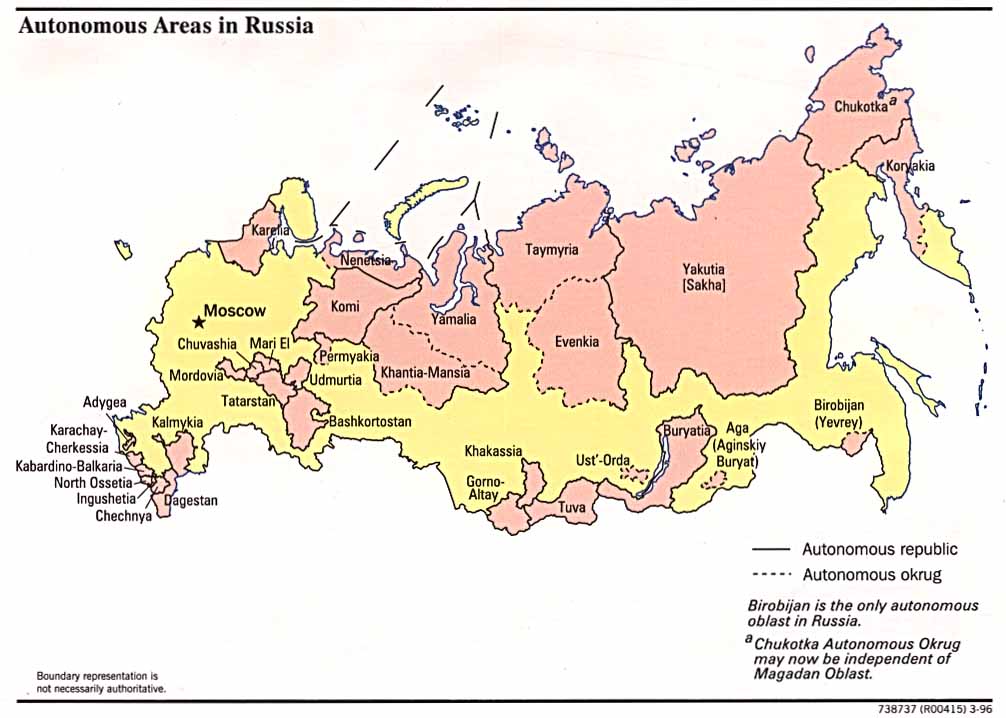
The Women’s World Championship has moved from Batumi [in Ajaria] to Elista. ‘Where the hell is Elista?’ you ask. Kalmykia, Tibetan Buddhism’s outpost in Europe (when it was independent, it was the only Buddhist kingdom in Europe). On this map, it’s south of Moscow and just above Dagestan.

To see where the Kalmyk-Oirat fit into the Greater Turanian States and Territories, visit the Ottawa Hungarian Folkdance Chamber Group, which seeks to restore Hungarians to their rightful place as masters of Eurasia.

See also Kalmykia and Buddhism in Russia.

UPDATE: On a more serious (but joyful) note, the U.S. and Russia seemed to have cooperated to help the citizens of Georgia and Ajaria liberate themselves from the now-exiled thug, Aslan Abashidze. The Argus offers a detailed chronology. I hope the Georgian sumo wrestler Kokkai (‘Black Sea’) is pumped up enough to make a spectacularly successful showing in this month’s sumo tourney.

UPDATE: In the comments, PF cites some evidence that the millionaire chess-enthusiast Kirsan Ilyumzhinov, President of Kalmykia, might deserve a good dose of thug-repellant as well. At the very least, he seems to suffer from a serious cult-of-personality disorder.

Leave a comment

Filed under sumo

Politburo Paranoia in China

On 23 April, Andrés Gentry cited a depressing article (no longer online) on MSNBC that illustrates how fragile and paranoid China’s top political leaders seem to feel.

The eight members of the New Youth Study Group never agreed on a political platform and had no real source of funds. They never set up branches in other cities or recruited any other members. They never even managed to hold another meeting with full attendance; someone was always too busy.

And yet they attracted the attention of China’s two main security ministries. Reports about their activities reached officials at the highest levels of the party, including Luo Gan, the Politburo member responsible for internal security. Even the president then, Jiang Zemin, referred to the investigation as one of the most important in the nation, according to people who have seen an internal memo summarizing the comments of senior officials about the case.

The leadership’s interest in such a ragtag group reflects a deep insecurity about its grip on power. The party has delivered two decades of rapid growth, defying those who believe economic reform must lead to political liberalization. But it is struggling to manage rising social tension and popular discontent and remains especially wary of student activism, which sparked the 1989 pro-democracy demonstrations in Tiananmen Square.

So the party moved quickly to eliminate the New Youth Study Group. In doing so, it forced eight young people to consider how much they were willing to sacrifice for their beliefs — and for their friends.

This account is based on interviews with the four members of the study group who escaped arrest, relatives and friends of those imprisoned, and others who attended the group’s meetings, as well as documents presented in court in the case.

Leave a comment

Filed under China

Flit(tm): Is the PRC Crashing?

TMLutas of Flit(tm) cites a Stratfor article (only temporarily accessible) under the heading, Is the PRC Crashing?

Essentially the argument is that the PRC is making the same errors that every other Asian country has lived through. It is aided by the fact that its currency is nonconvertible but that’s no panacea. It is suffering from a plague of crony loans made to connected people who have hollowed out their economy. Essentially, we’re in the end stages of the PRC’s economic pyramid scheme.

The stakes are quite high. If the PRC falls into crisis, it is much less likely to survive than Japan and more likely to fracture into the traditional solution of warlord dominated regional entities.

Leave a comment

Filed under China