Author Archives: Joel

Joel's avatar

About Joel

Executive Editor, Journals Dept. University of Hawai‘i Press

The Last Japanese Holdouts in the Philippines

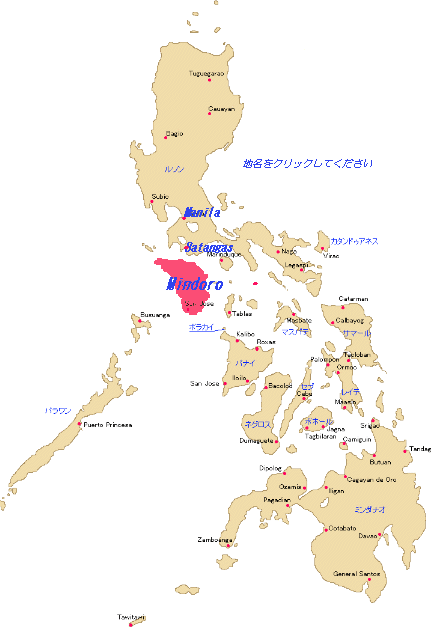
A little over 30 years ago, in 1974, Lt. Onoda of the Imperial Japanese Army surrendered on Lubang Island in the Philippines.

February 1946 – Post WWII island campaign

In February 1946 on 74 square mile Lubang Island, 70 miles southwest of Manila Bay a seven week campaign to clear the island was begun by the Filipino 341st and American 86th Division.

February 22, 1946 – Lubang island Allied casualties in a post WWII battle

Intense fighting developed on February 22, 1946 when troops encountered 30 Japanese. Eight Allied troops were killed, including 2 Filipinos. The Filipino and Americans sent for an additional 20,000 rounds of small arm ammunition, but not future battles occurred of this magnitude. In early April, 41 members of the Japanese garrison on Lubang island came out of the jungle, unaware that the war had ended….

March 5, 1974 – Lubang Island – 2nd Lt. Hiroo Onoda Born in the town of Kainan, Japan in 1922 and when he turned seventeen, he went to work for a trading company in China. In May of 1942, Onoda was drafted into the Japanese Army. Unlike most soldiers, he attended a school that trained men for guerilla warfare. On December 26, 1944 (age 23), Hiroo Onoda was sent to the small tropical island of Lubang Island, which is approximately seventy-five miles southwest of Manila in the Philippines. Shortly after Americans landed, all but four of the Japanese soldiers had either died or surrendered. Hiroo Onda was also with three other holdouts, who had different fates:

Private First Class Yuichi Akatsu – (age 22 in 1944) Left the group in September 1949. He managed to live six months on his own before surrendering to the Philippine Army. In 1950, the remaining three found a note left by Akatsu stating that he had been greeted by friendly troops. He even led a group of soldiers into the mountains in search of the remaining men. Onoda and his men quickly concluded that Akatsu was now working for the enemy.

Corporal Shoichi Shimada – (age 30 in 1944) In June of 1953 was shot in the leg during a shootout with some fishermen. Onoda nursed him back to health, but on May 7, 1954, Shimada was killed instantly from a shot fired by another search party sent in to find the men.

Private Kinshichi Kozuka – (age 24 in 1944) Killed by two shots fired by local police on October 19, 1972 when Kozuka and Onoda burned rice that had been collected by farmers, as part of their guerilla activities.

Circumstances of His Surrender

Despite the efforts of the Philippine Army, letters and newspapers left for them, radio broadcasts, and even a plea from Onoda’s brother they did not believe the war was over. On February 20, 1974, Onoda encountered a young Japanese university dropout named Norio Suzuki who was traveling the world and told his friends that he was “going to look for Lieutenant Onoda, a panda, and the Abominable Snowman, in that order.” The two became friends, but Onoda said that he was waiting for orders from one of his commanders. On March 9, 1974, Onoda went to an agreed upon place and found a note that had been left by Suzuki. Suzuki had brought along Onoda’s one-time superior commander, Major Taniguchi, who delivered the oral orders for Onoda to surrender. Intelligence Officer 2nd Lt. Hiroo Onoda emerged from the jungle of Lubang Island with his .25 caliber rifle, 500 rounds of ammunition and several hand grenades. He surrendered 29 years after Japan’s formal surrender, and 15 years after being declared legally dead in Japan. When he accepted that the war was over, he wept openly.

Afterwards

He returned to Japan to receive a hero’s welcome. He was a media sensation and was hounded by the curious public everywhere he went. He was unable to adapt to modern life but wrote his memories of survival in a book, No Surrender: My Thirty-Year War. After publication, he moved to Brazil to raise cattle. He revisited Lubang island in 1996, and still alive today. He then married a Japanese woman and moved back to Japan to run a nature camp for kids.

Actually, the last confirmed surrender was by Captain Fumio Nakahira, who held out until April 1980 near Mt. Halcon in Mindoro Island.

Leave a comment

Filed under Japan, Philippines, war

Philippine Doctors Retraining as Nurses

Cronaca (“Past Imperfect, Present Subjunctive, Future Conditional”), a wonderful history blog that Regions of Mind reminded me of, notes a report about new medical developments:

The Philippines is increasingly witnessing a trend that carries alarming implications for the future — its medical doctors are training to be nurses so they can leave the country and make more money.

Leave a comment

Filed under Philippines

New Offensives in Mindanao?

Belmont Club reports on ominous new developments in the Philippines.

The scene is now set for a possible resurgence of fighting. A glance at the map dramatically illustrates the bind that Gloria Macapagal Arroyo and the Philippine Government have worked themselves into. For the first time in a century, Muslim rebels have established themselves in force on the Mindanao mainland, away from their traditional strongholds of Sulu, Basilan and Tawi-tawi, island groups in the southwest corner of the archipelago. They are positioned on the west side of Mindanao’s breadbasket, the Cotabato valley. The MILF [Mindanao Islamic Liberation Front] camps guard the approaches to mountain massifs to the west which then give on the sea, their line of supply. They isolate the predominantly Christian Zamboanga peninsula from Northern Mindanao and essentially cut the huge island in two. The Armed Forces of the Philippines, despite a nominal strength of ten divisions, has very little combat power. A lack of logistical support and ammunition stockpiles means that (Belmont Club estimate) it can sustain offensive operations with only two battalions for a period of 12 weeks after which it simply runs out of everything. Thus, Manila has long lacked an offensive option against the MILF and has tried to compensate by “peace talks”, which are another name for appeasement.

Leave a comment

Filed under Islam, Philippines, war

The Dutch VOC in Burma in the 17th Century

The July 2004 IIAS Newsletter includes an article by Wil O. Dijk on the Dutch VOC in Burma during the 17th century, the same period in which they were conquering one sultanate after another in the Spice Islands and the rest of the Indonesian archipelago.

This article highlights a little known aspect of the Dutch East India Company (VOC)’s inter-Asian trade: the trade with Burma. The vast archives of the VOC at the National Archives in The Hague have yielded a treasure trove of detailed information on seventeenth century Dutch-Burmese relations. The archives throws light on the composition of the VOC’s Burma trade, and how it fit into the grand design of the Company’s inter-Asian commerce, where it was not as marginal as some historians would have it. Vital statistics on shipping, imports and exports, wages and prices, and inventories of Indian textiles the Dutch shipped across the Bay of Bengal, together with purchasing and selling prices, allow us a unique glimpse into life in seventeenth century Burma….

The VOC’s years in Burma can be divided into three distinct periods: the early years of indecision (1634-1648), the golden middle years (1649-1669) and the final years of decline and departure (1670-1680). During the first period suggestions were made, in turn by Pulicat and Batavia (the company’s head office in Asia), to close down the Burmese factories. Pulicat and Batavia, however, seemed unable to agree, with the result that trade continued halfheartedly. The second period witnessed a great improvement in conditions for trade. In the final years, a new king with little interest in trade or foreigners ascended the Burmese throne. By this time the objectives of the Dutch East India Company had altered, while forces beyond its control were working to undermine the company. In the end the Burma trade became a casualty of the company’s new priorities….

Empire of trade

Burma offered a large assortment of export goods. Statistics indicate that the Dutch generally took what they could get. Tin was a constant as were lac, elephant tusks, chillies (long peppers) and beeswax. In the 1650s, Chinese copper coins and Burmese ganza (a metal akin to bell metal) became major exports. The Company turned large quantities of Chinese copper coins, flowing into Burma from Yunnan, into money to be used as legal tender in Batavia and Ceylon. In the final years, the Dutch also exported a great deal of gold, much of it originating in China. The VOC, through its elaborate inter-Asian network, was in a position to trade Burmese goods in the most profitable markets throughout Asia.

[Ming China was at this time selling off copper and gold to convert to silver coinage, thereby fueling global trade, especially with Tokugawa Japan and the Spanish Empire in the New World.]

Their Bengal factory, always in need of additional funds, was sent valuable Burmese cargoes (including Chinese coins, ganza, and zinc). The copper extracted from Chinese coins and ganza was in great demand in Coromandel, as were gold, tin, timber and chillies. In Japan a profitable market existed for Burmese catechu, namrack, deerskins, buffalo hides and horns. Lac generated excellent profits in Mocha, as well as in Persia, where there was a good market for Burmese tin, elephant tusks, cardamom, and the costliest of Burma’s fabled rubies. Considerable quantities of Burmese elephant tusks were shipped to Surat, while in Holland there was demand for the excellent Burmese lac. As for Burma’s famous Martaban jars, there was constant demand throughout Asia for these huge, glazed pots used to store and transport a myriad of things, from potable water and rice to gunpowder and, on occasion, stowaways….

Military commitments

The main points of contention – the ban on direct trade with China at Bhamo, royal monopolies, high tolls, and the disarming of ships – were exasperating but not new. Rather, the circumstances and priorities of the Company had changed. Trade was no longer its main concern; the VOC had changed into a territorial enterprise with military and political commitments and began to operate increasingly from its two power bases, Batavia and Ceylon.

More importantly, a radical shift occurred in its commercial priorities. Whereas in the early days the company’s inter-Asian sea-borne traffic was a key element in its drive to create a vast empire of trade – with the outcome of this traffic largely determining the flow of trade between Asia and Europe – by 1680 the situation was different. The VOC’s inter-Asian trade had peaked by the 1670s, and was replaced by direct trade between Asia and Europe. This is perhaps the main reason behind the Dutch decision to abandon Burma. Whereas Burma had been an integral part of the VOC’s inter-Asian trade for nearly half a century, the company’s new priorities now made it irrelevant.

Leave a comment

Filed under China

The Appeal of Stalinism to Intellectuals

Crooked Timber has a long and interesting comment thread in response to John Quiggin’s response to Tyler Cowen’s challenge on Marginal Revolution: “If I could have the answers to five questions in political science/sociology, the appeal of Stalinism to intellectuals would be one of them.” Here are a few of the less esoteric responses.

Chris Bertram:

I can’t agree with you entirely John. The [Beatrice and Sydney] Webbs, in particular don’t seem to me to be a good example of people who backed the Soviet Union because they thought it was more just and democratic. Rather, they seem (along with others like [George Bernard Shaw]) to have been captivated by the idea of a rationally managed society. Tidiness and orderliness were the reasons for a certain type of intellectual being attracted to Stalinism.

An entirely different type of person was attracted to communism (in its various forms rather than Stalinism) by their perception of the injustice of capitalism, the experience of mass slaughter in WW1 and by the feeble response of the Western democracies to the rise of fascism. Unlike what motivate the Webbs of this world, those are laudable aspirations.

The twist comes when you add a dose of “realism” to the mixture. Once you’ve identified some agency as the best means of fighting injustice, war and fascism, it is all too easy to convince yourself of something like Sherman’s “war is hell” doctrine and to shield yourself from a proper appreciation of what your side is really becoming. If you want a recent parallel for this psychological process, look at the way that people who believe the values of the West need to be defended by any means necessary and take solace in the writings of Victor Davis Hanson and the like.

And the fact is that there is something (but exactly how much?) to the idea that one shouldn’t be too squeamish in fighting for a just cause when the other side will use any means at its disposal. Differing views on that question and on whether the Soviet Union remained an effective means for prosecuting justice etc or had turned into part of the problem, explain many of the fractures in the communist movement from 1917 on….

Burritoboy:

It’s simply not true that few intellectuals supported ultra-right politics.

In continental Europe, there were always a very large percentage of prominent intellectuals who were on the right, at least before 1939 or so. Heidegger, probably the greatest of all twentieth-century philosophers, is but the best-known of cases …. Before 1918, ultra-right intellectuals were arguably more important: Baudelaire, the most influential poet of the nineteenth century; Flaubert, the most influential post-Romantic novelist; Celine, Yeats / Eliot/ Pound and many others.

It’s that intellectuals have been attracted to radical politics on both sides. It’s interesting that Cowen wants to ignore half of the equation….

Lindsay Beyerstein:

Anyone who thinks they have True Knowledge is at high risk for self-deception. In retrospect, it seems amazing that these smart people would continue to support Stalin.

Self-deception isn’t pure wishful thinking. Simply wanting X to be true isn’t usually sufficient to sustain massive self-deception. The self-deceiver must also engage in an active process of rationalization in which she explains away inconvenient observations in terms of her background theory. We call people self-deceived when they are unwilling to reexamine their background theories in light of the evidence, especially if wishful thinking fuels that reluctance.

When Stalinist intellectuals were confronted with evidence of Stalinist crimes against humanity they persuaded themselves that these were i) Lies and distortions perpetrated by an unreliable capitalist media, or, ii) Historical inevitabilities on the way to an equally inevitable utopia, and/or, iii) Snags that were only to be expected in the greatest experiment in human history.

Simon Kinahan:

While some intellectuals no doubt deceived themselves (and some still do) into believing that the Soviet Union really lived up to its proclaimed ideals, there were others for whom the totalitarianism that was implied by Marxism was part of the appeal.

The claim to knowledge of how history was going to progress. The ordering of society along “rational” lines. The important role of intellectuals in the revolution itself. Surely it’s not too hard to see how that might appeal? And still does, for that matter….

Brett Bellmore:

Why does it matter? Well, there’s that dictator just off the coast of Florida academics are still making excuses for, for one. The intellectual embrace of monsters in the name of ideology isn’t history, it’s still with us today.

Leave a comment

Filed under education, philosophy

Micronesian Diary: Meeting House and Eating Turtle, Yap

On 30 January 1999, archaeologist Felicia Beardsley visited a meeting house on the southern tip of Yap, Micronesia, where she ate sea turtle. Her Micronesian Diary entries focus on food as much as archaeology. I like that.

Anoth is at the south end of the island, the south tip. It is a coastal village, and we had been invited to the open house held in honor of the completion of rebuilding their traditional pebaey, or meeting house. The pebaey is right on the coastal flat — well, the entire village is — and immediately on the shore’s edge (not more than 50 meters from the pebaey) is the faluw, the men’s house. The only thing left of the faluw, however, is its foundation. It is a coral foundation, which is gradually eroding into the sea. In effect, the faluw foundation is an archaeological site.

Actually, a very large number of traditional dwellings in Yap were turned into similar archaeological sites by Typhoon Sudal in April 2004. Many people are still living in tents.

In these villages, the pebaey and faluw are used, reused, and rebuilt over time. Their locations generally do not change, so the same structure (or rather foundation) supports several generations of superstructures, all of which follow the same construction plan, with variation only in the decorative elements such as the plaiting in the walls and so on. Both structures are six-sided, and the only difference between the two is that the faluw is closed-walled, and the pebaey is not. That is because the faluw is (or was) used as a dwelling place for young men, where they would learn the skills that would carry them through life, including (but not limited to) fishing, the manufacture of all the tools necessary for fishing, fighting, dancing, oral histories, and of course, sexual skills. Each faluw used to house several girls who were obtained (kidnapped, purchased) from other villages. By contrast, the pebaey is a meeting house, or community house. It did not have need for walls, as it was not a place for permanent dwelling….

Teresa and I were the only girls at the open house; I was told the community had made a conscious decision not to include the women of the community. The festivities included roasting a sea turtle, which I was obliged to try. It really isn’t that bad, and tastes quite good when you eat the meat with the fat. But, as one of the chiefs pointed out, it is not something I am accustomed to eat, so it was of course understandable when I handed what was left on my plate over to someone else.

One of the most valuable phrases any fieldworker or traveller needs to learn is how to say in the local language, “I’m not accustomed to that yet.”

Then he went on to describe the preparation of the turtle, step-by-step, including how its shell is opened when it is basically half-cooked. There are times, he said, when the heart is still beating at this point. This is when the meat and fat is distributed, and several of the organs are removed. After this, the blood of the turtle continues to cook in its shell; it is this cooked blood that this particular chief prefers. Many others at the site also told me they prefer the cooked turtle blood, and could hardly wait until it was done. This same chief has a son whom Teresa was obliged to watch throughout the course of the day. She did a good job, keeping them both out of trouble and out of harm’s way. I think she welcomed this “job” because it kept her occupied….

I also had an opportunity to chat with the chief. What I found interesting is that chiefs like him are raised as chiefs from the time they take their first steps, and that is what he is doing with his son too. He said that he has seen so many changes in the traditions of Yap. Today, he said (and he seemed a little concerned about it), there are people who aren’t chiefs but who want to be. So, sometimes, he said, he just steps back and says, go ahead. Then watches. He said they don’t know how to do it, and they get frustrated and give it up.

The caste system in Yap has driven many talented commoners–and outcastes–to seek their fortunes overseas, many in the U.S. military. (Yapese have served in Bosnia, Afghanistan, and Iraq.) But it also seems to have contributed to a healthier fiscal and cultural cautiousness than in some of the other Micronesian states.

Leave a comment

Filed under Micronesia

Naipaul on Inadvertent Journalistic Heresy

Nusrat had lived through hard times before. I had first met him in 1979, at the time of the Islamizing terror of General Zia. Nusrat, a devout man, had tried to meet the fanatics halfway, but had had little stumbles. And one careless day he got into serious trouble. He was working for the Morning News. It was Mohurram, the Shia mouming month. He thought it was a good idea to run a feature piece from Arab News about the granddaughter of Ali, the Shia hero. The piece was flattering about the woman’s looks and artistic attainments. But the Shias were outraged; to them it was insulting and heretical even to say that Ali’s granddaughter was good-looking. There was talk of taking out a procession of forty thousand and burning down the Morning News. For three days the paper was closed down. Nusrat himself was in danger; he could have been set upon at any time. Some months after this incident I passed through Karachi again. Nusrat had turned gray

When we said good-bye he said, “Can you arrange for me to go to a place where I can read and write and study for five years? Because in five years, if you see me again, I may have become a cement-dealer or an exporter of ready-made garments.”

That, spoken at a bad time, showed his style. And, in fact, he had become a public relations man for an oil company, and done well. The oil-drilling business was not affected by the troubles. But life in the city had been a day-to-day anxiety and Nusrat had developed a heart condition. His gray hair had gone white and short and thin; he was still under fifty.

SOURCE: Beyond Belief: Islamic Excursions Among the Converted Peoples, by V.S. Naipaul (Vintage, 1998), p. 350

Leave a comment

Filed under Islam, Pakistan

Changing Chin Identity in Burma

The July 2004 IIAS Newsletter includes a review of the book In Search of Chin Identity: A Study in Religion, Politics and Ethnic Identity in Burma by Lian H. Sakhong (NIAS Press, 2003).

Traditional tribal society was exclusivist and tightly knit, with a hierarchy of nobles, commoners and slaves. At its apex, chiefs (ram-uk) were not only owners and distributors of land, heads of their communities and commanders in war, but also high priests, responsible for offering sacrifices to the Khuahrum, locally rooted guardian deities whose good will was believed necessary for prosperity. When Baptist missionaries challenged the power of the Khuahrum and Khua-chia (evil spirits, causing accidents and disease), conversion to the new faith was eased by the old belief in Khua-zing, a Supreme God to whom the chiefs did not sacrifice, because He, viewed as the source of all life (zing), is ‘good, never cruel and never harms people’ (p. 46).

Detribalisation

The British ‘pacification’ of Chinram between the first invasion of the country in 1871 and the Anglo-Chin War of 1917-19 cleared the way for ‘detribalisation’, the breakdown of the old ‘chief-land-god’ nexus. Sakhong, however, argues that detribalisation did not result in dehumanisation, as the Christianity preached by American Baptist missionaries provided the Chin with the basis for a new way of life. The latter overcame the traditional isolationism of the tribes, creating a new Chin identity based on a community of worshippers in a wider world where they could relate as equals to ‘civilized’ lowlanders….

The author does not carry his narrative through to the Ne Win (1962-88) and State Law and Order Restoration Council/State Peace and Development Council (1988-) periods. This is unfortunate, since there is limited information in Western languages on how the Chins maintain their identity in the face of military-enforced ‘Burmanisation’, including the post-1988 junta’s aggressive promotion of the Buddhist religion. While the SPDC builds new pagodas nationwide, it discourages the construction of new churches and mosques and the renovation of old ones.

This same pattern broadly describes so many parts of the boondocks of Southeast Asia, where the hill people only began to “join civilization” and adopt one of the major evangelical religions during the 19th and 20th centuries, often converting to some variety of Protestant Christianity, no matter whether the long-converted lowlanders were Buddhist, as in Burma, Thailand, or Cambodia; Muslim, as in the Malay Peninsula and Indonesian archipelago; or Catholic, as in the Philippines.

Leave a comment

Filed under Burma

Naipaul on Malay Chinese Muslims

On a hill overlooking the Perak River, and almost at the entrance to the royal enclave, was the house of Raja Shahriman, a sculptor and a prince, distantly related to the royal family. It was an airy house of the late 1940s, and it was furnished in the Malay style, with rattan chairs, brightly colored fabrics, and cloth flowers.

The sculptor was small, five feet six inches, and very thin, in the pared-down Malay way. There was little expression on his face; the nature of his work didn’t show there. He worked with found metal; there was a forge in the yard at the back of the house. He created martial figures of great ferocity, two to three feet high, in clean flowing lines; and the effect of the black-metal figures in that house, with the pacific, restful views, was unsettling.

The sculptor, in fact, lived in a world of spirits. He also made krises, Malay daggers; it was part of his fascination with metal. Krises found out their true possessors, the sculptor said; they rejected people who didn’t truly own them. He had a spiritual adviser, and would have liked me to meet him; but there wasn’t time. The world of Indonesian animism felt close again. In more ways than one we were close here to the beginning of things, before the crossover to the revealed religions.

The sculptor had a middle-aged Chinese housekeeper. She would have been given away by her family as a child, because at that time Chinese families got rid of girls whom they didn’t want. Malays usually adopted those girls. The sculptor’s housekeeper was the second Malay-adopted Chinese woman I had seen that day. It gave a new slant to the relationship between the two communities; and it made me think of the Chinese in a new way.

In 1979 I had been looking mainly for Islam, and I had seen the Chinese in Malaysia only from the outside, as the energetic immigrant people the Malays were reacting to. Now, considering these two gracious women, and their fairy-tale adoption into another culture, I began to have some idea how little the Chinese were protected in the last century and the early part of this, with a crumbling empire and civil wars at home and rejection outside: spilling out, trying to find a footing wherever they could, always foreign, insulated by language and culture, surviving only through blind energy. Once self-awareness had begun to come, once blindness had begun to go, they would have needed philosophical or religious certainties just as much as the Malays.

SOURCE: Beyond Belief: Islamic Excursions Among the Converted Peoples, by V.S. Naipaul (Vintage, 1998), pp. 369

Leave a comment

Filed under China, Islam, Malaysia

Naipaul on Ahmed Rashid

I had got to know Ahmed Rashid [author of Taliban]. He was a journalist. He also owned, with a partner, a coal mine in the Punjab hinterland. The news, from him, was that three of the mine’s jeeps had been stolen, and six of the men kidnapped. The stealing and the kidnapping had occurred in stages. First a jeep and the two men in it had been taken, in the big town of Sargodha. After ten days there had come a ransom demand for two lakhs, two hundred thousand rupees, five thousand dollars. Ahmed had sent two men in a jeep to negotiate with the kidnappers. He hadn’t sent any money by these two men. This had enraged the kidnappers. They had seized the two men and the second jeep. Ahmed, taking the hint, had then sent two clerks in a third jeep with the ransom money. But the kidnappers were apparently still very angry. They held on to the two clerks and the ransom money, and made a fresh demand for twenty lakhs, fifty thousand dollars.

Ahmed, ever the journalist, was excited by the whole thing, this nice little story breaking on his own doorstep, as it were; and in his detached journalist’s way he found the sequence of events funny, the men from the mine going in two by two into some kidnappers’ pit somewhere in the frontier. He had got in touch with the army and the intelligence people; only they could help him. And he thought now–and this wasn’t going to be so funny for the kidnapped men–that negotiations could go on for many months. It was important to keep the negotiations going, and in this way to prevent the kidnapped men from being taken across the border. If that happened, it was all over; the jeeps and the men could be forgotten.

Where there was no law, no institutions that men could trust, the code and the idea of honor protected men. But it also worked the other way. Where the code was strong there could be no rule of law. In the frontier, as Saleem Ranjha’s Pathan guest had said at Mansura, the modern state was withering away; it was superfluous. People were beginning to live again with the idea of clan and fiefdom; and it was good for business.

SOURCE: Beyond Belief: Islamic Excursions Among the Converted Peoples, by V.S. Naipaul (Vintage, 1998), pp. 328-329

Leave a comment

Filed under Pakistan, publishing