Monthly Archives: May 2011

Wordcatcher Tales: Mourning Fabrics, 1860s

From This Republic of Suffering: Death and the American Civil War by Drew Gilpin Faust (Knopf, 2008), Kindle Loc. 2332-2384:

By convention, a mother mourned for a child for a year, a child mourned for a parent the same, a sister six months for a brother. A widow mourned for two and a half years, moving through prescribed stages and accoutrements of heavy, full, and half mourning, with gradually loosening requirements of dress and deportment. A widower, by contrast, was expected to mourn only for three months, simply by displaying black crape on his hat or armband. The work of mourning was largely allocated to women….

In the South, where 18 percent of white males of military age perished in the war, death was omnipresent, and fabrics and fashions were scarce…. In the North, where the death rate of men of military age was one-third that in the Confederacy, mourning was less universal, and the goods that made it possible proved more readily available….

At Besson & Son, Mourning Store, at 918 Chestnut Street in Philadelphia, one could find in July 1863—just in time for Gettysburg—a veritable taxonomy of mourning fabrics all but unrecognizable by twenty-first-century Americans:

  • Black Crape Grenadines [A thin gauzelike fabric of silk or wool, for women’s wear]
  • Black Balzerines [A light mixed fabric of cotton and wool for women’s dresses, commonly used for summer gowns before the introduction of barege]
  • Black Baryadere Bareges
  • Black Bareges [A sheer fabric woven of silk or cotton and wool, used for women’s apparel]
  • Black Barege Hernani [A grenadine dress fabric woven in small meshes of coarse threads of silk, cotton, or wool, and their intermixtures]
  • Silk Grenadines
  • Challies [a soft fabric of plain weave in wool, cotton, or other staple fiber]
  • Summer Bombazines [A fine twilled fabric of silk and worsted or cotton, often dyed black and used for mourning clothes]
  • Mousseline de Laines [wool] [A fine sheer fabric resembling muslin, originally made in Mosul, Iraq]
  • Tamises [A cloth made for straining liquids]
  • Mourning Silks, Lawns, Chintzes, Alpacas
  • Barege Shawls, Grenadine Veils, English Crapes

Leave a comment

Filed under economics, language, religion, U.S., war

Railroads and Other Baffling Innovations

From A Most Magnificent Machine: America Adopts the Railroad, 1825-1862, by Craig Miner (U. Press of Kansas, 2010), pp. 253-254:

Why do our clothes not fit so well? It results from a chain of circumstances the origins of which are obscure to most and the direction of which was partially accidental. Early in the nineteenth century, inventors came up with an automated loom, and businesspeople put these to work in England and in such American industrial cities as Lowell, Massachusetts, turning out cheap cotton cloth. This, along with the application of the cotton gin to cotton production, revitalized slavery as well as creating an incentive for inexpensive ready-made and therefore not specifically tailored clothing.

Such long-range deep impacts of technological and business developments have long been studied. Lynn White, in Medieval Technology and Social Change, documented the enormous impact of clocks, heavy harness and stirrups on population growth, shock warfare, and the age of exploration. Siegfried Giedion wrote in his Mechanization Takes Command of what he called “anonymous history.” Who can estimate the impact of the invention of the toilet, or the assembly line in food production, or household machinery on the status of women? Langdon Winner observed “Developments in the technical sphere continually outpace the capacity of individuals and social systems to adapt. As the rate of technological innovation quickens, it becomes increasingly important and increasingly difficult to predict the range of effects that a given innovation will have.”

A recent touring art exhibit called “The Railway: Art in the Age of Steam” reaffirmed the impact of that technology on perceptions of life and landscape. “The application of steam power to motion,” the catalog noted, “came as a startling turn of events.” Some found it wondrous, but “for others it heralded a frightening, almost demonic energy.” There was something supernatural about it, even extraterrestrial. It made middle-class people “physically and psychologically susceptible to impersonal and potentially lethal industrial machines.”…

Think of the social and psychological changes wrought by the telegraph, electricity, the phonograph, the automobile, the airplane, radio, television, the computer, the Internet, the long-playing record, video games, the cell phone, fast food, the shopping mall, and the iPod. And think of how “baffled,” in many ways, we are by them and how they should fit in with the rest of our existence. These devices have become ubiquitous parts of modern life. An age when they did not exist is nearly unimaginable to many, while an age where they do exist is unendurable to others.

Leave a comment

Filed under democracy, industry, science, slavery

Railroad Depot Architecture, 1830–1860

From A Most Magnificent Machine: America Adopts the Railroad, 1825-1862, by Craig Miner (U. Press of Kansas, 2010), p. 92:

Railroad depots came to dominate urban architecture, and their size brought much comment. The Boston & Maine depot in Boston, constructed in 1846, was 200 feet long and 80 feet wide. It had Corinthian columns, and on its upper story was the largest meeting hall in the city. Behind it was a freight depot 500 feet long and 50 feet wide. The Union depot at Troy, New York constructed in 1853, was 400 feet long and 150 feet wide. The distance from the top of the roof arch to the floor was 65 feet. The roof was made entirely of iron supported by twenty trusses.

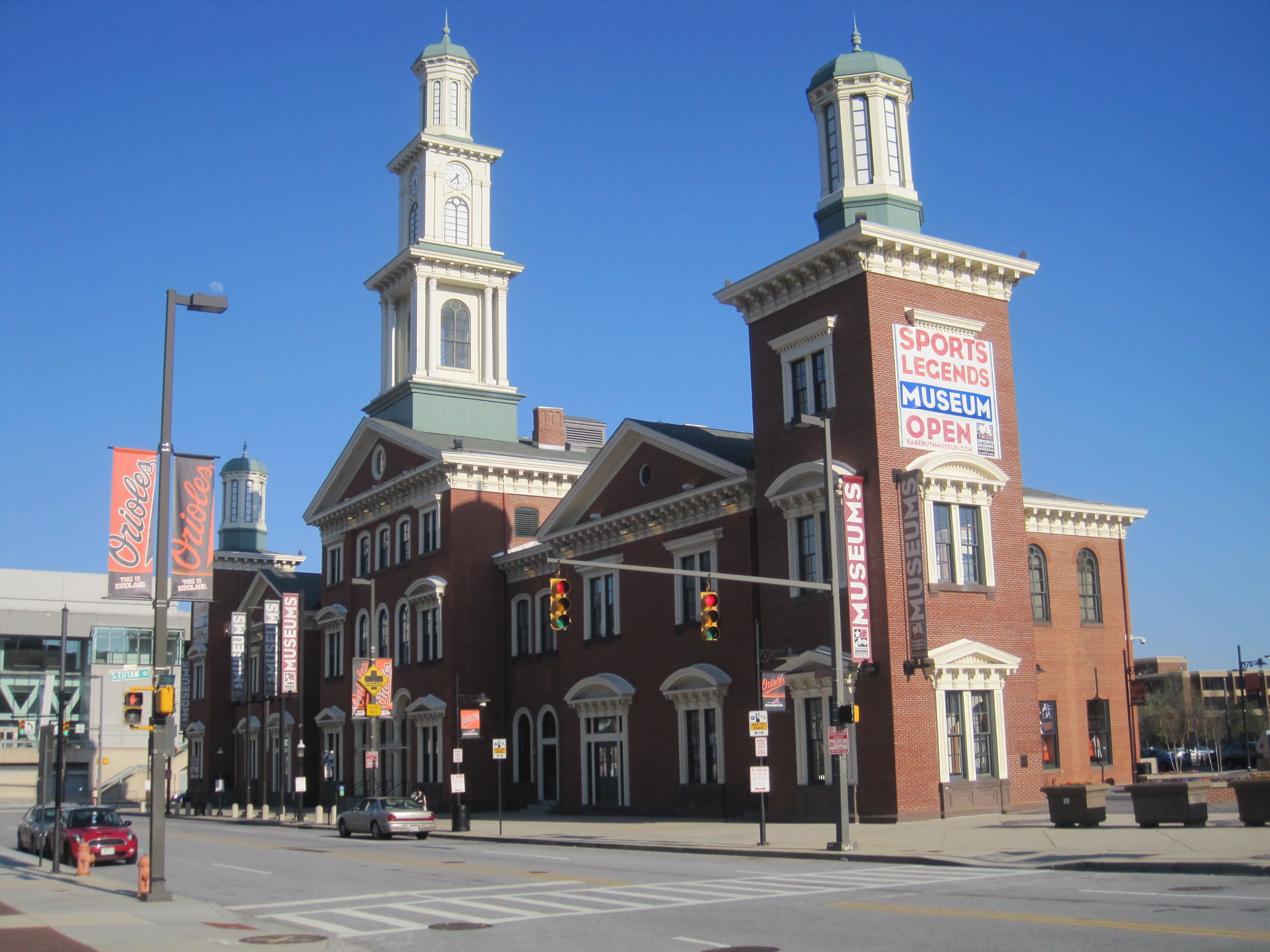
Former B&O Camden Station

Former Baltimore & Ohio Railroad's Camden Station, built in 1856, now the Babe Ruth/Sports Legends Museum next to Camden Yards

Time only increased the impressiveness of these structures. A reporter for the Chicago Daily Tribune visited the new buildings constructed by the Illinois Central Railroad along the lakeshore in 1854. The passenger depot at the foot of Water Street was all of stone. It was 500 feet long, 166 feet wide and 60 feet high to the top of its towers. Its windows were 16 feet high. The walls looked like they would “remain in all their strength when the final ‘wreck of matter and the crash of worlds’ shall come. The turntable there would hold eighteen locomotives.

The depots were the entry to a new world of travel, every aspect of which became a subject for travelogue comments. John Daggett riding the B&O in 1834, thought the beginning of his rail journey was its highlight:

One of the happiest effects of traveling on railroads is the freedom it gives you from the impertinence and impositions of porters, cartmen, et omne id genus, who infest common steamboat landings. A long and solitary row of carriages was standing on the shore awaiting our arrival; not a shout was heard, scarcely any thing was seen to move except the locomotive, and the arms of the man who caught the rope from our boat. The passengers were filed off along a planked walk to the carriages through one gangway, while their luggage, which had already been stowed safely away, was rolled on shore by another, in two light wagons; and almost without speaking a word, the seats were occupied, the wagons attached behind, the half-locomotive began to snort, and the whole retinue was on the way with as little ado and as little loss of time as I have been guilty of in telling the story.

Others, however, were not so impressed with the stressful experience of boarding a train. A Frenchman, Michel Chevalier, thought that the pandemonium at the railroad station reflected the nervousness and disorder of American society itself. The American, he wrote, was “devoured with a passion for locomotion” and could not stay still.

Leave a comment

Filed under industry, travel, U.S.

Cameroon Tales: The PTA Meeting

After spending our first night in Cameroon in a hotel in Yaoundé, we changed money with a friendly Nigerian Igbo at the Hilton, went shopping for food at the central market and for baguettes at a suburban bakery, then drove the two hours back to the village where my brother was staying in time for a short rest before the parent-teacher meeting for the local preschool (maternelle) that we were invited to attend that afternoon at 4 p.m.

We had been invited in order to thank my brother for his small monetary donation, which had enabled the teacher to buy some new and much needed school supplies. The meeting was held in the salon of the chief of the village, and my brother and I stopped to buy a half-dozen large bottles of beer and soft drinks for those who attended. We purchased them from the village patriarch’s store, waking him up from his afternoon nap on his front porch.

In the chief’s salon, we found about a dozen parents seated across from the sofa that the chief had reserved for us, and an open box of school supplies on the coffee table in the center of the room. As others were allocating the drinks we had brought, the chief told me my brother had never accepted his offers of homemade oil palm wine (there called vin blanc) but he wondered whether I would like to try it. After a moment’s hesitation, I said I would be happy to, rationalizing that the alcohol in it would help neutralize the residual bacteria. The chief then called for his palm wine and filled two stemmed glasses from his cupboard. The palm wine was palatable, though poorly filtered.

The president then rose to welcome us, asking first whether he could address me in French (rather than switch to English, presumably). My brother assured him I spoke several languages, neglecting to mention my poor speaking ability. In fact, I could follow the proceedings pretty well until they later gave way to more free-flowing conversation and storytelling.

Then the president introduced the maitresse, who did a show-and-tell of the supplies she had bought, which included various (French) literacy and language materials, workbooks and educational activities, and about a dozen rolls of toilet paper to be used in the brick outhouse that had been started behind the school building. She regretted only that she had not been able to obtain materials to teach numeracy as well as literacy. As she finished, she offered to turn over her receipts to my brother, as the donor, but he suggested she turn them over to the president, who had replaced a corrupt predecessor.

The president was a successful businessman who got his start as a chauffeur for Catholic nuns, and my brother’s regular driver would usually rent the president’s car when he hired himself out as a driver. The maitresse was a trained and dedicated teacher who had recently fallen victim to pickpockets in a shared taxi on her way home from a bank in Yaoundé with a loan of 1.5 million francs CFA with which to build a house. She was very slowly paying back the loan from her very modest teacher’s salary.

After the formalities were over, the conversation drifted to other topics. One man asked us why Obama was not (yet) intervening in Libya. (This was an overwhelmingly Christian village less concerned than a largely Muslim village may have been about the delicacy of American relations with the Muslim world.) Later, after somebody else told a story about an encounter with a large snake, this same man said he had seen a show on National Geographic about people handling poisonous snakes without getting bitten. He obviously had access to satellite TV and was concerned to educate himself as well as his children. He and I (and the chief) were the only ones drinking the chief’s palm wine instead of beer.

Big pot of ndole

Ndole, a stew of bitterleaf, ground peanuts, and fish

We finally made our exit, explaining that our new cook had made a big pot of ndole, the national dish, to welcome us. This stew of bitterleaf greens, ground peanuts, and fish or meat takes a lot of time and effort, so everyone was impressed. In fact, we had hardly finished eating when the chief showed up at our door, with the village patriarch and another of his drinking buddies, saying they had come to sample our ndole, which their wives rarely made. They pronounced it very well prepared, at which my brother could not resist telling the chief that he could be eating it more often if his son had gone ahead and married the cook after romancing her. They finally left after finding out we had no more beer or wine on hand.

The tale of two cooks will be the next installment.

Leave a comment

Filed under Cameroon, education, food

History of Naming U.S. War Dead

From This Republic of Suffering: Death and the American Civil War by Drew Gilpin Faust (Knopf, 2008), Kindle Loc. 1679-1700:

Men thrown by the hundreds into burial trenches; soldiers stripped of every identifying object before being abandoned on the field; bloated corpses hurried into hastily dug graves; nameless victims of dysentery or typhoid interred beside military hospitals; men blown to pieces by artillery shells; bodies hidden by woods or ravines, left to the depredations of hogs or wolves or time: the disposition of the Civil War dead made an accurate accounting of the fallen impossible. In the absence of arrangements for interring and recording overwhelming numbers, hundreds of thousands of men—more than 40 percent of deceased Yankees and a far greater proportion of Confederates—perished without names, identified only, as Walt Whitman put it, “by the significant word Unknown.”

To a twenty-first-century American, this seems unimaginable. The United States expends more than $100 million each year in the effort to find and identify the approximately 88,000 individuals still missing from World War II, Korea, and Vietnam. The obligation of the state to account for and return—either dead or alive—every soldier in its service is unquestioned. But these assumptions are of quite recent origin. There have been many revolutions in warfare in the last century and a half. Although perhaps less dramatic than transformations of military technology and organization, changing attitudes toward the dead and missing have profoundly altered the practices and experience of war—for soldiers and civilians alike. Only with the Korean War did the United States establish a policy of identifying and repatriating the remains of every dead soldier. Only with World War I did soldiers begin to wear official badges of identity—what came to be known as dog tags. Only with the Civil War did the United States create its system of national cemeteries and officially involve itself with honoring the military dead. It was the Civil War, as Walt Whitman observed, that made the designation “UNKNOWN” become “significant.”

The dead of the Mexican War received no official attention until 1850, two years after the conflict ended, when the federal government found and reinterred 750 soldiers in an American cemetery in Mexico City. These bodies represented only about 6 percent of the soldiers who had died, and not one body was identified. But with the Civil War, private and public belief and behavior gradually shifted. This was a war of mass citizens’ armies, not of professional, regular forces; it was a war in which the obligation of the citizen to the nation was expressed as a willingness to risk life itself. In its assault upon chattel slavery, the conflict fundamentally redefined the relationship between the individual and the nation. This affirmation of the right to selfhood and identity reflected beliefs about human worth that bore other implications, for the dead as well as the living.

Later in the chapter, Faust notes that military chaplains were frequently counted upon to keep track of the dead, but that neither the Union nor the Confederate military felt any obligation to inform the families of the dead.

Leave a comment

Filed under military, U.S., war