Monthly Archives: June 2008

Chinese Prisoners in Nagasaki, September 1945

From First into Nagasaki: The Censored Eyewitness Dispatches on Post-Atomic Japan and Its Prisoners of War, by George Weller (1907-2002), ed. by Anthony Weller (Three Rivers, 2006), pp. 56-57 (reviewed at length in Japan Focus and more briefly at HNN):

Omuta, Japan—Wednesday, September 12, 1945, 0100 hours
Allied Prison Camp #17, Omuta, Kyushu

American and Chinese prisoner coal miners emerging from underground darkness in central Kyushu are discovering for the first time that their prison camps are adjacent.

For nearly one month since the surrender the Chinese have been going foodless because their Japanese guards have departed from the camp. Their serious medical condition was discovered today by two parties headed by American doctor Captain Thomas Hewlett, of New Albany, Indiana, and Crystal River, Florida, who was captured on Corregidor, and Australian Captain Ian Duncan, of Sydney, captured in Singapore.

B-29s today dropped the Chinese their first food supplies since the surrender.

Hewlett reported that the nearest Chinese camp commander is a remnant of a party under American-trained Airman Lieutenant Colonel Chiu, which left North China two years ago, then numbering 1,236. Three hundred men died on reaching Japan. The Japanese never provided a camp physician and the Chinese have none. Thus in the Chinese camp every man regardless of condition has been considered by the Japanese fit for underground work. Fifty are seriously ill, about half of these with deficiency disease.

This Chinese camp counted 70 men killed by Japanese guards in two years, plus 120 dead of disease, with 546 still living.

The other coal miners’ camp of Chinese consists of what remains of 1,365 who left China eighteen months ago; 54 have been executed or otherwise beaten to death by the Japanese, and 60 died of mining injuries.

Many of the surviving Chinese are ”as thin as skeletons,” with bandages made of rags or newspapers. The camp has one Chinese doctor who possesses neither a scalpel, forceps, thermometer nor stethoscope.

Both those Mitsui mines worked by Americans and those worked by Chinese are defective, “stripped” mines, dangerous to operate because their tunnels’ underpinnings have been removed to obtain the last vestiges of coal.

Another Chinese camp is known to exist somewhere in Kyushu and is being sought by a party headed by Medical Warrant Officer Houston Sanders, of Hartwell, Georgia.

Leave a comment

Filed under China, Japan, U.S., war

A Bad Omen: Nkrumah vs. Cocoa Farmers, 1954-57

From The Fate of Africa: A History of Fifty Years of Independence, by Martin Meredith (PublicAffairs, 2005), pp. 24-27:

After winning the 1954 election, Nkrumah seemed set to make rapid progress towards independence. But he encountered unexpected resistance centred on his conduct of government. In the final stages of colonial rule, the Gold Coast, once a model colony, was riven by such bitterness, division and violence that it appeared in danger of breaking up.

At the core of the crisis was cocoa money. To protect cocoa farmers from price fluctuations, the colonial authorities had established a Cocoa Marketing Board (CMB) which each year fixed a guaranteed price for farmers and acted as the sole buyer, grader, seller and exporter of cocoa. Once in office, Nkrumah instructed the CMB to keep the price as low as possible, aiming to raise funds for development projects. But the CMB soon became notorious for corruption and mismanagement; it was regularly exploited to distribute credit, contracts, commissions, licences and jobs to CPP [Convention People’s Party] supporters. An official investigation revealed that the CPP used a CMB subsidiary to enrich the party’s coffers, to coerce farmers into joining the party and to control petty commerce.

Soon after the 1954 election, Nkrumah announced that the price paid to farmers would be fixed for a period of four years at a level less than one-third of ruling world prices. This decision provoked a surge of anger across Asante, the central forest region where half of the country’s cocoa crop was grown. Not only farmers but cocoa traders, merchants and businessmen based in the Asante capital, Kumasi, resented the loss of income. A new opposition party, the National Liberation Movement (NLM), sprang up, proclaiming to defend Asante interests and culture against a central government it portrayed as corrupt, dictatorial and bent on undermining the beliefs and customs of the Asante people. With the blessing of the Asante paramount chiefs and backed by fervent support in the Asante heartland, the NLM demanded a federal constitution prior to independence, giving Asante and other areas that wanted it a substantial measure of local autonomy.

Nkrumah saw the issue as a struggle between a modern democratic government and the feudal power of traditional chiefs trying to protect the old order. But he misjudged the extent of popular support for Asante institutions. As the NLM and Nkrumah’s CPP struggled for ascendancy, violent disturbances broke out. A bomb attack was made on Nkrumah’s house in Accra. Alarmed by the disorders, the British government refused to set a date for independence and eventually insisted on resolving the issue by calling another general election. At the polls in July 1956, Nkrumah’s CPP won an outright majority, 72 of 104 seats, though only 57 per cent of the votes cast. While the CPP received 398,000 votes, the opposition tally was 299,000 votes. Satisfied with the result, Britain finally pronounced a date for independence: 6 March 1957….

No other African state was launched with so much promise for the future. Ghana embarked on independence as one of the richest tropical countries in the world, with an efficient civil service, an impartial judiciary and a prosperous middle class. Its parliament was well established, with able politicians in both government and opposition. The prime minister, himself, then only forty-seven years old, was regarded as a leader of outstanding ability, popularly elected, with six years of experience of running a government. The country’s economic prospects were equally propitious. Not only was Ghana the world’s leading producer of cocoa, with huge foreign currency reserves built up during the 1950s cocoa boom, but it possessed gold, timber and bauxite.

Leave a comment

Filed under Britain, democracy, economics, Ghana

A Whirlwind Visit in the Wisconsin Dells

Car & cabin at Cedar Crest LodgeThe Far Outliers spent last weekend in the stormy Wisconsin Dells, celebrating my mother-in-law’s 80th birthday with a small family reunion in a cabin at Cedar Crest Lodge on the Wisconsin River, just off Sauk County Highway A, barely half a mile from where Lake Delton cut a new path (or widened an old path) across the highway into the river. When we tried to drive out down Highway A last Monday, we were turned back by policemen at the floodpath who told us to head back uphill to Bunker Drive, which we had heard was partially washed out the previous night when part of the family drove back to Madison.

The Wisconsin River near Lake DeltonWe got away at 6 a.m., stopped in tiny DeForest, WI (home of the Pink Elephant), to refill our rented Camry’s near-empty gas tank for $57.50 (@ $3.96/gal., the cheapest we found) and to have a good, meaty breakfast at DeForest Family Restaurant, and managed to return the car to O’Hare by 10:30 a.m., in ample time for our flight out. That one full tank took us from O’Hare to the Dells and back, and from the Dells to Dane County Regional Airport and back to pick up our daughter on Saturday, the day when all hell broke loose.

Tree felled by storm windsSoon after Miss Outlier and I returned, the sky darkened, the wind kicked up, the power went out, and the manager came around to announce a tornado warning and advise us to seek shelter in the exercise lodge, which had windowless concrete block walls in two long, narrow restrooms on the ground floor. That warning period lasted about an hour. Not long after it ended, we heard sirens again, and spent another half hour watching tree branches fall to the ground and getting to know our few neighbors a bit better. Fortunately, the wind and rain let up a little and the power came back on by the time the last of our party arrived from Madison for dinner, which featured brats, burgers, grilled veggies, salad, and a birthday cake with 80 candles (unfrosted except for some residue of candlewax on top).

Aloha Beach Resort, Lake DeltonFriday had been clear enough for us to drive down through Baraboo to Devil’s Lake and hike halfway up a rock face to a balanced rock. And Sunday was clear enough for me to walk a mile or so up Highway A to take a picture of the now rather beachless Aloha Beach Resort & Suites. The highway was crisscrossed with trails for Wisconsin Ducks, vehicles that have aided rescue efforts in many flood conditions, including yeoman work in New Orleans in the wake of Hurricane Katrina. For much of our time around the cabin, the Ducks would pass us going up Hillside Drive, but we saw one or two rush back downhill just after the tornado warnings.

UPDATE: On the way to and from Aloha Beach Resort, I passed some interesting gateways and an historical marker, which I’ll reproduce here.

Dawn Manor historical plaque

Here on the Wisconsin River the lost village of Newport was begun in 1853, planned for a city of 10,000. Assuming that the Milwaukee & Lacrosse Railroad would cross the river here, over 2,000 settlers quickly came to Newport, causing a lively land boom. When the bridge and dam were ultimately located a mile upstream after an alleged secret moonlight survey, Newport was almost completely deserted in favor of Kilbourn City (today Wisconsin Dells). Only Dawn Manor, with its servant quarters, remains. Dawn Manor was completed in 1855 by Capt. Abraham Vanderpoel, friend of Lincoln and a signer of the Wisconsin Constitution. The home is built of Potsdam sandstone, white mahogany, and white pine, put together with brass screws and wooden pegs. Dawn Manor houses the art collection of George Raab, one of Wisconsin’s famous artists.

More on Dawn Manor and the aftermath of the flooding and drainage of Lake Delton can be found at random blonde thoughts.

Leave a comment

Filed under family, U.S.

Rise and Fall of the Comanche Empire

From Frank McLynn’s review of The Comanche Empire, by Pekka Hämäläinen (Yale University Press, 2008) in Literary Review:

At the beginning of the eighteenth century the Comanches were a small tribe of hunter-gatherers in New Mexico. Once they acquired the use of horses, in three generations they evolved into the ‘Spartans of the plains’ and provided the fiercest of all Native American resistance to the Anglo-Hispanic conquest of the American West. For a hundred years from 1750, the Comanches dominated New Mexico, Texas and even parts of Louisiana and northern Mexico. As Amerindians, the Comanches were even more impressive than the Aztecs or the Iroquois, for until the American Civil War they largely forced Europeans to bend the knee, and did so moreover when the European imperialist impulse was at its height. Although the word ’empire’ may be author’s hyperbole, the Comanches ruled an extensive domain that worked on a melange of kinship ties, trade, diplomacy, extortion and violence….

So why were the Comanches so exceptional among American Indians? Pekka Hämäläinen, a Finnish scholar of the American West, currently at the University of California, Santa Barbara, argues that, like the Iroquois, the Comanches were fortunate geographically, since their heartland was at once central and peripheral, and at the intersection of Spanish and Anglo spheres of influence. They were inventive and flexible, using a nuanced division of labour in everyday life and operating a dual economy of hunting and pastoralism; they had a unique ability to make use of the horse; and their culture enabled them to incorporate change better than other Indians. They depended on two animals, the horse and the bison, which in the early days were present on the Great Plains in vast numbers. They had 120,000 horses in their herds and access to another two million wild ones.

Hämäläinen’s most detailed scholarly labours concern the eighteenth century: he claims that by 1730 the Comanches had all their people on horses and had reached what he calls ‘the critical threshold of mounted nomadism’. The narrative, firmly based on admirable scholarship, shifts from warfare to diplomacy and back in the Comanche’s dealings both with the colonial Spanish (for in those days the white-occupied American West was wholly Hispanic) and with the other Indian tribes of the Great Plains – principally the Utes, Navajos, Apaches, Osages, Pawnees and Wichitas. With the exception of the Lakota (Sioux) and the Blackfeet, every western Indian tribe was linked to the Comanches’ informal ’empire’. Far from being bit players in the drama of the Spanish colonial empire, the Comanches, especially after obtaining guns from French traders in the 1740s, had the edge in the continuing conflict with ‘New Spain’. One single statistic is eloquent on the Comanches’ rise to dominance in the American Southwest. Their population, 15,000 in 1750, had ascended to 45,000 by 1780 because of their superior diet and plentiful food supply. Their heartland was the so-called Comancheria – an area covering the valleys of the Arkansas, Cimarron, Canadian and Red Rivers, plus all the plains of northern Texas, especially the Llano Estacado in the Panhandle….

Hämäläinen’s great achievement is to force a rethink about Mexican history from its independence from Spain in 1821 to its defeat by the United States in 1846-8. Every September the Comanches sent a major raiding force into northern Mexico, and some of these bands of plains Indians ended up exploring tropical jungles and snow-covered mountains. Their penetration of northern Mexico was astonishing, since they raided as far south as Guadalajara and Queretaro, just 135 miles north of Mexico City and one thousand miles away from the centre of Comancheria….

By some indices the Comanches reached the apex of their power at just the moment, in the 1840s, when they began to collide with the US expansion westwards. Actually, smallpox and other diseases had already brought the Comanche population down to 20,000. And a whole host of factors seriously weakened them even before they inevitably came to blows with white settlers and the US government. Essentially the Comanches were overstretching their resources and habitat. They were killing more than 280,000 bison a year – the maximum loss the herds could sustain without imploding – and at the very time the great drought of 1845-50 was exacerbating the situation. Even worse, bison and horses were in competition for the same pasture and water, and if the bison moved farther west to new grasslands, they found these occupied by the sheep and shepherds of New Mexico. On the other hand, if the Comanches cut their horse numbers, they also cut down their military capacity. As everyone except a handful of Native American fundamentalists now accepts, the bison herds were in terminal decline even before the arrival of white hunters. There had originally been seven million ‘buffalo’ on the southern plains but by the 1860s, before the frenzy of the white bison hunters, half of these had already been killed by the Indians. Put simply, by the end of the 1840s there were too many Comanches raising too many horses and hunting too many bison on too small a land base. The writing was on the wall in other ways, too. While Comanche numbers had declined to 10,000 by 1850, the population of white Texas rose from 140,000 in 1847 to 600,000 by 1860s. Meanwhile, Arapahos and Cheyennes, pushed west by the expanding power of the Lakota, began encroaching on the Comanche heartland.

The end came suddenly. Faced with a shortage of bison, having lost access to firearms, maize and garden produce, and been forced to relinquish control of the long-distance trade routes into Mexico and across the Great Plains, the Comanches began literally to starve to death and in their weakened state to become prey to cholera, smallpox and other deadly diseases. In this terminal crisis, at the end of the 1850s they were engaged in warfare on three fronts, against the Fox Indians, the Texas Rangers and the Spanish buffalo hunters of new Mexico. Driven out of Texas by 1859, the Comanches were abruptly handed a lifeline when the American Civil War erupted. By 1865, with Texas on the losing side, the end of the drought on the Great Plains and a short-lived increase in bison numbers, the Comanches were able to enjoy a (literal) Indian summer. A new era of raiding in Texas partially restored the Comanche position there; in two years of devastation Texas lost 4,000 horses, 30,000 cattle and hundreds of human lives. But in 1871 the United States finally unleashed its military might on the Comanches. The US Cavalry wore down the enemy by dogging them so that they had no time to pasture and tend horses, hunt buffalo, dry meats or prepare hides. The coup de grace came when white buffalo hunters poured onto the plains. In just two years they slaughtered 3.3 million bison. The once proud Comanches ended up on tacky Indian reservations.

Sounds a bit more impressive than the Yapese Empire, though probably shorter-lived.

via Arts & Letters Daily

Leave a comment

Filed under Mexico, U.S.

Fates of Resistance to the Partition of Africa

From The Fate of Africa: A History of Fifty Years of Independence, by Martin Meredith (PublicAffairs, 2005), pp. 3-4:

Scores of African rulers who resisted colonial rule died in battle or were executed or sent into exile after defeat. Samori of the Mandingo was captured and died in exile two years later; the Asantehene, King Agyeman Prempeh, was deposed and exiled for nearly thirty years; Lobengula of the Ndebele died in flight; Behazin of Dahomey and Cetshwayo of the Zulu were banished from their homelands.

In the concluding act of the partition of Africa, Britain, at the height of its imperial power, set out to take over two independent Boer republics, the Transvaal and the Orange Free State, and incorporate them into the British Empire, assuming that a war of conquest would take at most a matter of months. It turned into a gruelling campaign lasting three years, required nearly half a million imperial troops to finish it, and left a legacy of bitterness and hatred among Afrikaners that endured for generations. Faced with guerrilla warfare for which they were unprepared, British military commanders resorted to scorched-earth tactics, destroying thousands of farmsteads, razing villages to the ground and slaughtering livestock on a massive scale, reducing the Boers to an impoverished people. Women and children were rounded up and placed in what the British called concentration camps, where conditions were so appalling that some 26,000 died there from disease and malnutrition, most of them under the age of sixteen. All this became part of a Boer heritage passed in anger from one generation to the next, spawning a virulent Afrikaner nationalism that eventually took hold of South Africa.

Small-scale revolts against colonial rule continued for many years. The Baoulé of Côte d’Ivoire fought the French village by village until 1911; the Igbo of Nigeria were not fully defeated until 1919; the Jola of Senegal not until the 1920s; the Dinka of southern Sudan not until 1927. In the desert wastelands of Somaliland a fiery Muslim sheikh, Muhammad ’Abdille Hassan, dubbed by his adversaries the ‘Mad Mullah’, led Dervish warriors in a holy war against the British for twenty years until his death in 1920. Bedouin resistance against Italian rule in Libya ended only in 1931 after nine years of guerrilla warfare. By the 1930s, however, the colonial states of Africa were firmly entrenched; they had, moreover, acquired a legitimacy in the eyes of their inhabitants.

Leave a comment

Filed under Africa, Britain, France, Italy, nationalism, Netherlands, war

Wordcatcher Tales: Hack, Buckboard, … Democrat

From Plain Buggies: Amish, Mennonite, and Brethren Horse-Drawn Transportation (Intercourse, Penn.: Good Books, 1998), by Stephen Scott, pp. 46-47:

The open spring wagon, the utility vehicle with one seat and a hauling space in back, has a wide variety of local names. In Holmes County, Ohio, it is a “Hack”; in Arthur, Illinois, a “Buckboard”; in Dover, Delaware, a “Durban”; in Adams County, Indiana, a “Johnny wagon”; in Daviess County, Indiana, a “Long John”; and in Aylmer, Ontario, a “Democrat.”

A recent style of spring wagon, featuring an open bed or long storage compartment in back and an enclosed driver’s seat will be referred to as a “cab wagon” in this book. In Pennsylvania a carriage-like vehicle with heavier suspension on the rear axle is called a “market wagon” or “peddle wagon.”

A number of vehicles used by the plain people are somewhat out of the scope of this book. These include heavy farm wagons and other agricultural vehicles. The special wagons designed to transport benches from one Amish meeting place to the next are found in each Amish church district. In Lancaster County the Old Order Amish and Mennonites make use of specially designed hearses. In Holmes County vehicles resembling a cab wagon transport the coffins.

Sleighs, cutters, and bobsleds are rarely used in most communities and are not of any special style. Few new snow vehicles are produced. Enough antique vehicles are around to serve the limited demand.

Leave a comment

Filed under language, religion, U.S.

European Horsetrading for Backwaters

From The Fate of Africa: A History of Fifty Years of Independence, by Martin Meredith (PublicAffairs, 2005), pp. 1-2 (reviewed here, here, and here):

During the Scramble for Africa at the end of the nineteenth century, European powers staked claims to virtually the entire continent. At meetings in Berlin, Paris, London and other capitals, European statesmen and diplomats bargained over the separate spheres of interest they intended to establish there. Their knowledge of the African hinterland was slight….

As the haggling in Europe over African territories continued, land and peoples became little more than pieces on a chessboard…. Britain traded the North Sea island of Heligoland with the Germans for Zanzibar, and parts of northern Nigeria with the French for fishing rights off Newfoundland. France exchanged parts of Cameroon with Germany in return for German recognition of the French protectorate over Morocco. By the time the Scramble for Africa was over, some 10,000 African polities had been amalgamated into forty European colonies and protectorates.

Thus were born the modern states of Africa.

Leave a comment

Filed under Africa, Belgium, Britain, France, Germany, Italy, Portugal

Wordcatcher Tales: Lē‘ahi ‘Tuna Point’

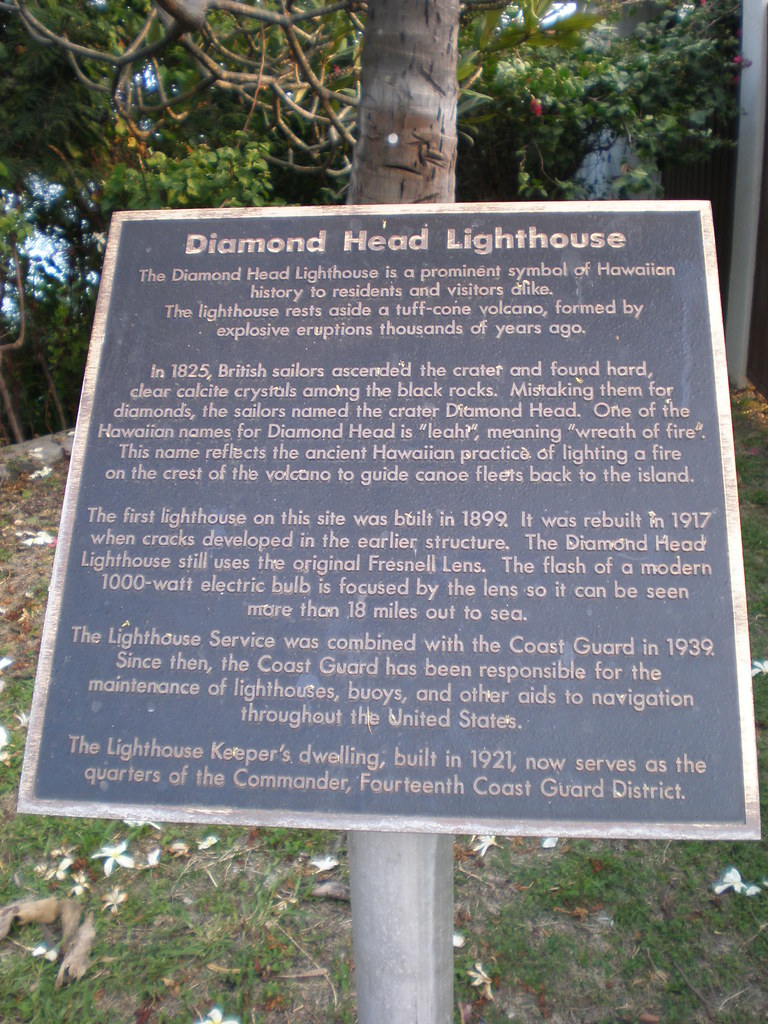
Most people who have lived in Hawai‘i for a while know that Diamond Head crater got its English name from the sparkle of worthless crystals in its rocky exterior, and not from real diamonds. And many know that it got its Hawaiian name, Lē‘ahi, from the resemblance of the crater’s ridgeline to the dorsal fin of a tuna. But the name doesn’t exactly mean ‘dorsal-fin of tuna’.

I gave the etymology a closer look after finding a bogus etymology on the historical plaque that marks Diamond Head Lighthouse. Lē‘ahi does not come from lei ‘wreath’ plus ahi ‘fire’, and thus has nothing to do with Hawaiian practices of navigational bonfires imagined by the builders of the modern lighthouse. Haw. ahi ‘fire’ comes from Proto-Polynesian (PPN) *afi ‘fire’, a good and widely reflected Austronesian root. In Numbami, a language I studied in Papua New Guinea, the word for ‘fire’ is yawi (with the /w/ slightly fricative before front vowels). Even highly aberrant Yapese seems to have a cognate, nifiy ‘fire’. But Haw. ‘ahi ‘tuna’ comes from Proto-Nuclear Polynesian (PNP) *kasi (with *k > /‘/, *s > /h/), which seems not to be so widely attested beyond Polynesia.

The first part of the compound is trickier. According to Place Names of Hawaii, comes not from lei ‘wreath, garland’, but rather from lae, which in place names usually translates ‘cape’ or ‘point’. However, the Hawaiian Dictionary lists a wider range of meanings: ‘forehead, brow; cape, headland, point, promontory; wisdom’ (< *la‘e). So some of the tourist literature now translates Lē‘ahi inappropriately as ‘tuna brow’ or ‘brow of the tuna’. Tuna Head(land) would be just as accurate, but Cape Tuna or Tuna Point would be more in keeping with the glosses in Place Names of Hawaii. (I think we can also rule out Tuna Wisdom!)

UPDATE: But what about Aku Head?

There used to be a well-known radio personality in Hawai‘i who called himself “J. Akuhead Pupule” (= ‘J. Tunahead Crazy’), reputedly after being called as much by irate listeners. I’m not sure why aku-head would be a sharper insult than ‘ahi-head, but it might be because aku is the Hawaiian name for the bonito or skipjack tuna genus Katsuwonus, whose name derives from Japanese katsuo, which in Japan is usually dried into a woodlike block, katsuobushi, from which flakes are shaved off for use as a flavoring. So maybe akuhead = blockhead.

From my fieldwork experience long ago in Papua New Guinea, where I elicited far more fishnames than I had ever heard of before, I would guess that Haw. ‘ahi matches pretty well with the genus Thunnus while Haw. aku names tuna of the genus Katsuwonus (and perhaps a few other similar genera).

In checking Wikipedia entries for other members of the family Scombridae (tunas, bonitos, and mackerals), I see that the one for wahoo, Haw. ono (< PPN *‘ono), offers entirely unsupported speculative etymologies for both names. Wikipedia should not confirm one person’s speculation with that of another. Leave that to the news media.

UPDATE 2: The cape at the southwestern tip of O‘ahu—a long, flat counterpart to Lē‘ahi at the southeastern tip—was for a time called Barber’s Point, but has now reverted to its Hawaiian name, Kalaeloa ‘The Long Point’.

A reader asks why I don’t simply consult a fluent native speaker of Hawaiian. One reason is that native speakers with encyclopedic knowledge are extremely rare in any language, but especially for Hawaiian these days, where most fluent speakers learned the language in a classroom, not from their parents and grandparents long resident on a plot of land. (In fact most have lost the lands of their ancestors.) Another reason is that local residents are usually content to offer folk etymologies and wild guesses when asked about anything not utterly transparent linguistically and historically. At least that is my experience from incessantly asking just such questions of local drivers, store clerks, wait help, baristas, sushi chefs, and random passers-by in my travels to odd parts of the globe over many years.

Leave a comment

Filed under Hawai'i, language