Monthly Archives: September 2006

Wordcatcher Tales: Poi-sute

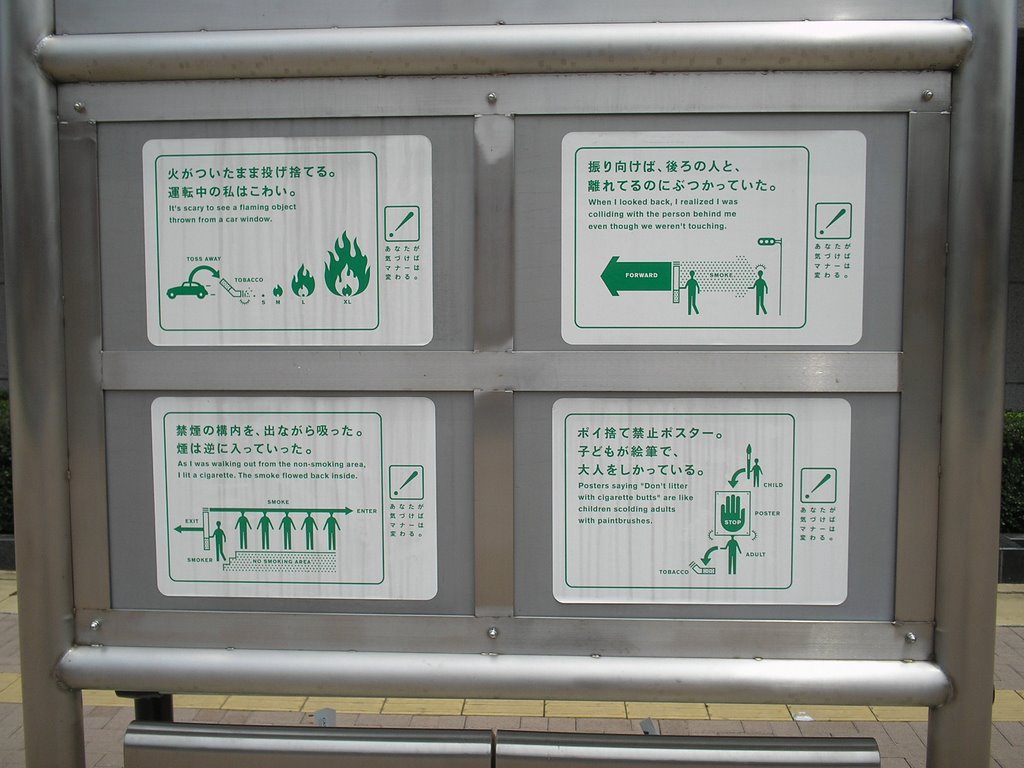
For all the sign-deciphering I did during my months in Japan earlier this year, I’m surprised how long it took me to notice “No littering” signs, which are often rendered in a katakana + kanji combination: ポイ捨て禁止 poi-sute kinshi ‘casual-discard forbidden’. The verb 捨てる suteru means ‘to throw away, discard’ as in the famous legend of Obasuteyama, a mountain where old women were left to die after outliving their usefulness. (I’m not sure if the men were left on a separate Ojisuteyama.) And ぽいと poi-to means ‘casually throwing or discarding something’ (according to my electronic Super Daijirin).

The photo above shows a set of four bilingual anti-smoking signs that can be found in many train stations in Japan. The English version of the sign on the bottom right says, Posters saying “Don’t litter with cigarette butts” are like children scolding adults with paintbrushes. It must be a Zen koan of an advanced type that exceeds my level of enlightenment, because I don’t quite get the point.

Leave a comment

Filed under Japan, language

The Ku Klux Klan in the 1920s

The Klan of the 1920s represented something frightening in America, frightening because it ran so close to the mainstream. Across the country, lawyers, doctors, and ministers—successful men, ambitious men, middle-class men—supported the Klan.

The Klan’s target was not really blacks. No politician was proclaiming racial equality. Even Calvin Coolidge, raised in Vermont, stated, “Biological laws shows us that Nordics deteriorate when mixed with other races.” The Klan’s target was change. Out of fear, the Klan enforced a populist conformity. In addition, as in Greenville [Mississippi], Klansmen generally tried to pry power out of the hands of the strongest and wealthiest men in a community, the men who had always run things. [MS Senator LeRoy] Percy was tired of fighting this battle. He even blocked plans to locate the new Delta State College, a normal school, in Greenville because he expected it to attract poor whites who would strengthen his enemies. Instead, in 1925 the school went to Cleveland, in neighboring Bolivar County.

In the larger sense, Percy sarcastically compared “the Klan virus” to “the good old days when [William Jennings] Bryan was the demagogue” and the Klan of the 1920s does fit uncomfortably close to America’s populist tradition.

American populism has always been a complex phenomenon containing an ugly element, an element of exclusivity and divisiveness. It has always had an “us” against a “them.” The “them” has often included not only an enemy above but also an enemy below. The enemy above was whoever was viewed as the boss, whether a man like Percy, or Wall Street, or Jews, or Washington; in the 1920s the enemy below was Catholics, immigrants, blacks, and political radicals.

The Klan continued to run strong nationally after Percy’s rare victory over it [in Washington County, MS]. It was in 1924 that it elected the mayors of Portland, Oregon, and Portland, Maine. That same year Percy tried to address the 1924 state Democratic convention; after complex parliamentary maneuvers finally gained him recognition, the convention erupted in tumult and he was shouted down.

He turned his attention to “mak[ing] it more difficult for the Democrats to evade the Klan proposition” at their national convention. The Democrats had hoped to avoid the issue, as the Republicans had. But William Pattangall, attorney general of Maine, proposed a platform plank condemning the Klan. His proposal lost by a vote of 542-3/20 to 541-3/20. The fight split the party and made the Democratic presidential nomination worthless. It took 103 ballots to nominate John Davis, who was crushed by Coolidge. Pattangall himself lost reelection.

A year later the Klan remained strong. In 1925, Colorado Judge Ben Lindsay wrote Percy, who was advising him on anti-Klan tactics: “I really believe there is nothing in the entire history of the South that shows such sudden and devastating sweep as [the Klan] has achieved in Colorado. This secret order has functioned as almost the entire state government from state militia to the last constable.”

Yet the 1920s Klan did collapse. It did so because it was not conceived as a political movement but as a scheme to make money selling memberships and regalia. It brought terrible forces together, like a magnifying glass concentrating the sun’s rays, but no leader with a political vision emerged to focus that power and make it explode into flame. Instead, its leaders wrestled scandalously over profits, embarrassing its members. Then David Stephenson, Indiana’s Klan leader who had amassed $3 million, was convicted of rape and murder; expecting a pardon and not receiving it, he revenged himself by revealing the corruption of dozens of Klan-backed politicians, including the governor and the mayor of Indianapolis, several of whom were also jailed. The Klan faded away.

SOURCE: Rising Tide: The Great Mississippi Flood of 1927 and How It Changed America, by John M. Barry (Touchstone, 1998), pp. 154-155

Leave a comment

Filed under U.S.

Greenville, Mississippi, in the 1920s

At the outbreak of World War I the [Mississippi] Delta was still the Wild West of the South. More than 60 percent of the land remained wilderness, with bears still invading cornfields and wolves devouring livestock. Like the West, and unlike the already settled South, it had few churches, few schools, much drinking (despite statewide prohibition), and violence….

Incongruously, cotton had simultaneously created an elite whose sons went to Harvard, Princeton, and Cornell and traveled the world; in 1914 several Greenville planters attending the annual Wagner festival in Bayreuth, Germany, were stranded by the outbreak of the war. After the war, with cotton prices soaring, the best Delta land brought $1,000 an acre …. Even the social elite of New Orleans considered Greenville exceptional….

By the 1920s, Greenville had become “The Queen City of the Delta,” with twelve miles of paved streets. Its population reached 15,000 souls, all nestled close to the river. Downtown teemed with life. Barges piled with goods docked at the concrete wharf, warehouses burst with cotton, trucks and spavined mules pulled supplies. The city had one French and two Italian restaurants, twenty-four-hour coffee shops, bowling alleys and pool halls and movie theaters. The biggest entertainers, including Enrico Caruso and Al Jolson, regularly stopped at the Opera House or the even larger People’s Theater. Enough Chinese lived in Greenville that a tong war erupted. The four-story Cowan Hotel was the state’s finest. The Armour Packing Company, the largest meatpacker between Memphis and New Orleans, distributed fresh meat throughout the Delta and into the hill country. Three cotton exchanges each had a wire to Liverpool, New Orleans, New York, and Chicago. The Greenville Cotton Compress, a huge operation owned by [Senator LeRoy] Percy, baled cotton and sold it directly to international buyers. Fourteen trains a day arrived in Greenville at the Y&MV [Yazoo & Mississippi Valley] railroad station; six more trains arrived daily at the Columbus & Greenville station. Four oil mills, the smallest covering two city blocks, crushed cotton seed. Half a dozen sawmills worked the great masses of logs floated to them; the two largest each made 150,000 board feet of lumber a day.

The city’s most exclusive gathering place was the Swan Lake Club, a shooting club outside the city. Since anyone in the Delta acceptable for membership already belonged, no guests were allowed who lived within a hundred miles. The Greenville Country Club was new; it and the Mississippi Club were for the fine families, and unlike other cities—including nearby Greenwood—both had Jewish members. (Only the Garden Club excluded Jews.) The Elysian Club, a two-storied yellow brick building with a vast porch, held dances renowned throughout the Delta; fans were placed behind a 300-pound block of ice to blow air over it and cool the room, and a hedge in front was used to hide corn whiskey. W. C. Handy, one of the fathers of the blues, frequently played there….

More than half of Greenville’s population was black, and there were two black neighborhoods. If young men from one entered the other, trouble followed. Newtown lay north of downtown; there “blacks tried to be citified, uppity,” according to one black man. Southside was more working-class. Most blacks worked on the river, or in the sawmills, or as servants for whites. By 6 A.M. the streets were alive with maids and cooks and chauffeurs heading to white folks’ homes. Several black doctors and dentists had offices in two buildings on the edge of downtown. There was a black printer, a black-owned newsstand serving whites, several black funeral home operators, black shoe repairmen. A black bank was nurtured largely by money from black prostitutes who serviced white men only. Their brothels flourished just east of downtown, near Broadway and Nelson, across from the pride of the black community, Mt. Horeb Church, a small but magnificent stone structure. A block away, there were black juke joints and pool halls and gambling joints. There was liquor, and women, and the blues. And there were knives, razors, and pistols….

In the 1920s, Greenville was a thriving small metropolis, and, like most ports, more cosmopolitan than neighboring communities. But what set Greenville apart was the imprint that [Senator] Percy and those few who allied themselves with him had imposed.

GREENVILLE’S SCHOOLS epitomized the difference. In 1920 the city spent $85 per white pupil, double the state’s second-most-generous locality; five Mississippi counties in the hills spent less than $5 per white child, while one spent only $2.75. The teachers and facilities were outstanding, and for its size Greenville produced an extraordinary number of writers, including LeRoy’s son William Alexander Percy and great-nephew Walker Percy, David Cohn, Ellen Douglas, Beverly Lowry, Charles Bell, and Shelby Foote.

For blacks, Greenville schools were, relatively, even more special. The city spent $17 per black child, compared to 68 cents in another district. At the same time that many Mississippi politicians opposed teaching blacks arithmetic and reading, Greenville public schools offered blacks Latin. Lizzie Coleman, principal of the black high school, intimidated students and teachers into excelling. She made each teacher raise $150 a year for the school, and also said, “I don’t believe in the melting pot.” But she knew how to survive. During the week she bought groceries from two black men; on Saturdays she bought steaks from Will Reed, a white man, on Washington Avenue. The steak was more expensive, but that did not matter. Because of her good relationships with whites, when black teachers asked school superintendent E. E. Bass to stop calling them by their first names in front of their students, he agreed to address them in school as “Mr.,” “Mrs.,” or “Miss.” Greenville was also state headquarters for several black fraternal organizations, including the Pythians and the Masons, and Percy had even sued a white fraternal organization on their behalf and won.

SOURCE: Rising Tide: The Great Mississippi Flood of 1927 and How It Changed America, by John M. Barry (Touchstone, 1998), pp. 132-135

2 Comments

Filed under U.S.

WHO Endorses DDT Use Indoors

Saturday’s Washington Post reports:

The World Health Organization reversed a 30-year-old policy yesterday and declared its support for indoor use of the pesticide DDT to control mosquitoes in regions where malaria is a major health problem.

The Geneva-based WHO, which provides advice to many developing countries, believes the benefits of the long-acting pesticide far outweigh any health or environmental risk it may pose….

The endorsement is only for once- or twice-yearly spraying of the pesticide on the inside walls of dwellings, especially mud and thatched huts. Used that way, DDT functions as both an insect repellent and — when a blood-engorged female mosquito lands on the wall to digest its meal — an insecticide.

One application costs about $5. Most of that cost is labor, as it is sprayed on by professional applicators, and each packet of the pesticide must be strictly accounted for.

About 1 million people die each year of malaria, most of them African children under age 5. …

Numerous countries in southern Africa use DDT, but the compound is generally not used in central and west Africa, which have more intense malaria transmission, said Shiva Murugasampillay, a physician at WHO in Geneva.

DDT was the chief chemical villain of Rachel Carson’s book “Silent Spring,” whose publication in 1962 helped nurture the modern environmental movement. The chemical was banned in the United States in 1972, and its use worldwide fell steeply after that. It is no longer used in agriculture.

A study in Zambia in 2000 found that when all houses in a neighborhood were sprayed, malaria incidence fell 35 percent compared with years when none was sprayed.

Swaziland and Madagascar each had malaria epidemics after suspending DDT spraying, the latter’s outbreak killing more than 100,000 people from 1986 to 1988. Both epidemics were stopped when DDT spraying resumed.

Leave a comment

Filed under malaria

Escherichia coli O157:H7

Human stomachs are naturally full of E. coli bacteria. That’s something that gets lost in most news reports about the current outbreak.

A majority of the infections have occurred in Wisconsin, where 29 people so far have contracted the disease. Utah had 11 cases, and New York and Ohio each had seven, Acheson said.

Other states where the infection has occurred are California, Connecticut, Idaho, Indiana, Kentucky, Maine, Michigan, Minnesota, New Mexico, Nevada, Oregon, Pennsylvania, Tennessee, Virginia, Washington and Wyoming, Acheson said.

The outbreak is part of a problem in the U.S. food supply that affects about 100,000 to 150,000 people each year. The bacteria can be spread by insufficiently cooked meat, sprouts, lettuce, unpasteurized milk and juice or contact with sewage-contaminated water. The last outbreak involving spinach was in California in 2003.

The bacteria can cause low-grade fever, vomiting and diarrhea, often with bloody stool, the FDA said. Most healthy adults recover within a week, though some people develop serious kidney damage.

The subspecific strain that is now causing problems is O157:H7, the same one that affected thousands of schoolchildren in Japan ten years ago.

To determine the cause of a July 1996 outbreak of Escherichia coli O157:H7 among factory workers in Kyoto, Japan, we conducted cohort and case-control studies. Eating radish sprout salad during lunch at the factory cafeteria had been linked to illness. The sprouts were traced to four growers in Japan; one had been associated with an outbreak of E. coli O157:H7 among 6,000 schoolchildren in Sakai earlier in July.

UPDATE: See the story behind the killer spinach on Carl Zimmer’s science blog The Loom.

Leave a comment

Filed under disease

Asia Watch on "Sea of Japan" vs. "East Sea"

Asia Watch presents a 27-point rebuttal to a Korea.net video that argues for renaming the Sea of Japan as the East Sea.

In summary: This video ignores the claim that “Sea of Japan” came into widespread usage in the early 19th century. Instead, it presents studies of pre-19th century maps, none of which discredit the findings of Japanese researchers with regard to the 19th century. After failing to discredit Japanese claims, it shows that the name “East Sea” has been used by Koreans for 2000 years. It then claims that the entire world is obligated to print foreign terms for seas alongside their traditionally-established native language terms, in accordance with a recommendation of a UN organization (but only in the case of the “East Sea”). The video attempts to disguise the anti-Japanese Korean ultranationalist agenda behind a thin veil of academic arguments, and does a remarkable horrible job. If this is the best argument the Korean government can produce, I doubt they’ll be winning over many converts through the spread of this video.

via Japundit

Why stop at the Sea of Japan? How about the Indian Ocean, the Arabian Sea, the Persian Gulf, the Gulf of Tonkin, the Marianas Trench, the Gulf of Siam/Thailand, and the Gulf of Mexico? Who gave the Coral Sea to the coral? Don’t the sea cucumbers have as valid a claim, or the moray eels? I say let’s restore the proper name for the English Channel: The Sleeve.

UPDATE: I was going to ask who gave the Bay of Pigs to the porkers, but its Spanish name is Bahía de Cochinos ‘Bay of Triggerfish‘. Cochinos are only metaphorically disgusting in behavior or appearance—like pigs, though nowhere near as intelligent. Also:

Some species of triggerfish are known to make a sound akin to a grunt or snarl when taken out of the water.

Leave a comment

Filed under Japan, Korea

Origins of Sharecropping in Mississippi

THE DELTA had always been too wild for one man or one family to subdue, and from the first, settlers had brought slaves and organization with them. Immediately after the Civil War, Mississippi and other southern states tried to resolve labor and racial questions by passing a “Black Code” that effectively reestablished slavery. One Mississippi provision required blacks to sign annual labor contracts or be arrested for vagrancy; the local government would then sell their services to contractors. Congress reacted to such laws with anger and instituted “Radical Reconstruction,” setting up new state governments that threw out those laws and putting a buffer of federal power between southern whites and blacks.

[MS Senator Charles] Percy recognized both the economic problems and the need to accept a new order, and advocated a solution. Planters had land but no cash. Blacks had labor but no land; they also resisted working in gangs under a foreman, which smacked of slavery and overseers. So Percy, who understood both the capital shortage and the importance of making labor content in order to maximize efficiency, advocated sharecropping. One man even credited Percy with inventing the system, and contemporaneous reports in other southern states did attribute the system’s beginnings to Mississippi. Planters supplied land; blacks supplied labor and gained some independence. Profits were theoretically split fifty-fifty (the cropper got more if he had his own mules), making blacks and whites partners and by implication comparable if not equal. However abusive sharecropping later became, because of the system’s implied partnership of white and black, initially whites resisted it while blacks welcomed it.

Sharecropping may have helped alleviate the Delta’s desperate shortage of labor in another way. Planters and their labor agents were scouring the rest of the state and the South recruiting former slaves, promising—and delivering—better pay and treatment than elsewhere. The new system may have helped attract blacks, for in a steady stream they came. From one Mississippi county outside the Delta, a single Delta plantation recruited 500 workers. From Columbus, Mississippi, near the Alabama line, 100 black workers left for the Delta in a single week. From Uniontown, Alabama, 250 blacks boarded a single train, heading for the Delta. From Virginia, the Carolinas, and Georgia as well, thousands of blacks came.

SOURCE: Rising Tide: The Great Mississippi Flood of 1927 and How It Changed America, by John M. Barry (Touchstone, 1998), pp. 102-103 (reviewed here)

My paternal grandfather was a (white) tenant farmer in southeastern Virginia. He sometimes managed the farms of landowning relatives, but never owned a farm himself. Not one of his children remained a farmer.

Leave a comment

Filed under economics, slavery, U.S.

Sumo’s Appeal for the Waka/Taka Brothers and Others

THE NAMES “WAKAHANADA” and “Takahanada” meant little of poetic significance. The “waka” and “taka” parts merely evoked their father and uncle, while “hanada” was their real last name. But among those watching in February 1988, it was understood that the boys would one day earn the right to take on the great names “Wakanohana” and “Takanohana.”

Why a young Japanese would want to take up the severe life associated with the national sport, while far less bizarre than when applied to an American, is a question that deserves attention. The total number of the [Sumo] Kyokai’s competitors usually hovers around only 800 in a country of some 120 million people, while baseball and soccer attract a far greater number of Japan’s promising athletes. Some join sumo, believe it or not, because the sumo world is a place where big guys can exist honorably without being teased. Teasing and bullying go on far past adolescence in Japan. Much is made in cultural definitions of Japan as a place of social conformity, and pressure to conform is indeed very real there. But rather than through some kind of Orwellian fear tactics, in practice the social pressure comes in the form of people being relentlessly annoying any time they see something even slightly out of the ordinary. A bigger-than-aver-age Japanese man looks different from most people, and thus becomes the object of constant ridicule, both from those he knows (in the form of obligatory fat jokes at absolutely every social encounter) and those he doesn’t (“Ah, Mr. Tanaka! It’s nice to meet you. Wow, you sure are big. How much do you weigh, anyway?”). For many overweight Japanese teenage boys who may never have had an interest in sport and who find themselves at the age when teasing is at its fiercest, sumo is a way out of mainstream Japan. The saddest part may be that the middle of the banzuke [‘rankings’] is clogged with nonathletic types with no hope of ever reaching the salaried ranks who’ve committed themselves to sumo as an alternative way of life: their topknots turn their size from points of obligatory ridicule to points of honor.

Other Japanese rikishi are recruited from rural areas with little economic opportunity. A former sekitori [‘professional wrestler’] explained, “Some kids, they come to the stable, but the ones the oyakata [‘stablemaster’] scout, they go to their house, they go to their parents, they give ’em a million yen. ‘Give me your boy for sumo.’ These boys are fifteen years old, and their parents are like, ‘A million yen!’ These guys are from the mountains; they don’t see that much money. ‘Oh, okay, okay! You go do sumo!'” They join sumo as a means of support and often toil for years in the lower ranks with no hope of making it, fortunate to be fed and housed. Other Japanese join in a rare show of national pride: “Because it is kokugi,” the national sport, one boy in the jonokuchi [lowest] division told me. Still others join as Jesse Kuhaulua [raised on Maui] had, as a natural progression of their junior high, high school, and/or college sumo careers.

Masaru and Koji Hanada joined because they were born into the sport. Sons of the great Ozeki Takanohana (the first) and nephews of the great Yokozuna Wakanohana (the first), they had sumo in their blood. While Chad Rowan had not known the meaning of the term “sumo-beya” [‘sumo stable’] until he was eighteen, the Hanadas had been raised in one. Young Koji Hanada entered his first sumo tournament when he was in third grade—and won. Six years after setting up his own Fujishima-Beya upon retiring in 1982, Fujishima Oyakata gave in to the relentless pleas from his boys by letting them formally become his deshi. Masaru Hanada’s 2000 autobiography offers a poignant account of the boys declaring themselves no longer Fujishima Oyakata’s sons, upon moving out of Fujishima-Beya’s top-floor apartment and down into a big shared room below, but rikishi under his charge.

By official registration day, Takahanada weighed a healthy 258 pounds, bigger than most of the other boys and a full 40 pounds heavier and nearly an inch taller than his older brother. And unlike the rest of the shin-deshi [‘new apprentices’] registering that day, Waka and Taka had already proved themselves on the dohyo [= ‘in the ring’]. Competing in high school, Masaru (Waka) had taken the All-Japan Senior High School yusho [tournament championship], while his younger brother had easily taken the Kanto District Junior High School yusho. Where Chad Rowan had come from nowhere into a sport as foreign to him as the language, these boys were sumo’s Ken Griffey Jr. and Barry Bonds.

SOURCE: Gaijin Yokozuna: A Biography of Chad Rowan, by Mark Panek (U. Hawai‘i Press, 2006), pp. 122-123

Well, the money must hold considerable appeal for the foreign wrestlers. At the end of Day 5 in the September Basho: two Mongolians, yokozuna Asashoryu and maegashira-6 Ama, are 5-0. Just one loss behind, at 4-1, are Bulgarian ozeki Kotooshu, Japanese ozeki Chiyotaikai, Mongolian ozeki Hakuho, Japanese sekiwake Kotomitsuki, Russian maegashira-1 Roho, Japanese maegashira-11 Homasho, and Korean maegashira-15 Kasugao. I would dearly love to see tiny Ama win the tournament.

UPDATE, Day 6: Asashoryu lost, leaving Ama (now 6-0) in sole possession of the lead!

UPDATE, Day 7: Ama lost, so now two Mongolians (Asa and Ama), one Russian (Roho), and one Japanese (Kotomitsuki) are tied for the lead at 6-1.

UPDATE, Day 8: Kotomitsuki loses, leaving the other three at 7-1.

UPDATE, Day 9: Tiny Ama (185 cm, 115 kg) went up against the giant Estonian Baruto (197 cm, 174 kg) and won! Well, technically, Baruto defeated himself by fumidashi, stepping backwards out of the ring while facing Ama. Asa beat Roho in the hard-fought final bout, so the two Mongolians still share the lead at 8-1.

UPDATE, Day 10: Asa and Ama now share the lead at 9-1, with Roho and Ama’s Ajigawa stablemate Aminishiki one loss behind, at 8-2.

UPDATE, Day 11: Asa and Ama now share the lead at 10-1, while Roho and Aminishiki have both dropped back to 8-3, alongside Chiyotaikai, Futeno, and Hokutoriki. Unbelievable. Ama will certainly regain komusubi rank after this basho.

UPDATE, Day 12: Fellow Mongolian Hakuho lifted Ama up and out of the ring, leaving him at 10-2, one loss behind Asashoryu (11-1), who won his bout against Tochiazuma.

UPDATE, Day 13: Ama had the chance to get back into a tie for the lead if he managed to defeat Asashoryu, but he had no such luck, so Ama stands at 10-3, while Asashoryu lengthens his lead to 12-1.

Topix.net has two sumo photos of interest from a Sadogatake-beya tour of Israel in June: Bulgarian ozeki Kotooshu in yukata and yarmulke at the Western Wall and stablemates Kotomitsuki and Kotoshogiku floating in the Dead Sea.

Leave a comment

Filed under baseball, Hawai'i, Japan, sumo

Percy/Daiki on Chad/Akebono

When I met Chad [Rowan = Akebono], he wasn’t that nice of a person, I guess ’cause all of the stress and stuff, but when I got to know him, he was one nice guy. Real humble. But mean personalities. I’ll tell you how he is. I been over there seven and a half years. The jungyo tournaments, comes in the morning. Doesn’t say one word. Sits down. Lies down. Rests a while. Gets up: “Mawashi!” Put on his belt, put on his yukata, walk straight to the dohyo. After he practice, he comes back, take a shower, then he start talking. “Oh, my back sore.” He neva like joking around. After that, then he jumps out of the shower, then he goes to eat. Different attitude. Quiet again, eating. Then he go back to his room. Joking around, talking story, listening to the radio, talking on the phone. Time for wrestle: pau. Attitude again. That’s why I used to watch his moods. I used to just practice with that. I know how he act already. I know what pisses him off. After practice, he go back to the shower; nobody bother him. Come back from the shower, eat, nobody bother him. After he pau eat, then you can talk story with him. You gotta catch him one perfect time. You don’t catch him one perfect time, he’s a bitch. Nobody can talk to him at all. —PERCY KIPAPA (DAIKI), 12/98

SOURCE: Gaijin Yokozuna: A Biography of Chad Rowan, by Mark Panek (U. Hawai‘i Press, 2006), p. 161

Percy Kipapa was found dead in a truck from multiple stab wounds on 16 May 2005 in Honolulu. —Honolulu Star-Bulletin, 19 May 2005

His friend, Kealiiokalani Meheula, was found guilty of second-degree murder in June 2006, and was sentenced to the mandatory life imprisonment with the possibility of parole on 6 September 2006. —Honolulu Star-Bulletin, 7 September 2006

“Percy Kipapa — he was my friend,” Meheula said yesterday, breaking down as he asked Kipapa’s family for forgiveness. “I loved him with my heart, and I have to live with this for the rest of my life.”

George Kipapa said he did not know how much love Percy, the youngest of the Kipapas’ three children, had shared with the people here and in Japan until his funeral.

“I’m not only proud that he had a career in sumo; most of all, I’m proud he learned the word love,” Kipapa said.

As for Meheula, Kipapa said he hoped God would have mercy on him and that in the future he would learn to let go of his anger and embrace others, not hurt them. “Today we gotta learn to love, not to hate,” Kipapa said.

The Honolulu Advertiser account on 7 September adds another pertinent detail.

Also speaking in court was Mark Panek, a friend of Percy Kipapa and author of a biography on sumo champion Chad Rowan. Panek said he met Percy Kipapa in Japan and said the other sumo wrestlers from Hawai’i miss him.

It looks as if Panek’s next biography has just been assigned to him. A biography with less triumph and more tragedy.

Leave a comment

Filed under Hawai'i, Japan, sumo

Auden on Yeats in 1939 Inspires Somali in Canada in 2003

W. H. Auden seems a favorite poet to quote in these dark times. Google returns over 500 links to the memorable line “Each sequestered in its hate” from Auden’s poem “In Memory of W. B. Yeats,” who died in 1939. The poem begins:

He disappeared in the dead of winter:
The brooks were frozen, the airports almost deserted,
And snow disfigured the public statues;
The mercury sank in the mouth of the dying day.
What instruments we have agree
The day of his death was a dark cold day.

But the most oft-cited verses seem to be the following.

In the nightmare of the dark
All the dogs of Europe bark,
And the living nations wait,
Each sequestered in its hate;

Intellectual disgrace
Stares from each human face,
And the seas of pity lie
Locked and frozen in each eye.

Now compare Auden’s words with a eulogy for the Somali exile Hussein Afrah Sheengiyale (d. Jan 2003):

Hussein Afrah Sheengiyaale died in the dead of winter
Earth, receive an honored Somali guest
Hussein Afrah Sheengiyaale is laid to rest
In this alien snow
In this old cold exile
In this old cold Canada …

All the crazy clans cower & wait
Each sequestered in its hate
Woefully arrogant
Willfully ignorant
That today
An important Son of Somalia died
In old cold Canadian exile
That every day
Thousands of Somalia’s best & the brightest
Languish
In anguish
Shivering
In this old cold Canadian exile

According to banadir.com, Norway (another cold country) is now forcing Somalis to return to their homeland.

The authorities in Norway, which has about 17000 Somali refugees and asylum seekers, have decided to return 400 whose asylum applications have been rejected. In fact, after a long period when Somalis were not returned to Southern Somalia, the changed situation in Mogadishu, including the opening of the airport, has given them the idea that it is now safe to return people there.

UNHCR has strongly advised against it, and other Scandinavian countries are not doing the same, preferring to wait and see.

Norway, which likes to be seen as a humanitarian nation, with peace-keepers and conflict solvers in many countries, is now practising a very strict policy in the case of Somalis.

This has caused a lot of debate and uproar. One party in the coalition government, the Socialist Left party, has condemned it, the Norwegian Organisation for Asylum Seekers, NOAS, is protesting, as is the Norwegian Refugee Council, and all major newspapers are daily writing about the situation. In fact, since this became known, the UNHCR has made a special appeal to the government, warning of the dangers of returning people to Somalia at the moment, as it is “a threat to the right to life”.

Leave a comment

Filed under Africa, Canada, Somalia