
Monthly Archives: May 2006

Saipan Impressions: Three Meals

No one goes to Saipan or Guam for the cuisine, but I did want to try something localized and not the standard American, Chinese, Japanese, or Korean fare near the major hotels. I had a bit of success, but it wasn’t easy. And I only had three meals to worry about.

Breakfast on the way back to the airport included the obligatory Spam: a Spam & egg sandwich combo (with coffee and donut) at Winchell’s, a U.S. West Coast chain whose menu may have been adapted to Saipan tastes. But I hadn’t expected the huge dollop of mayonnaise that dripped off at every bite (with a little help from me).

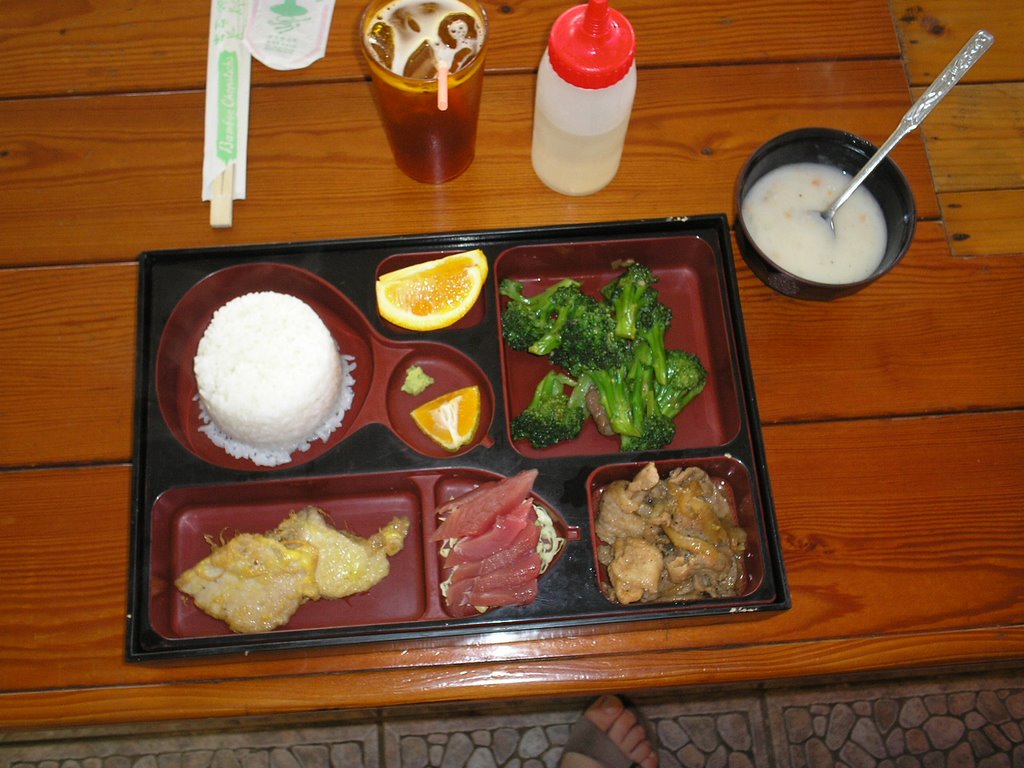
My first meal on Saipan was delayed until I returned from a drive to see the sights at the north end of the island, since there was almost nowhere to eat on that stretch of road. So I turned off into the port area on the way back and found the dowdy Seaman’s Restaurant at the end of a pier past a shipwreck listing in the shallows. It was 11 a.m. and I was the only customer—but a hungry one. The Chinese-run restaurant offered a $5 bento with Saipanese characteristics (pictured above). New England clam chowder substituted for miso soup, served with a Korean soup spoon. The rice and sashimi (with wasabi) were Japanese, the beef broccoli Chinese, and the fish jun vaguely Korean (with a wedge of local citrus to squeeze onto it), while the stewed chicken and onion looked like Philippine adobo, but with little pepper and garlic and even less vinegar or bay leaf. The ice tea was served with a squeeze bottle of sugar water, not packets of sugar or sugar substitute. Two orange slices served as a Chinese final course. It was just the sort of motley Pacific Island cuisine I was looking for.

After driving all over the island most of the day, I decided to see if any place looked promising within walking distance near the hotel. Moby Dick answered the call. A chalkboard listed fish kelaguen, a Chamorro dish of soft chunks of boneless raw fish “cooked” in lemon juice and tossed with slices of green and round onion, and sweet and spicy peppers. It was wonderful—and big enough to serve as an appetizer for two people. But I couldn’t resist ordering the local bottomfish catch of the day, either opakapaka or mafuti. I hadn’t heard of mafuti. When I asked what kind of fish it was, the Filipina waitress didn’t know any other name for it but brought it over to show me. I didn’t recognize it, but ordered it grilled. The whole fish came back to me a little bit overcooked, but I demolished most of it anyway. A Tagalog-speaking waiter later explained that “maputi” got its name from being a white fish. Tagalog for ‘white’ is indeed puti, but the fishname appears to be Chamorro, where the word for ‘white’ is a’paka’. So I don’t know what the story is. (More on Chamorro language later.)

Leave a comment

Filed under Micronesia, Pacific

Saipan Impressions: Package Tours

I needed to make a quick trip abroad by the end of May in order to renew my 90-day no-visa entry permit in Japan. Mrs. Outlier is on a work visa and had to teach, so I was on my own. Fortunately, package tours had dropped in price after the end of Golden Week, and so I began shopping for the cheapest, quickest tour to either the island of Cheju in Korea or the island of Saipan in the Northern Marianas, neither of which I had visited before. (I’ve spent a bit of time in Guam, Yap, Palau, and Pohnpei.) Saipan not only proved the cheaper option, but offered better chances of breaking away from the pack. In each case, the package was cheaper than the roundtrip airfare alone.

My only previous package tours were a relatively lavish academic junket in South Korea in 1995 and a dollar-denominated official minitour of the painted monasteries in Romanian Bukovina in 1983. Both were interesting, but confining. However, during the many setbacks in our self-booked travels around China in 1987-88, we wished more than once for the comfort and predictability of a package tour.

The timing of the JTB departures and arrivals was bizarre. The tour offered barely 30 hours in Saipan: two half-nights and one day in between. The major advantage seemed to be that tourists from near Narita would only have to miss one day of work. They could leave after work one day, and return before work two days later. I wonder how many of the (apparent) OLs on that flight called in sick for the Monday they were gone. There’s only a one-hour time difference between Saipan and Japan, but this trip left me rather jet-lagged.

NW 18 left Narita about 9 p.m. and arrived in Saipan about 1:45 a.m. I had no checked baggage and breezed through customs, so I had rented a car (from Budget, the only booth manned at that moment) and navigated in the dark to the massive Fiesta Resort & Spa in Garapan well before the rest of the tour had left the airport. (I had to wake up the gatekeeper to get out of the airport parking lot.) After some consternation, the hotel front desk was able to issue me a separate room key so that I could check in before the rest of the group arrived. The lobby was awfully quiet at 2:30 a.m., but the hostess bars, massage parlors, streetwalkers, and their potential clients were still at work just across the street in the contemporary equivalent of the old 城下町 jouka-machi ‘town below the castle’.

NW 17 left Saipan around 5 a.m., so the tour bus left the hotel at 2:40 a.m. I decided to aim for 3 a.m, but wasn’t sure that I could rely on the wake-up call or would hear my wrist alarm. But I awoke shortly after 2 a.m. to the sound of doors slamming as my neighbors headed for the lobby. I checked out of the hotel about 3 a.m. and had enough time to refill the gas tank (5 gallons for $18!), grab breakfast at a 24-hour coffee-and-donut shop, wake-up the car rental agent, check in at the very friendly NW counter overflowing with student trainees (all of whom later showed up at the boarding gate), and get a 10-minute (for $10) back massage in the departure lounge. Others spent most of that time in the Duty Free Shop.

Parts of Saipan never seem to sleep: the airport, gas stations, poker casinos, and the “pleasure quarters” near the big hotels.

UPDATE: I have flown a lot of miles on Northwest Airlines (visiting in-laws via Minneapolis) and don’t have any greater animus against them than I do against most other major airlines, but they do a really shoddy job on NW 17 and NW 18. Despite the fact that 3 out of 4 passengers is Japanese on that route, they didn’t stock a single pair of chopsticks in case passengers asked for them, and they enforced (at least in economy class) a strict limit of only 1 serving of alcohol per person on a flight that was maybe 1/3 OLs (not athletes) on holiday. I learned this from overhearing the requests of Japanese passengers around me. Finally, NW relied on one poor bilingual flight attendant to translate all the English-only messages, whether routine or exceptional. No kudos on this flight, Northwest.

Leave a comment

Filed under China

Military vs. Monks in Burma Now

In Burma, there is no escape from politics – not even at the pagoda. Many Buddhist monks joined the protests of 1988, and hundreds were shot and killed by soldiers. Two years later, some 7,000 monks walked silently through the streets of Mandalay with their begging bowls, to collect alms in memory of those who had died in 1988. The peaceful remembrance ended in bloodshed as soldiers shot into the crowd, killing and wounding a number of monks. Afterwards, the sangha, or holy Buddhist order, launched a nationwide religious boycott of the regime by refusing to accept alms from military families or to oversee their weddings and funerals. The action is known as pattam nikkujana kamma – ‘the overturning of the alms bowl’. This passive protest reportedly upset members of the army, as it robbed them of any control over their spiritual destiny: at Buddhist funerals, monks are necessary to guide a person’s vulnerable soul into the next life. Soldiers raided over 100 monasteries, arresting more than 3,000 monks and novices. The sangha now operates under strict government control. All monks must be checked by the government before ordination, even those who take holy orders for only a few weeks or months, as many Buddhist men do. Traditional ceremonies require prior permission from local authorities. And informers, dressed in the brick-red robes of a Burmese monk, are rife within the sangha itself. Senior monks are coerced into toeing the party line with threats and bribes. Abbots, who often have influential moral power within the village, are ordered to keep villagers in check.

SOURCE: Secret Histories: Finding George Orwell in a Burmese Teashop, by Emma Larkin (John Murray, 2005), p. 84

2 Comments

Filed under Burma, military, religion

Root Causes of the Burmese Crime Wave of 1924?

Orwell’s first year on the beat was a catastrophic one for the British police force in Burma. Retired civil servant J. K. Stanford wrote in his memoirs of that time, ‘Everyone had realized what an astounding assortment of malefactors – murderers, dacoits, thieves, robbers, house-breakers, forgers, coiners, blackmailers, and so on – each district possessed. They seemed to spring up like dragon’s teeth. Violent crime in Burma had risen at an alarming rate. Dacoity – defined as crime committed by roving gangs of more than five hooligans – had doubled in the last ten years, as had murder rates, giving Burma the dubious distinction of being the most violent corner of the Indian Empire. As one police report put it: ‘Murder stalks through the land with impunity.’ The sheer brutality of the crimes astounded British administrators. Dacoits raped women and girls as young as eleven, afterwards covering their victims in kerosene-soaked blankets and setting fire to them. There were descriptions of a dacoit king famous for crucifying his victims. The dead body of an Indian was found in a well with a bamboo stick forced up his anus. A monk was lured out of his dwellings to have his throat slit. A fisherman was hacked to death for his daily catch. ‘This year,’ said the police report for 1924, with considerable understatement, ‘has been a very difficult one for the Police.’

Burma’s unprecedented crime wave sent the police force into turmoil, and Orwell found himself right in the deep end. ‘Crime season,’ as the police called it, was between January and June, when the demands of agricultural labor were low. And this was exactly when Orwell began his first posting out in the field. The British police authorities set up countless committees to investigate the root causes of what one report called the ‘bestial savagery’ and to find out how best to deal with it. All police leave during crime season was revoked. Ninety British officers and 13,000 Burmese policemen had to oversee a land of some 13 million people. The Burmese policemen were underpaid and undertrained. Corruption was rampant among magistrates, and criminals were seldom convicted. It was a potentially disastrous situation.

The British authorities desperately searched for solutions. One committee denounced alcohol as a catalyst for murder. The ever present dani [nipa palm], which lined the rivers I had sailed through, could be distilled into a lethal brew, and toddy was attainable from any palm tree. The committee recommended total prohibition for Burmans. Another pointed to the demoralizing influence of the imported adventure movies – mostly violent depictions of America’s Wild West – that were doing the rounds on travelling cinematographs. One officer blamed the high rates of violence on the Delta’s infernal mosquitoes. And there were some, much more disturbing, diagnoses which referred to ‘the innate criminality of the Burmese character’. Only one report ventured to look at the impact of British intervention on Burmese culture: the way in which the British government had removed respected headmen and replaced them with its own bureaucratic counterparts. A Burmese police officer added ‘a minute of dissent’ to one report, pointing out that young Burmese boys now had to attend schools styled on the British educational system and were no longer able to go to the pongyi kyaung, or traditional monastic schools. He felt the government should have had the foresight to see that disabling the country’s centuries-old religious education system would lead to disaster. There is, he wrote, ‘no reason to assume it has come to such a stage that the Burmese people are less moral than any other nation’.

SOURCE: Secret Histories: Finding George Orwell in a Burmese Teashop, by Emma Larkin (John Murray, 2005), pp. 71-72

Leave a comment

Filed under Burma

Anti-imperialist Orwell "Bred for Empire"?

In 1923, Orwell came [to Maymyo] for a week’s holiday with Roger Beadon, a fellow probationary assistant district superintendent undergoing police training in Mandalay. Beadon was later one of the few old Burma hands able to remember much about the writer’s time in Burma. It was in Maymyo that Beadon realized that Orwell was not a typical empire builder. He recalled that, though they both enjoyed the trip, Orwell remained aloof the whole time and limited his conversation to what Beadon termed commonplace remarks. ‘I realized that he and I had very little in common, I presumably being an extrovert, he an introvert, living in a world of his own: a rather shy, retiring intellectual.’

Everything in Orwell’s background, however, indicated that he was, almost literally, bred for the Empire. He came from a long line of colonial families. His father’s ancestors had owned Jamaican sugar plantations. His grandfather had been ordained as a deacon in Calcutta, later serving as a priest in Tasmania. And his father spent his entire career in the colonial service in India, overseeing the production of government opium crops. On his mother’s side, Orwell’s family had lived and worked as shipbuilders and teak-traders for three generations in Lower Burma. Orwell himself was born in Motihari, a small town in northern India, and first moved to England, with his mother, shortly before his second birthday. Yet, in Mandalay, Orwell acquired a reputation as someone who didn’t fit in. According to Beadon, Orwell was thought not to be ‘a good mixer’. Beadon described him as a man who was ‘sallow-faced, tall, thin, and gangling, whose clothes, no matter how well-cut, seemed to hang on him’. Beadon spent his time living it up at the Upper Burma Club, playing snooker and dancing, but Orwell ‘cared little for games, and seemed to be bored with the social and Club life’. He preferred to stay behind in his room at the mess, reading, spending most of his time alone – much like John Flory, who, in Burmese Days, ‘took to reading voraciously, and learned to live in books when life was tiresome’.

The social life of Mandalay and Maymyo, it seems, was too hedonistic for the young Orwell.

SOURCE: Secret Histories: Finding George Orwell in a Burmese Teashop, by Emma Larkin (John Murray, 2005), pp. 42-43

Leave a comment

Filed under Burma

Restraining Rock Concerts in Tehran

I should put the word concert in quotation marks, because such cultural affairs were parodies of the real thing, performed in private homes or, more recently, at a cultural center built by the municipality in the south of Tehran. They were the focus of considerable controversy, because despite the many limitations set upon them, many in government considered them disreputable. The performances were closely monitored and mostly featured amateur players like the ones we went to see that night. But the house was always packed, the tickets were always sold out and the programs always started a little late….

When we finally entered the auditorium, we found people stuffed into the concert hall, sitting in the aisles, on the floor and standing clustered against the wall…. We were greeted by a gentleman who insulted the audience for a good fifteen or twenty minutes, telling us that the management did not wish to entertain audiences of “rich imperialists” contaminated by decadent Western culture. This brought smiles to many of those who had come that evening to hear the music of the Gipsy Kings. The gentleman also admonished that if anyone acted in an un-Islamic manner, he or she would be kicked out. He went on to instruct women to observe the proper rules and regulations regarding the use of the veil.

It is hard to conjure an accurate image of what went on that night. The group consisted of four young Iranian men, all amateurs, who entertained us with their rendition of the Gipsy Kings. Only they weren’t allowed to sing; they could only play their instruments. Nor could they demonstrate any enthusiasm for what they were doing: to show emotion would be un-Islamic. As I sat there in that packed house, I decided that the only way the night could possibly be turned into an entertainment was if I pretended to be an outside observer who had come not to have fun but to report on a night out in the Islamic Republic of Iran.

Yet despite these restrictions and the quality of the performance, our young musicians could not have found anywhere in the world an audience so receptive, so forgiving of their flaws, so grateful to hear their music. Every time the audience, mostly young and not necessarily rich, started to move or clap, two men in suits appeared from either side of the stage and gesticulated for them to stop clapping or humming or moving to the music. Even when we tried to listen, to forget these acrobats, they managed to impose themselves on our field of vision, always present, always ready to jump out and intervene. Always, we were guilty.

The players were solemn. Since it was almost impossible to play with no expression at all, their expressions had become morose. The lead guitarist seemed to be angry with the audience; he frowned, trying to prevent his body from moving—a difficult task, since he was playing the Gipsy Kings.

SOURCE: Reading Lolita in Tehran: A Memoir in Books, by Azar Nafisi (Random House, 2004), pp. 299-301

Leave a comment

Filed under Iran

Trusting Only Old Books in Burma

Hla Htut sat reading a collection of Tolstoy’s short stories in a faded deckchair. I gave him my letter of introduction, from a mutual friend in Rangoon. He read it carefully, folded it up, and handed it back to me. With great solemnity he pulled a plastic stool from behind some boxes and offered me a seat. Then he leaned back in his chair, lit a slender cheroot, and confessed that he hates books.

Hla Htut is in his early thirties. He has placid, sculpted features and an easy, slow manner. Since his schooling was disrupted by the government’s frequent and haphazard closure of Burma’s universities, he never finished the bachelor’s degree he started in English literature. Instead, he began dealing in books. It isn’t that he hates all books, he clarified: he just hates Burmese books. In fact, Hla Htut has no time for any contemporary Burmese writing, be it novels, newspapers or magazines. ‘I don’t trust them. They always lie,’ he said….

Burma has always had a high literacy rate, thanks to a strong tradition of education instilled by the country’s Buddhist monasteries, and reading for pleasure became a widespread pastime under the British. After a few generations under the colonial education system and with the introduction of printing presses, Burmese writers began to write more for the masses rather than for the palace elite. An adventure story inspired by The Count of Monte Cristo was published in 1904 and is considered the first example of the novel in Burma. It was an instant hit, and a few years later novels and short stories written by Burmese writers were everywhere.

The Burmese, explained Hla Htut, had always been primed to love stories. All Burmese children were weaned on the Jataka stories, a collection of some 550 moral tales which described the many reincarnations of Prince Siddhartha before he achieved enlightenment as the Buddha. Prince Siddhartha appears in human and animal form wandering through the Buddhist cosmological landscape – a wonderland of celestial beings and forests filled with mythical beasts. Among other early favorites were H. Rider Haggard and Arthur Conan Doyle (the translator of the latter transformed Sherlock Holmes into the longyi-clad Sone Dauk Maung San Sha, or Detective Maung San Sha, and the sleuth’s famous Baker Street address became Bogalay Zay Street in Rangoon). A hundred years later, both Rider Haggard and Conan Doyle are still big sellers. Hla Htut puts it down to the oppressive political environment in which people live. ‘We Burmese, we need to escape. We don’t want to read non-fiction. We want only fiction and fantasy. We want to read about heroes – strong men, clever men.’

SOURCE: Secret Histories: Finding George Orwell in a Burmese Teashop, by Emma Larkin (John Murray, 2005), pp. 26-28 (reviewed here and here)

Leave a comment

Filed under Burma

Sumo’s Battle of the Ozeki

With the only consistent tournament winner and only reigning yokozuna (grand champion), Asashoryu, on the injured list, the competition is tight among the remaining top wrestlers as they reach the home stretch of the Natsu Basho, which ends on Sunday. (Inconsistent ozeki Tochiazuma, who won the opening tournament in January, also dropped out after a string of losses.)

Two veteran Japanese rikishi, ozeki (champion) Chiyotaikai and sekiwake (junior champion) Miyabiyama, share the lead (at 9-1) with the newly promoted Mongolian ozeki, Hakuho. However, both the Japanese veterans are relying on relatively crude techniques, mostly unrelenting thrusts and slaps, as they try to avoid the clinch. They face each other today, so one of them is going to fall off the lead. Hakuho seems favored to win, and he already has the calm, confident gravitas of a yokozuna (more so than Asashoryu, in my opinion).

Just one loss (at 8-2) behind the leaders are Japanese veteran ozeki Kaio (my favorite among the Japanese contenders), Mongolian “Supermarket of TricksKyokushuzan, and the Estonian phenom Baruto (the “Balt”), Kaido Hoovelson, whose ceremonial apron shows a Viking helmet, and who rose to sumo’s Makuuchi division (the “Majors”) after winning the last Juryo (“Triple A”) division tournament with a perfect 15-0 record.

UPDATE, Day 12: Chiyotaikai lost first to Miyabiyama, and then to Kotomitsuki, dropping off the pace at 9-3; while Miyabiyama defeated the struggling Bulgarian Kotooshu to preserve his one loss at 11-1. So Miyabiyama, a veteran Japanese ozeki, remains neck-and-neck with Hakuho, a rookie Mongolian ozeki, in the home stretch, with the giant newcomer Baruto just one loss behind.

UPDATE, Day 13: All three leaders won. Hakuho (now 12-1) pulled down fellow ozeki Kotooshu (now 6-7), who risks demotion if he doesn’t win the next two bouts. Miyabiyama (now 12-1) shoved out Kyokushuzan (now 9-4). And Baruto (11-2) managed to get both hands on (yokozuna Asashoryu’s stablemate) Asasekiryu’s belt, immobilize him, then lift him up and drop him outside the ring. The rookie has done his homework and is winning respect. You might expect a wrestler of his size to just drive his opponents backward out of the ring, but over 13 days Baruto has won by 10 different techniques, many of them defensive moves where he helps his opponent charge down toward the clay or out of the ring.

UPDATE, Day 14: Well, Miyabiyama quickly ended the Estonian rookie’s dreams of winning the tournament during his makuuchi debut, handing him his 3rd loss. Baruto made the mistake of trying to force Miyabiyama’s head down. All that accomplished was to lower the center of gravity and concentrate the weight of the heaviest rikishi still wrestling. Hakuho and Miyabiyama remain at 13-1 and could face a final playoff if both win or both lose on Day 15, when Hakuho gets his shot at Baruto (11-3) and Miyabiyama faces Asasekiryu (10-4). Even if he doesn’t win the tournament, Miyabiyama is sure to win promotion from sekiwake to ozeki, while the Bulgarian Kotooshu (7-7) risks demotion from ozeki back to sekiwake unless he can defeat fellow ozeki Chiyotaikai (10-4) tomorrow.

UPDATE, Day 15: New ozeki Hakuho wins his first tournament after defeating Miyabiyama in a playoff. Both rikishi finished at 14-1 after Hakuho quickly left Baruto (11-4) prone on the clay and Miyabiyama shoved out Asasekiryu (11-4). Miyabiyama is likely to be the newest ozeki at the Nagoya basho in July. Kotooshu (8-7) barely managed to retain his rank by defeating fellow ozeki Chiyotaikai (10-5). However, the two Mongolian komusubi are likely to lose their ranks: small but scrappy Ama (4-11) and middle-of-the-pack Kyokutenho (5-10). Asasekiryu and Baruto may well replace them.

RELATED POSTS: Japundit’s Danny Bloom notes a Japan Times article about the differences between how well foreigners in Japan master Japanese in professional sumo and in professional baseball.

Twenty years ago, the most prominent foreign rikishi (sumo wrestlers) tended to be from Hawaii, which has a large Japanese-American population and close cultural ties with Japan. More recently, however, most foreign rikishi have hailed from Mongolia (Asashoryu), as well as Bulgaria (Kotooshu), Russia (Rohou) and other former Soviet bloc countries. Frequently appearing in TV interviews, the wrestlers do, of course, make the occasional error — but when they speak, they sound like sumo rikishi, and they express themselves in a manner remarkably similar to their Japanese counterparts [yeah, mumbling and inarticulate in both cases–J.].

This language proficiency, particularly among foreign grapplers from countries with only tenuous historical and cultural ties to Japan, has become a topic of academic study. Dr. Satoshi Miyazaki, a professor at the Graduate School of Japanese Applied Linguistics, Waseda University, began his field work in 1997….

“To learn the language, they don’t need a teacher or a dictionary,” Miyazaki says. “They just learn through osmosis. Foreign rikishi are not here to learn Japanese, but to learn sumo. But by learning sumo they have to learn Japanese. That’s their motivation. Many students who learn in classroom studies don’t know what to do with the language they learn. So it’s a matter of identity.”

And Japundit‘s baseball contributor (and NY Yankees fan) Mike Plugh has two informative posts about ironman Hideki Matsui’s wrist injury: a backgrounder, Godzilla vs. Misfortune, and an update on fan reactions in Japan and the U.S., Feeding the monster.

Leave a comment

Filed under baseball, Japan, Mongolia, sumo

Reading Said vs. Austen in Tehran

Olga was silent.

“Ah,” cried Vladimir, “Why can’t you love me as I love you.”

“I love my country,” she said.

“So do I,” he exclaimed.

“And there is something I love even more strongly,” Olga continued, disengaging herself from the young man’s embrace.

“And that is?” he queried.

Olga let her limpid blue eyes rest on him, and answered quickly: “It is the Party.”

Every great book we read became a challenge to the ruling ideology. It became a potential threat and menace not so much because of what it said but how it said it, the attitude it took towards life and fiction. Nowhere was this challenge more apparent than in the case of Jane Austen.

I had spent a great deal of time in my classes at Allameh contrasting Flaubert, Austen and James to the ideological works like Gorky’s Mother, Sholokhov’s And Quiet Flows the Don and some of the so-called realistic fiction coming out of Iran. The above passage, quoted by Nabokov in his Lectures on Russian Literature, caused a great deal of mirth in one of my classes at Allameh. What happens, I asked my students, when we deny our characters the smallest speck of individuality? Who is more realized in her humanity, Emma Bovary or Olga of the limpid blue eyes?

One day after class, Mr. Nahvi followed me to my office. He tried to tell me that Austen was not only anti-Islamic but that she was guilty of another sin: she was a colonial writer. I was surprised to hear this from the mouth of someone who until then had mainly quoted and misquoted the Koran. He told me that Mansfield Park was a book that condoned slavery, that even in the West they had now seen the error of their ways. What confounded me was that I was almost certain Mr. Nahvi had not read Mansfield Park.

It was only later, on a trip to the States, that I found out where Mr. Nahvi was getting his ideas from when I bought a copy of Edward Said’s Culture and Imperialism. It was ironic that a Muslim fundamentalist should quote Said against Austen. It was just as ironic that the most reactionary elements in Iran had come to identify with and co-opt the work and theories of those considered revolutionary in the West.

SOURCE: Reading Lolita in Tehran: A Memoir in Books, by Azar Nafisi (Random House, 2004), pp. 289-290

Leave a comment

Filed under Iran

Peaktalk on the Fall of Ayaan Hirsi Ali

Dutch expatriate Peaktalk offers a fascinating take on Ayaan Hirsi Ali‘s downfall.

The other aspect that should be underlined here is the deep resentment that success and ambition usually generate in The Netherlands. Dynamic careers, success, outspokenness, standing out in the crowd are things that have always been frowned upon, although that has changed a bit in recent years I guess. Still, the Dutch coined the phrase “act normal, that is strange enough” and a very ambitious black Muslim woman who built up a spectacular political career with international allure by holding a mirror in front of the complacent and politically lethargic Dutch was of course not something that would be rewarded with eternal gratitude. Intelligent as she is, Hirsi Ali must have been keenly aware that she was bound to get into real trouble and by that I do not mean a jihadist ready to kill her. No, her once receptive hosts and former friends will now have the honor of wielding the knife.

Coming so quickly after the court ruling in the case that seeks to evict her from her house it is hard not to escape the conclusion that some sort of concerted effort is under way to get rid of her. As it stands, I believe that both the left and the right have a vested interest in bringing this about and without the support of her own party Hirsi Ali’s chances to hang on and run on the VVD ticket in the general election next year are remote.

Leave a comment

Filed under religion