
Monthly Archives: March 2006

Malaya’s Role in the British Empire, 1930s

If India was the jewel in the imperial crown, Malaya was the industrial diamond. In 1940, the governor of Singapore estimated, Malaya was ‘worth’ an estimated £227.5 million to the British Empire. Its exports were £131.25 million, of which £93 million were to foreign countries, especially to the United States, to which it sold more than any other territory of the British Empire except Canada. From 1895 until the Japanese war, at no point did British Malaya need financial help from outside. Its status as a model colony was achieved from its own resources, and its accumulated budget surpluses saw it through the Great Depression. The key to the great public works and civic conceits of the Straits Settlements was opium. Duty on opium accounted for between 40 and 60 per cent of its annual revenue. Its production was monopolized by the government ‘Chandu factory’ on Pepys Road in Singapore which turned out 100 million tubes a year. Much of the revenue burden of Malaya therefore fel upon the Asian, particularly Chinese, labourers who were the greatest consumers of opium. The British crescent in Asia was supported by narco-colonialism on a colossal scale.

One of the most dramatic effects of the coming war was the way it forged the crescent into a bloodstained unity. First, the Japanese unified the peninsula from Singapore through Thailand to the borders of Assam by armed invasion. In response the British punched a land route from north India through the nearly impassable ranges of Assam and north Burma into the Irrawaddy valley. Reoccupying the Malay peninsula, they reclaimed their Southeast Asian patrimony. In fact, the designation ‘Southeast Asia’ was itself a brainchild of the military strategists who created Southeast Asia Command in 1943. Yet, as jazz-age imperialism drew to its end in 1939, there seemed little enough as yet, besides their rock solid belief in British superiority, to draw together the white settler societies of the crescent.

SOURCE: Forgotten Armies: Britain’s Asian Empire & the War with Japan, by Christopher Bayly and Tim Harper (Penguin, 2004), pp. 33-34
Leave a comment

Filed under Britain, Malaysia

Japanese in Southeast Asia before WW2

Japanese goods were at the heart of the consumer boom in Malaya in the later 1930s. The closure of American markets in the Depression led Japanese manufacturers to focus their attention on the emerging markets to the south. In 1941, Japanese investments in British Malaya totalled 85 million yen. Japanese firms attempted to corner the market in goods from matchboxes to condensed milk; they imported over half of Malaya’s everyday goods The people of Singapore marvelled at the new technology in a ‘Japanese Commercial Museum’. Children in Malaya grew up with toys from the ‘ten-cent’ stalls on Middle Road in Singapore and elsewhere; the small army of Asian clerks depended on Japanese stores such as Echigoya for the cheap white shirts and ties they were required to wear in European offices. The Japanese were responsible for what was perhaps the most revolutionary innovation within the rural economy of Southeast Asia at this time: the bicycles with which country people could get their own goods to market. In the Blitzkrieg in Malaya in 1941, this technology would be used to devastating effect by General Yamashita’s shock troops in a highly mobile form of warfare.

The Japanese had been a prominent feature of the urban landscape of Southeast Asia for many decades. Japanese ships routinely visited the ports; Japanese sailors drank in the bars and cafés, many of which catered especially to their needs. In the early period of Japanese southward enterprise, some of the earliest economic pioneers were the karayuki-san, the Japanese prostitutes. The rationale for this was, in the words of one pimp: ‘Put a whorehouse anywhere in the wilds of the South Pacific and pretty soon you’ve got a general store to go there with it.’ In the face of the 1915 boycott of Japanese businesses by the Chinese in Southeast Asia, it was largely the karayuki-san that kept Japanese commerce afloat.

SOURCE: Forgotten Armies: Britain’s Asian Empire & the War with Japan, by Christopher Bayly and Tim Harper (Penguin, 2004), pp. 5-6

Leave a comment

Filed under Japan

Rapa Nui Settled Later Than Thought?

New archaeological findings from Rapa Nui suggest the island may have been settled later and denuded faster than previously thought.

HONOLULU – Recent archaeological study and analysis conducted by University of Hawai‘i at Manoa anthropology professor Terry Hunt suggests that the colonization of Rapa Nui (Easter Island) took place not between 400 and 800 A.D. as previously assumed by scientists, but at least 400 to 800 years later, closer to 1200 A.D.

The finding, which challenges current beliefs about the island’s prehistoric chronology and the dramatic environmental changes that occurred on the island, is detailed in an article by Hunt and co-author Carl Lipo of California State University, Long Beach, and scheduled for publication in the journal Science. It is previewed and available online now in Science Express.

As part of a UH archaeological field school on Rapa Nui, Hunt and a team of field researchers have been excavating archaeological deposits at Anakena, Rapa Nui’s only sand dune and the landing and settlement site of the island’s first inhabitants. Archaeological materials found here with superb preservation include artifacts, charcoal, faunal remains, and the distinctive tubular root molds of the giant Jubaea palm, now extinct….

A later settlement raises some interesting implications for Rapa Nui.

“Human impacts to the environment, such as deforestation, began almost immediately, at least within a century,” explains Hunt. “This means that there was no period where people lived in some ideal harmony with their environment; there was no early period of ecological sustainability. Instead, people arrived and their population grew rapidly, even as forest resources declined. The short chronology calls much of the traditional story into question.”

Leave a comment

Filed under Hawai'i

The Best and the Worst of the Immigrant Mentality

[My mother] and my father brought a curious blend of Jewish-European and African-American distrust and paranoia into our house. On his end, my father, Andrew McBride, a Baptist minister, had his doubts about the world accepting his mixed family. He always made sure his kids never got into trouble, was concerned about money, and trusted the providence of the Holy Father to do the rest. After he died and Mommy remarried, my stepfather, Hunter Jordan, seemed to pick up where my father left off, insistent on education and church. On her end, Mommy had no model for raising us other than the experience of her own Orthodox Jewish family, which despite the seeming flaws—an unbending nature, a stridency, a focus on money, a deep distrust of all outsiders, not to mention her father’s tyranny—represented the best and the worst of the immigrant mentality: hard work, no nonsense, quest for excellence, distrust of authority figures, and a deep belief in God and education. My parents were nonmaterialistic. They believed that money without knowledge was worthless, that education tempered with religion was the way to climb out of poverty in America, and over the years they were proven right.

SOURCE: The Color of Water: A Black Man’s Tribute to His White Mother, by James McBride (Riverhead Books, 1996), pp. 28-29

Leave a comment

Filed under religion, U.S.

Pamuk on the Assassination of Writers

Ka took some consolation in imagining that his poems might be translated into German and published in Akzent magazine, but it was still perfectly clear to him that should this article in the [eastern Anatolian] Border City Gazette prove to be the death of him, the published translations would mean nothing….

The many writers killed in recent years by Islamist bullets paraded before his eyes: first the old preacher-turned-atheist who had tried to point out “inconsistencies” in the Koran (they’d shot him from behind, in the head); behind him came the righteous columnist whose love of positivism had led him to refer in a number of columns to girls wearing head scarves as “cockroaches” (they’d strafed him and his chauffer one morning as he drove to work); then there was the investigative journalist who had tenaciously sought to uncover the links between the Turkish Islamist movement and Iran (when he turned on the ignition, he and his car went sailing into the sky). Even as he recalled these victims with tender sorrow, he knew they’d been naïve. As a rule the Istanbul press, like the Western press, had little interest in these fervent columnists and even less in journalists apt to get shot in the head for similar reasons on a backstreet of some remote Anatolian city. But Ka reserved his bile for a society that so easily forgot its writers and poets: For this reason he thought the smartest thing to do was retreat into a corner and try to find some happiness.

SOURCE: Snow, by Orhan Pamuk (Vintage, 2004), pp. 296-297

Leave a comment

Filed under literature, Turkey

Pamuk on Two Kinds of Communists

There are two kinds of Communists: the arrogant ones, who enter the fray hoping to make men out of the people and bring progress to the nation; and the innocent ones, who get involved because they believe in equality and justice. The arrogant ones are obsessed with power; they presume to think for everyone; only bad can come of them. But the innocents? They feel so guilty about the suffering of the poor, and are so keen to share it, that they make their lives miserable on purpose.

SOURCE: Snow, by Orhan Pamuk (Vintage, 2004), p. 115

Leave a comment

Filed under philosophy, Turkey

Pamuk on the Hectoring "Pappy State"

All over the world, men are three or four times more likely to kill themselves than women; it was a young civil servant in the National Office of Statistics in Ankara who had first noticed that in Batman [in eastern Turkey] the number of female cases was three times greater than the number for males and four times greater than the world average for females. But when a friend of his at the [secular] Republican published this analysis in “News in Brief,” no one in Turkey took any notice. A number of correspondents for French and German newspapers, however, did pick up on the item, and only after they had gone to Batman and published stories in the European press did the Turkish press begin to take an interest….

A committee of suicide experts—including psychologists, police officers, judges, and officials from the Department of Religious Affairs—was already preparing to decamp from Batman to [nearby] Kars; as a preliminary measure the Department of Religious Affairs had plastered the city with its SUICIDE IS BLASPHEMY posters, and the governor’s office was to distribute a pamphlet with the slogan as its title. Still, the deputy governor worried that these measures might produce the result opposite from the one intended—not just because girls hearing of others committing suicide might be inspired to do the same, but also because quite a few might do it out of exasperation with the constant lecturing from husbands, fathers, preachers, and the state.

“What is certain is that the girls were driven to suicide because they were extremely unhappy. We’re not in any doubt about that,” the deputy governor told Ka. “But if unhappiness were a genuine reason for suicide, half the women in Turkey would be killing themselves.” He suggested that these women might be offended if they had to listen to a chorus of male voices remonstrating, “Don’t commit suicide!” This, he told Ka proudly, was why he had written to Ankara asking that the antisuicide propaganda committee include at least one woman.

SOURCE: Snow, by Orhan Pamuk (Vintage, 2004), pp. 14-15

Pamuk portrays the forces of secularism in the Turkish state as even more arrogant, brutal, and oppressive than the Islamists—and not a whit less patriarchal.

Leave a comment

Filed under Turkey

Three Views of the Purge of Singapore Chinese, 1942

A member of the Japanese Kempeitai:

The Military Police had no power to change or even protest the order for a purge of the Overseas Chinese, although they opposed it from the outset. At the Military Police Academy they had studied various national legal systems as well as international law and were, accordingly, more knowledgeable than staff officers in matters of trial and penalty. To the police it was difficult to believe that those glorious warriors, who had just gained a stupendous victory, those prominent staff officers who had received the highest military education, would talk and behave so erratically, at a time of busy operations and when Malaya was in an unsettled state immediately after the stupendous British surrender.

Without influence and lacking assertiveness, Lt. Onishi returned to his Headquarters and conveyed the liquidation order to the captain of his auxiliary Military Police. The cruel task would fall on his company of auxiliary police. Neither the auxiliary forces nor the military police were eager to massacre the Chinese. A company at that time consisted of around 60 soldiers equipped with rifles or light machine guns. They hauled the victims away in lorries and slaughtered them down by the beaches. One of his auxiliary Military Policemen, Yamaguchi, carried out the executions with the help of the others, near Changi Road. The number of victims is not known. The figure given by the Japanese was 6,000. The highest Chinese figure was 50,000.

A Chinese survivor:

Yap Yan Hong was one of those who went to Onishi’s Jalan Besar checkpoint for screening. On the morning of the radio announcement, he put on a pair of new shoes and his best shirt. They were told to bring food and drink for three days. At the packed Jalan Besar Stadium he had a harrowing time, suffering from heat during the day, from exposure to cold at night, never knowing what to expect from one moment to the next. On the third day the women and children were told to go home. But the men were lined up and paraded before a high-ranking officer. As they passed him he flicked one index finger. If it was his left it meant the person must be detained; a flick of the right finger was a sign to go home. The fate of many thousands of people hung on the whim of a single person, on the wagging of a finger.

When asked by the military policeman at the third interrogation point where he had worked since the outbreak of war, young and naive Yap Yan Hong thought of the most innocent occupation. “In the map drawing business,” he replied. This could be a spy, the policeman thought. So Yap was detained for two days. Then he was tied with a rope as part of a group of six and made to mount a truck with two other groups. They were taken past Changi prison to the end of the island. It was already evening when his group was made to wade into the sea and was shot by the Japanese auxiliary military police forces. Yap was lucky. When his rope made contact with the sea water, it loosened and Yap, miraculously, was able to swim away, and survived to tell his story.

An Indian Independence League member:

On the afternoon of 21 February, Mr. Royal Goho, leader of the Singapore branch of the Indian Independence League, visited Maj. Fujiwara Iwaichi, who at his liaison agency (the Fujiwara-kikan) was successfully recruiting Indians to join the Indian National Army.

“Major, do you know that the Japanese soldiers are indiscriminately detaining Overseas Chinese and massacring them? One can barely face such cruelty. Has the Japanese Army lost its mind? The British had already surrendered and the war was supposed to be over!”

Busy overseeing the surrender of the 55,000 Indian POWs, Fujiwara was unaware of the incident.

Goho pleaded:

The residents of Singapore and Malaya respected the Japanese soldiers’ bravery and their fine policy to liberate and protect the natives. It is true that Indians and Malays were deeply hostile towards those Chinese who had been exploiting them to their hearts’ content under the British. And it is true that some even rejoiced in the massacre of Overseas Chinese. However, upon witnessing horrifying scenes, their regard for the Japanese Army has turned into fear. This is a sad thing for the Japanese Army. Can’t you do anything to stop it?

Fujiwara dispatched some members of his agency to investigate the situation. The result of the investigation was even worse than what Mr. Goho had recounted. Shocked by the seriousness of the matter, Fujiwara immediately went to see Chief-of-Staff Sugita at Army Headquarters, and inquired if this really was an order from the Army.

With a pensive expression, Sugita lamented that his moderate position had been overruled by staff officers holding extreme opinions, and an order to carry out the massacres had been issued much against his wishes. Fujiwara countered that the result of this purge was a disgrace for the Japanese Army ….

SOURCE: Guns of February: Ordinary Japanese Soldiers’ Views of the Malayan Campaign & the Fall of Singapore 1941-42, by Henry Frei (Singapore U. Press, 2004), pp. 153-154

See also British accounts of the fall of Malaya and Singapore (via Wikipedia).

Leave a comment

Filed under China, Japan, Malaysia

Repatriating Japanese Handbones, 1942

The commander decided to stay put for the night. It would give them time to bury the dead (after first severing their wrists to return hands to their homes). But digging in proved difficult, and after only 30 centimeters water appeared. So they did the opposite, they heaped earth to create a burial mound where they placed the corpses.

With two others, Tsuchikane was then ordered to ossify the wrists and hands by burning them to the bone. In an adjoining house, after sealing it and making sure no smoke escaped outside, they washed the pan from which they had just eaten their hot meal and put it on the stove. First they took commander Miyamoto’s hand from the mess tin and began to grill it. “Shuu, shuu,” it sizzled in the pan, with lots of grease escaping from the hand. Strong smoke with a hideous stench soon filled the room. It got unbearably hot and the three stripped to their loincloths as sweat cascaded down their bodies. One wrist took ages. Their chopsticks got shorter, catching fire many times owing to their efforts of turning the flesh and then burning away the muscle from the bones. The bones picked from the charcoal were transferred to a British tobacco can and passed on to the men waiting outside. They, in turn, put the bones in a white cloth and stored the packages with great care in their service bags.

The soldiers had promised each other to enter Singapore together, even if it were only their remains. They had fought together until today, they had eaten the same rice, they had ducked under the same bullets, and they felt bonds no different from those between brothers. Perhaps the bonds were even stronger through their knowledge of man’s fleeting existence they had experienced each day over the past months.

SOURCE: Guns of February: Ordinary Japanese Soldiers’ Views of the Malayan Campaign & the Fall of Singapore 1941-42, by Henry Frei (Singapore U. Press, 2004), pp. 135-136

Leave a comment

Filed under Japan

Sano: Ramen Town or Premium Outlet Town?

Until recently, the city of Sano (佐野) in southern Tochigi prefecture was known throughout the region for its ramen. Its official tourist map is headlined Ramen Town (らーめんの郷) and says that the keywords for Sano City are “Eat, Look, Worship”: くう みる おがむ. The back of the map lists the name, telephone number, regular day off, and hours of operation for 69 different ramen shops. The map itself also has textboxes listing 5 local tourist itineraries and 17 local festivals, each with its chief sponsor and annual schedule.

But Sano’s reputation for ramen is now being outshone by its reputation for retail. The Sano Premium Outlets mall sits across National Route 50 (connecting Mito and Maebashi) on the southern edge of town. Old Route 50 runs right through the older part of town, parallel to the JR Ryomo line that used to serve the textile industries along the northern edge of the Kanto Plain. Now the major Tohoku Highway (connecting Tokyo and Sendai) also skirts the eastern edge of Sano. The mall lies at the juncture of these two major traffic arteries, one running north-south, the other east-west. All the long-distance buses make regular stops there.

The Outlier father and daughter recently paid a visit to Sano, arriving in time for lunch at Dai-chan Ramen, well-known enough locally that each of the three successive people we asked for directions were able to help us home in on it. It was a friendly, family-run place, whose daughter my wife had taught. The ramen was good, the portions were ample, and the weather was fairly mild, so we decided to walk the rest of the way to the outlet mall, along a busy, gassy highway lined with rather ghastly strip malls, whose highlight was a billboard advertising the nearby リストランテ ジアッポネゼ / Ristorante Giapponese, featuring Italian cuisine, not Japanese.

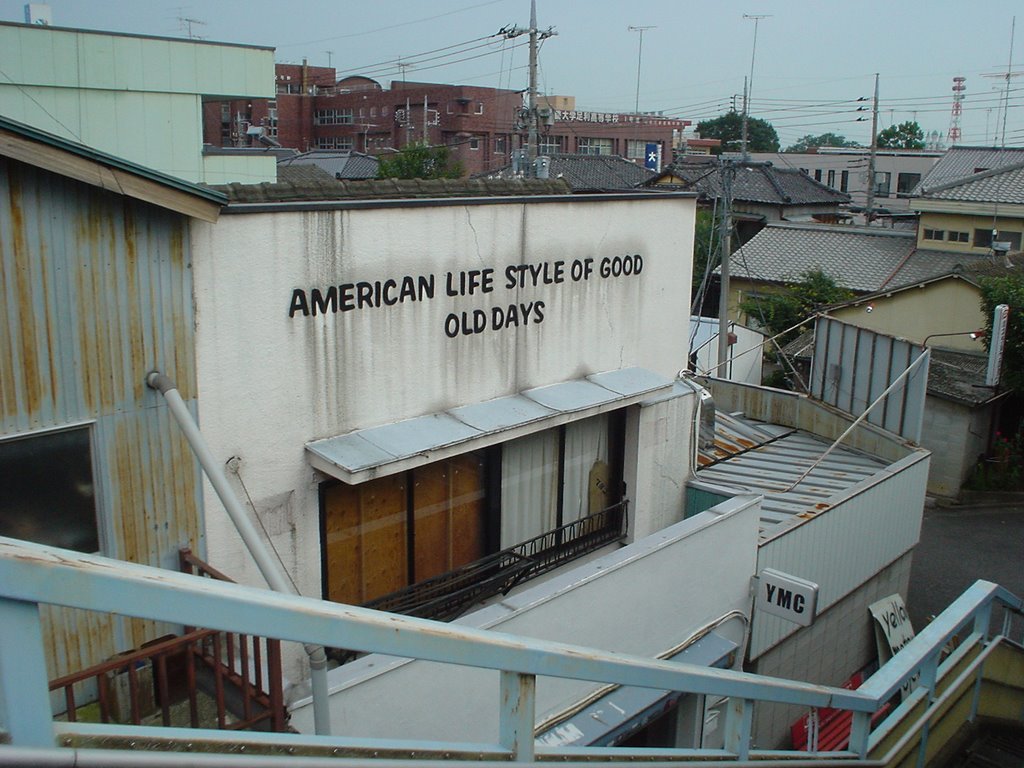
The Sano Premium Outlets map lists, not 69, but 159 shops, ranging from Adidas, Armani, and Billabong to Tommy Hilfinger, Victorinox, and Wedgwood. The lines were longest at Godiva and Cold Stone Creamery. The architecture is colonial America, with two tall, white steeples rising above red-brick walls, and the major thoroughfares linked by Boston, Cambridge, Lancaster, and Princeton Avenues. The shoppers were at least as interesting as the shops. Many were quite stylishly dressed, and there seemed to be an unusually high proportion of middle-aged dowagers with lapdogs and young parents with young kids. Among the first shoppers we encountered was a lady with two poodles, one of which walked around on its hind legs. I was tempted to ask her whether the poodle was also capable of a たち小便 (‘standing piss’), but I didn’t want to embarrass my daughter. I never embarrass my daughter! Well, at least not if I can help it–and I usually can’t.

UPDATE: Ashikaga is locally famous for its soba, not its ramen, but some of the most elegant ramen I’ve had anywhere can be found at the Maruyama hand-made ramen restaurant about a block south and west of the Tobu Ashikaga-shi train station. Its leek and garlic ramen is to die for! Couldn’t resist spooning up all the broth, either. Plus, it’s open on Wednesdays, when most Ashikaga restaurants take the day off.

Leave a comment

Filed under Japan