Monthly Archives: May 2004

The Ambiguous Role of the Tsushima Governor Between Korea and Japan

During the 15th and 16th centuries, the Muromachi Bakufu (1333-1573) in Kyoto was barely able to control provinces close to the capital, but it was able to establish trade relations with the Ming court (1368-1644) in China and the Chosôn court (1392-1910) in Korea. This was the Sengoku (“Warring States”) Period when powerful local daimyo (feudal lords) clashed with each other and sought their own allies abroad. Local daimyo in Kyushu established trade relations with the Portuguese, the Ryukyu Kingdom (Okinawa), and others. In 1550, Francis Xavier also undertook a mission to the capital, Kyoto.

The enterprising governor of Tsushima was empowered by the Chosôn court to issue access permits to Japanese envoys wishing to trade with Chosôn, according to historian Kenneth R. Robinson of International Christian University in Tokyo, who published an article on “The Tsushima Governor and Regulation of Japanese Access to Chosôn in the Fifteenth and Sixteenth Centuries” in Korean Studies 20 (1996): 23-50.

This article suggests that Chosôn government officials did not strictly adhere to the tributary system model of international relations in their dealings with Japanese. Officials borrowed from Chinese example and from domestic policy in designing Japanese access control policies that responded flexibly to political conditions in Japan. The munin access permits issued by the Tsushima shugo [‘provincial governor’] were perhaps the most important feature of these policies. But treatment of Tsushima and the Tsushima shugo by Korean officials made ambiguous the identities not only of Tsushima and the Tsushima shugo, but also the state boundaries of Chosôn and Japan. These negotiable ambiguities raise questions of how to conceptualize relations between Koreans and Japanese in the fifteenth and sixteenth centuries….

The munin systems of access control, in which Japanese bound for Chosôn obtained a munin (access permit) from the Tsushima shugo, did not originate directly from the tributary system of international relations [that prevailed in China]. Adapted from Chosôn government policies for controlling the domestic travel of Koreans, the munin systems served the complementary needs of the Chosôn government in regulating Japanese contact and of Sô Sadamori and his successors as Tsushima shugo in enhancing the powers of that office. The Tsushima shugo issued three types of access permits to three types of Japanese for three distinct activities: to envoys for diplomacy, which was understood generally to be a fiction for trade; to Tsushima islanders trading in fish and salt along the Chosôn coast; and to Tsushima fisherman for fishing in Chosôn waters. In the space between the vision offered by international relations in the tributary system model and the complexities of policymaking that faced Chosôn government officials, Muromachi Bakufu officials, and the Tsushima and other provincial governors there emerged policies that made ambiguous the administrative boundaries of “Chosôn” and “Japan” and the identity of “Tsushima.”

Apparently, a fair number of these envoys were imposters, according to the abstract of a 1997 paper by Robinson presented at the Association for Asian Studies annual meeting entitled “Japanese Imposter Sovereign Envoys to Choson: The Late Fifteenth Century.”

Royal envoys from Ryukyu, envoys of Japanese provincial governors and traders, and Japanese shogunal envoys began visiting Choson Korea in the late 1300s and early 1400s. In the late fifteenth century, Japanese impostor sovereign envoys began seeking to trade with the Choson government. They donned a variety of disguises, modeling themselves after envoys with whom the Choson court had been trading for decades. Some represented the “King of Ryukyu,” others the rulers of countries unknown to Korean officials. Choson court officials met (impostor) Ryukyu envoys as they had earlier royal envoys until they began to recognize mistakes in the envoys’ documentation. These less fortunate envoys were received at a reduced level of reception, one reserved for foreign government elites. As for the envoys of the rulers of the unknown countries, they failed to convince Korean officials of the existence of those countries. But, rather than turn away these visitors, Choson court officials received them at the same, reduced status as the unmasked impostor Ryukyu royal envoys. Reception of these impostor envoys displays elements of the Choson Korea world order. Formed in part to promote trading over raiding, this hierarchical world order functioned simultaneously with the Ming Chinese tributary system. Choson court officials ranked the Chinese emperor as superior, the rulers of the tributary states of Japan and Ryukyu as equals to the Choson king, and Japanese and Ryukyuan government officials and traders as of lower status. The tributary system informed the structure of the Choson court’s reception system, but tributary status did not confine Choson court officials to a set portfolio of foreign policies. Stated differently, Korean officials did not defer to the Chinese in their conduct of relations with Japanese and Ryukyuans.

The position of Tsushima seems a good deal less ambiguous than it was 500 years ago, but the general nature of international diplomacy doesn’t seem to have changed all that much, regardless of the polite fictions enshrined in the Treaty of Westphalia (at which England, Poland, Muscovy, and Turkey were the only European powers that were not represented).

Leave a comment

Filed under China

Badly Handled Territorial Pissing Matches

The Marmot has a couple of sad but funny posts about “stupid territorial pissing matches”: the latest flare-up over Dokdo/Takeshima in the East Sea/Japan Sea, and over Hans Island in the North Atlantic, with a few asides about the Great Turbot War between Canada and Spain in the mid-1990s, the Cod War between Iceland and the U.K. in the mid-1970s, the Aroostook (or Pork and Beans) “War” between New Brunswick and Maine in the 1830s, and similar disputes, with a lot of links.

Leave a comment

Filed under Japan, Korea

Literacy, Emotion, and Authority on a Polynesian Atoll

Is writing just speech in a different medium? Is writing more authoritative, objective, and reliable than speech? Can a text be understood without its context? Not in the literacy practices of the Polynesian atoll in Tuvalu, according to a book by anthropologist Niko Besnier.

The chief value of a good ethnographic description lies not in what its readers learn about others, but in what they learn—or unlearn—about themselves. Besnier (B) provides the ingredients for a healthy dose of unlearning in this useful and stimulating attempt both to describe the roles of literacy on Nukulaelae in Tuvalu and to offer a broader comparative and theoretical perspective, as the series title implies. This work is especially valuable in casting doubt on several assumptions that linguists too rarely question about the written vs. spoken word: (1) that writing is just speech in a different medium; (2) that writing is more authoritative, objective, or reliable than speech; and (3) that a transcribed text can be understood without its context.

B starts with a useful introduction to literacy theory (1–20) and concludes with a very stimulating comparative-ethnographic discussion (169–187). He contrasts two primary approaches: “the autonomous model” primarily articulated in a series of works by Jack Goody, and “an ideological model” primarily articulated in works by Brian Street. (The choice of determiner already reveals B’s sympathies, since it implies that the former has begun to lapse into rigor mortis, while the latter is still growing in new directions.) According to B, the autonomous model proposes that literacy itself is a causal (or at least enabling) factor that explains the differences often described (or imagined) between preliterate and literate individuals, societies, and cultures (2–3). Critics, including B, “find highly suspect the uncanny resemblance between middle-class academic ways of viewing literacy … and the social, cultural, and cognitive characteristics purported to be the consequences of literacy” (3). They argue instead that “literacy should be viewed not as a monolithic phenomenon but as a multi-faceted one, whose meaning … is crucially tied to the social practices that surround it and to the ideological system in which it is embedded” (3). B thus concentrates on the two most important products of literacy on Nukulaelae: letters and sermons.

Although whalers first visited Nukulaelae as early as 1821, literacy was first implanted by Samoan teachers and pastors dispatched by the London Missionary Society (LMS) in the 1860s. Conversion to Protestant Christianity was swift and thorough, but the language of religion and literacy remained primarily Samoan for a hundred years thereafter. Western missionaries rarely visited and the Bible was not fully translated into a dialect of Tuvaluan until 1987. Although English has by now supplanted Samoan as the model for literacy practices, few residents of Nukulaelae command it as well as their ancestors did Samoan. (Those who do so are likely to have learned it elsewhere and to seek salaried work that takes them elsewhere.)

As in many other parts of the world, literacy was introduced to Nukulaelae primarily for evangelistic purposes. Although some thus consider it to be an unredeemably nefarious hegemonic technology, the islanders quickly put it to use for a very important socioeconomic function of their own: keeping in touch with their far-flung networks of relatives and friends, benefactors and beneficiaries. Virtually all adults on the atoll are able to read and write their native language in a rough-and-ready orthography based on Samoan, which lacks only the geminate consonants found in Tuvaluan and several other Polynesian outliers and thus affords no consistent means to write them. Whenever the government ship arrives in Nukulaelae on its unpredictable rounds (at perhaps monthly intervals), the island becomes a hive of activity as people feverishly prepare to receive and then dispatch passengers, packages, and letters by the time the ship leaves the next day. Letters serve the purpose of renewing emotional as well as economic ties across long distances. They tend to be read and written late into the night in the same emotionally charged state that characterizes traditional farewells and returns. If anything, letters often display an even greater emotionality than is socially acceptable face-to-face. Cousins of opposite gender, for instance, are supposed to avoid each other’s presence, and yet letters between them “display as much affect as any other letter” (108). Nukulaelae Islanders thus appear to “define letter writing and reading as affectively cathartic contexts” (111). At the same time, letters undertake the more prosaic task of listing the contents of accompanying packages or the material needs of the writers that their correspondents are invited to fulfill. But here too, letters cannot be considered more objective and reliable than speech. Letters are often lost, damaged, delayed, or misunderstood, so the most authoritative and reliable way to send a message is for someone to deliver it in person and to explain the context in which it was written and answer any questions the recipient might have.

The written word is considerably more authoritative in religious contexts, with the printed Bible the most authoritative of all. However, written tracts distributed by competing religious groups are not accorded the same degree of respect. The authorship of a message confers authority and legitimacy more than its medium….

SOURCE: Review of Literacy, emotion, and authority: Reading and writing on a Polynesian atoll, by Niko Besnier (Cambridge: Cambridge U. Press, 1995) in Oceanic Linguistics 35 (1996): 148-151

Leave a comment

Filed under language, Polynesia

Women’s World Chess Championship Moves to Tibetan Buddhist Outpost in Europe

The Argus has a whole series of interesting posts about the conflicts between the newly renovated democratic Republic of Georgia and its separatist movement in Ajaria. Living With Caucasians is on the case, too. Among the drastic bits of fallout is this:

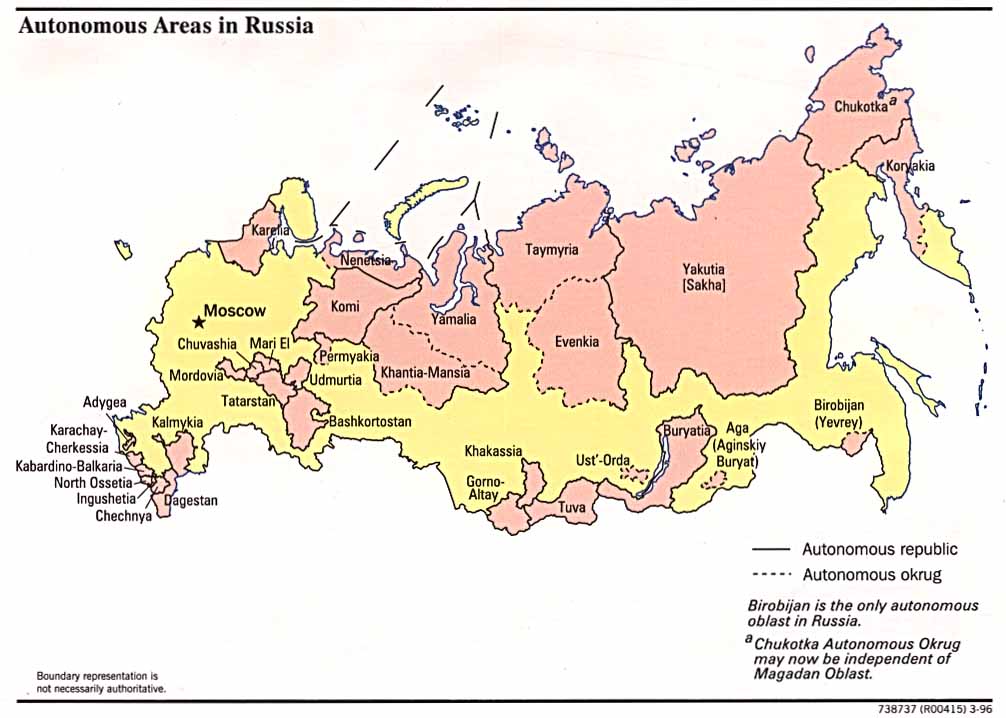
The Women’s World Championship has moved from Batumi [in Ajaria] to Elista. ‘Where the hell is Elista?’ you ask. Kalmykia, Tibetan Buddhism’s outpost in Europe (when it was independent, it was the only Buddhist kingdom in Europe). On this map, it’s south of Moscow and just above Dagestan.

To see where the Kalmyk-Oirat fit into the Greater Turanian States and Territories, visit the Ottawa Hungarian Folkdance Chamber Group, which seeks to restore Hungarians to their rightful place as masters of Eurasia.

See also Kalmykia and Buddhism in Russia.

UPDATE: On a more serious (but joyful) note, the U.S. and Russia seemed to have cooperated to help the citizens of Georgia and Ajaria liberate themselves from the now-exiled thug, Aslan Abashidze. The Argus offers a detailed chronology. I hope the Georgian sumo wrestler Kokkai (‘Black Sea’) is pumped up enough to make a spectacularly successful showing in this month’s sumo tourney.

UPDATE: In the comments, PF cites some evidence that the millionaire chess-enthusiast Kirsan Ilyumzhinov, President of Kalmykia, might deserve a good dose of thug-repellant as well. At the very least, he seems to suffer from a serious cult-of-personality disorder.

Leave a comment

Filed under sumo

Politburo Paranoia in China

On 23 April, Andrés Gentry cited a depressing article (no longer online) on MSNBC that illustrates how fragile and paranoid China’s top political leaders seem to feel.

The eight members of the New Youth Study Group never agreed on a political platform and had no real source of funds. They never set up branches in other cities or recruited any other members. They never even managed to hold another meeting with full attendance; someone was always too busy.

And yet they attracted the attention of China’s two main security ministries. Reports about their activities reached officials at the highest levels of the party, including Luo Gan, the Politburo member responsible for internal security. Even the president then, Jiang Zemin, referred to the investigation as one of the most important in the nation, according to people who have seen an internal memo summarizing the comments of senior officials about the case.

The leadership’s interest in such a ragtag group reflects a deep insecurity about its grip on power. The party has delivered two decades of rapid growth, defying those who believe economic reform must lead to political liberalization. But it is struggling to manage rising social tension and popular discontent and remains especially wary of student activism, which sparked the 1989 pro-democracy demonstrations in Tiananmen Square.

So the party moved quickly to eliminate the New Youth Study Group. In doing so, it forced eight young people to consider how much they were willing to sacrifice for their beliefs — and for their friends.

This account is based on interviews with the four members of the study group who escaped arrest, relatives and friends of those imprisoned, and others who attended the group’s meetings, as well as documents presented in court in the case.

Leave a comment

Filed under China

Flit(tm): Is the PRC Crashing?

TMLutas of Flit(tm) cites a Stratfor article (only temporarily accessible) under the heading, Is the PRC Crashing?

Essentially the argument is that the PRC is making the same errors that every other Asian country has lived through. It is aided by the fact that its currency is nonconvertible but that’s no panacea. It is suffering from a plague of crony loans made to connected people who have hollowed out their economy. Essentially, we’re in the end stages of the PRC’s economic pyramid scheme.

The stakes are quite high. If the PRC falls into crisis, it is much less likely to survive than Japan and more likely to fracture into the traditional solution of warlord dominated regional entities.

Leave a comment

Filed under China

Thailand: Dangers of Jihadi Reprisal

The South Asia Analysis Group has just posted an analysis of the recent clash between Muslim youth and Thai police in the Pattani area of southern Thailand.

3. The tactics adopted by the poorly-armed Muslim youth bring to mind more that of the LTTE in the early years of its struggle against the Sri Lankan Armed Forces or of the Maoists of Nepal or of the tribal insurgents of India’s North-East than that of the jihadi terrorists active in the South-East Asian and South Asian region. The LTTE, the Maoists and the Indian tribal insurgents used to adopt such tactics to replenish their stocks of arms and ammunition.

4. What these young Muslims have exhibited in common with their co-religionists in Pakistan, Afghanistan and elsewhere is their fierce motivation and not the modus operandi adopted by them. They do not appear to be bandits or narcotics smugglers as projected by Prime Minister Thaksin Shinawatra of Thailand and his officials. They are politically and religiously motivated fighters, with no evidence so far of any external influence–either from the Jemaah Islamiyah of the South-East Asian region or the jihadi organisations of Pakistan and/or Bangladesh–on their mind.

5. Attacking in large numbers with machetes is not the known modus operandi of any of the identified jihadi organisations of the International Islamic Front (IIF). They do slit the throat of their victims with a knife just as they slit the throat of a sacrificial goat with one, but they do not indulge in massive attacks on posts of the security forces and the police carrying only machetes.

At the same time, Nirmal Ghosh in the Straits Times reports:

PATTANI – A top security adviser to the [Thai] government said yesterday that an underground shadowy movement that has been building its ranks for almost a decade was behind the recent spate of violence in the country’s restive south.

And the Weekend Australian reports:

SUSPECTED Islamic militants killed by security forces at a south Thailand mosque may have been trained abroad by the al-Qaeda linked South-east Asian terror network Jemaah Islamiah (JI), a news report said today.

Pattani is just across the piracy-plagued Straits of Malacca from Aceh.

Hat tip: Winds of Change

Leave a comment

Filed under Islam, Thailand

Indonesian Legislative Elections, 2004: Round-up and Analysis

The South Asia Analysis Group has the most comprehensive round-up of data and analysis on the April 5 legislative elections in Indonesia that I’ve seen so far.

The voting pattern has indicated that majority still prefers the old school of politics as seen from the strong showing of Golkar, PDI-P and the PPP. On the other hand there are voters (presumably in the urban areas and the younger generation) who are looking for a political change as is reflected in the emergence of parties such as the Democratic Party and the PKS.

There is widespread political disillusionment over the last 5 years (2 years under the deposed president Abdurrahman Wahid and 3 years under Megawati Sukarnoputri). News reports elicited from the people from various walks of life indicated that the general public would be happy to go back to the New Order days when there was more political stability.

One of the main reasons for the disillusionment of Megawati regime has been the slow progress of the economic reforms. Besides some of the reforms such as cuts in power subsidies were unpopular. The high percentage of unemployment has not been attended to. Corruption at all levels is also affecting the economy. Incidentally a survey of foreign businessmen carried out by Hong Kong based Political and Economic Risk Consultancy Limited indicates that Indonesia is the most corrupt country in Asia for the third year running.

Unfortunately, the analysis was posted on 20 April, just before the final vote tally and just before Golkar nominated General Wiranto as its presidential candidate. Here’s what the SAAG had to say about the upcoming presidential elections on 5 July.

It may be remembered that in 1999, a loose grouping of Islamic parties succeeded in preventing Megawati from becoming the president even though her party (PDI-P) was the leading party with 34 per cent of the votes. Amien Rais of the National Mandate party, who is also speaker of the People’s Consultative Assembly (MPR), is trying a similar strategic move this time by forming a coalition called “Save the Nation Axis” with the Prosperous Justice Party (PKS). This only confirms his ambitions for the post of the president.

The leading contenders to the post of the President are:

Akbar Tandjung of Golkar (party ranking first in this election)

Megawati Sukarnoputri of PDI-P

Susilo Bambang Yudhyono of Democratic Party

Amien Rais of the National Mandate Party

The position may become clear once the Golkar convention scheduled for 20 April decides about its presidential candidate. Akbar Tandjung, a seasoned politician since 1977 and a former minister under Suharto, has recently been accused of corruption in a major case though he has been cleared by the Supreme Court. The fight in Golkar is primarily between him and General Wiranto, a former armed forces chief who has been indicted for atrocities in East Timor.

With the strong mandate for Golkar, Akbar Tandjung has all the advantages and the political acumen for becoming the next president. However the opinion polls show that Susilo Bambang Yudhyono, the former security minister under Megawati and a former general is ahead of all the other presidential candidates including Akbar Tandjung. He has also scored over Golkar and the PDI-P by selecting Jusuf Kalia, the Chief Social Welfare Minister as his running mate for the presidential election. Both Golkar and the PDI-P were eyeing him as their vice presidential candidate. The chances of Megawati returning as president by a successful manipulation of a viable coalition are not very bright. As Abdurrahman Wahid made it to the presidency in 1999 from nowhere, the presidential poll this time also can bring a surprise winner, though it may not be in the best interests of the country.

Leave a comment

Filed under Indonesia

The Oldest Malay Manuscript Ever Discovered

Uli Kozok, assistant professor of Indonesian language at the University of Hawai‘i, is studying the oldest Malay manuscript ever discovered. It appears to date from before the advent of Islam.

In 2001 I received a Research Relation grant to study the Kerinci script of central Sumatran as part of my work on the palaeography of Southeast Asia. The grant was used for the mapping of existent variants of the central Sumatran scripts that provided us with new insights into the internal relationship between the two closely related scripts. [See map.]

In 2002 I received a second Research Relation grant that resulted in the spectacular discovery of what I believed was the oldest extant Malay manuscripts. This manuscript, a legal code of 34 pages that I found in the village of Tanjung Tanah, contains two texts, one in the old Malayu script, and one in an ancient form of the Kerinci script, which is very likely the missing link in the development of the Kerinci and other South Sumatran scripts from an earlier version of the Sumatran version of the kawi script [Indic-derived and used to write Old Javanese].

The research was continued in 2003, again supported by a Research Relation grant. In the meanwhile my assertion that the Tanjung Tanah manuscript is the oldest extant Malay manuscript came under attack by scholars of Javanese palaeography who argued that, on palaeographic grounds, the manuscript is not older than 200 years. As an expert in Sumatran script I immediately knew that such a late age was impossible, and also the textual evidence (e.g. the absence of any Arabic loanwords) ruled out a date as recent as the 18th century. Since I was unable to challenge their conclusion (I am not in expert of the Javanese script to which the Sumatran Malayu script is closely related), I decided to support my claim with scientific evidence and asked the owner to provide me with a small sample of the manuscript that I sent to the Rafter laboratory in Wellington, New Zealand. The result corroborated my hypothesis which was based on philological and historical evidence unanimously.

This manuscript is now beyond any doubt the oldest Malay manuscript in the world (most likely 2nd half of the 14th century) predating the hitherto oldest manuscript by nearly 200 years! …

My research on the Tanjung Tanah manuscript (which is the only Malay manuscript in a pre-Islamic script) is significant in that it makes a number of theories on early Malay literacy obsolete, and forces us to entirely rethink the intellectual history of the pre-Islamic Malay world.

If it can be established that the Tanjung Tanah manuscript is palaeographically related to the 13th century Adityawarman inscriptions, we will not [only] have convincing proof that the manuscript dates to the 14th century, but it is also very likely that the manuscript will force us to entirely rethink Sumatran palaeography that hitherto had been closely linked to Java with its abundance of stone inscriptions and (from the 14th century onwards) manuscripts [in Arabic-derived Jawi script].

The translation of the manuscript, and the analysis of the language it is written in will give us new insights into the early Malay legal system, the political relationship between the coastal Malay maritime kingdoms with the upriver communities in the Bukit Barisan mountain range, but also into the development of the Malay language since this is the oldest existing substantial body of text in the Malay language.

Leave a comment

Filed under language, Malaysia

Impearls on May Day, the Haymarket Riots, and Capital Punishment

Impearls has a timely look back at the origins of May Day in the 1886 Haymarket Riots in Chicago, which serve as an object lesson in a polemic about the dangers of capital punishment.

Today is May Day, May 1st. People in America are often vaguely aware that other regions of the world, especially Europe and leftist-impressed parts, celebrate May Day as the occasion for a pro-labor holiday, the equivalent of the U.S.’s Labor Day held in the fall. Few Americans, however, recall that this day actually commemorates events which occurred in the United States, in Chicago, on and after May 1, 118 years before this day.

Fifteen years ago, three years after the centenary, I posted a progenitor of this polemic on the Usenet (aka Newsgroups), which rather than emphasizing the labor aspect of the day in history, treated it as an abject example of the dangers of application of the death penalty by society, and the certainty that innocents will be executed in error if capital punishment is employed to any significant extent. I believe the subject is even more pertinent today than it was back then.

Read the rest.

Leave a comment

Filed under U.S.