Pamuk on Linguistic Cleansing in Istanbul

After a long period when no one of consequence came to Istanbul, and local journalists interviewed all foreigners who turned up at the Hilton Hotel, the Russian-American poet Joseph Brodsky published a long piece entitled “Flight from Byzantium” in The New Yorker.

Perhaps because he was still smarting from W. H. Auden’s brutal review of the book recounting his journey to Iceland, Brodsky began with a long list of reasons he’d come to Istanbul (by plane). At the time I was living far from the city and wanted to read only good things about it, so his mockery was crushing, yet I was glad when Brodsky wrote, “How dated everything is here! Not old, ancient, antique, or even old-fashioned, but dated!” He was right. When the empire fell, the new Republic, while certain of its purpose, was unsure of its identity; the only way forward, its founders thought, was to foster a new concept of Turkishness, and this meant a certain cordon sanitaire to shut it off from the rest of the world. It was the end of the grand polyglot multicultural Istanbul of the imperial age; the city stagnated, emptied itself out, and became a monotonous monolingual town in black and white.

The cosmopolitian Istanbul I knew as a child had disappeared by the time I reached adulthood. In 1852, Gautier, like many other travelers of the day, had remarked that in the streets of Istanbul you could hear Turkish, Greek, Armenian, Italian, French, and English (and, more than either of the last two languages, Ladino, the medieval Spanish of the Jews who’d come to Istanbul after the Inquisition). Noting that many people in this “tower of Babel” were fluent in several languages, Gautier seems, like so many of his compatriots, to be slightly ashamed to have no language other than his mother tongue.

After the founding of the Republic and the violent rise of Turkification, after the state imposed sanctions on minorities—measures that some might describe as the final stage of the city’s “conquest” and others as ethnic cleansing—most of these languages disappeared. I witnessed this cultural cleansing as a child, for whenever anyone spoke Greek or Armenian too loudly in the street (you seldom heard Kurds advertising themselves in public during this period), someone would cry out, “Citizens, please speak Turkish!”—echoing what signs everywhere were saying.

SOURCE: Istanbul: Memories and the City, by Orhan Pamuk (Vintage, 2006), pp. 238-239

Dumneazu blogger Zaelic comments:

True, but with holes in it. On my last trip to Istanbul I managed to find myself in several situations where other languages indigenous to Istanbul were openly used. Kurdish and Laz were not rare among my friends. On the street where we lived in Beyoglu (known as the Tomtom Kapitan neighborhood) Kurdish was never rare, Arabic was common and occaisionally I heard Romani. I found Ladino spoken both at the booksellers shops near Tunel, as well as on the Princess Island of Burgaz Ada. Also Greek on Burgaz Ada, as well as Pontic Greek among some Muslim Rumca-speaking friends from the Black Sea coast (who moved back to Istanbul after being raised speaking Rumca in Germany! They essentially had to learn Turkish in Turkey – in Essen they spoke Rumca as kids and thought it was Turkish! On the weekend ferry to Buyuk Ada – where the upper class Armenians of Istanbul have their weekend homes – I heard a lot of Armenian, something which my American friend who has resided in a strongly Armenian neighborhood of Istanbul for years (Samatya) says came as a great surprise to him. I wouldn’t say that Pamuk is wrong, but things have loosened up in the last five years… people are less afraid to be heard speaking languages in the streets that have often been confined to the kitchen.

For a skeptical take on either Pamuk’s Istanbul and his memories of Brodsky and Auden or the translation thereof, see House of Mirth, who notes that Auden, not Brodsky, was the author of the travelogue about Iceland.

Leave a comment

Filed under Armenia, language, Turkey

Romanian Synonymy: Romanian and French

The following synonym sets are formed from Romanian and French components.

  • călătorie ~ voiaj ‘trip’
  • întrecere ~ concurs/competiţie ‘competition’
  • convorbire ~ conversaţie/discuţie ‘conversation, discussion’
  • însufleţire/înflăcărare ~ entuziam ‘inspiration, enthusiasm’
  • cleveteală/bârfeală ~ calomnie ‘gossip, slander’
  • indignare ~ revoltă ‘revolt’
  • dovadă ~ argument ‘evidence, argument’
  • putere/tărie ~ forţă ‘power, force’
  • a înfăptui/îndeplini ~ a realiza ‘to fulfill, realize’
  • a zugrăvi/înfăţişa ~ a reda/descrie ‘to depict, render’
  • a contrazice ~ a combate/obiecta ‘to contradict, object’
  • a înapoia ~ a restitui ‘to give back, make restitution’
  • a pregăti ~ a prepara ‘to prepare’
  • a întrece ~ a depăşi ‘to overtake’
  • a înştiinţa ~ a comunica/anunţa ‘to inform, announce’

SOURCE: Section 3.1.5.7 in “Formation of Synonyms” Probleme de sinonimie, by Onufrie Vinţeler (Bucureşti: Editură Sţiinţifică şi Encliclopedică, 1983) [my translation].

In sharp contrast to the mostly rural, earthy Slavic borrowings examined earlier, these adoptions from French seem to reflect usage by cosmopolitan, high-society types, thus conforming to one of the earliest assumptions about why speakers of one language borrow words from another: because the lending language has more prestige. However, note that the Romanian equivalents of French Bon voyage and Bon appétit are Drum bun and Poftă bună, respectively, where the nouns are in both cases of Slavic origin.

Leave a comment

Filed under France, language, Romania

Pamuk on Humiliation as a Teaching Method

In his memoirs, Falaka and Nights, Ahmet Rasim wrote at length about his school days a century ago, when teachers in Ottoman schools held rods so long they could hit their pupils without even rising from their seats; our teachers encouraged us to read these books, perhaps to show us how lucky we were to have been spared the pre-Republican, pre-Atatürk era of the falaka [= bastinado]. But even in wealthy Nişantaşı, in the well-endowed Işık Lycée School, the old teachers left over from the Ottoman period found in some “modern” technical innovations new tools for oppressing the weak and defenseless: Our French-made rulers, and especially the thin hard strips of mica inserted into their sides, could, in their practiced hands, be as effective as the falaka and the rod.

In spite of myself, I almost rejoiced whenever someone else was disciplined for being lazy, uncivilized, stupid, or insolent. I was happy to see it applied to one gregarious girl who came to school in a chauffeur-driven car; a teacher’s pet, she was always standing up before us to do a croaky rendition of “Jingle Bells” in English, but this earned her no clemency when she was found guilty of doing sloppy homework. There were always a few who hadn’t done their homework but pretended they had, acting as if it was somewhere in their notebook if only they could find it. They’d cry out, “I can’t find it right now, teacher!” just to delay the inevitable for a few seconds, but it only added to the violence with which the teacher smacked them or pulled their ear.

When we’d moved on from the sweet and motherly women teachers of our early years to the angry old embittered men who taught us religion, music, and gymnastics in the upper grades, these rituals of humiliation became more elaborate, and there were times when the lessons were so boring that I was glad for the few minutes of entertainment the punishments provided….

I’d watch these scenes—first a scolding, then an angry shower of books and notebooks, while the rest of the class sat in frozen silence—thankful I was not one of those hapless pupils marked for humiliation. I shared my good fortune with about a third of the class. If this had been a school for children of all backgrounds, the line that set the lucky ones apart might have been more distinct, but this was a private school and all the pupils came from wealthy families. In the playground during recess, we enjoyed a childish fellowship that made the line disappear, but whenever I watched the beating and humiliation, I, like the awesome figure seated at the teacher’s desk, would ask myself why it was that some children could be so lazy, dishonorable, weak-willed, insensitive, or brainless. There were no answers to my dark moral probings in the comic books I’d begun reading; their evil characters were always drawn with crooked mouths. Finding nothing, either, in the shadowy depths of my own childish heart, I’d let the question fade away. I came to understand that the place they called school had no part in answering life’s most profound questions; rather, its main function was to prepare us for “real life” in all its political brutality. And so, until I reached lycée, I preferred to raise my hand and remain safely on the right side of the line.

SOURCE: Istanbul: Memories and the City, by Orhan Pamuk (Vintage, 2006), pp. 124-126

Leave a comment

Filed under education, Turkey

The Two Koreas: Cold War Tails Wagging Dogs

“NON-ALIGNMENT” was not the only weapon available to small powers seeking to expand their autonomy while living in the shadow of superpowers: so too was the possibility of collapse. There was no way that staunch anti-communists like Syngman Rhee in South Korea, Chiang Kai-shek on Taiwan, or Ngo Dinh Diem in South Vietnam could plausibly threaten to defect to the other side (although Diem, desperate to hang on to power as the Americans were abandoning him in 1963, did implausibly attempt to open negotiations with the North Vietnamese). Nor could such dedicated anti-capitalists as Kim Il-sung in North Korea or Ho Chi Minh in North Vietnam credibly raise the prospect of alignment with the United States. What they could do, though, was encourage fears that their regimes might fall if their respective superpower sponsors did not support them. The “dominos” found it useful, from time to time, to advertise a propensity to topple.

Korea’s history after the Korean War provides a clear example. Rhee had adamantly opposed the 1953 armistice that left his country divided, and in an effort to sabotage it, had released thousands of North Korean prisoners-of-war so that they could not be sent home against their will. Washington was as outraged by this as was Pyongyang, for Rhee acted on his own. He did not succeed in scrapping the armistice, but he did signal the Eisenhower administration that being a dependent ally would not necessarily make him an obedient ally. His most effective argument was that if the United States did not support him—and the repressive regime he was imposing on South Korea—that country would collapse, and the Americans would be in far worse shape on the Korean peninsula than if they had swallowed their scruples and assisted him.

It was a persuasive case, because there was no obvious alternative to Rhee. The United States could “do all sorts of things to suggest … that we might very well be prepared to leave Korea,” Eisenhower noted gloomily, “but the truth of the matter was, of course, that we couldn’t actually leave.” And so Rhee got a bilateral security treaty, together with a commitment from Washington to keep American troops in South Korea for as long as they were needed to ensure that country’s safety. This meant that the United States was defending an authoritarian regime, because Rhee had little patience with, or interest in, democratic procedures. South Korea was what he, not the Americans, wanted it to be, and to get his way Rhee devised a compelling form of Cold War blackmail: if you push me too hard, my government will fall, and you’ll be sorry.

The Soviet Union, it is now clear, had a similar experience with Kim Il-sung in North Korea. He was allowed to build a Stalinist state, with its own cult of personality centered on himself, at just the time when Khrushchev was condemning such perversions of Marxism-Leninism elsewhere. That country became, as a result, increasingly isolated, authoritarian—and yet totally dependent on economic and military support from the rest of the communist world. It was hardly the result Khrushchev or his successors would have designed, had they had the opportunity. They did not, however, because Kim could counter each suggestion for reform with the claim that it would destabilize his government, and thereby hand victory to the South Koreans and the Americans. “[I]n the interests of our common tasks, we must sometimes overlook their stupidities,” one Soviet official explained in 1973. Both Washington and Moscow therefore wound up supporting Korean allies who were embarrassments to them. It was a curious outcome to the Korean War, and another reminder of the extent to which the weak, during the Cold War, managed to obtain power over the strong.

SOURCE: The Cold War: A New History, by John Lewis Gaddis (Penguin, 2005), pp. 129-130

Leave a comment

Filed under Korea, U.S., USSR, war

China Train Trips: Via Nanjing to Jingdezhen

After an idyllic few days in Hangzhou during our Chinese New Year getaway vacation in 1988, the Far Outliers boarded a train for Nanjing, sitting on hard-class seats. We had decided to bypass Shanghai, which was dealing with a cholera outbreak. But throngs of people were heading in that direction anyway. The crowd on the way to the wickets and platform was so closely packed that we were afraid our two-year-old daughter might fall and get trampled.

We arrived in Nanjing that evening and found rooms at a somewhat dilapidated grand hotel a short taxi ride from the train station. The weather was foggy and rainy and the streets were snowy and wet, so instead of walking the city the next morning, we killed time in the warmth and luxury of the Jinling Hotel, trying not to spend any dollars. For lunch, we walked down the street to a place specializing in Mongolian hotpot (lit. ‘firepot’, 火鍋 or 火锅 huoguo), where we could spend renminbi.

Although the hotel complex overlooked the Yangtze River, thick fog prevented us from ever seeing either the river or the bridge. However, we did spend a lot of time listening to languages from all over the world in the sprawling lobby. One lady we chatted with challenged us to identify the language she was speaking with her friends. Her intonation sounded Scandinavian, but I couldn’t recognize any Germanic cognates, so I correctly guessed Finnish. She was sure I had relied on nonlinguistic clues.

As soon as we had arrived in Nanjing, we had booked soft-class sleeper tickets to
Jingdezhen for the following day, then sent a telegram to our friends awaiting us there. They were fellow teachers at Sunwen College in Zhongshan City in Guangdong Province, who had provided me with a Chinese-character telegram template into which I was to write the day and time of our arrival. The telegram worked fine. I felt sorry for the clerk who had to translate each character into a 4-digit Chinese telegraph code for transmission, but she had probably memorized most of the codes for times and well-used place names.

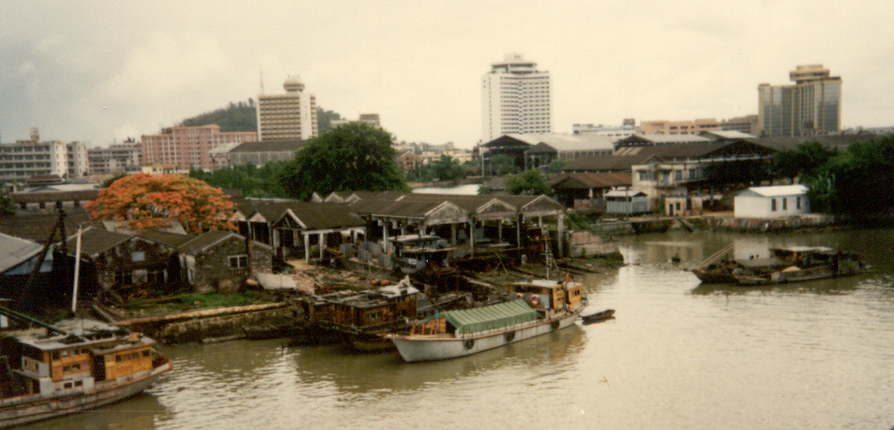
Jingdezhen in 1988 (pictured above) was a muddy, gray, dilapidated industrial city without any tourist hotels that we noticed, despite its long-standing fame for producing some of the finest porcelain in China. It gave us a feel for what life was like away from the coastal cities and a bit off the beaten track. Our friends had arranged for us to stay at a guesthouse for visiting delegations and they gave us a walking tour of their hometown. Among the things that struck me as we walked past storefronts were tinsmiths that repaired pots and pans, and television vendors offering video games on black-and-white sets. But there were also a large number of porcelain shops as well as street vendors selling “factory seconds,” from whom we bought several small vases and tea sets with hand-painted designs.

Among the highlights of our visit was the chance to share lunch and xiuxi (‘rest time’) in the home of one set of parents near the city hospital where they worked, and dinner in the home of the other set at the edge of town across the river. The father, who had only seen Americans on Korean battlefields, was overcome with emotion when recounting his experiences. Only my youngest uncle served in the Korean War—as a sailor aboard a submarine tender. (All my older uncles, except the eldest, served in World War II, but only one served in the Pacific.)

Leave a comment

Filed under China, travel

Pamuk on Religion and the Secular Elite

My first trip to a mosque helped confirm my prejudices about religion in general and Islam in particular. It was almost by chance: One afternoon when there was no one home, Esma Hanım took me off to the mosque without asking anyone’s permission; she was not so much burning with a need to worship as tired of being inside. At Teşvikiye Mosque we found a crowd of twenty or thirty people—mostly owners of the small shops in the back streets or maids, cooks, and janitors who worked for the rich families of Nişantaşı; as they gathered on the carpets, they looked less like a congregation of worshipers than a group of friends who had gathered to exchange notes. As they waited for the prayer time, they gossiped with one another in whispers. As I wandered among them during prayers, running off to the far corners of the mosque to play my games, none of them stopped to scold; instead, they smiled at me in the same sweet way most adults smiled at me when I was a young child. Religion may have been the province of the poor, but now I saw that—contrary to the caricatures in newspapers and my republican household—religious people were harmless.

Nevertheless, I was given to understand by the high-handed ridicule directed at them in the Pamuk Apartments that their good-hearted purity carried a price. It was making the dream of a modern, prosperous, westernized Turkey more difficult to achieve. As westernized, positivist property owners, we had the right to govern over these semiliterates, and we had an interest in preventing their getting too attached to their supersititions—not just because it suited us privately but because our country’s future depended on it. If my grandmother discovered that an electrician had gone off to pray, even I could tell that her sharp comment had less to do with the small repair job he had left unfinished than with the “traditions and practices” that were impeding “our national progress.”

The staunch disciples of Atatürk who dominated the press, their caricatures of black-scarved women and bearded reactionaries fingering prayer beads, the school ceremonies in honor of the Martyrs of the Republican Revolution—all reminded me that the nation-state belonged more to us than to the religious poor, whose devotion was dragging the rest of us down with them. But feeling at one with the mathematics and engineering fanatics in our own household, I would tell myself that our mastery did not depend on our wealth but on our modern western outlook. And so I looked down on families that were as rich as we were but not as western. Such distinctions became less tenable later on, when Turkey’s democracy had matured somewhat and rich provincials began flocking to Istanbul to present themselves to “society”; by then my father’s and my uncle’s business failures had taken their toll, subjecting us to the indignity of being outclassed by people who had no taste for secularism and no understanding of western culture. If enlightenment entitled us to riches and privilege, how were we to explain these pious parvenus? (At the time I knew nothing about the refinements of Sufism or the Mevlana or the great Persian heritage.) For all I knew, the new class denounced as “rich peasants” by the political left held views no different from those of our chauffeurs and cooks. If Istanbul’s westernized bourgeoisie gave support to the military interventions of the past forty years, never strenuously objecting to military interference in politics, it was not because it feared a leftist uprising (the Turkish left in this country has never been strong enough to achieve such a feat); rather, the elite’s tolerance of the military was rooted in the fear that one day the lower classes would combine forces with the new rich pouring in from the provinces to abolish the westernized bourgeois way of life under the banner of religion. But if I dwell any longer on military coups and political Islam (which has much less to do with Islam than is commonly thought), I risk destroying the hidden symmetry of this book.

SOURCE: Istanbul: Memories and the City, by Orhan Pamuk (Vintage, 2006), pp. 181-183

Leave a comment

Filed under religion, Turkey

China Train Trips: Hard-class to Hangzhou

Nineteen years ago this month, the Far Outliers were very much looking forward to some Chinese New Year vacation travel after a semester teaching English at newly established Sunwen College in Zhongshan City, China. The school was very much worried about the prospect of our traveling alone and wanted to get two students to accompany us. But we felt that would be a terrible imposition on both the students and ourselves, and we felt confident that we could negotiate the Chinese train system. After all, I had spent a lot of my childhood traveling on Japanese trains. How much harder could it be in China?

Somebody may have helped us buy the train tickets from Guangzhou to Hangzhou. We booked hard-class sleeper berths because we were being paid exclusively—and not very lavishly—in renminbi (‘people’s currency’), which was not yet convertible in those days. We hoarded our dwindling supply of dollar savings acessible via credit card, but nevertheless came back to the U.S. flat broke, despite getting substantially more renminbi during our second semester teaching there. The latter at least enabled us to afford a trip to Beijing and Xian before leaving China that summer.

Hard-class sleeping compartments had four berths facing each other across a narrow walkway. I was on a top berth and my wife shared a lower berth with our two-year-old daughter. There was another young child in our compartment who spent a lot of time playing with a pear, alternately holding it with his unwashed hands, dropping it on the grime-caked floor, and taking bites out of it. By Chinese standards, our daughter’s habit of thumb-sucking was just as unsanitary, but we always made sure to travel with a clean washcloth, rinsed in boiled water, and she soon learned to ask “Suck this thumb?” and get a thumb-wipe before indulging in one of her favorite contemplative activities at the time: sucking her thumb and twiddling her belly button. (As a babe in arms, she used to like to reach in and twiddle her mom’s nipple while sucking her thumb.)

By dinner time, the train was winding its way through mountain valleys beside terraced rice paddies. Vendors came down the aisles selling meals in styrofoam boxes, and about the same time we began to notice a lot of styrofoam scattered along the fields beside the tracks. After we had all eaten, we found out where it came from, as janitors worked their way down the aisles sweeping all before them with pairs of handheld brooms. At the end of each railcar, they would open a window and chuck all the rubbish out, then move on to the next car. They also seemed entirely to ignore the toilets, whose floors were awash in urine-tainted water.

We arrived in Hangzhou—so serene compared to bustling Guangzhou—early the next morning, a bit too early to check into the exquisite, Austrian-run Shangri-la Hotel Hangzhou on the north shore of West Lake. So we dawdled over bowls of hot jook (congee, 粥) in the warm hotel restaurant before checking into our rooms, where we found chocolates on the pillow and were offered complimentary glasses of warm glühwein. That stay was worth the precious dollars we spent on it. Over the next few days, we visited some of the scenic spots, bicycled around the lake, and sampled the famous Longjing (龍井 or 龙井 Dragon Well) tea grown in the nearby hills. What a welcome respite those days were.

Leave a comment

Filed under China, travel

The Iron Rooster Reaches Lhasa

The AEI‘s online magazine American.com reports that one can now ride the iron rooster all the way from the Forbidden City to the Potala and back.

The extraordinary technological challenges to building a rail line from scratch in Tibet are consid­erably easier to overcome, especially for a powerful centralized regime like China’s, than the legal and political challenges to improving a key rail connec­tion (like Boston–Washington) in the world’s most advanced economy. Also, at this point in history, the Chinese clearly value public infrastructure more than Americans.

The new western railroad creates a bittersweet reality. It will transform Tibet from a thinly populated nation with a largely nomadic population and exotic, remote tourist destinations into a more common and accessible place. For many Tibetans, especially adaptable youth, opportunities will multiply; the loss of a unique history will seem less troublesome to them than it is to the isolated, older population.

The Lamaist State of Tibet is already a memory. Chinese soldiers invaded in 1950, and Tibet became part of the PRC a year later. After an unsuccess­ful rebellion, the Dalai Lama went into exile in India in 1959, and it is clear that the Chinese will not tolerate the re-emergence of a the­ocracy—especially since the government has endowed the west with so much strategic impor­tance. In 1979, Deng Xiaoping declared that China should get on with development. “I don’t care,” Deng said, “whether the cat is black or white, as long as it can catch mice.”

Whether Tibetans will fare better under the Chinese government than they did under the Lamaist theocracy remains to be seen. The outlook for traditionalists is bleak, but for most Tibetans, the chances for a better future are enhanced by the construction of the rail line to Lhasa.

via RealClearPolitics

The author of the article takes the opportunity to bash the U.S. government for not investing enough in physical infrastructure, while lauding the PRC government for doing so. I suspect few Chinese citizens who live far from the coastal cities would share that view. They would likely be thrilled to have the equivalent of the Eisenhower Interstate Highway System instead.

Leave a comment

Filed under China, economics

Barry Obama at Punahou School in Hawai‘i

Today’s Honolulu Star-Bulletin features a fluffy front-page profile of Barack Obama’s time at Punahou School in Hawai‘i.

Long before he became Barack Obama — junior senator from Illinois and presidential candidate — he was just Barry, the good-natured, unassuming kid.

He loved basketball. He loved books. He always wore a smile. He got along with everyone.

He did not come from privilege, but was able to attend the exclusive Punahou School based on his achievement and with the help of financial aid….

“In retrospect, everybody enjoyed having him as a classmate,” said Mitchell Kam, another member of the Punahou Class of 1979.

That is also why many say they were surprised to read about his internal personal struggle, which he detailed in his 1995 memoir, “Dreams from My Father.”

“In this lyrical, unsentimental, and compelling memoir, the son of a black African father and a white American mother searches for a workable meaning to his life as a black American,” the book’s jacket reads.

In it, Obama recalls the experience of his childhood and how he dealt with some discrimination, even in a racially diverse location such as Hawaii….

In an essay for the Punahou Bulletin, published in 1999, two decades after his high school graduation, Obama wrote, “The opportunity that Hawaii offered — to experience a variety of cultures in a climate of mutual respect — became an integral part of my world view, and a basis for the values that I hold most dear.”

Leave a comment

Filed under Hawai'i, U.S.

Australia–Japan Security Agreement to Be Signed

Japundit‘s Iron Chef reports that Australia and Japan are on the verge of signing a joint security agreement (that carefully avoids the word “treaty”) when Australian Prime Minister Howard visits Japan next month. Although some Australian veterans of World War II still hold bitter feelings toward Japan, the Returned and Services League (RSL) has apparently come out in support of the treaty agreement.

Leave a comment

Filed under Australia, Japan