Category Archives: U.S.

Quirky Minor League Team Names

Montgomery, Alabama, Visitor Center/Union StationIn the Montgomery, Alabama, visitor center that used to serve as the city’s Union Station, there’s a cleverly named restaurant called Lek’s Railroad Thai. It was there that I discovered that the city’s minor league (AA) baseball team is called the Biscuits (2006 Southern League Champions). What a nice bit of self-mocking regional pride! Of course, we were headed that night for the home of the Columbus, Georgia, Catfish, a name that inspires such headlines as RiverDogs fry Catfish and Braves filet Catfish. And the next day, we were headed toward the hometown of the Savannah, Georgia, Sand Gnats.

A lot of minor league team names are not only boring, but predictable. Guess whose farm teams the following are: the Richmond Braves, Iowa Cubs, Sarasota Reds, Binghamton Mets, Reading Phillies, San Jose Giants, Springfield Cardinals, Potomac Nationals, Dunedin Blue Jays, Scranton/Wilkes-Barre Yankees, Omaha Royals, Kinston Indians, and Pawtucket Red Sox.

Other team affiliations are not dead giveaways, but pretty easy derivatives of the parent team name: the Tucson Sidewinders, Delmarva Shorebirds, Aberdeen Ironbirds, Rochester Red Wings, San Antonio Missions, Memphis Redbirds, Tacoma Rainiers, and Harrisburg Senators.

But my favorite team names are those with strong local flavor, and little reflection of their parent organizations: the Augusta GreenJackets (Giants), Cedar Rapids Kernels (Angels), Chattanooga Lookouts (Reds), Lansing Lugnuts (Blue Jays), Louisville Bats (Reds), Hickory Crawdads (Pirates), Great Lakes Loons (Dodgers), Rancho Cucamonga Quakes (Angels), Albuquerque Isotopes (Marlins), Lowell Spinners (Red Sox), Tennessee Smokies (Cubs), Mahoning Valley Scrappers (Indians), Durham Bulls (Devil Rays), Norfolk Tides (Orioles), Brevard County Manatees (Brewers), and–my favorite–Modesto Nuts (Rockies).

Future team names I’d like to see are the Orange County Fruits, Gilroy Garlics, Salinas Lechuga, Monterey Squid, Madison Brats, Waukegan Wieners, Ozark Nightcrawlers, Bismarck Sugar Beets, Rapid City Rutabagas, and Smithfield (Virginia) Hams.

UPDATE: Isotopes Park in Albuquerque hosted the Triple-A All-Star Game on 11 July 2007.

1 Comment

Filed under baseball, travel, U.S.

The Scottsboro Boys Revisited

Today’s Opinion Journal features an editorial by John Steele Gordon that reminds us of another famous case of wrongful prosecution on the basis of race and class:

On March 25, 1931, a group of nine young black men got into a fight with a group of whites while riding a freight train near Paint Rock, Ala. All but one of the whites were forced to jump off the train. But when it reached Paint Rock, the blacks were arrested. Two white women, dressed in boys clothing, were found on the train as well, Victoria Price, 21, and Ruby Bates, 17. Unemployed mill workers, they both had worked as prostitutes in Huntsville. Apparently to avoid getting into trouble themselves, they told a tale of having been brutally gang raped by the nine blacks.

The blacks were taken to the jail in Scottsboro, the county seat. Because the circumstances of the women’s story–black men attacking and raping white women–fit the prevailing racial paradigm of the local white population, guilt was assumed and the governor was forced to call out the National Guard to prevent a lynch mob from hanging the men on the spot. The nine were indicted on March 30 and, by the end of April, all had been tried, convicted and sentenced to death (except for the one who was 13 years old, who was sentenced to life in prison).

A year later, the Alabama Supreme Court upheld the convictions of those on death row, except for one who was determined to be a juvenile. By this time, however, the “Scottsboro Boys” had become a national and even international story, with rallies taking place in many cities in the North. Thousands of letters poured into the Alabama courts and the governor’s office demanding justice.

The International Labor Defense, the legal arm of the Communist Party USA, provided competent legal help, and the convictions were overturned by the U.S. Supreme Court because the defendants had not received adequate counsel. Samuel Leibowitz, a highly successful New York trial lawyer (he would later serve on the state’s highest court) was hired to defend the accused in a second trial, held in Decatur, Ala. This turned out to be a tactical error, as Leibowitz was perceived by the local jury pool–all of them white, of course–as an outsider, a Jew and a communist (which he was not). Even though Ruby Bates repudiated her earlier testimony and said no rape had taken place, the accused were again convicted, this time the jury believing that Ruby Bates had been bribed to perjure herself.

Again the sentences were overturned, and in 1937–six years after the case began–four of the defendants had the charges dropped. One pleaded guilty to having assaulted the sheriff (and was sentenced to 20 years) and the other four were found guilty, once again, of rape. Eventually, as Jim Crow began to yield to the civil rights movement, they were paroled or pardoned, except for one who had escaped from prison and fled to Michigan. When he was caught in the 1950s, the governor of Michigan refused to allow his extradition to Alabama….

Here is where the real difference between the Scottsboro boys and the Duke boys kicked in: not race but money. The Scottsboro boys were destitute and spent years in jail, while the Duke boys were all from families who could afford first-class legal talent. Their lawyers quickly began blowing hole after hole in the case and releasing the facts to the media until it was obvious that a miscarriage of justice had occurred. The three Duke boys were guilty only of being white and affluent.

But former defense attorney David Feige writes in Monday’s Slate that prosecutorial misconduct is common but rarely punished.

Now that justice has prevailed in the Duke rape case, with the nice innocent boys exonerated and the prosecutor who hounded them disbarred, it is tempting to chalk the whole incident up to an unusual and terrible mistake—a zany allegation taken too seriously by a run-amok prosecutor. It would be pretty to think that Nifong’s humbling suggests that our system of justice works well, harshly punishing the few rogue prosecutors who subvert the legal process. But this is simply not true.

Prosecutors almost never face public censure or disbarment for their actions. In fact, it took a perfect storm of powerful defendants, a rapt public, and demonstrable factual innocence to produce the outcome that ended Mr. Nifong’s career. And because only a handful of prosecutors will ever face the sort of adversaries Nifong did or come close to the sort of scrutiny the former DA endured, the Duke fiasco will make little difference in how criminal law is practiced in courthouses around the country. Regardless of Nifong’s sanction, the drama leaves prosecutorial misconduct commonplace, unseen, uncorrected, and unpunished.

One could say the same for all the myopic lemmings with pitchforks of the Fourth Estate, talk radio, university campuses, and the political blogosphere, not to mention the sorry political class worldwide.

Leave a comment

Filed under U.S.

New Madrid: Spanish Influence at the Confluence

The Mississippi at Trail of Tears State Park, MissouriThe name of New Madrid is but one indication that the Spanish once controlled the Mississippi River as far north as its confluence with the Ohio. A plaque erected by the Missouri Marquette Tercentenary Commission at Trail of Tears State Park on the river between Ste. Genevieve and Cape Girardeau reminds us of why Marquette and Joliet turned around near that point on the river.

In 1672, Louis Joliet and Father Jacques Marquette were commissioned by King Louis XIV to discover the course of the Mississippi River. On June 17, 1673, the expedition entered the Mississippi via the Wisconsin river and began their descent by canoe.

On July 4, 1673, the seven-man expedition passed the mouth of the turbulent and later observed the confluence of the Ohio and Mississippi. On reaching an Arkansas Indian village near present Helena, July 17, they were certain that the Mississippi flowed into the Gulf of Mexico. Fearful of the Spanish if they continued southward, at this point Father Marquette and Joliet turned back.

A dedicated and gentle priest, Father Marquette first brought the Word of God into the Mississippi Valley, gave the world an account of its lands and, with Joliet, laid the basis for France’s claims to the area.

Born in Laon, France, June 1, 1637, Father Marquette died April 18, 1675, on the eastern shore of Lake Michigan from the hardships of his missionary life.

The Spanish were still influential at the time of the Meriwether Lewis and William Clark expedition in 1804–1806, as a State Historical Society of Missouri signboard at the Trail of Tears State Park notes.

Writing in 1803, Nicholas de Finiel, a French military engineer, described the Shawnee villages along Apple Creek that Lewis mentioned: “These villages were more systematically and solidly constructed than the usual Indian villages. Around their villages the Indians soon cleared the land, which was securely fenced around in the American style in order to protect the harvest from animals. The first of these villages is located five or six leagues from Cape Girardeau, along the road to Ste. Genevieve…”

Shawnee presence in the area was a matter of international politics. Shawnee and Delaware Indians from Ohio were invited to Cape Girardeau in the 1780s by Spain’s district commandant, Louis Lorimier, who had traded with those tribes in Ohio. Spain, which governed the Louisiana territory then, welcomed the “Absentee Shawnee” with ulterior motives. It believed they would be a buffer against the Osage and against American ambitions to expand their borders. Coincidentally, Gen. George Rogers Clark, William Clark’s older brother, had burned Lorimier’s Ohio post because Lorimier sided with the British during the American Revolution.

An historical marker on the levee at New Madrid calls it “The first American town in Missouri”:

Founded in 1789 by George Morgan, Princeton graduate and Indian trader, on the site of Francois and Joseph Le Sieur’s trading settlement, L’Anse a la Graise (Fr. Cove of Fat). Flood and caving banks have destroyed the first town site.

Named for Madrid, Spain, the town was to be an American colony. Morgan was promised 15 million acres by the Spanish ambassador, eager to check U.S. expansion with large land grants. Spain did not confirm his grant but gave land to colonists. Morgan left but he had started American immigration to Missouri.

French and American settlers contributed to town growth. Here were founded a Catholic church, 1789; a Methodist church, 1810; and here was the southern [northern?] extent of El Camino Real or King’s Highway, 1789. There are over 160 Indian mounds in the county, two near town.

“Boot Heel” counties, including a strip of New Madrid, are said to be part of Missouri through efforts of J. H. Walker (1794-1860), planter at Little Prairie (Caruthersville), Pemiscot Co. In nearby Mississippi Co. is Big Oak Tree State Park, a notable hardwood forest.

2 Comments

Filed under France, Spain, travel, U.K., U.S.

Atlanta’s Black Aristocracy

There is no major metropolitan area that has a better-organized black upper class than the city of Atlanta. Exerting its power in the worlds of politics, business and academia, Atlanta’s black elite sets the gold standard for its counterparts in other cities.

“We’ve had three black mayors with national reputations,” says my friend Janice White Sikes of the city’s Auburn Avenue Research Library on African American Culture and History, the nation’s best collection of black Atlanta history documents. “We are home to the best-known historically black colleges. And in addition to hosting the Olympics we have some black-owned companies that are the oldest of their kind in the country.”

Although she has spent most of her career researching and writing about an older, more rural Georgia, it is obvious that what excites Sikes most as we sit in the dining room of the Atlanta Ritz-Carlton is talking about the new Atlanta and how the black community has played a role in making it one of the most popular destinations for elite blacks in search of a city where they are in control.

“This city produced older civil rights leaders like Dr. Martin Luther King Jr., Julian Bond, and Congressman John Lewis,” she adds while looking over some notes describing her uncle, a black class-of-1933 Harvard graduate, “but Atlanta has also elevated people like Andrew Young, Maynard Jackson, and Johnetta Cole to national standing in recent years.”

Unlike other cities of its size and sophistication, Atlanta has seen a black elite forge strong enough ties between blacks, whites, and the business communities of both groups to elect three consecutive black mayors. What is also interesting is that Maynard Jackson, Andrew Young, and current mayor William Campbell are solidly representative of the black upper class—a characteristic that historically has not been welcome in black electoral candidates in cities like Washington, Chicago, or Detroit. In fact, when Marion Barry and Coleman Young of Washington and Detroit, respectively, were campaigning in mayoral races, they bragged about their ties to the urban working-class community. In Atlanta, good lineage, money, and top school credentials are appreciated by the black mainstream.

In addition to excelling in political clout, black Atlantans outstrip other cities’ elite in the area of college ties. Atlanta’s black academic community is larger than any other city’s because of prestigious schools like Spelman, Morehouse, Morris Brown, and Clark Atlanta. When former Spelman College president Johnetta Cole received a $20 million gift from Bill and Camille Cosby (she is a Spelman alumnus) in 1993, other cities and their black colleges took notice of the strong black university consortium that was growing on the southwest side of Atlanta.

And further reinforcing the role and place of the black elite in the city are its black-owned businesses. While it does not outnumber New York or Chicago in black entrepreneurs, the city does claim the nation’s largest black-owned insurance company (Atlanta Life), the largest black-owned real estate development firm (H. J. Russell), and some of the country’s top black-controlled investment firms, law firms, auto dealerships, and food service companies.

SOURCE: Our Kind of People: Inside America’s Black Upper Class, by Lawrence Otis Graham (Harper, 2000), pp. 321-322

1 Comment

Filed under travel, U.S.

Wordcatcher Tales: Haint Blue

In Savannah, Georgia, last month the Far Outliers toured the Telfair Museum of Art‘s Owens-Thomas House, where we saw haint blue paint on the walls and rafters of the former slave quarters that now serves as a gift shop, waiting room, and exhibit (upstairs). Such blue paint is common in areas influenced by slaves from Africa.

The blue paint is said to ward off evil spirits and, by some accounts, insects. I lean toward the more practical explanation, for reasons elaborated below, but first I want to note an odd set of sound correspondences, where one member of each pair is not just nonstandard, but highly stigmatized.

  • haint ~ haunt
  • aint ~ aunt
  • ain’t ~ aren’t (in r-less dialects)
  • cain’t ~ can’t

I don’t know anyone who pronounces every member of the set with the ai vowel. Nor do I know anyone who has the same vowel in each member of the set. Nowadays, I pronounce each with a different vowel: (roughly) hawnt, ahnt, arnt, kænt. As a kid, I used to say cain’t (as my father still does), but I made a conscious effort to expel such (self-)stigmatized regionalisms from my speech during my youth. Worse yet, I used to tease my Southern Baptist missionary kid cohorts who returned from their furlough years with their regional accents in full flower. Some of my southern Virginia relatives also pronounce aunt the way Andy Griffith did in the name of Aunt Bee on Mayberry RFD (said to be based on Mt. Airy, NC), but I don’t know anyone who pronounces haunt the same way, except in jest.

Has anyone else noticed this odd correspondence set? Are there other possible members of the set?

Enough linguistics; now back to insects. Last year in Japan, I heard that indigo dye had mosquito-repellent properties, among other magical qualities. Historian and librarian Jennifer Payne has compiled some interesting evidence for the beneficial effects of indigo plantations, not just its blue dye. Here are a few excerpts (omitting footnotes).

Agriculture, disease, and slavery were three basic and interconnected aspects of life in Colonial South Carolina. Where one existed, the other two were sure to follow within a very short time. By the mid eighteenth century, rice culture, slavery, malaria and yellow fever were well established as a self-perpetuating cycle which had an adverse effect upon the life spans of the colonists. This study examines the establishment of the “rice-slavery-disease” cycle, speculates on how this cycle was broken by the introduction of indigo, and postulates how indigo effected the yellow fever/malaria mortality rates of Colonial South Carolina….

During the very same fifty years in which indigo took hold in South Carolina, an interesting phenomenon occurred. Persons in Berkeley County near Charleston began to live longer; the number of persons dying during the malarial months [August through November] began to drop. Furthermore, the frequent outbreaks of yellow fever in Charleston began to slow down and eventually, for a time, discontinue entirely….

The most dramatic change occurred between 1760 and 1800 during the years in which indigo gained its height. Only 20% of the males died before forty and some 45% lived to be sixty or more. Moreover, only 18% of adult women died before fifty and some 70% survived beyond seventy. Those statistics involving women are especially revealing for women tended to become victims to malaria during their childbearing years. The fact that a greater percentage of the female population survived past fifty is significant. Thus, according to this evidence, something was enabling the people of Christchurch and St. Johns parishes in Berkeley county to survive malaria and malarial complications during the last forty years of the eighteenth century….

Why was there a decline in malarial mortality and a cessation of yellow fever epidemics? One medical historian jokingly suggested that perhaps the Mosquitoes simply went away for forty years. This might be true. Interestingly, the yellow fever epidemics ended just as indigo gained ground as a staple cash crop. Even more fascinating is the fact that the yellow fever epidemics resumed as indigo culture was rapidly phased out after the Revolution. Although in 1788, 833,500 pounds of indigo were being exported, in 1790, only 1694 casks of the stuff were exported. By 1796, indigo had been virtually eliminated from the agricultural economy. Conversely, the epidemics raged within three years of this decline. Thus, it is quite possible that the introduction, rise, and subsequent fall of indigo production had an effect upon mortality rates in colonial South Carolina….

Was it simply coincidence that yellow fever and malaria experienced a decline during indigo’s rise, or are the two related in some manner[?] Whatever the connection between indigo and the mosquito is, the is little doubt that during the years of indigo’s sudden and swift rise in cultivation, the number of people dying from malaria related complications and those dying from yellow fever dropped markedly. Eliza Lucas Pinckney introduced a new cash crop which helped to make South Carolina one of England’s wealthiest colonies. However, her actions might have also helped the population of South Carolina reduce the fever mortality rates. The introduction of indigo broke the vicious cycle of rice cultivation, slavery, and fever by introducing a method of agriculture which did not rely on large amounts of standing water. Furthermore, the return of yellow fever epidemics in the mid 1790’s coincided with the rapid decline of indigo production due to the loss of the incentive of the bounty. Although the exact nature of indigo’s influence on the mosquito can only be speculated, research conducted to date indicates the probability of a connection between the two.

Leave a comment

Filed under Africa, language, slavery, travel, U.S.

Chicago’s Black Elite

First founded and settled by the black explorer Jean-Baptiste DuSable of [Saint Domingue =] Haiti, in 1773, Chicago was begun as a thirty-acre land parcel. DuSable, working as a fur trapper and trading-post operator, eventually owned in excess of four hundred acres. He and his new Native American wife remained in the area until 1800, when he moved to Missouri.

With an early black population that was much smaller than those of southern cities like Washington, Memphis, Atlanta, and Richmond, Chicago had a small black elite in the mid- and late 1800s—it consisted of only a few families. Most of them lived very integrated lives: They interacted while working together with liberal whites who had been abolitionists when the Underground Railroad moved black southern slaves into the North. The black elite of the period included people like physician Daniel Williams, Pullman Train Company executive Julius Avendorph, caterer Charles Smiley, and attorney Laing Williams. They were all educated people who lived, worked, and socialized among whites. “In fact,” says Travis, who also wrote the book Autobiography of Black Chicago, “at that time, there were blacks living throughout the North Side and elsewhere. Though we were small in numbers, we were represented in every census tract.”

Travis points out, however, that the total black population was still under fifteen thousand people. It was not until around World War I, the time of a major black migration from the South to the North, that a substantial black population arrived in the city. Most of these black southerners came—about seventy thousand of them between 1900 and 1920—as a result of the Chicago Defender, a black newspaper that was read in the South by educated blacks eager to escape their more rural environment. When these blacks arrived in town, the old-guard black families and their social clubs immediately decided who was “in” and who was not. Truman Gibson’s parents and Maudelle Bousfield Evans’s parents were clearly “in” as far as the black old guard was concerned. Interestingly, as old-guard blacks were busy trying to separate the “society blacks” like themselves from the new working-class arrivals, whites were making plans to ghettoize both groups together on the South Side. And they quickly did so by establishing restrictive covenants that moved blacks out of white areas.

In fact, the white community responded quite aggressively to black mobility during the early years of World War I. In the working-class and middle-class white neighborhoods that saw blacks moving in, white residents simply bombed the houses or set them afire. In more upscale neighborhoods like Hyde Park, which surrounds the University of Chicago, white residents organized a full-blown plan to preempt any sales to upwardly mobile blacks who might be able to afford homes in the well-to-do community. My Uncle Telfer, who died before the upscale neighborhood allowed blacks to buy homes there, had saved a copy of Hyde Park’s neighborhood newspaper, published in 1920, which read, “Every colored man who moves into the Hyde Park neighborhood knows that he is damaging his white neighbor’s property. Consequently … he forfeits his right to be employed by the white man…. Employers should adopt a rule of refusing to employ Negroes who persist in residing in Hyde Park.”

Soon after that time, restrictive covenants making it illegal to sell homes to blacks, regardless of their wealth, were strictly enforced.

But regardless of how violently whites reacted to the influx of poor and upwardly mobile blacks, the old-guard blacks of Chicago had their own dismal way of responding to their fellow blacks in this northern city. They were not happy to see them arriving.

“Not surprisingly, elitism was quite evident. But the rules governing black society in Chicago were always slightly different from the rules that were used in the southern cities,” explains former Chicago Defender society columnist Theresa Fambro Hooks. “In the South, black society was determined by the years your family had lived in a particular city and by their ties to one or more of the nearby black colleges like Howard or Fisk or Spelman. But the rules were different in Chicago because almost everybody was new—almost all of them had migrated from the South. There were very few old families and there were no old local black universities to be tied to.”

So the standard for black society in Chicago became, instead, financial success and, to a lesser extent, family ties to a few of the northern white universities. In both regards, the Gibson and Bousfield families were at the top. Acceptance by the right schools, the right churches, and the right clubs proved that.

SOURCE: Our Kind of People: Inside America’s Black Upper Class, by Lawrence Otis Graham (Harper, 2000), pp. 189-190

6 Comments

Filed under travel, U.S.

Paducah’s Men in Quilts

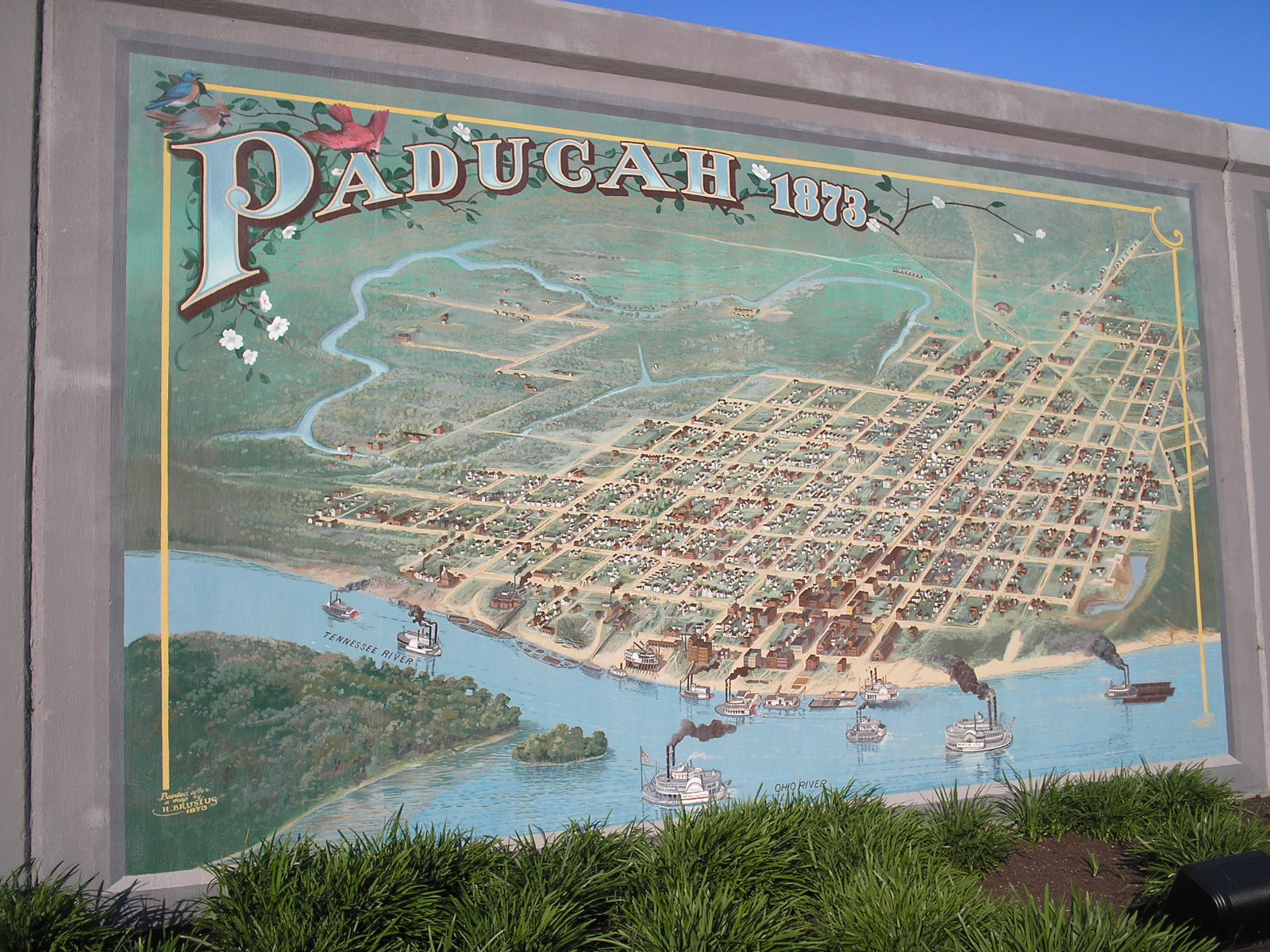
Paducah 1873One of the artistic highlights of our recent Great Square Route around the eastern U.S. (MN – MS – GA – CT – MN) was the stunning Museum of the American Quilting Society in Paducah, Kentucky, which had just opened a special exhibit, 4 Guys & Their Quilts:

On exhibit May 16-August 12, these quilts combine the talents of four male award-winning quilters: John Flynn, Gerald E. Roy, Arturo Alonzo Sandoval and Ricky Tims. MAQS Curator of Collection Judy Schwender is proud to bring lesser known viewpoints from the quilting world to the Museum’s visitors.

“Any quilt reveals the sensibilities of its maker, and men bring perspectives to quilting that are unique to the medium,” Schwender explains. “Within the world of quilting, men are a minority, and the museum is committed to presenting quilting viewpoints of underserved populations.”

My favorite among the 4 Guys was Ricky Tims, whose work ranges from exquisite variations on traditional quilting patterns, like his Bohemian Rhapsody or New World Symphony, to renditions in fabric of depictive art that would not look out of place on a framed canvas or in stained glass, like his South Cheyenne Canyon or Glen Eyrie Castle.

Among the new quilting terms and techniques I learned about at the museum was trapunto (also called “stuffed work”), a texture-enhancing technique that Tims puts to fine use in his Rhapsody in Green.

2 Comments

Filed under art, travel, U.S.

Minnesota’s Canned Corn and Carp

A 1997 Minnesota Historical Society plaque at a rest area near the state line on I-35 tells a bit about the history of Minnesota’s canneries.

Early settlers grew bumper wheat crops on Minnesota’s fertile prairies, land that today supplies produce for a thriving 270-million-dollars-a-year canning industry.

Sweet corn canneries opened in Austin and Mankato in the 1880s, followed soon thereafter by similar factories in Faribault, Owatonna, and LaSueur. Soon Minnesota’s canners were experimenting with new technologies and new products, and in 1903 the automated Big Stone Canning Company founded by F. W. Douthitt changed the industry nationwide. Douthitt’s plant in Ortonville had a conveyor system, mechanical corn husking machines, and a power driven cutter that produced the first whole kernel canned corn. The Green Giant Company, also founded in 1903 as the Minnesota Valley Canning Company, introduced golden cream-style corn in 1924 and the first vacuum packed corn in 1929.

Corn is still the major canning crop in Minnesota. The state’s more than thirty plants also freeze and can peas, beans, carrots, tomatoes, pork, beef, chicken products, and such unusual items as rutabagas. Mankato was the site of the nation’s first carp cannery in 1946.

For more on canned carp, read Dumneazu‘s well-illustrated blogpost on the Odessa Fish Market. In fact, just keep scrolling for an incomparable travelogue series on Dumneazu’s recent adventures in Ukraine.

Leave a comment

Filed under industry, travel, U.S.

Iowa’s Passing Mormons and Utopians

A State Historical Society of Iowa plaque at a pretty little welcome center off Exit 4 on I-35 in Iowa tells two interesting stories, one on each side.

The Mormon Trail

The Mormons of Nauvoo, Illinois, forced from their homes following the murder of their prophet, Joseph Smith, Jr., began their trek across Iowa in 1846 on their way to the Great Salt Lake Valley. From their first permanent campsite on Sugar Creek they travelled across southern Iowa toward Winter Quarters, near present-day Omaha. In addition to Sugar Creek, the Mormons also established permanent camps at Garden Grove in Decatur County, Mount Pisgah in Union County, and Kanesville in Pottawattamie County.

While camped by Locust Creek, near Corydon, William Clayton learned of the birth of his son in Nauvoo. On April 15, 1846, to commemorate this joyous event, he wrote the famous hymn “Come, Come, Ye Saints.” The hymn became a great rallying song of the Mormons.

In 1846, seven Mormon families became separated from the larger body of migrants. They stopped for the winter in present-day Green Bay Township, Clarke County, and established what was known as “Lost Camp.” These families remained in the area until 1854, when they resumed the trek to Utah.

Utopian Experiments in Southern Iowa

Several utopian groups attempted to implement in southern Iowa their dreams of a better social structure. In 1839, Abner Kneeland, a pantheist, started Salubria in Van Buren County. Beset with economic problems, the experiment dissolved after Kneeland died in 1844. In 1843, followers of French socialist Charles Fourier founded Phalanx in Mahaska County, but this communal experiment lasted only two years. Followers of another Frenchman, Etienne Cabet, tried several experiments in the United States, including Icaria in Adams County, which existed from 1860 to 1895.

Led by Ladislaus Ujhazy, a group of Hungarian refugees from the Revolutions of 1848 settled in Decatur County in 1850 and founded the town of New Buda. After experiencing economic difficulties, most of these people moved to Texas in 1853.

In 1851, people from near Farmington formed a communal association called the Hopewell Colony. They moved to Clarke County later that year, and founded the town of Hopeville. Although the communal nature of the colony soon changed, the village survived and for several decades was a thriving community. It is the only one of these southern Iowa utopian experiments whose remnants lasted into the 20th century.

Wisconsin also seems to have attracted more than its share of utopians, these days confined mostly to Madison, I suspect.

The best-known communal experiment in Wisconsin was the Wisconsin Phalanx, a community based on the principles of Charles Fourier, established at Ceresco (Ripon). It was the second largest Fourierist experiment in the country, lasting from 1844 until 1850, and housed around 180 people, most of whom lived communally in the Long House. Although the Phalanx was an economic success and attract[ed] national attention, problems developed and the members agreed to dissolve their community in 1850.

Leave a comment

Filed under religion, travel, U.S.

Wordcatcher Tales: Gum naval, Jump-butt, Stumpage value

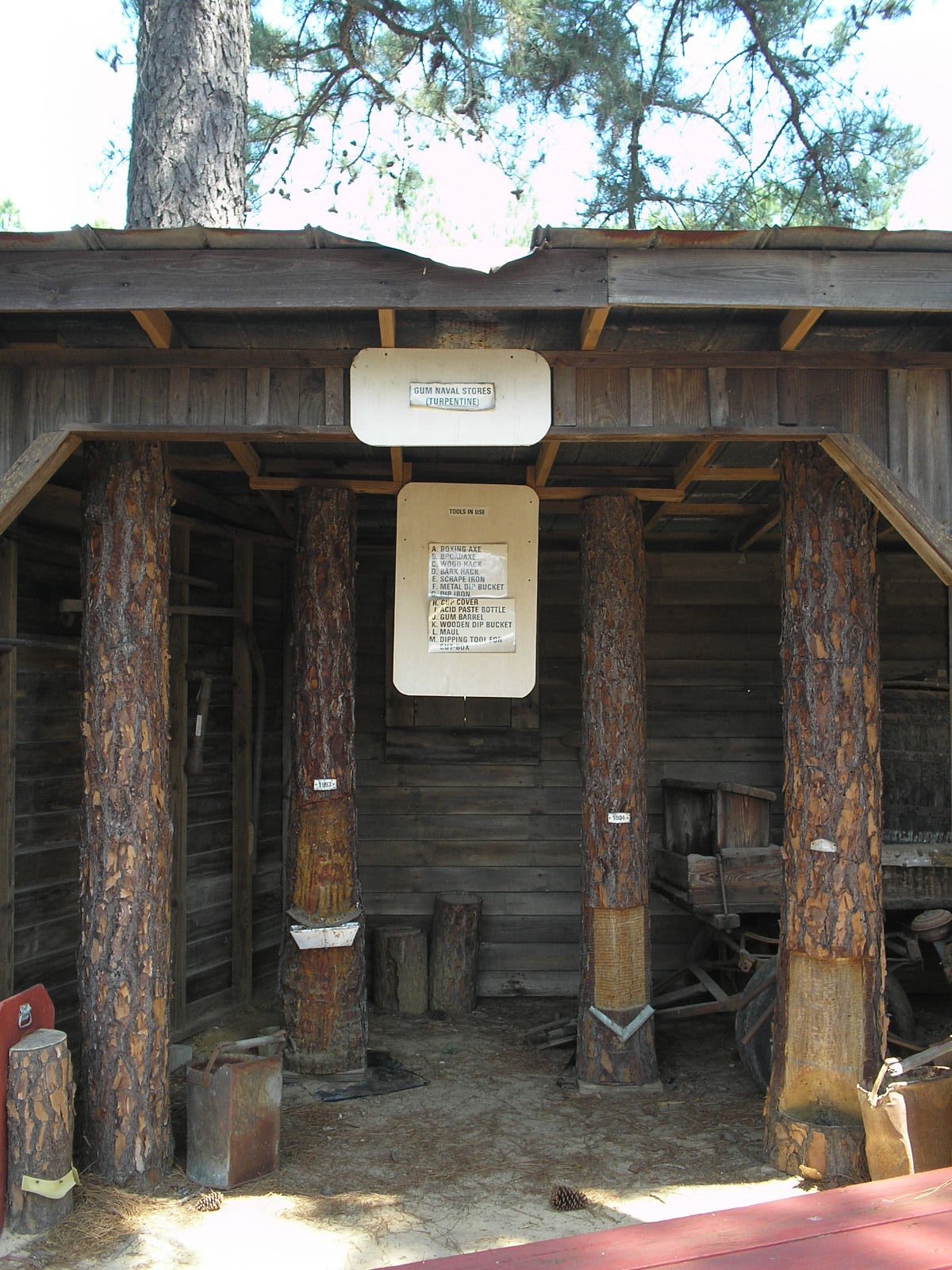
Gum naval stores and toolsOn the road from Columbus to Savannah, Georgia, during our recent Great Square Route around the eastern U.S. (MN – MS – GA – CT – MN), we stopped at the Million Pines Visitor Center off I-16 in Soperton, Georgia. The visitor center includes the Curt Barwick House, built of wood about 1845, which houses the front desk, gift shop, restrooms, and various display items; a one-room wooden house with a tin roof that served as the post office for Blackville, Georgia, from 1888 to 1904; and a wooden shed containing tools used to produce gum naval stores.

The latter term was new to me. It bears no relation to naval jelly (phosphoric acid), which is used on iron ships. Gum naval dates back to the days of wooden ships, when Georgia played an important role in the naval stores industry, as the New Georgia Encyclopedia relates:

In the late nineteenth and early twentieth centuries, Georgia was the world’s leading producer of naval stores, which are materials extracted from southern pine forests and then used in the construction and repair of sailing vessels. Typical naval stores include lumber, railroad ties, rosin, and turpentine.

The naval stores industry in North America originated in the mid-eighteenth century in North Carolina. Before 1800 the major products of the trade were raw gum, pitch, and tar. After the American Revolution (1775-83), processes were developed for distilling spirits of turpentine from gum. By 1850, 96 percent of U.S. naval stores came from North Carolina.

In the early 1870s North Carolina naval stores producers began migrating to southeast Georgia’s sandy coastal plain to take advantage of the untapped virgin pine forests in that region. They brought their equipment and black laborers and established residential villages on large turpentine farms. By the mid-1880s about seven in ten turpentine workers in southeast Georgia had been born in North Carolina.

The industry grew so rapidly that by 1890 Georgia was the national leader in naval stores production, a ranking that lasted until 1905. Florida was the leader from 1905 to 1923, after which Georgia regained its predominance and maintained it until the 1960s.

The USDA Forest Service Southern Research Station Headquarters in Asheville, North Carolina, describes some of the nitty gritty of production. Here are two photo captions from their website:

Photo caption: Improved gum naval stores extraction methods require new tools and techniques. Bark streaks 9 feet from the ground require a special long handled tool for pulling the streak and safely applying the acid. A combination bark-pulling and acid-treating tool was designed to meet this need. The laborer is shown applying 50-percent sulfuric acid to a streak 8 feet from the ground. This tool enables a laborer to stand a safe distance from the tree and reduce the hazard of acid drifting down on his head and clothes.

Photo caption: No more jump-butts and wasted timber as a result of turpentining. A turpentined tree containing both front and back faces and worked for 8 years is shown entering a German gang-saw to produce quality lumber. Developing conservative gu[m] extraction methods for the gum producer represents only half the problem, research must also prove to wood using industries that modern turpentining does not impair the stumpage value of the worked out tree.

The punctuation in the second caption sucks rather badly, but the wonderful collocations make up for it. Jump-butts in this context seems to refer to the discarded lower portion of turpentined trees. Stumpage value is the calculated value of standing timber. The butt log is the often slightly irregular log taken from the base of a tree.

Leave a comment

Filed under industry, language, travel, U.S.