Category Archives: U.S.

Political “Upstarts” and the D.C. Black Elite

From Our Kind of People: Inside America’s Black Upper Class, by Lawrence Otis Graham (Harper, 2000), pp. 226-227:

In talking to black Washingtonians, one gets the distinct impression that there have been so many prominent names over the past few decades that people don’t even attempt to rank them in their minds. “Instead we just group them into the doctor crowd—people like the Leffalls, the Rayfords, the Spellmans, the Clarks, or the Freemans,” says an elderly man who has belonged to the Bachelor Benedicts club for more than twenty-five years. “And there was always the lawyer-government-policy crowd—the Brantons, the Brimmers, the Duncans, the Webbers, the Lynks—and of course, Vernon Jordan.”

The man paused for a moment. “But actually, Jordan isn’t one of us. He’s new.” The man laughed. “My wife would know it better because I never really paid much attention to lawyers—especially the new ones like Jordan or Brown.”…

The fact that he dismisses a power broker who is as important and relevant as Vernon Jordan—former head of the National Urban League; partner at the law firm of Akin, Gump; and close confidant to President Clinton—as being “new” reveals what it requires to be taken seriously by some members of the old guard in this city. Equally outrageous was his lack of enthusiasm over one of my mentors, Ron Brown, who was living in Washington and serving as the U.S. secretary of commerce when he died in 1996.

“Upstarts,” the man explains. “Sure they’re in the Boulé and they know where to buy a house, but every four years—with every administration—they come and go. No roots, no history, no plans to stay. Why should I invest the time in knowing them all?”

Because Washington is a city of politicians and government officials, there are many blacks who have received national prominence from blacks and whites outside of the District yet little acclaim from the black elite who have lived in the city for multiple generations. The most clannish residents will admit that Jordan and Brown were clearly accepted into the group, but will note that the old guard is usually less likely to be enamored with new government appointees who come in from Little Rock, Atlanta, or New York after being appointed by the newest president who is sworn into office. Instead, this group prefers to adopt the permanent professionals—the doctors, the lawyers, the economists, the intellectuals and, to some extent, the entrepreneurs who come to the city to live and stay.

Leave a comment

Filed under U.S.

Black Resorts in the U.S., White Resorts in Japan

From Our Kind of People: Inside America’s Black Upper Class, by Lawrence Otis Graham (Harper, 2000), pp. 152-153

Even though we’d been going there since I was two years old, such was the arrogance of black privilege on that island that it never even occurred to me that white people had summer homes on Martha’s Vineyard until I was ten or eleven years old. Of course I saw white people at the Flying Horses, at Our Market, and at the tennis courts off South Circuit Avenue in Oak Bluffs. But I assumed they were just passing through as guests of black people who had homes there, or as unrooted tourists. Just people passing through a place that was ours.

But of course Martha’s Vineyard had white families. The black neighborhoods of Oak Bluffs were dwarfed by the white sections in the town and by the white population that dominated the rest of Martha’s Vineyard. But I was a summer kid who defined the resort by the boundaries of the black neighborhoods and by whole days and evenings spent with our extended black family in our all-black tennis tournaments, all-black yachting trips, all-black art shows, and all-black cookouts, and the white vacationers had no relevance for me.

As I grew older, I saw what my younger and more naive, self-satisfied eyes had missed. As an adolescent, I finally paid notice to the racial lines that long ago had been drawn between blacks and whites on Martha’s Vineyard. I eventually even saw the many hierarchies that existed within the groups of blacks who summered there. But in spite of these changed perceptions and my newfound confrontation with reality, the one unalterable impression that remains today is that when vacationing among our own kind, in places that have been embraced by us for so long, there is a comfort—and a sanctity—that makes it almost possible to forget that there is a white power structure touching our lives at all.

Today, America’s black elite is closely associated with three historic resort areas that became popular as a result of laws that had kept other vacation spots exclusively white. They are Sag Harbor, Long Island; Oak Bluffs, Martha’s Vineyard; and Highland Beach, Maryland. In the past, and to some extent still today, blacks also choose Hillside Inn, a black-owned resort in Pennsylvania’s Pocono Mountains; and Idlewild, Michigan, a small town two hundred miles north of Detroit that was a popular escape for the midwestern black elite. In recent years, the elite have built ancillary vacations around the annual Black Summit ski vacation event that brings hundreds of black skiers and their families to resorts in Aspen and Vail, Colorado.

Until I read this book, I had never given much thought to the favorite resorts of America’s black elites, but a lot of what Graham says about Oak Bluffs and Martha’s Vineyard conjures up memories of my own childhood experiences at a couple of the favorite resorts of foreigners long resident in Japan: Karuizawa and Lake Nojiri.

Starting in the 1920s, many missionaries of all denominations from Europe and North America would spend summers in rustic cabins at Lake Nojiri’s Gaijin-mura (“Foreigner-ville”), where they could boat, golf, hike, play tennis, swim, read, relax, and catch up with other missionaries from all over Japan. An earlier generation of missionaries during the late 1800s had helped turn Karuizawa into what’s now a thriving upscale resort where only the very wealthy can afford to buy vacation homes. The Nojiri Lake Association seeks to prevent the same thing from happening to Gaijin-mura by enforcing rustic standards: for instance, by keeping roads and paths unpaved, and by allowing electricity but not indoor plumbing. The last time I was there, in 1975, we had to haul water in buckets from community faucets. It was considered bad form to run a hose all the way into your cabin’s kitchen or toilet.

Our family spent a week or so at Karuizawa in 1957, the same year Japan’s current Emperor Akihito and Empress Michiko first met on a tennis court there. We stayed at the rustic cabin of one of my father’s Quaker cronies, Herbert Nicholson, a prewar missionary in Mito who was affectionately known to the postwar generation of Japanese schoolkids as Uncle Goat (Yagi no ojisan) for his relief work after the war.

We couldn’t afford a vacation cabin of our own. We depended instead on the kindness of cronies with different furlough schedules. The next year we spent a week or so at an isolated beach bungalow in Chiba that belonged to a wealthier Japanese American missionary family from Waimea, Kaua‘i. My mother enjoyed the absence of other missionary wives, and we two eldest boys enjoyed playing on a big derelict fishing boat lying on the beach, then watching the fishermen and their often bare-chested wives haul their boats up on shore every day at dusk.

The next summer we two oldest boys took a long overnight train trip by ourselves, up the Japan Sea side from Kyoto to Aomori, to visit another missionary family there with boys of the same age. That family brought us back down to the annual Southern Baptist summer mission meeting at Amagi Sanso, up in the mountains of the Izu Peninsula.

The physical environment at mission meetings was very Japanese: each family had its own tatami room, older boys and girls slept in separate group rooms, males and females of all ages bathed in separate public baths, and everyone removed shoes inside the buildings. But the cultural environment was very American: from Southern fried chicken, Kool-Aid, and 12-oz. cans of Coke, to loud talk, boisterous laughter, and emotion-laden church services. I found the unrestrained gregariousness and emotionality rather alien and intimidating. But I can imagine that it was a great relief for the American-raised missionaries to finally let loose after working in a foreign culture for most of the year.

Those missionaries who had dachas at Lake Nojiri would then spend a few more weeks of Euro-American summer vacation before returning to the stress of work and school in the majority culture. My first summer at Nojiri was after 10th grade, when our family borrowed the cabin of another family on furlough. I took a junior life-saving class, went sailing a time or two with friends who had boats, and played the only round of golf I’ve ever played.

At mission meeting that year (1964), I had hung around with an agemate who had arrived in Japan on the same ship I did in 1950. I was painfully shy; she was not. That relationship intensified in the back of the overnight bus full of missionary families en route to Nojiri, but our summer romance ended when my family returned to Hiroshima, hers returned to Mito, and we each returned to our respective high schools in Kobe and Tokyo that fall. (Our next and final date was at her senior prom in Tokyo.)

My next mission meeting’s budding romance was nipped in the bud when neither of us went to Nojiri that year. She was a schoolmate and we had already been to the junior prom together, but my family didn’t get a cabin that year, and her parents didn’t approve of such long vacations. So we spent the rest of that summer at our respective homes in Hiroshima and Osaka, and then found other distractions when school resumed in the fall. Such were the disadvantages of not frequenting the right resorts.

2 Comments

Filed under family, Japan, migration, U.S.

My Father’s Mule

Mules were like members of the family. We were dependent on them for plowing and for pulling the carts used to haul things on the farm, and the wagons used to take us to town, to church, or to visit relatives in distant places—as far as ten miles away! Feeding, watering, and caring for them were among our more important daily chores. We spent much time with them, talked to them—I preached my first sermon to a mule—and planned our work according to their ability to work. Mules are stronger than horses and smarter, contrary to the opinion suggested by the phrase “horse sense.” They are also stubborn, but they are less temperamental and therefore more predictable than horses. I do not ever remember our farming with horses; we always used mules.

In 1946 when I went on a cattleboat to Poland, I had to care for horses. I discovered then what I had already suspected, namely, that the derogatory reputation of mules relative to horses was quite mistaken. “Mule sense” might be a better term than “horse sense” to describe common sense. For example, when the sea got rough and the boat rocked the horses panicked, and when they got seasick, they lay down and would not try to get to their feet. Even when we helped them to their feet, they fell again. They gave up, and 30 of the 800 horses on board died during our trip to Poland and had to be dumped overboard. Mules would have stubbornly fought to stand and would not have so easily given up.

One thing that can certainly be said of mules is that “they have a mind of their own,” but they are not really stubborn. They can seem lazy because they will not put themselves in danger. A horse can be worked until it drops, but a mule has better sense. The “stubborn” streak is just the mule’s way of telling humans that things are not right. Mules are very intelligent and it is not a good idea to abuse them. They will do their best for their owner, with the utmost patience.

I remember one mule from my childhood especially; his name was Blackie. He was not a big mule or a very healthy one, so I don’t know why we had him. He had a very bad sore on his face which was raw most of the time and made it difficult for him to wear a bridle. The two larger mules did most of the work. They were stronger, browner, more like horses than donkeys, and we didn’t have pet names for them.

Blackie did odd jobs. He seemed to be the one assigned to me for the plowing, cultivating, etc., which I did when I got home from school in the afternoon or on Saturdays. He really didn’t seem to like to work. Maybe that’s why I felt it appropriate to preach my first sermon to him. However, when the work was done and we headed towards the house he seemed to have plenty of energy so that it was hard to keep up with him. I remember that my brother, Murray, and I sometimes hooked up Blackie to the buggy on Sundays and went for a ride. So Blackie was my workmate and my playmate. I remember him more vividly than any other mule we ever had. When he died we mourned as for a friend.

SOURCE: My father, who was raised a Quaker in rural Southampton County, Virginia, but became a Baptist preacher and then a missionary to Japan, where my siblings and I were raised.

Leave a comment

Filed under family, Virginia

Japanese and Other Loanwords in Palauan

I got a little carried away this weekend extracting Japanese, English, German, and Spanish loanwords from the New Palauan–English Dictionary, ed. by Lewis S. Josephs (U. Hawaii Press, 1990). The nature of the words borrowed from each language tells a lot about the nature of the interactions between Palauans and their successive colonizers: Spain until 1899, Germany until 1914, Japan until 1945, and the U.S. after that. By 1940, there were 3 Japanese colonists (including Okinawans, Koreans, and Taiwanese) in the islands for each indigenous Palauan.

The current Palauan orthography originated under the Germans, but has continued to evolve since then. There are only five vowel symbols, i u e o a, but e represents the eh sound when stressed and the uh sound (schwa) when unstressed. Vowel length is indicated by doubling the vowel. Palatal and velar glides are written with the vowel symbols i and u.

Consonants show much greater variation. The obstruents /b/ and /d/ are basically voiced, but are devoiced next to other consonants or in word-final position. The obstruents /t/ and /k/ and are basically voiceless, and are strongly aspirated in word-final position. Glottal stop is written with a ch. The fricative /s/ is slightly palatalized (in the direction of sh). There are only two orthographic nasals, bilabial m and velar ng, but ng is pronounced [n] before the dental consonants t, d, s, and r. The flap /r/ and lateral /l/ can each be doubled, and the /l/ corresponds to /n/ in other related and unrelated languages. The consonants h and z are only found in loanwords.

The underlying morphology of Palauan is very complex, but looks a lot like that of Philippine and other western Austronesian languages once you correct for a lot of strange behavior on the part of the nasals (like infixed -l- and the me- prefixes that end up as o- on certain stems). Perhaps I’ll provide a few glimpses in a future blogpost.

babier ‘paper, letter, book’ (G)
badre ‘priest’ (S)
baeb ‘pipe’ (E)
baias ‘bias or slant (in sewing)’ (E)
baiking ‘disease, germs’ (J)
baket ‘bucket, pail’ (E)
bakudang ‘dynamite; bomb; explosion; air raid; bombardment’ (J)
bakuhats ‘explode’ (J)
bakutsi ‘gambling; card game’ (J)
balas ‘ballast’ (E)
bambuu ‘bamboo’ (E)
bando ‘belt’ (J)
bangd ‘bounce; rebound; suspension (of car)’ (E)
bangd ‘musical band; orchestra’ (E)
bangderang ‘flag, banner’ (S)
bangk ‘bank; safe; strongbox’ (E)
bangk ‘get punctured, blow out’ (J)
bangkeik ‘pancake’ (E)
bar ‘crowbar; coconut husking spike’ (E)
bar ‘bar, tavern’ (E)
bara ‘rose’ (J)
barb ‘valve’ (E)
barikang ‘hair clipper’ (J)
baror ‘table lamp’ (S)
barrill ‘wooden barrel’ (S)
bas ‘bus’ (E)
bas ‘bass (in singing)’ (E)
basio ‘place’ (J)
basket ‘basket’ (E)
Baskua ‘Easter’ (S)
bastaor ‘bath towel’ (J)
bastor ‘pastor’ (E)
bat ‘bat’ (E)
bata ‘butter’ (J)
baterflai ‘fickle’ (E)
batrol ‘patrol; guardian; supervisor’ (S)
batteri ‘battery’ (E, J)
beek ‘bake’ (E)
bek ‘sack, bag’ (E)
bengngos ‘lawyer’ (J)
benia ‘plywood’ (J)
benster ‘window’ (G)
bento ‘food eaten away from home’ (J)
bentobako ‘lunchbox’ (J)
benzio ‘toilet’ (J)
berangdang ‘veranda’ (E)
beragu ‘spark plug’ (J fr E)
berib ‘letter’ (G)
bet ‘bed’ (E)
biang ‘beer’ (E?)
bib ‘bib’ (E)
Biblia ‘Bible’ (S)
bid ‘auction, bidding’ (E)
bilt ‘holy picture’ (G)
bings ‘beans’ (E)
bioing ‘hospital’ (J)
bioingseng ‘hospital ship’ (J)
birhen ‘virgin’ (S)
Biskor ‘Peace Corps’ (E)
bisob ‘bishop’ (E)
bistong ‘piston’ (E)
blaks ‘cement blocks’ (E)
blangtalos ‘plaintain (bark used for cord)’
blasbabier ‘sandpaper’ (G)
blauang ‘flour’ (E)
blok ‘pulley’ (G)
bloridang ‘pomade’ (S brandname?)
boi ‘servant’ (J)
boi ‘buoy; property marker’ (E)
bokket ‘pocket’ (E)
boks ‘large wooden tray with legs’ (J?)
bokso ‘elephant grass (used as animal feed)’ (J)
bokungo ‘storage pit, air-raid shelter’ (J)
bomado ‘pomade’ (J)
bomb/bomk ‘pump; small boat engine’ (E)
bongd ‘pound’ (E)
bongkura ‘dull or slow-witted’ (J)
bor ‘ball (in baseball)’ (J fr E)
borhua ‘walk (in baseball)’ (J fr E)
boruu ‘(head) completely shaved’ (J)
bos ‘(motorless) boat’ (E)
bos ‘boss’ (E)
bost ‘post-office’ (E, G)
Bostol ‘apostle’
botang ‘button; flower similar to peony’ (J)
boteto ‘potato’ (E)
bozu ‘(head) completely shaved’ (J)
bresengt ‘present’ (E)
bud ‘booth’ (E)
budo ‘Panama cherry; capulin’ (J)
buk ‘book’ (E)
bul ‘(swimming) pool; pool (game), billiards’ (E)
bulis ‘police’ (E)
bumpo ‘grammar’ (J)
bung ‘minute’ (J)
bungsu ‘fraction’ (J)
buraia ‘pliers’ (E)
burek ‘brake’ (E)
burgatorio ‘purgatory’ (S)
bus ‘puss, cat’ (E)
bussonge ‘red hibiscus’ (J)
butabutabuta ‘way of calling pigs’ (J)
butiliang ‘bottle; glass’ (S)
buts ‘boots’ (E)

chabarer ‘get angry, get violent’ (J)
chabunai ‘dangerous’ (J)
chaburabang ‘fried bean paste bun’ (J)
chaburasasi ‘oil-can (with long spout)’ (J)
chaiamar ‘apologize to’ (J)
chaikodetsiu ‘tie [breaker] in game of ziangkempo’ (J)
chainoko ‘half-caste child’ (J)
chais ‘ice’ (E, J)
chaiskeeki ‘popsicle’ (J)
chaiskurim ‘ice cream’ (E, J)
chakimer ‘surrender; give up’ (J)
chaltar ‘altar’ (E)
chamatter ‘plenty; more than enough’ (J)
chambang ‘baked bean paste bun’ (J)
chambelangs ‘ambulance’ (E)
chameiu ‘wheat gluten?, coconut syrup?’ (J)
chami ‘screen’ (J)
chamonia ‘ammonia’ (E)
chanakangari ‘button hole’ (J)
changar ‘(salary) increase; (person) get excited or nervous; promote’ (J)
changari ‘rise; increase’ (J)
changhel ‘angel’ (S)
changko ‘bean paste’ (J)
changtena ‘antenna’ (E)
chansing ‘feel relaxed, at ease’ (J)
chanzang ‘add; do sums’ (J)
chanzeng ‘[safety] razor blade’ (J)
charai ‘strict or harsh sounding’ (J)
charuminium ‘aluminum’ (J)
chas ‘ace (in cards)’ (E)
chasagao ‘morning glory’ (J)
chasbering ‘aspirin’ (E, J)
chasiba ‘scaffolding’ (J)
chasuart ‘asphalt’ (J)
chatter ‘appropriate, suitable’ (J)
chauanai ‘inappropriate, unsuitable’ (J)
chausbengdik ‘know thoroughly; memorize’ (G)
chautomatik ‘automatic’ (E)
chauts ‘out (in baseball)’ (E)
chazi ‘flavor, taste’ (J)
chazinomoto ‘flavor enhancer; MSG’ (J)
chea ‘air (for tire)’ (J fr E)
cheisei ‘sanitation (inspection); hygiene’ (J)
chi ‘stomach’ (J)
chihukuro ‘(pouch of) stomach’ (J)
chikes ‘place for storing live bait or fish in boat’ (J)
chimi ‘meaning; implication (of one’s words)’ (J)
chiro ‘color’ (J)
chirochiro ‘many-colored; fathered by different men’ (J)
chomotenangio ‘territory outside of Japanese Pacific mandate’ (vs. utsinangio) (J)
chos ‘holding tight (when dancing); making a play for; getting too close’ (J)
chosarai ‘girls’ game juggling cloth balls filled with seeds’
chotemba ‘flirtatious; loose or fast (woman)’ (J)
choto ‘noise or sound (usu. mechanical)’ (J)
chotobai ‘motorcycle’ (J)
chuki ‘life-preserver’ (J)
chundo ‘physical exercise’ (J)
chundongutsu ‘athletic shoes’ (J)
chuntens ‘driver’ (J)
churi ‘muskmelon’ (J)
chusangi ‘rabbit’ (J)
chuts(i)us ‘take (photo)’ (J)

dai ‘platform; support’ (J)
daia ‘diamond suit (in cards)’ (J)
daikong ‘radish; turnip’ (J)
daiksang ‘carpenter’ (J)
dainamait ‘dynamite’ (E)
dainamo ‘generator’ (J)
daigak ‘university’ (J)
daitai ‘general; fine; all right; okay’ (J)
daiziob ‘fine; all right; okay’ (J)
dangs ‘dance’ (E)
datsio ‘disease of testicles aggravated by the cold’ (J)
dempo ‘telegram’ (J)
dengki ‘electricity’ (J)
dengkibasira ‘telephone pole’ (J)
dengkibu ‘power plant’ (J)
dengkiskongi ‘electric phonograph’ (J)
dengu ‘dengue fever; rheumatism’ (J)
dengua ‘telephone’ (J)
deser ‘diesel’ (G)
diab(e)long ‘devil; Satan’ (S)
diakon ‘deacon’ (S)
Dios ‘God’ (S)
Dois ‘Germany’ (J)
dokurits ‘independent; capable of taking care of oneself’ (J)
donats ‘doughnut’ (E)
dongu ‘tool’ (J)
doraib ‘drive around (in car)’ (E)
dorobo ‘robber; thief’ (J)
dosei ‘anyway; at any rate; after all’ (J)
dotei ‘rampart; terrace’ (J)

haburasi ‘tootbrush’ (J)
hadaka ‘bare-breasted; nude; naked’ (J)
hadasi ‘bare-footed’ (J)
haibio ‘tuberculosis; tubercular’ (J)
haisara/haizara ‘ashtray’ (J)
haisia ‘dentist’ (J)
haitsio ‘cabinet’ (J)
hake ‘paintbrush’ (J)
hall ‘Halt! Stop!’ (G)
hambung ‘half; half-witted’ (J)
hanabi ‘fireworks; firecracker’ (J)
hanahuda ‘Japanese card game’ (J)
hang ‘hamlet; part of town’ (J)
hangkats ‘handkerchief’ (J)
hansubong ‘(walking) shorts’ (J)
hantai ‘opposite; opposed or disagreeing’ (J)
harau ‘pay’ (J)
hasi ‘chopsticks’ (J)
hatoba ‘pier; dock’ (J)
hats ‘bee; wasp’ (J)
heya ‘room’ (J)
hanzi ‘answer’ (J)
hermet ‘helmet’ (E)
Hesus ‘Jesus’ (S)
himbiokai ‘fair; exhibition’ (J)
himits ‘secret’ (J)
hokori ‘dust’ (J)
homrang ‘home run (in baseball)’ (J fr E)
hong ‘book’ (J)
honto ‘Babeldaob (main island of Palau)’ (J)
hos ‘hose (of automobile)’ (E)
hosengka ‘garden balsam’ (J)
hotai ‘bandage’ (J)
hoter ‘hotel’ (J fr E?)
huda ‘identification or name tag’ (J)
Hu(i)ribing ‘Philippines’ (J)
Hurans ‘France’ (J)
huseng ‘balloon; condom’ (J)
huto ‘envelope’ (J)
hutsu ‘common; usual; ordinary’ (J)

iakiu ‘baseball’ (J)
iaksok ‘promise’ (J)
iama ‘raise hairdo at front of hair’ (J)
ianagi ‘Formosa koa tree; willow’ (J)
iasai ‘vegetable’ (J)
iasaibune ‘vegetable boat’ (J)
iasui ‘cheap’ (J)
iasumba ‘resting place’ (J)
iings ‘inch’ (E)
iings ‘hinge’ (E)
ikelesia ‘church’ (S)
Ingklis ‘England’ (E, J?)
iorosku ‘regards; greetings’ (J)
iosiharu ‘spring (season)’ (J)
iosiuki ‘winter’ (J)
iotei ‘schedule; plan’ (J)
iotsieng ‘kindergarten’ (J)
iudoraib ‘rent-a-car; U-drive car; loose woman’ (E)

kab ‘curve; curve-ball’ (J fr E)
kaba ‘armor; protective covering’ (J)
kabaiaki ‘broiled canned fish’ (J)
kabitel ‘captain’ (G)
kabur ‘flip someone over one’s shoulder (when wrestling)’ (J)
kadenia ‘gardenia; carnation’ (E)
kaer ‘return’ (J)
kahol ‘wooden box; coffin’ (S)
kai ‘shell’ (J)
kaisia ‘company; business’ (J)
kamang ‘sickle; twisted, crippled’ (J)
kambalang ‘bell’ (S)
kanadarai ‘large basin’ (J)
kanaria ‘gonorrhea’ (E)
kangdalang ‘candle’ (S)
kangkei ‘relationship; connection’ (J)
kangkeister ‘related to; connected with’ (J)
kangkodang ‘tourist’ (J)
kangngob ‘nurse’ (J)
kanibisket ‘Crab biscuit’ (J brandname)
kansok ‘meteorological survey’ (J)
kansume/kanzume ‘canned goods’ (J)
kantang ‘simple; plain’ (J)
karas ‘glass’ (J fr E)
kardina ‘cardinal’ (E)
kare ‘curry’ (J fr E)
kas ‘gas; gasoline’ (E)
kasinoma ‘cancer’ (E)
kasorin ‘gasoline’ (J)
kastera ‘yellow pound cake’ (J)
kat ‘playing cards’ (E)
kata ‘shape; form; body form; frame for weaving’ (J)
katangami ‘sewing pattern’ (J)
katai ‘stubborn, inflexible or unyielding’ (J)
kataki ‘revenge’ (J)
katate ‘dextrous; needing only one hand to do things’ (J)
katatsumuri ‘African (land) snail’ (J)
kateng ‘curtain’ (E)
katolik ‘Catholic’ (S)
kats ‘winner; win’ (J)
katsudo ‘movie’ (J)
katsudokang ‘movie theater’ (J)
katsuo ‘bonito’ (J)
katsuobusi ‘dried bonito meat’ (J)
katsuoseng ‘bonito-fishing boat’ (J)
kaua ‘leather’ (J)
kauar ‘change’ (J)
keik ‘cake’ (E)
keikak ‘(economic or political) plan’ (J)
keis ‘court or legal case’ (E)
keisang ‘calculate’ (J)
keizai ‘economics’ (J)
kelebus ‘jail, prison’ (S)
kembei ‘police’ (J)
kengri ‘right; privilege’ (J)
kensa ‘inspection; medical examination’ (J)
kerebou ‘cow; carabao; water-buffalo; beef; corned beef’ (S fr Philippines)
kerisil ‘kerosene’ (G)
keristiano ‘Christian’ (S)
kerus ‘cross; crucifix’ (S)
kes ‘erase; obliterate’ (J)
keskomu ‘pencil eraser’ (J)
kets ‘stingy’ (J)
kia ‘gear’ (E)
kiab ‘carburetor’ (J fr E)
kiabets ‘head cabbage’ (J fr E)
kiande ‘candy’ (J fr E?)
kil/kir ‘keel’ (E)
kilo ‘kilogram’ (G?)
kimots ‘feeling’ (J)
king ‘king (also in cards)’ (E)
kigatsakani ‘be unaware of; miss import or implication’ (J)
kigatsku ‘notice; be aware of; understand import or implication’ (J)
kingko ‘safe; strongbox’ (J)
kintama ‘testicles; exclamation uttered when batter strikes out’ (J)
kirioke ‘projecting eave of roof’ (J)
kiro ‘kilogram’ (J)
kisets ‘faint; lose consciousness’ (J)
kisu ‘scar’ (J)
kita ‘guitar’ (E)
kiter ‘effective or strong (words, medicine); convincing (argument); in working order’ (J)
kitsingai ‘crazy; obsessed with’
kitte ‘postage stamp’ (J)
kiubio ‘heart attack’ (J)
klab ‘club; association’ (E)
klas ‘class; classroom’ (E)
klas ‘drinking glass; eyeglass; diving glass’ (E)
klok ‘clock, watch’ (E)
kobito ‘midget; dwarf’ (J)
kohi ‘coffee’ (J)
koi ‘thick or strong (liquid); dark in color’ (J)
koibito ‘sweetheart’ (J)
kokubang ‘blackboard’ (J)
kolt ‘gold’ (E)
komakai ‘stingy; detailed; thorough; accurate’ (J)
komatter ‘inconvenienced or in trouble or hard-pressed financially’ (J)
kombalii ‘company; helpers in preparing food; food so prepared’ (E)
kombas ‘compass’ (E)
komeng ‘sorry; excuse me’ (J)
komi ‘trash, garbage’ (J)
komibako ‘trash can’ (J)
komisteba ‘trash dump’ (J)
komu ‘rubber’ (J)
komunion ‘Holy Communion’ (S)
komunoki ‘India rubber tree; banyan tree’ (J)
komuteib ‘elastic band for clothing’ (J)
kona ‘powdered soap; detergent’ (J)
Kongkong ‘Hong Kong’ (J)
kongro ‘kerosene stove’ (J)
korira ‘gorilla’ (J)
korona ‘crown’ (S)
kort ‘court of law’ (E)
kosi ‘buttocks; hips’ (J)
kosio ‘out of order; broken; get stuck; stop working; have a fit’ (J)
kosui ‘perfume’ (J)
kotai ‘answer (to math problem); (written) solution’ (J)
kotsiosensei ‘high school teacher’ (J)
koziak ‘bald-headed person’ (E name)
kozukai ‘spending money; pocket money’ (J)
Kristo ‘Christ’ (S)
Kristus ‘Christ’ (G)
ksai ‘bad-smelling’ (J)
ksari ‘neck chain (for holding keys, medal, etc.)’ (J)
kuabang ‘guava’ (S)
kudamono ‘passion flower; grandilla’ (J)
kukobokang ‘aircraft carrier’ (J)
kuma ‘bear’ (J)
kumade ‘rake’ (J)
kumi ‘rubber; elastic’ (G)
kumi ‘group; association’ (J)
kungreng ‘military training’ (J)
kurangd ‘playground’ (E)
kureiong ‘crayon’ (E)
Kurismas ‘Christmas’ (J, E)
kurob ‘baseball glove’ (J fr E)
kusarang ‘spoon’ (S)
kutsibeni ‘lipstick’ (J)
kuzira ‘whale’ (J)

mado ‘window’ (J)
mael ‘mile’ (E)
mahobing ‘thermos’ (J)
mahongani ‘mahogany’ (J, E?)
mahura ‘muffler; scarf’ (J)
maikake ‘apron’ (J)
Maikronesia ‘Micronesia’ (E)
maingami ‘bangs’ (J)
mais ‘corn [maize]’ (S)
mak ‘fifty cents’ (G)
make ‘loser; loss’ (J)
makit ‘(produce) market’ (E)
mame ‘beans’ (J)
manaita ‘cutting board; chopping block’ (J)
mang ‘ten thousand’ (J)
mangnga ‘cartoon’ (J)
mangtang ‘black cloth’ (S)
mangtekang ‘lard’ (S)
manguro ‘yellowfin tuna’ (J)
manneng ‘fountain pen’ (J)
Marialas ‘Marianas’ (S)
Marsial ‘Marshall Islands’ (E)
mases ‘matches’ (E)
masku ‘mask; sanitary mask’ (J fr E)
mastang ‘master; leader’ (E)
matsi ‘capital; main town’ (J)
mauar ‘turn’ (J)
mauas ‘turn (something)’ (J)
mazegohang ‘rice mixed with vegetables, meat, etc.’ (J)
mazui ‘bad-tasting; unskilled or unsuccessful (in persuasion)’ (J)
mihong ‘sample; example’ (J)
milk ‘milk’ (E)
minatobasi ‘harbor bridge between Koror and Ngemelachel’ (J)
misang ‘Mass’ (S)
mitsumata ‘three-pronged farming implement’ (J)
miuzium ‘museum’ (E)
mokar ‘gain profit from’ (J)
mongk ‘complaint; criticism’ (J)
motsio ‘appendicitis’ (J)
musiba ‘cavity; rotted tooth’ (J)
musing ‘cooperative enterprise’ (J)

nakas ‘sink’ (J)
namari ‘lead weight; molded lead’ (J)
namer ‘challenge; hold in contempt; make a fool of’ (J)
nangiosakura ‘flame tree’ (J)
nappa ‘long cabbage’ (J)
nas ‘eggplant’ (J)
neibi ‘navy’ (E)
nengi ‘green onion’ (J)
nenneng ‘sleep’ (J baby talk)
nezi ‘screw’ (J)
nezimauas ‘screwdriver’ (J)
nikibi ‘pimple; acne’ (J)
niku ‘meat (esp. beef)’ (J)
nimots ‘baggage; luggage’ (J)
ningio ‘doll’ (J)
ninzin ‘sweet potato with orange flesh’ (J)
nitske ‘fish simmered with sugar and vegetables’ (J)
niziu ‘twenty’
nori ‘glue; paste; starch’
nurs ‘nurse’ (E)

oiakodomburi ‘chicken and eggs with rice’ (J)
okane ‘money’ (J)
okasi ‘candy; sweets’ (J)
oni ‘demon; “it” in games of tag’ (J)
osbitar ‘hospital’ (E)
osime ‘diaper’ (J)
osimekaba ‘diaper cover’ (J)
otsir ‘fail (a test)’ (J)
otsuri ‘change (from purchase); benefit; recompense; advantage’ (J)
otsuringanai ‘having no benefit’ (J)
ouasi ‘walk or go on foot’ (J)

raiskare ‘rice curry’ (J)
rakket ‘racquet’ (E)
rami ‘rummy’ (E)
ranningngu ‘tank-top’ (J fr E)
razieta ‘radiator’ (E, J)
razio ‘radio’ (J, E)
rekodo ‘phonograph record’ (J)
rimbio ‘venereal disease’ (J)
ringngo ‘apple’ (J)
roba ‘donkey; ass’ (J)
rosario ‘rosary’ (S)
Rosia ‘Russia’ (J)
rot ‘piston rod’ (E)
rrat ‘bicycle’ (G)
rrom ‘liquor; alcoholic drink’ (E)
rum ‘room’ (E)

sabis ‘bonus; special service; tip’ (J)
sabisi ‘lonely’ (J)
sablei ‘long knife; machete’ (S)
sabtbol/sobtbol ‘softball’ (E)
saidang ‘cider; soft-drink’ (J)
saing ‘sign’ (E)
saingo ‘last time; end (of relationship)’ (J)
saireng ‘siren’ (J)
sak ‘unit of measure; foot’ (J)
salad ‘salad’ (E)
saladaoil ‘salad oil’ (J, E)
sambas ‘dock with piers’ (J)
samui ‘cold’ (J)
sandei ‘week; Sunday’ (E)
sandits ‘arithmetic’ (J)
sangdiang ‘type of watermelon’ (S)
sangkak ‘triangle’ (J)
sangklas ‘sunglasses’ (E)
sangta ‘female saint’ (S)
sangto ‘male saint’ (S)
sao ‘pole for fishing or support’ (J)
sar ‘salt’ (S)
sarmetsir ‘liniment’ (J brandname)
sarumata ‘panties, underpants’ (J)
sasimi ‘sashimi; raw fish’ (J)
Satan ‘Satan’ (S)
sausab ‘soursop (tree or fruit)’ (E)
sbiido ‘speed (up)’ (J)
sbots ‘sports’ (J)
seb ‘safe (in baseball)’ (J fr E)
sebadong ‘Saturday’ (S)
Sebangiol ‘Spain’ (S)
sebel ‘shovel’ (E)
sebulias ‘green onion’ (S)
seikats ‘life’ (J)
seiko ‘succeed; prosper’ (J)
seinendang ‘youth group’ (J)
seizi ‘politics’ (J)
sembuki ‘electric fan’ (J)
semmong ‘expert; specialist’ (J)
seng ‘insulated wire; electrical wire; cable’ (J)
sengk ‘money gift’ (G)
sengkio ‘election’ (J)
sengko/katorisengko ‘mosquito coil’ (J)
sensei ‘teacher’ (J)
serangk ‘bookcase; cupboard; shelf’ (G)
seraub ‘screw’ (G)
Siabal ‘Japan’ (E)
siasing ‘photo’ (J)
siasingki ‘camera’ (J)
siats ‘shirt’ (J)
sib ‘sheep’ (E)
sidosia ‘car; automobile’ (J)
sikang ‘hour’ (J)
sikar ‘cigar’ (E)
simang ‘vain; boastful’ (J)
simpai ‘worry’ (J)
simbung ‘newspaper’ (J)
simer ‘strangle; choke; close; turn off’ (J)
Sina ‘China’ (J)
singyo ‘trust’ reputation’ (J)
sintsiu ‘brass, copper’ (J)
sinzo ‘heart (= internal organ)’ (J)
siobai ‘business’ (J)
siobang ‘loaf of bread’ (J)
siokumins ‘farm colony’ (J)
sionga ‘ginger’ (J)
sioning ‘witness’ (J)
sioningdai ‘witness stand’ (J)
siorai ‘future’ (J)
siraber ‘investigate or interrogate (someone)’ (J)
sirangkao ‘face feigning ignorance; innocent face’ (J)
sisiu ‘embroidery’ (J)
sister ‘nun; sister’ (E)
sits ‘(linen) sheet’ (J)
siukang ‘custom; (bad) habit; idiosyncrasy’ (J)
skak ‘square’ (J)
skamaer ‘confront; face; corner; catch; get hold of’ (J)
skareter ‘tired’ (J)
skarister ‘serious, conservative or self-controlled or strait-laced or not easily swayed’ (J)
skato ‘skirt’ (J)
skemono ‘pickles; condiments’ (J)
skeng ‘test; examination’ (J)
skidas ‘drawer (of desk, table, etc.)’ (J)
skoki ‘airplane’ (J)
skongki ‘(manual) phonograph’ (J)
skozio ‘airport’ (J)
skuul ‘school’ (E)
slibs ‘necktie’ (G)
sobdringk ‘soft drink’ (E)
sodang ‘discussion’ (J)
soko ‘storage area; shed’ (J)
soldau ‘soldier’ (S)
song ‘take a loss; waste time’ (J)
songngai ‘(financial) loss’ (J)
sorobang ‘abacus’ (J)
sos ‘sauce; soy sauce’ (E)
sotets ‘cycad [palm]’ (J)
sotsungiosei ‘graduate’ (J)
sotsungioski ‘graduation ceremony’ (J)
stamb ‘rubber stamp; seal’ (E)
stangi ‘underwear’ (J)
statmota ‘(engine) starter’ (E)
stengles ‘stainless’ (E)
stereo ‘stereo’ (E)
stoang ‘store’ (E)
stob ‘stove’ (E)
stob ‘stop’ (E)
sub ‘soup’ (E)
sudare ‘rolling bamboo curtain’ (J)
suester ‘nun; sister’ (G)
sukal ‘sugar’ (S)
suklatei ‘chocolate’ (S)
sumi ‘charcoal’ (J)
sumitsubo ‘carpenter’s tool for marking lumber’ (J)
sung ‘unit of measure (close to inch)’ (J)

tabasko ‘tabasco’ (E)
taber ‘blackboard’ (G)
tabi ‘canvas shoe’ (J)
tada ‘free of charge’ (J)
taem ‘time; occasion’ (E)
taia ‘tire’ (J fr E)
taib ‘typewriter’ (E)
Taiheio ‘Pacific Ocean’ (J)
taiko ‘drum’ (J)
Taiuang ‘Taiwan’ (J)
takai ‘expensive; high status’ (J)
taki ‘waterfall’ (J)
tama ‘marble; fried dough ball; ball bearing’ (J)
tamanengi ‘onion; shaved head’ (J)
tamango ‘egg’ (J)
tamangodomburi ‘rice topped with egg’ (J)
tamangongata ‘egg-shaped’ (J)
tamangoudong ‘noodles topped with egg’ (J)
tana ‘shelf’ (J)
tane ‘seed’ (J)
tangk ‘water tank or drum’ (E)
tansiobi/tanziobi ‘birthday’ (J)
taor ‘towel’ (J)
taorer ‘faint; collapse’ (J)
tarai ‘large basin’ (J)
tatami ‘tatami’ (J)
tatemai ‘action of building frame of house’ (J)
tauas(i) ‘scrubbing brush’ (J)
te ‘ability; skill; style’ (J)
tebel ‘table; desk; chair’ (E)
teb(u)kuro ‘glove; mitten’ (J)
teng ‘grade; point; score’ (J)
tengki ‘weather’ (J)
tengus ‘cat-gut; plastic fishing line’ (J)
tenis ‘tennis’ (E, J?)
tenor ‘tenor’ (E)
tento ‘tent’ (J fr E)
tenzio ‘ceiling’ (J)
teppo ‘hand of cards in hanahuda’ (J)
tibi ‘television’ (E)
todai ‘lighthouse’ (J)
tokas ‘make (something) melt’ (J)
toker ‘melt; die of embarrassment’ (J)
tokoia ‘barber’ (J)
toktang ‘doctor’ (E)
tokuni ‘especially; particularly’ (J)
tomato ‘tomato’ (J fr E?)
tongang ‘squash’ (J)
torak ‘truck’ (J fr E)
torangk ‘trunk; suitcase’ (E)
toseng ‘ferry-boat’ (J)
Trinidad ‘Holy Trinity’ (S)
trombetang ‘trumpet; bugle’ (S)
tsesa ‘chaser; snack to accompany beer’ (E)
tsiok ‘chalk’ (E)
tsiokkolet ‘chocolate’ (E)
tsios ‘condition’ (J)
tsitsibando ‘brassiere’ (J)
tsiub(u) ‘inner tube’ (J fr E)
tsiui ‘be careful; warn (someone)’ (J)
tsizim ‘shrink’ (J)
tsubame ‘barn swallow’ (J)
tsuingam ‘chewing gum’ (E)
tsunami ‘tidal wave’ (J)
tsurubasi ‘pick-axe’ (J)
turm ‘church tower; steeple’ (G)

uaia ‘wire’ (E)
uaks ‘wax’ (E)
uata ‘cotton’ (J)
uatasibune ‘ferry-boat’ (J)

zeitak/seitak ‘luxurious; high-class; select’ (J)
ziabong ‘pomelo; shaddock’ (J)
ziakki ‘jack (for car)’ (J fr E)
ziangkempo ‘game [paper-scissors-rock]’ (J)
zibiki ‘dictionary’ (J)
ziteng ‘dictionary’ (J)
ziu ‘gun; rifle’ (J)
ziu ‘freedom (to do as one wishes)’ (J)
zori ‘rubber slippers’ (J)
zubong/subong ‘trousers’ (J)
zunga/sunga ‘picture; drawing’ (J)
zurui/surui ‘sly; sneaky; shrewd’ (J)

17 Comments

Filed under Germany, Japan, language, Micronesia, Spain, U.S.

Wordcatcher Tales: Bunch butter beans

At a mini family reunion at Paulette’s Place in Halifax, Virginia, my elder cousin’s husband, who’s quite an accomplished farmer, looked at the small green butter beans several of us had ordered as our vegetable side dishes and said they looked like “bunch butter beans,” not “running butter beans.” I asked him how the hell he could tell that.

Well, if I understood him right, bunch beans grow in tighter clusters and are smaller and rounder, while running beans climb along poles and get larger and flatter. They’re not different species, just different cultivars. According to GardenLad at the Heirloom Plants & Garden Forum, there are similar distinctions among green beans.

In some places, though, if you ask if it’s a pole bean they’ll look at you strange, because—particularly in the mountains of the South, and in the Ozarks, they differentiate them as stick and bunch beans, rather than as pole and bush—which, btw, are called “dwarf” in England and some parts of North America.

From this I conclude that the more space you give a bean to grow, the bigger it’ll get.

According to Japan’s NIAS Genebank, the same is true of pole and bunch cultivars of Phaseolus lunatus L., a bean of many disguises and aliases.

Pole type cultivar and wild form of P. lunatus are twining, perennial herbs, 2-4m tall, with enlarged rootstock (Purseglove, 1974). Annual and small bush forms, 30-90cm high, have been developed in cultivation.

In my experience of Southern usage, butter beans are the smaller, sweeter, greener varieties that are eaten as vegetables, while lima beans are the larger, starchier, whiter varieties that are more often found in soup. (Ochef seems to have it precisely backwards.)

The University of Melbourne has a very useful, multilingual compilation of names for different varieties of the bean genus Phaseolus. Phaseolus lunatus L. is divided into three broad groups: Lunatus, the large limas of Andean origin; Sieva, the small-seeded limas of Mesoamerican origin; and Potato, the round-seeded, Caribbean limas. The principal Japanese term for limas is ライマメ raimame, which seems to have been formed by haplology from ライママメ raima mame ‘lima bean’.

Leave a comment

Filed under language, U.S.

Eating Across America: Road Trip Food Stops

On the long travel days during our Great Square Route (MN – MS – GA – CT – MN) car trip in May, we would aim to get on the road early, then stop for a late breakfast at some place with local flavor, trying to avoid national chains. We might snack a bit on the road, but would not eat another meal until the evening, again trying to avoid national chains. Here are the most memorable food stops. Like my father and brothers, when I travel I tend to remember the meals above all else.

First breakfast stop – Our first breakfast stop on I-35 South out of Minneapolis was at the Perkins restaurant in Clear Lake, IA. Despite being a national chain, it offered the big plate of biscuits and gravy that I was determined to indulge in at least once on this trip.

Greasiest omelet – After a nice visit with my stepbrother and his family in Kansas City, MO, we hit the road early on I-70 East. We didn’t see much with local flavor until we got to the Midway Auto/Truck Plaza near exit 121 between the Missouri River and Columbia. Their Southwestern Omelet needed extra tabasco to cut the grease as much as to add spice.

Most filling meal – We made good time around St. Louis, whose waterfront we had each visited before, then dawdled down I-55 South on the way into Sikeston, MO, where I was determined to subject my wife and mother-in-law to regionally famous Lambert’s Cafe, “The Only Home of Throwed Rolls.” I ordered just 4 vegetables (cole slaw, green beans, turnip greens, and white beans), but helped my mother-in-law with her (very tasty) catfish and my wife (very little) with her polish sausage and kraut. Between those ample portions and the irresistible black-eyed pea and fried okra “pass-arounds,” I came away stuffed to the gills.

Tiniest restaurant – After stopping two nights in Paducah, KY, to see two brothers, a new sister-in-law, a niece, and a nephew-in-law, grand niece, and grand nephew that I hadn’t met yet, and also to pick up my wife’s sister who flew in from Minneapolis to join us for the jaunt across the South, we headed out on I-55 South, stopping for breakfast at The Grill on Main Street in New Madrid, MO. It had only three or four tables, but served a steady stream of take-out customers and had a lot of local flavor. Above the kitchen doorway was a sign honoring a local U.S. Army lieutenant killed in action.* Every table had a well-used ashtray, emptied but not washed between customers. The restroom in the kitchen contained various cosmetics used by the staff. And the steak I ordered with my eggs—on the chef’s recommendation—was very nicely marinated, very nicely grilled, and very tender.

(*The New Madrid KIA was 1st Lt. Amos C. R. Bock, 4th Battalion, 320th Field Artillery Regiment, 4th Brigade Combat Team, 101st Airborne, killed when a roadside bomb exploded near his vehicle in Baghdad, Iraq, on 23 October 2006.)

Ameristar Casino, Vicksburg, MississippiFanciest restaurant – We found a motel in Jackson, MS, before driving over to Vicksburg. After little success finding a restaurant overlooking the Mississippi River, we ended up at Bourbon’s in the Ameristar Casino. (It was my first time in a casino.) The food and drinks were excellent and we could look out on the river when we weren’t fiddling with the wooden blinds trying to keep the glare of the sunset off the water out of the eyes of our neighbors and ourselves. I had a cup of their Seafood Gumbo (which turned out to be dirty rice, not soup) and Caribbean Steak Salad.

Emptiest restaurant – Traveling east the next day on I-20, we stopped for breakfast at a Barnhill’s restaurant in a ghost-town of a shopping center in Meridian, MS. Barnhill’s is a regional chain that mostly offers Southern-style buffets, but some branches offer breakfast buffets on the weekends. I had sausage, grits, and a good bit more. It was Sunday morning about time for Sunday school to start, so the huge dining hall was practically empty.

Strangest smell – We crossed most of Alabama on U.S. 80, passing through Selma and Montgomery on the way to visit old friends from Micronesia who now live on Ft. Benning, GA, where the father, a Sgt. 1st Class born and raised on Yap, has been teaching infantry tactics to officers ever since he returned from deployment in Afghanistan with the 10th Mountain Division (Light Infantry). During his 20+ years in the Army, he earned a B.A., and is now pursuing an M.A. in international relations.

After a long visit and a quick chew of betel nut, we repaired off-base to Country’s Barbecue in Columbus for a late supper. The food was tasty, but the dining room smelled more like a wet mop than a hot grill. When the party at the booth next to us left, I understood why. The waitresses not only cleared, wiped, and reset the table, they also pulled it out and mopped the floor beneath it. The wait help doubled as bus help and tripled as janitorial help. We left a good tip.

Best grits – It was slim pickings for breakfast the next morning along GA 96 through the heart of pecan and peach country. We got off course in the old railroad junction town of Fort Valley and ended up in Perry, where we settled on an outlet of the Krystal regional fastfood chain. I tried their breakfast “scrambler” with egg and sausage atop grits in a bowl. It was surprisingly tasty, billed as low-carb but plenty high in fat, salt, and cholesterol. The outlet we stopped at seemed exceptionally well managed.

Gang of baby gators, The Crab Shack, Tybee Island, GeorgiaSecond most gimmicky (after Lambert’s Cafe) – After an afternoon exploring a bit of historic downtown Savannah, GA, we drove out to Tybee Island on U.S. 80, which ended at a sign saying “my other end is in San Diego” (an assertion that hasn’t been true for several decades). We dined that night at The Crab Shack, at an outdoor table that had a hole in the middle to discard the shells and corncobs from our heaping platter of seafood. The baby alligator pond was the gimmick that most caught my fancy. I asked the host on the way in if I could pick which one I wanted to eat. He said, “You can pick one, but we ain’t gonna cook it for you.”

Homiest atmosphere – Driving up I-95 from Savannah, we stopped for breakfast at the Olde House Cafe in Walterboro, SC. It was the only “unchained” restaurant we could find. The food was great but the architecture was more interesting. As the name suggests, the building really was built to be someone’s home. We ate in what may once have been a bedroom, and the front porch had a rocking chair on it.

Second worst chitlins – Before we arrived at my dad’s place in South Boston, VA, I had asked him to find some place in his neck of the wood that served decent chitlins (= chitterlings). A long time ago, when he lived in Roanoke, he had taken my wife and me to a mostly black restaurant that served the only good Southern-style chitlins I’ve ever tasted. They were chopped, marinated, and sauteed with vinegar and pepper. (Since then, I’ve had pretty decent Korean-style chitlins several times, both grilled and in soup.) The worst (and first) chitlins I ever tasted was when I was a kid in Winchester, VA. My mother boiled them without enough flavor to disguise the taste and they were terrible. I couldn’t get them past my tongue (or nose). I’m sure my father made a valiant effort to eat them, but we kids all turned up our noses.
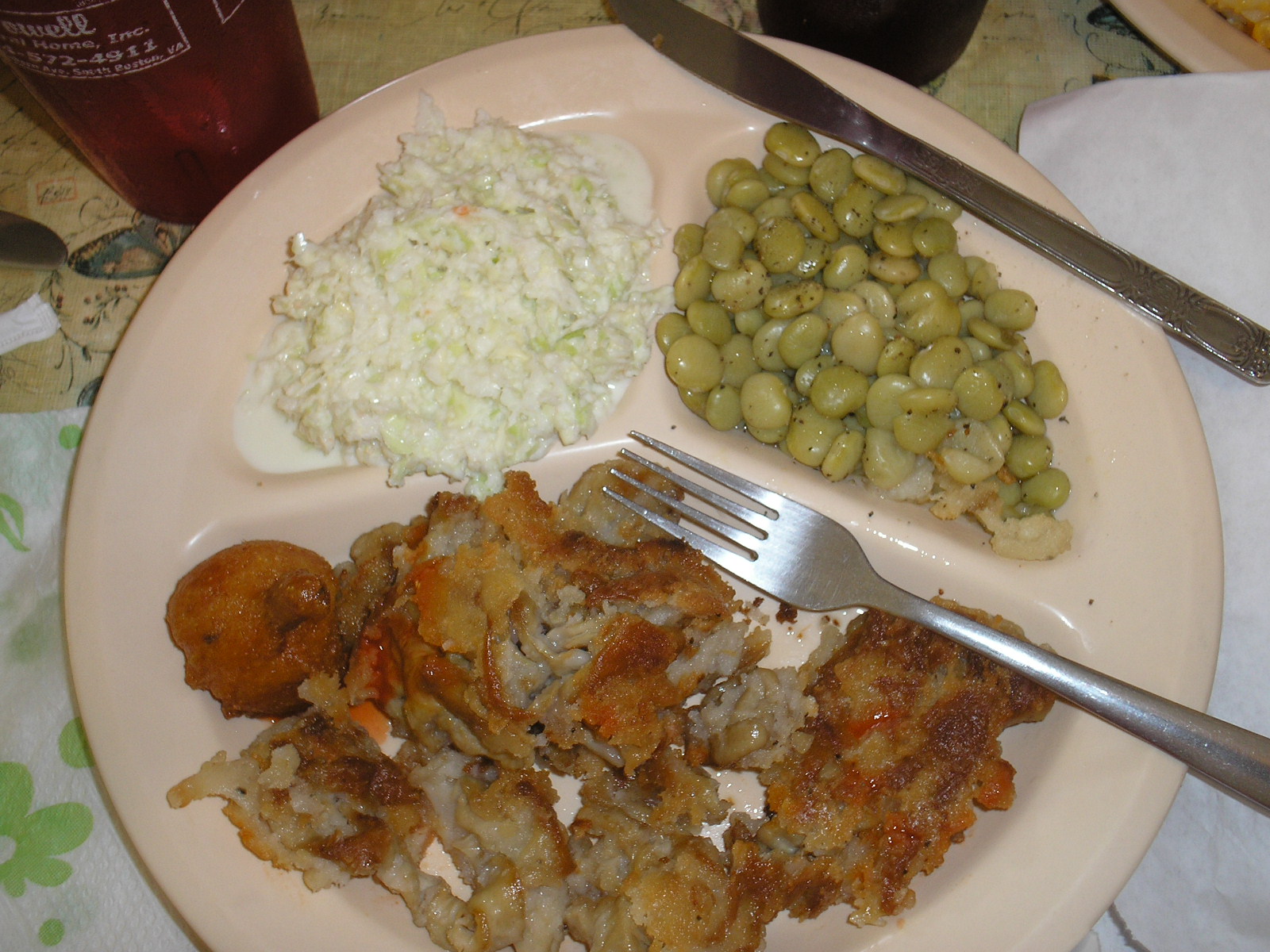
Chitlins with slaw and butterbeansWell, on this occasion, my youngest uncle and an older cousin and their respective spouses had driven over from Tidewater Virginia, so we all went out to Paulette’s Place in Halifax, which served batter-fried fish, shrimp, oysters, and chitlins. My father, my uncle, and I ordered the chitlins. Everyone else had better sense. My uncle drowned his in vinegar, and I dumped tabasco on mine, but I think my father was the only one who didn’t leave any on his plate. The rest of the menu was fine.
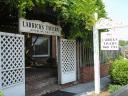
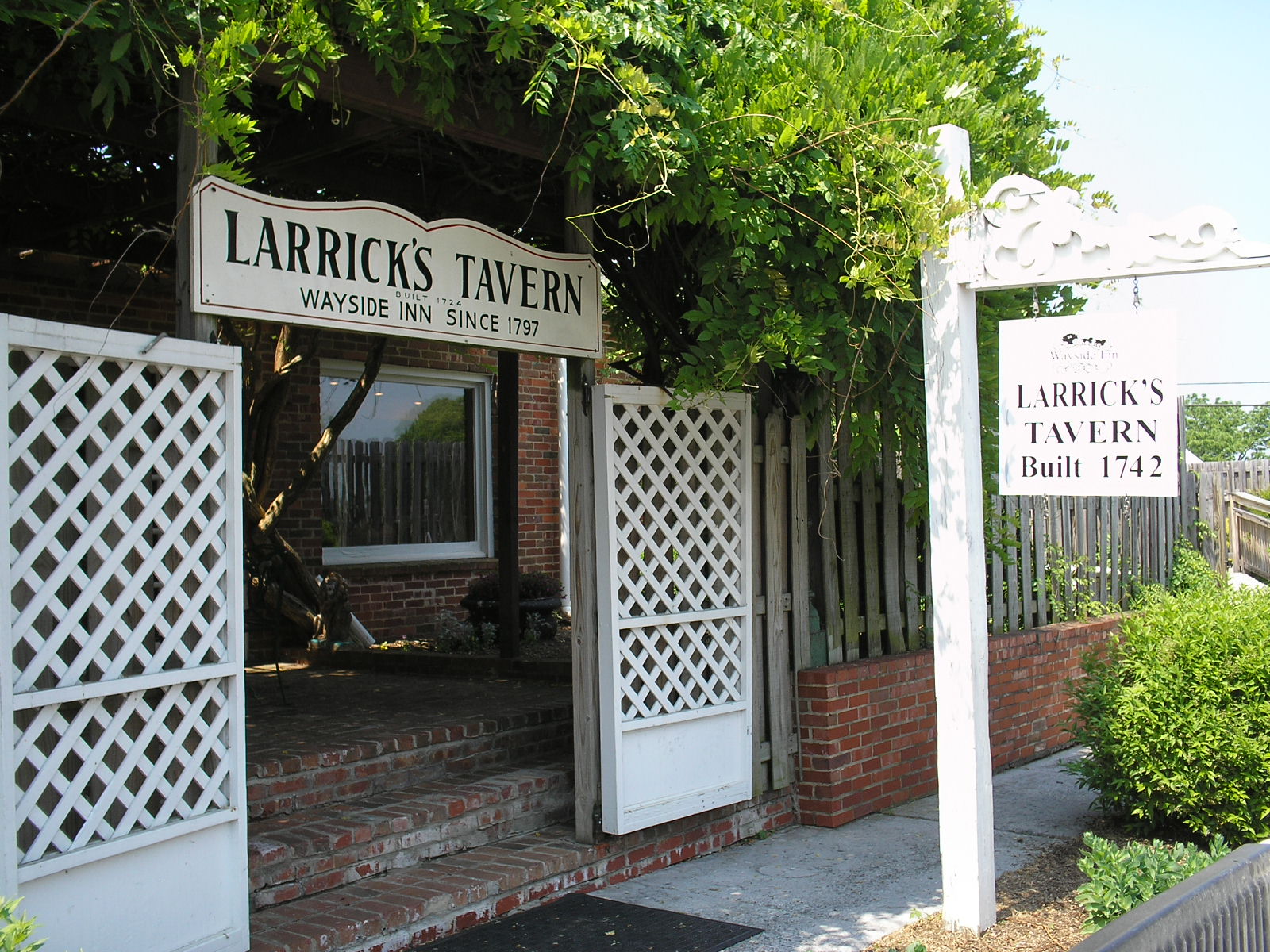
Larrick’s Tavern, Wayside Inn, Middletown, VAOldest restaurant – The next leg of our journey ran through the Blue Ridge Mountains and up the Shenandoah Valley to Middletown, VA, where we stopped for a light snack at the historic Wayside Inn, founded in 1797, before paying respects to my aunt, who lives on a farm nearby, and my cousin’s wife and mother-in-law, who live up the road a bit in a house that dates back to the 1740s. (My cousin was off hunting big game on a South African preserve.) The four of us confused the waitress by ordering three house salads and three bowls of their signature Colonial Peanut Soup, reputed to be one of George Washington’s favorites.

Most sushi – The reason we snacked so lightly in Middletown is that we were headed for another family reunion at the other end of I-66, at the Todai [= Lighthouse] Restaurant in Fairfax with: my brother, sister-in-law, and their two kids; my sister and brother-in-law from Annapolis, MD; my father, who came up from South Boston; and my mother-in-law and sister-in-law, who were flying back to Minneapolis the next day, leaving us the car for the rest of our trip. When I eat at Todai, I concentrate on the huge variety of sushi and a few cold salads. When my brother in Fairfax turned 50, I took him to Todai for lunch and we ate 50 pieces of sushi between us.

Dishes at Fiesta Atlantic, Stamford, ConnecticutBest oasis – Our worst day of driving, by far, was between Fairfax, VA, and New Haven, CT, on the Friday before Memorial Day. Even though we avoided I-95 as much as possible, we spent far too much time in bumper-to-bumper traffic until we got past Baltimore during the morning rush hour, then again after we got across the Hudson on the Tappan Zee Bridge later that afternoon. After trying a stretch of U.S. 1 between Greenwich and Stamford, we decided to break for an early supper in Stamford. After finding the food court still under construction at a brand-new downtown shopping plaza, we discovered Fiesta Atlantic, a refreshing Peruvian restaurant across Atlantic Street that was already open for dinner before 5 pm. Their Sangria had canned fruit cocktail in the bottom of the glass, but tasted quite refreshing, and the two appetizers and two side dishes we ordered were fresh, flavorful, and nicely presented. We had cebiche (ceviche) mixto, ensalada de pulpo (octopus), platano (plaintain) frito, and yuca (yucca) frita.

Most unexpected language – After a long but lovely ride through Pennsylvania on I-80, then through a rather ugly corner of Ohio, we took the North Ridgeville exit on the way to the pleasant Cleveland suburb of Avon Lake, OH, where a busy friend had invited us to stay the night. We had agreed to meet her for breakfast the next morning, so we looked for supper on our own. The Gourmé [sic] Family Restaurant (“Good Home Cooking”) on Lorain Road caught our fancy, so we sampled their fare. I had their lake perch and pierogie combination. Two things puzzled me. Why did every table have a squeeze bottle of syrup as well as ketchup on it? (If ketchup was for the fried fish, was syrup for the pierogies?) And which language was the staff speaking to each other? Their appearance and their accents were vaguely Eastern European, but I heard enough of their talk to rule out Germanic, Slavic, Romance, Hellenic, Turkic, and even Finnic and Ugric. It turned out to be Albanian. We never did solve the mystery of the syrup.

1 Comment

Filed under family, food, military, travel, U.S.

Gimme That Upscale Religion

“The black upper class has most often been associated with the Episcopal Church,” says Rev. Harold T. Lewis, the author of Yet with a Steady Beat: The African American Struggle for Recognition in the Episcopal Church and rector of Calvary Episcopal Church in Pittsburgh. Despite earlier affiliations with the Baptist and Methodist denominations and the larger numbers of blacks who currently make up those congregations, the black elite have often selected the more formal high Episcopal Church or Congregational Church.

The Episcopal faith was attractive because of its formality, and both faiths were appealing because they were known for having well-educated clergy and a small number of members. Well-to-do black Americans with roots in the West Indies had natural historic ties to the Episcopal Church, which had served a major role in Jamaica and other former British colonies for several generations. The Congregational Church’s popularity among the black elite grew from the fact that it was the denomination that had given the greatest support to the American Missionary Association’s efforts in establishing secondary schools and colleges for southern blacks in the late 1800s.

And for some of the most cynical and status-conscious members of the black elite, the two denominations were particularly appealing simply because most blacks were not of that faith.

In every city where there are members of the black elite, there is an Episcopal or a Congregational Church that dominates the upper-class black religious scene: In Chicago, it is St. Edmund’s or Good Shepherd; in Detroit, St. Matthew’s; in Philadelphia, St. Thomas; in Memphis, Second Congregational; in Charleston, St. Mark’s; in Washington, St. Luke’s; in Atlanta, First Congregational; and in New York, St. Philip’s. Some say that the black upper class disdains the open display of emotions that are often shared in Baptist and AME [= African Methodist Episcopal] churches, while others say that Episcopal and Congregational denominations have better-educated church leaders.

For whatever the reason, the choice does keep the elite separated. And just as there have been special churches for the black upper class, so are there special social groups that separate men, women, and children of different classes.

SOURCE: Our Kind of People: Inside America’s Black Upper Class, by Lawrence Otis Graham (Harper, 2000), p. 13

St. Andrew’s Cathedral (Anglican Episcopal), HonoluluI believe I first became aware of the social-class correlates of religious affiliation during my junior high school years in very status-conscious Winchester, Virginia, where one of the standard pejoratives among my peers during the early 1960s was “common”: “Oh, she’s so common!” We were Baptists—common enough in those parts, in both senses. In fact I was baptized in Winchester’s First Baptist Church, my mother’s home church, where my father served as associate pastor during our extended furlough there. My two wealthier uncles belonged to Presbyterian and Lutheran churches, somewhat more upscale denominations in those parts, but not as upscale as Episcopalians, who were at the top of the denominational heap.

UPDATE: Reader Aidan Kehoe wonders whether this phenomenon is as strong in any other country as it is in the U.S. In any country in which there is an established religion (or sect), there would seem to be a strong correlation between the elites and the established religion. It has at times been quite a social handicap (or worse) to be Catholic in the U.K.; Protestant in Spain, France, or Poland; Christian in Japan or Sumatra, Muslim in the Philippines or Moluccas (Maluku), Hindu in Pakistan or Sri Lanka, or Jewish almost anywhere. It’s still tough to be Shi’a (or anything but Sunni) over most of the Muslim world. Nowadays, however, secularism seems to be the creed of the elites in West; it’s at least a social faux pas to openly profess belief in any Western religion on any elite Western university campus. What makes the U.S. exceptional with regard to correlations of creed and class may be the combination of (1) perhaps the most extreme religious diversity of any current state, especially of sects within Christianity, with much regional variation; and (2) very high social mobility across boundaries of class, sect, and region.

2 Comments

Filed under religion, U.S.

Effects of the New Madrid Relief Act of 1815

On February 17, 1815 [three years after the strongest earthquakes in U.S. history], Congress passed the New Madrid Relief Act, the first federal disaster relief act in U.S. history. Unfortunately, the act itself turned out to be a disaster.

The legislation provided for residents whose land had been damaged in the earthquakes to trade their land titles for a certificate that would be good for any unclaimed government land for sale elsewhere in the Missouri Territory. The only restriction was that the new grants had to be between 160 and 640 acres, regardless of how much or little land a person had previously owned. Well-intentioned though the legislation was, it did little to help the residents of the New Madrid area.

Communications being what they were, word of the New Madrid Relief Act did not reach the New Madrid area for months. News did reach St. Louis and other places, however, and speculators were soon beating a hasty path to New Madrid and buying up land for a pittance from unsuspecting locals. Of the 516 certificates issued for redemption, only twenty were held by the original landowners. Three hundred and eighty-four certificates were held by residents of St. Louis, some of whom had as many as forty claims. Adding insult to injury, many banks in Missouri failed, making the Missouri banknotes used to pay for these claims worthless. Governor Clark himself was not above profiting from the situation, as he authorized two of his agents, Theodore Hunt and Charles Lucas, to purchase land in the New Madrid area. Meanwhile, opportunists in New Madrid caught on to what was happening and began selling their land titles many times over. Before too long, the term “New Madrid claim” came to be synonymous with fraud.

Litigation over the resulting land claims tied up the courts for over twenty years, with hundreds of fraudulent claims being pressed. Over the next three decades, Congress passed three more pieces of legislation to try and straighten out the mess. The last case stemming from the New Madrid Relief Act was finally settled in 1862, fifty years after the earthquakes of 1811–12—by which time the frontier had moved a thousand miles west.

SOURCE: When the Mississippi Ran Backwards: Empire, Intrigue, Murder, and the New Madrid Earthquake, by Jay Feldman (Free Press, 2005), p. 236

Plus ça change …

1 Comment

Filed under U.S.

Media Disastermongering in 1990

OVER THE COURSE of the next century and more [after 1811–1812], the New Madrid earthquakes gradually receded from public awareness, as the New Madrid fault system produced just two shocks greater than magnitude 6.0 in the 180 years following the 1811–12 sequence—a 6.5 in 1843 and a 6.8 in 1895. An occasional magazine article would appear and several epic poems and novels using the quakes as a setting were written, but in general, the largest series of earthquakes ever to hit the North American continent faded from memory—until 1990, when a prediction by Dr. Iben Browning suddenly brought the New Madrid fault system to the forefront once again.

Browning was a climatological and business consultant who claimed to have predicted the magnitude 6.9 Loma Prieta quake that struck northern California during the 1989 World Series, causing extensive damage in the San Francisco Bay area. Browning also claimed to have predicted other large earthquakes and volcanic eruptions, including the 1980 explosion of Mount St. Helens in Washington.

Addressing a business seminar in Atlanta in February 1988, Browning told his audience that an earthquake could strike the Memphis area in early December 1990. More than a year and a half later, on November 27, 1989, a short Associated Press story made the prediction public, and the following day, a longer story appeared in the Memphis Commercial Appeal. Two weeks later, speaking to the Missouri Governor’s Conference on Agriculture, Browning repeated his prediction that there was a 50 percent probability that a magnitude 6.5–7.5 earthquake would hit the New Madrid area on December 3, 1990. Browning’s prognostication was based on tidal forces, which were going to be extraordinarily high on December 2 and 3.

Suddenly, people were interested in the New Madrid fault system again. The Lorna Prieta quake in October 1989 had received widespread television coverage, and the repeated viewings of the worst of the damage had created a climate in which Browning’s prediction was taken seriously by the media and the public. Despite the fact that the connection between tidal forces and earthquakes has never been proven, and despite the refutation of Browning’s prediction by several seismologists, including the Center for Earthquake Research and Information director Arch Johnston, media outlets all over the country began picking up the story and running with it.

The issue was given further apparent credence in June 1990 when David Stewart threw his support behind the Browning forecast. Stewart, a geophysicist, was then the director of the Center for Earthquake Studies at Southeast Missouri State University and one of Missouri’s leading earthquake preparedness experts. On July 21, in an article in the St. Louis Post-Dispatch entitled, “Quake Prediction Taken Seriously,” Stewart was quoted as saying that Browning’s “methodology does seem to be promising and worthy of serious and thorough consideration.”

In fact, Browning’s methodology was highly questionable—he had no physical model for his prediction and showed no verifiable evidence to back up his prediction. Moreover, it turned out that his “predictions” of the Lorna Prieta quake and the Mount St. Helens eruption were also suspect. Browning’s doctorate was in zoology; he was a self-taught climatologist with no scientific expertise in seismology or earthquake prediction. After Stewart joined Browning, a number of seismologists made efforts to debunk the prediction, but the cow was already out of the barn.

The Associated Press picked up the Post-Dispatch piece, and it was reprinted in newspapers throughout the New Madrid Seismic Zone region. Stories then ran in major newspapers all across the country, including the New York Times, Wall StreetJournal, Chicago Tribune, and Miami Herald. Soon the national media jumped in. Time and Newsweek published articles and USA Today ran close to a dozen stories. Browning appeared on Good Morning America. Johnston was interviewed for the Today show. World News Tonight and NOVA planned segments on the New Madrid fault system.

Earthquake and natural disaster agencies, together with organizations like the Red Cross, unwittingly exacerbated the crisis by sending out literature on earthquake preparedness without also providing a disclaimer regarding Browning’s prediction. Throughout the New Madrid Seismic Zone, agencies were inundated with requests for information. National Guard units in Missouri and Arkansas conducted earthquake drills. Department stores passed out survival-tip literature and stocked up on blankets, bottled water, and first-aid kits. Many school districts announced that schools would close on December 3. A minor 4.6 tremor near Cape Girardeau, Missouri, on September 26, made the situation that much worse, as many people interpreted the event to be a foreshock of the anticipated December quake.

Except for Stewart, the entire scientific community was aligned against the Browning prediction. “Earthquake experts across the country consider this ‘prediction’ ridiculous and unscientific,” wrote Douglas A. Wiens, a professor of earth and planetary sciences at Washington University of St. Louis, in an op-ed piece for the Post-Dispatch on September 30. “The public should disregard all predictions about the specific date that an earthquake will occur. No one can make such predictions. Though scientists have investigated many different factors that could signal an impending quake, none has proved reliable.” Nevertheless, the media continued to treat the Browning prediction as genuine news.

In mid-October, the National Earthquake Prediction Evaluation Council (NEPEC) released a study that thoroughly refuted Browning’s prediction, but still the media hype went on. By the beginning of December, the New Madrid Seismic Zone region was in a state of near-hysteria.

On the weekend of December 1–2, a carnival-like atmosphere prevailed in New Madrid. More than thirty satellite trucks from television and radio networks worldwide were parked in downtown New Madrid, with its population of just over 3,300. Church marquees advertised sermons with earthquake-inspired themes like, “Preparing for the Big One? Are You Prepared for the Last One?” Cars prowled the town displaying homemade signs along the same lines: “New Madrid save your city fast and repent.” Rev. Frank McRae of the St. John’s United Methodist Church cheerfully admitted, “You don’t get breaks like this often.” Tourists roamed the streets, and the Chamber of Commerce sold “official” earthquake T-shirts and sweatshirts. Tom’s Grill offered quake burgers that were served divided down the middle by a jagged line, while McDonald’s advertised free coffee, “a price you can shake & rattle about.” Near the Mississippi River, the Faultline Express Band played earthquake songs. A California psychologist featured an Iben Browning doll that children were encouraged to pummel as a way of dealing with their fears about the earthquake prediction.

December 3 came and went with no earthquake, of course. The tourists and media crews quickly left, and after several months in the limelight, New Madrid went back to being an ordinary Mississippi River town.

The Browning prediction underscored the fact that there is only one thing certain about the New Madrid fault system, and that is that it will go off again. It could be in two hundred years. Or it could be tomorrow.

SOURCE: When the Mississippi Ran Backwards: Empire, Intrigue, Murder, and the New Madrid Earthquake, by Jay Feldman (Free Press, 2005), pp. 238-241

Plus ça change …

2 Comments

Filed under publishing, U.S.

Black Memphis vs. Black Nashville

From Our Kind of People: Inside America’s Black Upper Class, by Lawrence Otis Graham (Harper, 2000), pp. 276-277:

I am still a devoted fan of Memphis because of my childhood memories and because of the progressive people—both black and white—who I know are working together today; but like its black elite, who were educated elsewhere, I feel it is a town trying to overcome great odds. The thriving downtown that it once had along Main Street—between Beale and Jefferson—was killed in the 1970s when the whites abandoned the increasingly black city, which now is only 44 percent white. There is not a department store within ten miles of City Hall. Big stores like Gerber’s, Lowenstein’s, and Bry’s are all gone now. The area surrounding the municipal buildings, courthouses, and county offices is littered with pawnshops, bail bondsmen, and vacant storefronts. What would have long ago been a well-developed Mississippi River waterfront in any other town is just now seeing walking paths, green grass, and trees. With the exception of a few tall buildings built by the city’s superior hospitals—Baptist and Methodist—and by First Tennessee Bank and Union Planters Bank, one gets the sense that no major company or industry calls Memphis its home. Federal Express is there—several miles out of downtown, near the airport, but the headquarters for Holiday Inn and Cook Industries left years ago.

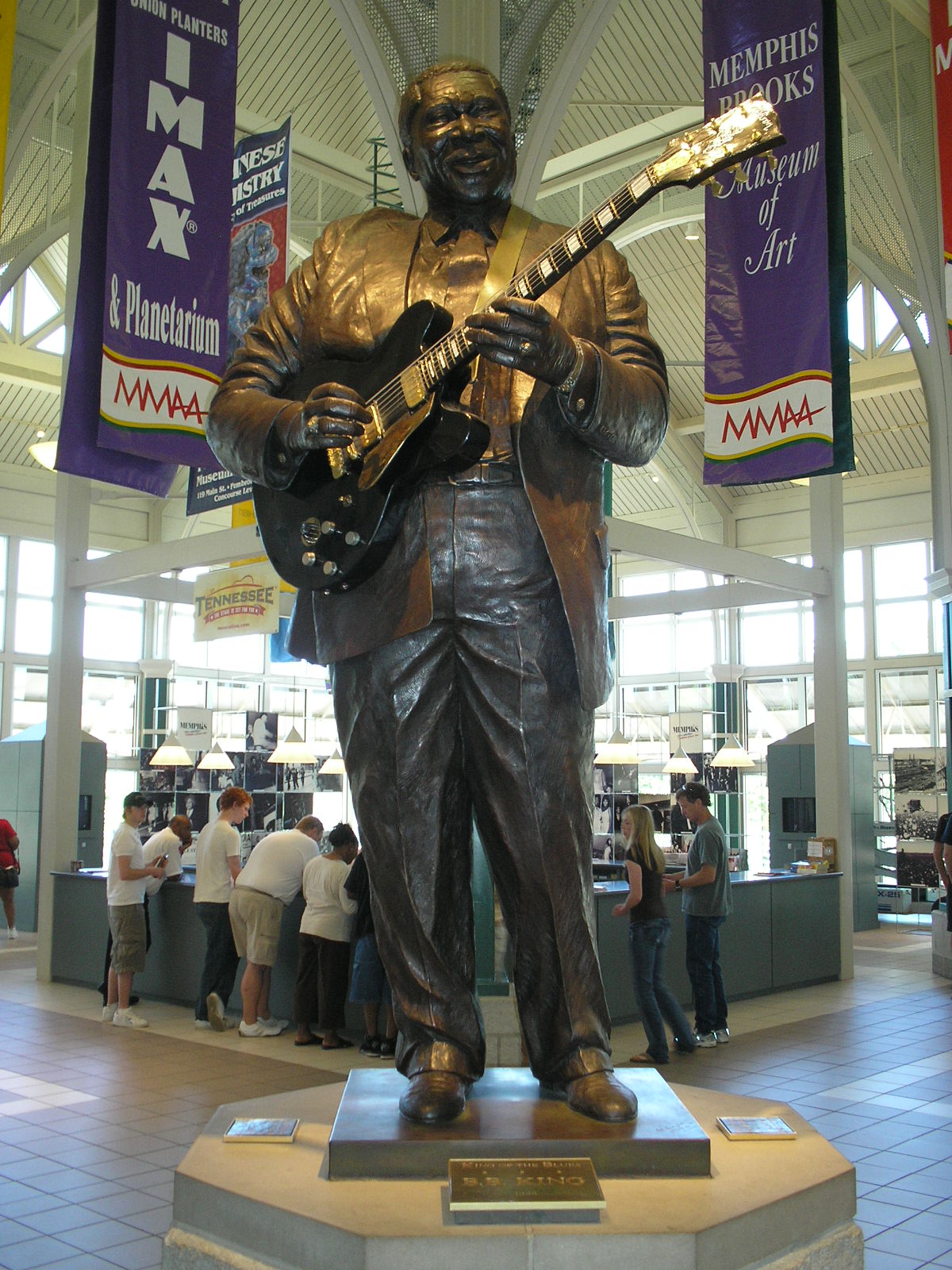
Statue of B. B. King, Memphis Visitor CenterEven the city’s premier hotel, the Peabody—as plush as it is, by Memphis standards—seems a bit corny and anachronistic. Founded in 1869 and rebuilt in the 1920s, the imposing brick structure attracts tourists to its main lobby each morning for a ritual that began in the 1930s and continues today, seven days a week. At 11:00 A.M. sharp, an elevator door opens on the main floor, and marching in line across the carpeted floor are five trained ducks. Marching in unison to taped music that plays over the lobby speakers, the small ducks waddle toward a small, ornate fountain and pool in the middle of the floor. One by one, they hop up to the fountain and then dive into the pool. The routine is repeated in reverse at 5:00 each afternoon. Since the hotel had a policy of segregation thoughout my older relatives’ lives, it was not until we were teenagers that they permitted us to visit the building and view this amusing event.

“Memphis used to have the largest and most developed metropolitan area in Tennessee,” explained a black former city councilman who acknowledges that a fear of integration is what kept Memphis small and rather underdeveloped. “It can’t be blamed on the people who are in power today,” he says, “but those who were making decisions in the 1950s and 1960s created a problem between the races and within the corporate community that was hard to correct.”

The city’s black elite seem to be painfully aware of how much better their black counterparts are doing in Nashville—a city whose metropolitan area had once been less affluent, less respected, and less populated than that of Memphis. In fact, most of the Memphis black elite who had grown up in the city prior to the 1960s had to leave town and go to Nashville in order to get their education. Although the town had the small, all-black LeMoyne College since 1870, it lacked the truly elite black institutions that Nashville had: Fisk University and Meharry Medical College. The black Memphians also lacked Nashville’s Tennessee State University, a black public college that ran itself like an elite private school.

“Although I grew up in Memphis—a city that looked down on Nashville at the time,” explains a sixty-year-old physician who attended Fisk, “I always had the feeling that Nashville was going to catch up and then leave us behind—intellectually and racially. Memphis had no premier schools for whites or blacks, and Nashville had Vanderbilt for whites and these other top schools for us. White Memphians—and even some black Memphians—seemed to get more backward and more provincial as other cities outgrew us. So few blacks here were able to break out of the box and really gain national exposure the way that blacks in Nashville did.”

6 Comments

Filed under travel, U.S.