Category Archives: travel

Paducah’s Men in Quilts

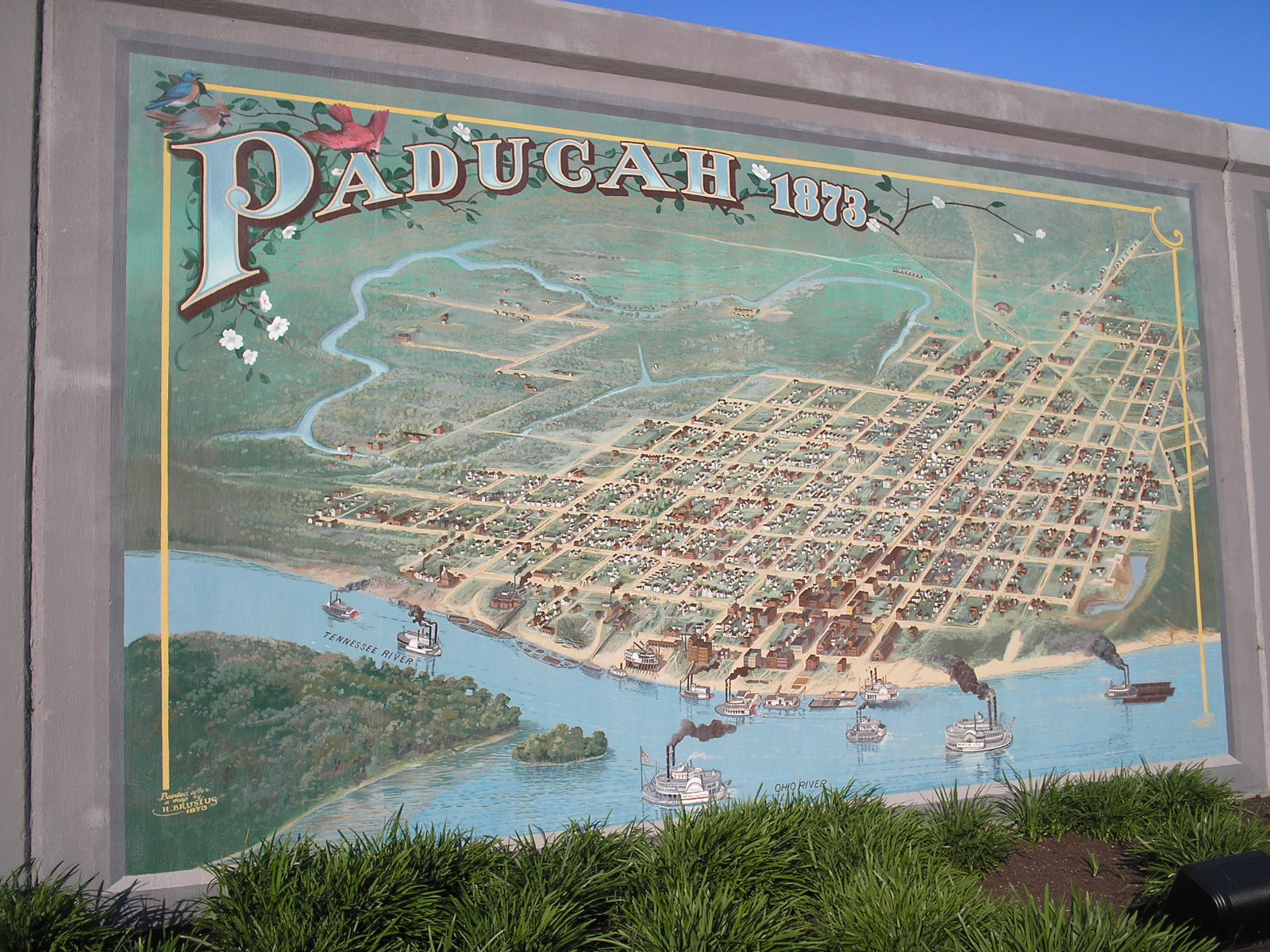
Paducah 1873One of the artistic highlights of our recent Great Square Route around the eastern U.S. (MN – MS – GA – CT – MN) was the stunning Museum of the American Quilting Society in Paducah, Kentucky, which had just opened a special exhibit, 4 Guys & Their Quilts:

On exhibit May 16-August 12, these quilts combine the talents of four male award-winning quilters: John Flynn, Gerald E. Roy, Arturo Alonzo Sandoval and Ricky Tims. MAQS Curator of Collection Judy Schwender is proud to bring lesser known viewpoints from the quilting world to the Museum’s visitors.

“Any quilt reveals the sensibilities of its maker, and men bring perspectives to quilting that are unique to the medium,” Schwender explains. “Within the world of quilting, men are a minority, and the museum is committed to presenting quilting viewpoints of underserved populations.”

My favorite among the 4 Guys was Ricky Tims, whose work ranges from exquisite variations on traditional quilting patterns, like his Bohemian Rhapsody or New World Symphony, to renditions in fabric of depictive art that would not look out of place on a framed canvas or in stained glass, like his South Cheyenne Canyon or Glen Eyrie Castle.

Among the new quilting terms and techniques I learned about at the museum was trapunto (also called “stuffed work”), a texture-enhancing technique that Tims puts to fine use in his Rhapsody in Green.

2 Comments

Filed under art, travel, U.S.

Minnesota’s Canned Corn and Carp

A 1997 Minnesota Historical Society plaque at a rest area near the state line on I-35 tells a bit about the history of Minnesota’s canneries.

Early settlers grew bumper wheat crops on Minnesota’s fertile prairies, land that today supplies produce for a thriving 270-million-dollars-a-year canning industry.

Sweet corn canneries opened in Austin and Mankato in the 1880s, followed soon thereafter by similar factories in Faribault, Owatonna, and LaSueur. Soon Minnesota’s canners were experimenting with new technologies and new products, and in 1903 the automated Big Stone Canning Company founded by F. W. Douthitt changed the industry nationwide. Douthitt’s plant in Ortonville had a conveyor system, mechanical corn husking machines, and a power driven cutter that produced the first whole kernel canned corn. The Green Giant Company, also founded in 1903 as the Minnesota Valley Canning Company, introduced golden cream-style corn in 1924 and the first vacuum packed corn in 1929.

Corn is still the major canning crop in Minnesota. The state’s more than thirty plants also freeze and can peas, beans, carrots, tomatoes, pork, beef, chicken products, and such unusual items as rutabagas. Mankato was the site of the nation’s first carp cannery in 1946.

For more on canned carp, read Dumneazu‘s well-illustrated blogpost on the Odessa Fish Market. In fact, just keep scrolling for an incomparable travelogue series on Dumneazu’s recent adventures in Ukraine.

Leave a comment

Filed under industry, travel, U.S.

Iowa’s Passing Mormons and Utopians

A State Historical Society of Iowa plaque at a pretty little welcome center off Exit 4 on I-35 in Iowa tells two interesting stories, one on each side.

The Mormon Trail

The Mormons of Nauvoo, Illinois, forced from their homes following the murder of their prophet, Joseph Smith, Jr., began their trek across Iowa in 1846 on their way to the Great Salt Lake Valley. From their first permanent campsite on Sugar Creek they travelled across southern Iowa toward Winter Quarters, near present-day Omaha. In addition to Sugar Creek, the Mormons also established permanent camps at Garden Grove in Decatur County, Mount Pisgah in Union County, and Kanesville in Pottawattamie County.

While camped by Locust Creek, near Corydon, William Clayton learned of the birth of his son in Nauvoo. On April 15, 1846, to commemorate this joyous event, he wrote the famous hymn “Come, Come, Ye Saints.” The hymn became a great rallying song of the Mormons.

In 1846, seven Mormon families became separated from the larger body of migrants. They stopped for the winter in present-day Green Bay Township, Clarke County, and established what was known as “Lost Camp.” These families remained in the area until 1854, when they resumed the trek to Utah.

Utopian Experiments in Southern Iowa

Several utopian groups attempted to implement in southern Iowa their dreams of a better social structure. In 1839, Abner Kneeland, a pantheist, started Salubria in Van Buren County. Beset with economic problems, the experiment dissolved after Kneeland died in 1844. In 1843, followers of French socialist Charles Fourier founded Phalanx in Mahaska County, but this communal experiment lasted only two years. Followers of another Frenchman, Etienne Cabet, tried several experiments in the United States, including Icaria in Adams County, which existed from 1860 to 1895.

Led by Ladislaus Ujhazy, a group of Hungarian refugees from the Revolutions of 1848 settled in Decatur County in 1850 and founded the town of New Buda. After experiencing economic difficulties, most of these people moved to Texas in 1853.

In 1851, people from near Farmington formed a communal association called the Hopewell Colony. They moved to Clarke County later that year, and founded the town of Hopeville. Although the communal nature of the colony soon changed, the village survived and for several decades was a thriving community. It is the only one of these southern Iowa utopian experiments whose remnants lasted into the 20th century.

Wisconsin also seems to have attracted more than its share of utopians, these days confined mostly to Madison, I suspect.

The best-known communal experiment in Wisconsin was the Wisconsin Phalanx, a community based on the principles of Charles Fourier, established at Ceresco (Ripon). It was the second largest Fourierist experiment in the country, lasting from 1844 until 1850, and housed around 180 people, most of whom lived communally in the Long House. Although the Phalanx was an economic success and attract[ed] national attention, problems developed and the members agreed to dissolve their community in 1850.

Leave a comment

Filed under religion, travel, U.S.

Wordcatcher Tales: Gum naval, Jump-butt, Stumpage value

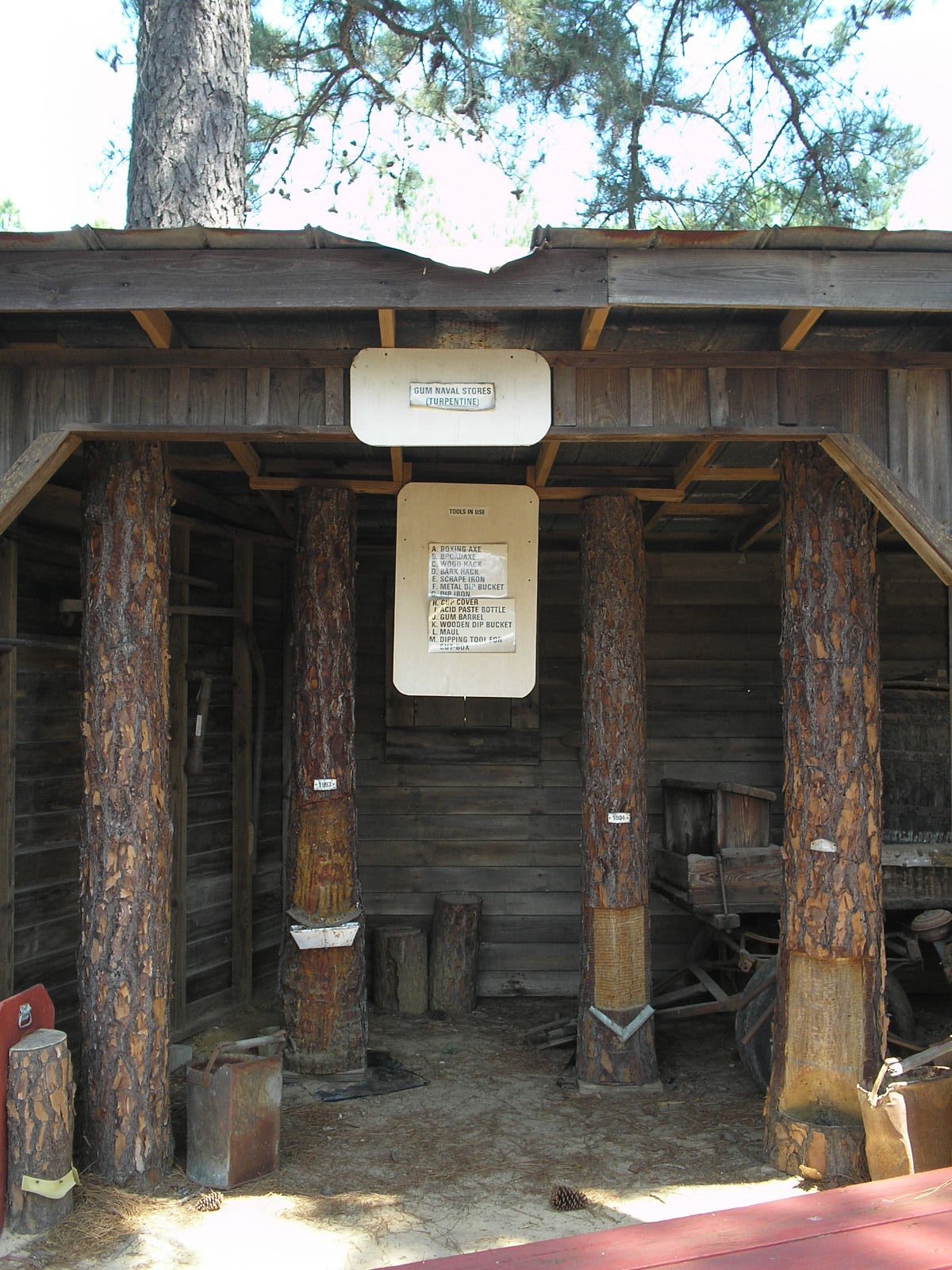
Gum naval stores and toolsOn the road from Columbus to Savannah, Georgia, during our recent Great Square Route around the eastern U.S. (MN – MS – GA – CT – MN), we stopped at the Million Pines Visitor Center off I-16 in Soperton, Georgia. The visitor center includes the Curt Barwick House, built of wood about 1845, which houses the front desk, gift shop, restrooms, and various display items; a one-room wooden house with a tin roof that served as the post office for Blackville, Georgia, from 1888 to 1904; and a wooden shed containing tools used to produce gum naval stores.

The latter term was new to me. It bears no relation to naval jelly (phosphoric acid), which is used on iron ships. Gum naval dates back to the days of wooden ships, when Georgia played an important role in the naval stores industry, as the New Georgia Encyclopedia relates:

In the late nineteenth and early twentieth centuries, Georgia was the world’s leading producer of naval stores, which are materials extracted from southern pine forests and then used in the construction and repair of sailing vessels. Typical naval stores include lumber, railroad ties, rosin, and turpentine.

The naval stores industry in North America originated in the mid-eighteenth century in North Carolina. Before 1800 the major products of the trade were raw gum, pitch, and tar. After the American Revolution (1775-83), processes were developed for distilling spirits of turpentine from gum. By 1850, 96 percent of U.S. naval stores came from North Carolina.

In the early 1870s North Carolina naval stores producers began migrating to southeast Georgia’s sandy coastal plain to take advantage of the untapped virgin pine forests in that region. They brought their equipment and black laborers and established residential villages on large turpentine farms. By the mid-1880s about seven in ten turpentine workers in southeast Georgia had been born in North Carolina.

The industry grew so rapidly that by 1890 Georgia was the national leader in naval stores production, a ranking that lasted until 1905. Florida was the leader from 1905 to 1923, after which Georgia regained its predominance and maintained it until the 1960s.

The USDA Forest Service Southern Research Station Headquarters in Asheville, North Carolina, describes some of the nitty gritty of production. Here are two photo captions from their website:

Photo caption: Improved gum naval stores extraction methods require new tools and techniques. Bark streaks 9 feet from the ground require a special long handled tool for pulling the streak and safely applying the acid. A combination bark-pulling and acid-treating tool was designed to meet this need. The laborer is shown applying 50-percent sulfuric acid to a streak 8 feet from the ground. This tool enables a laborer to stand a safe distance from the tree and reduce the hazard of acid drifting down on his head and clothes.

Photo caption: No more jump-butts and wasted timber as a result of turpentining. A turpentined tree containing both front and back faces and worked for 8 years is shown entering a German gang-saw to produce quality lumber. Developing conservative gu[m] extraction methods for the gum producer represents only half the problem, research must also prove to wood using industries that modern turpentining does not impair the stumpage value of the worked out tree.

The punctuation in the second caption sucks rather badly, but the wonderful collocations make up for it. Jump-butts in this context seems to refer to the discarded lower portion of turpentined trees. Stumpage value is the calculated value of standing timber. The butt log is the often slightly irregular log taken from the base of a tree.

Leave a comment

Filed under industry, language, travel, U.S.

Road Trip Hiatus until June

The Far Outliers will be on the road for the rest of the month. The overland portion will start in Minnesota, then head south through Iowa, Kansas, Missouri, Kentucky, Tennessee, and Mississippi, then east through Alabama and Georgia, then north through South Carolina, North Carolina, Virginia, Maryland, Pennsylvania, New Jersey, and New York to Connecticut for our daughter’s graduation over Memorial Day weekend. Then we’ll head back west through New York, New Jersey, Pennsylvania, Ohio, Indiana, Illinois, Wisconsin, and Minnesota.

We’ll see family in Minnesota, Missouri, Kentucky, Virginia, and Wisconsin; old friends in Georgia, Ohio, and Illinois; and do some sightseeing in the Deep South, especially Natchez and Savannah. Expect little or no blogging, but a lot of new photos on my Flickr account after we return. Among the books I plan to read on the trip are the novel East Wind, Rain, by Caroline Paul (Harper, 2006) and Our Kind of People: Inside America’s Black Upper Class, by Lawrence Otis Graham (Harper, 2000).

Leave a comment

Filed under blogging, travel, U.S.

Night Sounds on the River of Doubt

COMPOUNDING THE misery wrought by the rain was an overarching sense of isolation and uncertainty, a feeling that was magnified by strange noises that shattered the forest’s silence and set the men’s nerves on edge. That afternoon, as Roosevelt and the men in his dugout paddled quietly down the river, a long, deep shriek suddenly ripped through the jungle. It was the roar of a howler monkey, one of the loudest cries of any animal on earth. The sound, which can be heard from three miles away, is formed when the monkey forces air through its large, hollow hyoid bone, which sits between its lower jaw and voice box and anchors its tongue. The result is a deep, resonating howl that vibrates through the forest with strange, inhuman intensity, and echoes so pervasively that its location can be nearly impossible to identify.

Worse even than the noises they could recognize were those that none of them could explain. These strange sounds, which disappeared as quickly as they came and were a mystery even to those who knew the rain forest best, had made a strong impression on the British naturalist Henry Walter Bates fifty years earlier. “Often, even in the still hours of midday, a sudden crash will be heard resounding afar through the wilderness, as some great bough or entire tree falls to the ground,” the naturalist wrote. “There are, besides, many sounds which it is impossible to account for. I found the natives generally as much at a loss in this respect as myself. Sometimes a sound is heard like the clang of an iron bar against a hard, hollow tree, or a piercing cry rends the air; these are not repeated, and the succeeding silence tends to heighten the unpleasant impression which they make on the mind.”…

The Amazon’s sudden, inexplicable sounds were especially terrifying at night, when they were all in the pitch-black forest, with no way to see a potential attacker and no sure means of escape. While the jungle in daylight could sometimes appear completely devoid of inhabitants, the nightly cacophony left no doubt that the men of the expedition were not alone. Even for veteran outdoorsmen like George Cherrie, the setting of the sun came to mark an unnerving threshold between the relative familiarity of a long day on the river, and sleepless nights in the jungle, spent trying to imagine the source of the spine-chilling noises that echoed in the darkness around him. “Frequently at night, with my camp at the edge of the jungle,” he wrote, “I have lain in my hammock listening, my ears yearning for some familiar sound—every sense alert, nerves taut. Strange things have happened in the night.”

The screams, crashes, clangs, and cries of the long Amazon night were all the more disturbing because they often provoked apparent terror among the unseen inhabitants of the jungle themselves. In the fathomless canyons of tree trunks and the shrouds of black vines that surrounded the men at night, the hum and chatter of thousands of nocturnal creatures would snap into instant silence in response to a strange noise, leaving the men to wait in breathless apprehension of what might come next.

“Let there be the least break in the harmony of sound,” Cherrie observed, “and instantly there succeeds a deathlike silence, while all living things wait in dread for the inevitable shriek that follows the night prowler’s stealthy spring.”

SOURCE: The River of Doubt: Theodore Roosevelt’s Darkest Journey, by Candice Millard (Doubleday, 2005), pp. 156-158

Leave a comment

Filed under Brazil, travel

Water Colors in the Amazon Basin

Each of the Amazon’s thousands of tributaries starts at a high point—either in the Andes, the Brazilian Highlands, or the Guiana Highlands—and then steadily loses elevation and picks up speed until it begins to approach the Amazon Basin. Scientists have divided these tributaries into three broad categories—milky, black, and clear—in reference to the color that they take on while carving their way through three different types of terrain. Alfred Russel Wallace, British naturalist and friend of Henry Walter Bates and Charles Darwin, made the distinction widely known in the mid-nineteenth century when he published his Narrative of Travels on the Amazon and Rio Negro. Wallace noted the striking difference between the milky Amazon and the black waters of the Negro where they collide on the northern bank of the Amazon. Seen from above, the meeting of these two colossal rivers looks like black ink spilling over parchment paper. The visual effect is heightened because the Negro, which is warmer and thus lighter in weight, rides on top of the Amazon, and the rivers do not fully blend until they have traveled dozens of miles together downstream.

Milky rivers, such as the Amazon and the Madeira, generally have their origins in the west and are clouded by the heavy sediment load that they carry down from the youthful Andes. Blackwater rivers, on the other hand, usually come from the ancient Guiana Highlands in the north and so wash over nutrient-poor, sandy soils. Scoured by millions of years of hard rains, these soils cannot retain decomposing organic matter—mostly leaves—which, when swept into a river, literally stains the water black like tea.

Although during the rainy season the River of Doubt is nearly as black as the Negro and as murky as the Amazon, it is technically a clearwater river. Like the Amazon’s largest clearwater rivers, the Tapajos and the Xingu, it has its source in the Brazilian Highlands, and so it picks up very little sediment as it flows over ancient and highly eroded soil. Clearwater rivers are also less acidic than blackwater rivers. Some, most notably the Tapajos, are so clear that they look blue, perfectly mirroring the sky above them. But most, like the River of Doubt, mix with either blackwater or milky tributaries as they snake through the rain forest, and so look neither blue nor clear by the time they reach their mouth.

SOURCE: The River of Doubt: Theodore Roosevelt’s Darkest Journey, by Candice Millard (Doubleday, 2005), pp. 171-173

Leave a comment

Filed under Brazil, travel

Naipaul on Writing Fiction and Nonfiction

In the Guardian V. S. Naipaul looks back on his evolution as a writer.

I had no great love for [Trinidad], no love for its colonial smallness. I saw myself as a castaway from the world’s old civilisations, and I wished to be part of that bigger world as soon as possible. An academic scholarship in 1950, when I was 18, enabled me to leave. I went to England to do a university course with the ambition afterwards of being a writer. I never in any real sense went back.

So my world as a writer was full of flight and unfinished experience, full of the odds and ends of cultures and migrations, from India to the New World in 1880-1900, from the New World to Europe in 1950, things that didn’t make a whole. There was nothing like the stability of the rooted societies that had produced the great fictions of the 19th century, in which, for example, even a paragraph of a fairytale or parable by Tolstoy could suggest a whole real world. And soon I saw myself at the end of the scattered island material I carried with me.

But writing was my vocation; I had never wished to be anything but a writer. My practice as a writer had deepened the fascination with people and narrative that I had always had, and increasingly now, in the larger world I had wanted to join, that fascination was turning into a wish to understand the currents of history that had created the fluidity of which I found myself a part. It was necessary for me as a writer to engage with the larger world. I didn’t know how to set about it; there was no example I could follow.

The practice of fiction couldn’t help me. Fiction is best done from within and out of great knowledge. In the larger world I was an outsider; I didn’t know enough and would never know enough. After much hesitation and uncertainty I saw that I had to deal with this world in the most direct way. I had to go against my practice as a fiction writer. To record my experience as truthfully as possible I had to use the tools I had developed. So there came this divide in my writing: free-ranging fiction and scrupulous non-fiction, one supporting and feeding the other, complementary aspects of my wish to get to grips with my world. And though I had started with the idea of the nobility of the writer of the imagination, I do not now rate one way above the other.

via Arts & Letters Daily

When I finished high school I wanted to be a writer, and I studied journalism when I first started college (before dropping out). But I had already discovered that I couldn’t write very convincing dialogue, and my journalism professor told me I wrote in a very “scientific” style. So I ended up writing analytical essays, academic arguments, and—much later—travelogues. My youngest brother is the fiction-writer in the family, as was our maternal grandmother, who alternated between school-teaching and (mostly religious) writing.

Leave a comment

Filed under India, literature, travel, Trinidad

The End of the Golden Age of Exploration

[Theodore] Roosevelt lived during the last days of the golden age of exploration, a time when men and women of science roamed the world, uncovering its geographical secrets at a breathtaking pace and giving rise to bitter international competitions. The year he was born, the earnest young explorer John Hanning Speke, traveling with the famed Orientalist Richard Burton, discovered the source of the White Nile. In 1909, the year that Roosevelt left the White House, Americans Robert Peary and Matthew Henson won the race to reach the North Pole … Just two years later, in late December 1911, Norwegian explorer Roald Amundsen became the first man to reach the South Pole. Robert Scott, a renowned explorer and British hero, made it to the pole a month later, only to find the Norwegian colors flapping in the polar wind where he had planned to plant the British flag. Shocked and dispirited, Scott and his men froze to death on their long, bitter journey back to their ship. Sir Ernest Shackleton and his men, in a legendary attempt to cross Antarctica, narrowly escaped the same fate two years later, the same year that Roosevelt would set off down the River of Doubt.

To [Henry Fairfield] Osborn, Roosevelt’s decision to descend this river seemed insane if not suicidal, and he ordered [Frank] Chapman to tell the former president that the American Museum of Natural History expected him to adhere to his original plan. However, when Chapman’s letter, with all the weight of the museum behind it, reached Brazil, it had less effect than a leaf falling in the rain forest. Having found the challenge he had been yearning for, Roosevelt was beyond the reach of Osborn’s persuasion. In a letter to Chapman, Roosevelt wrote, “Tell Osborn I have already lived and enjoyed as much of life as any nine other men I know; I have had my full share, and if it is necessary for me to leave my bones in South America, I am quite ready to do so.”

SOURCE: The River of Doubt: Theodore Roosevelt’s Darkest Journey, by Candice Millard (Doubleday, 2005), pp. 61-62

Leave a comment

Filed under Brazil, Paraguay, travel

China Train Trips: Back Home in the Cold South

In addition to the Far Outliers, there was one other foreign English teacher family in Zhongshan City, Guangdong Province, China, in 1987–88. They averred that the winter we shared with them in “subtropical” south China was the coldest they had ever experienced—and they were from Winnipeg, Canada! The difference was that people in Canada heated their houses and transport and workplaces during the winter, while people in south China did not. So, below China’s Mason-Dixon line—the Yangtze River—there was nowhere you could go to get out of the cold. That was the strongest memory of our trip back home to Guangdong after our vacation trip for Chinese New Year that February.

We started south from Jingdezhen, this time traveling soft class. Our hosts in Jiangxi Province and fellow teachers in Guangdong Province boarded the same train but traveled hard class. (They didn’t have a child at that time.) We had to change trains in Yingtan, a cold and drab railway junction city on the Shanghai–Guangzhou line. We had a long layover, with not much to see, no nice places to eat, and nowhere to take an afternoon nap. Fortunately, our friends found a small, cheap restaurant with hot food, but with a dirt floor and a doorway open to the cold; then they took us to a railway workers’ dormitory and talked the supervisors into letting us all spend a little siesta time under warm blankets on dormitory beds.

The rest of our train trip south was uneventful, but we arrived at Guangzhou after midnight, too late to find a room in the fairly reasonable Liuhua Hotel near the station. So we tramped over to a much more expensive hotel where we spent the remaining few hours of the night in warmth before catching a bus back over the long, muddy, congested road to Zhongshan City the next morning. Our big concrete and tile apartment offered no respite from the cold. It had no heating, and the damp north wind off the rice paddies leaked through every door and window. It was cold, sweet home.

Leave a comment

Filed under China, travel