
Category Archives: Vietnam

Cambodia’s Thirty Years War

From After the Killing Fields: Lessons from the Cambodian Genocide, by Craig Etcheson (Texas Tech U. Press, 2006), pp. 2-4 (footnote references omitted):

It is an extraordinary situation. Cambodia is a country where as much as a third of the population died in one of the worst genocides of modern times, and many Cambodians do not believe it happened. How can it be that so much destruction occurred so recently, yet so few are aware of this history? In order to explain how this peculiar situation came about and perhaps to help to correct it, we must start at the beginning of the Thirty Years War.

That war began in 1968, when the Communist Party of Kampuchea—popularly known as the “Khmer Rouge”—declared armed struggle against the government of Cambodian leader Prince Norodom Sihanouk. Over the course of this war, the conflict took many different forms, went through many phases, and involved a list of participants nearly as long as the roster of the membership of the United Nations. The country changed its name six times during the Thirty Years War, beginning as the Kingdom of Cambodia, changing to the Khmer Republic in 1970, Democratic Kampuchea in 1975, then the People’s Republic of Kampuchea in 1979, the State of Cambodia in 1989, and finally back to the Kingdom of Cambodia again in 1993. These contortions reflected the extraordinary violence of the underlying turmoil. Cambodia finally emerged from the Thirty Years War in 1999, with the capture of the last Khmer Rouge military leader still waging armed resistance.

The Thirty Years War wrought upon Cambodia a level of destruction that few nations have endured. At the epicenter of all this violence, from the beginning until the end, there was one constant, churning presence: the Khmer Rouge. Though they have now ceased to exist as a political or military organization, Cambodia continues to be haunted both by the influence of the individuals who constituted the Khmer Rouge and by the legacy of the tragedy they brought down on the country. The social, political, economic, and psychological devastation sown by the Khmer Rouge will take generations to heal, if indeed it ever can be healed. This epic saga of havoc is so complex and confusing that scholars do not even entirely agree on how to name all the ruin.

Many historians describe the conflicts in Southeast Asia during the second half of the twentieth century in terms of three Indochinese wars. The First Indochina War was the war of French decolonization in Vietnam, Laos, and Cambodia, beginning in 1946 and ending with the Geneva Conference of 1954. The Second Indochina War can be said to have run from 1954 to 1975; it is typically known in the United States as the “Vietnam War” and in Vietnam as the “American War,” a dichotomy that reveals much about who was centrally involved. In this war of Vietnamese unification, as the United States attempted to prevent the consolidation of communist rule over all of Vietnam, the war also spread to engulf both Laos and Cambodia. The Third Indochina War began hard on the heels of the second, when from 1975 to 1991, the issue of who would rule Cambodia and how it would be ruled drew deadly interest from virtually every country in the region and from all the world’s major powers.

From 1968 onward, it appeared to many Cambodians that these wars flowed from one into the other, as inexorably as the Mekong River flows into the sea. The 1991–1993 United Nations peacekeeping mission in Cambodia marked the end of the Third Indochina War, but the fighting in Cambodia continued for nearly another decade afterward. The outlines of the conflict in Cambodia changed with the United Nations intervention, but the basic issue underlying the war—the Khmer Rouge drive for power—was not resolved by the peace process. Combat continued between the central government and the Khmer Rouge until the government finally prevailed in 1999. Thus, what historians characterize as distinct wars with distinct protagonists appeared to many Cambodians to be simply one long war, with one central protagonist—the Khmer Rouge—driving the entire conflict.
2 Comments

Filed under Cambodia, China, France, Laos, Thailand, U.N., U.S., Vietnam, war

Overview of Southern Immigration

The latest issue of Southern Culture (vol. 13, no. 4, pp. 24-44; Project Muse subscription required) contains an article by Carl L. Bankston entitled New People in the New South: An Overview of Southern Immigration (voluntary immigrants only; not slaves). Here are a few excerpts that caught my eye.

Old South

In 1850 Louisiana had the largest concentration of immigrants in the South, about 75,000 people and approximately one-quarter of Louisiana’s free population. New Orleans, the largest port in the South and the second largest in the nation after New York, was a natural point of entry for people from other countries. Between 1820 and 1860, over half a million immigrants arrived in Louisiana. Given Louisiana’s French history and the large French-speaking population in the state during the nineteenth century, it is easy to assume that France would be the place of origin for most of the state’s foreign-born residents. Many immigrants to Louisiana were, in fact, from France. About 15,000 people in Louisiana in 1850, or one out of five immigrants in the state, gave France as their birthplace. The largest immigrant group in Louisiana, though, came from Ireland. An estimated 26,580 Louisianans, or nearly 38 percent of the state’s immigrants, were born in Ireland in 1850. The Irish are generally described as having arrived in Louisiana in two waves. Those known as the “Old Irish” came primarily from the northern part of Ireland between 1803 and 1830. These earlier immigrants became part of the middle classes of New Orleans. The “New Irish,” consisting mainly of peasants, left their homes because of poverty and famine, particularly after the potato blight, which hit Ireland about 1845 and lasted into the following decade, leaving Ireland devastated. They settled in the area known as the City of Lafayette, which was later incorporated into New Orleans and is still identified as the Irish Channel. The New Irish provided much of New Orleans’s low-paying manual labor.

Germans made up the second largest immigrant nationality in antebellum Louisiana. Over 20,000 people in the state in 1850, or 28 percent of all immigrants, had been born in Germany. Germans first arrived at the port of New Orleans when Louisiana was a French colony. Many settled just north of New Orleans in the Parishes of St. John and St. Charles, in an area known as the Côte des Allemands, or German Coast. A second wave of peasant German workers followed the first wave of German settlers between 1820 and 1850.

New South

As a consequence of geographic access, Texas’s main immigrant population is Hispanic or Latino, yet Texas also has a substantial Asian minority (see Table 1), attributable to some extent to the general rise in Asian migration around the United States and to the booming economy in Texas cities such as Houston. In 2000 the Vietnamese were Texas’s single largest Asian immigrant group, accounting for one out of every four foreign-born Asian Texans, and the state had the second largest Vietnamese population in the United States, after California, with 12 percent of all Vietnamese in the United States.

The case of the Vietnamese illustrates the importance of Texas as a point of access even for members of these more distant national-origin groups. Initial U.S. government resettlement efforts in 1975 had planted Vietnamese communities in the cities of Dallas and Houston. Additional Vietnamese Americans were drawn to Texas by the existing ethnic communities, combined with the availability of jobs in that state. Shrimping became something of an ethnic specialty for Vietnamese Americans along the Gulf Coast of Texas and other states….

As a world center, Atlanta has attracted a diverse Asian population. The largest grouping of Atlanta’s Asians in 2000 consisted of people from the South Asian subcontinent, with just under 36,000 Asian Indians, over 1,000 Bangladeshis, and well over 3,000 Pakistanis. At that time, Atlanta was also home to nearly 25,000 Vietnamese, close to 22,000 Koreans, and just under 21,500 Chinese. Largely members of an educated work force, the South Asian migrants were drawn to this international-airport-hub city by its professional, white-collar opportunities in professional, scientific, and technical industries, which in 2000 employed one in five of the Asian Indians in the metropolis.

As in Texas, the Vietnamese first came to Atlanta as part of government resettlement efforts, and the initial Vietnamese communities provided bases for secondary migration from other parts of the country while Vietnamese job seekers looked for work. They found it in the blue-collar sector, with nearly one-third of Atlanta Vietnamese occupied in the city’s manufacturing industry in 2000. Koreans, as in New York and Los Angeles, became the small shopkeepers of Greater Atlanta, with about 22 percent of Koreans in retail trade. Chinese, like the South Asians, had often come with educational credentials to seek jobs in professional, scientific, and technical fields, which held 17 percent of the area’s Chinese workers. Other Chinese migrants tended to go in to restaurant and related work, as accommodations and food services held 16 percent of the city’s Chinese workers. A diversified metropolitan economy with global connections had pulled in workers from all over the world into a mosaic of national-origin specializations.

2 Comments

Filed under Asia, France, Germany, Ireland, migration, South Asia, U.S., Vietnam

Woolsey Hall, Memorial Walls, and Stacked Pencils

When she submitted her design for the Vietnam Veterans Memorial on the National Mall in Washington, D.C., Maya Lin was still an undergraduate at Yale, where she was no doubt partially inspired by the names on the walls of Woolsey Hall, which houses the university auditorium and the university cafeteria, and on whose interior walls one can find the names of Yale alumni killed in many wars, revolutionary (Nathan Hale), civil, and foreign. In November 1922, Yale dedicated its War Memorial, adding 225 names of Yale alumni killed in World War I.

The names on Woolsey Hall include military ranks, dates of death, and place of death, if known. The vast majority of Yalies served as officers, as befitted their elite status during most of Yale’s history. (Nowadays our elites are too good to serve in the military.) But a minority of Yalies in each war served in the enlisted ranks. When the Far Outliers attended a baccalaureate service at Woolsey Hall last May, I found a few of those names of Yalies who apparently dropped out and enlisted before they graduated, for whatever reason. Here are just two, one killed in Vietnam, one in Korea.

  • Donald Porter Ferguson, class of 1969, CPL, U.S. Army, killed on 13 January 1968 in Bienhoa, Vietnam. (One of my classmates learning Romanian at Army Language School in 1969–70 graduated from Yale in 1968.)
  • Harold Ackerman Storms Jr., class of 1953 (or 1952), PFC, Infantry, killed 10 July 1953 on Christmas Hill in Korea. (The armistice was signed on 27 July 1953.)

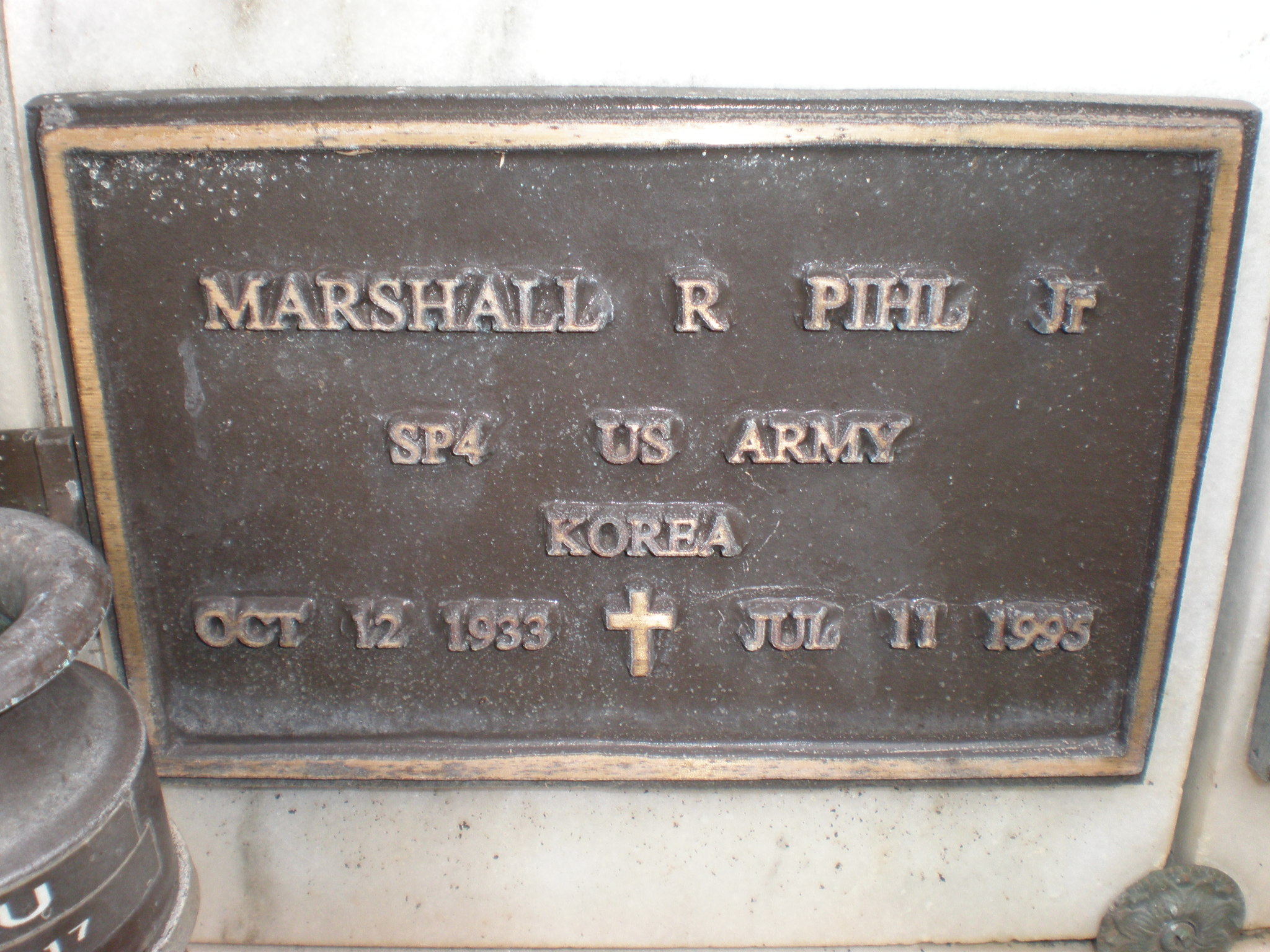
However, the Ivy League veteran I would most like to honor on this Veterans Day is Marshall R. Pihl (1933–1995), Harvard class of 1960, who learned Korean courtesy of the Army Language School and used his G.I. Bill funding to become a renowned scholar of Korean literature, especially the “performed literature” he described in his dissertation, later published as The Korean Singer of Tales (Harvard U. Press). Here’s the obituary posted to a Korean studies listserv in July 1995.

MARSHALL R. PIHL, renowned translator and leading scholar in the field of Korean literature, died at his home over the weekend of July 8. He was 61.

Since early spring his health had been deteriorating, at first gradually and then more and more rapidly. Nevertheless he diligently kept his appointments and continued his research. At least outwardly, he remained optimistic about recovery until the end.

After graduating from Harvard College in 1960, where he majored in Far Eastern languages, Marshall became the first Fulbright student grantee in Korea, receiving an M.A. in Korean language and literature from Seoul National University in 1965. He was the first Westerner to earn a graduate degree from a Korean university. He then entered the doctoral program at Harvard University, receiving his Ph.D. in 1974.

During another Fulbright year in Korea in 1970-71, Marshall was named the winner of the first annual Modern Korean Literature Translation Award, sponsored by the Korea Times. His first collection of translations, Listening to Korea, was published by Praeger in 1973. Later he produced The Good People: Korean Stories by Oh Young-su, published by Heinemann in 1985, and coedited (with Bruce and Ju-Chan Fulton) Land of Exile: Contemporary Korean Fiction, published by M. E. Sharpe/UNESCO in 1993. He also published many articles and translations in periodicals such as Korea Journal and Korean Studies and in collections such as Peter Lee’s Anthology of Korean Literature (1981) and Flowers of Fire (1986). But he was most proud of the beautifully produced work that originated as his dissertation, The Korean Singer of Tales, published by Harvard University’s Council on East Asian Studies in 1994.

Because he was a pioneer in a then-tiny field, Marshall was unable to secure a full-time academic position and was forced to combine teaching with administrative duties until he joined the Department of East Asian Languages and Literatures at the University of Hawaii in 1989. Although he was an exceptionally capable administrator, serving as associate director and then director of the Harvard University Summer School from 1977 to 1987, he was thrilled to be able to devote full-time to teaching and research in Hawaii.

His contributions were well recognized at UH, where he received tenure in 1992 and a promotion to full professor in 1995. His administrative skills were also highly valued by his colleagues on the executive committee of the Center for Korean Studies.

Marshall was not just a fine scholar, but also a dedicated teacher and an unfailingly generous, optimistic, and energetic mentor for junior colleagues everywhere. He attracted a growing number of graduate students into Korean literature, and always gave higher priority to their academic advancement than to his own projects. Even in the two months before his death he chaired one dissertation defense, two thesis defenses, and served as outside member on several more.

He had planned to devote his upcoming sabbatical to finishing several of his own projects, including translating and condensing Cho Dongil’s comprehensive history of Korean literature and coediting several textbooks in a series on Korean literature organized by the International Korean Literature Association, which he helped establish in 1992.

———-

Marshall was an extraordinarily powerful person. I never spoke with him without feeling infused with some of his energy and obvious love of life. —Jonathan Petty, University of California, Berkeley

Not only was he a fine scholar who brought an incredible amount to the field, but he was also simply an extraordinary human being—kind, helpful, and generous to those around him and blessed with a terrific sense of humor. His passing leaves not only a large vacuum in the field but a huge void in the hearts of those who knew him. —Stephen Epstein, Victoria University, Wellington

Marshall used to say that at the end of each duty day in Korea, regular soldiers might stack arms, but his fellow translator/interpreters would stack pencils. His ashes are interred in Punchbowl National Memorial Cemetery of the Pacific in Honolulu.

Marshall R. Pihl grave marker

Marshall R. Pihl grave marker

1 Comment

Filed under education, Korea, U.S., Vietnam, war

Shall I Confess to Being a Capitalist or a Prostitute?

In front of a crowd full of sleepy faces, my mother was directed to speak about herself, not as a form of self-introduction, but in a confession of her past sins against the Communist party and the new government. Standing alone onstage with a microphone in her hand, my mother rushed through the major events of her life, trying to convey enough sincerity to keep herself out of trouble. She acknowledged her guilt and ignorance during the Republican era, and praised the enlightened attitudes she had since learned. Her Communist vocabulary had improved a great deal through her encounters with Mr. Tran, and she incorporated his words into her speech, maintaining her eye contact with everyone except Lam. He sat among a group of men, acting as inconspicuous as possible.

When my mother had finished, the community leader stepped up to the podium. Unlike Mr. Tran, who had earned his position through spying, the new leader was a high-ranking officer in the Vietcong’s military. He was in his early fifties, with thin silver hair and a catchy smile. He had spent the past ten years of his life in the Truong Son Mountains, trekking the Ho Chi Minh trail. Rumors had it that he was now waiting to be reunited with his wife and children.

Taking the microphone in his hand, he said, “Thank you, Miss Khuon. What a story! Does anyone care to give any feedback? It is time for some constructive criticism, so without further ado, let’s start. May I remind you that each time anyone among you makes a statement, he or she will earn a point toward community work.”

A man stood up. My mother recognized him as one of her regular customers at her bank during her pre-Revolutionary days. A chill shot through her, since his appearance conjured up in her mind the hundreds of angry customers who had confronted her only a short time ago. As for the man, earning up to thirty points would exempt him from a day of volunteer work in the jungle; however, he also understood my mother’s capacity to hurt him, through her knowledge of his past business affairs.

He cleared his throat and said, “It was a sincere story, told from the heart. But are you leaving out any details? I want to know more about your personal life. Do you have any children? And how many? Have you been married?”

The Communist leader looked at my mother, waiting for her reply. “Well, to tell the truth,” my mother began, mechanically touching her stomach through her blouse, “I have never been married. I have two sons, and a new child on the way.”

“Tell us about your sons,” a voice said. It belonged to a woman who lived in a farm a few blocks away from my house. She was the wife of the town butcher.

“What do you want to know about my sons?” my mother said. “They are still very young.”

The butcher’s wife stood, looking up and down at my mother. Then she blurted out, “I’ve been watching you since you moved into this neighborhood. I don’t need you to tell me how old your children are. What I want to know is the nature of their ethnicity. Are they half-breeds or not? Because if they are, it is an issue to us.”

“Yes, they are.” My mother swallowed.

“Then how did you get these children—through a catalogue?”

“I got them the same way you got your children, through intercourse, of course.” My mother’s answer stirred up a round of laughter in the crowd.

The community leader warned my mother, “Behave yourself, lady. This isn’t a nightclub.”

The butcher’s wife turned bright red but was not giving up. “Under the Imperialist government,” she said fervently, “there are two possible ways for a person to have had mixed-blood children: through prostitution or through adoption. You have admitted earlier that fucking was how you got them, so you must be a hooker.” She ended triumphantly, looking around the audience for affirmation.

My mother swallowed again. She knew at that moment she had to make up her mind about her past status before these strangers. They wanted to label her so that later, they could justify any action taken against her. What was the lesser of the two evils she could admit to being a lowly prostitute or an arrogant capitalist? To the new regime, capitalism was considered the higher crime. Fifteen seconds dragged by before she could speak. Finally, with the crowd’s full attention, my mother nodded in agreement. “Yes, I was,” she said. “A prostitute is exactly what I was. And I am utterly ashamed of it.”

SOURCE: The Unwanted: A Memoir of Childhood, by Kien Nguyen (Back Bay, 2002), pp. 109-111

Leave a comment

Filed under Vietnam, war

Teaching a Fishy English Lesson, Nhatrang, 1978

Jimmy and I attended the local elementary school, where our studies focused on math, literature, history, and science. All were taught from the Communist point of view. Miss San, who continued to teach my class, decided to hold a free tutorial session at her home every Sunday afternoon. Those were the only lectures in my experience that were not delivered with any political overtone.

Miss San lived in a two-story dwelling several blocks away from my street. She used her first floor as a fish-sauce factory, and three enormous earthenware jars were constantly at work there. Each container could hold two to three hundred pounds of fish, marinating in an equal amount of salt. She explained to us that making fish sauce was her main source of income. Teaching was just a recreational activity. The rancid smell of rotten fish was deadly, like the stench of tooth decay, only stronger. The odor permanently clung to her clothes, seeped into her hair, and like a miasma, spread to her surroundings. The adults, especially men, avoided her. They feared her eccentric nature. Children, however, were drawn to her warm personality, and no one found her more magnetic than I did.

As each Sunday afternoon approached, we eagerly wondered what surprise she had in store for us this week. Sitting on the floor in her rumpled bedroom among her scattered clothes, we waited for her appearance like the audience of a performing artist. One of Miss San’s favorite subjects was English. “The only way for us to grow as a nation is to learn from other countries’ technologies,” she often told us. “How can you learn their technologies? You can start by learning the universal language — English.”

She winked at us with a mischievous smile. “Today, let’s not learn from the textbook. Instead, let’s test our vocabularies, shall we? For the next hour, all of us must speak in English. I know this is a very difficult game, but we can try. Let’s have some fun together.”

We were trembling with excitement. Abandoning our language in a large group discussion such as this one was a forbidden act, yet it seemed so natural and harmless to us in that moment. As if she sensed our uncertainty, Miss San continued, “Let’s keep this our own little secret, children.”

She switched to English and the lesson began. “Duy went out last night,” she said, and I saw my friend sit up a little straighter. Pointing at a small girl in a ponytail, Miss San ordered, “Chi, please finish that thought.”

Chi pondered a few seconds and then said carefully, “Duy went out with a girl last night.”

There were some giggles among the students. The image of Duy with a girl was funny in any language. Miss San turned to me. “Kien, please?” she asked.

“Who was that girl? ” I formed a sentence quickly.

“Yes, that is a good question,” she said. “Tell us who that girl was, Duy.”

Duy stood up. Scratching his ears, he stuttered, searching the room for help. Someone whispered an answer, and he seized it as though he were drowning. “That girl was — was — was — my — mother,” he shouted. His voice cracked from the excitement. We fell into each other’s arms with laughter. Leaning against the wall, Miss San, too, was smiling. In the shadow of the room, I thought she was quite a beautiful lady, almost like a vision.

SOURCE: The Unwanted: A Memoir of Childhood, by Kien Nguyen (Back Bay, 2002), pp. 139-141

Miss San abruptly disappeared soon thereafter.

Leave a comment

Filed under education, language, Vietnam

Trying to Leave Saigon, April 1975

SAIGON WAS IN its last free hours. The smell of chaos filled the air, and confusion was written all over the faces of the people on the street. Groups of armed convicts were breaking into houses, screaming up and down the streets, and shooting into the sky. Furniture flew onto the street, blocking the traffic. Discarded items were set on fire, either by accident or purposely; the smoke and flames added to the terror. Soldiers ran in all directions, tossing their rifles into trash bins, and stripping off their uniforms as if they were on fire. Some children who had lost their parents huddled on a street corner, crying. Above their heads, fire was consuming a coconut tree, and sparks of flame rained down on them. From the car window, they looked as if they were being burned alive in some sacrificial ritual.

We did not get far. The streets were blocked by hordes of desperate people, all with the same futile intention of getting to the airport. Just as we reached the freeway, a painful truth dawned on us: we weren’t going anywhere. As far as we could see, the highway was clogged with civilian vehicles and military tanks. The hellish shriek of panic was dreadful in the hot air. People were abandoning their cars, running over each other, jumping on top of one another, climbing onto anything within their reach in order to move forward. Dead bodies lay in contorted positions, grinning horribly at the living. A few steps away from our van, a pregnant woman lay dead near the sidewalk. Her stomach had been ripped open by many hasty footsteps, and next to her lay her dying fetus, moving weakly under a dark mob of curious flies. A pool of dark blood beneath her dried slowly under the harsh sun. My mother quivered and recoiled in her seat, pulling us closer to her.

All along the freeway, people flowed like water down a stream. The crying of lost children looking for their parents, the screams of people being robbed, the songs blaring from the radio, the gunshots, the wailing of the wounded victims all blended into an incoherent symphony of grief. And like the humidity evaporating in the air, this collective keening lifted higher and higher, mixing with the noxious tear gas in a dark cloud of suffering.

Inside the car, my brother and I were too afraid to make a sound. Lam no longer looked relaxed. His long hair fell over his forehead, which was slick with sweat. His fingers, which held to the wheel tightly, were white at the knuckles. His head shook uncontrollably with each breath he took, and his eyes were opened wide, exaggerating the whiteness of his eyeballs.

Lam let out a loud, frustrated scream, as he pounded the horn in a fury. He turned to face my mother. “We have to get the fuck out of the car,” he spat. “This is not going to work just sitting here. You take the children and move.”

My mother’s lips tightened into a straight line. She grasped my arm, and I felt her fingernails dig deeply into my flesh.

“Are you insane?” she replied. “Look at these people! I am not leaving this car.”

Lam leaned within an inch of my mother’s face. I could see his jugular veins, engorged with blood like two swollen earthworms, as they stared at each other. At last Lam broke the silence.

“Then give me my damned ticket and my passport. I am sick of listening to you, wretched woman. I am leaving with or without you.”

My mother did not respond. “Now!” he cried.

The scream startled my mother. She shook her head as if to clear it, then reached for her purse.

Lam’s eyes followed her hands. “Give me your ticket and passport as well,” he blurted. “I am taking Loan with me.”

“Why her?” my mother asked. Lam focused on something invisible on the floor. “She is having my baby.”

Loan let out a small cry. My mother ignored her. After exhaling a deep breath, she gazed at Lam calmly.

“So am I. How do you explain this to me? Can’t you see that I am also pregnant with your child? ” she asked.

“So what? You don’t need me. You never did,” he said bitterly. “Trust me, you will do just fine.”

He yanked the purse out of my mother’s hand, searching intensely until he found what he was looking for. In addition to the papers, he grabbed a thick bundle of cash. Waving them teasingly in front of my mother, Lam said, “You just consider this payment for my devoted services.”

Behind my mother, Loan finally spoke up. “I am not leaving with you, Lam. I am staying here with the mistress.”

He turned to look at her as if she were deranged. Then, his lips pulled back in a distorted smile. “Fine, you stupid servant. Stay. Be my guest.”

He picked out my mother’s passport and ticket and threw them together with her purse back in her lap. Keeping the money and his own passport, Lam rammed them into the front pocket of his pants. Then, the smile returned to his face. He sank back in his seat, adjusting his clothing, before opening the door to let himself out. Oddly, he turned back one last time to look at us.

“Have a nice life, all of you,” was all he said before he disappeared into the crowd.

SOURCE: The Unwanted: A Memoir of Childhood, by Kien Nguyen (Back Bay, 2002), pp. 25-27

Leave a comment

Filed under Vietnam, war

The Cultural Revolution Hits Seinan Seminary in Japan

In the fall of 1970 [the year right-wing novelist Mishima Yukio committed ritual suicide] the [cultural] battlefield shifted to the seminary campus in Fukuoka, where most [Japan Baptist] Convention ministers were trained. The seminary was–and is–a part of Seinan Gakuin University, which was plagued by student rebellions in 1969…. The rebellions were nationwide in scope, affecting private and public universities alike, though carried out by a militant minority and not by the majority of students. At Aoyama Gakuin University (Methodist) in Tokyo and Kanto Gakuin University (American Baptist) in Yokohama, the theology departments became so involved as to self-destruct over a period of time. Neither has been reopened. Belatedly, though no less ominously, a group of dissident students at the Fukuoka seminary called a strike in September 1970.

The seminary had 34 students: 23 in the theology department of the university and 11 in an unaccredited Bible school. The striking students numbered only 10 at first and never exceeded 11, but they forced the cancellation of all classes until January 1971. With the backing of a few area pastors, they assailed the faculty for not speaking out jointly against the Vietnam War, the Security Treaty, the Baptist congress, Expo ’70, and government efforts to nationalize Yasukuni Shrine, where the war dead are enshrined. A theology that does not address such issues is invalid, the students declared; any evangelism that does not attack the evil structures of society is incomplete.

These social activists declared that the seminary was bankrupt and not salvageable, that the faculty should resign en bloc to clear the way for a new beginning. George Hays had the misfortune of being seminary dean at the time. On October 7, citing “two instances of misunderstanding related to the language,” he resigned the position, no longer confident that he could negotiate with the students. Hays was succeeded by Professor Sekiya….

Numerous meetings were held, some of them loud and boisterous, in quest of reconciliation. Position papers were demanded of each faculty member, and each was interrogated as though an accused heretic at an inquisition. No exceptions were made of the three missionary teachers: Hays, Bob Culpepper, Vera Campbell. Culpepper returned from an emergency furlough in November 1970, in the midst of the turmoil, and went on trial as the others had done. All three handled themselves well and helped the seminary to survive. When the new school year opened in Apri1 1971, however, total enrollment was down to 22. Not until the next decade did it reach 34 again.

Ozaki Shuichi has said that the most tragic result of the strike was the loss of some very promising students to the gospel ministry. If so, a close second was the loss of Ozaki himself to the seminary faculty. This New Testament scholar, second-generation preacher, and sometime interpreter to Billy Graham resigned during the struggle. Consequently, he was scathingly denounced as irresponsible and harassed by late-night phone calls. Dean Sekiya also got calls at night. The harassments came to an end when Ozaki’s daughter Yoko, the seminary librarian, was struck and killed by a train–an apparent suicide. So great was the shock that 16 years were to pass before Ozaki accepted an invitation to speak at the seminary, though he lived in Fukuoka all this time.

SOURCE: The Southern Baptist Mission in Japan, 1889-1989, by F. Calvin Parker (University Press of America, 1991), pp. 238-240

Nowadays Seinan [‘Southwestern’] Seminary is independent of the (U.S.) Southern Baptist Convention, which since the 1970s has imposed stricter doctrinal controls at all the major seminaries in the U.S. (Southern in Louisville, Southeastern in Wake Forest, Southwestern in Fort Worth, and New Orleans). Seinan Seminary pays the salaries of several former missionaries who would likely have trouble passing the current SBC creed tests.

Leave a comment

Filed under Japan, Vietnam

Hero of My Lai Has Died

Hugh Thompson, the helicopter pilot who interrupted the My Lai massacre in 1968, has died.

NEW ORLEANS — Hugh Thompson Jr., a former Army helicopter pilot honored for rescuing Vietnamese civilians from his fellow GIs during the My Lai massacre, died early Friday. He was 62.

Thompson, whose role in the 1968 massacre did not become widely known until decades later, died at the Veterans Affairs Medical Center in Alexandria, hospital spokesman Jay DeWorth said….

As the years passed, Thompson became an example for future generations of soldiers, said Col. Tom Kolditz, head of the U.S. Military Academy’s behavioral sciences and leadership department. Thompson went to West Point once a year to give a lecture on his experience, Kolditz said.

“There are so many people today walking around alive because of him, not only in Vietnam, but people who kept their units under control under other circumstances because they had heard his story. We may never know just how many lives he saved.”

A U.S. News heroes page has more details of that day.

On that historic morning, Thompson set his helicopter down near the irrigation ditch full of bodies. He asked a sergeant if the soldiers could help the civilians, some of whom were still moving. The sergeant suggested putting them out of their misery. Stunned, Thompson turned to Lieutenant Calley, who told him to mind his own business. Thompson reluctantly got back in his helicopter and began to lift off. Just then [crew chief Glenn] Andreotta yelled, “My God, they’re firing into the ditch!”

Thompson finally faced the truth. He and his crew flew around for a few minutes, outraged, wondering what to do. Then they saw several elderly adults and children running for a shelter, chased by Americans. “We thought they had about 30 seconds before they’d die,” recalls Colburn. Thompson landed his chopper between the troops and the shelter, then jumped out and confronted the lieutenant in charge of the chase. He asked for assistance in escorting the civilians out of the bunker; the lieutenant said he’d get them out with a hand grenade. Furious, Thompson announced he was taking the civilians out. He went back to [door gunner Lawrence] Colburn and Andreotta and told them if the Americans fired, to shoot them. “Glenn and I were staring at each other, dumbfounded,” says Colburn. He says he never pointed his gun at an American soldier, but he might have fired if they had first. The ground soldiers waited and watched….

Thompson wasted no time telling his superiors what had happened. “They said I was screaming quite loud. I was mad. I threatened never to fly again,” Thompson remembers. “I didn’t want to be a part of that. It wasn’t war.” An investigation followed, but it was cursory at best.

A month later, Andreotta died in combat. Thompson was shot down and returned home to teach helicopter piloting. Colburn served his tour of duty and left the military. The two figured those involved in the killing had been court-martialed. In fact, nothing had happened. But rumors of the massacre persisted. One soldier who heard of the atrocities, Ron Ridenhour, vowed to make them public. In the spring of 1969, he sent letters to government officials, which led to a real investigation and sickening revelations: murdered babies and old men, raped and mutilated women, in a village where U.S. soldiers mistakenly expected to find lots of Viet Cong.

Not all soldiers at My Lai participated in the carnage. Some men risked courtmartial or even death by defying Calley’s direct orders to shoot civilians. Eckhardt doesn’t think these men were heroes, because they didn’t try to stop the murderers. But Colburn thinks they did the best they could. “We could just fly away at the end of the day,” he notes. The ground troops had to live together for months.

The Pentagon’s investigation eventually suggested that nearly 80 soldiers had participated in the killing and coverup, although only Calley (who now works at a jewelry store in Columbus, Ga.) was convicted. The eyewitness testimony of Thompson and Colburn proved crucial. But instead of thanking them, America vilified them. Many saw Calley as a scapegoat for regrettable but inevitable civilian casualties. “Rallies for Calley” were held all over the country. Jimmy Carter, then governor of Georgia, urged citizens to leave car headlights on to show support for Calley. Thompson, who got nasty letters and death threats, remembers thinking: “Has everyone gone mad?” He feared a court-martial for his command to fire, if necessary, on U.S. soldiers.

via Winds of Change

Leave a comment

Filed under Vietnam

Betel Chewing in Myanmar (and Elsewhere)

Betel nut is ubiquitous in Myanmar. Many people chew betel incessantly, despite half-hearted government attempts to curb the practice, or at least to stop the spitting associated with chewing. The streets are covered with big red blotches because, when locals finish chewing their quids, they hawk red gobs and streams of juice onto the roads and walkways, permanently staining the concrete.

The legendary British colonial chronicler of Burma, Sir James George Scott, also known as Shway Yoe, wrote, ‘No one can speak Burmese well till he chews betel’. That’s probably because ardent adherents have a quid stuck permanently in their cheek and this impediment affects their speech. It also affects their breath because it rots the teeth, turning them into gruesome reddish stumps, and it’s best to stay downwind from chronic chewers so as to avoid a whiff of the rank ‘betel breath’, as it’s called.

Thousands of one-man betel nut stalls are dotted throughout Yangon. Betel quid makers have a stack of small, green betel vine leaves, a pot of white, gloopy slaked-lime paste and an array of herbs and fillings, including cloves, aniseed, grated coconut, cinnamon, camphor, cardamom seeds, cumin and tobacco, plus small, broken pieces of the actual nut.

The ingredients are mixed on the leaf and a stick is scraped through the white gloop, which is liberally daubed over the leaf. The leaf is then carefully folded into a small packet or quid, and enclosed in a small cellophane pouch. Users place the betel nut quid in their mouth and slowly suck. The lime breaks down the ingredients quickly, leaving a pleasant but bitter spearmint-like taste in your mouth.

By the time the betel nut quid U Tun Htun has given me has totally dissolved in my mouth, with the hard nubs of nut softened into a mush, we have reached the outskirts of Yangon and it is time for me to do what all betel nut chewers do. When we stop at traffic lights I open the passenger door, lean out and expectorate a rancid red stream onto the road. Some Myanmar people in the car next to me are watching. They laugh and give me their version of a thumbs-up.

SOURCE: Land of a Thousand Eyes: The subtle pleasures of everyday life in Myanmar, by Peter Olszewski (Allen & Unwin, 2005), pp. 74-75

Well, I don’t know much about Burma, but I do know a bit about chewing betel. It sounds like the Burmese chew (or suck) just the dried pulpy core of the areca nut, and not the fibrous husk. Chamorros on Guam do the same, but as far as I know they don’t add spices, unless you count tobacco.

I first learned to chew in Yap, the betel chewing capital of the Pacific, where men, women, and children chew day and night, if supplies permit. Yapese prefer to chew young areca nuts, husk and all, wrapped in betel pepper leaf and sprinkled with dry slaked-lime powder. Baby bottles or babyfood jars are favorite lime containers these days, supplanting the small, hollow coconut or bamboo containers of old. If the nuts are small and plentiful, people will chew the whole thing, but people often bite the nut in two, then share half. Larger nuts might be quartered with a machete. In fact, the sharing of betel ingredients is a typical icebreaker in any kind of social interaction. People rarely have exactly equal supplies of nuts, leaves, and lime in the woven baskets everyone carries on Yap. (Brown paper bags often substitute when not in Yap.) The only additional flavoring Yapese sometimes use is tobacco. Dark, sticky twist tobacco is best, but some people will also bite off the end of a cigarette after popping the betel quid into their mouths. Yapese will often spit to clear the first, inadequately mixed juice from their mouths, but usually swallow after the juice gets redder and thicker. The betel mixture, especially with tobacco, is supposed to be a vermifuge of sorts, but chewing also helps to suppress hunger pangs. Betel makes your heart beat faster, and strong betel can make your head spin and your forehead sweat, but only for a short while.

Palauans chew a lot of betel, too, but they don’t tend to swallow, so people often carry around an empty beer or soda can to spit into, especially if they’re indoors. When I was in grad school at the University of Hawai‘i, you usually had to find a Palauan connection to supply your betelnut fixings, but nowadays in Hawai‘i little Korean convenience stores will often stock betel supplies in neighborhoods where a lot of Micronesians hang out.

But nowhere is betel more commercialized than in Taiwan. When we passed through Taiwan on the way back from Guangdong in 1988, my wife and I were pleased to find prepared quids available for sale from most small tobacconists. Chewing was common enough to prompt fastfood outlets like MacDonald’s or KFC to post “No betel chewing” signs on their premises. But our impression at the time was that betel chewing was more common in rural areas and among older women. Well, that seems to have changed, thanks to the marketing efforts of scantily clad binlang xishi (檳榔西施). Taiwanese betel quids are sold ready to pop into one’s mouth. The quid consists of a small split areca nut holding dab of lime paste and either a piece of betel pepper catkin inside or a wrap of pepper leaf outside.

UPDATE: Reader Lirelou’s comment needs to be prevented from vanishing into Haloscan’s black hole.

My first experience with betel nut was in Vietnam. With only a few days in country, I tagged along with a Vietnamese reconnaissance platoon and one US Sergeant for an ambush. Moving up into our position at about 02:00 in the morning, we were in turn ambushed. After much firing with no casualties, the VC withdrew. We followed after them and caught site of movement within a small nearby hamlet. The sergeant sent a squad up along the edge of the hamlet, and put an observation post on the river ford at the other side. A quick glassing with our starlight scope (early version of night vision goggles) led him to believe that our ambushers had sought shelter within the hamlet. At dawn we moved up, cordoned off the hamlet, and began our house to house search, just as the village path began to fill with people about their daily chores. As I approached a house with half a squad of Vietnamese, I looked down and saw a large splotch of red colored liquid with I took to be fresh blood. Motioning for the squad to stand fast, I excitedly called up the sergeant, reporting that I had found a blood trail. The Vietnamese troopers looked at me and grinned, which seemed a bit strange considering that there must be a badly wounded and presusmably armed VC nearby. As the sergeant approached, I excitedly pointed out my discovery. He laughed, and was about to explain my “blood trail” when a passing peasant woman let loose a long stream of liquid that splashed an identical red splotch on the pathway. The Vietnamese troopers now laughed hysterically, and quickly spread the news throughout the platoon. Needless to say, our search was fruitless, and over the next few months I would hear his congenial “Hey Lieutenant, seen any more blood trails?” whenever he judged that I was getting a bit too big for my britches. As a postscript, on a walk through the village two years ago I discovered that it was not only larger, but that the habit of betel nut chewing had disappeared.

My first impression from walking the paths of Yap in Micronesia was that I was on an island sanitarium for tuberculosis patients.

3 Comments

Filed under Vietnam

Cambodian Gen. Lon Nol’s Worst Enemy: Vietnam

During a meeting with one of our agents in a safe house [in Hong Kong], we obtained information that told of huge Chinese arms shipments going through Cambodia and into South Vietnam to help the Viet Cong. We also learned that the head of Cambodia’s armed forces, Lieutenant General Lon Nol, was overseeing the shipments and taking a cut of the arms for the benefit of himself and his own army. In the late 1960s at the time when the arms shipments were at their highest levels, Lon Nol was a favorite of Peking. He was said to have a big picture of Chairman Mao over his desk in Phnom Penh. But we knew that Lon Nol was also a Cambodian patriot. Like their Laotian neighbors to the north, the Cambodians were strongly against Vietnam, whom they saw as the regional bully. Lon Nol was particularly upset that, in their effort to prosecute the war in South Vietnam, the North Vietnamese Army had occupied areas of eastern Cambodia. Our source told us that when the Cambodian Defense Minister traveled to Peking in the fall of 1969, he made a strong appeal to the Chinese to help him get the Vietnamese out of Cambodia. Lon Nol said he was willing to help supply the Viet Cong, but he insisted that Vietnamese troops belonged in Vietnam, not in Cambodia. The Chinese demurred. In Peking’s eyes the North Vietnamese were fighting a war of national liberation against the American imperialists, and it was China’s socialist duty and in the country’s own interest to support its communist brethren.

The tiff between Lon Nol and Peking turned out to pay off, at least temporarily, for the U.S. Just six months after visiting Peking, in March 1970 General Lon Nol, in part bitter and disappointed at being rebuffed by the Chinese, staged a coup along with First Deputy Premier Sisowath Sirik Matak against Prime Minister Sihanouk and seized power. From Hong Kong we reported to Washington the first signs of a coup when we picked up information that commercial flights from Hong Kong to Phnom Penh were being canceled because the Phnom Penh Airport was closed. Once in power, Lon Nol turned from a supplier to the communist cause in Southeast Asia into an adversary. In an attempt to hinder the Vietnamese communists in their fight to take over South Vietnam, he tried to cut weapons supply lines through Cambodia to Vietnam. Then he cooperated with the U.S. military in its incursion into Cambodia in the spring of 1970, which hurt the North Vietnamese but did not drive them out. In this backdrop to the war next door in Vietnam, thanks in part to the reporting from our source, the U.S. briefly gained the upper hand at China’s expense.

SOURCE: China Hands: Nine Decades of Adventure, Espionage, and Diplomacy in Asia, by James Lilley with Jeffrey Lilley (PublicAffairs, 2004), pp. 149-150

Leave a comment

Filed under China, Vietnam