Category Archives: Indonesia

Royal Dutch Marines vs. South Moluccan Terrorists, 1977

Most baby boomers (scroll to the bottom at the link) should have a vague memory of this incident.

One bright May morning in 1977, the children of Bovendsmilde were settling down for their lessons when four South Moluccan terrorists stormed the school. Armed with submachine guns and grenades, they took 105 children and 4 teachers hostage. A short time later, just outside of town, nine heavily armed South Moluccans boarded a commuter train, taking 60 hostages. After 14 long hours, the terrorists begin issuing their political demands. As negotiations dragged on for an interminable two weeks, the Royal Dutch Marines were taking action. See how the elite counter-terrorism and commando squad used thermal imaging and listening devices to formulate a rescue plan. This double siege is the most famous mission of the Royal Dutch Marines and is still studied by counter-terrorism units worldwide as a textbook example of how to handle a hostage crisis.

This was just one of many, many terrorist incidents during the 1970s. And the number of such incidents seems to have grown with each passing decade.

What were the South Moluccans on about, anyway? Well, according to the UNPO (Unrepresented Nations and People’s Organization, whose membership includes East Turkestan, Kurdistan, the Hungarian minority in Romania, and Ka Lähui Hawai‘i), they were very unhappy when the Dutch ceded sovereignty to Sukarno’s Federal Republic of Indonesia in 1949, and more unhappy when Sukarno then began to turn the federal republic into a unitary state under tight Javanese control. The European Academy continues the story.

In 1950, a rebellion against the Indonesian central government broke out in the South Moluccas, calling for an independent republic. In the same year, however, the revolt was struck down. Many South Moluccans emigrated to the Netherlands, and in the 1970s tried to compel the government there to petition the Indonesian government to allow south Moluccan independence using terrorist methods.

Unfortunately for them, such methods backfired badly. In 1978, the Dutch parliament ceased to recognize the Republik Maluku Selatan (RMS) government in exile.

For a fuller understanding of the history of the South Moluccan exiles in the Netherlands, read “From Black Dutchmen to White Moluccans: Ethnic Metamorphosis of an East Indonesian Minority in the Netherlands,” by Dieter Bartels. It begins thus:

After returning to Indonesia after World War II, the Dutch employed 25,000 Moluccan soldiers in their attempt to foil the movement for Indonesian Independence. With the transfer of sovereignty in 1949, 12,000 of these troops were demobilized, 6,000 were discharged, and 1,000 entered the Indonesian army (TNI). Circa 2,000 soldiers stationed in the South Moluccas became the core forces of a movement to establish an independent South Moluccan Republic, the RMS. About 4,000 others, mostly stationed on western islands, mainly on Java, refused to be mobilized or discharged anywhere but in the Moluccas or (then still) Dutch New Guinea ….

The problem was solved by “temporarily” moving the troops, and about 8,500 family members, to the Netherlands in 1951. Over 75 percent of them were Protestant Christian ethnic Ambonese from the Central Moluccan islands who were dominating the political actions of this minority. Fanatically anti-Indonesian, they were never allowed back and over the next two decades their population increased to approximately 40,000. In the late 1960s and 1970s, the Moluccan youth became restless and shocked the world with a number of spectacular acts of terrorism in futile attempts to force the Dutch to help them to return to their homeland to be freed of Indonesian rule.

Leave a comment

Filed under Indonesia

Impressions of Eastern Indonesia, 1991 and 2001

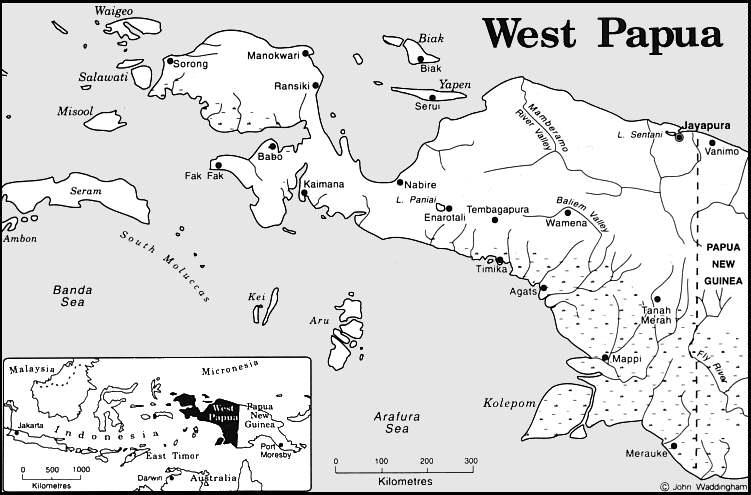
In 1991, I accompanied a Fulbright group research tour to Eastern Indonesia. Our Garuda flight from Honolulu landed first in Biak, West Papua (formerly Irian Jaya), our port of entry into Indonesia. It seemed like many other places in Melanesia, except that Indonesian, not an English- or French-based pidgin, was the national language.

By the time we landed in Ujung Pandang (Makassar) on Sulawesi (Celebes), we were clearly out of Oceania, with its sea breezes, root and tree crops, and easygoing lifestyle, and into Southeast Asia, with its monsoons, endless rice paddies, and hustle-bustle. Ujung Pandang was as far west as we got. We avoided the well-trodden tourist routes of Bali and Java, concentrating instead on booming, Southeast Asian, largely Muslim Sulawesi, and the faded glory of Oceanic, largely Christian Maluku (the Moluccas), the Spice Islands.

We were parceled out to host families at IKIP Ujung Pandang, the local teacher’s college. My host was a professor who had been trained at Manado, perhaps the top teacher-training college on Sulawesi, located in a mixed Christian-Muslim city on the tip of the far northern peninsula near the Philippines. The family was Muslim, very genteel, prosperous, and cosmopolitan. Voices were never raised in that household, at least not during my stay. They had relatives from the countryside living with them and helping with the housework. Neither my host mother nor her very demure and attractive college-age daughter wore head scarves, although the mother affected considerable shock one evening at an immodestly dressed female performer we saw on TV. (Nothing approaching current MTV standards, of course.) I jokingly offered to send her some black lipstick so she could keep up with the latest styles. My generous hosts were also kind enough to take me for an overnight trip to their rustic bungalow in Rappang, where they owned rice fields. The only intrusion of international tensions occurred when the son and daughter were showing me around their campus, Universitas Hasanuddin, where a few students at some distance away started chanting “Saddam, Saddam” when they saw foreign visitors. My hosts quickly moved us on.

Our group next took a scenic bus ride over sometimes dangerous mountain roads up to Rantepao, in Tana Toraja, where the heavily anthropologized highlanders were mostly Christian. The local governor had an American anthropology degree and showed us pictures of the Toraja float that had appeared in a recent Rose Bowl parade. The Toraja are famous for their huge, boat-shaped rice barns and their famously elaborate and gory funeral celebrations, featuring animal sacrifices and often a sizable contingent of foreign funeral tourists. I was one of those who preferred instead to spend a quiet day walking the cool mountain paths between rice fields, through hamlets where the sound of dogs and the smell of pigs served as reminders that we were in Christian territory.

Our next destination was the old Dutch colonial outpost of Ambon (Amboina), Maluku (Moluccas). Again we were parceled out to host families, this time near Universitas Pattimura, where the faculty was mostly Christian. My hostess was a dietician who lived in the Rumah Tiga neighborhood off campus and who cooked meals rather more Dutch than Indonesian. She was Christian and was not amused when I once greeted her with a “Salaam Aleykum.” From Ambon we visited a Christian village far up in the mountains, where we sampled coconut toddy; visited a very rustic resort near a Muslim village on the far side of the island, where baskets of drying sardines and cloves lay outside nearly every house; and made a side trip to an old Portuguese fort on the north side of the island, from where we could gaze across the straits at the huge island of Seram in the distance.

Our last major excursion was to the old sultanates of Ternate and Tidore and their formerly heathen, and now Christian hinterland on Halmahera. Our bus misaligned its rear axle early on, and spent a long time in the middle of nowhere driving over large rocks trying to knock it back into alignment, while we passengers waited beside the road. Finally, the drivers gave up and drove carefully to the next town large enough to have a repair shop, all the while steering against the sideways drift of the back wheels. After repairs, we finally reached Galela at the northern tip of Halmahera. There we spent a day at a small village of only recently converted (Christian) highlanders who had just moved down from the mountains. We enjoyed their betelnut and their outdoor cooking, with rice steamed in green bamboo roasted over open fires. Much to our collective relief, we took an airplane back to Ambon.

Indonesia is the most populous Muslim country in the world, and each year sends more pilgrims to Mecca than any other country but Iran, or so they said at the time. But the country is really many nations in one, and the government at that time saw religious intolerance as a threat to unity. I came away impressed with the modernizing influence of Islam in Indonesia, its tradition of learning, egalitarianism, enterprise, and openness to the outside world. But foremost in my mind are memories of warm hospitality, hot weather, wonderful food, boring lectures, vehement discussions, time to think, grueling bus trips, the joy of language-learning, and the sunrise and sunset calls to prayer.

By 2001, Ambon had turned into another Beirut, and the whole area had become another Lebanon.

Pattimura University and the neighborhoods that hosted us in Ambon, Maluku, were all burnt to the ground. My hostess may well have been killed. The whole island has now been carved up into armed enclaves.

The root causes in Ambon may include local Muslim resentment of local Christian dominance, coupled with local Christian fear of being overwhelmed by the huge Muslim majority of Indonesia as a whole. The factors that ignited and fueled that unrestrained outbreak of violence include the Asian economic crisis that hit in 1997; the subsequent collapse of the discredited Suharto regime and its authoritarian commitment to a unified secular state; the brutal, corrupt, and demoralized Indonesian military, which has done little to control the violence and much to worsen it, especially by allowing the influx of thousands of well-armed mujahidin (including foreigners) from the training camps of the Laskar Jihad paramilitary in Java. It is hard to imagine how to address any root causes until these thugs and local militias are disarmed and either detained or deported by some credible peacekeeping force. The Javanese-dominated Indonesian military has unfortunately not been such a force. The sectarian and ethnic violence is beginning to subside in Ambon, as it finally did in East Timor (only after foreign intervention), but it continues to escalate in West Papua, where many of the thuggish militias have reconstituted themselves after leaving Maluku.

In future blogposts, I plan to examine in more detail some of these events and their historical contexts.

1 Comment

Filed under Indonesia, religion, travel

Torajan Carvers in Exotic England

Anthropologist Nigel Barley invited a team of Indonesian woodcarvers from Torajaland to build an exhibit at the British Museum. They found the British to be an exotic people.

The first shock for them was that all British were not white. West Indians look to them like Irian Jayans, the Indonesian half of New Guinea, so they tended to expect them to talk Indonesian. Chinatown did not surprise them. ‘Chinese are good at business. They get everywhere.’ Indians they would assume to be Arabs. The most mortifying experience was to discover that there was no slot ‘Indonesian’ in English folk categories and that they themselves would be regarded as Chinese.

A second shock was that all Europeans were not rich. Admittedly, they had seen young puttypersons [i.e., orang putih ‘white person’, like orang utan ‘inland person’] in Torajaland playing at being poor, but everyone knew they would be carrying larger sums of money than a Torajan farmer would see in a lifetime. Why did I have no servants, no car, and no chauffeur? They were distressed by the drunks who roam the streets of London, being unused to situations where you pretend that people shouting at you are not there. That people should have no work and receive money from the government staggered them like right-wing Tories. Surely they had misunderstood. Were these people not pensioners? Had they not at some time been in the army and were receiving money for their wounds?

They arrived at a moment of high political activity, just days before a General Election, and were amazed at the lack of respect we show politicians. ‘We would go to jail for that!’ was their constant cry. Yet it should not be assumed that they envied us our freedom. To them, it appeared more as lack of order, as messy and reprehensible ill-management. Johannis summed it up swiftly, ‘I see that England is a place where no one respects anyone.’

The position of the Queen puzzled them too. Like many foreigners they found it hard to imagine the relationship between a female prime minister and a female sovereign and drew the inevitable conclusion that only women are eligible for positions of power in this strange land. ‘It is like the Minang people of Sumatera,’ they opined with appropriate ethnographic example. ‘There it is the women who own everything and the poor men are sent abroad to work for them. You are just like them. We feel sorry for you.’

SOURCE: Nigel Barley, Not a Hazardous Sport (Henry Holt, 1988), pp. 182-183.

1 Comment

Filed under England, Indonesia

South Korea and the Vietnam-era Mindset

A Vietnam-era mindset still influences many Americans, perhaps especially longtime leftists. The same is true in South Korea. But the Vietnam era meant rather different things to South Koreans than it did to Americans.

For one thing, many South Koreans mapped their images of a divided Vietnam onto a divided Korea, and vice versa. This shows up very starkly in a novel like The Shadow of Arms, by Hwang Suk-Young, whose English translation by Chun Kyung-Ja was published by the Cornell University East Asia Program in 1994. I had the chance to write a review of the book for the journal Korean Studies in 1996.

At one point during a huge antiwar rally in San Francisco that I attended while on a weekend pass from the Defense Language Institute in Monterey in 1969, a speaker standing beneath the flag of North Vietnam began attaching conditions to his hitherto well-received calls for peace. But almost as soon as his “We demand peace” turned to “We will accept no peace until …” the more-alert members of the crowd began to chant “Peace now! Peace now!” More and more people took up the cry until they drowned out the rest of the speech. For the speaker, peace was a step on the road to partisan victory. For the crowd, it was an end in itself. The crowd won that round but, in typical fashion, the partisan peaceniks were better represented among the organizers, while the naive peaceniks were far more numerous among the organized.

Although utterly cynical about the enterprise (and especially the entrepreneurs) of war, The Shadow of Arms is not exactly an antiwar novel. It is written more in the spirit of that partisan peace activist beneath the North Vietnamese flag in San Francisco. Set almost entirely amidst the logistics-and-supply cornucopia behind the lines rather than in the more intense violence of the free-fire zones, it presents the war as essentially a struggle between self-sacrificing patriots (supported by the communist North Vietnamese) and self-indulgent profiteers (supported by the capitalist Americans). This focus on the wartime black market in South Vietnam may well reflect Hwang Suk-Young’s own experience in the 2nd ROK Marine Brigade, which was deployed to Vietnam from 1965 to 1972. But it also appears to reflect his vision of Cold War South Korea, whose greedy and corrupt military leaders presumably abandoned the goals of reunification and independence for personal profit. By implication, North Korea is the preserve of self-sacrificing patriots still wedded to nationalist, rather than capitalist, goals.

This novel thus evokes the shared fate of Korea and Vietnam. It does not explore the motives (other than profit) for South Korean participation in the war, nor the reactions of individual Koreans to the experience. There is no hint, for instance, of the kind of introspection found in Ahn Junghyo’s [war novel] White Badge, where the protagonist is reminded of his own childhood picking through the garbage of the American soldiers when he sees Vietnamese kids sifting through the rubbish of the Korean troops. Nevertheless, Hwang’s novel is an engrossing tale of individuals caught up in blackmarket plunder within a command economy during the chaos of war. (Although Hwang appears to consider such plunder typical of capitalist economies, I suspect–having spent a year in Romania under Ceausescu–that it is typical of any economy in which an elite has monopoly control of crucial resources, whether that elite meets in corporate boardrooms or in people’s palaces.)

For many Koreans, their participation on the American side during the Vietnam War was quadruply shameful. Not only did they fight on the losing side, but they fought to preserve a divided country, they fought for capitalism, and they fought in a mercenary capacity. Many others, of course, were eager to combat communism and to repay a debt to a vital ally.

The mercenary issue is particularly nettlesome. It’s a toxic label. But it’s hard to deny that, to a certain extent, the Vietnam War provided the same kind of stimulus to South Korea’s postwar economy that the the Korean War did to Japan’s earlier postwar economy (and European wars did to the U.S. economy even earlier). That’s why the same review also considered a related book, Mercenaries and Lyndon Johnson’s “More Flags”: The Hiring of Korean, Filipino and Thai Soldiers in the Vietnam War, by Robert M. Blackburn (McFarland, 1994).

The mercenary nature of foreign involvement in the war is the central theme of Robert M. Blackburn’s fascinating nonfiction account of U.S. President Lyndon Johnson’s attempt to beg or buy international support for South Vietnam under “The Free World Assistance Program” (commonly labeled “More Flags”), which began in 1964. Blackburn, like Hwang, is a Vietnam War veteran who “had the good fortune to fight alongside, though never with, some units of the ROK Marines, and was never bothered by what label they wore” (155). He is careful to distinguish the soldiers who fight wars from the politicians who make wars, observing that any stigma attached to the word mercenary belongs to the leaders, not to the soldiers.

However, Blackburn offers a more subtle analysis of the status of mercenaries. He notes that individual soldiers may choose to fight for a foreign country for reasons other than simply pay, although the pay itself defines their status as mercenaries. Soldiers-of-fortune may fight for the thrill of it. Others enlist because they believe in the cause they are being paid to fight for. Much the same can be said for entire military units, or even for nations that inject their own troops into foreign wars. “In the Spanish Civil War of the 1930s, for example, Franco’s Moroccan battalions fought only for pay, while the opposing members of the Abraham Lincoln Brigade fought for a cause. Both units, however, … shared the common status of mercenaries” (146).

Australia and New Zealand sent military units to Vietnam at their own expense (and therefore not as mercenaries) and for their own reasons. In fact their support for South Vietnam began before Johnson’s More Flags program. Both countries had helped fight communist insurgencies in the Malay Peninsula, and both were alarmed by what Sukarno and his Communist Party allies were doing in Indonesia. Each apparently considered it in its own national interest to help assure the survival of a capitalist South Vietnam. South Korea had at least as much national interest in the survival of South Vietnam as those two countries did. But it also had a “debt of honor” (46) to repay to the allies who helped assure its own survival little more than a decade earlier.

Other countries contributed varying amounts to South Vietnam, from Morocco’s “10,000 cans of sardines worth $2,000” to Japan’s “$55 million worth of economic assistance from a World War II reparations agreement” (141). Most contributed medical supplies and equipment. Costa Rica (actually the Costa Rican Sugar Growers Association) sent an ambulance (143), and South Korea’s first military unit to arrive was a Mobile Army Surgical Hospital (MASH) [emphasis added] (159). However, of all the More Flags allies, South Korea committed the most troops (50,000 out of the 65,000 in 1968 [158]), suffered the most casualties (4,407 out of the 5,241 killed [xiii]), and reaped the greatest economic benefits in return. Blackburn (64-65) estimates that South Korean soldiers received about $1 billion just in pay, allowances, and benefits alone in 1967-73. A ROK private with a base pay of $1.60 a month could earn $1.00-$1.25 for each day’s service in Vietnam. Still, each ROK soldier cost the U.S. only about half as much as a comparable American soldier.

2 Comments

Filed under Indonesia, Korea, military, Vietnam

Tana Toraja: From Ethnogenesis to Ethnotourism

A hundred years ago, the Toraja people did not exist. “Toraja” was merely a derogatory term applied by the Bugis and Makassarese living in the lowlands of the southwest peninsula of Sulawesi (then called Celebes) to any of the many different peoples living in the mountainous regions of the peninsula and central Sulawesi. Today, Tana Toraja (Toraja Land) is an administrative district in the province of South Sulawesi, the people living there comprise one of the four official suku bangsa (ethnic groups) of the peninsula, and the Toraja are celebrated (at least amongst anthropologists, tourists, and television crews) for their fantastic architecture and elaborate funerals. People who have been born in the area of Tana Toraja now call themselves Toraja, bringing this identity with them in their migrations throughout Indonesia and the rest of the world.

So begins a fascinating paper entitled From “You, Toradja” to “We Toraja”: Ethnicity in the Making, in which an anthropology graduate student, Jaida n’ha Sandra, attempts “to trace how a pejorative turned into a people.” The extended quotes below are from the same article. (Read the whole thing.)

Before the arrival of the Dutch, the Muslims in the lowlands had regarded the politically fragmented highlanders as a major source of slaves, as well as coffee and other highland products.

The Dutch had been a colonial presence on Sulawesi since the seventeenth century but had mainly ignored the inaccessible and agriculturally unproductive mountain areas. In the late nineteenth century, however, they became increasingly worried about the growing Islamic influence in Sulawesi. The animist highlanders were viewed as a pool of potential Christians; the company mandate was to convert as many as possible, thereby aligning the highlands with the Dutch should lowland Muslims get too obstreperous.

Starting in 1906, the Dutch influenced the formation of Toraja in four main ways. First, they abolished slavery, bringing peace and relative safety to the area. Second, they introduced Christianity, which would later be adopted as a defense against lowland Islamic fundamentalism. Third, they furthered the cash economy by demanding taxes. And, finally, they drew a line around the Sa’dan area and named it Tana Toraja.

Tana Toraja, like Bali, has since become one of the most intensely anthropologized places on earth. The Toraja are famous for their huge, boat-shaped rice barns and their famously elaborate and gory funeral celebrations, featuring animal sacrifices and often a sizable contingent of foreign funeral tourists. Ethnic identity, however, remains a contentious issue.

The nobility … were satisfied with their power and status under the old system. Lower class Toraja have been less conservative, taking advantage of the egalitarian mores of Christianity, the opportunities presented by education and the cash economy, and the political implications of ethnic identity to contest the authority of the nobility…. Christianity has been increasingly popular as an avenue towards modernity and gaining a transnational identity….

In the 1940s, few Toraja had ever left their village and almost none had left the Indonesian archipelago. By 1978, however, sixty percent of the population was spending extended periods outside Tana Toraja. Many never come back except for the occasional family funeral. Toraja have eagerly pursued education and now work outside Tana Toraja as government officials, professors, medical professionals, and lawyers. At the same time, they have never been above manual labor and so also work in mining and lumber operations on far-flung islands as well as in furniture and clothing manufacture closer to home.

Out-migration has led simultaneously to a greater identification with the Toraja suku (ethnicity) while at the same time facilitated alterations in that identity. On the one hand, Toraja abroad go to great lengths to retain links with family. They follow all the funerals and attendant gossip….

At the same time, there are complaints that the rituals are no longer authentic or “true”. Fewer Toraja can reach a consensus on what aspects of funeral ceremonies are fixed and what can be reinterpreted. There is no longer a shared expectation and experience of ritual. As ritual defines Toraja to the outside world, it is also changing to accommodate outsiders tastes. Some students from Toraja consider having tourists at funerals a travesty and feel tourists should be treated only to staged shows of songs, chants, dances, even sacrifices that are not part of any meaningful ritual. Others feel that removing the ritual practices from the ritual, doing it at inappropriate times or in inappropriate places, is the travesty. The ceremonies should be whole or abandoned, not carved into bits for tourists’ eyes. Discussion groups, seminars, and arguments abound as Toraja try to sort out how they can abide by Church authority and please the tourists while maintaining some meaning in their traditions….

For the sake of tourism, Toraja have also begun to reinvent themselves… They respond to lowland stereotypes of themselves as crude, backwards, non-religious ex-slaves by characterizing themselves as pork-eaters, pacifists, honest, delicate, quick-witted, hard working, and thrifty. At the same time, they discuss at length their own foolishness in racking up huge debts and then wasting wealth on funeral ceremonies….

Meanwhile, the nobility make use of visiting anthropologists to play out family rivalries. Adams reports how she was recruited as a pet anthropologist by one family who asked her to “write a book about the real Torajan identity and history.” What this really meant was a history of that particular family. She came to realize, only later, that she was a pawn in an ancient game. She writes:

[A] rival aristocratic family from another Torajan district visited our village and my Torajan hosts introduced me as “their anthropologist” …. To this, the visitors responded that they, too, had an anthropologist live with them and write about them. After these guests departed, my Torajan family disparaged the other anthropologist’s understanding of Torajan culture and proclaimed that my “book” would be “much bigger and better.”

One of the most famous books on the Toraja, of course, is Nigel Barley’s Not a Hazardous Sport, quoted immediately below.

Leave a comment

Filed under Indonesia

Asian Acronyms: Did you teach at GWYX or at Guangwai?

Discriminating linguists sometimes distinguish between acronyms pronounced as if they were a word, like NATO and UNICEF; and initialisms pronounced as a series of letters, like IBM or the UN. This distinction breaks down in orthographies that write whole syllables at a time, like Chinese.

In Chinese, for instance, acronyms are composed of the initial syllabic characters of (usually) two-syllable words. So, Peking (= Beijing) University, or Beijing Daxue [lit. ‘NorthCapital BigSchool’] becomes Beida [lit. ‘NorthBig’]. In Korean, Korea University, or Koryo Taehak [lit. ‘HighBeautiful BigSchool’] becomes Kodae [lit. ‘HighBig’]. In Japanese, it’s a bit more complicated. Chinese characters can be pronounced not just in their Chinese loan forms, but as native Japanese words that mean (more or less) the same thing. This is what makes Japanese far and away the most complex, least efficient writing system on earth. In either case, each character is usually pronounced as two syllables, since Japanese had to add final vowels to one-syllable Chinese roots in order to pronounce any final consonants, most of which have been lost in modern Mandarin Chinese. (The same thing happens to current Japanese borrowings from English: ranchi < lunch, setto < set, beisubouru < baseball, and so on.) So the acronym for Hiroshima University, or Hiroshima Daigaku [lit. ‘WideIsland BigSchool’] becomes HiroDai [lit. ‘WideBig’]. The name Hiroshima is native Japanese (the Sino-Japanese pronunciation would be Koutou = Ch. Guangdao), but Daigaku is Sino-Japanese [= Ch. Daxue].

After China adopted the supplementary Latin-based alphabetic pinyin writing system, which is increasingly used in computer input, you could begin to see alphabetic abbreviations, some of them rather alarming and most of them quite unpronounceable. Very few Chinese syllables start with vowels: a- is not uncommon, but e- and o- are rare, and i- and u- are nonexistent. Even worse, initial q-, x-, y-, and z- are way too common.

So, if you were to take the first pinyin letter of each syllable, Guangzhou Foreign Language Institute would be abbreviated GZWGYYXY < GuangZhou WaiGuo YuYan XueYuan [lit. ‘WideState OutCountry SpeechTalk LearnYard’]. You would do better to take the first letter of each two-syllable word rather than the first letter of every single syllable, in which case the same school would end up as GWYX < Guangzhou Waiguo Yuyan Xueyuan [lit. ‘Guangzhou Foreign Language Institute’]. However, most Chinese acronyms are more economical than that. The common name for this particular school was equivalent to “GuangFor” (Guangzhou Foreign), namely, GuangWai [lit. ‘WideOut’]. (It has now merged into GDUFS, the Guangdong University of Foreign Studies, which would still qualify for the acronym GuangWai in Chinese. The unfortunate English acronym must certainly be guh-doofs.)

These syllabic acronyms aren’t unique to Chinese. Indonesian (or Malay) uses a Latin-based alphabetic writing system, but is chock full of syllabic as well as alphabetic acronyms (and initialisms). Acronyms seem to proliferate under big bureaucracies–especially if the military has a free hand. Examples of syllabic acronyms in Indonesian include the names of provinces like Sulsel < Sulawesi Selatan [‘south’], Sulut < Sulawesi Utara [‘north’], and Sulteng < Sulawesi Tengah [‘central’] on the island of Sulawesi (Celebes); schools like UnHas < Universitas Hasanuddin in Sulawesi and UnPatti < Universitas Pattimura in Maluku (Molucca); and terms like tapol < tahanan politik [‘political prisoner’].

UPDATE: Like Japanese and Korean, Vietnamese used to be written in Chinese characters and has lots of Chinese loanwords. Judging from the website of Vietnam National University – Ho Chi Minh City, Vietnamese seem to abbreviate by taking the first letter of each separately written syllable. Thus, (ignoring diacritics) Dai hoc Quoc gia Thanh pho Ho Chi Minh [lit. ‘University National City Ho Chi Minh’] is abbreviated DHQG-HCM. Ho Chi Minh City is also abbreviated TP.HCM, which I’m pretty sure is often pronounced Saigon. Otherwise, I don’t have a clue how these abbreviations are pronounced.

FURTHER UPDATE: Korean usage of taehak seems to be diverging from that of its cognates in Japanese (daigaku) and Chinese (daxue). While each term applies to a variety of institutions of tertiary education, Korean now distinguishes between taehak ‘college’ and taehakkyo ‘university’ very much long the lines of American usage. Taehakkyo indicates a larger institution that offers graduate education. So Kodae now stands for Koryo Taehakkyo, as the Chinese characters and Korean title on their homepage shows. I don’t think the cognate forms, Jp. daigakkou and Ch. daxuexiao, even exist, much less serve a similar function.

Leave a comment

Filed under China, Indonesia, Japan, Korea, language

Sukarno’s Sweet Breads

“Now I must admit in my youth I was so terribly handsome that I was almost girlish-looking. Because there were so few female intellectuals in those days, there weren’t many girl members and when Young Java put on a play I was always given the ingènue role. I actually put powder on my face and red on my lips. And I will tell you something but I don’t what foreigners will think of a President who tells such things … Anyway, I will tell it. I bought two sweet breads. Round breads. Like rolls. And I stuffed them inside my blouse. with this addition to my shapely figure, everybody said I looked absolutely beautiful. Fortunately my part didn’t call for kissing any boys on stage. I couldn’t waste my money so after the show I pulled the breads out of my blouse and ate them. Watching me on stage, spectators commented that I showed a definite talent for playing to audiences. I concurred wholeheartedly.”

SOURCE: Sukarno: An Autobiography, as told to Cindy Adams, as quoted in Nigel Barley, The Duke of Puddledock: Travels in the Footsteps of Stamford Raffles (Henry Holt, 1992).

Leave a comment

Filed under Indonesia

Context for the Missionary Killings in Palau

Shortly before Christmas, three Seventh Day Adventist (SDA) missionaries were slain in Palau. The Republic of Palau is as close as anywhere in Micronesia to two hotspots of radical Islamist guerrilla violence against Christians: the southern Philippines, where Abu Sayyef has “kidnapped foreigners for ransom, often killing them in grisly fashion” since the 1990s; and eastern Indonesia, where the Laskar Jihad waged holy war against the numerous Christian communities there during 1999-2002. (Laskar Jihad reportedly disbanded in the wake of the Bali bombing, but it appears to have simply relocated to West Papua.)

Do these killings mark the spread of terrorist groups into Palau? Apparently not. Instead they signal the spread of another scourge already well-known in urban parts of Asia and the Pacific: crystal meth. Palau has an ice problem, and the killing seems to fit the all too typical pattern of a crackhead burglar surprised in the act.

More on international borders: The DePaiva family members killed were SDA missionaries from Brazil by way of Andrews University in Michigan. Their memorial service was held in Texas, where DePaiva relatives live. Justin Hirosi, the person charged with the killing, is a Palauan whose surname comes from the Japanese given name of one of his paternal ancestors (a pattern common in Micronesia). Audy MacDonald Maldangasang, the fugitive “ice” dealer wanted in Palau who was just arrested in Saipan had arrived there from South Korea in 2002 after fleeing Palau in 2001.

More on international religions: The Micronesian states allow admirable freedom of religion. The State Department’s latest Religious Freedom Report gives the following breakdowns for the Republic of the Marshall Islands (RMI), the Federated States of Micronesia (FSM: Kosrae, Pohnpei, Chuuk, Yap), and the Republic of Palau.

In round numbers, about 55% of the population of the RMI belongs to the United Church of Christ (formerly Congregational), and about 25% belong to the Assembly of God. Fewer than 10% are Roman Catholic, about 2% are Mormon, and fewer than 1% each are SDA, Full Gospel, and Baha’i. Just under 3% belong to another Assembly of God church, Bukot Nan Jesus. There is a large Marshallese community in Arkansas, where the Assembly of God is “over-represented” and its adherents are more likely than others to migrate between Arkansas and the RMI.

In the FSM, most Protestant denominations, as well as the Roman Catholic Church, are present on the four states of the country. On the island of Kosrae, 99 percent of the population are members of the United Church of Christ. On the island of Pohnpei, clan divisions mark religious boundaries in some measure. More Protestants live on the Western side of the island, while more Catholics live on the Eastern side, and most immigrants are Filipino Catholics. There is a small group of Buddhists on Pohnpei. On Chuuk and Yap, approximately 60 percent are Catholic and 40 percent are Protestant.

In Palau, there are 19 Christian denominations. The Roman Catholic Church is the dominant religion, and approximately 65 percent of the population are members. There are Bangladeshi Muslims in the country, and a primarily Catholic Filipino labor force (approximately 3,700 persons).

Leave a comment

Filed under Indonesia