Category Archives: Pakistan

To: Commander Jamalpur Garrison, 10 December 1971

In late November 1971, the Indian Army decisively invaded East Pakistan (now Bangladesh) in support of the Bengali resistance army, the Mukti Bahini (‘freedom fighters’).

At Jamalpur, near Dhaka, the Indian brigadier, Hardit Singh Kler, surrounded a Pakistani unit led by Lt. Colonel Ahmed Sultan. On 10 December the two officers exchanged letters. The first, written by the Indian brigadier, was taken across the front line by an elderly man who delivered it by hand.

To,

The Commander Jamalpur Garrison

I am directed to inform you that your garrison has been cut off from all sides and you have no escape route available to you. One brigade with full compliment of artillery has already been built up and another will be striking by morning. In addition you have been given a foretaste of a small element of our air force with a lot more to come. The situation as far as you are concerned is hopeless. Your higher commanders have already ditched you.

I expect your reply before 6.30 p.m. today failing which I will be constrained to deliver the final blow for which purpose 40 sorties of MIGs have been allotted to me.

In this morning’s action the prisoners captured by us have given your strength and dispositions, and are well looked after.

The treatment I expect to be given to the civil messenger should be according to a gentlemanly code of honour and no harm should come to him.

An immediate reply is solicited.

Brigadier HS Kler. Comd.

The reply was sent a few hours later:

Dear Brig,

Hope this finds you in high spirits. Your letter asking us to surrender had been received. I want to tell you that the fighting you have seen so far is very little, in fact the fighting has not even started. So let us stop negotiating and start the fight.

40 sorties, I may point out, are inadequate. Ask for many more.

Your point about treating your messenger well was superfluous. It shows how you under-estimate my boys. I hope he liked his tea.

Give my love to the Muktis. Let me see you with a sten in your hand next time instead of the pen you seem to have such mastery over,

Now get on and fight.

Yours sincerely

Commander Jamalpur Fortress.

(Lt. Colonel Ahmed Sultan)

The next morning the fight did indeed begin when Lt. Colonel Sultan tried to break out of his garrison. Over 230 of his men were killed. They died in vain. When the Indian brigadier had written ‘your higher commanders have already ditched you’, he was absolutely right. The military and political leadership in Dhaka already knew that the war was lost….

Pakistan’s hopeless military situation on the ground was matched on the diplomatic front. The Indians’ diplomatic position would have been far worse if [Gen.] Yahya [Khan] had acted with greater speed and determination to isolate Delhi for what was, after all, a blatantly illegal invasion of a foreign country. Amazingly, Yahya failed to raise the Indian invasion of Pakistan formally at the UN Security Council. He probably feared that any ceasefire resolution would include a provision that he had to negotiate with the Awami League–something he was determined to avoid. But whatever the rationale, it was a significant blunder.

The Security Council did nevertheless discuss the situation in East Pakistan but successive resolutions were vetoed by either Russia or China. The Russians, backing India, wanted any resolution to include commitments for a transfer of power to the Awami League; the Chinese, backing Pakistan, did not. In his capacity of foreign minister, Zulfikar Ali Bhutto went to New York but was unable to affect the course of events. With Pakistan’s unity on the verge of destruction and frustrated by the Russians’ Security Council vetoes, Bhutto decided to make the best of a bad job and strengthen his own political position back at home. On 15 December he told the Security Council that he would never address them again. As he ripped up some Security Council papers, he asked: ‘Why should I waste my time here? I will go back to my country and fight.’ It was the speech of a leader in waiting.

SOURCE: Pakistan: Eye of the Storm, 2nd ed., by Owen Bennett Jones (Yale Nota Bene, 2002), pp. 178-181

27 Comments

Filed under India, Pakistan, war

Pakistan, 1971: Three Men, Two Nations

In the year 1971 the future of East Pakistan depended on a struggle between three men: a habitual drunk, General Yahya Khan; a professional agitator, Sheikh Mujibur Rahman; and a political operator par excellence, Zulfikar Ali Bhutto. Relying respectively on military force, street power and pure guile, this volatile trio pursued their incompatible objectives. Yahya, Pakistan’s military ruler, repeatedly claimed that he had one, and only one, objective: to keep the east and west wings of Pakistan united. If unity was assured then he was prepared to offer East Pakistan substantial autonomy. In fact, Yahya did go further than any other Pakistani leader in trying to make the necessary compromises to find a solution for East Pakistan. A durable settlement, though, eluded him. Ever since the defeat of 1971, many Pakistanis had complained about Yahya’s drinking and womanising. But those were the least of his problems. Yahya was simply outclassed. Politically, intellectually and in terms of sheer drive, he was never in the same league as either Zulfikar Ali Bhutto or Mujibur Rahman.

Yahya viewed politicians with disdain and Mujibur Rahman was a politician to the core. Starting out as an angry activist addressing groups of ten to twenty students, he ended up as the founder of Bangladesh, speaking to the hearts of many millions. His creed never altered: he believed in Bengali nationalism. When Mohammed Ali Jinnah struggled for Pakistan he relied on legal arguments. Mujibur Rahman had to engage in a far rougher, dirtier fight for Bangladesh and, unlike Jinnah, he spent long periods in jail. From the moment he became interested in politics at Dhaka University he was never afraid of defying the authorities: on the contrary, he relished it. No one doubts that Mujibur Rahman deserves the title ‘founder of the nation’ but there are sharp differences of opinion as to when exactly Mujib became irrevocably committed to Bengali independence. Many believe this was his goal from the outset. Speaking after independence, Mujib himself claimed that he had been planning to divide Pakistan ever since 1947. As we shall see, however, there is good evidence that even as late as December 1970 or February or March 1971 he was still thinking in terms of a united Pakistan and did not foresee a complete rupture.

The third contestant in the struggle for East Pakistan had no particular interest in the place. Zulfikar Ali Bhutto may have preferred to keep Pakistan united but he shed few tears when Bangladesh broke away. Bhutto’s role in the 1971 crisis has been fiercely debated. He has argued that he did his best to save the country from splitting up but many believe he played a sophisticated, cynical game to fulfil his personal ambitions, even if that meant the Pakistani nation was broken in the process. Bhutto was a man in a hurry. After the 1970 elections, one senior minister told Yahya that if Bhutto did not become prime minister within a year he would literally go mad. Bhutto himself made little secret of his lust for power and, at the start of 1971, General Yahya and Mujibur Rahman were standing in the way of his becoming prime minister. By the end of 1971, having lost a war with India, Yahya was in disgrace and Mujibur Rahman was ruling Bangladesh. The path was clear for Bhutto to take over in the west.

The complicated interplay between Yahya, Mujib and Bhutto had a decisive role in the break-up of Pakistan and the creation of Bangladesh. But Bengali nationalism was alive and well before any of them were even born. The British had always considered Bengal to be a troublesome province: the Muslims there had been the most vociferous champions of Muslim rights and a Muslim homeland on the subcontinent. In 1906 the All India Muslim League was inaugurated in Dhaka and thirty-four years later it fell to a veteran Bengali politician to propose what is now seen as one of the fundamental texts of Pakistan, the Lahore Resolution. The resolution declared: ‘the areas in which the Muslims are numerically in the majority, as in the north-western and eastern zones of India should be grouped to constitute “Independent States” in which the constituent units shall be autonomous and sovereign’. The resolution plainly indicated a desire for ‘Independent States’ and not one independent state.

SOURCE: Pakistan: Eye of the Storm, 2nd ed., by Owen Bennett Jones (Yale Nota Bene, 2002), pp. 147-149

Leave a comment

Filed under Pakistan

Pakistan’s Competing Nationalisms

My description of the partition as the greatest blunder in the history of mankind is an objective assessment based on the bitter experience of the masses … Had the subcontinent not been divided, the 180 million Muslims of Bangladesh, 150 million of Pakistan and about 200 million in India would together have made 530 million people and, as such, they would have been a very powerful force in undivided India. –Muttahida Qaumi Movement (MQM) leader Altaf Hussain, October 2000

‘I have been a Baloch for several centuries. I have been a Muslim for 1,400 years. I have been a Pakistani for just over fifty.’ The tribal chief Nawab Akbar Bugti Khan has little love for Pakistan. Secure in his heavily guarded, mud-walled fort deep in the Baloch desert, he runs a state within a state. Pakistan may have been in existence for over half a century but he still considers any Pakistani troops in his vicinity as part of an occupation army. Other tribal chiefs, feudal leaders and politicians in Balochistan, rural Sindh, NWFP and even some in southern Punjab share his attitude towards Pakistan. Islam was meant to be the binding force–but, for many, ethnic ties have proved to be stronger.

Like Israel, Pakistan was created in the name of religion. In 1948 there were just a few hundred thousand Jews living in their new country’s territory; most Israelis came from elsewhere. When Pakistan was created, by contrast, there were already over 70 million Muslims living in the ‘land of the pure’ and they were by no means united. As well as the Bengalis in East Pakistan, the new state had to integrate five major groups: the Sindhis, the Baloch, the Pukhtoons, the Punjabis and the incoming Mohajirs [refugees from India; h-j-r as in Arabic hijrah ‘flight’]….

Whatever their background, Pakistani leaders have consistently seen expressions of provincial feeling as a threat to the Pakistani state. Nationalist leaders in the provinces have tended to associate such centralist attitudes with Punjabi arrogance. In reality, it has never been as simple as that. After all, [Mohammed Ali] Jinnah was born in Karachi, Ayub Khan was a Pukhtoon [= Pashtun, Pathan] and Zulfikar Ali Bhutto came from Sindh.

SOURCE: Pakistan: Eye of the Storm, 2nd ed., by Owen Bennett Jones (Yale Nota Bene, 2002), pp. 109-111

Leave a comment

Filed under Pakistan

Kashmir Compromise Potential

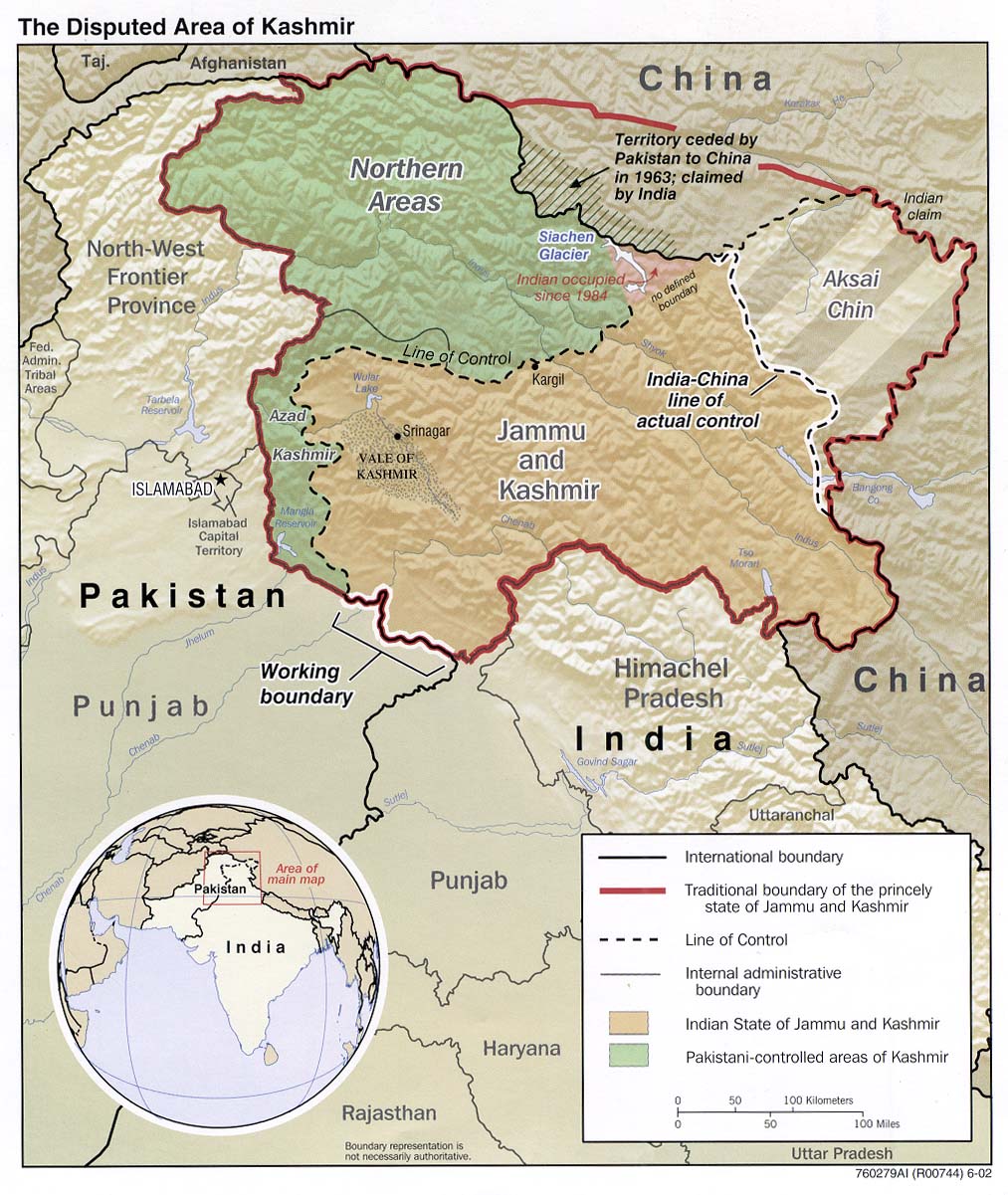
Musharraf’s speech on 12 January 2002 had clear implications for Kashmir. By announcing bans on Lashkar-e-Toiba and Jaish-e-Mohammed, he increased the chance that the insurgency in Kashmir would be weakened. If it faced a less intense battle in Kashmir, it is likely that the Indians would want to put the issue on the back burner. But it is worth bearing in mind two developments. First, the Kashmiri people are tiring of the struggle. Most informed Pakistanis now accept that, given the chance, most Kashmiris would opt for independence rather than a merger with Pakistan. But above all else the people of Kashmir want peace. That is not to say they will accept any settlement but it does raise the possibility that most would accept a compromise. The second new element is that many Pakistanis are also tiring of the conflict. Before Musharraf’s January speech it was conventional wisdom that no Pakistani leader could confront the religious extremists and remain in office. The lack of any backlash to Musharraf’s speech helped dispel that myth.

Might the same be true of Kashmir? Proponents of the view that no Pakistani leader can afford to back down in Kashmir rely on a number of arguments. First, the Pakistani people, informed by decades of intensive propaganda, are highly mobilised on the issue. Second, the army has made so many sacrifices in Kashmir that a significant climb-down would be seen as unacceptable. Not even an army chief, it is suggested, could compromise on Kashmir and expect to survive. That may be true, but there are counter arguments. Despite all the propaganda, many people in India and Pakistan are not particularly concerned about the Kashmir dispute. Many of those living, for example, in Sindh or Tamil Nadu would be quite happy to see any settlement of a dispute that is quite clearly holding back the subcontinent’s social and economic development. After a decade of insurgency, there is a growing feeling in Pakistan that India will never pull out. Pakistan’s size and economic weakness means it is not in a position to force the hand of a country with a billion people and great power aspirations. If General Musharraf or any subsequent Pakistani leader did make a compromise on Kashmir he or she might receive more support than is generally predicted.

In his account of the Kashmir dispute, the Indian author Sumantra Bose has rejected the idea of splitting up Kashmir because, he argues, none of the political districts are either ethnically or religiously homogeneous. In the Jammu region, for example, one third of the population is Muslim. Indeed, some of its districts have strong Muslim majorities. In Ladakh, meanwhile, the Buddhists may have a clear majority in Leh but the adjoining Ladakhi district of Kargil has a predominantly Shia Muslim population. Whilst Bose undoubtedly has a point, the history of the late twentieth century, for better or for worse, suggests that his objections to the possible partition of Kashmir are far from overwhelming. In the Baltic States and former Yugoslavia, to give just two examples, international boundaries were redrawn without regard to the fact that, in the process, new minority populations were created….

Ever since 1947 the views of the Kashmiris have been obscured by the dispute between India and Pakistan. With the insurgency over a decade old most Kashmiris are sick of the conflict and are desperate for a peaceful settlement. But for both India and Pakistan the symbolic importance of the Kashmir dispute means that they will inevitably follow their own perceived national interests rather than those of the Kashmiri people. If the Kashmiris had been conducring a straightforward fight for independence in the same way as the Chechens or East Timorese they would have had a greater chance of success. The tragedy of Kashmir is that the voices of the Kashmiri people themselves have been drowned out by the Islamists, nationalists and ideologues in Islamabad and Delhi.

SOURCE: Pakistan: Eye of the Storm, 2nd ed., by Owen Bennett Jones (Yale Nota Bene, 2002), pp. 106-108

Leave a comment

Filed under Pakistan

Pakistan: An Army with a Country

Pervez Hoodbhoy reviews The Idea of Pakistan by Stephen Philip Cohen (Brookings Institution Press, 2004) in the November/December issue of Foreign Affairs. Here’s an excerpt about the role of the all-important army.

According to a popular but rather humorless Pakistani joke, “all countries have armies, but here, an army has a country.” Indeed, even when civilian governments have nominally been in charge in Pakistan, there has never been much doubt about who actually makes decisions there. In addition to holding political power, the Pakistani army controls vast commercial and industrial interests and owns massive rural and urban properties. As Cohen remarks, “regardless of what may be desirable, the army will continue to set the limits on what is possible in Pakistan.

“General Pervez Musharraf, the country’s current chief executive, seized power in a bloodless coup in 1999, and there have since been several attempts on his life. After each, the media has warned of a nuclear state careening out of control, with radical Islamists fighting to get into the driver’s seat. Cohen rightly dismisses this view as alarmist. If the general were killed, the army establishment would quickly replace Musharraf with another senior officer, and various measures-the installation of former Citibank executive Shaukat Aziz as prime minister, most notably-have recently been undertaken to protect against a leadership crisis. Cohen also breaks with Musharraf’s staunchest international backers, who “see him as a wise and modern leader, a secular man who is not afraid to support the West or to offer peace to India, and a man who can hold back the onrush of demagogues and Islamic extremists.” Cohen notes that “no serious Pakistani analyst sees Musharraf in these terms. … If he resembles any past Pakistani leader, it is General Yahya Khan-also a well-intentioned general who did the United States a great favor.”

The question of why the warrior class was never tamed by civilian rule points back to the founding of the Pakistani state. As the respected Pakistani scholar Eqbal Ahmad has emphasized, the civilian system of power was never regarded by Pakistan’s citizens as just, appropriate, or authoritative. And despite Jinnah’s declarations, the idea of Pakistan was unclear from the start. Lacking any clear basis for legitimacy or direction, the state quickly aligned with the powerful landed class: the army leadership and the economic elite joined forces to claim authority in a nation without definition or cohesion. In subsequent years, the government maintained the feudal structure of society and entered into a manifestly exploitative relationship with Pakistan’s poor eastern wing (which became Bangladesh in 1971 after a short but bloody war). Even now, bonded labor is common, and many peasants live in conditions close to slavery. Politicians, with the exception of the mercurial demagogue Zulfiqar Ali Bhutto, have made no attempt at reform, ignoring the hearts and minds of the masses in favor of cultivating elite favor and pursuing quick financial gain.

The result has been ideological confusion, civilian helplessness, and an environment eminently hospitable to putsches. Indeed, no elected government has completed its term in Pakistan’s 57-year history. Pakistani generals express contempt for the civilian order and steadfastly hold that “what is good for the army is good for Pakistan,” and Pakistani society is thoroughly militarized. Bumper stickers read, “The Finest Men Join the Pakistan Army”; tanks parade on the streets of Islamabad while jet aircraft screech overhead; discarded naval guns, artillery pieces, and fighter aircraft adorn public plazas. It is even a criminal offense to “criticize the armed forces of Pakistan or to bring them into disaffection.”

The military is only one (albeit the most important) component of the wider “establishment” that runs Pakistan. Cohen calls this establishment a “moderate oligarchy” and defines it as “an informal political system that [ties] together the senior ranks of the military, the civil service, key members of the judiciary, and other elites.” Membership in this oligarchy, Cohen contends, requires adherence to a common set of beliefs: that India must be countered at every turn; that nuclear weapons have endowed Pakistan with security and status; that the fight for Kashmir is unfinished business from the time of partition; that large-scale social reforms such as land redistribution are unacceptable; that the uneducated and illiterate masses deserve only contempt; that vociferous Muslim nationalism is desirable but true Islamism is not; and that Washington is to be despised but fully taken advantage of. Underlying these “core principles,” one might add, is a willingness to serve power at any cost.

Leave a comment

Filed under Pakistan

Kashmir at Partition, 1947

In August 1947, Kashmir’s autocratic ruler, His Highness Maharaja Sir Hari Singh Indar Mahindar Bahadur Sir Hari Singh, was faced with a momentous decision. The imperial government in London had always allowed some major landholders on the subcontinent a degree of autonomy and, technically, Kashmir had never been part of British India. The maharaja’s antecedents had secured the right to govern some of their own affairs by recognising the paramountcy of the British Crown. The compact between the British and the maharaja’s family was symbolised by the payment of a tribute: each year Hari Singh had to provide the British government with a horse, twelve goats and six of Kashmir’s famous shawls or pashminas.

When the British left, the maharaja had three options: Kashmir could become independent or join either India or Pakistan. The rulers of over 550 Princely State rulers faced the same decision but in the case of Kashmir the issue was especially sensitive. Its large population and proximity to both China and Russia gave the state considerable strategic importance. The matter was further complicated by religion: Kashmir was one of a handful of Princely States in which the ruler did not practise the same religion as most of his people. While the maharaja was a Hindu, over three-quarters of his subjects were Muslims. The fact that Kashmir was not only predominantly Muslim but also congruous with Pakistan convinced Mohammed Ali Jinnah that the maharaja’s decision would go in his favour. ‘Kashmir’, he said at the time of partition, ‘will fall into our lap like a ripe fruit.’ It was a naive misjudgement of Himalayan proportions.

The maharaja had most of the foibles associated with India’s decadent aristocracy. He was a hedonist and a reactionary whose main interests were food, hunting, sex and, above all else, horse racing. As his own son put it: ‘Quite clearly, my father was much happier racing than administering the State …’ On one occasion, he had been tricked by a prostitute in London’s Savoy Hotel who proceeded to blackmail him. He showed a similar lack of judgement in matters of state. In July 1947, with the transfer of power just weeks away, he took the view that ‘the British are never really going to leave India’!

The maharaja’s ancestors had been blessed with greater political acumen. The State of Jammu and Kashmir had been established in the first half of the nineteenth century by a relatively minor Jammu chieftain, Gulab Singh. A combination of adept military conquests and astute financial deals enabled him to create one of the largest Princely States on the subcontinent. By 1850 he had moved on from Jammu (with its Hindu majority population) and had added Ladakh (Buddhist majority), Baltistan (Muslim majority) and the Kashmir Valley (Muslim majority). In the latter half of the nineteenth century, Gulab Singh’s successors extended their control to another Muslim majority area, Gilgit.

SOURCE: Pakistan: Eye of the Storm, 2nd ed., by Owen Bennett Jones (Yale Nota Bene, 2002), pp. 56-57

1 Comment

Filed under India, Pakistan

Hyderabad and Junagadh at Partition, 1947

Once again, however, Jinnah failed to explore all the options open to him. One possibility was to make compromises over another Princely State, Hyderabad. The Muslim ruler or nizam of Hyderabad faced the same dilemma as Maharaja Hari Singh. He wanted independence but was far from sure he could achieve it. Jinnah understood that it was never realistic to expect the nizam to accede to Pakistan: Hyderabad was entirely surrounded by Indian territory. But he always hoped that the nizam could pull off independence. He considered Hyderabad to be the ‘oldest Muslim dynasty in India’ and hoped that its continued existence as an independent state right in the heart of India would provide a sense of security for those Muslims who didn’t move to Pakistan. Once again, however, Jinnah was thinking in terms of legally possible options rather than political realities. In the long term the independence of Hyderabad, while constitutionally proper, was never going to happen. The new Indian leadership saw the issue clearly enough and when the nizam tried to strike a deal which would allow him to hang on to some degree of autonomy, Delhi flatly refused to consider the idea.

In retrospect most Pakistanis would agree that it would have been worth abandoning the aspiration for an independent Hyderabad if it had meant securing Kashmir’s accession to Pakistan. Furthermore, Jinnah had good reason to believe that such a deal could have been struck. In late November 1947 Nehru and Liaquat Ali Khan met to discuss the situation in Kashmir. To understand their conversation it is first necessary to consider briefly what had happened in yet another Princely State, Junagadh.

The Muslim nawab of Junagadh ruled over a million people, 80 per cent of them Hindus. Junagadh was located in western India and, even though it was not strictly contiguous with Pakistan, its coastline offered the possibility of sea links to the Muslim state that was just 200 miles away. The nawab of Junagadh, guided by his pro-Pakistani chief minister Sir Shah Nawaz Bhutto (the father of Zulfikar Ali Bhutto), decided to ignore the feelings of his Hindu population and acceded to Pakistan. It was the mirror image of the situation in Kashmir. The Indian government did not accept the decision, blockaded Junagadh and then invaded it. Delhi then imposed a plebiscite and secured the result it desired: Junagadh became part of India.

When Liaquat Ali Khan met Nehru at the end of November he exposed the illogicality of India’s position. If Junagadh, despite its Muslim rulers’ accession to Pakistan, belonged to India because of its Hindu majority, then Kashmir surely belonged to Pakistan. When Liaquat Ali Kahn made this incontrovertible point his Indian interlocutor, Sardar Patel, could not contain himself and burst out: ‘Why do you compare Junagadh with Kashmir? Talk of Hyderabad and Kashmir and we could reach agreement.’ Patel was not alone in this view. On 29 October 1947 officials at the American embassy in Delhi had told the US State Department: ‘the obvious solution is for the government leaders in Pakistan and India to agree … [to the] accession of Kashmir to Pakistan and the accession of Hyderabad and Junagadh to India’. British officials in London concurred.

SOURCE: Pakistan: Eye of the Storm, 2nd ed., by Owen Bennett Jones (Yale Nota Bene, 2002), pp. 68-69

7 Comments

Filed under nationalism, Pakistan, religion, South Asia

Naipaul on Inadvertent Journalistic Heresy

Nusrat had lived through hard times before. I had first met him in 1979, at the time of the Islamizing terror of General Zia. Nusrat, a devout man, had tried to meet the fanatics halfway, but had had little stumbles. And one careless day he got into serious trouble. He was working for the Morning News. It was Mohurram, the Shia mouming month. He thought it was a good idea to run a feature piece from Arab News about the granddaughter of Ali, the Shia hero. The piece was flattering about the woman’s looks and artistic attainments. But the Shias were outraged; to them it was insulting and heretical even to say that Ali’s granddaughter was good-looking. There was talk of taking out a procession of forty thousand and burning down the Morning News. For three days the paper was closed down. Nusrat himself was in danger; he could have been set upon at any time. Some months after this incident I passed through Karachi again. Nusrat had turned gray

When we said good-bye he said, “Can you arrange for me to go to a place where I can read and write and study for five years? Because in five years, if you see me again, I may have become a cement-dealer or an exporter of ready-made garments.”

That, spoken at a bad time, showed his style. And, in fact, he had become a public relations man for an oil company, and done well. The oil-drilling business was not affected by the troubles. But life in the city had been a day-to-day anxiety and Nusrat had developed a heart condition. His gray hair had gone white and short and thin; he was still under fifty.

SOURCE: Beyond Belief: Islamic Excursions Among the Converted Peoples, by V.S. Naipaul (Vintage, 1998), p. 350

Leave a comment

Filed under Islam, Pakistan

Naipaul on Ahmed Rashid

I had got to know Ahmed Rashid [author of Taliban]. He was a journalist. He also owned, with a partner, a coal mine in the Punjab hinterland. The news, from him, was that three of the mine’s jeeps had been stolen, and six of the men kidnapped. The stealing and the kidnapping had occurred in stages. First a jeep and the two men in it had been taken, in the big town of Sargodha. After ten days there had come a ransom demand for two lakhs, two hundred thousand rupees, five thousand dollars. Ahmed had sent two men in a jeep to negotiate with the kidnappers. He hadn’t sent any money by these two men. This had enraged the kidnappers. They had seized the two men and the second jeep. Ahmed, taking the hint, had then sent two clerks in a third jeep with the ransom money. But the kidnappers were apparently still very angry. They held on to the two clerks and the ransom money, and made a fresh demand for twenty lakhs, fifty thousand dollars.

Ahmed, ever the journalist, was excited by the whole thing, this nice little story breaking on his own doorstep, as it were; and in his detached journalist’s way he found the sequence of events funny, the men from the mine going in two by two into some kidnappers’ pit somewhere in the frontier. He had got in touch with the army and the intelligence people; only they could help him. And he thought now–and this wasn’t going to be so funny for the kidnapped men–that negotiations could go on for many months. It was important to keep the negotiations going, and in this way to prevent the kidnapped men from being taken across the border. If that happened, it was all over; the jeeps and the men could be forgotten.

Where there was no law, no institutions that men could trust, the code and the idea of honor protected men. But it also worked the other way. Where the code was strong there could be no rule of law. In the frontier, as Saleem Ranjha’s Pathan guest had said at Mansura, the modern state was withering away; it was superfluous. People were beginning to live again with the idea of clan and fiefdom; and it was good for business.

SOURCE: Beyond Belief: Islamic Excursions Among the Converted Peoples, by V.S. Naipaul (Vintage, 1998), pp. 328-329

Leave a comment

Filed under Pakistan, publishing

Naipaul on the Barber-Factotum of the Northwest Frontier

A small dark mustached man came in and, without saying anything, sat down in one of the armchairs. He was wearing the flat pie-shaped felt cap of the frontier and the mountains. He was the nai, the barber, Rahimullah said, and he had come to find out whether anyone in the house wanted a trim or a shave. His name was Qaim Khan. He came every Friday, and sometimes on other days as well; there were certain households that he served. This explained the ease with which he had come in and sat down, while others appeared to wait. He was in a pale blue shalwar-kameez with a raw-cotton gilet. Rahimullah and his brother and his son were in pale peach; the color spoke of cleanliness and sabbath rest. For the barber, though, the sabbath was a busy working day, and the blue he wore could more easily disguise dirt and wear.

And, indeed, as Rahimullah began to tell me, the barber didn’t only cut hair. He had other duties, and he was available all the time. He could act as a cook when there was a wedding or a death; he would bring his big pots and tubs and cooking implements to the house, create a cooking place in the yard, and cook rice and other simple things in quantity. He was also a messenger; he took round wedding invitations; he broke the news of deaths. He could do circumcisions. Qaim Khan had an extra, inherited skill. He could sing and play on the flute, and people sometimes asked him to perform. His wife also sang. She and Qaim Khan’s mother and sister were also always on call, to serve the women of the households in certain ways, taking messages for them, or accompanying them when they went out.

In the transplanted Indian community in Trinidad, on the other side of the world, the village barber (where Indian villages existed) had ritual duties like this (though not all of them). This went on up to fifty years ago, when I was growing up. So what Rahimullah was saying was half familiar to me; and I thought it remarkable that in a shaken-up and much-fractured colonial community this ancient kind of messenger and go-between and matchmaker should have reappeared; and that in that other world people of this caste calling, not a high one, should have declared themselves.

The nai Rahimullah was describing was also, I thought, in some ways like the village coum of converted Java: the handler of dead bodies, and also the cook, a man of low Hindu caste absorbed into Islam. Though the coum had been given the dignity of leading the Muslim congregation in prayer–as if in this new incarnation he destroyed older caste ideas–his other functions were still, after five hundred years, recognizably part of the old Hindu order.

In some such way, here in the frontier, the nai, as Rahimullah was describing him, seemed to be part of the Hindu past, a thousand years after conversion. (Though here, too, there were fantasies and a general neurosis about racial origins and the history.) Sitting in Rahimullah’s guest house, considering Rahimullah and the blue-suited nai, the one man big and scholarly-looking and gracious, the other small and dark and with respectful eyes, I felt I could see how, when the older religion lost its footing, the antique social order had been lifted with small adjustments into the new religion. It was as though in the subcontinent the idea of caste was ineradicable.

Qaim Khan had no land and no house. Many nais had become well off now, but few of them had their own house. Qaim Khan would have loved to buy some land and build a house, but he had no money. To earn money he would have to go away. He wouldn’t mind going to local towns like Mardan and Peshawar. But–he was speaking through Rahimullah–he didn’t want to go too far. What he really wanted was to live and work here in the village.

When I asked–Rahimullah translating for me–whether he wouldn’t like to go outside the village and open his own barbershop, he fixed Rahimullah with his eyes, familiar yet respectful, as though the question was Rahimullah’s own, and he began to look very small. He said that if he went to Peshawar or Karachi and found a job in a shop he would make thirty-five rupees a day at the most, less than two dollars. With that kind of wage he wouldn’t be able to save. A number of his friends and relations had gone to Karachi. He himself had once gone to Karachi. He worked for somebody who had a barbershop, a richer relation from the village. He was the servant of this family, and he got twelve hundred rupees a month, sixty dollars. It wasn’t enough for him, so he came back.

He had gone to school until he was eight or nine. He had reached the third class. He had had one daughter, and she had died. That was his story. He had nothing else to say, and he was content after that to sit in the armchair and say and do nothing.

SOURCE: Beyond Belief: Islamic Excursions Among the Converted Peoples, by V.S. Naipaul (Vintage, 1998), pp. 317-319

Leave a comment

Filed under Pakistan