Category Archives: South Asia

Indian Sati, German Totenfolge in Universal Context

The September 2004 issue of Journal of World History has a thought-provoking article on a much maligned, but not nearly rare enough phenomenon: the Indian custom of sati (= suttee). Author Jörg Fisch’s title is Dying for the Dead: Sati in Universal Context. Here’s the conclusion (courtesy of The History Cooperative).

Sati, the burning of widows in India, has probably been the best-known (and the most despised or lamented) Indian custom in Europe since the ancient Greeks. Comparisons with other customs usually have been made on the phenomenological level, especially with the burning of witches and heretics. Here it is suggested to introduce comparisons on the functional level. The main question is thus not what happens, but what the function and purpose of the act are. Seen in this perspective, the central aspect becomes the connection between this world and the other world, between the living and the dead. On the basis of a belief in a hereafter that is an immediate continuation of this life, both worlds are connected by an act in which a dead person is followed, voluntarily or by force, in a public ceremony, by one or several living persons, thus emphasizing the continuity between the two worlds. The particulars of the ritual, whether it is killing or self-killing, and the manner of killing are, from a functional point of view, unimportant. Usually, this manner corresponds to the manner of disposing of the dead. Thus, for example, in Indian castes that bury the dead, sati is usually performed by burying alive. In other contexts, the method of killing is to preserve the body of the followers as intact as possible, so as to enable them to do their duties in the hereafter, which often leads to strangling.

Following into death thus defined can be shown to have occurred, in the course of history, in most areas of the world for a longer or a shorter time, with the notable exception of Western Europe [Eva Braun?–J.], for which there is no satisfactory explanation so far, due to the lack of sources. Two further important questions cannot be answered either: we can only guess the context in which such customs had their origin, as we don’t know when they developed, and we do not know whether there was a kind of diffusion from one point of origin or whether the relevant customs developed independently from each other in different places. The only exceptions are Southeast Asia, where the occurrence of widow burning makes Indian influence very likely, and Japan, where there was probably Chinese influence.

Following into death is of special interest because it links two worlds and thus religious with sociopolitical aspects. It is a matter of life and death. As it is physically impossible to accompany every dead person, the question of who has the right to be followed and who has the duty to follow arises. Following into death thus not only becomes a mirror of social structure and political power; it also can influence them. There are two main functions in this framework. Especially in India, sati reflects, confirms, and strengthens the subordination of men to women [vice versa, surely–J.]. In many other places it has the same effect for the superiority of the ruling groups. The ceremony of killing the followers shows the long-term results of social and political power struggles.

Following into death presupposes certain religious beliefs (as a necessary, not a sufficient, condition). Wherever beliefs in a final judgment prevailed over beliefs in a transfer of this world into the other, following into death either vanished, if the beliefs of the people at large changed, or were suppressed, if foreign conquerors had sufficient strength to abolish them. This is what European colonialism did, mainly with humanitarian arguments, but basically because of its own religious background.

Leave a comment

Filed under Germany, India

Bix on Judge Radhabinod Pal

The Indian appointee to the [Tokyo war crimes] court was sixty-year-old Radhabinod Pal of the High Court of Calcutta. Pal had been a supporter of the pro-Axis Indian nationalist, Chandra Bose, and a longtime Japanophile. Unlike most Indian elites, who condemned both British and Japanese imperialism and never embraced the ideology of the Greater East Asia Coprosperity Sphere, Pal was an outright apologist for Japanese imperialism. Arriving in Tokyo in May, he accepted his appointment under the charter in bad faith, not believing in the right of the Allies to try Japan, let alone judicially sanction it any way. Determined to see the tribunal fail from the outset, Pal intended to write a separate dissenting opinion no matter what the other judges ruled. Not surprisingly he refused to sign a “joint affirmation to administer justice fairly.”

Thereafter, according to the estimate of defense lawyer Owen Cunningham, Pal absented himself for 109 of 466 “judge days,” or more than twice the number of the next highest absentee, the president of the tribunal, Sir William Webb himself (53 “judge days”). Whenever Pal appeared in court, he unfailingly bowed to the defendants, whom he regarded as men who had initiated the liberation of Asia. Pal, the most politically independent of the judges, refused to let Allied political concerns and purposes, let alone the charter, influence his judgment in any way. He would produce the tribunal’s most emotionally charged, political judgment. Many who repudiate the Tokyo trial while clinging to the wartime propaganda view of the “War of Greater East Asia,” believed that the main cause of Asian suffering was Western white men–that is, Pal’s “victors.” They would cite Pal’s arguments approvingly. So too would others who saw the war primarily in terms of the “white” exploitation of Asia.

SOURCE: Hirohito and the Making of Modern Japan, by Herbert P. Bix (HarperCollins, 2000), pp. 595-596

4 Comments

Filed under India, Japan, war

Bhutan’s Constitutional Reforms

The Acorn notes efforts by the King of Bhutan to move his realm toward a constitutional monarchy dedicated to Life, Liberty, and Gross National Happiness.

While King Wangchuk is not about to become a relic any time soon, Bhutan’s movement towards becoming a constitutional monarchy is impressive, not least because there is no real pressure on the King to change. Tiny as it may be, in a subcontinent where democratic traditions are eroding rather alarmingly, Bhutan’s progress towards constitutional rule is a very welcome development.

Drawing a parallel with Nepal is inevitable — because of the warning it holds out for both countries. The moral of the story is that once a constitution come into effect, bad things will happen if the King insists on reliving the old days.

To the King’s further credit, he wants the Constitution to be short and sweet, with only 34 articles. And perhaps the steps toward GNH can be enumerated in Clouds 1-9.

Leave a comment

Filed under South Asia

Radio Free Nepal

Rebecca MacKinnon’s RConversations and Jeff Jarvis’s Buzz Machine have introduced a new blog, Radio Free Nepal, with this “chilling intro”:

King Gyandendra of Nepal has issued a ban on independent news broadcasts and has threatened to punish newspapers for reports that run counter to the official monarchist line. Given that any person in Nepal publishing reports critical of “the spirit of the royal proclamation” is subject to punishment and/or imprisonment, contributors to this blog will publish their reports from Nepal anonymously.

Leave a comment

Filed under Nepal

"Democracy has few supporters in Pakistan"

Democracy has few supporters in Pakistan. The army has been in power for nearly half the country’s existence and it is commonplace for senior officers to complain wistfully that the politicians are too incompetent and too corrupt to govern. ‘The Western type of parliamentary democracy’, Ayub Khan once wrote, ‘could not be imposed on the people of Pakistan.’ Many civilians have shared his jaundiced view. The feudal landlords, the bureaucrats, the intelligence agencies and the judiciary have all shown a reluctance to accept, never mind promote, the rule of law. Pakistan’s urbane, sophisticated elite and the country’s Islamic radicals do not agree about much. But on the issue of democracy they can find common ground. ‘It’s a good thing’, said Lashkar-e-Toiba’s spokesman Abdullah Muntazeer speaking of Musharraf’s 1999 coup, ‘the parliament was un-Islamic and he’s got rid of it.’

There have been three periods of civilian rule in Pakistan. The first, between 1947 and 1958, began with independence and ended when the chief of army staff, Lt. General Ayub Khan, mounted the country’s first military coup. The second, between 1971 and 1977, belonged to Zulfikar Ali Bhutto. The third, dominated by Bhutto’s daughter, Benazir, and her rival, Nawaz Sharif, started after General Zia’s death in a plane crash and came to an end when Musharraf took over. Many Pakistanis explain the failure of democracy to take root by bemoaning the poor quality of their elected leaders. In reality, there are more fundamental reasons for the fact that no civilian leader in the country’s entire history has ever completed his or her term in office.

1947-1958

Mohammed Ali Jinnah wanted Pakistan to be a constitutional, parliamentary democracy informed by Muslim values. Many Pakistanis believe that, had he lived longer, Jinnah would have been able to transform his vision into reality. Yet, for all his ideals, Jinnah never behaved democratically. From the moment of independence he effortlessly assumed control of all the key levers of power in Pakistan. He was not only the governor general but also the president of the Muslim League and the head of the Constituent Assembly. As the founder of the nation, Jinnah had such massive personal authority that few dared to challenge him and, even if they did, a momentary scowl was enough to silence his most determined opponent. Arguably, the new country, lacking any political institutions, needed a strong leader. But even Jinnah’s most ardent supporters concede that the concentration of power in his hands set an unfortunate precedent! When Jinnah died, thirteen months after Pakistan was born, there was no one capable of filling the vacuum he left behind.

Pakistan’s first generation of politicians were inexperienced men faced with truly daunting challenges. As well as being confronted by fundamental national issues such as the demand for provincial rights, the status of the [small minority] Urdu language and the role of Islam in the new state, they had to deal with the millions of Muslim refugees who arrived in Pakistan at a time when an economy barely existed. It was perhaps inevitable that power inexorably slipped into the hands of the only people capable of delivering any semblance of governance: Pakistan’s small cadre of highly educated civil servants. As Jinnah’s aide-de-camp, Ata Rabbani wrote:

… our senior politicians had little experience of the running of a government for they had spent most of their lives criticising governments in power. Now saddled with the responsibility they took the easy way out. Instead of applying themselves to the task and working hard to learn the ropes they relied on the advice of senior bureaucrats.

SOURCE: Pakistan: Eye of the Storm, 2nd ed., by Owen Bennett Jones (Yale Nota Bene, 2002), pp. 223-225

Leave a comment

Filed under democracy, Pakistan

To: Commander Jamalpur Garrison, 10 December 1971

In late November 1971, the Indian Army decisively invaded East Pakistan (now Bangladesh) in support of the Bengali resistance army, the Mukti Bahini (‘freedom fighters’).

At Jamalpur, near Dhaka, the Indian brigadier, Hardit Singh Kler, surrounded a Pakistani unit led by Lt. Colonel Ahmed Sultan. On 10 December the two officers exchanged letters. The first, written by the Indian brigadier, was taken across the front line by an elderly man who delivered it by hand.

To,

The Commander Jamalpur Garrison

I am directed to inform you that your garrison has been cut off from all sides and you have no escape route available to you. One brigade with full compliment of artillery has already been built up and another will be striking by morning. In addition you have been given a foretaste of a small element of our air force with a lot more to come. The situation as far as you are concerned is hopeless. Your higher commanders have already ditched you.

I expect your reply before 6.30 p.m. today failing which I will be constrained to deliver the final blow for which purpose 40 sorties of MIGs have been allotted to me.

In this morning’s action the prisoners captured by us have given your strength and dispositions, and are well looked after.

The treatment I expect to be given to the civil messenger should be according to a gentlemanly code of honour and no harm should come to him.

An immediate reply is solicited.

Brigadier HS Kler. Comd.

The reply was sent a few hours later:

Dear Brig,

Hope this finds you in high spirits. Your letter asking us to surrender had been received. I want to tell you that the fighting you have seen so far is very little, in fact the fighting has not even started. So let us stop negotiating and start the fight.

40 sorties, I may point out, are inadequate. Ask for many more.

Your point about treating your messenger well was superfluous. It shows how you under-estimate my boys. I hope he liked his tea.

Give my love to the Muktis. Let me see you with a sten in your hand next time instead of the pen you seem to have such mastery over,

Now get on and fight.

Yours sincerely

Commander Jamalpur Fortress.

(Lt. Colonel Ahmed Sultan)

The next morning the fight did indeed begin when Lt. Colonel Sultan tried to break out of his garrison. Over 230 of his men were killed. They died in vain. When the Indian brigadier had written ‘your higher commanders have already ditched you’, he was absolutely right. The military and political leadership in Dhaka already knew that the war was lost….

Pakistan’s hopeless military situation on the ground was matched on the diplomatic front. The Indians’ diplomatic position would have been far worse if [Gen.] Yahya [Khan] had acted with greater speed and determination to isolate Delhi for what was, after all, a blatantly illegal invasion of a foreign country. Amazingly, Yahya failed to raise the Indian invasion of Pakistan formally at the UN Security Council. He probably feared that any ceasefire resolution would include a provision that he had to negotiate with the Awami League–something he was determined to avoid. But whatever the rationale, it was a significant blunder.

The Security Council did nevertheless discuss the situation in East Pakistan but successive resolutions were vetoed by either Russia or China. The Russians, backing India, wanted any resolution to include commitments for a transfer of power to the Awami League; the Chinese, backing Pakistan, did not. In his capacity of foreign minister, Zulfikar Ali Bhutto went to New York but was unable to affect the course of events. With Pakistan’s unity on the verge of destruction and frustrated by the Russians’ Security Council vetoes, Bhutto decided to make the best of a bad job and strengthen his own political position back at home. On 15 December he told the Security Council that he would never address them again. As he ripped up some Security Council papers, he asked: ‘Why should I waste my time here? I will go back to my country and fight.’ It was the speech of a leader in waiting.

SOURCE: Pakistan: Eye of the Storm, 2nd ed., by Owen Bennett Jones (Yale Nota Bene, 2002), pp. 178-181

27 Comments

Filed under India, Pakistan, war

Pakistan, 1971: Three Men, Two Nations

In the year 1971 the future of East Pakistan depended on a struggle between three men: a habitual drunk, General Yahya Khan; a professional agitator, Sheikh Mujibur Rahman; and a political operator par excellence, Zulfikar Ali Bhutto. Relying respectively on military force, street power and pure guile, this volatile trio pursued their incompatible objectives. Yahya, Pakistan’s military ruler, repeatedly claimed that he had one, and only one, objective: to keep the east and west wings of Pakistan united. If unity was assured then he was prepared to offer East Pakistan substantial autonomy. In fact, Yahya did go further than any other Pakistani leader in trying to make the necessary compromises to find a solution for East Pakistan. A durable settlement, though, eluded him. Ever since the defeat of 1971, many Pakistanis had complained about Yahya’s drinking and womanising. But those were the least of his problems. Yahya was simply outclassed. Politically, intellectually and in terms of sheer drive, he was never in the same league as either Zulfikar Ali Bhutto or Mujibur Rahman.

Yahya viewed politicians with disdain and Mujibur Rahman was a politician to the core. Starting out as an angry activist addressing groups of ten to twenty students, he ended up as the founder of Bangladesh, speaking to the hearts of many millions. His creed never altered: he believed in Bengali nationalism. When Mohammed Ali Jinnah struggled for Pakistan he relied on legal arguments. Mujibur Rahman had to engage in a far rougher, dirtier fight for Bangladesh and, unlike Jinnah, he spent long periods in jail. From the moment he became interested in politics at Dhaka University he was never afraid of defying the authorities: on the contrary, he relished it. No one doubts that Mujibur Rahman deserves the title ‘founder of the nation’ but there are sharp differences of opinion as to when exactly Mujib became irrevocably committed to Bengali independence. Many believe this was his goal from the outset. Speaking after independence, Mujib himself claimed that he had been planning to divide Pakistan ever since 1947. As we shall see, however, there is good evidence that even as late as December 1970 or February or March 1971 he was still thinking in terms of a united Pakistan and did not foresee a complete rupture.

The third contestant in the struggle for East Pakistan had no particular interest in the place. Zulfikar Ali Bhutto may have preferred to keep Pakistan united but he shed few tears when Bangladesh broke away. Bhutto’s role in the 1971 crisis has been fiercely debated. He has argued that he did his best to save the country from splitting up but many believe he played a sophisticated, cynical game to fulfil his personal ambitions, even if that meant the Pakistani nation was broken in the process. Bhutto was a man in a hurry. After the 1970 elections, one senior minister told Yahya that if Bhutto did not become prime minister within a year he would literally go mad. Bhutto himself made little secret of his lust for power and, at the start of 1971, General Yahya and Mujibur Rahman were standing in the way of his becoming prime minister. By the end of 1971, having lost a war with India, Yahya was in disgrace and Mujibur Rahman was ruling Bangladesh. The path was clear for Bhutto to take over in the west.

The complicated interplay between Yahya, Mujib and Bhutto had a decisive role in the break-up of Pakistan and the creation of Bangladesh. But Bengali nationalism was alive and well before any of them were even born. The British had always considered Bengal to be a troublesome province: the Muslims there had been the most vociferous champions of Muslim rights and a Muslim homeland on the subcontinent. In 1906 the All India Muslim League was inaugurated in Dhaka and thirty-four years later it fell to a veteran Bengali politician to propose what is now seen as one of the fundamental texts of Pakistan, the Lahore Resolution. The resolution declared: ‘the areas in which the Muslims are numerically in the majority, as in the north-western and eastern zones of India should be grouped to constitute “Independent States” in which the constituent units shall be autonomous and sovereign’. The resolution plainly indicated a desire for ‘Independent States’ and not one independent state.

SOURCE: Pakistan: Eye of the Storm, 2nd ed., by Owen Bennett Jones (Yale Nota Bene, 2002), pp. 147-149

Leave a comment

Filed under Pakistan

Nepal as a Failed State

The Acorn quotes The Economist (subscription) about the need for intervention in Nepal.

Like a severely disturbed individual, a failed state is a danger not just to itself but to those around it and beyond.

… there is no chance that the government can defeat the rebels; there is, however, a small but growing possibility that the rebels could defeat the government.

If this were purely an internal matter, the world could afford to look shamefacedly away. But it isn’t. Nepal’s Maoists have formed links with India’s own Maoist insurgents, who go by the local name of Naxalites, and, says India, with some of the vicious groups fighting secessionist wars in its north-east.

The Acorn‘s prescription follows.

It does not take much to take the wind out of the Maoists’ (already flagging) sail — usurp their agenda, especially the one calling for a new constituent assembly. Even in the absence of the Maoist threat, King Gyanendra has sufficiently distorted Nepal’s politics that a return to the 1990-system is next to impossible. Clearly, Nepal needs reconciliation, but the Maoists are the worst possible agents to provide it.

The constituent assembly can then decide whether Nepal becomes a republic, or ends up with a Japanese-style constitutional monarchy. India should intervene to bring about this outcome by bearing down on the king and his prime minister. Should the Maoists continue their armed struggle even after this, India would have no alternative left but to intervene militarily. In that case it must take up the responsibility, preferably but not necessarily with the sanction of the UN Security Council.

Leave a comment

Filed under Nepal

Pakistan’s Competing Nationalisms

My description of the partition as the greatest blunder in the history of mankind is an objective assessment based on the bitter experience of the masses … Had the subcontinent not been divided, the 180 million Muslims of Bangladesh, 150 million of Pakistan and about 200 million in India would together have made 530 million people and, as such, they would have been a very powerful force in undivided India. –Muttahida Qaumi Movement (MQM) leader Altaf Hussain, October 2000

‘I have been a Baloch for several centuries. I have been a Muslim for 1,400 years. I have been a Pakistani for just over fifty.’ The tribal chief Nawab Akbar Bugti Khan has little love for Pakistan. Secure in his heavily guarded, mud-walled fort deep in the Baloch desert, he runs a state within a state. Pakistan may have been in existence for over half a century but he still considers any Pakistani troops in his vicinity as part of an occupation army. Other tribal chiefs, feudal leaders and politicians in Balochistan, rural Sindh, NWFP and even some in southern Punjab share his attitude towards Pakistan. Islam was meant to be the binding force–but, for many, ethnic ties have proved to be stronger.

Like Israel, Pakistan was created in the name of religion. In 1948 there were just a few hundred thousand Jews living in their new country’s territory; most Israelis came from elsewhere. When Pakistan was created, by contrast, there were already over 70 million Muslims living in the ‘land of the pure’ and they were by no means united. As well as the Bengalis in East Pakistan, the new state had to integrate five major groups: the Sindhis, the Baloch, the Pukhtoons, the Punjabis and the incoming Mohajirs [refugees from India; h-j-r as in Arabic hijrah ‘flight’]….

Whatever their background, Pakistani leaders have consistently seen expressions of provincial feeling as a threat to the Pakistani state. Nationalist leaders in the provinces have tended to associate such centralist attitudes with Punjabi arrogance. In reality, it has never been as simple as that. After all, [Mohammed Ali] Jinnah was born in Karachi, Ayub Khan was a Pukhtoon [= Pashtun, Pathan] and Zulfikar Ali Bhutto came from Sindh.

SOURCE: Pakistan: Eye of the Storm, 2nd ed., by Owen Bennett Jones (Yale Nota Bene, 2002), pp. 109-111

Leave a comment

Filed under Pakistan

Kashmir Compromise Potential

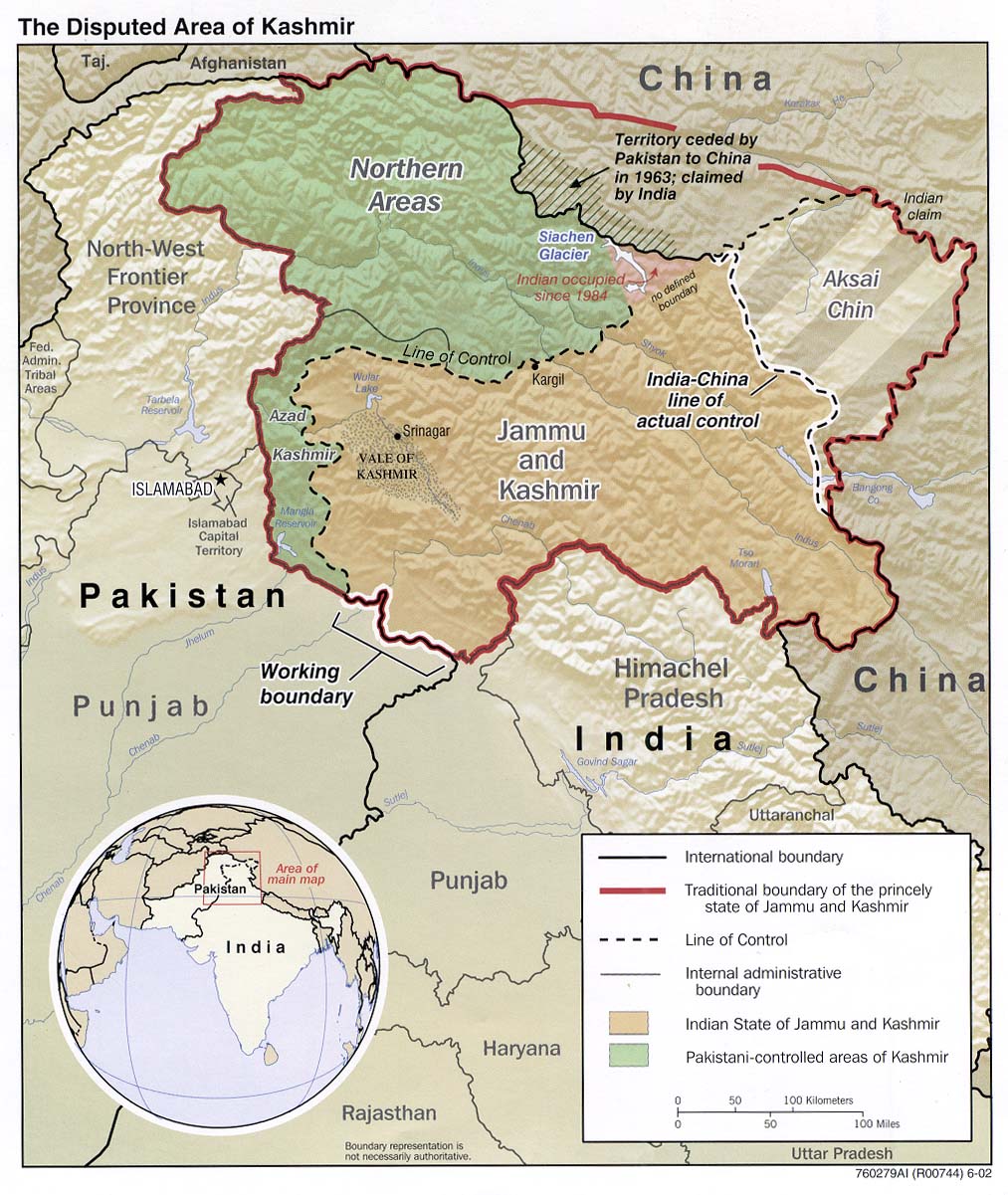
Musharraf’s speech on 12 January 2002 had clear implications for Kashmir. By announcing bans on Lashkar-e-Toiba and Jaish-e-Mohammed, he increased the chance that the insurgency in Kashmir would be weakened. If it faced a less intense battle in Kashmir, it is likely that the Indians would want to put the issue on the back burner. But it is worth bearing in mind two developments. First, the Kashmiri people are tiring of the struggle. Most informed Pakistanis now accept that, given the chance, most Kashmiris would opt for independence rather than a merger with Pakistan. But above all else the people of Kashmir want peace. That is not to say they will accept any settlement but it does raise the possibility that most would accept a compromise. The second new element is that many Pakistanis are also tiring of the conflict. Before Musharraf’s January speech it was conventional wisdom that no Pakistani leader could confront the religious extremists and remain in office. The lack of any backlash to Musharraf’s speech helped dispel that myth.

Might the same be true of Kashmir? Proponents of the view that no Pakistani leader can afford to back down in Kashmir rely on a number of arguments. First, the Pakistani people, informed by decades of intensive propaganda, are highly mobilised on the issue. Second, the army has made so many sacrifices in Kashmir that a significant climb-down would be seen as unacceptable. Not even an army chief, it is suggested, could compromise on Kashmir and expect to survive. That may be true, but there are counter arguments. Despite all the propaganda, many people in India and Pakistan are not particularly concerned about the Kashmir dispute. Many of those living, for example, in Sindh or Tamil Nadu would be quite happy to see any settlement of a dispute that is quite clearly holding back the subcontinent’s social and economic development. After a decade of insurgency, there is a growing feeling in Pakistan that India will never pull out. Pakistan’s size and economic weakness means it is not in a position to force the hand of a country with a billion people and great power aspirations. If General Musharraf or any subsequent Pakistani leader did make a compromise on Kashmir he or she might receive more support than is generally predicted.

In his account of the Kashmir dispute, the Indian author Sumantra Bose has rejected the idea of splitting up Kashmir because, he argues, none of the political districts are either ethnically or religiously homogeneous. In the Jammu region, for example, one third of the population is Muslim. Indeed, some of its districts have strong Muslim majorities. In Ladakh, meanwhile, the Buddhists may have a clear majority in Leh but the adjoining Ladakhi district of Kargil has a predominantly Shia Muslim population. Whilst Bose undoubtedly has a point, the history of the late twentieth century, for better or for worse, suggests that his objections to the possible partition of Kashmir are far from overwhelming. In the Baltic States and former Yugoslavia, to give just two examples, international boundaries were redrawn without regard to the fact that, in the process, new minority populations were created….

Ever since 1947 the views of the Kashmiris have been obscured by the dispute between India and Pakistan. With the insurgency over a decade old most Kashmiris are sick of the conflict and are desperate for a peaceful settlement. But for both India and Pakistan the symbolic importance of the Kashmir dispute means that they will inevitably follow their own perceived national interests rather than those of the Kashmiri people. If the Kashmiris had been conducring a straightforward fight for independence in the same way as the Chechens or East Timorese they would have had a greater chance of success. The tragedy of Kashmir is that the voices of the Kashmiri people themselves have been drowned out by the Islamists, nationalists and ideologues in Islamabad and Delhi.

SOURCE: Pakistan: Eye of the Storm, 2nd ed., by Owen Bennett Jones (Yale Nota Bene, 2002), pp. 106-108

Leave a comment

Filed under Pakistan