Category Archives: India

Kashmir at Partition, 1947

In August 1947, Kashmir’s autocratic ruler, His Highness Maharaja Sir Hari Singh Indar Mahindar Bahadur Sir Hari Singh, was faced with a momentous decision. The imperial government in London had always allowed some major landholders on the subcontinent a degree of autonomy and, technically, Kashmir had never been part of British India. The maharaja’s antecedents had secured the right to govern some of their own affairs by recognising the paramountcy of the British Crown. The compact between the British and the maharaja’s family was symbolised by the payment of a tribute: each year Hari Singh had to provide the British government with a horse, twelve goats and six of Kashmir’s famous shawls or pashminas.

When the British left, the maharaja had three options: Kashmir could become independent or join either India or Pakistan. The rulers of over 550 Princely State rulers faced the same decision but in the case of Kashmir the issue was especially sensitive. Its large population and proximity to both China and Russia gave the state considerable strategic importance. The matter was further complicated by religion: Kashmir was one of a handful of Princely States in which the ruler did not practise the same religion as most of his people. While the maharaja was a Hindu, over three-quarters of his subjects were Muslims. The fact that Kashmir was not only predominantly Muslim but also congruous with Pakistan convinced Mohammed Ali Jinnah that the maharaja’s decision would go in his favour. ‘Kashmir’, he said at the time of partition, ‘will fall into our lap like a ripe fruit.’ It was a naive misjudgement of Himalayan proportions.

The maharaja had most of the foibles associated with India’s decadent aristocracy. He was a hedonist and a reactionary whose main interests were food, hunting, sex and, above all else, horse racing. As his own son put it: ‘Quite clearly, my father was much happier racing than administering the State …’ On one occasion, he had been tricked by a prostitute in London’s Savoy Hotel who proceeded to blackmail him. He showed a similar lack of judgement in matters of state. In July 1947, with the transfer of power just weeks away, he took the view that ‘the British are never really going to leave India’!

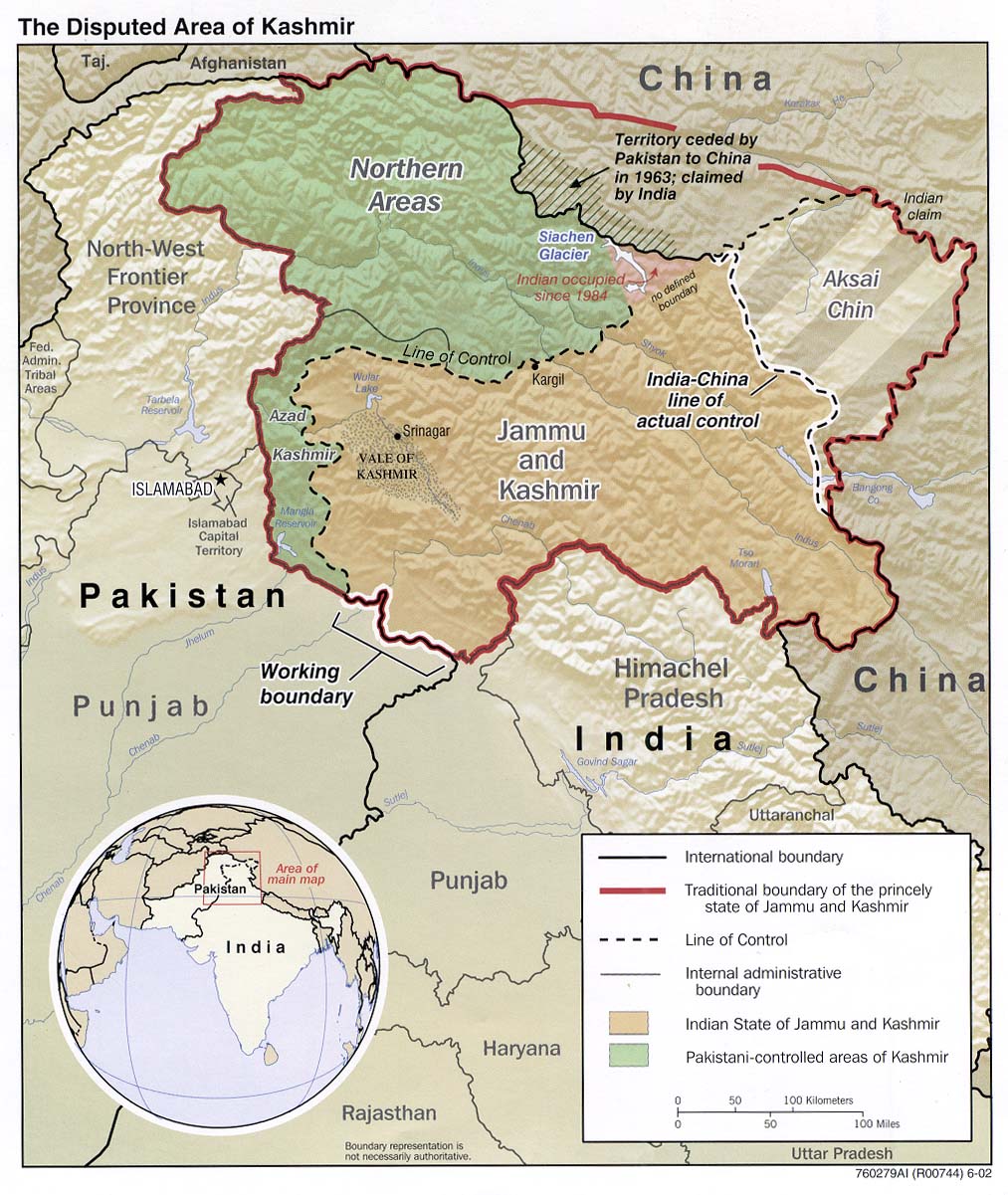
The maharaja’s ancestors had been blessed with greater political acumen. The State of Jammu and Kashmir had been established in the first half of the nineteenth century by a relatively minor Jammu chieftain, Gulab Singh. A combination of adept military conquests and astute financial deals enabled him to create one of the largest Princely States on the subcontinent. By 1850 he had moved on from Jammu (with its Hindu majority population) and had added Ladakh (Buddhist majority), Baltistan (Muslim majority) and the Kashmir Valley (Muslim majority). In the latter half of the nineteenth century, Gulab Singh’s successors extended their control to another Muslim majority area, Gilgit.

SOURCE: Pakistan: Eye of the Storm, 2nd ed., by Owen Bennett Jones (Yale Nota Bene, 2002), pp. 56-57

1 Comment

Filed under India, Pakistan

Willie Chandran’s Identity Makeover

Willie Somerset Chandran, a youth from a starkly dysfunctional mixed-caste family in India, manages to attend university in England during the 1950s.

Willie was living in the college as in a daze. The learning he was being given was like the food he was eating, without savour…. He was unanchored, with no idea of what lay ahead….

At the college he had to re-learn everything that he knew. He had to learn how to eat in public. He had to learn how to greet people and how, having greeted them, not to greet them all over again in a public place ten or fifteen minutes later. He had to learn to close doors behind him. He had to learn how to ask for things without being peremptory.

The college was a semi-charitable Victorian foundatioin and it was modelled on Oxford and Cambridge. That was what the students were often told. And because the college was like Oxford and Cambridge it was full of various pieces of “tradition” that the teachers and students were proud of but couldn’t explain. There were rules, for instance, about dress and behaviour in the dining hall; and there were quaint, beer-drinking punishments for misdemeanours. Students had to wear black gowns on formal occasions…. The academic gown probably was copied from the Islamic seminaries of a thousand years before, and that Islamic style would have been copied from something earlier. So it was a piece of make-believe.

Yet something strange was happening. Gradually, learning the quaint rules of his college, with the churchy Victorian buildings pretending to be older than they were, Willie began to see in a new way the rules he had left behind at home. He began to see–and it was upsetting, at first–that the old rules were themselves a kind of make-believe, self-imposed. And one day, towards the end of his second term, he saw with great clarity that the old rules no longer bound him.

His mother’s firebrand uncle had agitated for years for freedom for the backwards [low-caste people]. Willie had always put himself on that side. Now he saw that the freedom the firebrand had been agitating about was his for the asking. No one he met, in the college or outside it, knew the rules of Willie’s own place, and Willie began to understand that he was free to present himself as he wished. He could, as it were, write his own revolution. The possibilities were dizzying. He could, within reason, remake himself and his past and his ancestry.

And just as in the college he had boasted in the beginning in an innocent, lonely way of the friendship of his “family” with the famous old writer and the famous Beaverbrook journalist, so now he began to alter other things about himself, but in small, comfortable ways. He had no big over-riding idea. He took a point here and another there. The newspapers, for instance, were full of news about the trade unions, and it occurred to Willie one day that his mother’s uncle, the firebrand of the backwards, who sometimes at public meetings wore a red scarf (in imitation of his hero, the famous backward revolutionary and atheistic poet Bharatidarsana), it occurred to Willie that this uncle of his mother’s was a kind of trade-union leader, a pioneer of workers’ rights. He let drop the fact in conversation and in tutorials, and he noticed that it cowed people.

It occurred to him at another time that his mother, with her mission-school education, was probably half a Christian. He began to speak of her as a full Christian; but then, to get rid of the mission-school taint and the idea of laughing barefoot backwards (the college supported a Christian mission in Nyasaland in Southern Africa, and there were mission magazines in the common room), he adapted certain things he had read, and he spoke of his mother as belonging to an ancient Christian community of the subcontinent, a community almost as old as Christianity itself. He kept his father as a brahmin. He made his father’s father a “courtier.” So, playing with words, he began to re-make himself. It excited him, and began to give him a feeling of power.

His tutors said, “you seem to be settling in.”

SOURCE: Half a Life: A Novel, by V.S. Naipaul (Vintage, 2001), pp. 56-58.

Leave a comment

Filed under Britain, India

India, Religiously Profligate Secular State

Josh Chafetz on OxBlog comments on the aftermath of India’s recent elections:

KINDA COOL: India is over 80% Hindu. Last week, they kicked a Hindu nationalist party out of power. A plurality was won by the party led by an Italian-born Catholic. She then stepped aside in favor of a Sikh (who happens to be largely responsible for instigating the economic reforms that have made the Indian economy take off the last few years). The new Prime Minister was officially appointed by India’s President, who is Muslim.

Leave a comment

Filed under India, religion

Rushdie’s Two Wishes for India’s New Era

In a Washington Post column headed “India’s New Era,” Salman Rushdie articulates two wishes for India under the Congress Party after the latter’s upset victory in the latest elections.

I have two immediate wishes for the new era. The first is that the debates about “foreignness” can be laid to rest. Those of us who are part of the Indian diaspora, and who have fought for years to have Indians recognized as full citizens of the societies in which we have settled and in which our children have been born and raised, have found the attack on the Italian origins of Sonia Gandhi, the Congress Party’s leader and widow of the slain prime minister Rajiv Gandhi, to be highly unpleasant. Even more unpleasant were the BJP’s suggestions that her children, the children of Rajiv Gandhi, were also somehow aliens. You can’t have it both ways. If Indians outside India are to be seen as “belonging” to their new homelands, then those who make India their home, as Sonia Gandhi has done for 40 years or so, must be given the same respect. Gratifyingly, the electorate has shown it just doesn’t care about the “foreignness” issue. A BJP leader foolishly said in the immediate aftermath of his party’s rejection that he thought it “shameful” that India might be led by a foreigner. Such slurs are part of the reason for the BJP defeat. They are essentially racist, and must cease.

My second wish is that the study of India’s history can now be rescued from the extremists and ideologues. The outgoing government’s politicization of historical scholarship — its determination to impose textbooks peddling a narrow, revisionist, Hindu-nationalist vision of India’s past on the country’s schools and colleges, and its deriding of the work of the greatest Indian historians, such as Professor Romila Thapar — was one of its most alarming initiatives. The BJP has often seemed to want to inflame our perceptions of the past in order to inflame the passions of the present. Congress and its allies have it in their power to restore the atmosphere of cool objectivity that true learning requires.

Leave a comment

Filed under India

Anglo-Indian Convention in Australia

Radio Australia carries a report of a recent Anglo-Indian convention in Melbourne.

They’ve survived generations of negative stereotypes and mistrust, often finding themselves ostracised by both mainstream Indian society and their British colonial masters.

But today, Anglo-Indian communities around the world say they’re ready to reclaim the best of both sides of their ancestry….

There are about 125,000 Anglo-Indians living in India today, with almost as many living abroad – many in Australia.

They’re the descendants of people who had a European father and an Indian mother – a mainly Christian community first established about 400 years ago in Kolkata – formerly Calcutta.

Yet another category of TCK/Global Nomads. I wonder what percent of the world population we’re up to now.

Leave a comment

Filed under Australia, India