
Category Archives: Korea

What If China Takes Over North Korea?

In a long analytical piece in the Asia Times, Andrei Lankov concludes that a Chinese puppet regime (on the former Soviet model in Eastern Europe) might be the least worst option for all concerned in case North Korea finally falls apart. Here is some of his reasoning.

Americans might worry about proliferation threats and feel sorry about sufferings of North Koreans. Yet they are not very likely to dispatch troops to a chaotic and violent country whose population has been taught for three generations that Americans are evil incarnate, natural born torturers and killers, to be resisted at all costs. Chaos in North Korea, if it happens, cannot be stopped by the use of hi-tech weapons, and Americans are not eager to mire themselves in local intrigues, fights and hatreds. This is not what they like nor what they know how to handle well.

South Koreans are not necessarily different. State-sponsored nationalism is an important feature of the South Korean ideological landscape and lip service to unification as the nation’s supreme goal is made by all political forces in Seoul. However, South Koreans have demonstrated throughout the last decade that they are not too eager to risk their hard-won affluence for the sake of unification. South Korea is a democracy, and parents will not be too happy to send their only sons to the dangerous North, to get involved in necessarily dirty and immoral work there – and probably get killed in the process.

So, if everything else fails, the Chinese move across the Yalu will be tacitly (or openly) welcomed. Beijing is not overwhelmed with worries about excessive losses, has good local knowledge and intelligence and, like any authoritarian government, does not care too much about losses of the opposite force. So, it can do this work with brutal efficiency.

And then what? It would be naive to expect China just to leave after it sorts out the problems in its neighbor. It is probable it will maintain a presence for long time while supporting a friendly (or, better to say, semi-puppet) government. Such a government will not continue with the old policies of the Kim family’s regime, since these are remarkably inefficient and China, while willing to provide some aid, will not pump large amounts of aid into the North indefinitely. The new dependency will have to be made self-sustainable, and the only way to do this is to encourage reforms in accordance with the tested Chinese-Vietnamese model.

However, for a cold-minded (or cynical, if you prefer) observer it means that the Chinese and their puppets will assume a heavy responsibility. Post-communist reforms are always difficult and dirty to bring about. They solve many old problems – and create a lot of new ones. That is why the South now sees a German-style instant unification as a nightmare: it would mean that Seoul assume the total responsibility for transforming the North, and everybody understands that this will be a costly and unthankful task.

The economic gap between North and South is so large that it cannot be bridged in less than two or three decades, and its existence alone is bound to produce mutual resentment and tensions. The transformation means that nearly all adult North Koreans will find themselves at the bottom of the new social ladder and remain there for the rest of their lives, even though their absolute living standards will improve considerably.

The resulting discontent will be strong and lasting, as experience of former Soviet states testifies. The hagiographic biographies of Generalissimo Stalin constitute a large part of the best-sellers in the Russian book market these days. Most people who admire these stories and feel nostalgic about the grandeur of the Soviet era actually live remarkably better-off lives than they had under the communist regime, and far better then their grandparents, the subjects of Stalin, could even dream about living.

Nonetheless, they take the current material benefits (and right to read uncensored books) for granted while feeling sorry about the loss of established order, collapse of their beliefs and deep wounds inflicted on Russia’s national pride. It is not incidental that in the past decade the word “democracy” has become a popular term of abuse in Russian parlance: it is associated with real or perceived national humiliation, social disruption, corruption and instability.

There are few doubts that reforms in a Chinese-controlled North Korea will produce a fast and remarkable improvement in the living standards – much as has happened in Vietnam and China itself. However, if those reforms are undertaken without unification with the South, the North Koreans will not compare their state and their consumption level with those of rich South, but rather with their own sorry past, and as a result they will have less psychological reason for discontent.

As an added benefit, the discontent when it arises will be channeled not against a democratically elected national government but against a regime that will be clearly a dictatorship, forcefully imposed by a foreign power, and largely consisting of Kim Jong Il’s ex-officials – that is, people responsible for earlier abuses and economic disasters. These opportunistic puppets will make convenient scapegoats, and this will mean that ideas of liberal democracy will not become seriously discredited. Meanwhile, the South will be seen as a land of prosperity, beacon of democracy and a truly national polity.

Beside, under such a regime there will be many more opportunities for starting a genuine pro-democracy movement inside North Korea. China might be an authoritarian state, but it is far cry from present-day North Korea, arguably still the least free society on the face of Earth.

A measure of political liberalization is unavoidable if one wants to reform a Stalinist system: a functioning market economy cannot exist in a society where for a trip outside the country one has first to apply for police permission and then wait for days (or even weeks) until such permission is issued, as is still technically the case in North Korea.

Greater freedoms means that dissenters will be at least able to gather information, publish or read some hitherto underground material, or even stage occasional strikes and pickets – like the situation in the USSR and East Europe in the Brezhnev era of the 1970s. Nowadays in North Korea every potential dissenter just goes to prison, sometimes accompanied by his or her entire family, well before he or she undertakes any kind of meaningful action. Chinese dissenters gather press conferences in their kitchens – North Koreans disappear without trace.
via The Marmot’s Hole

Leave a comment

Filed under China, democracy, economics, Korea

Woolsey Hall, Memorial Walls, and Stacked Pencils

When she submitted her design for the Vietnam Veterans Memorial on the National Mall in Washington, D.C., Maya Lin was still an undergraduate at Yale, where she was no doubt partially inspired by the names on the walls of Woolsey Hall, which houses the university auditorium and the university cafeteria, and on whose interior walls one can find the names of Yale alumni killed in many wars, revolutionary (Nathan Hale), civil, and foreign. In November 1922, Yale dedicated its War Memorial, adding 225 names of Yale alumni killed in World War I.

The names on Woolsey Hall include military ranks, dates of death, and place of death, if known. The vast majority of Yalies served as officers, as befitted their elite status during most of Yale’s history. (Nowadays our elites are too good to serve in the military.) But a minority of Yalies in each war served in the enlisted ranks. When the Far Outliers attended a baccalaureate service at Woolsey Hall last May, I found a few of those names of Yalies who apparently dropped out and enlisted before they graduated, for whatever reason. Here are just two, one killed in Vietnam, one in Korea.

  • Donald Porter Ferguson, class of 1969, CPL, U.S. Army, killed on 13 January 1968 in Bienhoa, Vietnam. (One of my classmates learning Romanian at Army Language School in 1969–70 graduated from Yale in 1968.)
  • Harold Ackerman Storms Jr., class of 1953 (or 1952), PFC, Infantry, killed 10 July 1953 on Christmas Hill in Korea. (The armistice was signed on 27 July 1953.)

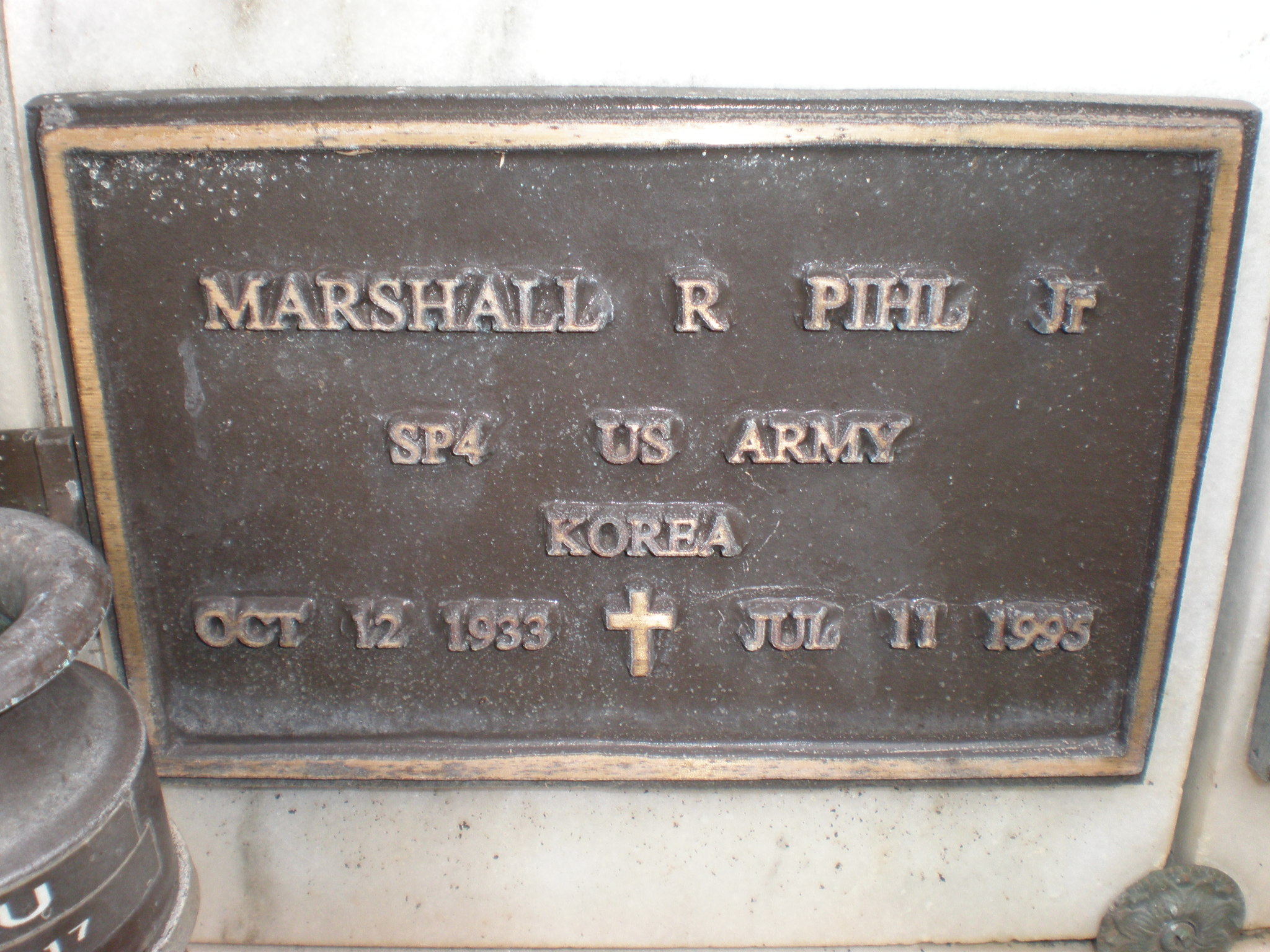
However, the Ivy League veteran I would most like to honor on this Veterans Day is Marshall R. Pihl (1933–1995), Harvard class of 1960, who learned Korean courtesy of the Army Language School and used his G.I. Bill funding to become a renowned scholar of Korean literature, especially the “performed literature” he described in his dissertation, later published as The Korean Singer of Tales (Harvard U. Press). Here’s the obituary posted to a Korean studies listserv in July 1995.

MARSHALL R. PIHL, renowned translator and leading scholar in the field of Korean literature, died at his home over the weekend of July 8. He was 61.

Since early spring his health had been deteriorating, at first gradually and then more and more rapidly. Nevertheless he diligently kept his appointments and continued his research. At least outwardly, he remained optimistic about recovery until the end.

After graduating from Harvard College in 1960, where he majored in Far Eastern languages, Marshall became the first Fulbright student grantee in Korea, receiving an M.A. in Korean language and literature from Seoul National University in 1965. He was the first Westerner to earn a graduate degree from a Korean university. He then entered the doctoral program at Harvard University, receiving his Ph.D. in 1974.

During another Fulbright year in Korea in 1970-71, Marshall was named the winner of the first annual Modern Korean Literature Translation Award, sponsored by the Korea Times. His first collection of translations, Listening to Korea, was published by Praeger in 1973. Later he produced The Good People: Korean Stories by Oh Young-su, published by Heinemann in 1985, and coedited (with Bruce and Ju-Chan Fulton) Land of Exile: Contemporary Korean Fiction, published by M. E. Sharpe/UNESCO in 1993. He also published many articles and translations in periodicals such as Korea Journal and Korean Studies and in collections such as Peter Lee’s Anthology of Korean Literature (1981) and Flowers of Fire (1986). But he was most proud of the beautifully produced work that originated as his dissertation, The Korean Singer of Tales, published by Harvard University’s Council on East Asian Studies in 1994.

Because he was a pioneer in a then-tiny field, Marshall was unable to secure a full-time academic position and was forced to combine teaching with administrative duties until he joined the Department of East Asian Languages and Literatures at the University of Hawaii in 1989. Although he was an exceptionally capable administrator, serving as associate director and then director of the Harvard University Summer School from 1977 to 1987, he was thrilled to be able to devote full-time to teaching and research in Hawaii.

His contributions were well recognized at UH, where he received tenure in 1992 and a promotion to full professor in 1995. His administrative skills were also highly valued by his colleagues on the executive committee of the Center for Korean Studies.

Marshall was not just a fine scholar, but also a dedicated teacher and an unfailingly generous, optimistic, and energetic mentor for junior colleagues everywhere. He attracted a growing number of graduate students into Korean literature, and always gave higher priority to their academic advancement than to his own projects. Even in the two months before his death he chaired one dissertation defense, two thesis defenses, and served as outside member on several more.

He had planned to devote his upcoming sabbatical to finishing several of his own projects, including translating and condensing Cho Dongil’s comprehensive history of Korean literature and coediting several textbooks in a series on Korean literature organized by the International Korean Literature Association, which he helped establish in 1992.

———-

Marshall was an extraordinarily powerful person. I never spoke with him without feeling infused with some of his energy and obvious love of life. —Jonathan Petty, University of California, Berkeley

Not only was he a fine scholar who brought an incredible amount to the field, but he was also simply an extraordinary human being—kind, helpful, and generous to those around him and blessed with a terrific sense of humor. His passing leaves not only a large vacuum in the field but a huge void in the hearts of those who knew him. —Stephen Epstein, Victoria University, Wellington

Marshall used to say that at the end of each duty day in Korea, regular soldiers might stack arms, but his fellow translator/interpreters would stack pencils. His ashes are interred in Punchbowl National Memorial Cemetery of the Pacific in Honolulu.

Marshall R. Pihl grave marker

Marshall R. Pihl grave marker

1 Comment

Filed under education, Korea, U.S., Vietnam, war

Multilingual Name Changes in the Bonin Islands

From English on the Bonin (Ogasawara) Islands, by Daniel Long (Duke U. Press, 2007; Publication of the American Dialect Society, no. 91; Supplement to American Speech, vol. 81), pp. 125-128

There is something of a misconception among Japanese—or at least among that minute percentage of the population that has any knowledge of the subject—that the Westerners of Ogasawara acquired Japanese family names when they were naturalized as Japanese citizens back in the early Meiji era. This is not true….

When the original inhabitants of the islands began to be naturalized in 1877, only a few took Japanified names. Among these was the almost legendary German figure Frederick Rohlfs (1823–98), who settled on Hahajima and aided subsequent Japanese arrivals when they were on the verge of starvation. He was commonly called “Rose,” probably because this is how his name sounded to Japanese listeners when pronounced by English speakers. His legal Japanese name was composed of five kanji (Sino-Japanese) characters chosen strictly for their pronunciation. Although they convey no coherent meaning, when combined the characters (pronounced as Rōsu Rarufu) sounded something like the two pronunciations of his family name. Rohlfs was in the minority, however; most of the Westerners (referred to as kikajin ‘naturalized people’ in those days) used katakana renderings of their own Western family names as the official names in their koseki, or Official Lineage Registries. These were not Japanese family names, nor Japanified versions of their Western names, but simply adaptations of them to the Japanese phonology and representations of them in the Japanese script (e.g., Gilley became Gērē, Savory became Sēborē, Webb became Uebu, Washington became Washinton, Gonzales became Gonzaresu).

The usage of kata[ka]na names continued for a couple of generations. It was not until the Sōshi Kaimei (創氏改名‘Establishment of Family Names and Alteration in Given Names’) law that people with non-Japanese surnames were forced to change them. This 1940 law is mainly known for its effect on the millions of colonized people in Korea, but it also affected the Bonin Islanders. Elderly islanders today recall choosing their own last names, often hurriedly and quite randomly….

Some of the islanders chose kanji characters that either sounded like their original names or expressed some significant meaning. The Savorys became Sebori (瀬堀[‘rapids-ditch’]), and the Ackermans, the Akaman (赤満 [‘red-full’) family. The Webbs chose characters that could be read as Uebu (上部 [‘upper-part’]) (though the name is pronounced Uwabe today). Other families decided on a name with some symbolic value. The Gilleys, proud of the “South Sea Islander” part of their roots, chose the name Minami (南 ‘lit. south’). Other families abandoned the idea of names in which either the sound or the meaning of the kanji held significance. In most cases, different family names were chosen by distant branches of the family tree, so that the Gonzales family descendants became either Ogasawara (小笠原 [‘little-hatshade-field’]) or Kishi (岸 ‘shore’).

During the war years, Westerners gave their children Japanese names. Children born after World War II (during the U.S. Navy period) were given only English names, and they use these today—written in katakana—as their official Japanese names.

Following the reversion to Japan, Westerners adopted the practice of giving Japanese names—written in kanji—to their children, but even here, we find cases of islanders identifying with their cultural roots. One case of this is Nasa Sēborē (セーボレー那沙), born in the 1980s, whose name, although written in kanji, is an homage to his ancestor Nathaniel (pronounced “Nasanieru” in Japanese).

Some of the Westerners legally changed their surnames back (from Japanese ones forced upon them in 1941) to their older katakana names following the changes in the Japanese law in the 1980s.

In many cases, a single individual has possessed four legal names in the span of his or her life. A case in point is Able Savory. He was born Sēborē Ēburu (in katakana, セーボレーエーブル), was forced to changed his name to Sebori Eiichi (in kanji, 瀬堀栄一) at the start of the war, and used Able Savory (in the Roman alphabet) during the Navy Era. After the 1968 reversion, he reverted to his wartime kanji family name, but used the katakana “first name” given to him at birth, resulting in the name Sebori Ēburu. In the 1980s, when some of the Savory clan changed their surname back to the katakana Sēborē, he decided four names in one lifetime were enough and retained the kanji surname.

In Ogasawara today, one finds many interesting name-related phenomena. Nicknames—in both Japanese and English—are the norm. Then, most of the Westerners have two names; many have both Japanese and English surnames and given names, which means there often are at least five or six ways to refer to most Westerners.

This reminds me my favorite comment thread ever on Language Hat, in reaction to a post about a poem entitled Peaches in Cluj.

3 Comments

Filed under anglosphere, Japan, Korea, language

Marmot’s View of Islam in Medieval Korea

Robert Koehler at The Marmot’s Hole offers his summary of early relations between the Islamic world and Korea, based on a 2005 Korean-language piece in the Hankyoreh Shinmun by Professor Jeong Su-il. Here are a few excerpts.

Following the establishment of the Goryeo kingdom, the Muslim presence in Korea would reach new heights. At first, it was mostly Arab traders flooding into the kingdom, but in the late Goryeo era, when Korea was dominated by the Mongol Yuan Dynasty, Muslims would come to Korea as soldiers and administrators, and the Muslim faith would begin putting down roots in the country.

Historical records show that in the early years of the Goryeo era, large Muslim — probably Arab — tribute delegations came to the Korean capital of Gaegyeong (present day Kaesong) in 1024, 1025 and 1037, presenting such rare gifts as mercury and myrrh. The Goryeo king prepared for these travelers special lodging and presented them with gold and silk upon their return to their homeland….

Professor Jeong noted the historic irony that Islam was brought to Korea on the (horse)back of non-believers. This irony could be taken even further by noting that the afore mentioned non-believers were not just your garden-variety infidels, but the very same enemies of God who that year had single-handedly stuck a fork in the Islamic Golden Age with the “Mother of All Sackings” of Baghdad.

Following the Mongol conquest of Goryeo, the saengmokin, regarded by the Mongols as highly cultured and educated (many Central Asians, particularly Uighurs, served as administrators for the empire — even the Mongol script was invented by a Uighur), came to Korea as guards, military aide-de-camps and attendants to the Mongol princesses sent to Korea to marry the Goryeo princes. At the same time, many Muslims came to Korea in a civilian capacity as traders, with many settling down for good.

An update links to another article in English by Don Baker in Harvard Asia Quarterly entitled Islam Struggles for a Toehold in Korea. Here’s the abstract.

This paper explores the history of Islam in Korea from its first introduction on the peninsula in as early as 11th-century to the present day. Although Korea is rightfully perceived as a country whose religious landscape has been traditionally dominated by Buddhist temples, Confucian study halls, and shrines for Korea’s own folk religion, Islam has also secured a foothold in this East Asian country. The author reveals the traces of the early contacts with the Muslim civilization in Korea’s own culture, ranging from the adoption of advanced calendrical techniques to the import of a sophisticated distillation technology that came to be used for the production of soju, Korean rice wine. Against the backdrop of this historical overview, the paper goes further to analyze why Islam has not made more headway in Korea. This research concludes suggesting that Islam’s failure to adapt itself to local customs accounts for its status as a minority religion that attracts primarily foreign residents of Korea and has only a small number of Korean adherents.

Leave a comment

Filed under Islam, Korea

East German Female Seeking North Korean Male

The Korea Times profiles a German woman seeking her North Korean husband, long since repatriated from the former East Germany to North Korea. Quite an unusual case of Ostnostalgie: “Liebe Kennt Keine Grenzen.”

A German woman has expressed hope that the upcoming inter-Korean summit will be a breakthrough toward meeting her husband, Hong Ok-geun, 73, who was sent back to North Korea 46 years ago.

“I believe that my long-time desire will come true now that talks between South and North Korea are taking place,” Renate Hong, 70, told a news conference in Seoul Thursday.

The now elderly Hong first met her North Korean husband when she was 18 and they were both students at a university in East Germany. The two fell in love and married after dating five years.

Hong, however, has not seen her husband since North Korea forcibly called back students studying abroad in 1961. They had been married for one year and Hong was pregnant with their second child.

via The Marmot’s Hole

Leave a comment

Filed under Germany, Korea

Hawaiian Kanji Syllabary Design

Language Hat recently noted a kanji syllabary devised at a very unusual state charter school in Hilo, Hawa‘i, where Hawaiian is not just the medium of instruction, but also

the language of administration, support staff, grounds keepers, and school events for parents. This creates an environment where Hawaiian is growing much stronger than in standard immersion programs and also leading to a major increase in the number of families using Hawaiian as a first language of the home.

That’s exactly what the language needs to survive.

The kanji syllabary was not designed to replace the existing, steadily evolving orthography of Hawaiian. Instead, it was designed to give the students a better understanding of East Asia, where many of their ancestors came from. It also strikes me as a brilliantly concrete and practical way to instill some key linguistic concepts into young minds: the arbitrariness of signs, the phonetic basis of all full writing systems, evolution of writing systems, orthography design, syllable structure, and so on.

Unfortunately, the PDF version of the article posted online contains only graphic images of the entire kanji syllabary, the Hawaiian word chart on which the syllables are based, and actual samples of writing. So this blogpost unpacks the images and presents the characters as text in order to examine the design of this syllabary and compare it with similar systems. See the chart below.

Citation Order

The list-ordering sequence commonly referred to as “alphabetical” order differs according to the writing system of each language. In Korean, all the consonants of the alphabet precede all the vowels: ga na da la ma ba sa … a ya eo yeo o yo u yu …. Japanese kana are commonly cited starting with the five vowels, then adding a consonant before the same vowels: a i u e o, ka ki ku ke ko, sa si su se so, etc. Bilingual dictionaries in both languages arrange the native-language entries in those orders.

The citation order for the Hawaiian syllabary, known as hakalama, goes back to the earliest days of teaching Hawaiians to read and write. It owes little to foreign antecedents. Like Korean, however, consonant-initial syllables are cited before vowel-initial syllables. Unlike Japanese, all the consonants are pronounced with each vowel, then all the consonants with the next vowel, and so on: ha ka la ma na pa wa ‘a, he ke le me ne pe we ‘e, etc. If applied to Japanese kana the same principle would yield the order a ka sa ta na ha ma ya ra wa, e ke se te ne he me [y]e re [w]e, etc.

Choice of Symbols

The hakalama syllables of Hawaiian could easily have been written in Japanese kana, but Chinese characters (kanji) were chosen because they were common to all the East Asian ancestral homelands of the students: China, Japan, Korea, Okinawa. The first step in choosing logographic symbols was to turn the hakalama syllable chart into a chart of basic words starting with the same syllables—on the same principle as A is for Apple, B is for Boy, C is for Cat, and not Alpha, Bravo, Charlie, Delta (or Able, Baker, Charlie, Dog), which are designed to enhance auditory discrimination. Thus, Ha is for Hana ‘work’, Ka is for Kanaka ‘person’, La is for Lani ‘sky’, and so on.

Basic kanji were then chosen to match the meanings of each of those words. Thus, Ha and Hana are written with the kanji for ‘work’ (作), Ka and Kanaka with the kanji for ‘person’ (人), La and Lani with the kanji for ‘sky’ (天). (Although I knew most of the Hawaiian words, I learned a few of them from the kanji.)

UPDATE: It should be stressed that these kanji were borrowed only for their semantics, not for their sound values in any other language. Thus, 人 is free of any possible Sino-Hawaiian readings (kini?) or Japano-Hawaiian readings (hiko?). Despite the origins in other languages, these symbols are used in strictly monolingual fashion.

Diacritics and Variant Readings

The kanji syllabary was not really designed to become a comprehensive orthography. It was primarily designed to expose students to East Asian Sinographic traditions, especially the concept of logography, where a symbol can stand for a whole word. The primacy of logography in its design is apparent from the clumsy way that diacritics are used.

When the symbols are used as logographs, no diacritics are required; but every time they’re used as syllables, diacritics are required to show whether the vowel is long or short. Thus, 石 without diacritics is to be read pōhaku, while the syllable must be written 石¯ to mark the long vowel and the syllable po must be written 石° to mark the short vowel. This seems completely backwards. In a true syllabary, symbols that represent syllables should be the unmarked case, while logographic usages should be the marked case. Matt at No-sword discusses the diacritic issues in more detail, with plenty of examples.

Hawaiian Kanji Syllabary Chart

Syllable

Word

Meaning

Symbol

ha

hana

‘work’

ka

kanaka

‘person’

la

lani

‘sky’

ma

maka

‘eye’

na

nahele

‘forest’

pa

pahi

‘knife’

wa

waha

‘mouth’

‘a

‘ai

‘eat’

he

hele

‘go’

ke

keiki

‘child’

le

lepo

‘dirt’

me

mea

‘thing’

ne

nele

‘lack’

pe

pepeiao

‘ear’

we

wela

‘hot’

‘e

‘ele‘ele

‘black’

hi

hiki

‘able’

ki

kino

‘body’

li

lima

‘hand’

mi

mile

‘mile’

ni

niho

‘tooth’

pi

pipi

‘cattle’

wi

wili

‘mix’

‘i

‘ike

‘see’

ho

holo

‘run’

ko

komo

‘enter’

lo

lo‘i

‘paddy’

mo

moku

‘ship’

no

noho

‘stay’

po

pōhaku

‘stone’

wo

wō (= hola)

‘hour’

‘o

‘oki

‘cut’

hu

hulu

‘feather’

ku

‘stand’

lu

luna

‘high(er)’

mu

‘insect’

nu

nui

‘great’

pu

pua

‘flower’

wu

wū (= makuahine)

‘mother’

‘u

‘umi

‘ten’

a

ali‘i

‘chief, king’

e

ea

‘life, breath’

i

i‘a

‘fish’

o

ola

‘life, live’

u

ua

‘rain’

UPDATE: Lameen of Jabal al-Lughat offers a very interesting analysis of writing systems that are not syllabaries, but do mark in an interesting variety of ways the vowel codas or lack thereof after each consonant.

In Canadian Syllabics, for example Cree, the shape of a symbol represents the consonant, while its orientation represents the vowel that follows it, and length or labialisation may be represented by dots.

3 Comments

Filed under China, Hawai'i, Japan, Korea, language

North Korean Ideology: Juche as Kokutai

The North’s successful quasi-Stalinist economic development did not mean that North Korea adopted the particular blend of Marxism-Leninism developed under Stalin in the 1930s. On the contrary, if the North’s ideology resembled any socialist experiment, it was closer to the Chinese model [under Mao]. In retrospect, it is now clear that North Korea actually developed an independent ideological line from the beginning. Perhaps because of its early close association with the USSR and the PRC, the North continued to parrot a line of Marxism-Leninism, but from Kim Il Sung’s first formal elaboration of Chuch’e [= Juche] thought in a 1955 speech, Marxism-Leninism progressively declined as a formal category of thought in the North. In hindsight, it is difficult to see how the North’s economic and social revolution had anything at all to do with Marxist antecedents. Since the collapse of the Soviet Union and its Eastern European satellites after 1989, North Korea quickly disassociated itself from Marxism altogether. Moreover, the development of Chuch’e thought in tandem with the rise of the cult of the leader has provided the North with a ready explanation for the survival of its revolution even after the collapse of the Socialist world order.

Not only do North Korean ideologues assert they have leaders such as the world has never seen before, they also have an ideology that completes their self-image as the center of a world revolution. This ideology revolves around the seminal idea of Chuch’e. Chuch’e is a Sino-Korean compound formed from Chinese characters for the words “subject” [or ‘lord, master’] and “body” [主体]. Together they adumbrate the concept of “autonomy” or “self-reliance.” In its most straightforward use, Chuch’e can denote one’s independence and autonomy from any external control or manipulation. Therefore, one core meaning of Chuch’e resonates in society-wide contexts to describe an autonomous, independent, and self-reliant nation. The ch’e in Chuch’e is the same character used in kukch’e, often translated as “national body” or “polity” (see below). Here it can also carry the connotation of the “national face,” as in self-respect. Thus an independent and autonomous nation’s face (honor) must not be besmirched or denigrated. This core definition goes a long way to understanding the intense emphasis in North Korean ideology on their independence, whether in terms of their national integrity, their position earlier in the global socialist revolution, or their autarkic economic policies. The nationalist connotations of Chuch’e developed in the late nineteenth century, when it was used as an antonym of the concept of “serving the great” (sadae), a term used originally to describe the interstate relationship between Korea and China during the Chosŏn period. In the twentieth century, sadaejuŭi (the “ism” of sadae) became synonymous with being subordinate to another, with being a toady. To have sadae consciousness means to worship the outside world while denigrating one’s own culture. Chuch’e thus had come to mean an independent stance, in mind and in body, and in nationalist context it means to uphold the independence and integrity of the nation.

Chuch’e was a useful concept in creating distance with the early Soviet presence in North Korea, and later, during the time of extensive Soviet assistance in the rebuilding and first Five-year Plans, it was deployed to signal North Korean independence. The term, first elaborated by Kim Il Sung in 1955, moved to its central position during the 1960s as Kim maneuvered between his giant socialist neighbors during the Sino-Soviet split. By the 1970s Chuch’ e thought had become so linked to the genius of the Great Leader that it literally became the “ism” of Kim Il Sung, as in “Kim Il Sung-ism.”

In the polemical warfare between the two Koreas, the North’s Chuch’e stance gave it an advantage over the South, especially in the first decades of division. The South was an economic dependent in the 1950s, and until the mid-1960s it relied heavily on American military protection. Although the North was also relatively dependent on the PRC and USSR in the early years, foreign troops withdrew after the Korean War, leaving the North to defend itself. To the North Koreans, the continuing presence of the US Eighth Army in the South has been proof of the ROK government’s “slavish” dependence on outside power. The Chuch’e argument continued to resonate with opposition forces in South Korea into the 1980s, since they had from the start questioned the legitimacy of the ROK government and they railed against the continuing US military presence in the South. They pointed to the contrasting stance of the North and its resolute emphasis on autonomy. Whatever the facts may have been with regard to the North’s actual independence, its consistent propaganda and its emphasis on national independence reminded all South Koreans of Korea’s historical humiliations at the hands of imperialist and colonial powers.

Chuch’e has become the principle behind all government policy in the North, which, of course, has significant implications for economic policy. Indeed, in keeping with astrict adherence to independence in all matters, North Korea has developed perhaps the most autarkic economy in the world. Economic achievements are touted as successes based on self-reliance, and great pains were taken to seek internal solutions to economic problems. The story of the creation of the synthetic fiber “vynalon” by North Korean scientists using indigenous raw materials (in this case limestone) became an often-repeated morality tale of technological self-reliance in state propaganda. Where indigenous capital was scarce or other inputs unobtainable inside the country, the state resorted to exhortation and mobilization of the innate creativity of the masses. Thus all problems, technical or otherwise, are solvable if the people retain a staunch consciousness of Chuch’e. Such a stance inhibits overtures to the outside world for the economic or technical assistance the North now desperately needs to solve its economic woes. With the principle of Chuch’e inviolate, the state finds itself in its own straitjacket. And as we will see below, the new policies that have created zones for foreign investment, initiatives to find foreign capital, and, most obviously, accepting foreign food aid during the 1995 famine are issues that must be justified in terms of the unitary logic of self-reliance.

At its most abstract, Chuch’e operates as a code word for North Korean identity itself. Thus holding a consciousness of Chuch’e is to have a North Korean subjectivity. Some speculate that Kim Il Sung developed the idea in reaction to the vague and virtually indefinable concept of kokutai (kukch’e in Korean) used to evoke “national essence” in Japanese ideology before 1945. All North Koreans are enjoined to hold Chuch’e in their minds and hearts, as only in so doing will their actions be appropriate. Since Chuch’e is the leader’s core inspiration, all his subjects carry the leader in their hearts when they hold fast a consciousness of Chuch’e. Just as the emperor embodied the essence (kokutai) of the nation in pre-World War II Japan, so does the leader, now Kim Jong Il, embody the very essential principle that guides all thought and action in North Korea today.

SOURCE: Korea’s Twentieth-Century Odyssey: A Short History, by Michael E. Robinson (U. Hawai‘i Press, 2007), pp. 158-161

2 Comments

Filed under Japan, Korea, philosophy

Japan, Korea, Manchuria :: Torso, Arm, Fist

THE YEARS BETWEEN the collapse of the United Front in the fall of 1931 and the outbreak of the war with China in 1937 brought colonial Korea’s ironies and contradictions into sharp focus. While the fall of the United Front meant the collapse of overt nationalist resistance, what emerged in its place was a more violent anti-Japanese movement represented by the guerrilla movement in Manchuria and the Red Peasant Unions in the far northeast of the peninsula. Japan’s seizure of Manchuria in 1931 altered Korea’s position in the empire, for Korea then became a middleman in the empire’s development of northeast China’s vast untapped resources. The subsequent, seemingly anomalous industrialization of North Korea provided new jobs for peasants, but at the price of dislocating them from the densely populated south and moving them to the north; furthermore, Korea’s industrial labor force expanded simultaneously with the deepening immiseration of the Korean countryside. Finally this period witnessed the flowering of a capitalist mass culture in Korea’s cities, a popular culture providing the façade of a modernity that had evolved unevenly in the colony. The alluring consumer culture and glittering nightlife in the cities contrasted with abject poverty in the countryside, symbolizing each end of the economic spectrum of a dual economy—dual in the sense that parts of Seoul were as modern as anything in Tokyo, yet in rural backwaters profound poverty and wretched material conditions remained unchanged from the nineteenth century.

The addition of Manchuria caused large-scale shifts within the Japanese Empire. Increasingly isolated in world affairs and threatened by economic isolation as trading nations erected tariff barriers to protect their own economies, Japan began to create an autarkic economy formed around its colonies. The main axis of this system ran from Japan proper through Korea and Manchuria, with Taiwan playing an important, but less crucial role. Because Korea was more firmly integrated politically, had a more developed infrastructure, and was labor rich—not to mention its being geographically central—Japan began to industrialize Korea in order to exploit the raw materials of Manchuria. The state-led industrialization of Korea in the 1930s was an anomaly in colonial history. No colony had ever before been industrialized to the level of Japan’s Korea colony, a process that shifted labor from the densely populated south to the sites of huge new factories in northern Korea and Manchuria and spurred urban growth as well.

The increasing economic importance of Korea within the empire motivated Japan to intensify its efforts to spread Japanese values, language, and institutions within the colony. By the mid-1930s Japanese authorities were demanding active Korean participation in Shinto ceremonies, stepping up the pressure within the education system to spread Japanese language use, and trying to eliminate the last differences in legal and administrative practices that distinguished the Japanese naichi (inner lands) from the colonial gaichi (outer lands). The goal in the minds of colonial officials was a seamless cultural, legal, and administrative assimilation of Korea, and where this could not be accomplished in reality, cosmetic fiction would do. This was especially true in the dark years of the Pacific War (1941–1945), when the Japanese assimilation policies became increasingly hysterical and unrealistic.

By the end of the colonial period in 1945, Korean society [like Japan—J.] was suffering under a cripplingly harsh mobilization for total war. It was no consolation that the Japanese Diet had recommended the complete elimination of the distinction between naichi and gaichi, or true Japanese from their imperial subjects on the periphery. [One might say the same for the distinction between soldiers and civilians—J.] Becoming assimilated meant that Koreans would be allowed the same privileges to sacrifice for the emperor granted the citizenry of the main islands—namely, to be conscripted for the military and labor forces, to render their rice and precious metals to the imperial treasury, and to be forcefully moved wherever manpower was needed. Of course while distinctions disappeared in theory, Koreans and other colonials still carried identity cards designating their ethnicity.

SOURCE: Korea’s Twentieth-Century Odyssey: A Short History, by Michael E. Robinson (U. Hawai‘i Press, 2007), pp. 76-77

Leave a comment

Filed under China, industry, Japan, Korea, war

Korea’s Cultural Renaissance, 1920s

At least for Korea’s middle-class intellectuals, the early 1920s marked a time of hope and renewed cultural and political activity…. Renaissance is an apt description of the outpouring of essays, commentary, literature, and political analyses that fueled the reemergence of a Korea press after 1920….

The magnitude of the 1920s publishing boom was enormous in relative terms. The Japanese had issued permits for only forty magazines and journals during the entire 1910–1920 period, but in 1920 alone, they granted permits to 409 different magazines and journals, not to mention the coveted “current events” (sisa) permits to two daily newspapers, the East Asia Daily and the Korea Daily (Chosŏn ilbo), and almost half a dozen politically oriented journals. In 1910 the combined circulation of Korean daily papers and important journals probably did not exceed 15,000; by 1929 the circulation of the two Korean newspapers alone had increased tenfold to 103,027. The sisa permit allowed discussion not only of current events, but also of political and social commentary. Moreover, no cumbersome change in the legal system that governed publishing had been necessary. Suddenly permits that for the most part had been denied Koreans for a decade were forthcoming. There was no lag between policy and practice, and given the youth and energy of the new publishers—the founder of the East Asia Daily, Kim Sŏngsu, was only thirty and his reporters were in their twenties—new publications hit the streets weekly in the early years of the 1920s.

In the early 1920s the new publications were poorly financed; there was plenty of patriotic enthusiasm but little business sense. With journals it did not matter; the goal was to get ideas and plans into the open for discussion. Many of the political journals were supported by donations, and they almost always lost money. The newspapers did not make money for several years, but they were sustained by investors’ patriotic fervor. By the mid-1920s, however, increasing advertising revenues (ironically from Japanese commercial sources) brought them into the black, and by the early 1930s each was publishing successful entertainment monthlies aimed at segmented audiences such as youth, women, sports fans, and children. Publishing was becoming a profitable business that competed with other enterprises for a share of the expanding market for entertainment. This called forth lamentations from political activists, who decried the commercialization of the press and the corresponding enervation of its political commitment….

Perhaps even more startling than the outpouring of publishing after the Cultural Policy thaw was the mushrooming of organizations of all types. In 1920 there 985 organizations of all types registered with the Colonial Police. These were local youth groups, religious organizations, educational and academic societies, and social clubs. Two years later this number had swelled to almost 6,000. These included occupational groups, tenant and labor associations, savings and purchasing cooperatives, temperance unions, health and recreational clubs, and groups clustered by Japanese statisticians into a vague category called “self-improvement.” The Cultural Policy clearly set loose an enormous pent-up demand for associational life in the colony. And while most groups restricted their activities to politically innocuous social, enlightenment, or self-help projects, even a cursory glance at their charters reveals that many linked their goals to national self-strengthening. There were, however, many groups who forsook nationalism altogether in order to promote social reform among Koreans themselves, most notably, early feminist groups and the movement to eliminate discrimination against the traditionally low-status paekchŏng [comparable to Japan’s outcaste burakumin]. In the short term the Japanese chose to ignore the potential for nationalist mischief that these organizations represented, but they were very keen to monitor and selectively suppress what they saw as class-based—and therefore more dangerous—tenant and labor organizations….

Another important feature of the organizational boom was the increasing participation of women in public life. Women’s clubs and educational associations had appeared on the heels of the Independence Club’s activities in the late 1890s. Thereafter aristocratic and middle-class women took the lead to establish schools for women and to reform oppressive customs such as child-marriages and the prohibition of widow remarriage (some of these customs had been outlawed already by the Kabo social legislation of 1894–1895). Before annexation, women in the Christian churches had formed groups around a number of social reform issues. Soon the number of patriotic women’s associations (aeguk puinhoe) burgeoned, and they played an important role in the largest private campaign mounted in Korea before annexation—the National Debt Repayment Movement. After March First [1919] the term “new woman” (sinyŏsŏng) became standard usage in the press to describe modern, educated women who had become a very visible part of public life. By the 1920s more radical demands for a true liberation of women emerged in Korea’s first avowedly feminist journals, Kim Wŏnju’s New Woman (Sin yŏsŏng) and Na Hyesŏk’s Women’s World (Yŏjagye). In these publications women’s issues were not justified by merging them with the agenda of national self-strengthening. Instead, for the first time, Na and Kim directly confronted the inequity and oppression of Korean patriarchy. Radical feminism, however, was ultimately marginalized, while the less confrontational agenda of Christian-dominated, reformist women’s groups found favor within the male-led nationalist movement.

SOURCE: Korea’s Twentieth-Century Odyssey: A Short History, by Michael E. Robinson (U. Hawai‘i Press, 2007), pp. 56-61

2 Comments

Filed under Japan, Korea, publishing

Independence Club: Decenter China, Elevate Korea

Formed in the spring of 1896, the Independence Club (Tongnip hyŏphoe) … began a campaign to petition the king to rename the kingdom the Empire of the Great Han (TaeHan Cheguk) in order to make more explicit Korea’s independence from China; in addition, the club urged Kojong to adopt the title of emperor (hwangje) in place of king (wang) in order to assume equal nominal status with the Chinese and Japanese emperors. Kojong, who had left Russian protection in July 1897, granted their wish; he took the title emperor and declared the first year of his new reign era Kwangmu (Illustrious Strength) in a coronation ceremony in October of 1897. The club also raised funds to erect a monumental arch, Independence Gate (Tongnipmun), on the site of the Gate of Welcoming Imperial Grace (Yŏng’unmun), where the Chosŏn kings had officially welcomed envoys from China. This project expanded to remake the former Chinese diplomatic residence, the Hall of Cherishing China (Mohwagwan), into a public meeting place renamed Independence Hall (Tongnipgwan), which they then surrounded with a public park. These were popular projects both at court and with the Seoul public, and they ended formally the usage of the now, in nationalist terms, humiliating tributary language of past Korea–China relations.

The club charted a course for a movement that encompassed public education, the creation of a national newspaper, and the beginning of language reform, all projects that anticipated the gradual emergence of a new public sphere in Korea. The club’s newspaper was the vehicle for realizing, at least in part, all of these goals. The Independent used the vernacular script han’gŭl, which had been invented in the fifteenth century during the reign of one of Chosŏn’s most revered monarchs, Sejong the Great. From that time Classical Chinese had continued to be the official written language of the court and elite communication, but han’gŭl was used for didactic tracts published for the peasantry and for popular translations of Confucian and Buddhist texts. The proliferation of novels written in han’gŭl in the seventeenth and eighteenth centuries had solidified its nonofficial use in society.

The Independent‘s use of han’gŭl was a deliberate statement about national cultural unity and linguistic identity. Editorials in the paper decried the use of Classical Chinese as the official language of government and literary language of the yangban. In a scathing editorial on the national language, Chu Sigyŏng (1876–1914), a young member who later became the founder of the modern vernacular movement, asserted that perfecting and spreading the use of han’gŭl was the principle means for “ending the habit of aristocratic cultural slavery to Chinese culture.” This widened the attack begun against symbolic arches and imperial nomenclature on what the club perceived to be a slavish subordination of Korean elites to Chinese culture in general. This nationalist attack against elite identification with China began the process of transforming the very language used to describe Korean–Chinese relations. The term sadae (to serve the great) had heretofore simply described the old ritual relationship between Korea and China. But Chu turned it into an epithet that denounced subservience or toadyism to foreign culture in general. Subsequently, sadae and its various forms, sadaejuŭi (the doctrine or “ism” of subservience) or sadae ŭisik (a consciousness or mentality of subservience) became a trope for antinational sentiments or subservience to things foreign. In postcolonial and divided Korea this terminology still lingers in political and cultural discourse.

The gradual decentering of China in the Korean worldview had begun the redefinition of Korea as a nation-state, but moving Korean cultural identity away from any reference to China was neither an easy nor happy task. While Korea’s participation within the cosmopolitan East Asian world order had made sense in a Sino-centric world order, within the particularistic logic of nationalism it was an anathema. This logic assumed that nations were the building blocks of the global order, with each claiming a distinct culture, history, and identity as a society. In East Asia the neologism used to represent the concept of nation—minjok in Korean—had been in use for at least thirty years before Koreans actually began to think and write about their society in such particularistic terms. The Chinese characters for minjok—min (people) and jok (family)—lend a unique quality to the term itself; so combined, these characters carry strong racial/ethnic and genealogical connotations. To this day, because of American stress on legal citizenship, an identity potentially open to all races and ethnicities because the United States is a nation of immigrants, Americans are surprised by the racial/familial emphasis carried within Korean national identity. In the period between 1905 and 1910, the first explorations of the evolution and character of the Korean minjok began to appear in calls for the rethinking of Korea’s history.

A young editorial writer for the Korea Daily News, a man now celebrated as Korea’s pioneering nationalist historian, Sin Ch’aeho, became one of the first to advocate writing a new, minjok-centered history for the nation. In “A New Reading of Korean History,”‘ a serialized essay published in 1908 by the Korea Daily News, Sin reread Korean history as a story of the Korean people (minjok), not its state (kukka) or its ruling family (wangjok). He attacked the tradition of Confucian historiography with its moral judgments of good and bad kings and its emphasis on the fortunes of the state. What was needed, according to Sin, was an account of the minjok from its earliest moments and of its contact and competition with its neighbors. In this view history became a story to bind together the people who comprised the national subject; the purpose of history was to celebrate the triumphs of the minjok and mourn its defeats, and to account for the evolution of its unique culture and identity into the present. Sin’s “New Reading” emphasized the ethnic/racial difference of the Koreans from their neighbors by locating the origins of the Korean race in 2333 B.C. in the person of a mythological progenitor Tan’gun. Thus Sin reoriented Korean history as a story of a single people that was distinct from China or any other neighboring group. By locating the beginning of Korean history with Tan’gun, Sin sought to invalidate the Sino-centric myth of Korea’s civilization being founded by a migrating Chinese official, Kija, a tale that had been in favor during the Confucianized Chosŏn period.

SOURCE: Korea’s Twentieth-Century Odyssey: A Short History, by Michael E. Robinson (U. Hawai‘i Press, 2007), pp. 23-24, 27-28

Leave a comment

Filed under China, Korea, language