Category Archives: Japan

Model Japanese Entrepreneur in Cambodia

The Asahi Shimbun carried a story on 19 April about a model Japanese business entrepreneur in Cambodia.

SIEM REAP, Cambodia–Two years ago, a savvy Japanese tour guide saw her chance to fill a business niche here.

Sachiko Kojima opened a cookie factory. She was soon supplying foreign tourists from Japan and around the globe with souvenir confections from this northern Cambodia city, the gateway to the Angkor Wat Khmer ruins.

Her “Madam Sachiko” cookies, shaped like the ancient ruins, are now the must-buy souvenir for tourists visiting the city.

Kojima, 33, who grew up in Gunma Prefecture, runs her business with Japanese management finesse. But her company, Khmer Angkor Foods Co., procures all its ingredients from Cambodian suppliers. The factory includes a bakery, sales shop and head office….

In the shop and bakery, Kojima follows a Japanese business style. The shop’s interior is attractive and inviting. The factory is clean and sanitary. Her employees follow rules similar to workers in Japan: No sitting down and no eating or drinking while on duty in the shop.

Foreigners in Cambodia rarely start businesses outside of travel agencies and restaurants. Kojima had the choice of starting up as a non-governmental organization (NGO), which would have received tax breaks and other advantages.

However, she was determined to form a privately owned, for-profit company.

“I think the people here need to see examples of basic business ideas, such as how to make a profit and how to pay taxes,” she said.

via Colby Cosh

Leave a comment

Filed under Cambodia, economics, Japan

Japanese Straggler in Ukraine

BBC News reports on yet another long-lost Japanese soldier finding his way back to Japan.

A Japanese ex-soldier who disappeared after World War II and was officially declared dead in 2000 has turned up alive in Ukraine.

Ishinosuke Uwano [上野石之助] was serving with the Japanese Imperial Army in Russia’s Sakhalin Island when the war ended. He was last reported seen there in 1958.

The 83-year-old has now reappeared, in Ukraine, where he is married and has a family, Japanese officials say.

Mr Uwano is due to visit Japan for the first time in six decades on Wednesday.

He is expected to visit his surviving family members and friends in Iwate, 290 miles (467 km) northeast of Tokyo, with his son before returning to Ukraine on 28 April, the AFP news agency reported.

The family’s last reported sighting of him was on Sakhalin in 1958; after that they lost all contact with him.

He’ll arrive in Iwate just in time to see the cherry blossoms he has expressed a desire to see. Uwano has pretty much forgotten his Japanese, but speaks Russian quite fluently, it seems.

Leave a comment

Filed under Japan, Ukraine

Mound Tombs in Northern Japan

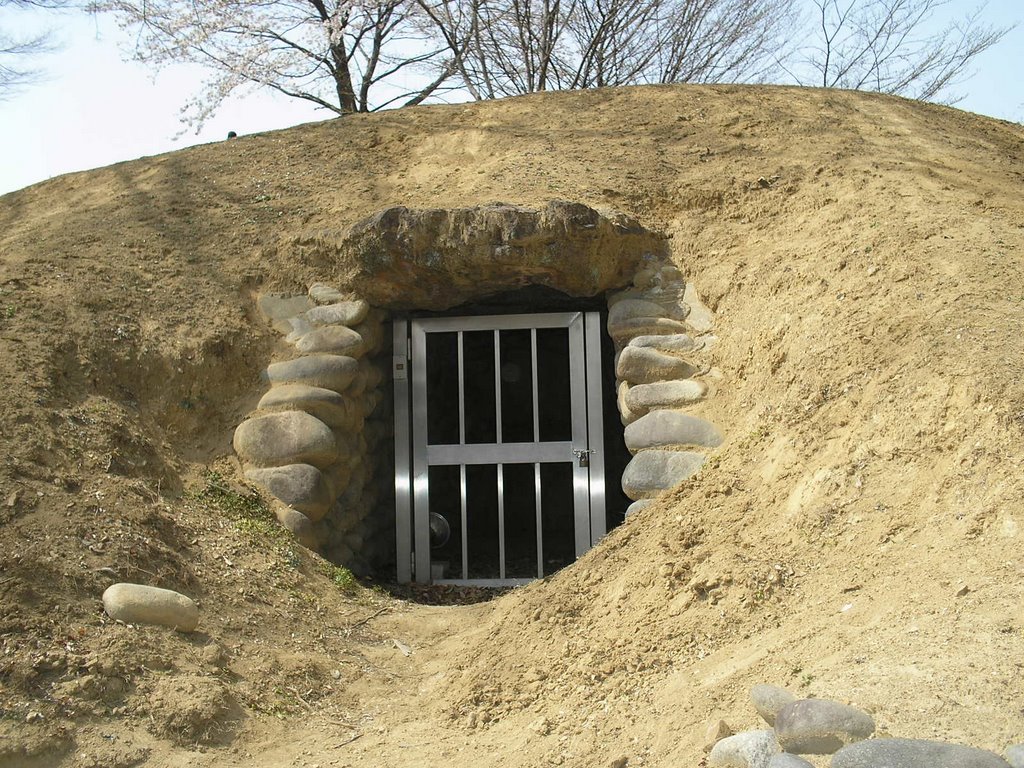
Before spending time in Ashikaga, I had not been aware how widespread in Japan were the mound tombs known as 古墳 kofun lit. ‘ancient grave’. When we walked over to Ashikaga Park to see the cherry blossoms there two weeks ago, we found that the hillside park includes 12 kofun, two of which have small, blocked-off, stone passageways facing east. (You would enter facing west.) I had always associated kofun with western Japan, where the largest imperial tombs were built, but an article on the Kofun Period (A.D. 300–700) by Sophia University archaeology professor Charles T. Keally set me straight.

  • The first excavation of a mound tomb in Japan was conducted my Mito (Tokugawa) Mitsukuni in 1692, the 5th year of the Genroku era. Mitsukuni (1628-1701) was the grandson of Tokugawa Ieyasu, founder of the Tokugawa Shogunate. The tomb he excavated is called the Samuraizuka Kofun, located in Ohtawara City, Tochigi Prefecture, just north of Tokyo. This excavation is considered the first academic, or scientific, excavation conducted in Japan.

Origins:
The origins of the Kofun Period mound tombs is clearly in the Yayoi Period, although ultimately continental influence might well be a factor, too. The most common Yayoi burials were in the ground in a square area delimited by a ditch or moat. The burial in the middle had a low mound over it. Toward the end of Yayoi, some of these ditches or moats became round. With higher mounds, these were the most common kofun tomb in the Kofun Period, but the burial was on top of the mound instead of under it. The square mounds, too, continued from Yayoi into Kofun, but these later ones also had the burial in the top of the mound instead of under it.

Forms:
The most distinctive mounds of the Kofun Period are the keyhole-shaped mounds, thought to be associated with the Imperial Family. This shape is uniquely Japanese and its origins are unknown. But Korean archaeologists recently have identified a few contemporary mound tombs in southeastern Korea that they say are also keyhole-shaped. Some people try to use these recent Korean finds to argue for a Korean origin of the keyhole-shaped mound tombs. But this fails to explain why this shape is rare in Korea and only recently recognized there through excavation, whereas this shape is common in Japan, obvious without excavation, and has been known for centuries….

Regions:
Mound tombs, especially the larger ones, tend to be located in clearly defined regions. Mound tombs are common in Kyushu only in the northwest, especially in the Chikugo River plain in Saga and southern Fukuoka prefectures. There is another such concentration of tombs in the eastern part of the Inland Sea in Okayama Prefecture on Honshu island and just across the water in Kagawa and Tokushima prefectures on Shikoku island. Similar concentrations are found in eastern Shimane Prefecture from Izumo to Matsue City on the Sea of Japan, in Nara and Kyoto prefectures, along the shores of Ise Bay from Nagoya to Ise, in Ishikawa Prefecture on the Sea of Japan, on the Kanto Plain in eastern Japan (especially in North Kanto), and on the Sendai Plain in northern Japan. There are smaller concentrations of tombs in Shizuoka Prefecture, and in the intermontane basins around Nagano, Yamagata and Kofu cities.

Archaeologists identify these concentrations with regional power centers, and they identify small clusters of tombs within these concentrations with the various clans known from later documents. In the north, keyhole-shaped mounds appeared in the Sendai Plain as early as the 5th century; the northern-most such tomb is in southern Iwate Prefecture. But most tombs in the northern regions are later. This northern region was the frontier with the Emishi barbarians who lived in northern Tohoku. Keyhole-shaped mound tombs are extremely rare in southern Kyushu, the home of the Hayato barbarians.

Ashikaga has always struck me as a city of Old Money, but I never thought it went back quite that far.

Leave a comment

Filed under Japan, Korea

Wordcatcher Tales: Udo no Taiboku

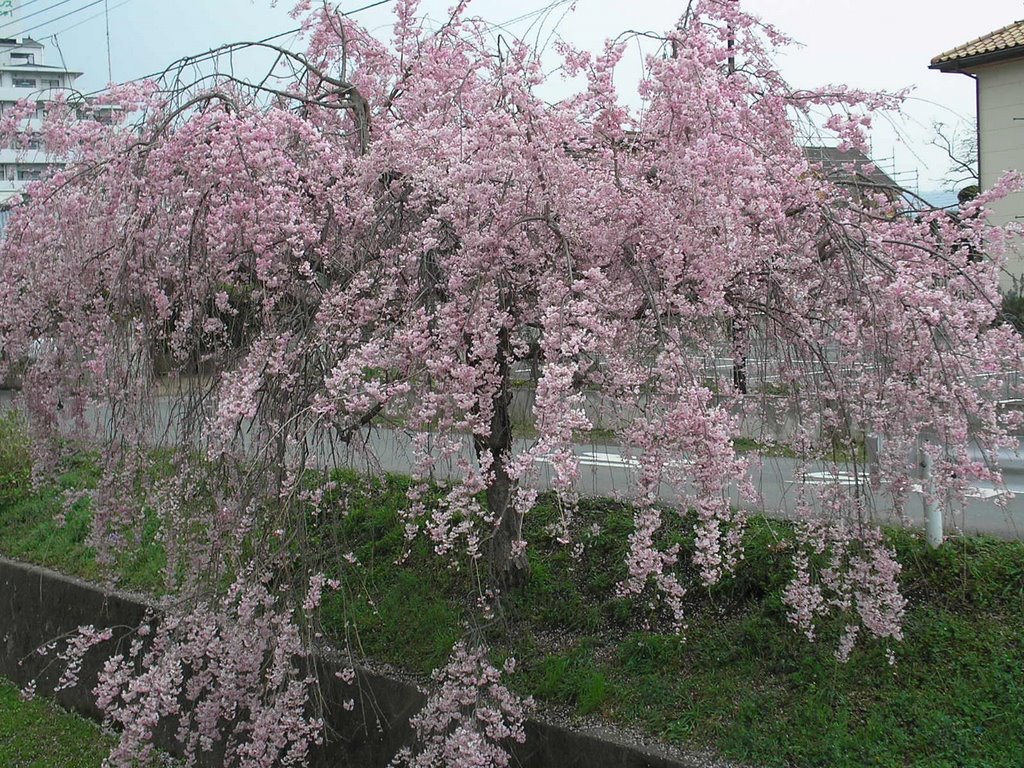
うどの大木 udo no taiboku ‘all hat, no cattle’ – We tried out a new restaurant in Ashikaga the other night, after a long circuit to view the many lovely shidare-zakura ‘weeping cherry trees’ that line a long, curving, landscaped ditch that borders the city’s huge civic center athletic complex.

The seafood restaurant Yanagi-ya [柳屋 ‘willow shop’] turned out to be a haven for Hanshin Tiger and sumo fans in the area. It caught my eye last month when it advertised the sumo wrestler’s special chanko nabe on the first day of the Osaka Grand Sumo Tournament. Unfortunately, the chanko nabe season is over now that the weather has started to get warmer, but the various dishes we ordered were all nicely presented, and tasty to boot. Each glass of sake had the name of a sumo wrestler on it.

At one point, the waitress brought over a complimentary dish of tempura vegetables that looked like celery tops, but tasted less bitter than celery, more like asparagus. She identified it as うど, which my electronic dictionary identified only as ‘an udo (a plant of the ginseng family cultivated for its edible shoots)’. The University of Virginia Library’s Japanese Haiku Topical Dictionary page for spring plants is more helpful.

独活 【うど】 udo, udo [a wild asparagus-like plant, Aralia cordata, sometimes cultivated and noted for its edible young shoots] (late spring).
山独活 【やまうど】 yamaudo, mountain udo [a wild variety, noted for its pungency]
深山独活 【みやまうど】 miyama-udo, high-mountain udo [Aralia glabra, rare]
芽独活 【めうど】 meudo, sprouting udo / udo shoots

The Anime Companion Supplement U offers a different context.

udo うど or 独活 Aralia cordata. The leaves and stalks of this plant are eaten either raw or cooked. The flavor is similar to asparagus. The cultivated type is grown in the dark to blanch it. Wild udo is used in sansai ryôri (mountain vegetable cooking), as the flavor is stronger it must be blanched before it is used in dishes.
Anime:
Udo salad is one of the foods cherry mentions in the Urusei Yatsura TV series (Episode 36 story 59)
Maho buys udo from Tachikawa in MahoRomatic (ep.3) and pickles it.

Wikipedia includes udo in its surprisingly long list of English words of Japanese origin, defining it as ‘an edible plant found on the slopes of wooded embankments, also known as the Japanese Spikenard’.

Well, “Japanese spikenard” is not likely to be any more intelligible to most English speakers than the term “udo” itself, but here’s a derivative expression that has more familiar English parallels: うどの大木 udo no taiboku lit. ‘huge tree of udo’. (I had expected the pronunciation for 大木 to be daimoku but it seems to be taiboku in all contexts.) The Hoita Kokoro Center in Canada explains its meaning:

Just big man with nothing (lit. A huge udo tree) All bark and no bite or All hat and no cattle in English

Wikipedia explains further.

Despite its size, it is not a woody plant, as demonstrated in the popular saying Udo no taiboku (独活の大木), literally “great wood of udo”, meaning roughly useless as udo has a very soft stem.

1 Comment

Filed under Japan, language, sumo

Japanese Zen’s Return to Shinto Aesthetics

Many commentators associate the Japanese emphasis on naturalness and simplicity with Zen Buddhism rather than Shinto. In such books as Zen and Japanese Culture, D. T. Suzuki popularized this view in Japan as well as in the West. Suzuki was correct to point out that many arts associated with Japan have a close association with Zen Buddhism, especially through the tea ceremony and all its accoutrements including ikebana, calligraphy, poetry, gardens, and pottery. Suzuki accurately portrayed Zen’s historical significance in the development and institutionalization of these arts. At times, though, he seemed to imply more—namely, that Zen Buddhism introduced the aesthetic of simplicity and naturalness to Japan. This claim, if he indeed meant to make it, is wrong.

Simplicity and naturalness were part of Japanese culture and represented in Shinto practices centuries before Zen’s emergence in the thirteenth century. The kind of grand simplicity found in many Shinto shrines such as that of the sun kami at Ise is an obvious example. Zen prospered through its connection with the Japanese arts, not so much because it was introducing something totally new to the culture, but because it resonated with something old. The so-called Zen simplicity in many drinking bowls used in the tea ceremony, for example, can also be seen as far back as some of the unglazed pottery of the Yayoi period, a millennium before Japanese Zen developed and tea plants were cultivated in Japan.

One can argue, therefore, that the Zen aesthetic was similarly a return to a simplicity predating the Heian court’s aesthetic of elegance. This aesthetic of courtly elegance predominated among the aristocrats of the Heian period (794–1185) and reflected the high arts from China, including those from esoteric Buddhism, rather than Shinto. The power of the nobles had waned, however, by the time Zen blossomed in Japan. Zen melded the Kamakura period‘s (1185–1333) tendency to go back to the ideals of a simpler, less refined, sometimes even rustic, lifestyle. This aesthetic fit the military mentality of the new political leaders, many of whom had come from the outlands distant from the cultural capital of Kyoto [like Ashikaga]. By this process, Zen values and practices became the center of aesthetic development in the thirteenth through sixteenth centuries [during the Ashikaga shogunate].

SOURCE: Shinto: The Way Home, by Thomas P. Kasulis (U. Hawai‘i Press, 2004), pp. 45-46

Leave a comment

Filed under China, Japan

Shinto: Practices vs. Doctrines

From ancient times, the Japanese (indeed East Asians generally) had not missed the point that many of what we call “religious traditions” of East Asia were alike in some fundamental way. In general, the Japanese grouped together the Asian spiritual traditions by giving them names (usually borrowed from Chinese) sharing one of two suffixes: kyō ([教] broadly meaning “teachings”) or ([道] broadly meaning “path,” “way,” or “course”). The convention was to precede this suffix with the name of the spiritual inspiration behind the tradition. Thus jukyō indicated Confucianism ([儒教] “Confucian scholar” plus kyō), butsudō or (later) bukkyō indicated Buddhism ([仏道/仏教] Buddha” plus or kyō), and dōkyō indicated Daoism ([道教] “dao” plus kyō). The name “Shinto” itself consists of the character for kami ([神] in such compounds pronounced shin) and dō ([道] in this case mutated into ). In referring to Christianity today in Japan, the common term is kirisutokyō ([キリスト教] “Christ” plus kyō).

As we see in the two terms for Buddhism (butsudō and bukkyō), the suffixes and kyō may be interchangeable. There is, however, a difference in their etymologies: has the nuance of praxis and kyō of doctrines. Hence the Japanese arts as well as religions may have the suffix dō: budō ([武道] “way of the warrior” or martial arts), chadō ([茶道] “way of tea” or tea ceremony), shodō ([書道] “way of writing” or calligraphy). In self-consciously creating a word to translate the Western term “religion,” this difference in nuance between kyō and is relevant. The use kyō in shukyō suggests a Japanese impression that the concept of “religion” is more about doctrine or creed than practice.

What about the first part of the word, the shū of shūkyō [宗教]? The term shū suggests a discrete religious community with common practices and teachings. In fact, the term shūkyō was not truly a neologism. There was a rather arcane Buddhist use of the term to mean specifically the doctrines of any particular Buddhist sect or school. Given this etymological context, to inquire in Japanese whether someone is “religious” (shūkyōteki) may seem a little like asking them if they are “sectarian” or “dogmatic.” In choosing such a word to designate “religion,” the scholars who created the neologism might have been thinking of the evangelical and exclusivist aspects of the Western religions they had encountered (especially through Christian missionaries). This exclusivity in Japanese Christianity continues today, incidentally: the large majority of the 1 percent of Japanese who designate “Christian” as their religious affiliation do not, unlike many of their Buddhist or Shinto compatriots, also select another tradition.

SOURCE: Shinto: The Way Home, by Thomas P. Kasulis (U. Hawai‘i Press, 2004), pp. 30-31

NOTE: Some quotes around italics eliminated. Kanji characters added.

Leave a comment

Filed under Japan, religion

The Shinto Torii: A Reminder to Purify the Heart

[The torii (鳥居)] does not demarcate something external into which I can simply tap. To function properly, the mysterious power beyond the torii must be in an internal relation with the person passing through it. If your mind is befuddled and clouded, if your heart is defiled and disingenuous, passage through the gateway will only return you to that. A symbol sacred to Shinto is the mirror. In fact, in many shrines, large and small, major and minor, the altar contains nothing other than a mirror. Along with the sword and comma-shaped jewel [magatama], the mirror is part of the official regalia of the emperor as chief priest of the tradition. A mirror’s capacity to reflect depends on its cleanliness. Hence Shinto sites usually have a water trough for purification near the entrance. As people enter the heart of the shrine, they are expected to wash their hands and mouth, cleansing themselves of any pollution from physical or verbal misdeeds. Washing away dirt from the journey, they are ready to be a home in the kami-filled, tama-empowered shrine. Their hearts and minds are pure. Even the torii along the path on Mount Fuji serves a similar function. The torii reminds pilgrims to cleanse their inner self in preparation for approaching the peak.

SOURCE: Shinto: The Way Home, by Thomas P. Kasulis (U. Hawai‘i Press, 2004), p. 23

I’ve never climbed Mt. Fuji, but I can well imagine the female voice recording familiar to every train passenger in Japan telling the pilgrims as they approach the torii of their impending arrival at the summit, thanking them for having climbed up, and asking them to mind their magokoro ‘truehearts’ instead of their ashimoto ‘footsteps’ as they pass through the torii: 間もなく山頂に到着いたします。ご乗山真にありがとうございました。鳥居を通るとき真心にご注意願います。(Mamonaku sanchou ni touchaku itashimasu. Gojousan makoto ni arigatou gozaimashita. Torii o tooru toki, magokoro ni gochuui negaimasu.)

And then telling them where to find the toilets and vending machines.

Leave a comment

Filed under Japan

Shinto’s Material Spirituality

One of the books I brought along to read while in Japan is Shinto: The Way Home, by Thomas P. Kasulis (U. Hawai‘i Press, 2004). The introduction is available online in PDF form. Here’s how it begins.

Westerners with some exposure to Shinto know it also as a religious tradition stressing sensitivity to nature, purification, and simplicity. Most foreign tourists to Japan have been impressed with the extraordinary serenity, restrained design, and natural beauty of many Shinto sites. Towering trees, white gravel grounds, carefully pruned shrubs, and beautiful flowers instill peace in many visitors, a peace arising not from an aesthetic flight from the world but from a heightened appreciation and outright enjoyment of it. Boisterous Japanese families with young children and old folks on pilgrimages suggest Shinto not only celebrates life but also brings celebration to life. I have heard many foreigners say they felt oddly at home in such environs. Some who have lived in Japan for some time have gone so far as to say that on many occasions they have “felt Shinto” themselves.

Most people are aware of another dimension of Shinto as well: the Shinto of nationalism, imperial reverence, and ethnocentricity. It is the Shinto of kamikaze pilots and militarist fervor, the Shinto of a divine emperor leading a unique global mission for the Japanese nation and its people. It is the Shinto that dominated the international politics of the first half of the twentieth century.

This book investigates how these aspects—the traditional festivals and rites, the celebration of nature and life, the nationalism and militarism—can coexist in the same religion. Is there perhaps something about the paradox in Shinto that can shed light on other religious traditions as well? Or, on the contrary, is the case of Japanese Shinto unique? In exploring such questions we will examine Shinto spirituality as both point of departure and ultimate destination. By framing the discussion in this way, we will find subtle links within the development of Shinto that we might otherwise overlook. There are two warnings, however, about the term “spirituality” as employed in this book. First, the term is not being used to emphasize personal over social or institutional religiosity. Second, the term does not necessarily imply something mystical or transcendent. Let us consider each point briefly.

With respect to the first admonition, when some people hear the word “spirituality” rather than “religion” they think of a religious experience that is especially personal, individual, and outside “organized” religious institutions. Yet reflection shows that spirituality is seldom a strictly private affair. Felt as an inner resonance, spirituality is not an external phenomenon we can study simply by looking at it. Its character emerges only through the intimation of those who share their intimate experiences with us. The neophyte internalizes spirituality by doing what others do and talking how they talk. To express one’s own spirituality, one must first be impressed by the spirituality of others. Even the Buddhist or Christian hermit, alone in an isolated cave or cell, sits in the lotus position or kneels in prayer. The hermit did not invent these postures but learned them from someone else. Even in solitude, the hermit reflects a communal context. We must not overlook this vital communal dimension in even the most personal expressions of the spiritual.

The other admonition is not to assume that “spirituality” always implies a belief in something transcendent or supernatural. People sometimes think that spirituality is inherently mystical, a withdrawal from everyday affairs. It need not be so. Whereas any religious tradition may include ecstatic departures from the ordinary, religious people frequently find the spiritual in the most quotidian of human experiences. Spirituality can be like our awareness of light: we might experience it as a blinding, all-encompassing flash or as the medium through which we see the configuration and coloration of our ordinary world. It is the difference between a flashbulb going off near our faces in a darkened room and our being engrossed in the luminescent nuances of an Ansel Adams photograph. Both are experiences of light. Indeed the light of the flashbulb and the highlights on the misty peak of El Capitan are in some respects the same thing—light. Yet the different contexts make for a different kind of experience. So, too, for spirituality. It may appear so intensely and abruptly that it obliterates everything else, or it may be reflected off or refracted through the most mundane events. As we will see, Shinto spirituality most often takes the latter form. To limit our sense of spirituality to the mystical would be to miss a major part of what it means to be Shinto.

Long ago, when I was freelance proofreading to support myself in grad school, I had the chance to proofread Kasulis’s Zen Action/Zen Person, a book that very much impressed me with its creative thinking and clear writing. This one looks to be similar.

Leave a comment

Filed under Japan, religion

Wordcatcher Tales: Bokeh, Shidare-zakura

Yesterday the weather was clear and my wife was still on term break this week, so we took local trains through small towns and sometimes scenic countryside from Ashikaga to Oyama to Mito to visit the nationally famous Kairakuen (偕楽園 ‘shared pleasure park’), one of Japan’s three most beautiful landscape gardens. As the name implies, the park is open to the public; and the views are indeed spectacular. The blossoms on the 3,000 plum trees for which the park is most famous may have been a few weeks past their prime, but the cherry blossoms were in full bloom (満開, compare 満タン ‘full tank [of gas]) both in the park and across the broad expanse of Senba (千波 ‘thousand wave’) Lake and Park, which the Kairakuen hillside overlooks. Here are two verbal souvenirs from the trip.

Bokeh – This is an English technical term borrowed from Japanese, as I learned from Philbert Ono’s PhotoWords. The Photoxels Glossary of Digital Photography Terms defines it thus:

Boke (pronounced BOH-KEH), and increasingly referred to in print as “Bokeh” – Japanese word meaning “fuzzy” and referring to the out-of-focus (OOF) portions of a picture. A lens is said to have “good boke” if the OOF is pleasant and does not detract from the main subject. A lens with good boke produces out of focus smooth-edged highlights and reproduces an out of focus point of light as bright in the middle and progressively getting fainter with a fuzzy edge.

I’m not sure which Japanese boke this English borrowing comes from. Certainly not 木瓜 ‘Japanese quince, japonica’, which I was excited to find in full bloom, glistening like coral on the garden path down to Senba Lake. My best guess is 惚け/呆け, whose several meanings include ‘dull, dullheadedness’, as in 呆け色 boke iro ‘dull color’, from a verb 惚け/呆け meaning ‘grow senile; become mentally weak; fade, discolor’. The New Nelson kanji dictionary and Kenkyusha’s New Japanese–English Intermediate Dictionary, 5th ed. (in my Canon Wordtank), are not quite in synch on this, and neither of them mentions usage in photography. In any case, both my digital photographs and my digital words here are sure to provide plenty of evidence of boke.

Oddly enough, while English has borrowed a Japanese word for the out-of-focus part of a photo, Japanese appears to have borrowed a Dutch word for the in-focus spot: Japanese ピント pinto, from Dutch punt van focus or (focus)punt. (Dutch u is a front-rounded vowel—front like Italian i, round like Italian u—while Dutch oe renders the equivalent of English oo.)

枝垂れ桜 shidare-zakura ‘branch-drooping cherry tree’, Prunus pendula – Among the few types of cherry trees I can now reliably recognize are the branch-drooping ones. I’m also pretty good on 枝垂れ柳 shidare-yanagi ‘branch-drooping willow’. Yes, yes, I know that most people characterize both types as ‘weeping’, but that bit of poetic license completely bypasses the etymological briar patch that this prosaic pedant intends to poke his nose into.

Leaving out the tree itself, there are two pieces to the attribute 枝垂れ: 枝 shi ‘branch’, whose Japanese reading is eda, as in edamame ‘(soy)beans on the branch (or at least in their pods)’; and 垂れ tare ‘drippings, sauce, gravy, jus’. When it relates to apparel, 垂れ can also mean ‘hanging, curtain, lapel, flap, skirts of a coat’. So 垂れ tare covers the range of ‘drip, drop, droop, drape’ (which helped inspire one English linguist to coin the term phonaesthesia).

The Sino-Japanese phonetic element 支 shi of the two-part kanji 枝 itself means ‘branch’ in a lot of compounds, such as 支社 shisha ‘branch (company) office’; 支流 shiryuu ‘branch (flow), tributary’; 支族 shizoku ‘branch family, tribe’. To be more specific, one can rely on the semantic element 木 ki ‘tree’, which often relates to wood (either woody plants or items once made of wood), to disambiguate the 枝 shi that specifically means ‘tree branch’. Another contrast relies on the semantic element 肉 ‘meat’ (= 月 in combination), which usually relates to the body, so 肢 shi indicates ‘limbs of the body, arms and legs’.

Finally, 支 (in the shape of 枝) shi can be completely redundant. The New Nelson gives shidareru as an alternate reading for simple 垂れる tareru (vi and vt) ‘hang, droop, drop, lower, pull down; dangle; sag; drip, ooze, trickle’, so it’s perfectly okay to say 柳の枝が枝垂れている yanagi no eda ga shidareteiru ‘the branches of the willow are (branch-)drooping’. Webster’s Online Dictionary offers more—much more—on the semantics of droop in a wide range of languages. Turkish and Romanian are particularly rich.

Leave a comment

Filed under Japan, language

Wordcatcher Tales: Denchi

How many tales can be spun out of something as small and insignificant as a portable battery? Let’s see.

First, the word itself. In Japanese, ‘battery’ is rendered as 電池 denchi, lit. ‘electricity reservoir’. The second kanji also translates ‘pond’ and (small) ‘lake’, Japanese ike.

Second, where the word turns up. Denchi first lodged permanently in my mind while I was doing fieldwork in Yap, Micronesia, where (1) I was dependent on batteries for my flashlight and portable cassette-radio while living out in a village without electricity (at that time, anyway); and (2) people had managed to borrow a lot of Japanese vocabulary during three decades of Japanese rule (1914–1945), like sikoki ‘airplane’, and sikojo ‘airport’. Some of the more amusing borrowings are now archaic, if not obsolete, in Japanese, like sarumata ‘traditional Japanese men’s underwear’ (now used with reference to adult diapers) (Yapese didn’t need to borrow a word like fundoshi ‘loincloth’), chichibando ‘breast band’ (definitely a foreign concept in traditional Yap), and kachido ‘movie’ (< Japanese 活動大写真 katsudou daishashin ‘moving big picture’).

Third, how the items so labelled are subclassified. The relative sizes of the old familiar cylindrical dry-cell batteries are indicated numerically in Japanese, ranging from largest to smallest: 単1形 tan-ichi-gata (D cell), 単2形 tan-ni-gata (C cell), 単3形 tan-san-gata (AA cell), 単4形 tan-yon-gata (AAA cell). My electronic dictionary requires two 単4形, my digital camera requires two 単3形 (I forgot to bring my recharger), and our gas stove requires two 単1形. I’ve recently had to replace all three sets. At least I don’t have to carry two spares of the largest size around with me. (BTW, Philbert Ono’s Photowords is a great resource for translating photography-related vocabulary, including battery types, between English and Japanese.)

Finally, when I removed the Fujitsu 単1形 batteries from the stove and looked for the size designation, I first thought they were 単0形. After all, the midnight hour in Japanese is 0:00 reiji ‘zero o’clock’. But the characters surrounding the 0 were making a different claim: 水銀0使用 suigin zero shiyou ‘mercury zero use’. When I examined the other replacement batteries I had bought, they all made the same claim, no matter whether the brand was Maxell or Fujitsu (both made in Japan), or Konnoc (made in China). I hadn’t kept up on dry-cell battery technology. Fujitsu Magazine (July 1997) explains.

By using purified materials,a special zinc alloy powder,and a zinc-indium-bismuth-aluminum anode,and by establishing clean production lines,we have been able to develop an alkaline-manganese dry battery that has no mercury.The discharge rate of the battery was improved by remodeling the structure of the cathode.Moreover,by remodeling the anode disc,the battery has been made much safer.

Also,since 1996 we have been producing ferrite cores for the deflection yokes of cathode ray tubes using raw material recovered from spent dry batteries.

There are still a few other products from which mercury needs to be eliminated.

POSTSCRIPT: It’s good that Japan is trying to restrict mercury pollution, which caused Minamata disease. BTW, the Japanese (and general Sinitic) compound for the element mercury 水銀 suigin translates literally as ‘water silver’ rather than ‘quick (i.e., living) silver’. The planet Mercury is 水星 suisei ‘water-star’, and Wednesday is 水曜日 suiyoubi ‘water weekday’, which matches pretty well the Romance-language names for the same day of the week: Romanian miercuri, Spanish miércoles, Portuguese mercoles, French mercredi.

UPDATE: Reader Peter North adds a comment and query:

Sorry, I can’t resist reporting a new usage in Philippine English, not “Taglish” (since 2003). “Low Bat” describing a child lacking energy – needing food or sleep. Presumably derived from abbreviations on cell phone displays – you appreciate how widespread and central to life cell phones have become. Anyone seen this elsewhere?

Leave a comment

Filed under Japan, language