Category Archives: Japan

Wordcatcher Tales: Kami-, Shimo-, -zen, -chu, -go

If you found yourself in Lower Slobovia and wanted to head for Upper Slobovia, in which direction would you head?

  1. upcountry
  2. upriver
  3. upstate
  4. upmarket
  5. up north (or up south down under?)
  6. to the capital city

In how many places outside Japan would the last answer be most likely? Anyone who regularly rides the long-distance trains in Japan knows that all trains bound for Tokyo are ascending trains (上り列車, noboriressha), while all trains heading away from Tokyo are descending trains (下り列車, kudariressha). That’s not too surprising for train systems in centralized states. Of greater interest is the fact that old placenames in Japan show the same alignment, as I discovered while deciphering a Japanese map from a few hundred years ago.

The names that most puzzled me were 上総 Kazusa ‘Upper Fusa’ in lower Chiba and 下総 Shimousa ‘Lower Fusa’ in upper Chiba (where my use of ‘lower’ means southern and ‘upper’ means northern), along with 上野 Kōzuke ‘Upper Keno’ for what is now Gunma and 下野 Shimotsuke ‘Lower Keno’ in what is now Tochigi. ‘Upper’ Gunma lies to the southwest of ‘Lower’ Tochigi. Neither riverflow nor terrain height will explain why one member of each of these pairs is ‘upper’ and the other is ‘lower’. Nor will orientation to Japan’s current capital, Tokyo (lit. ‘East Capital’).

The key to the answer fairly leapt out at me when I factored two more sets of old provinces into the equation.

  • The old provinces of 越前 Echizen ‘Near Echi’, 越中 Etchu ‘Middle Echi’, and 越後 Echigo ‘Far Echi’ run up the Japan Sea coast from southwest to northeast, corresponding to the current prefectures of Fukui, Toyama, and Niigata.
  • The old provinces of 備前 Bizen ‘Near Bi’, 備中 Bitchu ‘Middle Bi’, and 備後 Bingo ‘Far Bi’ run along the Inland Sea from east to west, corresponding to parts of the current prefectures of Okayama and Hiroshima.

In both cases, the provinces whose names end in -zen ‘before, in front, pre-‘ are closer to the old capital of Kyoto, while those whose names end in -go ‘behind, in back, post-‘ are farther from Kyoto. Kyushu also had three pairs of former provinces, where the half of each pair ending in -zen (Buzen, Chikuzen, Hizen) lay to the north (and thus nearer Honshu) of its counterpart ending in -go (Bungo, Chikugo, Higo).

LATER INSERT: These old placenames still turn up in modern contexts. The 上越新幹線 Jōetsu Shinkansen, the bullet train line that runs from Tokyo through Gunma to Niigata gets its name from the Sino-Japanese reading (jō) of the first character of 上野 Kōzuke ‘Upper Keno’ (now Gunma) and an alternate Sino-Japanese reading (etsu) of the first character of 越後 Echigo ‘Far Echi’ (now Niigata). Furthermore, a native Japanese reading of the latter character, 越 koshi, shows up in the name of perhaps the most famous cultivar of Japanese rice, Koshihikari (越光), which originated in Niigata (although Koshihikari is rarely written in kanji these days). Koshi was the older (7th century!) name for the province that was later divided into Near, Middle, and Far Echi, which were in turn eventually renamed as prefectures of Fukui, Toyama, and Niigata on Japan’s Hokuriku coast.

How many other placenames that can be rendered as Upper X and Lower X, or Near X and Far X, describe relative distance from capital cities? (Far Rockaway in Queens, NYC, was apparently named for its relation to what used to be East Rockaway, now part of Nassau County, NY, and not for its relation to NYC.)

UPDATE: The title of this post does not include the usage of nobori ‘ascending’ and kudari ‘descending’ for travel toward and away from the capital city, respectively. That usage I suspect is very, very common, as two commenters have pointed out. I’m interested in placenames, where Japanese usage is unique, at least in my experience. Lower Saxony is on the coast and lower in elevation than landlocked Saxony farther inland. Orientation to Berlin, or Vienna, or Rome is irrelevant. The Prussian province of Lower Silesia was actually closer to the Prussian capital, Berlin, than Upper Silesia. There are many towns on the slopes of the Carpathians in Romania named along the lines of Făgăraş de Sus and Făgăraş de Jos, but Sus means upslope and Jos means downslope, not closer or farther from Bucharest or Vienna or wherever the capital may have been at one time. In East Asia, Korea has many provinces split into North (-bukdo) and South (-namdo) parts—Hamgyong, Hwanghae, Pyongan, Chungcheong, Gyeongsang, Jeolla—none of which are distinguished relative to the position of the capital city. China, similarly, has several sets of matching province names—Guangxi, Guangdong; Hunan, Hubei; Henan, Hebei—but all of them are distinguished by cardinal positions relative to the globe, not relative to the capital city. So the question remains: In what other country or language would the equivalent of Upper Slobovia be closer to the capital than Lower Slobovia?

UPDATE 2: In the comments, Nathanael of Rhine River notes the conflict between the German usage of upper and lower to signal the highlands and lowlands of German-speaking lands and the (North) American tourist usage of upper and lower to distinguish northern and southern Germany, plus similar conflicts in usage that afflict those who equate ‘upper’ with ‘north’ and ‘lower’ with ‘south’ in reference to both the Nile and the Mississipi, which flow in opposite directions.

UPDATE 3: Well, this post prompted me to consult my hitherto underutilized electronic Super Daijirin and solve a few onomastic problems that have nagged at me for a long time. (And just in time, too, since I leave Japan tomorrow.) As noted above, Tochigi Prefecture used to be called 下野 Shimotsuke ‘Lower Keno’ while Gunma used to be called 上野 Kōzuke ‘Upper Keno’. It turns out there are several ways to write both province names. In fact, the Keno portion is rendered more accurately by adding the syllable for ke ‘hair’, as in 下毛野 ‘Lower Hair Field’ and 上毛野 ‘Upper Hair Field’. (I wonder if those names refer to the bearded wheat and barley that still dominate the agriculture of the region.)

Not only are there multiple ways to write each placename, there are also multiple ways to pronounce each kanji in the placename. Older placenames seem to have been pronounced in native Japanese form (like Koshi instead of Echi/Etsu for 越), but the kanji originally used to write them have contributed Sino-Japanese pronunciations to the same placenames, and the latter readings usually show up in abbreviations. So the old name of Gunma is alluded to in the 上 Jō- of 上越新幹線 Jōetsu Shinkansen, and a slightly longer version appears in the name of 上毛電鉄, Jōmō Electric Railway, which runs from the Gunma border city of Kiryū, which abuts Ashikaga City in Tochigi Prefecture, to Maebashi, the capital of Gunma Prefecture. Two local newspapers also conjure up the old placenames: Jōmō Shimbun (“Upper Hair News”?) in Gunma and Shimotsuke Shimbun (“Lower Field News”) in Tochigi.

Now, finally, the pièce de résistance: The JR line that runs through Ashikaga is known as the Ryōmō line. It runs between Oyama City in southeastern Tochigi, and Takasaki City in central Gunma. The Tōbu railway express train that runs through Ashikaga and terminates at Akagi in central Gunma is also called the Ryōmō. Ryōmō is written 両毛 ‘Both Hairs’, a strange name that doesn’t make much sense unless you know that it refers to the combination of regions formerly known as ‘Upper Hair’ (上毛, now Gunma) and ‘Lower Hair’ (下毛, now Tochigi). Weird, huh?
Leave a comment

Filed under Japan, language

Chijimi vs. Pajon: Korean Okonomiyaki in Japan

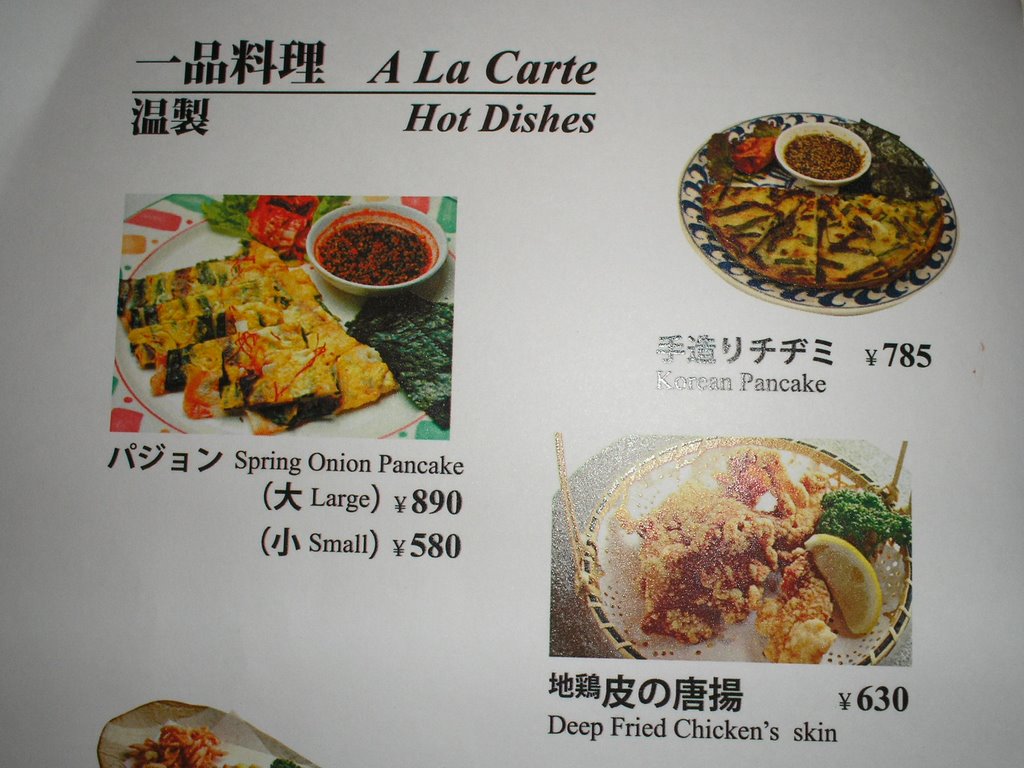
Korean okonomiyaki in JapanAmong my favorite Korean dishes is 파전 (p’ajŏn, pajeon), which usually shows up on North American menus as Pa Jun. In North America, it’s often compared to pizza, and in Japan to okonomiyaki. But Jun refers to a much thinner egg batter for quick pan-frying than the batter used in either pizza or okonomiyaki. (In Hawai‘i and parts of the West Coast, you can also find meat jun.)

Japanese Wikipedia tries to clarify the difference.

日本ではよく、チヂミと「パジョン」(파전)が混同されることがあるが、パジョンとはプチムゲ(慶尚道ではチヂミ)の一種である「ジョン」(전)のうち、ネギ(パ、파)を使用したものである。「ジョン」にはこのほか、キムチを使用した「キムチジョン」(김치전)、ジャガイモを使用した「カムジャジョン」(감자전)、海産物を使用した「ヘムルジョン」(해물전)などがある。

My rough translation follows (as amended by Matt of No-Sword), using Japanese roumaji (‘roman letters’) for the katakana.

In Japan, chijimi and pajon (파전) are often confused, but pajon is actually jon (전) that uses green onions (pa, 파). Jon, in turn, is a type of puchimuge (called chijimi in Kyongsang Province). There are other types of jon that use kimchee (kimuchijon, 김치전), potato (kamujajon, 감자전), or seafood (hemurujon, 해물전).

While doing a bit of nostalgia-driven culinary fieldwork near the Sannomiya area of Kobe (where I went to high school), I chanced upon a menu that listed both pajon and chijimi side by side (pictured above). So I sampled a small order of pajon to go with a glass of Taishikan Weizen at the Tor Road branch of the New Muenchen Kobe Taishikan, a beer hall whose ambience I fondly remembered, but whose location had drifted away from me (unless it was rebuilt in a different location after the Great Hanshin Earthquake of 1995).

My research results seem to indicate that Kyongsang-style chijimi more closely resembles Osaka-style Japanese okonomiyaki than does pajon, because that style of chijimi has both a thicker batter and a milder dipping sauce. If chijimi is ever served with mayonnaise, well, that would add an even more decisive factor. The essential difference seems to lie in the batter. Jon uses a lighter egg batter for quick frying, while chijimi uses a heavier batter thickened with more flour. The チヂミ粉 ‘chijimi flour’ that you can buy in Japanese supermarkets apparently contains bean flour as a thickener.

PS: In my careful scrutiny of the New Muenchen Tor Road menu, I noticed a few odd transcriptions out of Japanese katakana into something other than German, Italian, or English: waizen beer, focatcha bread, and humberger sandwich. Being the roving editorial dogooder that I am, I wrote out a note for the management listing the oddities and suggesting corrections. The Japanese spellings in my note were no less idiosyncratic than the romanized spellings on the menu, but I hope the management at least will get a second opinion on the items I noted. (The menu at the main brewpub was much more accurate. It also featured beer-flavored ice cream, which was fortunately beyond the scope of my fieldwork agenda.)

eGullet Forum has a pertinent discussion thread on Korean food in Japan. Some commenters clearly regard Chijimi as just a dialectal synonym of Pa Jun.

UPDATE: I’ve made some revisions in response to corrections by Matt of No-Sword, who was kind enough to be my roving editorial dogooder.

Leave a comment

Filed under Japan

Wordcatcher Tales: Dekoboko, Kappou

凸凹 dekoboko ‘unevenness, roughness, bumpiness’ – Today I went to my neighborhood barbershop, not so much because my hair was getting too long for the increasingly muggy weather, but because my beard was getting too scraggly. Well, instead of looking up ‘scraggly’ in my electronic dictionary, which would have returned 不揃い fuzoroi ‘uneven, not uniform, irregular, mismatched’, I looked up ‘uneven’ and found the wonderfully graphic 凸凹 dekoboko ‘unevenness, roughness, bumpiness, inequality’.

The barber seemed to understand fine what I meant when I characterized my beard as dekoboko. He might have had more difficulty processing the Sino-Japanese pronunciation of the combination, tatsuou, but someone who works with lenses might have found it more familiar, as 凸 also translates ‘convex’ and 凹 translates ‘concave’.

割烹 kappou ‘fine cuisine’ – To celebrate their 25th wedding anniversary, the Far Outliers treated themselves to an elegant dinner at nearby 割烹 懐石 蝶や Kappou Kaiseki Chou-ya ‘fine-cuisine tasting-menu butterfly-shop’. Wikipedia’s “tasting menu” is a good characterization of kaiseki, which has an interesting etymology in its own right, but I want to examine 割烹 kappou, which was new to me. At one level, it’s just a synonym of 料理 ryouri, but the respective etymological ingredients of the two words bring out different flavors.

While 料理 describes cooking in the abstract, as Ingredients Management, 割烹 describes cooking as concrete actions, Slicing and Simmering. You can see the ‘sword’ (刀) radical (刂) down the right side of 割 waru ‘divide, cut, halve; separate; split, rip; break, crack, smash; dilute’ (Sino-Japanese katsu), and the ‘fire’ (火) radical (灬) flickering under 烹 niru ‘boil, cook’ (Sino-Japanese hou). (The usual way to write niru ‘boil, cook’ is with 煮, Sino-Japanese sha.)

Perhaps it’s not too misleading to propose a rough analogy along the lines of 割烹 : 料理 :: cuisine : cooking. At first I suspected kappou was only used for fine Japanese cuisine, but then I found 中華割烹 Chuuka kappou ‘Chinese fine-cuisine’, to label a Chinese-style “tasting menu” approach (to judge from the images).

So here’s how our kaiseki meal progressed. We sampled two local brands of sake as we ate, both served in a small teapot of clear glass with gold trim. Our sake cups were also of glass. Mine had gold flakes on the bottom, and with twelve delicate, alternating green and white vertical lines. My wife’s was slightly smaller, made of cut glass of a purplish hue.

  1. Starter: tiny scallop on half shell, fresh ginger shoot (myoga), and a slice of chicken on fishcake
  2. Hashiarai: clear soup with noodles made of fish cake (surimi) in lacquer bowl
  3. Sashimi: slices of snapper (tai), scallop (hotate), and yellowfin tuna (maguro)
  4. Mushimono: I can remember the dish, but not what was on it!
  5. Nimono: simmered pork kakuni hidden under a scoop of rice in covered lacquer bowl
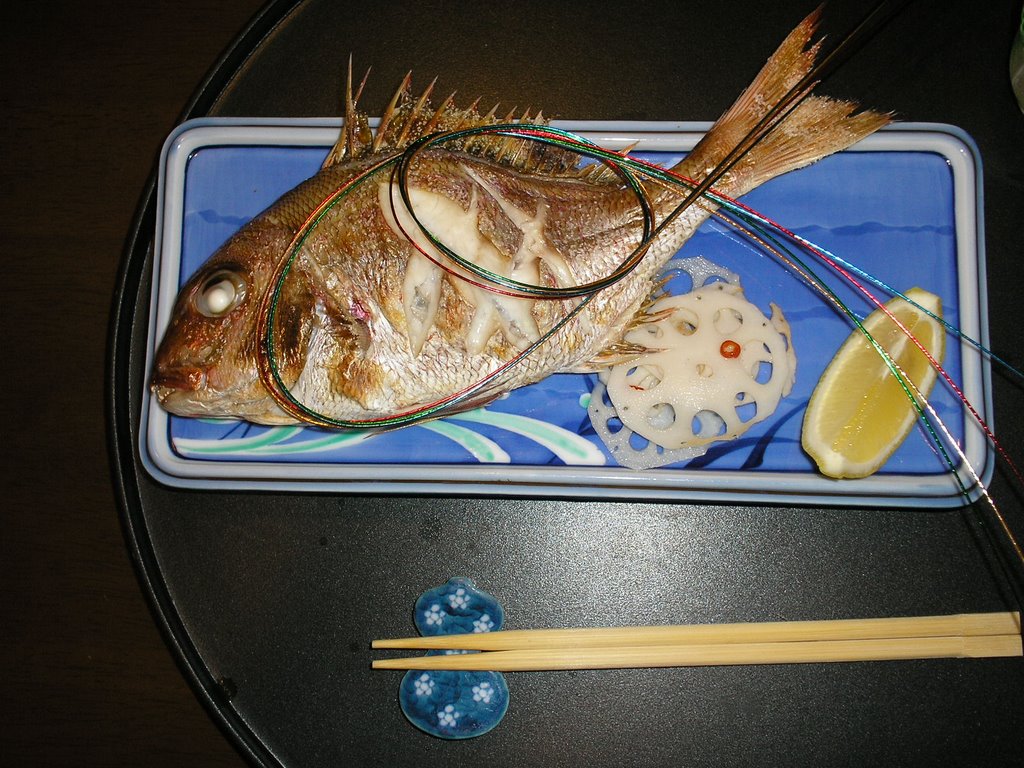
  6. Yakimono: whole celebratory red snapper (tai, implying mede-tai)
  7. Hassun: clear broth with daikon, shiitake, takenoko, broccoli, green fishcake, and shrimp
  8. Agemono: oily shrimpcake
  9. Sumono: vinegared tomato with sesame-flavored bean threads
  10. Udon: thin Akita noodles and thin chirashi nori
  11. Dessert: fresh local strawberry gelato bursting with flavor, paired with bitter green tea

Our rather unpretentious hostess didn’t describe each dish as she presented it, but was only too happy to answer my questions when I asked. Here‘s a photo gallery of a more elaborate kaiseki dinner.

Leave a comment

Filed under Japan, language

Wordcatcher Tales: Hanabishisou, Hotaru-Bukuro, Tade

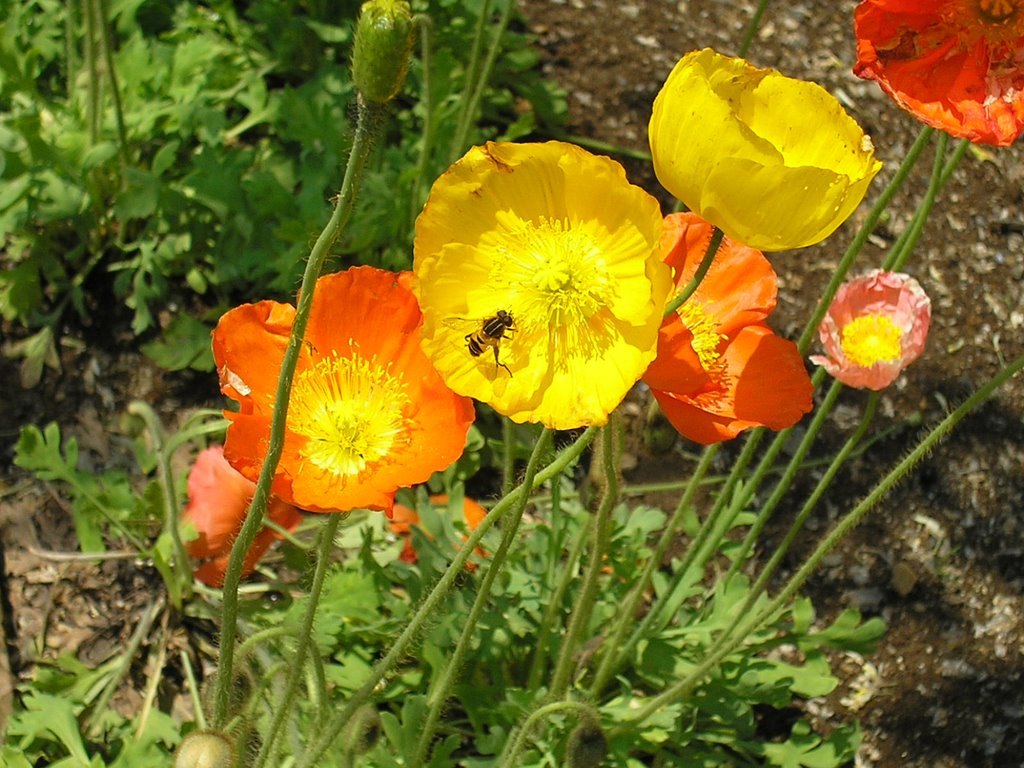
花菱草 hanabishisou ‘California poppy’ – The common, vulgar, lowly, ubiquitous (but not somniferous) California poppy has a most impressive moniker in Japanese: 花 hana ‘flower’ + 菱 hishi ‘water chestnut’ + 草 sou ‘grass’. Almost makes you want to ingest it.

蛍袋 hotaru-bukuro Campanula punctatacherry bells‘ – One flower that seems to bloom with the sprightly bluebells is what looks like its depressive cousin, the hotaru-bukuro ‘firefly sack’. One can win many points with dowager gardeners by learning this obscure plant name.

The specific cultivar ‘Cherry Bells’ was developed in Japan. It is really one of the most pleasing campanulas for tidiness of basal leaves & beauty & colorfulness of large longlasting pendulous flowers. The stems have an appealing flowing tilt which does not look floppy, but permits the “bells” to dangle naturally, so that staking is never required.

tade ‘smartweed, knotweed’ (Polygonum spp.) – At Uotami (‘Fish Nation’) izakaya in nearby Kiryu, Gunma Prefecture, over the weekend, the Far Outliers were served an unusual blue-hued dipping sauce for our tasty whole ayu (鮎) ‘sweetfish’ on a stick. The waitress said the sauce was made from tade, which The New Nelson defines oversimply as ‘smartweed’ (also known as ‘smartass’), a plant with a nasty reputation. But the blue hue turns out to offer a subtle hint. The Japanese variety, also known as dyer’s knotweed (Polygonum tinctorium), is one of several secondary herbal sources for indigo dye (Indigofera tinctoria), along with woad (Isatis tinctoria), a favorite of the Picts, who got their Latin name from their fondness for body-dye.

UPDATE: Matt of No-sword adds a tade-related proverb that I neglected to mention: 蓼喰う虫も好き好き Tade kuu mushi mo sukizuki ‘Even bugs who eat tade are quite fond of it’—corresponding to “There is no accounting for taste” or De gustibus non disputandem est. I wonder if the smell of tade, like other indigo dyes, is supposed to repel mosquitoes.

1 Comment

Filed under Japan, language

Wordcatcher Tales: Tanchou, Momonga, Kuroten

Among the things I’ll miss when I leave Japan at the end of this month are NHK nature shows. The photography is often spectacular, of course, but the spare and clear narrative style, with equally spare but clear captions on screen, are perfect for an obsessive language-learner who watches Japanese TV with denshi jisho in hand—and a mute button within easy reach if it’s a commercial channel. Here are three animal names I learned while watching a show about Hokkaido wildlife recently.

丹頂 tanchouJapanese crane, red-crested white crane’ – The 丹 is ‘red’ (as in cinnabar or vermilion), while the 頂 is ‘crest, peak, summit’, so the prosaic version of the name is ‘red crest’.

ももんが momonga ‘Eurasian flying squirrel’ – A rare, nocturnal creature of the far north whose image graces Estonian postage stamps. It’s possible to write the name much more obscurely in kanji, but I don’t see the point, and neither did NHK.

くろてん kuroten ‘sable’ – There are at least three kinds of てん (a native Japanese word that can also be written 貂): 黒てん kurotensable‘, 白てん shirotenermine‘, 松てん matsutenpine marten‘. (These flesh-and-blood creatures are not to be confused with the animé “Black AngelKuroten. Nor should ermines be confused with ferrets!)

1 Comment

Filed under Japan, language

Chindonya with Saxophone in Utsunomiya

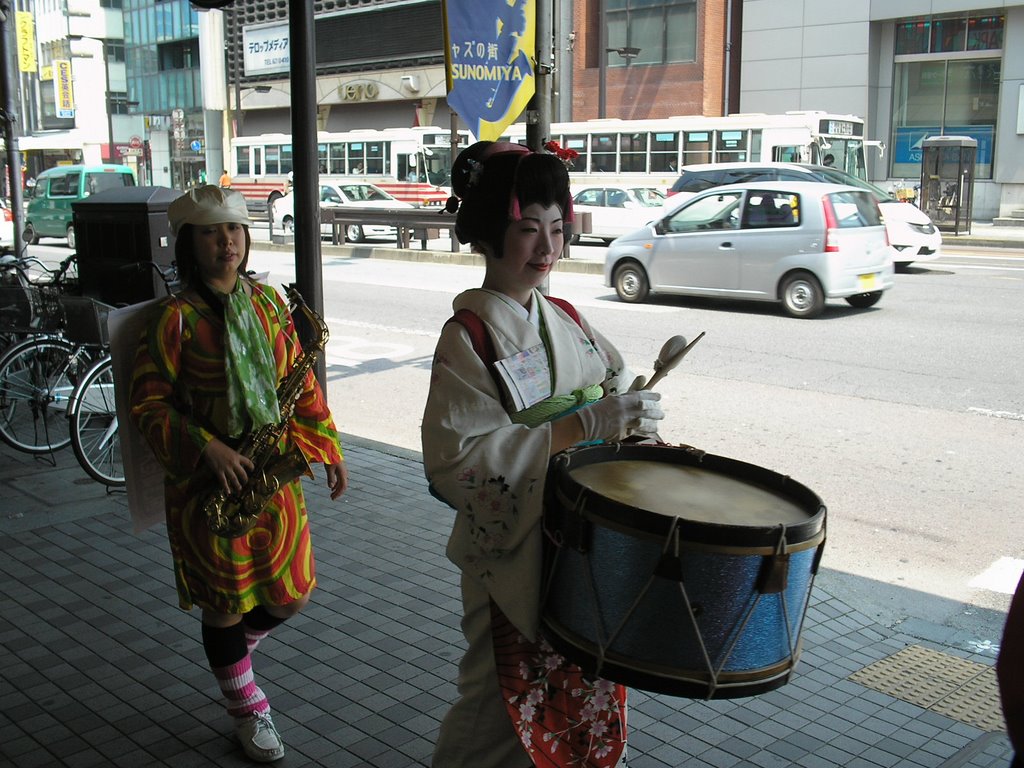
utsunomiya chindonyaYesterday I met a friend in Utsunomiya, a city regionally famous for its gyoza and its jazz. (It’s the hometown of Sadao Watanabe and it was the home base of a division deployed to China during Japan’s more warlike days.) It’s awfully hard to find much gyoza or jazz in Utsunomiya before the sun goes down, but we did come across a chindonya troupe that included a saxophonist who did a great job of imparting a Japanese feel to her playing.

Leave a comment

Filed under Japan

Wordcatcher Tales: Imari, Potters, and Abduction

Recently the Far Outliers finally got around to visiting one of Ashikaga City’s principal tourist attractions, the Kurita Museum near the Flower Park, both of which lie in the outlying town of Tomita, one JR train stop to the east.

The beautiful Kurita Museum grounds house not only one of the finest and largest collections of Imari and Nabeshima porcelain (磁器 jiki) in the world, they also include exhibits of international archaeological finds and pottery-making techniques, a climbing kiln (登り窯 noborigama, as opposed to the single-chamber 穴釜 anagama), gift and snack shops, and an off-limits working potters’ village. The Sushi and Maple Syrup blogger has posted a lot of photos from a weekend visit to the Museum (and Ashikaga Gakko) last year.

伊萬里 (or 伊万里) Imari – My sources seem to indicate that Imari is one subset of Arita ware and Nabeshima is another. They were all manufactured in Arita (有田), in Saga Prefecture in northwest Kyushu. Imari is the port (near Hirado in neighboring Nagasaki Prefecture) from which export varieties were shipped, and Nabeshima (鍋島 ‘Pot Island’) is the name of the Saga domain lords who controlled production, guarded secrets, and commissioned works of the highest quality for their peers in Japan.

As porcelain grew in popularity, the Nabeshima Clan took steps to keep their production and decorating techniques a closely guarded secret. They were aided in this effort by the Tokugawa Shogunate and other feudal lords, who commissioned the Nabeshima Clan to make porcelain for only the elite classes — the sale of Nabeshima ware to commoners was actually forbidden, and the number of kilns and wheels was strictily limited by law.

無名陶工 Mumei toukou ‘Unnamed potters’ – The highest point on the grounds of the Kurita Museum is a memorial hall dedicated to all the unknown potters whose work Mr. Kurita so obviously cherishes. Unfortunately, Mr. Kurita’s flowery words of appreciation fail to note that the first of these potters were Korean, and that at least one went by the name Ri Sampei in Japanese (李参平, 1579-1655).

In the early 1600s, Nabeshima Naoshige, the feudal lord of the Sage [sic] Clan, brought a group of Korean potters to Japan, including the potter Risampei, who in 1616 discovered a superior white-stoned clay at Izumiyama (Izumi Mountain, Arita). Wares fired with this earth are called “hakuji” (white porcelain …). Some say this was the beginning of Arita Ware.

拉致 ratchi or rachi ‘abduction’ – This word is much in the Japanese news these days as the government and individual citizens seek to determine the fate of various young people thought to have been abducted by North Korea in order to teach Japanese to North Korean spies. After failing to find the word (under either pronunciation variant) in my electronic dictionary, I had to resort to looking up the individual characters. The first kanji (拉, Sino-Japanese ratsu) is used to indicate the sound Ra as an abbreviation for Raten ‘Latin’ (which is usually written in katakana when spelled in full). But 拉 also appears in the native Japanese verb 拉ぐ hishigu ‘crush, smash, overpower’ and in the Sino-Japanese verb 拉っする rassuru ‘drag along; kidnap’. The second kanji, whose Sino-Japanese reading is chi, is used to write 致す itasu ‘do; send; cause; render (assistance); exert (oneself)’, as in どう致しまして dou itashimashite ‘what have I done (to deserve thanks)?’ (= ‘Not at all / Don’t mention it’).

The Japanese arts website bleu et blanc provides a succinct account of the role of international supply and demand in the early history of Imari ware. (“Blue-and-white” is the English epithet for 染付け sometsuke porcelain. Literally, it means ‘dye added’ but the default coloring agent for porcelain was cobalt, just as the default dye for textiles was indigo, which I recently heard is also effective as an insect repellent.)

Porcelain was first fired in Hizen province of Northern Kyushu in the early 17th century by Korean potters, and most likely by the potter named Ri Sanpei, who was brought to Japan by Toyotomi Hideyoshi in his second invasion of Korea in 1597.

Early examples were somewhat primitive (but now highly prized) white or celadon toned wares, decorated with underglaze cobalt blue, until the 1640s when the first enamels were fired in red, green, blue, yellow, purple, and eventually gold; associated with the first enamels is the famous Sakaida Kakiemon (1596-1666). Before long Dutch traders aggressively sought to obtain Japanese porcelains, whose sources in China had been disrupted due to political turmoil [the fall of the Ming and rise of the Qing dynasties]; they quickly turned to Arita to provide for European demands. The first large order at Arita was placed by the VOC in 1653, and in a short time the area enjoyed prosperity as providers for the European elite, with export production reaching a peak in the 1680s, the beginning of Arita’s “golden age.”

While market demand continued for some time into the 18th century, Arita could not compete with China, who from a near cessation of operations in the 17th century, rebounded in the 18th century. The last official order from the VOC in 1759 was for three hundred pieces, and the VOC itself was dissolved in 1799.

Simultaneously, and more substantially, Arita provided for its own domestic market throughout its long history. Both style and form evolved parallel with artistic and cultural trends, and show the strong influence at different times of Japanese tea ceremony (chanoyu), Chinese ceramics, painting trends, and Chinese style tea ceremony (Sencha). Some of these domestic pieces were exported privately and incidentally to the West, however much of upper tier pieces were reserved for use by feudal lords and like members of society. Arita porcelains are remarkable for their rich variations in form, style and subjects.

POSTSCRIPT: To those who think I am suggesting a moral equivalence between contemporary North Korea and contemporary Japan, let me suggest a much better match, one between Kim Il Sung, would-be unifier of a fractured Korea, and Toyotomi Hideyoshi, successful unifier of a fractured Japan. That should irritate both Korean and Japanese nationalists.

Leave a comment

Filed under Japan, Korea, language

Knowing How to Use vs. Knowing About Keigo

Information presented in the how-to industry confirms that the formal grammar of keigo [‘polite language’] itself is not the central issue for Japanese speakers. Of much greater interest are situations associated with keigo or that call for particular language. In the classes I took at the hanashikata-kyōshitsu [‘how-to-speak classroom’] formal instruction was kept to a minimum. Even when it was included, its function seemed to be as much to lend credibility to the enterprise as to teach. When our formal knowledge was tested in the hanashikata-kyōshitsu, the results frequently brought me up short. As we sat through numerous keigo quizzes, I noticed that a friend, a woman in her thirties, was consistently befuddled when asked to provide, for example, the honorific (sonkeigo) form of iu [‘say’] (ossharu); the humble kenjōgo form for iku ‘go’ (mairu); or the error in Okyaku-sama no onamae wa nan to mōsararemasu ka? ‘What do you say your name is?’ (Mōsararemasu is incorrect because it is an honorific inflection [-araremasu] attached to a humble verb [mōs-u].)

These were tasks that I, as a language student and a linguist, found eminently reasonable and even comforting. But for most of those around me, including my friend, appeared to find such tasks frustrating and artificial. They exhibited consternation at the analysis of language. But at the same time, I never heard my friend err in any of her conversations with our instructors. She may have lacked the confidence in or been suspicious of what educational psychologists term her “declarative” knowledge of Japanese, but she was far from inept in her “procedural” know-how. She just used common sense—and apparently took comfort in the instructor’s excursus on the importance of correct keigo. What she lacked, in my estimation, was confidence in her own ability to apply her common sense to heretofore unknown situations. So to the extent that the hanashikata-kyōshitsu class expanded its participants’ horizons, it served an educational purpose. But from the relational perspective, the proffered advice of how-to does not serve actually to instruct consumers in using language. Rather, it lays out familiar (to the insider) contexts that serve as frames for keigo usage that speakers may not have seen or heard before.

This is surely one way in which native speakers differ from non-natives, as I had demonstrated to me again and again. One aspect of the hanashikata-kyōshitsu that I found instructive was the constellation of contexts and other phenomena that came together in the course of a class—naturally for the Japanese participants, in edifying fashion for me. One example of this was the six-week class called shikaisha yōsei senka ‘training for emcees’. A shikaisha in Japan is the person who chairs the PTA meeting, operates as master of ceremonies at weddings, or in general runs the social event. We were given specific training for weddings and business meetings, but we also did a unit on running outings for work associates. In our case, because it was May, and spring was upon us, we elected to role-play a get-together at a park to engage in hanami (cherry-blossom viewing). I learned that for such get-togethers there are secondary roles that had to be filled, for which the shikaisha was ultimately responsible: the person who made the reservation, the “treasurer” who collected each participant’s contribution, the person who acted as uketsuke ‘receptionist’ for the event. There was also an agreed-upon progression for the event itself, where each person was given a chance to speak in front of the group. Each of us was expected to practice and gain control of the language forms associated with our role. My colleagues were already inculcated in the roles, as well as in the secondary basic communicative practices (who did what when). Keigo emerged as just one aspect of the whole package of what it meant to be a shikaisha.

Such conflation of language and the real world is not unique to Japan.

SOURCE: Keigo in Modern Japan: Polite Language from Meiji to the Present, by Patricia J. Wetzel (U. Hawai‘i Press, 2004), pp. 99-100

If only foreign languages were taught in Japan in the same way as keigo, that is, as an instrument of social interaction rather than as a body of facts to be memorized and tested on.

Leave a comment

Filed under Japan

Wordcatcher Tales: Noborifuji, Shakunage, Tsurubara

This afternoon the Outliers paid another visit to the Ashikaga Flower Park. We waited until the peak season crowds had cleared and the price had dropped, thereby saving ¥600 each at the cost of missing the Park’s signature exhibit: the huge arbors of purple, white, and yellow blossoms hanging from massive wisteria trees (藤 fuji). But the great profusion of roses (バラ, bara), clematis (クレマチス, kuremachisu), and rhododendrons (シャクナゲ, shakunage) almost made up for it. And so did the chance to learn a little more about plants and their names—in English as well as Japanese.

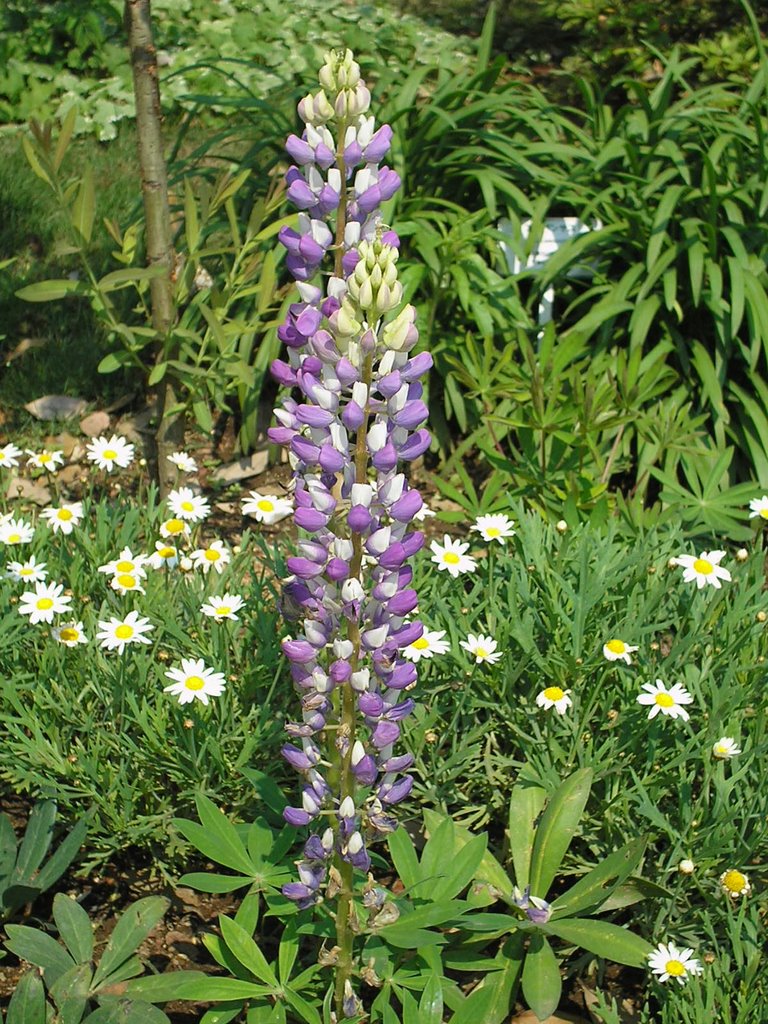
上り藤 noborifuji ‘ascending wisteria’ – Although we missed the hanging wisteria, we discovered another plant still in bloom whose nickname in Japanese is ‘ascending wisteria’: lupines, also called ルピナス, rupinasu (pictured above). I remember first reading about lupines while devouring a lot of Steinbeck during language school in Monterey, California, but had never really studied them up close, and had certainly never compared them to wisteria.

石楠花 shakunage ‘rhododendron’ – When I checked the labels and read their name in kanji, it took me a good while to figure out that what seemed to be seki+nan+ka ‘stone+camphor+flower’ was actually read shaku+na+ge and meant ‘rhododendron‘. That’s why plant identification labels in Japan usually render the names in katakana.

つるバラ tsurubara ‘rambling rose’ – When we first encountered a long hedgerow with trellises, the flowers didn’t look like roses, but a nearby label identified them as tsurubara カクテル (kakuteru, ‘cocktail’ probably meaning ‘hybrid’). The flowers looked a bit like John Cabot explorer roses, but with golden centers. They turned out to be just one of the varieties of rambling roses (or climbing roses) on display in the park.

Leave a comment

Filed under Japan, language

Sumo’s Battle of the Ozeki

With the only consistent tournament winner and only reigning yokozuna (grand champion), Asashoryu, on the injured list, the competition is tight among the remaining top wrestlers as they reach the home stretch of the Natsu Basho, which ends on Sunday. (Inconsistent ozeki Tochiazuma, who won the opening tournament in January, also dropped out after a string of losses.)

Two veteran Japanese rikishi, ozeki (champion) Chiyotaikai and sekiwake (junior champion) Miyabiyama, share the lead (at 9-1) with the newly promoted Mongolian ozeki, Hakuho. However, both the Japanese veterans are relying on relatively crude techniques, mostly unrelenting thrusts and slaps, as they try to avoid the clinch. They face each other today, so one of them is going to fall off the lead. Hakuho seems favored to win, and he already has the calm, confident gravitas of a yokozuna (more so than Asashoryu, in my opinion).

Just one loss (at 8-2) behind the leaders are Japanese veteran ozeki Kaio (my favorite among the Japanese contenders), Mongolian “Supermarket of TricksKyokushuzan, and the Estonian phenom Baruto (the “Balt”), Kaido Hoovelson, whose ceremonial apron shows a Viking helmet, and who rose to sumo’s Makuuchi division (the “Majors”) after winning the last Juryo (“Triple A”) division tournament with a perfect 15-0 record.

UPDATE, Day 12: Chiyotaikai lost first to Miyabiyama, and then to Kotomitsuki, dropping off the pace at 9-3; while Miyabiyama defeated the struggling Bulgarian Kotooshu to preserve his one loss at 11-1. So Miyabiyama, a veteran Japanese ozeki, remains neck-and-neck with Hakuho, a rookie Mongolian ozeki, in the home stretch, with the giant newcomer Baruto just one loss behind.

UPDATE, Day 13: All three leaders won. Hakuho (now 12-1) pulled down fellow ozeki Kotooshu (now 6-7), who risks demotion if he doesn’t win the next two bouts. Miyabiyama (now 12-1) shoved out Kyokushuzan (now 9-4). And Baruto (11-2) managed to get both hands on (yokozuna Asashoryu’s stablemate) Asasekiryu’s belt, immobilize him, then lift him up and drop him outside the ring. The rookie has done his homework and is winning respect. You might expect a wrestler of his size to just drive his opponents backward out of the ring, but over 13 days Baruto has won by 10 different techniques, many of them defensive moves where he helps his opponent charge down toward the clay or out of the ring.

UPDATE, Day 14: Well, Miyabiyama quickly ended the Estonian rookie’s dreams of winning the tournament during his makuuchi debut, handing him his 3rd loss. Baruto made the mistake of trying to force Miyabiyama’s head down. All that accomplished was to lower the center of gravity and concentrate the weight of the heaviest rikishi still wrestling. Hakuho and Miyabiyama remain at 13-1 and could face a final playoff if both win or both lose on Day 15, when Hakuho gets his shot at Baruto (11-3) and Miyabiyama faces Asasekiryu (10-4). Even if he doesn’t win the tournament, Miyabiyama is sure to win promotion from sekiwake to ozeki, while the Bulgarian Kotooshu (7-7) risks demotion from ozeki back to sekiwake unless he can defeat fellow ozeki Chiyotaikai (10-4) tomorrow.

UPDATE, Day 15: New ozeki Hakuho wins his first tournament after defeating Miyabiyama in a playoff. Both rikishi finished at 14-1 after Hakuho quickly left Baruto (11-4) prone on the clay and Miyabiyama shoved out Asasekiryu (11-4). Miyabiyama is likely to be the newest ozeki at the Nagoya basho in July. Kotooshu (8-7) barely managed to retain his rank by defeating fellow ozeki Chiyotaikai (10-5). However, the two Mongolian komusubi are likely to lose their ranks: small but scrappy Ama (4-11) and middle-of-the-pack Kyokutenho (5-10). Asasekiryu and Baruto may well replace them.

RELATED POSTS: Japundit’s Danny Bloom notes a Japan Times article about the differences between how well foreigners in Japan master Japanese in professional sumo and in professional baseball.

Twenty years ago, the most prominent foreign rikishi (sumo wrestlers) tended to be from Hawaii, which has a large Japanese-American population and close cultural ties with Japan. More recently, however, most foreign rikishi have hailed from Mongolia (Asashoryu), as well as Bulgaria (Kotooshu), Russia (Rohou) and other former Soviet bloc countries. Frequently appearing in TV interviews, the wrestlers do, of course, make the occasional error — but when they speak, they sound like sumo rikishi, and they express themselves in a manner remarkably similar to their Japanese counterparts [yeah, mumbling and inarticulate in both cases–J.].

This language proficiency, particularly among foreign grapplers from countries with only tenuous historical and cultural ties to Japan, has become a topic of academic study. Dr. Satoshi Miyazaki, a professor at the Graduate School of Japanese Applied Linguistics, Waseda University, began his field work in 1997….

“To learn the language, they don’t need a teacher or a dictionary,” Miyazaki says. “They just learn through osmosis. Foreign rikishi are not here to learn Japanese, but to learn sumo. But by learning sumo they have to learn Japanese. That’s their motivation. Many students who learn in classroom studies don’t know what to do with the language they learn. So it’s a matter of identity.”

And Japundit‘s baseball contributor (and NY Yankees fan) Mike Plugh has two informative posts about ironman Hideki Matsui’s wrist injury: a backgrounder, Godzilla vs. Misfortune, and an update on fan reactions in Japan and the U.S., Feeding the monster.

Leave a comment

Filed under baseball, Japan, Mongolia, sumo