Category Archives: food

Japan’s Worst Century, the 700s

From Japan to 1600: A Social and Economic History, by William Wayne Farris (U. Hawai‘i Press, 2009), pp. 36-37:

Between 698 and 800, there were at least thirty-six years of plagues in Japan, or about one every three years. The most well-documented epidemic—and to judge by the mortality and its social, economic, and political effects, the most significant—was a smallpox outbreak during 735–737. It started in northern Kyushu, a certain sign of its foreign origin, but by 737 the virus had spread up the Inland Sea and on to eastern Honshu, aided, ironically enough, by the improved network of roads linking the capital and provinces. To its credit, the court tried to apply pragmatic principles to treat the symptoms of the disease, but to little effect. Statistics from various provinces scattered from northern Kyushu to eastern Honshu suggest that mortality was about twenty-five percent, meaning that a million or more persons may have succumbed. As a result of the depopulation, an entire layer of village administration was abolished. Another irony was that the death rate among the exalted aristocracy—living crowded together in the capital at Nara—was even higher, a full thirty-nine percent. At the end of 737, chroniclers wrote,”Through the summer and fall, people … from aristocrats on down have died one after another in countless numbers. In recent times, there has been nothing like this.” In the wake of the epidemic, government revenues plunged by more than twenty percent, even more draconian measures were implemented to stem cultivator flight from the land, and a guilt-ridden [Emperor] Shōmu approved large expenditures for Buddhist temples, statues, and other religious icons.

Epidemics certainly helped to reverse the long demographic expansion of the last several centuries, but two other factors contributed to population stasis. The first was crop failure and widespread famine, occurring about every third year between the late seventh and eighth centuries. Causes for bad harvests were complex, but various climate data indicate that the eighth century was one of the hottest and driest in Japanese history. In Western Europe, where there was a “medieval warm” at this time, the effect was to dry out water-logged soils and encourage the expansion of agriculture; in Japan, where farmers often depended upon rainfall as the only way to irrigate their paddies, the result was frequent crop failure and hunger. At ten to fifteen percent, mortality from a severe famine was lower than an epidemic, but, like pestilence, malnutrition also reduced fertility. Even in years when the harvest seemed adequate, the populace frequently went hungry in the spring when their supplies of grain were exhausted. More sophisticated means of watering rice paddies may have remedied the problem, but they were either unavailable or not applied.

A second factor leading to population stasis was the ecological degradation besetting the Kinai, the richest and most financially important region in the eighth century. Altogether, the government sponsored the construction of six capital cities and countless temples, shrines, and aristocratic mansions from 690 to 805. All these structures were built from timber harvested in the Kinai and adjacent provinces, and most had roof tiles requiring baking with charcoal in a kiln. During the second half of the eighth century, the shortage of lumber became so critical that planners began to recycle used timbers and roof tiles from older capitals, such as Fujiwara and Naniwa. When the court left Nara for Nagaoka in 784, for example, they used recycled lumber and tiles almost exclusively.

By the late eighth century, tile bakers were relying upon red pine to fire their kilns, a secondary forest cover that typically grows in nutrient-poor soil. Furthermore, the government began to note that the bald mountains in the Kinai and vicinity produced less rain and more erosion. In essence, the stripping of the forests throughout central Japan exacerbated the effects of the hot, dry climate and encouraged farmers to give up cropping altogether and flee to the seashores and mountains to forage as of old.

2 Comments

Filed under disease, economics, energy, food, Japan

Early Japan’s Peaceful Foragers, Violent Farmers

From Japan to 1600: A Social and Economic History, by William Wayne Farris (U. Hawai‘i Press, 2009), pp. 13-14:

Yayoi society was constantly at war, as historians have known from brief citations about the islands in Chinese annals. For example, of the five thousand skeletons surviving from the Jōmon era, practically none suggests a violent death, whereas among the one thousand skeletons preserved from Yayoi times, about one hundred betray signs of gruesome ends, including beheading and piercing with a dozen or more arrowheads. Iron and stone arrowheads are among the most common finds in Yayoi sites, and by the middle and late Yayoi, iron arrowheads were heavier and more deadly than ever.

Settlement location and structure also imply that Yayoi society was violent. Scattered throughout upland areas, highland settlements for just a few people probably served as lookouts for attackers. Some of these hamlets have pits containing ash, which suggests a system of smoke signals. On the flatlands, one and sometimes two moats with a V-shaped cross section encircle large settlements; as of 1998, about eighty moated villages have been found for the Yayoi period. At Ōtsuka in the Kanto, a trench measured twenty by one hundred thirty meters and was two meters deep. At Ōgidani near Kyoto, there were two ditches one kilometer in length; it is estimated that it would have taken one thousand ten-ton dump trucks to haul away the earth. Many moated settlements also used stakes, twisted branches, and earthen walls as barricades.

Why did the Yayoi resort to war so frequently? The reason is probably related to the importation of agriculture, which, even though it diffused slowly over the archipelago, soon produced classes of haves and have-nots. Villagers resorted to violence when their harvest was inadequate or when they wanted to take over a neighbor’s surplus grain and the lands that had produced them. The discovery of similar moated and walled settlements around the world from an analogous period, when agriculture was just underway, also supports such a view.

The invention of war went along with famine to comprise new ways for agrarian peoples to die. Malnutrition had been a problem under forager regimes, of course, but with the advent of agriculture and the consequent population growth, many more people were dependent on a new subsistence system and liable to starve to death. Known as the “spring hungers,” famine usually beset a family or village whose crop had failed or whose reserves of grain had been exhausted by the late winter. Along with the greater chance of extensive famine came war, which was really just theft organized on a village-wide scale. Every system of subsistence has its advantages and disadvantages.

Leave a comment

Filed under economics, food, Japan, war

Rise of the American Sushi Chef

In the June issue of The Atlantic, sushi concierge and author Trevor Corson highlights the rise of American sushi chefs.

At Fin Sushi in Lenox [Massachusetts], Nick Macioge jokes with his diners and encourages them to get to know each other. Like a sushi bar in Japan, Fin is small and dominated by the counter. It’s not just the atmosphere. Macioge also tries to serve a more authentic meal. Instead of suggesting tuna, for example, he’ll talk his customers into sampling one of the most traditional sushi fish there is—saba, a mackerel that Macioge lightly marinates in salt and vinegar to bring the fish to the peak of flavor….

Macioge is one of a growing number of successful non-Asian sushi chefs. In 2005, Food & Wine magazine chose as one of its Best New Chefs a Caucasian sushi chef in Texas named Tyson Cole. A few months later, a San Diego chef named Jerry Warner was picked as California’s Sushi Master. Two years ago, one of the most high-profile Japanese restaurants in America, Morimoto, in New York City—operated by Masaharu Morimoto, an “Iron Chef” of Food Network fame—chose as its head sushi chef a young Caucasian named Robby Cook. And this year, one of the most talked-about sushi bars in San Francisco has been Sebo, run by chefs Daniel Dunham and Michael Black. (Black is half-Japanese and spent the first seven years of his life in Japan.) These chefs offer sushi fish so traditional that most Americans have never heard of them—which is why Dunham and Black chat across the fish case with customers about what they’re serving, just like the chefs I remember in Japan.

Exactly because these new chefs are rooted in American culture and society, they are well equipped to offer an experience that is, in important ways, authentically Japanese. Consider the case of Marisa Baggett, an African American chef based in Memphis. She told me her goal is to teach Americans in Tennessee and Mississippi to appreciate authentic sushi, but she approaches the task through the local idiom. She educates her customers about traditional sushi etiquette, using clever comparisons to southern manners. And she creates sushi with local ingredients such as smoked duck and pickled okra. This is a fair interpretation of authenticity—in Japanese, the word sushi can refer to just about any dish that includes rice seasoned with vinegar, sugar, and salt. Chefs like Baggett put the lie to claims by Japanese sushi-industry lobbyists that eating endangered bluefin tuna is essential to Japanese culture. Indeed, in Portland, Oregon, the head sushi chef at Bamboo Sushi, a Caucasian named Brandon Hill, has just had his menu certified by conservation groups.

Yum. Pickled okra or smoked duck sushi sounds pretty good to me. Pickled pig’s feet sushi might not be too bad, either. But let’s leave sushi and gravy to Hardee’s, shall we?

Leave a comment

Filed under food, Japan, U.S.

Wordcatcher Tales: Sawa-azami, Hime-gonomi

During our day-trip to Gifu, Japan, last summer, we picked up an easy-to-carry packet of a local food specialty from the gift shop of a hotel whose lobby we relaxed in while waiting to see the cormorant fishing that evening. The box languished in our cupboard until recently, when we finally used it as a side dish in a somewhat Japanese-style meal.

沢薊 sawa-azami (Cirsium yezoense) ‘marsh thistle’ – This particular species of thistle is not even listed under Cirsium in English Wikipedia. In Japanese Wikipedia, however, it is not only listed under azami (Cirsium); it even has its own separate entry as sawa-azami: Cirsium yezoense (Maxim.) Makino, a thistle found along mountain streams along the Japan Sea side of northern Honshu and southern Hokkaido (old Yezo country). Kamchatka, too, seems to have its own species of thistle, and several subspecies. This particular package of pickled thistle was labeled as coming from the Neo (根尾 ‘root hair’) region of Gifu Prefecture, right on the border of Fukui Prefecture, which faces the Japan Sea. And, speaking of root hairs: Did you know that another genus of thistle—Arctium, burdock—was the inspiration for Velcro? Don’t dis thistles! (I used to know a weekend sailor who named his sloop Thistle Dew.)

姫ごのみ hime-gonomi ‘princess-fond (= flamboyant)’ – The package of lowly thistles is labelled somewhat incongruously as both (一) coming from the inaka ‘countryside’ (田舎, a kanji combination I didn’t recognize, but a word I know well), and (二) fit for a princess, that is, for one who is flamboyant. The -gonomi part can also be written -好み, as in お好み焼き o-konomi-yaki ‘cooked as you like it’, which nowadays means something quite different from the better-known ‘cooked as you like it’: すき焼き suki-yaki. However, as far as I can tell, the following three constructions all describe the same type of showy, flamboyant woman: 派手好み hade-gonomi ‘flamboyance-fond’; 派手好き hade-zuki ‘flamboyance-fond’; and 姫ごのみ hime-gonomi ‘princess-fond’.

Leave a comment

Filed under food, Japan, language

Wordcatcher Tales: Hamachi vs. Buri, Pāpio vs. Ulua

A delicious plate of hamachi kama (‘yellowtail collar’ [or ‘sickle’]), pictured below, serendipitously led me to discover that hamachi (魬) and buri (鰤) are merely different sizes of the same fish, the Japanese amberjack (Seriola quinqueradiata). Yellowtail is the usual translation in Japanese restaurants, but that name can also apply to a whole lot of other fishes (as well as other animals). You can tell you’re dealing with a highly commercialized and regulated industry when the difference between the smaller and larger fish is defined so precisely: hamachi weigh less than 5 kg, buri weigh 5 kg or more. The fry are called by yet another name, mojako.

According to Japanese Wikipedia, buri has a plethora of synonyms that vary by size and region. The term hamachi seems to come from Kansai; its match in Kanto seems to be inada. The names used on Japan Sea side are even more varied. (See here for a romanized glossary of Japanese fish names.)

Hamachi kama (yellowtail collar), Hanamaru Restaurant

This put me in mind of other types of jackfish (Jp. 鯵科 ajika, Carangidae) that have different names at different sizes in Hawaiian. Ulua refers to several types of large jackfish weighing 10 lbs or more, including the white ulua, or giant trevally (Caranx ignobilis); the omilu, or bluefin trevally (Caranx melampygus); and the kagami [< Jp. ‘mirror’] ulua or African pompano (Alectis ciliaris). At smaller sizes, the same fish are called papio. (Papio papio is also the genus and species name of the Guinea baboon.) In older Hawaiian usage, the smallest ones were called pāpio(pio); the somewhat larger ones, pā‘ū‘ū; and the largest ones, ulua.

2 Comments

Filed under food, Hawai'i, Japan, language

Bucharest, 1984/2008: Back to Tineretului

Tineretului metro entranceOne of our goals during our very brief visit to Bucharest in January was to see how much things had changed in the neighborhood we used to live in during 1983–84. The first change we noticed was that we could get there on the M2 north–south metro line, getting on at Aviatorilor and getting off five stops later at Tineretului. In 1984, the metro line (now M1) only ran in a broad northeast-to-west arc from (I think) Republica to Semănătoarea (lit. ‘the inseminator’), apparently designed to serve the huge housing blocs in the most populous new suburbs. So the Bucharest Metro has improved a lot since 1984.

Tineretului apartment blocWe lived at Bulevardul Pionierilor 25, Blocul Z7. Note that Romanian place names look a lot like those in other Romance languages, except that the definite articles are suffixed, as in the masculine singular bloc, blocul ‘bloc, the bloc’, and feminine singular semănătoare, semănătoarea ‘planting machine, the planting machine’. (The masculine semănător, semănătorul indicates a human planter.) There are a few wrinkles. On masculine nouns that end in -e, like câine ‘dog’, the singular article is -le, as in câinele ‘the dog’. On feminine nouns that end in stressed -a, like the Turkish borrowing cafea ‘coffee’, the singular definite article is -ua, as in cafeaua [kafjáwa]. And on the huge majority of feminine nouns that end in unstressed (schwa), like casă ‘house’, the singular article -a replaces the schwa, as in casa ‘the house’.

Parcul Tineretului looking north

Like quite a few other streets in Romania, Bulevardul Pionierilor changed its name after the “Revolution” (or lovitură de stat ‘coup d’état’) in 1989. The Young Pioneers were so discredited under Communist rule that the boulevard is now named after the neighboring Parcul Tineretului ‘the Park of the Young’ (in the sense of tinerime ‘collective offspring’). Compare the adjective ‘young’, tânăr/tineri for masc. sg./pl., and tânără/tinere for fem. sg./pl., each stressed on the first syllable; and the noun ‘youth’, tinereţe/tinereţi fem. sg./pl., stressed on the penultimate syllable. Compare also the masc. sg. vs. pl. genitive forms, tineretului ‘of the young’ vs. pionierilor ‘of the pioneers’; and the fem. sg. vs. pl. genitive forms in fântâna tinereţii ‘the fountain of youth’ vs. poluarea apelor ‘the pollution of the waters (= bodies of water)’.

Billboards at Parcul TineretuluiThese genitive nouns are used as place names in their own right, as in other Bucharest Metro stops like Eroilor ‘of the Heroes’ or Industriilor ‘of the Industries’. The first things that caught our eyes when we came out of the metro at Tineretelui were the large video panel and billboard advertisements at the corner of the park. Big, ugly commercial billboards hide a lot of distinctive architecture and scenery in Bucharest these days. There’s a lot more traffic, too, than there was in 1984.

Xmas tree in manholeSome things were still the same, though: treacherous winter sidewalks with layers of uncleared snow and ice, litter discarded in public spaces, and the odd open manhole cover. One dark night in 1984, we almost stepped in an open manhole while walking down a street with no lights except those of a passing tram. This year, we noticed that someone had thoughtfully stuffed a Christmas tree into an open manhole on Strada Trestiana, right in our path. We were lucky it was daytime.

Palatul de Sport, Parcul Tineretului

Our bloc at Pionierilor 25 contained several other flats housing Fulbright and IREX scholars from the U.S. (and apparently still did in 1995). We were a long way from the nicer northern neighborhoods cluttered with foreign embassies. I remember that, as Halloween approached in 1983, someone in the American, British, or Canadian embassy arranged for the diplomats to borrow costumes from the National Opera for an embassy costume party. We were a little worried that some embassy kids might come trick-or-treating at our doors. We had nothing that would pass muster for treats, but I prepared to shock the kids by offering them the boiled heads and feet of four whole chickens we had managed to find at the local market (rationed at two per customer). The chicken with lots of fresh garlic made a tasty broth, but no one came trick-or-treating that Halloween, so we discarded the heads and feet.

Egg and dairy shelvesWe did not eat too well that winter. Fresh food was hard to find. You had to supply your own containers, but eggs and (unpasteurized) milk, yogurt, sour cream, cream cheese, stale bread, wheat flour, and corn meal were usually available at local shops. Oil and sugar were rationed. However, in order to find fresh meat, hard cheeses, fresh fruit, or toilet paper, we had to keep an eye out for people queueing up at storefronts on our way to and from the city center, then get in line to find out what they were waiting for. At one point, we managed to obtain a big chunk of fresh pork through one of my Chinese classmates in Romanian language class.

Knorr & Maggi soup mixesOn our open balcony, we stored apples, onions, and potatoes in cardboard boxes insulated with newspaper. They were usually available throughout the winter in the central open markets, along with sour cabbage and its broth (used to make ciorbă). The common wisdom for canned goods was not to buy anything that had been produced toward the end of each month, when factories were rushing to fill their quotas. (Each label carried the production date.) We ate a lot of bean soups and stewed apples that winter.

Mega image supermarket, TineretuluiWell, a lot has changed on the food front. Now there is a small but convenient Mega Image supermarket (with signs on the doors saying, “Now hiring“) across from the entrance to the park. We walked in to have a look around and, after a little hesitation, I couldn’t resist photographing the shelves of goods, none of which would have been remarkable had we not longed for such a local market when we lived there 24 years ago. The bread, meat and deli shelves were not in danger of going bare. They even had Romanian-made vegetarian products like tofu in natural, cumin, dill, and pimiento flavors.

However, the prices did not seem very cheap. The average Romanian monthly wage is about 1400 RON (new lei), which works out to about US$600 at current exchange rates, or about $1000 in purchasing power parity. Nevertheless, the Romanian economy has been growing at a feverish pace since 2000. Bucharest, in particular, seems in 2008 to be a bit of a boomtown, much less dreary and downbeat than it was in 1984. But the countryside seems to be lagging behind.

Leave a comment

Filed under food, language, Romania, travel

Eating Across America: Road Trip Food Stops

On the long travel days during our Great Square Route (MN – MS – GA – CT – MN) car trip in May, we would aim to get on the road early, then stop for a late breakfast at some place with local flavor, trying to avoid national chains. We might snack a bit on the road, but would not eat another meal until the evening, again trying to avoid national chains. Here are the most memorable food stops. Like my father and brothers, when I travel I tend to remember the meals above all else.

First breakfast stop – Our first breakfast stop on I-35 South out of Minneapolis was at the Perkins restaurant in Clear Lake, IA. Despite being a national chain, it offered the big plate of biscuits and gravy that I was determined to indulge in at least once on this trip.

Greasiest omelet – After a nice visit with my stepbrother and his family in Kansas City, MO, we hit the road early on I-70 East. We didn’t see much with local flavor until we got to the Midway Auto/Truck Plaza near exit 121 between the Missouri River and Columbia. Their Southwestern Omelet needed extra tabasco to cut the grease as much as to add spice.

Most filling meal – We made good time around St. Louis, whose waterfront we had each visited before, then dawdled down I-55 South on the way into Sikeston, MO, where I was determined to subject my wife and mother-in-law to regionally famous Lambert’s Cafe, “The Only Home of Throwed Rolls.” I ordered just 4 vegetables (cole slaw, green beans, turnip greens, and white beans), but helped my mother-in-law with her (very tasty) catfish and my wife (very little) with her polish sausage and kraut. Between those ample portions and the irresistible black-eyed pea and fried okra “pass-arounds,” I came away stuffed to the gills.

Tiniest restaurant – After stopping two nights in Paducah, KY, to see two brothers, a new sister-in-law, a niece, and a nephew-in-law, grand niece, and grand nephew that I hadn’t met yet, and also to pick up my wife’s sister who flew in from Minneapolis to join us for the jaunt across the South, we headed out on I-55 South, stopping for breakfast at The Grill on Main Street in New Madrid, MO. It had only three or four tables, but served a steady stream of take-out customers and had a lot of local flavor. Above the kitchen doorway was a sign honoring a local U.S. Army lieutenant killed in action.* Every table had a well-used ashtray, emptied but not washed between customers. The restroom in the kitchen contained various cosmetics used by the staff. And the steak I ordered with my eggs—on the chef’s recommendation—was very nicely marinated, very nicely grilled, and very tender.

(*The New Madrid KIA was 1st Lt. Amos C. R. Bock, 4th Battalion, 320th Field Artillery Regiment, 4th Brigade Combat Team, 101st Airborne, killed when a roadside bomb exploded near his vehicle in Baghdad, Iraq, on 23 October 2006.)

Ameristar Casino, Vicksburg, MississippiFanciest restaurant – We found a motel in Jackson, MS, before driving over to Vicksburg. After little success finding a restaurant overlooking the Mississippi River, we ended up at Bourbon’s in the Ameristar Casino. (It was my first time in a casino.) The food and drinks were excellent and we could look out on the river when we weren’t fiddling with the wooden blinds trying to keep the glare of the sunset off the water out of the eyes of our neighbors and ourselves. I had a cup of their Seafood Gumbo (which turned out to be dirty rice, not soup) and Caribbean Steak Salad.

Emptiest restaurant – Traveling east the next day on I-20, we stopped for breakfast at a Barnhill’s restaurant in a ghost-town of a shopping center in Meridian, MS. Barnhill’s is a regional chain that mostly offers Southern-style buffets, but some branches offer breakfast buffets on the weekends. I had sausage, grits, and a good bit more. It was Sunday morning about time for Sunday school to start, so the huge dining hall was practically empty.

Strangest smell – We crossed most of Alabama on U.S. 80, passing through Selma and Montgomery on the way to visit old friends from Micronesia who now live on Ft. Benning, GA, where the father, a Sgt. 1st Class born and raised on Yap, has been teaching infantry tactics to officers ever since he returned from deployment in Afghanistan with the 10th Mountain Division (Light Infantry). During his 20+ years in the Army, he earned a B.A., and is now pursuing an M.A. in international relations.

After a long visit and a quick chew of betel nut, we repaired off-base to Country’s Barbecue in Columbus for a late supper. The food was tasty, but the dining room smelled more like a wet mop than a hot grill. When the party at the booth next to us left, I understood why. The waitresses not only cleared, wiped, and reset the table, they also pulled it out and mopped the floor beneath it. The wait help doubled as bus help and tripled as janitorial help. We left a good tip.

Best grits – It was slim pickings for breakfast the next morning along GA 96 through the heart of pecan and peach country. We got off course in the old railroad junction town of Fort Valley and ended up in Perry, where we settled on an outlet of the Krystal regional fastfood chain. I tried their breakfast “scrambler” with egg and sausage atop grits in a bowl. It was surprisingly tasty, billed as low-carb but plenty high in fat, salt, and cholesterol. The outlet we stopped at seemed exceptionally well managed.

Gang of baby gators, The Crab Shack, Tybee Island, GeorgiaSecond most gimmicky (after Lambert’s Cafe) – After an afternoon exploring a bit of historic downtown Savannah, GA, we drove out to Tybee Island on U.S. 80, which ended at a sign saying “my other end is in San Diego” (an assertion that hasn’t been true for several decades). We dined that night at The Crab Shack, at an outdoor table that had a hole in the middle to discard the shells and corncobs from our heaping platter of seafood. The baby alligator pond was the gimmick that most caught my fancy. I asked the host on the way in if I could pick which one I wanted to eat. He said, “You can pick one, but we ain’t gonna cook it for you.”

Homiest atmosphere – Driving up I-95 from Savannah, we stopped for breakfast at the Olde House Cafe in Walterboro, SC. It was the only “unchained” restaurant we could find. The food was great but the architecture was more interesting. As the name suggests, the building really was built to be someone’s home. We ate in what may once have been a bedroom, and the front porch had a rocking chair on it.

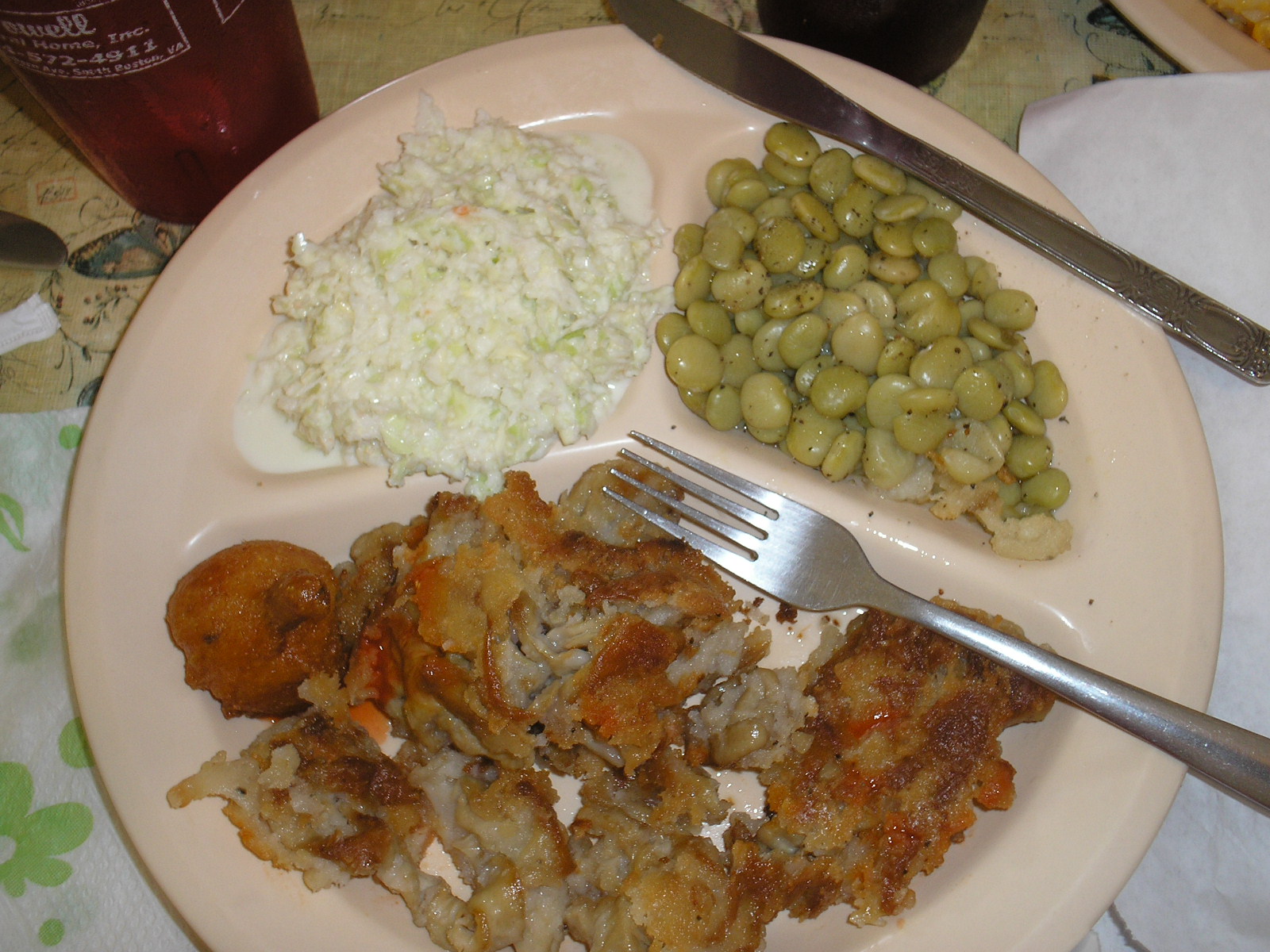
Second worst chitlins – Before we arrived at my dad’s place in South Boston, VA, I had asked him to find some place in his neck of the wood that served decent chitlins (= chitterlings). A long time ago, when he lived in Roanoke, he had taken my wife and me to a mostly black restaurant that served the only good Southern-style chitlins I’ve ever tasted. They were chopped, marinated, and sauteed with vinegar and pepper. (Since then, I’ve had pretty decent Korean-style chitlins several times, both grilled and in soup.) The worst (and first) chitlins I ever tasted was when I was a kid in Winchester, VA. My mother boiled them without enough flavor to disguise the taste and they were terrible. I couldn’t get them past my tongue (or nose). I’m sure my father made a valiant effort to eat them, but we kids all turned up our noses.

Chitlins with slaw and butterbeansWell, on this occasion, my youngest uncle and an older cousin and their respective spouses had driven over from Tidewater Virginia, so we all went out to Paulette’s Place in Halifax, which served batter-fried fish, shrimp, oysters, and chitlins. My father, my uncle, and I ordered the chitlins. Everyone else had better sense. My uncle drowned his in vinegar, and I dumped tabasco on mine, but I think my father was the only one who didn’t leave any on his plate. The rest of the menu was fine.

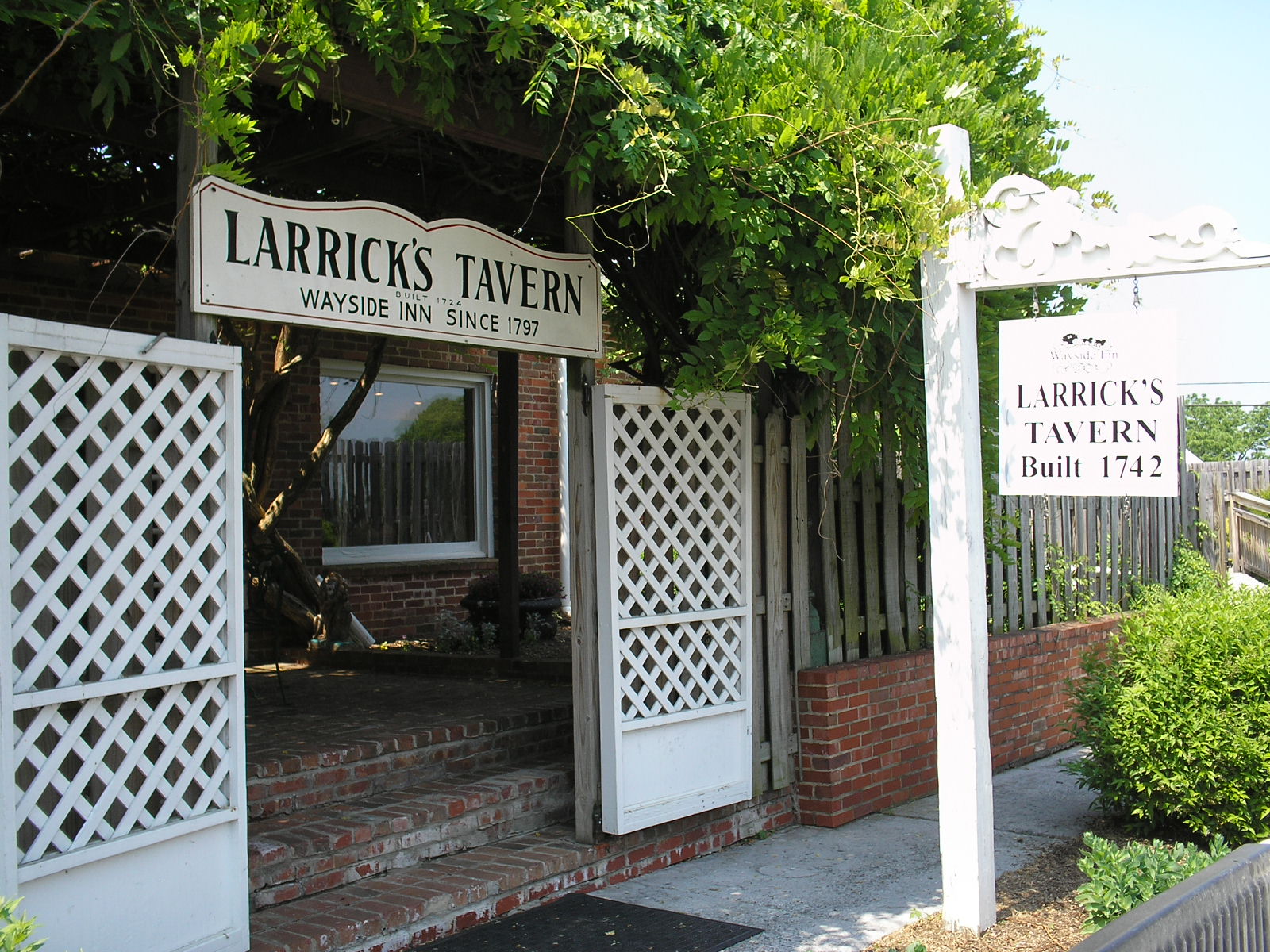
Larrick’s Tavern, Wayside Inn, Middletown, VAOldest restaurant – The next leg of our journey ran through the Blue Ridge Mountains and up the Shenandoah Valley to Middletown, VA, where we stopped for a light snack at the historic Wayside Inn, founded in 1797, before paying respects to my aunt, who lives on a farm nearby, and my cousin’s wife and mother-in-law, who live up the road a bit in a house that dates back to the 1740s. (My cousin was off hunting big game on a South African preserve.) The four of us confused the waitress by ordering three house salads and three bowls of their signature Colonial Peanut Soup, reputed to be one of George Washington’s favorites.

Most sushi – The reason we snacked so lightly in Middletown is that we were headed for another family reunion at the other end of I-66, at the Todai [= Lighthouse] Restaurant in Fairfax with: my brother, sister-in-law, and their two kids; my sister and brother-in-law from Annapolis, MD; my father, who came up from South Boston; and my mother-in-law and sister-in-law, who were flying back to Minneapolis the next day, leaving us the car for the rest of our trip. When I eat at Todai, I concentrate on the huge variety of sushi and a few cold salads. When my brother in Fairfax turned 50, I took him to Todai for lunch and we ate 50 pieces of sushi between us.

Dishes at Fiesta Atlantic, Stamford, ConnecticutBest oasis – Our worst day of driving, by far, was between Fairfax, VA, and New Haven, CT, on the Friday before Memorial Day. Even though we avoided I-95 as much as possible, we spent far too much time in bumper-to-bumper traffic until we got past Baltimore during the morning rush hour, then again after we got across the Hudson on the Tappan Zee Bridge later that afternoon. After trying a stretch of U.S. 1 between Greenwich and Stamford, we decided to break for an early supper in Stamford. After finding the food court still under construction at a brand-new downtown shopping plaza, we discovered Fiesta Atlantic, a refreshing Peruvian restaurant across Atlantic Street that was already open for dinner before 5 pm. Their Sangria had canned fruit cocktail in the bottom of the glass, but tasted quite refreshing, and the two appetizers and two side dishes we ordered were fresh, flavorful, and nicely presented. We had cebiche (ceviche) mixto, ensalada de pulpo (octopus), platano (plaintain) frito, and yuca (yucca) frita.

Most unexpected language – After a long but lovely ride through Pennsylvania on I-80, then through a rather ugly corner of Ohio, we took the North Ridgeville exit on the way to the pleasant Cleveland suburb of Avon Lake, OH, where a busy friend had invited us to stay the night. We had agreed to meet her for breakfast the next morning, so we looked for supper on our own. The Gourmé [sic] Family Restaurant (“Good Home Cooking”) on Lorain Road caught our fancy, so we sampled their fare. I had their lake perch and pierogie combination. Two things puzzled me. Why did every table have a squeeze bottle of syrup as well as ketchup on it? (If ketchup was for the fried fish, was syrup for the pierogies?) And which language was the staff speaking to each other? Their appearance and their accents were vaguely Eastern European, but I heard enough of their talk to rule out Germanic, Slavic, Romance, Hellenic, Turkic, and even Finnic and Ugric. It turned out to be Albanian. We never did solve the mystery of the syrup.

1 Comment

Filed under family, food, military, travel, U.S.