Category Archives: family

Winchester, Virginia: My First American Hometown

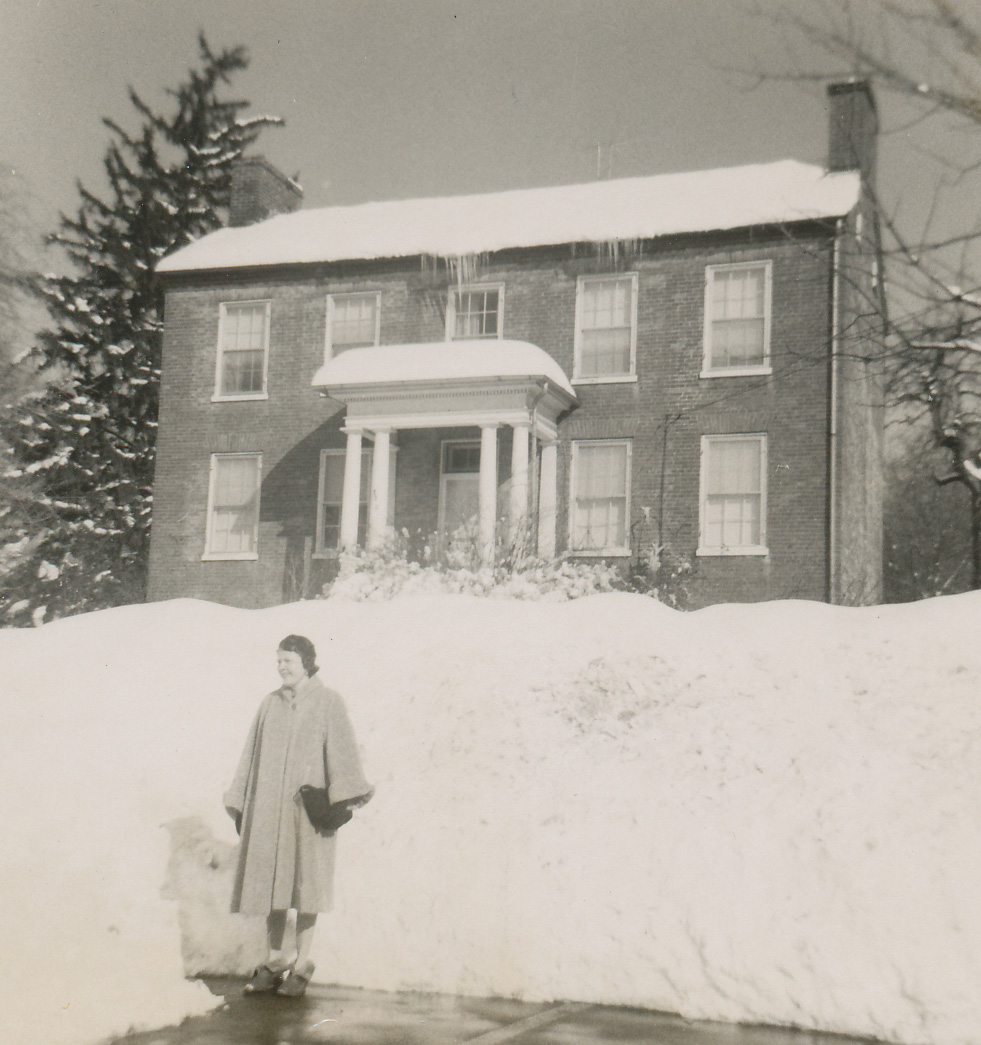
Fifty years ago this month, I arrived in a snow-covered city I would come to think of as my first American hometown, Winchester, Virginia. I had just spent most of my elementary school years in Kyoto, Japan, which I still think of as my Japanese hometown. My parents were missionaries. I was born in Louisville, Kentucky, where my father was in seminary, and I later attended first grade there during our first furlough while he finished his coursework toward a Th.D. But our two-and-a-half years in Winchester gave me my first prolonged exposure to life in small-town America.

Amherst St. house, Dec. 1960

Mom in front of our house on Amherst St., Dec. 1960

For 7th and 8th grades, I walked to my mother’s alma mater, Handley High School, where I soaped the windows of my homeroom one Halloween, and had a classmate whose parents threw a grand Bat Mitzvah party, for which I learned to jitterbug when other kids were just beginning to dance the Twist. We two oldest brothers were baptized in my mother’s home church, First Baptist, where my parents had gotten married and my father now served as associate pastor during our extended furlough. He would draft us to help shovel snow off its sidewalks along Piccadilly and Washington Streets. My brother and I both had paper routes, delivering the Winchester Star on the way home from school each afternoon. I joined the Boy Scouts, advancing to Life Scout and marching with my troop in the annual Apple Blossom Festival parade. My mother’s two brothers lived a few miles down the Valley Pike, while her sister lived up the Pike outside Martinsburg, West Virginia.

House on Henry Ave., Winchester, Va.

Our house on Henry Ave., c. 1962

My parents resigned after their regular furlough year (partly from burnout), and we moved into a smaller house near Quarles Elementary School, where I had earlier finished the last half of 6th grade. Without a missionary salary, my father supplemented his earnings at First Baptist by substitute teaching at the county high school (James Wood) and serving as interim pastor at a tiny Baptist church in Gore, Virginia (birthplace of Willa Cather and Patsy Cline, I later discovered).

Meanwhile, my mother had her hands full with five kids. Our family car was a Rambler station wagon with an extra rear-facing seat in back. One summer we drove it to Sebago Lake in Maine, where our pastor let us use his summer cabin, where in the evenings my mother would read to her own five children from The Five Little Peppers and How They Grew (one of whom—in each family—was named Joel). My mother, who had dropped out of Berea College after her junior year to get married and become a missionary, always felt inferior to the more educated missionary wives, especially the registered nurses at the Japan Baptist Hospital in Kyoto, where my father had served as chaplain. Perhaps she compensated to some extent by being somewhat of a Japanese-style kyōiku mama (at least where I, her eldest, was concerned).

But I remember those years as the least bookish, most outdoorsy era of my life. We went sledding on the slope above our big old house on Amherst St., and built igloos and snow forts behind our smaller house on Henry Ave. One summer, Uncle Bill took us waterskiing on the Shenandoah River. Dad took us oldest boys along for a campout in Monongahela National Forest with a group from his little country church in Gore. With Boy Scouts, I took a 50-mile hike along the Appalachian Trail through the Shenandoah Mountains, and I remember one Camporee that got hit by such a heavy rainstorm that many parents came to rescue their boys and a few boys abandoned their pup tents to spend the night in the scoutmasters’ vehicles.

Sometime during 8th grade, I started to show signs of near-sightedness. I don’t think it was while trying for my rifle-shooting merit badge in the old Winchester Armory. I think I first noticed it when I had trouble reading the blackboard from the back of the classroom during algebra class or my tryout semester of Latin. But Uncle Bill likely noticed it sooner when I accompanied him on trips to Baltimore to bring back a tanker of gas for his filling station. He used to ask whichever nephew accompanied him to be on the lookout for certain road signs, landmarks, or maybe patrol cars, and I don’t think I was as good at spotting them as he was—or as my brother was. I went for an eye exam and got a prescription for contact lenses (newfangled and expensive at the time), which were soon replaced by regular eyeglasses after I lost one down the drain.

Sometime during that same school year, my parents opted to return to the mission field, this time to Hiroshima, which became the Japanese hometown of my three youngest siblings. We two eldest sons went off to boarding school in Kobe, and I began my evolution into the most bookish nerd one can ever hope to become.

Leave a comment

Filed under family, Japan, migration, U.S., Virginia

Farmboy Seminarian on a Cattleboat to Poland, 1946

Chicken delivery truck, Poland, summer 1946While organizing a bunch of old photos during last week’s visit to my 85-year-old father, I came across a small set I had never seen before of images from his oft-recounted trip delivering livestock to Poland in 1946. His voyage was on the S.S. Carroll Victory under the auspices of UNRRA, but he heard about the cattleboats from his Quaker contacts, who cooperated with the Church of the Brethren and Mennonites on what later evolved into Heifer International. My father was raised a Quaker, but later joined a Baptist church and spent the war years at the University of Richmond on a ministerial deferment. He graduated at the end of 1945, then enrolled in Southern Baptist Theological Seminary in Louisville, Kentucky, in February 1946.

Horse stalls and hay bales on deck, Poland, summer 1946

The following is my father’s account, very lightly edited by me.

At the beginning of summer vacation in 1946 I heard about the need for volunteers to care for horses being sent to Poland by United Nations Relief and Rehabilitation Administration (UNRRA). The ships that transported the horses to Poland were called “cattleboats” but I do not remember any cattle on my boat. We did take baby chicks and horses. I had worked with mules as a boy but had little experience with horses. The chance to visit Europe and be paid for the trip rather than having to pay for it fascinated me as I really wanted to see other countries but couldn’t afford to travel. So, with three other seminary students I signed up for the trip. The ships were converted Liberty ships from WWII and were manned by members of the U.S. Merchant Marine. I was accepted as a “cattleman” and left Norfolk in June of 1946 on a boat with 800 horses and 3000 baby chicks. The horses were to be used for reconstruction and the chicks for supplying eggs for food in Poland which was devastated by Germany and Russia in World War II.

I had never traveled before on the ocean and was a real landlubber. The beginning of the trip was rather mild but the stench in the lower decks from horses and their excretion made for rather poor sailing conditions for one inexperienced in sea travel. I found that the more marked movements of the ship up and down were not as bad as the swaying motion from side to side. When I felt that I was going to get sick I would lie on my back and look up through the opening in the upper decks. If I could lie still and see the sky my stomach would settle down. Contrary to the reputation horses have for “horse sense,” I found them much less intelligent than mules. When a horse got sick and fell in its stall it would lie there and die. A mule would have struggled to its feet. About 30 horses died on the trip and had to be thrown overboard. For some reason which I do not remember (I probably volunteered) I was transferred to caring for baby chicks, which was more to my liking and more consistent with my experience. However, I found that chicks were even dumber than horses. They would trample each other to death as the boat rocked on the ocean, or they would drown themselves in the water troughs at the outer edges of the coops. I don’t know how many chicks we lost on the trip but I believe a goodly number managed to stay alive until the arrival in Poland. I watched with interest as the Polish men tried to handle the horses as they were lowered from the ship on to Polish soil. Their “horse sense” did not include the understanding of the Polish language and the commands they were given did not communicate well to them the desires of the handlers.

The environment on ship was anything but a churchly one. Of the 90 men on board very few were Christians and many if not most were misfits in society who were only on the trip for the month’s food and lodging and the $150 they would be paid for working on the way over to Poland. There were no responsibilities on the return trip. The four of us from the Seminary held services on Sundays. One young man played a guitar for the hymn singing and the four of us took turns preaching. The “congregation” was certainly different from any I had ever preached to before. In fact, the whole atmosphere on board ship was so foreign to anything I had ever experienced that I felt like I was in a foreign country even before we got to Poland. The food was not too bad but it was certainly not home cooking. We slept in bunks which had been built for sailors.

The trip to the English Channel took about eight days as I remember. The White Cliffs of Dover were the first sight of land that we had seen since we left the USA, and they were welcome sights. However, they offered no relief from the sea as we did not disembark in England. We could see land and cars and buildings as we slowly made our way through the almost placid English Channel, which was in a good mood that day. We approached the Kiel Canal soon and went through what was for me a fascinating experience of navigating the Canal. We could get a very good view of the north of Germany as we slowly made our way through the canal. I was taken by the beauty of the land. We went through Schleswig-Holstein where Holstein cattle grazed in immaculate pastures divided by rows of trees. In the land of my own childhood, trees were cut down on farmland and farms were not landscaped as in North Germany. The Germany I saw was vastly different from the pictures of bombed out cities on TV.

Flea market, Poland, summer 1946Street photographer, Poland, summer 1946
Shell of a fine building, Poland, summer 1946

Poland was very different from Germany. We landed in Gdansk and the devastation wrought by Germany and Russia in World War II was evident everywhere we looked. We were in port about 4 days and were allowed to go ashore. On the way across the Atlantic we had been told that cigarettes were the best currency in Poland since none were available there. On ship we had been permitted to buy two cartons apiece on about three occasions. I did not smoke and did not intend to engage in blackmarket trading so I didn’t buy any. Several who asked me to buy some for them were angry when I refused. One of the Seminary students and I tried to maintain some appearance of the faith we professed while on ship and in Poland, but the two others bought cigarettes and went to Warsaw while we were in port. We had been strictly forbidden to go anywhere farther than we could return to the ship at night. The two fellow travelers were strongly reprimanded and were not given a recommendation to take another such UNRRA trip. My friend and I were highly recommended for another voyage but did not go again.

Brick building intact, Poland, summer 1946There was a redheaded boy from Franklin, Virginia, on board. I did not know him and was not drawn to get to know him. He tried to get me to go with him in Poland but his description of his planned exploits did not appeal to me. Before he left the ship he started drinking vodka and chasing it with water. Then, as he began to become inebriated, he drank water and chased it with vodka. He left the ship alone. It was not too long before some kind Polish natives brought him back to the ship dead drunk. He lay on the floor of the ship unconscious with flies attending him for most of the time we were in port. Another young man went ashore, visited a prostitute and came back and developed the “clap.” He was so drunk that I persuaded him to leave his money with me before he left again. He cursed but he gave me his money. Later he thanked me, for the suffering of venereal disease was bad enough for him without losing his money too.

We found out why they drank so much beer in Poland. Water was very scarce and what there was tasted awful. We were taken on a tour of Gdansk and as far as Gdynia. There was not much to see. We did visit a few very old church buildings. They were always located on scenic spots and were beautifully constructed. When we remarked to our obviously not very religious tour guide that the cathedrals were beautiful he said, “Yes, and cold.” They were indeed symbols of great architecture rather than ardent religion – as might be said of many church buildings in all lands and ages.

Little girl, Poland, summer 1946After two days I was ready to head for home. On our rather uneventful trip home we had much leisure time to think about what we had seen. There were only two incidents worthy of mention, at least the only ones that I remember, on our return trip. As we were our leaving the Kiel Canal beside another Liberty ship the captains made a bet as to who would get there first. The navigator on our ship took us a tenth of a percentage point off course and we lost. While we were changing courses near the end of the trip to get to Norfolk I was standing on the ship without a shirt on in the hot sun looking for land, and I got so sunburned that I could not bear to wear a shirt. When I arrived at my brother Bob’s and Bertha’s house with a month’s beard and no shirt on my red back Bertha did not recognize me and only my voice persuaded her to let me in.

Street kids, Poland, summer 1946

44 Comments

Filed under economics, family, Poland, religion, travel, U.S., war

One Child’s Language: Compilation

This post links to all earlier blogposts in the One Child’s Language series of notes from two decades ago about our very own Far Outlier child, who’s now a teacher.

At 8 months
At 10 months
At 11 months
At 13 months
At 14 months
At 15 months
At 16 months
At 18 months
At 19 months
At 20 months
At 22 months
At 24 months (and abroad)
At 27 months (and abroad)
At 30 months (and abroad)
At 32 months (and abroad)
At 36 months
At 39 months
At 40 months
At 42 months
At 47 months

1 Comment

Filed under China, education, family, Hawai'i, language, travel, U.S.

One Child’s Language: at 47 months

Social notes: Her two favorite teachers (and actually best friends) at school are leaving for more gainful employment this month. She’ll miss them, but she is much more willing now to get to know new people. She is still very teacher-oriented, playing the role of teacher at home: directing games and circle time, asking for volunteers so she can do eeny-meeny-miny-moe (often fudging the last bit) to choose one of us.

Physical development: Fine motor skills have also improved. She can spend an hour at a time coloring within the lines, cutting paper with scissors, and writing smaller and neater uppercase and lowercase letters. She may have just finished a physical growth spurt and begun a mental one.

Intellectual notes: One day in the supermarket, Rachel pretended to read a story from the list she was holding. It was about a little boy who went for a walk, crossed the street by himself, got hit by a car, and died, leaving his parents all alone. They propagandize her well at school—she instinctively grabs a hand before crossing a street. But she also spends intervals trying to figure out the meaning of death. Time is another mystery. She knows the days of the week, some months of the year, and a bit about how years are numbered. But she often thinks that her afternoon nap starts a new day, that supper is breakfast and vice versa.

Size and measurements are still vague. We just came back from a weekend trip to the Big Island. She asked whether it was as big as the Soviet Union, asked several times how long a mile is, wanted to plot our course on the map, and monitored our elevation. Numbers are getting easier: she can read up to 99 (often mixing pairs like 25 and 52) and had little trouble singing from 21 bottles of beer on the wall down to zero.

Language notes: One evening as we sat down to dinner, Rachel clasped her hands and recited a complete table grace in Hawaiian. Another evening, she decided she wanted to study sign language and spent about half an hour practicing a few words with Daddy. She is a real language-learner right now. It’s a shame she doesn’t have another language to work on along with English.

She is rapidly expanding her vocabulary, stopping to ask us the meaning of any word she doesn’t know yet. She is on the lookout for familiar words everywhere and asks us to read and explain any public sign that contains a word or two she can recognize or sound out. At school, she has just been introduced to “mystery words” that can’t be sounded out. We encourage her to sound out regular words. She was able to read a note from Mama that said Can I get a hug from you? and she has come up with her own spellings, like jrink water and clowde, wnde, rane, sune day. (WordPerfect’s spellchecker offers the correct choice for some.) She copies whole sentences with all the devotion of a medieval monk reproducing a holy manuscript.

UPDATE: This child is now a 24-year-old teacher in Boston Public Schools.

2 Comments

Filed under education, family, Hawai'i, language, U.S.

One Child’s Language: at 42 months

Intellectual notes: Of all the Sesame Street characters, Rachel used to resemble sweet, innocent, and imaginative Elmo the most. But now she’s turning into the Count, whose greatest joy in life is to find something to count. She counts steps, parking meters, people on the bus, bites of food, and sips of water. She can now count past 100 without prompting, can count backwards from 10 to 0, and can add and subtract one number at a time so long as she’s dealing with numbers not much over ten. And, finally, she no longer misses 16 on her way to 20.

She is raptly attentive during Sesame Street, and we’ve just started watching the Sunday evening Disney hour with her. She asks a lot of questions. She likes cartoons but has not yet been exposed to Saturday morning TV. So her very active imagination has not turned to violence yet. Instead, she organizes a lot of weddings, birthday parties, travels, picnics, and classroom activities.

Language notes: Rachel is picking up more and more local English at school. One of the most noticeable lately is mines, as in Yours, Mines, and Ours. (That forces an exception to follow the same rule that adds s to the other forms.)

She has finally begun to use Please, Thank you, Excuse me, and Sorry fairly regularly. And she’ll wave good-bye to kids she knows. Her conversational habits are not always polite though. She wants to dominate every conversation around the house, and isn’t happy to yield the floor to either of us. She is very, very verbal, providing a running commentary on everything she does. When she’s tired, the running commentary turns into a babbling stream of consciousness.

UPDATE: This child is now a 24-year-old teacher in Boston’s Chinatown.

1 Comment

Filed under education, family, Hawai'i, language, U.S.

One Child’s Language: at 40 months

Physical development: Rachel’s handwriting is much smoother now. She doesn’t have to have little dots to mark the angle-points in A, M, Y and other letters. She has even got S and C down pretty well. She can also write quite small and has done a few exercises at school writing numbers. She jumps well with two feet and can stand on one foot. She likes to show how fast she can run. She is quite active during exercise at her school. We enrolled her in a “movement” class at the YWCA on Saturday mornings, but so far the only thing she has participated in is a balance-beam exercise that she enjoyed at preschool. She doesn’t like receiving a lot of attention from strangers. We doubt she’ll go into show business.

Intellectual notes: She still loves to count and do very simple addition and subtraction. In fact, she has discovered the Associative Principle: “Look, 2 and 2 and 1 make 5; and 3 and 2 make 5, too!” She was counting with her fingers in the stroller one day and announced “2 and 2 and 2 and 2 and 2 make 10!” She knows that 100 is a lot, and can count that high if you prompt her for the even multiples of ten. She no longer misses fifteen now that she knows fif is a funny way to say five, but she usually skips sixteen for some reason.

She also loves guessing and telling. “You don’t know how old Panda is?” [Just say “No!”] “I’ll tell you. He’s two.” “Do you know what we can use? … Think! Think!” She likes to involve us in long imaginary games in which everyone’s role is subject to redefinition whenever the fancy strikes her. She also does a lot of reasoning. This is the bicentennial of Chinese emigration to Hawaii. When Rachel asked why so many Chinese came here, Mama told her that many Chinese wanted to leave China. She said, “Yeah, they wanted to find a cleaner place, and Honolulu was clean enough.”

Language notes: Rachel returned from her Christmas visit having finally switched from referring to herself as Rachel to using I, me, my appropriately. She has also switched to an overcorrected pronunciation of the so that it always rhymes with thee. One of her teachers must have stigmatized the local pronunciation, da. (She has acquired the local auwe in place of ouch.) Her pronunciation of consonant clusters (st, str, sp, spr, etc.) seems to have slipped a bit while she concentrates on new grammatical constructions, especially comparatives (good, gooder, goodest, bad, badder, baddest), even complicated syntax like: “When I’m 100 years old, I’ll be tall enough that my head will touch the ceiling.” “Look, I can push the stroller as straight as you can.” Around us, she is extremely verbal, providing a running commentary on her every action.

UPDATE: This child is now a 24-year-old teacher in Boston’s Chinatown.

1 Comment

Filed under China, education, family, Hawai'i, language, U.S.

One Child’s Language: at 39 months

Social notes: Ever since Rachel moved to the bigger kids’ room at school, she has assigned herself a new role in life. She always reminds us of what a big girl she is and almost never goes into the little baby routines she was so fond of before the move: “Look how fast Rachel can run.” “Look how high Rachel can jump now.” In fact, she has changed her role-play at home from Baby to Teacher. She spends a lot of time at home comforting her stuffed animals, showing them things, putting them down on mats for naptime, waking them up again, reading to them, feeding them. She gets the funniest little serious look on her face when she is comforting them for crying. She repeats instructions from school to them, playing the teacher role to the hilt, telling them “This is a table mat activity, not a floor mat activity.”

Another way she marks her change in status is by constantly inquiring how she did things or said things when she was a little baby. “How did Rachel swim when Rachel was a little baby?” “How did Rachel talk when Rachel was one year old?” “How did Rachel say blue when Rachel was in China?” Then she will laugh and imitate our imitations of how she used to say things.

Physical development: Rachel is fascinated by writing now, and likes to take a pen or crayon and write messages on paper. She controls her scribble pretty well, doing a good imitation of a doctor’s prescription scrawl.

Intellectual notes: The biggest concept Rachel has mastered with her new rite of passage is the progress of time. Yesterday now means the previous day, or at least the other day, not just any time in the past. Tomorrow is also more immediate than it used to be. She knows about relative age and birthdays, knows most of the days of the week and the last four months of the year. She contrasts her life as a baby and her life in China with her present life. In fact, she has a renewed interest in her China past now and asks a lot more questions about her pictures from Chinese preschool.

Her other major fascination right now is numbers and arithmetic. She counts everything and knows the concept of adding one number to another. She will hold up one, two, three, four, or five fingers on each hand and ask “How much is this?” She hasn’t memorized the answers yet, but she can figure it out by counting all her fingers. She can count to twenty, but she tends to miss fifteen and sometimes sixteen.

Language notes: Rachel constantly asks “What’s that spell?” She has memorized an ABC book from the library that goes “A is for angry anteater, B is for bashful bear, ….” Her favorite road sign is the yellow BUMP sign. In fact, on the buses she often reads the yellow sign on every window “C-A-U-T-I-O-N Bump!” She looks for Chevron, Shell, and Union 76 signs; spells out STOP, WALK, EXIT, and NO PARKING signs; recognizes Safeway, MacDonalds, and Burger King logos; asks about the cover, half-title, title, and contents pages in books. She likes to take a pen and write messages which she translates as “Please take a juice can to school tomorrow” or “Let’s meet for breakfast at eight.”

Although she still never uses I, me, my in real communication, she will use them perfectly well when she is play-acting with her stuffed animals. And she now asks “How do you do” such and such rather than “How does Rachel do” such and such. But in talking to us, she still has her own special pronouns Deo or Daytoe (for Rachel) and Deo’s (for Rachel’s).

UPDATE: This child is now a 24-year-old teacher in Boston’s Chinatown.

1 Comment

Filed under education, family, Hawai'i, language, U.S.

One Child’s Language: at 36 months

Social notes: Rachel was very generous about taking toys to donate to her school before we left China. But she displayed almost no emotion on her last day of school, when her principal (and favorite auntie) was teary and her mama was too choked up to say anything. It was only after we got to Hong Kong and started talking about what her life in Honolulu would be like that Rachel protested, “But Rachel likes China.” She also liked travelling, because she had one or the other of us to herself all the time. Unlike us, she loves to spend time in waiting rooms and hotel lobbies.

Especially while travelling, we tend to praise her for being a “big girl.” But she is afraid to leave babyhood completely behind, so she often reminds us, “When Rachel sucks Rachel’s thumb Rachel is a little baby,” and then promptly demonstrates. She has also invented some baby talk expressions, like titidada. At other times, her conversational style is very adult, like when she says, “Mama, mama! Rachel has two questions. The first question is …. The second question is ….” She also likes to give long-winded explanations why she should or shouldn’t do something in a particular way, often word-for-word renditions of what one or the other of us has told her.

We had far better luck finding a preschool for Rachel in Honolulu than in China. Bamboo Shoots was one we just walked into one day. It was just about to convert to Montessori methods. We walked in during naptime, when the administrator was feeling relaxed and talkative, and had a good look around. We were later told that Rachel shows some of the same problems Chinese immigrant kids have when they enter American preschools: they require a lot of adult attention, and they have trouble going off and doing things on their own. She is adjusting well though. Having a year of Chinese school has helped. And she hasn’t had any trouble getting used to sandwiches for lunch, as some of the Asian immigrant kids have. Rachel seems to be only full haole (Caucasian) kid in the school (as in China).

Intellectual notes: Rachel is very, very fond of puzzles now. She is pretty quick to spot where each shape goes. After the first time or two, she has just about memorized how to put the simpler puzzles together. She is also a reading maniac. We usually make a trip to the State library’s children’s book section every week. She can spend hours listening to us read all the way through each week’s stack of books again and again. She is especially interested in transportation, which might have something to do with all the travelling we’ve done recently. She likes looking for contrasts between the “new kind of airplane” (jet) and the “old kind of airplane” (propeller craft), between city buses (with more than one door) and tour buses (with only one door), between fast ferry boats (hovercraft and hydrofoils) and slow ferry boats (like the Star Ferry in Hong Kong). In fact, she always tries to compare and contrast new things she learns about, to establish new categories or better define old ones. Her other most absorbing hobby right now is testing every water fountain she sees. She had an interest in water fountains before we went to China but had to do without them for a year. Her old fascination immediately revived as soon as we got into the Taipei airport.

Language notes: Her pronunciation keeps improving. Right now she’s working on getting her word-initial consonant clusters under control (/fr, sp, st, str, tr/ etc.) She hasn’t got /f/ separate from /s/ yet, so straight sounds like freight. She has just started to work on eliminating the /w/ she used to put on over and out, and the /n/ she used to put on the front of on and in. In other words, she has started to master the glottal stop (the abrupt onset before words starting with vowels in English; the sound in uh-uh ‘no’ that helps distinguish it from uh-huh ‘yes’). She also noticed a good while ago that Daddy pronounces why—her favorite word—with a /hw/ sound while Mama pronounces it with a plain /w/. She claims to use both pronunciations.

Rachel was just beginning to speak a good bit of Chinese by the time we left Zhongshan, but now she has just about quit speaking it. As soon as we hit Honolulu, she ceased hearing it around her so much and apparently decided there was no more use for it. In Hong Kong, we took her out to a nice playground near our hotel where she played with a couple of English-speaking kids her age. She wouldn’t say a word to them. Instead, she remarked to us, “They’re speaking English. Why?” At Bamboo Shoots, she has been slow to speak with the other kids, but it’s probably just her natural shyness. One of the teaching assistants there speaks Chinese but couldn’t extract Chinese responses from Rachel. When we would ask her if she spoke any Chinese at school, she would answer, “But it’s an English-speaking school!”

She hardly ever sings much at home now. She hasn’t learned the new school’s repertoire yet. But she is an avid and highly interactive story-telling audience. She nods as you go, asks for meanings of words she hasn’t learned yet, and asks so many questions sometimes that it’s hard to keep the story moving. She never drifts off during a story, but keeps asking for one more. She likes to participate by filling in salient words in the stories she has read many times. She also likes us to spell (“psell”) words, and always assigns us one to spell while brushing her teeth.

Her most remarkable achievement in our eyes is her discovery of what syllables are. On the way home from school one day in China, she asked why “e-le-phant” has three words but “bear” has only one. She was probably carrying over into English what her teachers had told her about Chinese characters, since each character is one syllable. We taught her the word syllable (which comes out Seminole when she says it) and now she can count off the syllables of any word you give her—fairly accurately too. Although she does tend to like to repeat the last syllable enough times to get through all the fingers on one hand.

UPDATE: This child is now a 24-year-old teacher in Boston’s Chinatown.

1 Comment

Filed under China, education, family, Hawai'i, language, travel, U.S.

One Child’s Language: at 32 months (and abroad)

Social notes: Rachel is experimenting with social graces now. She plays with using please and thank you sometimes, and is working up to saying xiexie (‘thank you’) and zaijian (‘goodbye’) aloud in Chinese. Her strategy seems to be to listen and repeat to herself for a long time while she is mastering something new, then finally perform out loud.

She often gets very upset if we let a guest into the house without her help, or see someone off before she gets to wave goodbye. One day, Daddy came home from school in the afternoon, let himself in, and went in to find Rachel and Mama in the kitchen. Rachel immediately cried that she wanted to meet Daddy at the door. So Daddy went back outside in the stairwell, Rachel sent him down to the landing, then she walked down the steps to greet him on the landing with “Hello, how are you?” She nodded her head in response to “Fine, thank you. And you?” and then turned around and said “Well, let’s go up.” She repeated this ritual about ten times before our downstairs neighbors, Uncle Xu and Auntie Ni, came out to invite Rachel to play with them.

For quite a long time now, she has not gotten tearful when we drop her off at school, and she has a “best friend” there now. When she hears classmates’ names she can point them out, but she won’t say their names out loud to us.

Intellectual notes: In Freudian jargon, she still shows a lot of typically “anal retentive” behavior. She is compulsive about arranging and matching things. If you slip out of your shoes, she is liable to run off with them to arrange them carefully among other shoes. When she gets dressed, she is always concerned that everything should match. After eating, she will often get down and rearrange the magnetic letters and numbers on the refrigerator door. She is more concerned about matching shapes than about sequential order, so she groups 694, 25, 17, 38, VY, KX, MN, IL, CG, FR, BD, OU, and so forth.

Language notes: Rachel is speaking more and more Chinese. Her teachers say she is becoming more verbal at school. She must be saying a lot more Chinese to herself than to anyone else. She is quite aware of the tones in Chinese and experiments with them sometimes. Everyone at school tries to get her to say simple greetings to them, but they are content for now if she simply shows she heard and understood them.

Her pronunciation keeps improving. She has /s/ and /z/, /ch/ and /j/ pretty much under control. When she demonstrated that she could produce a clear /s/ one day on the way home from school, Daddy praised her and asked her when she would be able to say /k/ as well. She said “Soon.”

She still sings school songs at home and also sings a lot of English songs. She sings This Old Man up through number five or six. (On one of our excursions she got to see a beehive up close, so she no longer needs prompting for “hive”.) Her going-to-sleep ritual every night includes the same series of songs: Sleep Baby Sleep, Teddy Bear (“Dayto” Bear), Mockingbird (Hush Little Baby), and then Angels Watching Over Me (“That Guy Is Watching Over Me”). She sings along on all of them and recently recorded them on tape, singing by herself.

She knows the lowercase as well as uppercase printed letters now. (After trying to think of easy terms other than “big/little” to distinguish the two styles, we just settled on “uppercase/lowercase”—and so has Rachel.) She often utterly loses her chain of thought when her eye catches any letter or Chinese character she can read. She reads off numbers on license plates or hotel-room doors as she walks by. Sometimes she spells words from right to left.

UPDATE: This child is now a 24-year-old teacher in Boston’s Chinatown.

1 Comment

Filed under China, education, family, language, travel, U.S.

One Child’s Language: at 30 months (and abroad)

Social notes: Rachel is a full member of the family now. She has her own independent moods, desires, habits, hobbies, and insights. Her many observations intrigue and delight us and her usually buoyant mood lifts us when we are feeling cold and discouraged. She is more and more articulate about the specialness of our family relationship. She likes to repeat “Mama, Daddy, Rachel” as she points to each of us, sometimes misnaming us for our collective amusement. She often calls Daddy “Mama” and vice versa. When she does, she just smiles and repeats her error to reaffirm it. She has also discovered our given names and sometimes uses them to amuse us. She likes to sit us all next to each other and often calls for three-person hugs. She gives nice strong hugs now. She likes to refer to us as “this baby’s Mama” and the like. When we were travelling, she once said, “If Rachel goes to Guangzhou by Rachel’s self, Rachel will cry.”

She continues to feel more comfortable with familiar people. She warms up to students and people we visit much quicker than she used to, and is willing to show off a bit for them when she’s in the mood. She readily waves goodbye to everyone and anyone—even the most obnoxious of the “hello, hello” types. She really likes her teachers at school and knows them all by name. They really like her too, and spend a lot of time teaching her Chinese and eliciting English words from her. Rachel recognizes her classmates when we run into them around town, and knows many of their names. She has also become much more attached to and affectionate toward her stuffed animals, and likes to arrange them around her when she’s sitting on her potty chair or lying down to sleep.

Intellectual notes: Rachel’s compulsion about arranging things has reached the stage where she will take every loose object in the house and make long lines across the floor. When she finishes a line she calls us to come look, and then spends some time sucking her thumb, rubbing her belly button, and surveying her work with an artist’s eye.

She also likes her routines to be just so. When Daddy doesn’t do exactly what Mama did the day before, she will object. One day, Daddy sang Old King Cole as he stirred Rachel’s milk into her oatmeal, inadvertently establishing a ritual. Only the living room will serve for the nighttime milk-drinking and teeth-brushing routine.

Right before we took our winter trip, Rachel started to ask WHY everything. “Oh, that boy has no shoes on! Why?” “Oh, that’s a steam locomotive! Why?” Now, about three weeks later, she is trying out “that’s why” constructions: “Rachel’s cold, that’s why Rachel has no pants on.” (She still gets it backwards sometimes.)

She has begun to exercise her imagination and sense of humor a lot. She will turn herself into a roaring lion, an old lady with a walking stick, a vendor and shopper at the market, or a train passenger with bags and ticket. One night, she said “Rachel is sleeping with Rachel’s eyes open because Rachel doesn’t have eyelids.” She laughs “Rachel made a moo-take!” when she slips up, and likes to deliberately set out to make us laugh with funny faces, words, or movements.

Language notes: Rachel makes a clear distinction between occasions to use Chinese and English. Sometimes when we use Chinese, she will protest, “But Daddy’s an English speaker!” She is still not very talkative at school, but gets chatty in English as soon as we show up. She frequently asks “How Rachel say X in Chinese?” Sometimes she gets confused: “How Rachel say China in English?” She has learned to read a few more characters: 中国 (Zhongguo, China), 美国 (Meiguo, the US), 中山大学 (Zhongshan Daxue, Zhongshan Univ.), and 园林管理处 (Yuanlin Guanlichu, Forest Park Management). [Well, the last only in the context of the sign in the photo that we passed on the way to her school and back everyday.] She sat up in bed one night and said “Apple is pingguo” and then lay back down to sleep.

Reading park rules, Shiqi, Zhongshan City, Guangdong, China

Her teachers were astounded to find that she knew all the letters of the English alphabet. (They seem rather easily astounded.) She knows how to spell her own name, and can say the 7 syllables of her full name pretty fluently. Her grammar is coming along nicely: “Rachel thought this walrus had a blue shirt on.” “If Rachel runs down this ramp slowly, Rachel won’t fall down.”

CHILD’S SCHOOL RECORD
OFFICIAL NO. 2 KINDERGARTEN – SMALL CLASS
NAME BO LIQIU, WEIGHT 29 lbs. HEIGHT 89 cm. (35 inches)
CHILD’S SCHOOL PERFORMANCE
Able to adapt very quickly to kindergarten life. Comes to school on time everyday. Asks for leave when needed. Able to play together with her little playmates. Likes to listen to stories. Can chant simple nursery songs. Can do morning exercise and play games. With teacher’s guidance, can do drawing exercises. Ability to get along independently has improved. Regularly washes her hands before eating and wipes her mouth afterwards. Can eat by herself. Noon nap normal. But usually drinks little water. Hope next semester to strive for even greater improvement.
TEACHER: ZHOU
HEAD OF HOUSEHOLD’S OPINION
SIGNATURE: BO DEXIAO

UPDATE: This child is now a 24-year-old teacher in Boston’s Chinatown.

1 Comment

Filed under China, education, family, language, travel, U.S.