Category Archives: Eastern Europe

Robert Kaplan’s "Modest Degree of Fatalism"

On 14 November 2004, Robert Kaplan published an op-ed piece (filed from Guam!) in the New York Times headlined Barren Ground for Democracy.

After the Berlin Wall fell in 1989, communist satellites like Poland, Czechoslovakia and Hungary promptly evolved into successful Western democracies. This transition was relatively easy because the countries boasted high literacy rates, exposure to the Enlightenment under Prussian and Hapsburg emperors, and strong industrial bases and middle classes prior to World War II and the cold war. In retrospect, it seems clear that only the presence of the Red Army had kept them from developing free parliamentary systems on their own.

But the idea that Western-style democracy could be imposed further east and south, in the Balkans, has proved more problematic. Beyond the Carpathian mountains one finds a different historical legacy: that of the poorer and more chaotic Ottoman Empire. Before World War II, this was a world of vast peasantries and feeble middle classes, which revealed itself in Communist governments that were for the most part more corrupt and despotic than those of Central Europe.

Unsurprisingly, upon Communism’s collapse, Romania, Bulgaria and Albania struggled for years on the brink of anarchy, although they at least avoided ethnic bloodshed. Of course, Yugoslavia was not so lucky. Though democracy appears to have a reasonably bright future there thanks to repeated Western intervention, it is wise to recall that for 15 years it has been a touch-and-go proposition.

Undeterred, Wilsonian idealists in the United States next put Iraq on their list for gun-to-the-head democratization. But compared with Iraq, even the Balkans were historically blessed, by far the most culturally and politically advanced part of the old Turkish Empire. Mesopotamia, on the other hand, constituted the most anarchic and tribalistic region of the sultanate.

In addition, the Balkans are affixed to Central Europe, and were thus a natural extension of it as NATO expanded eastward. Iraq is bordered by Iran and Syria, states with weakly policed borders and prone to radical politics, which themselves have suffered under absolutism for centuries.

Western intellectuals on both the left and right underplayed such realities. In the 1990’s, those supporting humanitarian intervention in Yugoslavia branded references to difficult history and geography as “determinism” and “essentialism” – academic jargon for fatalism. In the views of liberal internationalists and neoconservatives, group characteristics based on a shared history and geography no longer mattered, for in a post-cold war world of globalization everyone was first and foremost an individual. Thus if Poland, say, was ready overnight for Western-style democracy, then so too were Bosnia, Russia, Iraq – and Liberia, for that matter.

That line of thinking provided the moral impetus for military actions in 1995 in Bosnia and in 1999 in Kosovo: interventions that reclaimed the former Yugoslavia into the Western orbit. But the people who ordered and carried out those interventions, liberal Democrats in general, were canny. While they agreed with the idealists’ moral claims, they realized that it was the feasibility of the military side of the equation that made the interventions ultimately worth doing. Yes, they also favored democracy in places like Liberia, but they were wise enough not to risk the lives of Americans in such endeavors. They intuited that a modest degree of fatalism was required in the conduct of international affairs, even if they were clever enough not to publish the fact.

via Oxblog

I certainly share Kaplan’s “modest degree of fatalism”–if not downright pessimism–but I think he overstates his case as a result of his unfortunate inclination toward historical and cultural determinism (and essentialism), which I don’t share to the same degree. In fact, I’m adamantly antiessentialist. That’s why I like to focus on exceptions and outliers.

For one thing, Hungary, Czechoslovakia, and Poland did not “promptly” transform themselves into respectable democracies. They started rather painfully well before 1989. Hungary revolted very bloodily in 1956, Czechoslovakia more peacefully in 1968, and Poland all during the 1980s. Each led eventually to very modest reforms and tiny cracks through which civil society could begin to sprout.

Romania, Bulgaria, and Albania didn’t get the same headstart. I remember a Romanian telling me in 1983-84, “We’re not the Poles. When trouble comes, we take our sheep up into the mountains until it passes.” Maybe this only supports Kaplan’s case for cultural determinism–or essentialism.

A second issue is Kaplan’s claim that Bosnia and Kosovo are now within the “Western orbit.” That doesn’t speak too well for the Western orbit. Remember the exit strategy? It was just around the corner in 1998, and still just a few corners away in 2002. I’m sure European wisdom will prevail eventually, perhaps before the next fin de siècle.

Finally, I think Kaplan underestimates the power of redemptive suffering. I suspect redemptive suffering might help explain how Japan and Germany overcame their catastrophic militarism after World War II, and even how Afghans have begun to overcome their self-defeating fractiousness–at least enough to complete a national election of historic import. But perhaps my notions of redemptive suffering just betray the determinative cultural legacy of my Judaeo-Christian heritage. Or perhaps it was my Shiite, or Hindu, or Buddhist, or Plains Indian Sundance heritage in a prior life.

Leave a comment

Filed under Romania

Good Soldier Outlier: Language School Idyll

For two weeks after Basic Training, I visited my family at the Foreign Mission Board in Richmond as they were getting ready to return to Japan, then I flew military stand-by across the continent on July Fourth and reported for duty the next day at the Defense Language Institute, West Coast (DLIWC, “dillywick”) at the beautiful Presidio of Monterey, CA.

I’ll never forget what the sergeant who greeted us said after he formed the new students in ranks and marched us off to our barracks: “Not bad for school troops.” What a world of difference from our initial reception at boot camp!

Our barracks were cinderblock dormitories, with two or three students to a room, a mix of soldiers, sailors, airmen, and Marines. My first two roommates were sailors studying Spanish. (Spanish took 6 months, Romanian 9 months.) The Romanian class ahead of me consisted of a half dozen airmen, headed for listening stations in Turkey, and one sergeant in military intelligence. My class consisted of only three students: on my left, a soldier in military intelligence fresh out of Yale; on my right, an FBI agent from Chicago; and right between them, me, a 20-year-old college dropout. Most students at DLI seemed to be college graduates.

We spent 6 hours a day in class, 5 days a week, and were expected to spend a few hours afterward studying. But I found the classwork easy enough that I hardly spent more than 15 minutes after breakfast memorizing the daily dialog. We had few other duties, just keeping our rooms shipshape and regularly mopping and buffing the hallways. The TV lounge in the far wing of the barracks was where I watched the first moon landing, just 2 weeks after I arrived.

Somebody in the barracks, maybe it was the company clerk, kept a small boa constrictor in his room, and he would gather a crowd of spectators whenever he put a live lab mouse in the terrarium for the snake’s weekly feast. The Marines who took the crash course in Vietnamese at DLI had a far better chance of surviving than those poor mice.

I had a lot of time to read. Before getting to know the area, I spent a few long weekend afternoons at the snackbar on post, sipping a beer while wading through Thomas Mann’s The Magic Mountain, deciphering Mme Chauchat’s French on the basis of my high-school French. But once I had ventured out the back gate of the Presidio and walked straight downhill to Cannery Row, I read everything I could find by Steinbeck, nonfiction as well as fiction. This was before Cannery Row had been completely made over as a tourist attraction.

Romanian classes were known to take an excessive number of fieldtrips. One long weekend in August, our combined classes went to LA to attend a Romania Day picnic. When we tried out a few phrases of our new language, matronly ladies would praise us for maintaining the language–unlike their own kids. One evening on that trip, a group of us attended a Peter, Paul, and Mary concert at the Hollywood Bowl.

Perhaps the most memorable weekend trip, however, was not a class excursion. A group of us drove up to San Francisco in November to participate in a huge peace march, where I remember being a bit bothered by the number of North Vietnamese flags on display. That evening, we went to see the risqué rock musical Hair. We wore civilian clothes, but our short hair made it obvious we were military.

In some ways, DLIWC was the best school experience I’ve had: getting free room, board, and pay to study nothing but language for 9 months straight, and all in a beautiful setting like the Monterey Peninsula. Despite being in the military, it was a far more Athenian than Spartan existence.

2 Comments

Filed under military, Romania, U.S.

Nicholas Nagy-Talavera, requiescat in pace

Perhaps the most interesting raconteur I met in Romania in 1984 was Nicholas Nagy-Talavera, who arrived after we did on an IREX grant, but was assigned to the same apartment bloc on the south edge of town as the Bucharest Fulbrighters. His obituary announcement at Cal State Chico barely hints at what a rara avis he was, especially in academia.

Nicholas Nagy-Talavera, professor emeritus of history, died Jan. 23 [2000]. He was 70. He was born in Budapest and attended one year at the University of Vienna. Starting in 1949, he spent seven years in Soviet labor camps. He completed his education at UC Berkeley. Nagy-Talavera taught Russian and Eastern European history in the CSU, Chico history department from 1967 until he retired in 1991. He is author of Nicolae Iorga: A Biography and The Green Shirts and the Others: A History of Fascism in Hungary and Rumania.

It’s interesting that the official biography neglects to mention that he was of Sephardic Jewish heritage, hence the Talavera, and raised in Oradea, on the Hungarian-Romanian border, to a family of timber merchants and furniture makers. (Nagy [pron. Nodge] is Magyar for German Gross, Romanian Mare; just as Kis [pron. Kish] is Magyar for German Klein, Romanian Micu. Every person and place had at least three names back then–like Peaches in Cluj.)

But Nick’s life was no bowl of peaches. He survived his Bar Mitzvah in Auschwitz, and later survived the Soviet gulag. He survived the latter by sticking with the Ukrainian criminal gangs that controlled the prisons rather than with the political prisoners. As a result he learned Ukrainian and Russian well enough to pass for a native. In fact, he always insisted that the best place to learn a foreign language is in prison.

Perhaps the story that sticks best in my mind involved a starving prisoner one spring. Stealing food in the gulag was considered a betrayal of one’s comrades worthy of capital punishment. Nick described how one desperately hungry prisoner grabbed a loaf of bread and took off running. Nick was among the crowd that ran after him, and he remembered deliberately choosing a piece of wood with a nasty nail protruding from it, the better to kill the thief with. But the thief ran waist-deep into the prison sewage pond, which had thawed in the spring melt, then proceeded to eat the bread, standing chest deep in raw sewage. At that point, the angry posse that followed him had time to stop and think about the level of his desperation, eventually deciding to have mercy and let him live.

Nick also described the hush that came over the camp when the death of Stalin was announced in the spring of 1953–and the genuine sorrow many people felt to have lost the father of their motherland, who had ruled for 30 years, no matter how brutal and capricious he may have been.

Leave a comment

Filed under Romania

The Great Imperial Hangover

Many books written during the 1980s and 1990s have proven somewhat less than prescient about the directions the world has taken since the Iranian Revolution in 1979 and the dissolution of the Soviet empire after 1989. Andrei Codrescu’s The Hole in the Flag (1991), for instance, seems to capture well the moment of the Romanian Revolution in 1989, but doesn’t see very far into the future. V.S. Naipaul’s Among the Believers (1981) and his follow-up Beyond Belief (1998), on the other hand, seem equally incisive and far more prescient, even though both Codrescu and Naipaul have the advantage of being pessimists.

Academics are rarely able to capture the moment, but are often better at capturing long-term trends, especially if they involve looking back into the past rather than forward into the future. One academic work that offers a fairly clear long view back is The New Geopolitics of Central Asia and Its Borderlands, edited by Ali Banuazizi and Myron Weiner (Indiana U. Press, 1994), whose introduction begins thus.

No major empires have dissolved in this [20th] century without their successor states undergoing civil wars or regional conflicts. The breakup of the Ottoman empire was accompanied by the Balkan wars and by internecine conflicts among the successor Arab states. The dissolution of the Austro-Hungarian Habsburg empire triggered conflicts within both the Balkans and Central Europe. After the Second World War, the withdrawal of the British, French, Dutch, Americans and Portuguese from their overseas colonies left unstable states and regional conflicts. The departure of the British from South Asia left two successor states, India and Pakistan, in conflict, and Sri Lanka a deeply divided society. The withdrawal of the British, French and Portuguese from Africa left dozens of countries torn by civil conflicts, guerrilla warfare, refugee flows and declining economies in the midst of rapid population growth. The French and Dutch withdrawal from Indochina and Indonesia was, in both cases, followed by civil conflicts. What is it about the breakup of empires that leads to civil wars and regional conflicts among successor states?

It is first necessary to recognize that ethnic conflict within and between successor states is not merely the result of the reemergence of historic enmities that had been suppressed by the imperial centre. It is tempting to argue that the conflicts between Hindus and Muslims, Serbs and Croats, Bosnian Muslims and Serbs, Armenians and Azeris, Russians and Estonians are ancient battles that reflect fundamental clashes between peoples of different cultures, even different civilizations. While historic memories do play a role in ethnic conflict, imperial states typically create conditions which generate conflict among and within their successor states. Under imperial rule, nonindigenous peoples migrate into the region under colonial authority, where they often assume positions of political, social and economic superiority. The migrants often belong to the ethnic community of the imperial states, but they can also come from elsewhere. Under British and French rule, for example, Chinese or Indian migrants settled in various parts of the empire; under Ottoman rule Turks, but also Albanian and Bosnian Muslims, settled throughout the Balkans. These migrations were sometimes simply the result of the emergence of new opportunities; at other times they represented a systematic effort by the imperial power to relocate peoples for political reasons.

The governments of newly established states, and their supporters, often regard migrants and their descendants as an alien people whose very presence is illegitimate. Successor states may take away citizenship from the migrant communities, expel them, or impose restrictions on language use, education and employment which induce them to leave. Thus, Uganda and Burma expelled Indians; Indonesia massacred Chinese; Algeria forced out the French pieds noirs; Bulgaria expelled the Turks; and Romania pushed out the Hungarians.

Massacres and expulsion are by no means inevitable, because there are constraints upon nationalist elites. Although the nationalists’ capacity for economic self-destruction should not be underestimated, nationalist leaders may be aware of the economic importance of the migrant community and the losses incurred if entrepreneurs, professionals, financiers and skilled workers are forced to leave. Nationalists may also be constrained by fears of intervention by the country from which the migrants originate, or by a concern that discriminatory policies may result in civil conflict. How nationalist elites deal with the demographic legacy of imperial rule is a complex matter, often shaped by historic memories of overlordship, by deep cultural notions of jealousy, or by egalitarian levelling sentiments, rather than by concerns over economic growth or even of avoiding violent conflict.

A second feature of empires that generates conflict in successor states is that the internal borders of empires rarely coincide with linguistic, religious or racial boundaries. Empires are built by accretion, so that their administrative boundaries often reflect the manner of absorption of new territories. Moreover, imperial authorities often govern by pitting one community against another; they prefer, and therefore may create, administrative divisions that divide ethnic and religious communities so as to impede their mobilization. Each of the administrative units within an empire often contains minorities who form majorities in a neighbouring state. Azerbaijan’s Nagorno-Karabakh, Romania’s Transylvania, Serbia’s Kosovo and Burma’s Arakan are not unusual examples. When empires dissolve, it is common for the successor states to be based upon existing administrative divisions. Rarely is self-determination accompanied by redrawing of boundaries so as to be inclusive of an ethnic community, with minority-dominated regions transferred to another state. The presence of minorities from a neighbouring state combined with irredentist disputes over boundaries is a dangerous mix.

While successor states ever proclaim the general principle that state boundaries are inviolable, the fact is that irredentist wars have been commonplace — between Ethiopia and Somalia, between India and Pakistan over Kashmir, between Bulgaria, Yugoslavia and Greece over Macedonia, between Italy and Austria over Trieste, etc. The breakup of empires also often leaves some peoples without states of their own — Kurds, Baluch, Macedonians, for example.

In any event, multi-ethnicity in the successor states may be unrelated to migration under colonial rule or to the way in which administrative boundaries were established. Tamils and Sinhalese occupied Sri Lanka long before the Europeans arrived; in Africa tribes lived side by side, and sometimes fought one another, long before imperial rule. Under imperial rule some groups coalesce, and new alliances are formed, but also new cleavages are created. Some groups do relatively well under imperial rule, as they become disproportionately more educated and move into the professions and into the civil or military bureaucracy while others are left behind. At the end of imperial rule, some groups are in a stronger position than others to exercise political power or to control the major economic institutions. If a demographically hegemonic community assumes power, minorities are sure to be uneasy, especially when majorities assume political power, but minorities have a strong hold upon the economy. The removal of foreign domination creates a new political arena within which groups once subordinate to the imperial rulers now contend for power.

A third feature of successor states is that they are often weak. Under imperial rule the major institutions — the civil administration, the police, the military, the financial institutions, the universities, the corporations — were dominated by the imperial power. The successor states often lack the experienced manpower to manage these institutions; in some instances, the institutions themselves have become discredited and their legitimacy eroded by their nationalist opponents; and in still other instances these institutions continue to be dominated by the same individuals who controlled them during the era of imperial domination. It is also sadly not uncommon for emerging elites to regard these institutions as a source of personal gain for themselves and their families, and as a way in which they can now exercise autocratic authority over others. The result is a further erosion of these institutions and of public regard for them.

The successor governments may also find that their economies were in some fundamental ways warped by imperial domination, as they became suppliers of raw materials for the imperial centre, and their transport systems structured to meet the needs of a distant metropole.

A fourth and final feature of successor states is that violent conflicts within and quarrels among them readily become internationalized as each party to a dispute seeks external allies. Minorities within states often turn for support to a neighbouring country with whom there are ethnic bonds. As states dispute their borders, make claims upon each other’s territory, or support secessionist or irredentist movements within a neighbouring state, they often turn to outsider powers for support. Weaker states need military and political support from others and, in turn, stronger states often respond by creating alliances with those who are enemies of their neighbour’s allies. And so, in time, countries that have little intrinsic interest in the internecine quarrels of smaller states soon find themselves embroiled in large balance-of-power conflicts. Examples abound: during the interwar period, for example, Albania, in dispute with Yugoslavia, allied with Italy; Hungary joined with Germany; Bulgaria with Russia, then subsequently with Germany; the Serbs with the allies and the Croatians with the Germans; the Greeks with Britain, while Turkey flirted with the Germans. Similarly, in the postwar period, Sudan, Somalia, Ethiopia, Mozambique, Angola, India and Pakistan each turned to one or another of the great powers to help them in their regional disputes.

Leave a comment

Filed under Indonesia, Romania

MTV Generation vs. Corruption in Romania, 2004

Matt Welch has an update on Romania in the 17 July 2004 edition of Canada’s National Post, under the headline “Rapping the Commies Away: A New MTV Generation in Romania Tries to Drive out Corruption”:

This scuffling country of 23 million, long the redheaded stepchild of New Europe, received an unexpected and welcome jolt to its system this June, when a wave of youthful revulsion at government corruption rocked the ruling Social Democratic Party (PSD) in local elections, possibly paving the way for what could be Romania’s most important political development since pro-government miners literally clubbed the anti-Communist revolution into near-submission 14 long years ago.

Septuagenarian President Ion Iliescu may finally be driven from politics in this November’s national elections. Iliescu, an old Communist hack who once doled out punishment against sympathizers with the crushed Hungarian rebellion of 1956 and eventually rose to the Romanian Party’s Central Committee, manoeuvred his way into the presidency in December, 1989, won elections in 1990 and 1992, called in the miners to assault his political opponents in 1990 and 1991, stayed in opposition from 1996 to 2000, and regained the presidency four years ago.

Under his watch, the country has staggered down the path of economic and political reforms, flirted with noxious nationalism and successfully bargained itself into a post-Sept. 11 NATO while managing to become regionally synonymous with the word “corruption.”

Now, blue Romania is in open revolt against Iliescu’s mafia-style “Local Barons,” driving the fat-cat ex-Reds from the city halls of large municipalities like Cluj and the capital, Bucharest, while openly mocking the ruling technocrats’ ham-handed attempts at manipulating the media….

In the absence of quality media, news in the Romanian sticks travels by word of mouth, and retail politics takes on a surrealistic hue — when I was in the south-central Romanian village of Visina Noua during the second round of the elections, word travelled that the increasingly desperate incumbent PSD mayor was offering anyone who would vote for him a useful gift — a free coffin. (He’s a coffin-maker … and he won.)

In the big cities, by comparison, competitive newspapers describe the mechanics of corruption in pretty impressive detail, which the kids can then routinely cite. People generally know that the government attempts to influence newspapers and television by being one of the country’s largest advertisers (spending millions on hyping such crucial monopolist services as the Romanian international airport’s control tower); they know that Local Barons (such as the odious and recently defeated Bacua mayor Dumitru Sechelariu) threaten to “execute” journalists who uncover their dirty laundry; and they know specific cases of state assets being pilfered and/or stripped.

It’s no wonder they’re fed up with the generations that were raised under Communism.

Meanwhile, former Romanian intelligence official Ion Mihai Pacepa, writing in National Review Online on 20 July 2004, says Iliescu has now swung around to become an important U.S. ally.

Soon after the 1989 revolutionary wave changed the face of Europe, Vaclav Havel and Lech Walesa headed for Washington to express their gratitude for the long and painful efforts made by the U.S. to bring Communism to its knees. Romania’s new leader, Ion Iliescu, went to Moscow, where on April 5, 1991, he signed a treaty with Mikhail Gorbachev stating that in the future Romania would not belong to any military alliance that could be “detrimental to the Soviet Union.”

But all that had changed by 23 November 2002 when President Bush announced in Bucharest Romania’s invitation to join NATO.

Leave a comment

Filed under Romania

Ceausescu’s Mother of All Palaces

Andrei Codrescu, in The Hole in the Flag (Avon Books, 1991) cites the belief in Bucharest that architects were among the greatest criminals of Ceausescu’s rule.

Early the next day, on January 3 [1990], we went to interview the chief architect of Bucharest. He was one of the men responsible for implementing Ceausescu’s policy of sistematizare, including the destruction of Damieni [and other rural villages and relocation of villagers into urban blocks of apartments]. That this man was still in place was amazing in itself, but that he was still in charge was even more amazing. A guard in front of the building asked us where we were going. We told him. “The devil,” he said, “is going to fry that man in a piss pot. He’s under arrest up there.”

As it turned out, he wasn’t really under arrest but was really in charge. Or partly under arrest and partly in charge. No one knew for sure. The ministry building–the chief architect has ministerial rank–was a pretty turn-of-the century Victorian house. The two soldiers guarding the inner entrance barely glanced at our passports. There was little sense here of the emergency gripping the media or the front buildings. And yet it was here, more than anywhere else, that the evil of Ceausescu’s dream was made manifest. Dozens of historical monuments, churches, and architectural treasures had been demolished to make room for Ceausescu’s self-glorifying monuments. Gone was the beautiful Vacaresti Monastery, where I had once looked at icons, with its twin Byzantine towers, shady porticoes, and long galleries. Gone also were many old mysteries of my student years where I’d hidden to write poetry and dream. An old city is a sort of wilderness. Destroying it is the same as destroying a forest, an ecological crime. Ceausescu’s forest of apartment blocks, which stands over the ghosts of my youth, is regarded by many as the most ambitious construction project in Europe. But the presidential palace, built over the three layers of secret tunnels, is the regime’s most grimly symbolic building. Its floor space is more than 400,000 square feet and thirteen stories. There are great chandeliers over the immense marble staircase. The central area for receptions is as big as a football field, 240 feet long and 90 feet wide, with tower ceilings covered in gold leaf or pink gypsum. The five-ton chandelier over the main staircase consumes more electricity than two Romanian villages. At the time when average people’s apartments were required to use sixty-watt bulbs, the palace devoured eighty-five thousand watts. The marble columns are hand-carved. It is three times the size of Versailles and bigger than the Pentagon. Fifty thousand people lost their homes, so that the site for it could be cleared when construction began in 1984. Its cost has run to more than a billion dollars, and whole industries were set up to feed the palace’s demands for marble and lumber. Construction accidents claimed twenty lives. And yet … the palace is only two thirds finished! The reason is that the Ceausescus inspected the building every week and ordered rooms, staircases, and decorations already built to be destroyed and started again. Like insane minotaurs at the center of an ever-growing maze, the couple tried to put traps and walls between them and their fate. The roof had to be built and rebuilt several times and was never finished.

Their story is reminiscent of the legend of Master Manole, the builder of Neagoe Basarab’s Castle on the Arges in the 16th century. That edifice, the ruins of which can still be seen in forbidding starkness over the Arges River, could not be made to stand no matter how hard its builders worked. Every time their work seemed finished, the building collapsed. One night Master Builder Manole had a dream that the only way to finish the building was to build someone alive into the wall. The three builders decided that the first of their wives to come with lunch next day would be sacrificed to the castle. The two older men told their wives to stay home, but young Manole didn’t. His beautiful young wife came and was immured in the castle wall. To this day, say local legends, you can hear her crying and lamenting on certain nights, not understanding how her husband could have been so cruel to her. One can say that symbolically the Romanian nation was likewise nearly sacrificed on Master Builder Ceausescu’s orders.

After we arrived in Bucharest in 1983, and before the weather got too cold, we used to take long walks along the major boulevards exploring the fascinating architecture of the older parts of the city and the depressing architecture of the newer parts. I remember one day wandering into Rahova Street and seeing block after block of complete rubble. When we asked about it, people blamed it on the 1977 earthquake. We had no idea it was destined to become this.

The U.S. ambassador to Romania at the time was a North Carolinian Baptist named David Funderburk, who had studied Romanian at UCLA and the University of Washington and had spent a Fulbright year in Romania in 1971-72. He was a Jesse Helms protegé, anathema to me ideologically. But after six months in Romania, I decided that a mollycoddled thug like Ceausescu really deserved a U.S. ambassador like Funderburk, who didn’t take him seriously. I heard a story from someone at the U.S. embassy that Funderburk had once had his driver fly the Confederate battle flag on his diplomatic limo during a drive out of Bucharest, just to confuse the Securitate outposts who monitored all diplomatic excursions into the countryside. The U.S. embassy also seems to have had some ties to Bible smugglers, one family of whom was expelled in 1984.

When we crossed the Hungarian border into Romania in 1983, the customs officials specifically asked us if we had any weapons, typewriters, or Bibles. The only contraband we had was a small electronic typewriter, which didn’t have to be registered with the police (maybe because they didn’t recognize it as a typewriter), and a copy of Orwell’s 1984 (“banned in Romania”!) which was passed around the foreigner community during our year there. It proved a better guide to the local political culture than anything else we had read at the time.

Leave a comment

Filed under Romania

An Assembly Line at the Rumor Mill

Andrei Codrescu, in The Hole in the Flag (Avon Books, 1991) describes his trip out of Bucharest shortly after the fall of Ceausescu.

As we reached the outskirts ot the city, we saw immense lines tor milk, bread, and newspapers. People stood in the numbing cold, talking, moving their hands, pounding the ground to keep warm. They were dressed in long gray coats with lambskin hats pulled over their ears. Some wore several sweaters, and the women looked like onions with a half dozen skirts wrapped around them, as well as elaborate layers of kerchiefs around their heads. I remembered being a child in those lines, endlessly fascinated by the ceaseless chatter of the adults, gathering news tidbits for my mother, little bits of salacious gossip for my friends, even rare words I didn’t understand, which I put in a little notebook I had, called “Strange Words I Heard in Line.” These were the working people of Bucharest, of Romania. They had stood in line for forty-five years patiently waiting for the barest necessities. A revolution was going on, but the lines were still long–the same as the week before, the year before, the previous decade…. Are there, I wonder, people on this earth, whole countries, whole continents perhaps, doomed forever to the lines of misery, anticipation, and scarcity? As the world I know in America grows more satiated, more colorful, more overstimulated, these lines get longer, more desperate, the people in them more drab … and there is less at the counter when, after aeons of standing, they arrive, hands outstretched, the sweaty money they hold worthless after all that time…. Still, there is a difference between these lines and those of my childhood. No one is listening, waiting to report people’s discontents…. At least I hope so. Every word people speak now would have been considered treason only moments ago. And what of those people whose jobs had been to listen and to report? Do they feel shame, or embarrassment, or fear? They certainly haven’t disappeared; they are doubtlessly still in the line, listening. (After all, they, too, have families they have to feed.) Full of unusable information, would they eventually disintegrate? Publicly confess? Get religion? I had the fleeting vision of a revolution that works on the honor system: Bad people arrest themselves.

Throughout my childhood I believed that one had to lower one’s voice whenever speaking seriously. A normal tone of voice, possible to overhear, was reserved exclusively for trivia. One would use several tones in the course of a conversation, even within a single sentence. For instance, my mother would send me to stand in line for bread. As she handed me the ration book, she would say in a normal voice, “Get two loaves and five rolls,” and then, lowering her voice, “if there are enough coupons,” and then, lowering her voice even more, “and find out what people are saying.” This last phrase was well understood. We stood in breadlines not iust for bread but also for the news. The breadline was our newspaper since the actual newspapers printed nothing but lies. Rumors, innuendos, and mishearing made the rounds faster than print anyway.

Romania in 1984 was definitely an information-deprived society, where everything officially confirmed was considered a lie and everything officially denied was considered the truth. One restaurant near Piata Unirii that we passed every day–I believe it was the Budapesta–was reputed to have served human liver to its patrons for lack of any other meat. I found out later that the same rumor had persisted for a decade or more. There would have been no use officially denying it. That would only confirm the rumor.

Here’s an old joke about the ubiquitous food queues.

Ceausescu had heard there were food shortages and wanted to fly around in his helicopter to see for himself if the stories were true. He didn’t have to travel far to see a long line of people standing in the cold.

“What are these people waiting for?” he asked.

“For eggs, Comrade Ceausescu.”

“Then have a truckload of eggs delivered there immediately! My people shouldn’t have to stand in line for eggs!”

“And what are those people waiting for?” he asked, pointing in another direction.

“For milk, Comrade Ceausescu.”

“Then have a truckload of milk delivered there immediately! My people shouldn’t have to stand in line for milk!”

“And what are those poor people waiting for?” he asked, noticing another very long queue.

“For meat, Comrade Ceausescu.”

“Well, in that case, have a truckload of chairs delivered there immediately! My people shouldn’t have to stand in line for meat!”

That is one of the few jokes I heard in Romania that isn’t in the wonderful collection entitled You Call This Living? A Collection of East European Political Jokes, by C. Banc [= ‘joke’ in Romanian] and Alan Dundes (U. Georgia Press, 1990).

Leave a comment

Filed under Romania

A Romanian Exile Returns to Bucharest, 1989

Andrei Codrescu, in The Hole in the Flag (Avon Books, 1991) describes his return to Bucharest days after the fall of Ceausescu.

The Inter-Continental Hotel in Bucharest is the modern-day equivalent of Dracula’s castle on the Arges River, a fortress built to resist cannon. It can be seen from almost anywhere, just like Ceausescu’s palace. Its facade was scarred by fresh bullet holes from top to bottom. It looked like a giant with measles. The older buildings on University Square all around it were also pockmarked every few inches as if someone had been firing precision rounds in a kind of mad game. Hundreds of windows were broken; parts of roofs were seared. University Square was a solid sheet of uneven, thick ice, blackened here and there by the grime of cars trying desperately to cross. There was an overpowering smell of wax in the air from the hundreds of candles burning at makeshift shrines under small Christmas trees.

The entrance to the lobby of the Inter-Con was a madhouse of reporters, cameramen, doormen, men in suits, and swarms of Gypsy children with paper flowers on sticks who all but put their quick little hands in your pockets. Their lively faces, caroling and begging, gave a festive air to the whole place…. I felt as if I were at a crossroads. I was tempted to leave my suitcases and walk away. I imagined renting a room somewhere in Bucharest with a view of Cismigiu Lake. I had enough American dollars to live modestly for the rest of my life. I could change my name once more and tell nosy neighbors that I was a provincial literature teacher from a remote Transylvania burg who had come to the capital for “culture.” I would establish a new life, consisting of regular visits to a small cafe and long evening walks by the lake. I would dress in an old-fashioned coat and tails from the last century and die a few years hence, a figure of mystery. I’d had this fantasy in many forms before–becoming a gas station attendant in a small town in Utah, for instance–but here it nearly became real. I wasn’t sure, though, whether such a change of identity was yet possible in Romania. But the revolution would prove itself only if it succeeded in reestablishing the possibility of anonymity for its citizens, a great gift in a country where sticking one’s nose in others’ business had been the order of day and night. In spite of the cold, there was an indefinite familiar smell to the street, not the diesel smell of Budapest, but something older: crushed linden flowers and smoke. Under the ice and snow were the idle footsteps of my old walks, the fallen leaves of adolescent autumns, the shadows of complicated Byzantine porticoes…. I had the momentary illusion that all I had to do was to start walking, that my footsteps would find the shadow of my old footsteps, and that if I followed my old path, I would somehow cancel time and be nineteen years old again. Suppose that there is a moment in the midst of a revolution when it is possible to transcend time. There is something in the Romanian psyche that keeps searching for that moment. There is a man in a story by Mircea Eliade, the great Romanian religious scholar and novelist, who leaves an enchanted garden only to discover that thirty years have passed. Conversely, leaving the garden of my exile, I might discover that thirty years had not passed. Exiles–and Eliade was most consciously an exile–do not believe in chronological time. We hold the places of our youth unchanged in our minds and stay secretly young that way. On the other hand, what if age catches up with us when we return? What if death, a patient creature that never strays far from one’s birthplace, waits for us just behind the old pantry door? I felt my hair beginning to turn white, my back begin to bend under the question mark of old age … and in Bucharest today the possibility of death was not at all remote.

Alas, I was also a foreigner and soon had proof of it. Porters, doormen, and bellboys, unmindful of my reveries, swarmed all over me.

I well remember the landmark Inter-Con during our 1983-84 year in Ceausescu’s Romania–it was very near both the university and the U.S. embassy–but I don’t remember going in there very often. The last time I entered the premises, it was to meet another foreigner in the coffee shop and change money under the table, buying about 4500 lei for US$100 that my wife had earned teaching at the American School. (The official rate was less than 10 lei to US$1.) My own stipend of 4500 lei per month (plus free rent) was quite adequate for our needs and allowed us enough to take a train trip to another city about one weekend a month. The only reason we had to buy more lei was for a longer springtime trip to Maramures.

I would collect my stipend at the foreign liaison office at the law school. Foreign dormitory students in front of me in line might collect 2000 lei, then have to repay various charges amounting to several hundred lei. The largest denomination was 100 lei (to make smuggling less efficient), and we were enjoined to count our money on the spot to keep the clerks honest. I always felt a bit guilty holding up the line while counting my 45 bills, then stuffing them into my least-pickable front pockets for the long walk back to our apartment bloc on Bulevardul Pionerilor (‘of the [Young] Pioneers’, now Tineretului ‘of the Youth’)–between the crematorium and the abattoir, across from the Park of Youth.

Leave a comment

Filed under Romania

Workers of the World, We Apologize!

Andrei Codrescu, in The Hole in the Flag (Avon Books, 1991) quotes this apology from a banner in Moscow’s Red Square on 1 May 1989, just before he begins his introduction entitled “An Apology for History”–a couple paragraphs of which follow.

A gentle scholar of religions named Ioan P. Coulianou was murdered on May 21, 1991, in Chicago. It was a brutal and mysterious murder. He was found in a locked bathroom stall at the Divinity School of Chicago shot in the head. No money or valuables were taken. Someone had shot him over the top of the next stall. It was a professional execution. Coulianou, an erudite and multilingual man, wrote books about ancient religions and rituals. But he also cared about what might happen to our poor, sad country and wrote articles about it for Italian newspapers. He was critical, as many others including myself, were, of the neo-Communist government in power in Romania, critical about the survival of the vicious Securitate, critical about the resurgence of fascism and race-hatred. Were these criticisms sufficient to cause his death?

The day before Professor Coulianou was murdered, someone telephoned my family and many of my business associates and told them that I had committed suicide. At that time, this book had been circulating in galleys among reviewers and was scheduled for imminent publication. I was out of the country at the time and I was unable to deny the rumor immediately. It spread like wild fire. It was eerie trying to convince people that I wasn’t dead. And I wasn’t sure if the rumor was a warning or a cover in case I was really going to be dead. During the Ceausescu era this kind of calculated disinformation campaign was common. I cancelled the Chicago portion of my book tour.

Leave a comment

Filed under Romania

Romania’s "Big Dig" Turns 20

Transitions Online translates a recent story from Evenimentul Zilei [‘The Daily Happening’?].

On 26 May, Romania marked the 20th anniversary of the inauguration of the Danube-Black Sea canal. A dream of the then-communist authorities, the canal became a symbol of the nightmare of communist repression, at least during the first part of its construction between 1949 and 1951. After a break of 25 years, [former Romanian dictator] Nicolae Ceausescu resumed the construction process. It took another eight years of work–a huge national labor project followed by years of glorification of what the communists called “the Blue Thoroughfare,” and it was celebrated again and again during communist national festivities in the “Song of Romania.”

The construction of “the dustless road” [as the canal was called in a novel by Romanian writer Petru Dumitriu, an proponent of the social realism movement in the 1950s] required studies by more than 1,000 experts in construction and more than 33,500 execution reports. During its construction, 300 million cubic meters of soil were excavated, and some 3.6 million cubic meters of concrete were used. The result was a navigable canal 64.4 kilometers long with two, 310-meter-long double locks at each end.

Built on the backs of the country’s political detainees, with blood, effort, and maybe too much sacrifice, the Danube-Black Sea canal remains the biggest project ever carried out in Romania. But 20 years after it was opened, the canal works at only 40 percent of its capacity.

The idea for a canal linking the Danube River with the Black Sea reportedly originated in a Soviet “suggestion,” when Stalin sent a stern order to Gheorghe Gheorghiu-Dej [the Romanian communist leader until 1965] to liquidate the opposition in Romania. “I will give you the technical equipment, and you can solve two problems at the same time: You get rid of the kulaks and the landed gentry and irrigate Dobrogea [the territory between the lower Danube River and the Black Sea],” Stalin is said to have told the Romanian communist leader sometime in the late 1940s in Moscow….

Construction on the canal officially started on 15 July 1949. The labor force came from three sources: paid workers, forced labor, and military conscripts. The political detainees were euphemistically called “forces from the Interior Ministry.” […]

Ceausescu had the idea of resuming construction after a 1972 visit to Antwerp, Belgium, and a 1973 trip to Amsterdam and Rotterdam, where he learned about a project called “the Canal of Europe,” which aimed to link the Rhine with the Danube–a 3,500 kilometer, transcontinental river route….

On 26 May 1984, with tens of thousands of people lining the two sides, Nicolae Ceausescu inaugurated the canal in festive style. The project at the time was estimated to be worth 10 trillion lei [approximately 3.3 billion average monthly salaries in Romania at the time]….

The canal today links the Danube with the Black Sea and can be used in both directions. With the opening to traffic in 1992 of the Main-Danube canal in Germany, a direct link between the Black Sea and the North Sea (through the ports of Constanta and Rotterdam) was established. It has a capacity of 10 million tons of traffic a year.

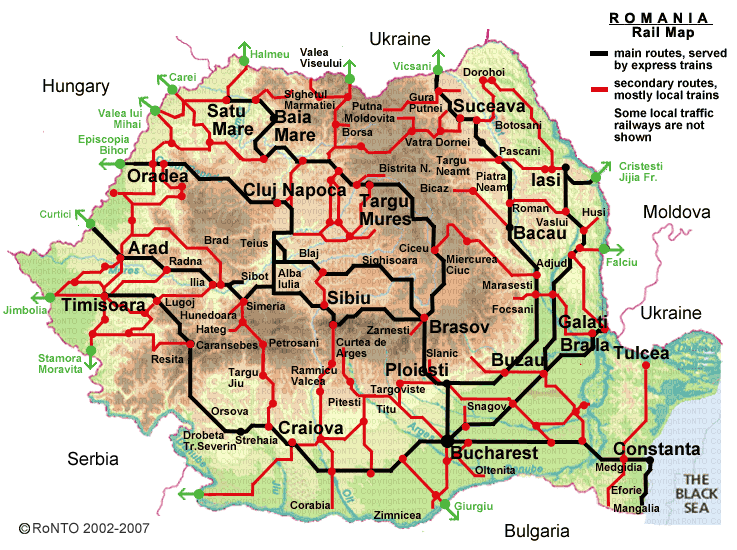
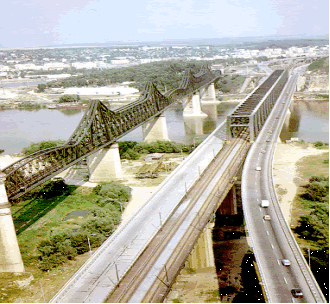
On 26 May 1984, Mr. and Mrs. Far Outliers were close to finishing a grim but fascinating year in Romania. We took a day trip by train from Bucharest to Constanta and back in the spring of 1984, crossing the Danube bridge and looking for the traces of the shortcut canal that so many Romanian dissidents spent their last years digging. The train was jam-packed, with people standing a handspan away from our heads blowing smoke into our hair. I finally tried to open a window. What an uproar that caused! Real springtime air on uncovered heads was deemed far more deadly than cigarette smoke in our lungs. In Constanta, we visited an impressive (but empty) mosque and the history museum, had lunch at a faded rococo casino, and were forbidden to take photos of the picturesque Port Tomis, lest it betray secrets to the U.S. (or Turkish?) navy.

Halfway Down the Danube has more.

Leave a comment

Filed under Romania