Category Archives: Eastern Europe

How Best to Reharvest a Ruined Past

From History of the Present: Essays, Sketches, and Dispatches from Europe in the 1990s, by Timothy Garton Ash (Vintage, 1999), pp. 276-277:

There is probably no such thing as a good purge, even if it is politely called lustration. The Czechoslovak lustration was prompt and crudely effective but deeply flawed by procedural injustice. The German “gaucking” has been procedurally more just: careful, individual, appealable. But it has sometimes been perverted by media abuse, and it has suffered from elephantiasis. Did postmen and train drivers really need to be gaucked? Again we come back to the question of who is doing it, for would the West Germans ever have done this to themselves?

Yet Poland has shown the price of not purging. The Hungarians, with their nice habit of taking the German model and then improving on it, came up with a defensible refinement: It applied careful individual scrutiny only to those seeking senior positions in public life. But this was seven years late. Now Poland has finally followed suit, with a law that is probably the most scrupulous of them all.

I believe the third path—that of history lessons—has been the most promising in Central Europe. Much of the comparative literature comes to a similar conclusion for other countries: What is somewhat biblically called “truth-telling” is both the most desirable and the most feasible way to grapple with a difficult past. This is what West Germany did best in relation to Nazism, at least from the 1960s on. What united Germany has done in this regard since 1990 has been exemplary: the parliamentary commission, the open archives, the unique opportunity for a very personal history lesson given by access to the Stasi files.

To advocate the third path does, of course, assign a very special place to contemporary historians. In fact, I do think that if you ask “Who is best equipped to do justice to the past?” the answer is, or at least should be, historians. But this is also a heavy responsibility. Truth is a big word, so often abused in Central Europe during the short, rotten twentieth century that people there have grown wary of it. Studying the legacy of a dictatorship, one is vividly reminded how difficult it is to establish any historical truth. In particular, across such a change of regime, you discover how deeply unreliable is any retrospective testimony.

Yet studying this subject also strengthens one’s allergy to some of the bottomless, ludic frivolities of postmodernist historiography. For this is too serious a business. Carelessly used, the records of a state that worked by organized lying—and especially the poisonous, intrusive files of a secret police—can ruin lives. To interpret them properly tests the critical skills that historians apply routinely to a medieval charter or an eighteenth-century pamphlet. But, having worked intensively with such records and read much else based on them, I know that it can be done. It is not true, as is often claimed, that this material is so corrupted that one cannot write reliable history on the basis of it. The evidence has to be weighed with very special care. The text must be put in the historical context. Interpretation needs both intellectual distance and the essential imaginative sympathy with all the men and women involved—even the oppressors. But, with these old familiar disciplines, there is a truth that can be found. Not a single, absolute Truth with a capital T but still a real and important one.

Leave a comment

Filed under democracy, Eastern Europe

Prague, 1994: Fractured Intelligentsia

From History of the Present: Essays, Sketches, and Dispatches from Europe in the 1990s, by Timothy Garton Ash (Vintage, 1999), p. 141:

The intelligentsia—one of the characteristic phenomena of modern Central and East European history—is now everywhere engulfed in sweeping change. This world of “circles of friends,” of milieux, where artists, philosophers, writers, economists, journalists all felt themselves to belong to the same group and to be committed to a certain common ethos (albeit often honored in the breach), was something anachronistic in late-twentieth-century Europe—but also something rich and fine. Its extraordinary character was summed up for me in a phrase that Ivan Klíma used in describing how he and his fellow writers had set out to revive the dormant Czech PEN club in 1989. “I was,” he said, “authorized by my circle of friends.” The peculiar world of the intelligentsia under communism was one in which you sought authorization from your circle of friends.

Freedom has changed all that. With remarkable speed, the intelligentsia has fragmented into separate professions, as in the West: journalists, publishers, academics, actors, not to mention those who have become officials, lawyers, diplomats. The milieux have faded, the “circles of friends” have dispersed or lost their special significance. Those who have remained in purely “intellectual” professions—above all, academics—have found themselves impoverished. Moreover, it is the businessmen and entrepreneurs who are the tone-setting heroes of this time. Thus, from having an abnormal importance before 1989, independent intellectuals have plummeted to abnormal unimportance.

1 Comment

Filed under democracy, Eastern Europe, philosophy

Out of Town on a Eurail

The Far Outliers will be on the road again for the next month, traveling by air, shank’s mare, and Eurail pass. Today we fly to Boston to visit our daughter for a week, then fly on to Frankfurt on Christmas Day on our way to Strasbourg to visit my historian brother who’s supervising a study-abroad program there. We plan to visit friends in Brittany the weekend of 4 January and make a return trip to Bucharest the weekend of 11 January, with a stop in Miklósvár in Székelyland, Transylvania, on the way there.

My brother speaks pretty good Central African French, and I’ve been working on reviving and expanding my high school French—il y a quarante ans! (I also passed a graduate reading exam in French.) Mrs. O and I can get around a bit in our high school German, and we will make a pilgrimage to the Black Forest town of Pfalzgrafenweiler from which her paternal ancestors emigrated to Ukraine during the Napoleonic era, only to emigrate to the Dakotas during the third Tsar-Alexandrine era and first or second President-Clevelandic era. I haven’t been working on my Ceauşescu-era Romanian, but I’m pretty sure it’ll come back enough to get around. We had hoped to branch out in more northerly and southerly directions from Strasbourg, but our long east–west jaunts won’t leave us much time.

While we’re away, you can get some interesting perspectives about where we’ll be by exploring Europe Endless (formerly Rhine River), Notes from a Tunnel, and the always entertaining travels of Dumneazu. If you can’t ignore Asia for that long, the latest Asian History Carnival at Frog in a Well should provide you with a lot of good reading.

Auf Wiedersehen, au revoir, şi la revedere.

1 Comment

Filed under France, Germany, Romania, travel

To Ceausescu and Back: Notes from a Tunnel

I recently discovered a new autobiographical blog called Notes from a Tunnel by someone who “was born as a member of the Hungarian minority in Transylvania, a child during Ceausescu’s dark 1970s, a teenager during the surreal Romanian ’80s, a student during the radical ’90s and a visiting émigré in recent years.” Here are some of the blogger’s earliest recollections about life in Romania during those years.

The First Glance Back

The following recollections though, from the Romanian pre- and post-Revolutionary years, are street-level snapshots with often surprising similarities between the old and the new country. They come together not as a grand portal into the past and quasi-present, but a small window for just one head at a time to peer through it….Having left that country eleven years ago, returning there regularly to this day, I can still meet and converse with many ghosts, ghosts cosily nesting in the altered, recently became ultra-material(istic) world of the Carpathian mountains.

This is about both the past when those ghosts still possessed powerful bodies in my weathered homeland, making Europe seem just some distant mirage, and the present when that world, still silently and slowly being kneaded by these ghosts, has gone through hasty re-decorating for its welcome party into a suddenly so reachable and tangible Europe…

It is also about the surprising and worrying parallels that one sees between that, thought to be defunct, world and the present day experiences in a historical democracy, the latter paradoxically resorting to exponentially increasing amounts of control in an attempt to safeguard its values…

Home

My home town, Marosvasarhely… A medieval city in Transylvania, comfortably resting in the valley of river Maros, in just one of the many valleys which spread themselves on the map like half-open protecting hands… Valleys that so often were not protective enough, but at least were able to soften the sounds of thunderstorms and too numerous battles into a gentle rumble that used to reverberate along the many rivers of that bruised land… A town that in peacetime used to gaze down on lively markets unfolding their tents on the plains outside its old walls… hence its name, ‘marketplace on river Maros’ ….

All this sits pretty much right in the middle of Transylvania where eminently non-fictional creatures have been spilling and consuming blood for too many centuries. They did this in broad daylight, totally immune to garlic, casting onto those hills and plains of ever-changing colour very long and dense shadows which persist to this day in political life, in the ethnic tensions arising from the echoes of annexing the former Hungarian territory to Romania… These shadows are also present in the collective psyche that only in the last few years was freed from the most recent non-fictional, demented, but so calculated Evil.

I grew up there, during Ceausescu’s ‘Golden Era’… and can’t recall whether there was a certain moment when I realised that everything surrounding me was a tragicomic absurd play, set in a theatre made to seem considerably smaller than the world entire.

I still find it difficult to reconcile those two sides of me… One, the small kid opening his eyes and ears tentatively and initially very fearfully, a happy kid enjoying to the max a very minimalist childhood, accepting the food rationing and powercuts, propaganda and fake celebrations as the normal and, above all, the only possible reality. Then there is the other person, the grown-up looking back and finding that weird reality filled with funny and sad absurdities, contradictions still tying the mind into a confusing identity-warping knot.

Light

My school days and years came after I learnt the fundamental physics of light and heat. Not the complex laws defining and governing them, but how ideological darkness and cold calculation can alter them when it came to what I then perceived as normal everyday existence. The joyous and by all means luminous play of the mind that took over for brief hours my early school days was quite opposite to what came after school, when due to shortages of class rooms we started doing ‘afternoon shifts’ alternating with our normal weeks of 8AM daily start…

I was finding my way on streets rendered pitch black by power saving measures, with constellations of warm orange and yellow and reddish dots, daubs and flecks of lights coming through the windows, coming from kerosene lamps and candles and the occasional battery-powered torches, projecting shadows of tired bodies animated by tired souls inhabiting the houses and block flats.

The economics of these cuts didn’t make any sense, as the consumption of the population was infinitesimal compared to what was engorged by old-fashioned, hopelessly obsolete industrial monsters. For example, the aluminium plant at Slatina was making deplorable quality aluminium with old electrolysis methods, soaking up every electron that the also inefficient power plants around it could squeeze out of low-grade coal or methane.

Leave a comment

Filed under Romania

Mongolians, Estonian Dominate Sumo Tourney

In the absence of Asashoryu, who has been under suspension, the junior and better-behaved Mongolian yokozuna, Hakuho (12-3), won his 5th Grand Sumo Tournament, while the smallest Mongolian, Ama (10-5), won his 2nd Outstanding Performance Award; the giant Estonian, Baruto (11-4), won his 2nd Fighting Spirit Award; and Fukuoka native Kotoshogiku (9-6) won his 2nd Technique Prize. I think they should hold the Natsu Basho (in May) in Ulan Bator instead of Tokyo each year. There are now seven Mongolians in the Makuuchi ranks and five in the Juryo ranks.

Leave a comment

Filed under Eastern Europe, Japan, Mongolia, sumo

Kosovars Sick of U.N. Occupation

Sunday’s Washington Post reports on the frustrations of Kosovars under occupation by the U.N.

PRISTINA, Kosovo My cabby curses at the white Nissan Patrol blocking a teeming intersection in Pristina. The SUV’s driver, a Pakistani U.N. worker, desperately jerks the gearshift while angry hooting builds from the cars behind him. Something inside my cabby snaps, and he roars with laughter: “First the Turks. Then the Serbs. And now? We are invaded by Pakistan!”

That’s right, he called the U.N. worker an invader. But you can hardly blame him. The man driving the Nissan Patrol is part of the most extensive U.N. operation in history, one that wore out its welcome long ago….

To understand this resentment, consider the case of a 70-year-old Kosovar widow who awoke one morning in December 2000 to find her telephone disconnected because of an unpaid bill. The bill wasn’t hers, she protested — it belonged to the international manager of Kosovo’s power company named Joe Trutschler who rented her home in Pristina. When the telephone company contacted him about the bill, he denied responsibility for the calls, even though they were made to his home phone number in Germany.

The widow didn’t give up. She didn’t have much choice: The bill was for the equivalent of $5,100, a year and a half’s salary in Kosovo. But when she appealed to U.N. officials, they claimed no responsibility for an employee’s private activities, she said. She filed a complaint at the local court in Pristina, only to learn that, as a U.N. employee, Trutschler enjoyed immunity in Kosovo.

Trutschler, who got his job with a bogus résumé that was never checked by U.N. officials, didn’t just bilk his landlady. In 2003, he was convicted in Germany of embezzling the equivalent of $4.3 million from the Kosovo power company, and he was recently named in newspaper reports as one of 11 suspects being investigated for bilking $10 million from the water company. Meanwhile, the widow’s phone is still dead.

Only 30 percent of Kosovars have faith in the United Nations, according to a U.N. bulletin in fall 2006 — half the number that believed in the international administration four years ago. Fifty percent of the population is prepared to participate in organized protests against the world community, U.N. reports say. It’s easy to see why. Kosovars have watched fraudsters use U.N. immunity to escape justice and seen foreign companies pocket millions of dollars in aid without delivering meaningful results….

Kosovo’s gross domestic product is scandalously low. Kosovars use soap from Bulgaria and wear T-shirts from Taiwan. Their flour comes from the Czech Republic and their drinking water from Hungary. As long as Kosovo remains a U.N. protectorate, a non-country, outside business investments will never come.

But what investments do you need to grow cucumber? While their own fields lie fallow, Kosovars eat tomatoes from Turkey and lettuce from Italy. It pays better to sell chewing gum to internationals than to toil in the fields. And eight years after the war, the local courts appointed and supervised by the United Nations still have not sorted out who owns the fields.

The United Nations could argue that it lacks the funds to pay judges. But then why does it pay an employee from Sierra Leone more than $11,000 per month to teach Kosovars how to run their railroads? The Kosovar railroad workers, who survive on just over $200 per month, were more than a little offended to learn that Sierra Leone’s last trains stopped running in 1975. Their teacher was an expert on harbors.

U.N. top brass knows full well that Kosovars are losing patience. Last year Inga-Britt Ahlenius, U.N. undersecretary general for internal oversight services, warned if the administration continued to ignore corruption, the whole mission could be jeopardized. “[T]he reluctance by senior Mission management to address fraud and corruption will have a devastating impact on public perception inside and outside of Kosovo,” she wrote.

via LaurenceJarvikOnline

UPDATE: Doug Muir at A Fistful of Euros wonders whether Kosovo is destined to become a Balkan Taiwan.

Leave a comment

Filed under Eastern Europe, U.N.

A Father Confessor Researcher in Ukraine

Saturday’s New York Times carries a fascinating report by Elaine Sciolino on a remarkable research project undertaken by a priest who also doubles as a father confessor to the historical actors whose belated confessions he elicits.

The Nazis killed nearly 1.5 million Jews in Ukraine after their invasion of the Soviet Union in June 1941. But with few exceptions, most notably the 1941 slaughter of nearly 34,000 Jews in the Babi Yar ravine in Kiev, much of that history has gone untold.

Knocking on doors, unannounced, Father Desbois, 52, seeks to unlock the memories of Ukrainian villagers the way he might take confessions one by one in church.

“At first, sometimes, people don’t believe I’m a priest,” said Father Desbois in an interview this week. “I have to use simple words and listen to these horrors — without any judgment. I cannot react to the horrors that pour out. If I react, the stories will stop.”

Over four years, Father Desbois has videotaped more than 700 interviews with witnesses and bystanders and has identified more than 600 common graves of Jews, most of them previously unknown. He also has gathered material evidence of the execution of Jews from 1941 to 1944, the “Holocaust of bullets” as it is called.

Often his subjects ask Father Desbois to stay for a meal and to pray, as if to somehow bless their acts of remembrance. He does not judge those who were assigned to carry out tasks for the Nazis, and Holocaust scholars say that is one reason he is so effective….

Father Desbois became haunted by the history of the Nazis in Ukraine as a child growing up on the family farm in the Bresse region of eastern France. His paternal grandfather, who was deported to a prison camp for French soldiers in Rava-Ruska, on the Ukrainian side of the Polish border, told the family nothing about the experience. But he confessed to his relentlessly curious grandson, “For us it was bad, for ‘others’ it was worse.”…

To verify witnesses’ testimony, Father Desbois relies heavily on a huge archive of Soviet-era documents housed in the Holocaust museum in Washington, as well as German trial archives. He registers an execution or a grave site only after obtaining three independent accounts from witnesses.

Only one-third of Ukrainian territory has been covered so far, and it will take several more years to finish the research. A notice at the exit of the Paris exhibit asks that any visitor with information about victims of Nazi atrocities in Ukraine leave a note or send an e-mail message.

“People talk as if these things happened yesterday, as if 60 years didn’t exist,” Father Desbois said. “Some ask, ‘Why are you coming so late? We have been waiting for you.’”

2 Comments

Filed under religion, Ukraine, war

Judt on Ceausescu and His Downfall

I’ve been rationing my posts from the eminently quotable Judt in order to excerpt this whole section on Nicolae Ceauşescu (illustrated with my own photos from 1984) from Postwar: A History of Europe Since 1945, by Tony Judt (Penguin, 2005), pp. 622-626:

[I]t seems clear that in December 1989 one faction within the ruling Romanian Workers’ Party did indeed decide that its best chance of survival lay in forcibly removing the ruling coterie around Nicolae Ceauşescu. Romania, of course, was not a typical Communist state. If Czechoslovakia was the most western of the Communist satellite countries, Romania was the most ‘oriental’. Under Ceauşescu, Communism had degenerated from national Leninism to a sort of neo-Stalinist satrapy, where Byzantine levels of nepotism and inefficiency were propped in place by a tentacular secret police.

Compared with Dej’s vicious dictatorship of the Fifties, Ceauşescu’s regime got by with relatively little overt brutality; but the rare hints of public protest—strikes in the Jiu mining valley in August 1977, for example, or a decade later at the Red Star tractor works in Braşov—were violently and effectively suppressed. Moreover, Ceauşescu could count not only on a cowed population but also upon a remarkable lack of foreign criticism for his actions at home: eight months after imprisoning the strike leaders in the Jiu Valley (and murdering their leaders) the Romanian dictator was visiting the United States as the guest of President Jimmy Carter. By taking his distance from Moscow—we have seen how Romania abstained from the 1968 invasion of Czechoslovakia—Ceauşescu bought himself freedom of maneuver and even foreign acclaim, particularly in the early stages of the ‘new’ Cold War of the 1980s. Because the Romanian leader was happy to criticize the Russians (and send his gymnasts to the Los Angeles Olympics), Americans and others kept quiet about his domestic crimes.* (*At least until the rise of Mikhail Gorbachev, after which the West had no further use for an anti-Soviet maverick.)

Romanians, however, paid a terrible price for Ceauşescu’s privileged status. In 1966, to increase the population—a traditional ‘Romanianist’ obsession—he prohibited abortion for women under forty with fewer than four children (in 1986 the age barrier was raised to forty-five). In 1984 the minimum marriage age for women was reduced to fifteen. Compulsory monthly medical examinations for all women of childbearing age were introduced to prevent abortions, which were permitted, if at all, only in the presence of a Party representative. Doctors in districts with a declining birth rate had their salaries cut.
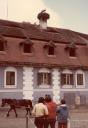
Stork nest, Rasinari, 1984The population did not increase, but the death rate from abortions far exceeded that of any other European country: as the only available form of birth control, illegal abortions were widely performed, often under the most appalling and dangerous conditions. Over the ensuing twenty-three years the 1966 law resulted in the death of at least ten thousand women. The real infant mortality rate was so high that after 1985 births were not officially recorded until a child had survived to its fourth week—the apotheosis of Communist control of knowledge. By the time Ceauşescu was overthrown the death rate of new-born babies was twenty-five per thousand and there were upward of 100,000 institutionalized children.

The setting for this national tragedy was an economy that was deliberately turned backward, from subsistence into destitution. In the early Eighties, Ceauşescu decided to enhance his country’s international standing still further by paying down Romania’s huge foreign debts. The agencies of international capitalism—starting with the International Monetary Fund—were delighted and could not praise the Romanian dictator enough. Bucharest was granted a complete rescheduling of its external debt. To payoff his Western creditors, Ceauşescu applied unrelenting and unprecedented pressure upon domestic consumption.

In contrast to Communist rulers elsewhere, unrestrainedly borrowing abroad to bribe their subjects with well-stocked shelves, the Romanian Conducator set about exporting every available domestically-produced commodity. Romanians were forced to use 40-watt bulbs at home (when electricity was available) so that energy could be exported to Italy and Germany. Meat, sugar, flour, butter, eggs, and much more were strictly rationed. To ratchet up productivity, fixed quotas were introduced for obligatory public labour on Sundays and holidays (the corvée, as it was known in ancien régime France).
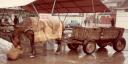
Horsecart in Sibiu, 1984Petrol usage was cut to the minimum: in 1986 a program of horse-breeding to substitute for motorized vehicles was introduced. Horse-drawn carts became the main means of transport and the harvest was brought in by scythe and sickle. This was something truly new: all socialist systems depended upon the centralized control of systemically induced shortages, but in Romania an economy based on over-investment in unwanted industrial hardware was successfully switched into one based on pre-industrial agrarian subsistence.

Plowing with oxen in the western mountains of Romania, 1984Ceauşescu’s policies had a certain ghoulish logic. Romania did indeed payoff its international creditors, albeit at the cost of reducing its population to penury. But there was more to Ceauşescu’s rule, in his last years, than just crazy economics. The better to control the country’s rural population—and increase still further the pressure on peasant farmers to produce food for export—the regime inaugurated a proposed ‘systematization’ [sistematizare] of the Romanian countryside. Half of the country’s 13,000 villages (disproportionately selected from minority communities) were to be forcibly razed, their residents transferred into 558 ‘agro-towns’. Had Ceauşescu been granted the time to carry through this project it would utterly have destroyed what little remained of the country’s social fabric.

The rural ‘systemization’ project was driven forward by the Romanian dictator’s mounting megalomania. Under Ceauşescu the Leninist impulse to control, centralize and plan every detail of daily life graduated into an obsession with homogeneity and grandeur surpassing even the ambitions of Stalin himself. The enduring physical incarnation of this monomaniacal urge was to be the country’s capital, scheduled for an imperial make-over on a scale unprecedented since Nero. This project for the ‘renovation’ of Bucharest was to be aborted by the coup of December 1989; but enough was done for Ceauşescu’s ambition to be indelibly etched into the fabric of the contemporary city. A historic district of central Bucharest the size of Venice was completely flattened. Forty thousand buildings and dozens of churches and other monuments were razed to make space for a new ‘House of the People’ and the five-kilometer-long, 150-meter-wide Victory of Socialism Boulevard.

The whole undertaking was mere façade. Behind the gleaming white frontages of the boulevard were run up the familiar dirty, grim, pre-cast concrete blocks. But the façade itself was aggressively, humiliatingly, unrelentingly uniform, a visual encapsulation of totalitarian rule. The House of the People, designed by a twenty-five-year-old architect (Anca Petrescu) as Ceauşescu’s personal palace, was indescribably and uniquely ugly even by the standards of its genre. Grotesque, cruel and tasteless it was above all big (three times the size of the Palace of Versailles …). Fronted by a vast hemicycle space that can hold half a million people, its reception area the size of a football pitch, Ceauşescu’s palace was (and remains) a monstrous lapidary metaphor for unconstrained tyranny, Romania’s very own contribution to totalitarian urbanism.
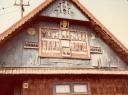
Woodcutter’s pantheon, Maramures, 1984Romanian Communism in its last years sat uneasily athwart the intersection of brutality and parody. Portraits of the Party leader and his wife were everywhere; his praise was sung in dithyrambic terms that might have embarrassed even Stalin himself (though not perhaps North Korea’s Kim Il Sung, with whom the Romanian leader was sometimes compared). A short list of the epithets officially-approved by Ceauşescu for use in accounts of his achievements would include: The Architect; The Creed-shaper; The Wise Helmsman; The Tallest Mast; The Nimbus of Victory; The Visionary; The Titan; The Son of the Sun; A Danube of Thought; and The Genius of the Carpathians.

What Ceauşescu’s sycophantic colleagues really thought of all this they were not saying. But it is clear that by November 1989—when, after sixty-seven standing ovations, he was re-elected Secretary General of the Party and proudly declared that there were to be no reforms—a number of them had begun to regard him as a liability: remote and out of touch not just with the mood of the times but with the rising level of desperation among his own subjects. But so long as he had the backing of the secret police, the Securitate, Ceauşescu appeared untouchable.

Timisoara cathedral, 1984Appropriately enough, then, it was the Securitate who precipitated the regime’s fall when, in December 1989, they tried to remove a popular Hungarian Protestant pastor, Lázslo Tökés, in the western city of Timisoara. The Hungarian minority, a special object of prejudice and repression under Ceauşescu’s rule, had been encouraged by developments just across the border in Hungary and were all the more resentful at the continuing abuses to which they were subject at home. Tökés became a symbol and focus for their frustrations and, when the regime targeted him on December 15th, the church in which he had taken refuge was surrounded by parishioners holding an all-night vigil in his support.

The following day, as the vigil turned unexpectedly into a demonstration against the regime, the police and the army were brought out to shoot into the crowd. Exaggerated reports of the ‘massacre’ were carried on Voice of America and Radio Free Europe and spread around the country. To quell the unprecedented protests, which had now spread from Timisoara to Bucharest itself, Ceauşescu returned from an official visit to Iran. On December 21st he appeared on a balcony at Party headquarters with the intention of making a speech denouncing the ‘minority’ of ‘troublemakers’—and was heckled into shocked and stunned silence. The following day, after making a second unsuccessful attempt to address the gathering crowds, Ceauşescu and his wife fled from the roof of the Party building in a helicopter.

At this point the balance of power swung sharply away from the regime. At first the army had appeared to back the dictator, occupying the streets of the capital and firing on demonstrators who tried to seize the national television studios. But from December 22nd the soldiers, now directed by a ‘National Salvation Front’ (NSF) that took over the television building, switched sides and found themselves pitted against heavily armed Securitate troops. Meanwhile the Ceauşescus were caught, arrested and summarily tried. Found guilty of ‘crimes against the state’ they were hastily executed on Christmas Day, 1989.* (*The trial and execution by firing squad were filmed for television, but not shown until two days later.)

The NSF converted itself into a provisional ruling council and—after renaming the country simply ‘Romania’—appointed its own leader Ion Iliescu as President. Iliescu, like his colleagues in the Front, was a former Communist who had broken with Ceauşescu some years before and who could claim some slight credibility as a ‘reformer’ if only by virtue of his student acquaintance with the young Mikhail Gorbachev. But Iliescu’s real qualification to lead a post-Ceauşescu Romania was his ability to control the armed forces, especially the Securitate, whose last hold-outs abandoned their struggle on December 27th. Indeed, beyond authorizing on January 3rd 1990 the re-establishment of political parties, the new President did very little to dismantle the institutions of the old regime.

As later events would show, the apparatus that had ruled under Ceauşescu remained remarkably intact, shedding only the Ceauşescu family itself and their more egregiously incriminated associates. Rumours of thousands killed during the protests and battles of December proved exaggerated—the figure was closer to one hundred—and it became clear that for all the courage and enthusiasm of the huge crowds in Timisoara, Bucharest and other cities the real struggle had been between the ‘realists’ around Iliescu and the old guard in Ceauşescu’s entourage. The victory of the former ensured for Romania a smooth—indeed suspiciously smooth—exit out of Communism.

The absurdities of late-era Ceauşescu were swept away, but the police, the bureaucracy and much of the Party remained intact and in place. The names were changed—the Securitate was officially abolished—but not their ingrained assumptions and practices: Iliescu did nothing to prevent riots in Tirgu Mures on March 19th, where eight people were killed and some three hundred wounded in orchestrated attacks on the local Hungarian minority. Moreover, after his National Salvation Front won an overwhelming majority in the elections of May 1990 (having earlier promised not to contest them), and he himself was formally re-elected President, Iliescu did not hesitate in June to bus miners in to Bucharest to beat up student protesters: twenty-one demonstrators were killed and some 650 injured. Romania still had a very long road to travel.

Leave a comment

Filed under Romania

Judt on Spies: Professional, Part-time, Freelance, & Volunteer

From Postwar: A History of Europe Since 1945, by Tony Judt (Penguin, 2005), pp. 697-698:

The Communist regimes did not merely force their rule upon a reluctant citizenry; they encouraged people to collude in their own repression, by collaborating with the security agencies and reporting the activities and opinions of their colleagues, neighbours, acquaintances, friends and relations. The scale of this subterranean network of spies and informers varied from country to country but it was present everywhere.

The consequence was that while the whole society thus fell under suspicion—who might not have worked for the police or the regime at some moment, even if only inadvertently?—by the same token it became hard to distinguish venal and even mercenary collaboration from simple cowardice or even the desire to protect one’s family. The price of a refusal to report to the Stasi might be your children’s future. The grey veil of moral ambiguity thus fell across many of the private choices of helpless individuals. Looking back, who—save a handful of heroic and unwavering dissidents—could pass judgment? And it is striking that many of those same former dissidents—Adam Michnik prominent among them—were the most vigorously opposed to any retribution for their fellow citizens….

In Germany … revelations concerning the size and reach of the state security bureaucracy had astonished the nation. It turned out that in addition to its 85,000 full-time employees the Stasi had approximately 60,000 ‘unofficial collaborators’, 110,000 regular informers and upwards of half a million ‘part-time’ informers, many of whom had no means of knowing that they even fell into such a category.* (*By way of comparison, the Gestapo in 1941 had a staff of fewer than 15,000 to police the whole of greater Germany.) Husbands spied on wives, professors reported on students, priests informed on their parishioners. There were files on 6 million residents of former East Germany, one in three of the population. The whole society had in effect been infiltrated, atomized and polluted by its self-appointed guardians.

To lance the boil of mutual fear and suspicion, the Federal Government in December 1991 appointed a Commission under the former Lutheran minister Joachim Gauck to oversee the Stasi files and prevent their abuse. Individuals would be able to ascertain whether they had a ‘file’ and then, if they wished, come and read it. People would thus learn—sometimes with devastating domestic consequences—who had been informing on them; but the material would not be open to the public at large. This was an awkward compromise but, as it turned out, quite successful: by 1996, 1,145,000 people had applied to see their files. There was no way to undo the human damage, but because the Gauck Commission was trusted not to abuse its powers the information it controlled was hardly ever exploited for political advantage.

Two out of four of my East German classmates in Romanian language class in Bucharest in 1983-84 were politically reliable and spying on the other two, as I discovered when I chanced upon one of the unreliables at a reception in the West German embassy. She panicked and implored me not to tell anyone. I didn’t, and when I went to the female foreign student dorm to pass my shortwave radio/cassette player on to one of my Chinese classmates before leaving Romania, Miss Unreliable insisted on giving me a grateful good-bye kiss. Saucy wench. I hope she and her fellow Unreliable survived reunification.

All my German classmates were primarily Russian translator/interpreters who added Romanian as backup. So perhaps one or both of the Reliables are now translating for former German Chancellor Gerhard Schroeder while he works for the Russians.

Leave a comment

Filed under Eastern Europe, Germany

Judt on New, Not Old, Fissions in Yugoslavia

From Postwar: A History of Europe Since 1945, by Tony Judt (Penguin, 2005), pp. 670-671:

Kosovo had historic significance for Serb nationalists as the last holdout of medieval Serbia against the advance of the Turks and the site of a historic battlefield defeat in 1389. The local Albanian predominance was thus regarded by some Serb intellectuals and politicians as both demographically troubling and historically provocative—especially since it echoed the Serbs’ displacement by Muslims as the largest minority in the adjacent Bosnian republic. Serbs, it appeared, were losing out-to hitherto subservient minorities who had benefitted from Tito’s rigorous enforcement of federal equality. Kosovo was thus a potentially explosive issue, for reasons linked only tenuously to ‘age-old’ Balkan feuds….

Whereas Serb dislike of Albanians fed on proximity and insecurity, in the far north of Yugoslavia the growing distaste for feckless southerners was ethnically indiscriminate and based not on nationality but economics. As in Italy, so in Yugoslavia, the more prosperous north was increasingly resentful of impoverished southerners, sustained—as it seemed—by transfers and subsidies from their more productive fellow citizens. The contrast between wealth and poverty in Yugoslavia was becoming quite dramatic: and it correlated provocatively with geography.

Thus while Slovenia, Macedonia and Kosovo all had approximately the same share (8 percent) of the national population, in 1990 tiny Slovenia was responsible for 29 percent of Yugoslavia’s total exports while Macedonia generated just 4 percent and Kosovo 1 percent. As best one can glean from official Yugoslav data, per capita GDP in Slovenia was double that of Serbia proper, three times the size of per capita GDP in Bosnia and eight times that of Kosovo. In Alpine Slovenia the illiteracy rate in 1988 was less than 1 percent; in Macedonia and Serbia it was 11 percent. In Kosovo it stood at 18 percent. In Slovenia by the end of the 1980s the infant mortality rate was 11 deaths per 1,000 live births. In neighbouring Croatia the figure was 12 per 1,000; in Bosnia, 16 per 1,000. But in Serbia the figure was 22 per 1,000, in Macedonia, 45 per 1,000 and in Kosovo, 52 per 1,000.

What these figures suggest is that Slovenia and (to a lesser extent) Croatia already ranked alongside the less prosperous countries of the European Community, while Kosovo, Macedonia and rural Serbia more closely resembled parts of Asia or Latin America. If Slovenes and Croats were increasingly restive in their common Yugoslav home, then, this was not because of a resurfacing of deep-rooted religious or linguistic sentiments or from a resurgence of ethnic particularism. It was because they were coming to believe that they would be a lot better off if they could manage their own affairs without having to take into account the needs and interests of underachieving Yugoslavs to their south.

Leave a comment

Filed under Eastern Europe, economics, nationalism