Category Archives: Ethiopia

Head Heeb on the Somalian Regional Proxy War

The ever-vigilant Head Heeb has been closely following the growing likelihood of a regional proxy war in Somalia. Here is are the final paragraphs of his latest post.

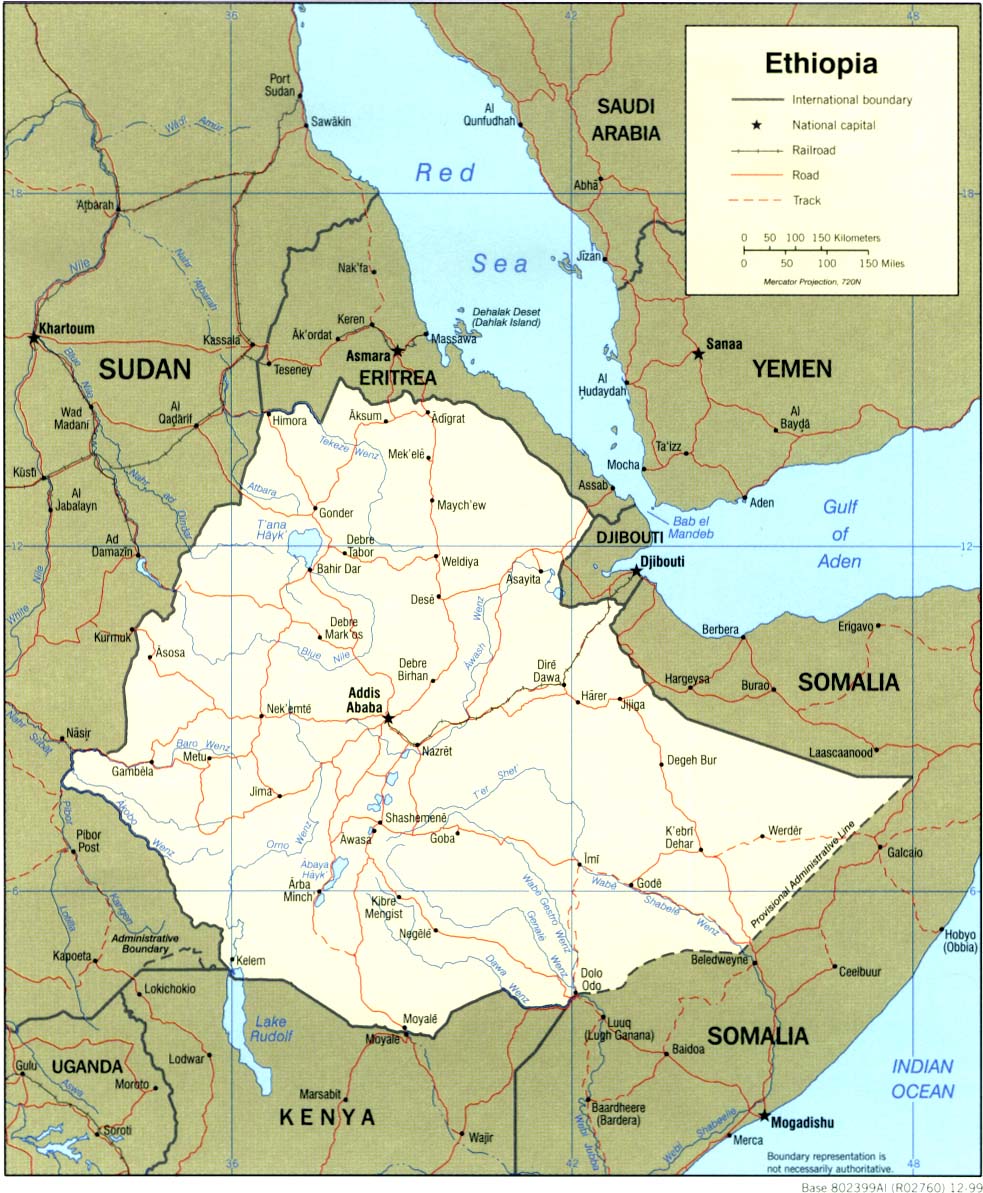
Ethiopia and its local allies will push south from Puntland at the same time as they try to break the encirclement of Baidoa. This may, in turn, spiral into a proxy war; the same UN report that estimated the Ethiopian troop presence at 6000 to 8000 noted ominously that up to 2000 Eritrean soldiers may be in the country fighting on the Islamist side. In addition to Ethiopia’s jitters over the possibility that an Islamist state in Somalia might support domestic insurgencies, its fears of a second front against its long-time regional enemy now seem to be materializing.

And as if this isn’t enough, the possibility of Somalia being torn apart in a regional proxy war has a truly ironic postscript. A report on the fighting in the Independent notes sardonically that “the Palestinians are next in line to take over as head of the Arab League – raising the bizarre prospect of the Somali peace talks (if they are ever restarted) moving from Khartoum to Gaza.” Bizarre this may be, but not necessarily inappropriate. Given the number of contending factions in Somalia, the diversity of their interests, the unlikelihood that they can be persuaded to compromise and the number of foreign countries that want a hand in the outcome, Gaza might be the perfect place for them to negotiate.

Leave a comment

Filed under Africa, Eritrea, Ethiopia, Somalia, war

South Korean Advice to Ethiopia

Ethiopundit posts excerpts from an interview with South Korea’s ambassador to Ethiopia that appeared in The (Ethiopian) Reporter in March of 2003.

The interviewer questioned him about the prospects for increased economic ties between the two countries and the Ambassador gave some frank responses.

The headline in The Reporter says a lot: “You have lost four decades. When Koreans were working hard what did you do?”

Ethiopundit compiles his own summary of the past four decades of conflict, with extended commentary

The link between peace and development seems to be an obvious one but it always needs emphasis. Tragically, modern Ethiopian history is largely defined by war and rumors of war. Here is a partial list of just the bloodiest internal ones and their aftermath that have consumed the past four decades and caused a steady erosion of per capita GNP.

Eritrean War of Independence 1961-1993 After a long colonization by Italy that Ethiopia was spared, Eritrea was federated then absorbed by Ethiopia. Many Eritreans resented the strictures of the reunion early on. However, it was the coming of the Marxist military dictatorship, the Dergue, and its bloody depridations from 1974 on, that pushed the conflict from one of occasional banditry to a full scale war for independence.

Ethiopian Civil War 1974-1991 The current Ethiopian government, an ostensibly ethnically based group adherent to Marxism, was allied with the regionally based Eritrean rebels and together they overthrew the Dergue.

Now for a list of the external wars being fought in the same time period.

The Greater Somalia Movement and Ethiopian-Somalian Border Clashes 1960-2004 The Somali flag chosen upon independence in 1960 held a five pointed star. Each point represented a ‘Somali’ region but only two of them were in Somalia. Thus from birth Somali governments were dedicated above all to the conquest of all of Djibouti (now independent and under French protection, then a colony of France), North-Eastern Kenya and almost a third of Ethiopia covering large swathes of territory in the Ogaden region and the South. Under the guise of liberation movements Somali irregulars and the Somali army began a campaign of continous destabilization of Ethiopia (which was apparently given the honor of first place on the list of star points to color in on the Somali flag). Somalia’s current chaos is largely due to its flawed national mission decided upon by its leaders at birth. The border conflict continues today as occasional Somali Islamist groups with designs on Ethiopia are often pursued across the border.

The Ogaden War 1977-1978 Somalia figured its moment had come in 1977 when an Ethiopia weakened by the disruptions of Dergue misrule and the Eritrean war was attacked. This led to a game of international musical chairs. Although well on the way to becoming a strategic enemy of the U.S., the Dergue turned solidly towards the Soviet camp by expelling American military advisors and signing deals for billions in arms with Moscow. The Soviets who had bankrolled and encouraged the Somali aggressions since the early 1960s did not mind when Somalia expelled them fron their bases. Attempts by the Somalis to reach out to the Carter Administration were not successful. Along with massive shipments of Soviet arms came up to 15,000 Cuban clients of Moscow who along with a mobilized Ethiopia solidly defeated the Somali invaders.

Ethiopian-Eritrean War 1998-2000 This fierce border war ended in an Ethiopian victory on the battlefield and afterwards both parties agreed to arbitration on the common border. Through arbitration Eritrea gained a victory at the conference table that the Ethiopian government has (not surprisingly) refused to accept. The conflict can also be partially understood as a contest between the erstwhile partners, the Ethiopian and Eritrean governments, over control of Ethiopia.

At one point in 1977-1978 Ethiopia was fighting two of the bloodiest wars in the world. To this ignoble list must be added the war that the Dergue was fighting against its own people to remain in power. A Civil War raged in the cities between the White Terror and the Red Terror (aptly named after the same period in Russian history) that consumed much of a generation of educated youth in an ongoing orgy of mass killings and perpetual violence. Rural uprisings against the dictatorship, famine as an instrument of state policy and genocidal resettlement programs add to the toll.

The human cost of all of this conflict was staggering. The excellent site Death Tolls for the Major Wars and Atrocities of the Twentieth Century (scroll down to Ethiopia section 11) attempts to quantify the losses that along with war related famine and political murders number into the millions.

via Inkyprimate’s Digest

Leave a comment

Filed under Ethiopia, Korea

Inside the Information Bubble during the Ethiopian Famine

In 2003, Vintage Books issued a new edition of Robert D. Kaplan’s Surrender or Starve: Travels in Ethiopia, Sudan, Somalia, and Eritrea (a collection of his magazine articles published in 1988 by Random House under the title, Surrender or Starve: The Wars Behind the Famine). The only thing added to the new edition appears to be a December 2002 postscript on newly independent Eritrea. But that hardly matters. While reading the book last year, I was struck by how little has changed, either in Western news reporting or in international relief efforts, over the past two decades.

The truth was that many in the Western community in the Ethiopian capital, who served as the West’s eyes and ears during the famine and provided the media with much of their information, did not want to admit the truth. Whatever nightmares the word “Ethiopia” may have conjured up in the United States, “Addis” was a nice place to be. (The same could not be said about capitals elsewhere in Africa, where the suffering in the countryside was far less.) The mountain climate was only partly responsible for the pleasant ambiance. As the headquarters of the Organization of African Unity, the Ethiopian capital was relatively clean, with good roads, a plethora of new public buildings, and well-manicured parks. The Hilton Hotel was one of the best managed, centrally located Hiltons in the world; the Hilton’s heated, outdoor swimming pool served as a magnet for the foreign community on weekend afternoons.

As for the food, millions may have been starving in the adjacent countryside, but for foreigners, “Addis” was one of the better places on the continent to eat: a well-prepared charcoal-broiled steak, Nile perch, and Italian and Chinese cuisine were always available. Not only was the Hilton equipped with several fine restaurants, but around the city there were several more. No nearby, heartrending scenes spoiled the repasts; just as walls of stone blocked off the sinister reality of the Dergue [the ruling party “Committee”], walls of corrugated iron blocked off the equally unpleasant reality of the slums. Nor were there many beggars in Addis Ababa; far less than in Egypt, for example, where nobody was starving. Christopher J. Matthews, in his article in The New Republic (January 21, 1985), made one of the most insightful comments ever about Ethiopia’s capital: “In a country where millions were starving, there was no sign of anyone begging or hustling to survive. I began to wonder. The price of coming into town must be higher than the price of staying away. If the price of staying away in the barren, dying parts of the country is near-certain death, the price of coming into the city must be even more terrible, even more certain.”

Matthews, perhaps without being aware of it, had stumbled close to the central fact of 1980s Ethiopia, a fact that many foreigners who actually lived there and many of the journalists who interpreted the famine for the public failed utterly to grasp–Ethiopia, in the manner of Syria and Iraq, was a modernizing and controlled praetorian police state, with a single tribe or ethnic group on top, supported by the most brutal and sophisticated means of repression. For the officers in charge, preserving the integrity of the empire against rebels was a far more uplifting and important goal than fighting famine was. The Soviets, the only great imperialists of the nineteenth century to have survived the twentieth, understood this. They helped, through massive arms shipments, the Dergue achieve its more important goal; the United States helped in the less important one.

As Matthews perceived, like the walls around the palace and around the slums, there was a wall around the famine, too. Destitute peasants were rounded up and arrested even before reaching the city limits. While Eritreans, Tigreans, and others in the northern provinces died by the hundreds of thousands, the markets of the Amhara fortess of Addis Ababa were brimming with grain. The price of it may have risen dramatically, but at least it was there. In Asmara, too, the government-held, fortified provincial capital of Eritrea, food was abundant because it was strategically necessary for the regime to keep the local population pacified. According to a confidential report by a Western relief agency, the “dedicated and efficient” RRC [the Dergue’s Relief and Rehabilitation Commission] was virtually starving the worst famine regions in Wollo, while at the same time pouring food into the embattled, militarily vital areas of Tigre and Eritrea and stockpiling it outside Addis Ababa….

The sanitized reality of the Ethiopian capital, a condition that only the most chillingly brutal of regimes could create, helped make the place especially attractive for its foreign residents. “Addis” was a plum posting for a relief official. The situation in the country was “absolutely horrifying” and thus “in the news,” which translated into prestige and career advancement for those on the scene. Few seemed to want to rock the boat when rocking the boat could get you thrown out. In the Hilton lobby, it was easier to criticize the Reagan administration than it was to criticize the Dergue.


In 1921 the nascent Bolshevik regime in the Soviet Union was shaken by a great famine that its own ruthless policy of crop requisition had caused. Foreign aid was essential and the U.S. proved to be the most generous. Herbert Hoover, who seven years later would be elected president of the United States, spearheaded an effort that put food in the mouths of more than 12 million peasants. The regime survived to inflict even greater famine in the following decade.

But in Ethiopia and in the United States, nobody paid attention to this legacy. In the February 7, 1985, report on the famine, issued by the Senate Subcommittee on Immigration and Refuge Policy and arising out of Senator Kennedy’s 1984 visit to the emergency feeding camps, six previous famines were listed in the table entitled, “Famine in Modern History.” The famines in the Ukraine, which were the largest of all, were not included in the list.

SOURCE: Robert Kaplan, Surrender or Starve: Travels in Ethiopia, Sudan, Somalia, and Eritrea (Vintage, 2003), pp. 37-39

This is one reason my regular list of news links includes only regional news aggregators, and not any of the major international news media.

Leave a comment

Filed under Africa, Ethiopia, war