Author Archives: Joel

Joel's avatar

About Joel

Executive Editor, Journals Dept. University of Hawai‘i Press

Transnistria: Moldova’s "Black Hole"

In 1992 Moldova experienced a brief but bloody conflict over the territory lying east of the Dnestr River, the region known to Romanian-speakers as Transnistria and to Russian-speakers as Pridnestrov’ia. The thin strip of land, less than 30 kilometers wide and only 4,118 square kilometers in area, had once been part of the Moldovan autonomous republic in the interwar period but was joined with Bessarabia to form the M[oldovan]SSR after the Soviet annexation in 1940. The separatist conflict that erupted there in the late 1980s, and sizzled until the outbreak of large-scale violence in the first half of 1992, left over 1,000 dead or wounded and produced 130,000 internally displaced persons and refugees who flooded into Ukraine, Russia, and the rest of Moldova. For the government in Chisinau, it remained the state’s foremost security problem, since the area along the Dnestr functioned as a de facto separate state, the Dnestr Moldovan Republic (DMR). It was also the first post-Soviet conflict in which the Russian military actively intervened with the ostensible goal of stopping the violence, and a conflict that launched the career of Alexander Lebed’, who as commander of the Russian Fourteenth Army stationed in Transnistria repeatedly affirmed the need to protect local Russians against the “genocidal” policies of the Moldovan government.

Despite the active involvement of the international community, primarily via the presence of the long-term mission of the Organization for Security and Cooperation in Europe (OSCE) in Chisinau, the dispute remained unresolved throughout the 1990s. There was no serious outbreak of violence after 1992, but the standoff between the two sides settled into what seemed an uneasy acceptance of the permanent division of the Moldovan state. Transnistria became another of the many “black holes” throughout the former Soviet Union, regions such as Chechnya, Nagorno-Karabakh, and Abkhazia where no long-term settlement had been reached but where the writ of central governments no longer ran. By the late 1990s, the Transnistrians still maintained a large force of men under arms, a force far better equipped than Moldova’s own tiny army. A multinational peacekeeping contingent remained deployed to keep the two sides apart.

The sources of the violence and the reasons for the long stalemate are not simple. Transnistria was often portrayed in both Russia and the West as an ethnic war between nationalists in Chisinau bent on union with Romania and ethnic Russians in Transnistria fearful of being swept up in an enlarged Romanian state. Things on the ground, however, were never that straightforward. It is the multifaceted origins of the Transnistrian conundrum, as well as the political and economic interests spawned by the war itself, that have made the dispute so difficult to resolve.

SOURCE: The Moldovans: Romania, Russia, and the Politics of Culture, by Charles King (Hoover Press, 2000), pp. 178-179

The Head Heeb has more on Moldova’s “Black Hole” and human trafficking in Moldova itself. Jonathan also points to an article by Charles King in NYU School of Law’s Fall 2001 issue of East European Constitutional Review about Eurasia’s Nonstate States:

Since the end of the fighting, Russian policy has been schizophrenic. There has, in fact, been a set of policies, rather than a single policy, in each of the disputes, depending on which portion of the Russian establishment one is considering. The Russian presidents, both Boris Yeltsin and Vladimir Putin, have repeatedly affirmed that Russia respects the territorial integrity of its neighbors. At the same time, the State Duma has passed resolutions calling for Russia to support the interests of the separatist elites and their populations against what is perceived as the march of nationalism in Georgia, Azerbaijan, and Moldova….

The Russian factor is indisputable, and officials in Georgia, Azerbaijan, and Moldova frequently point to Russia as the key source of support for the unrecognized states. But Russia has not been the most serious obstacle to resolution. Today, the most vexing reasons for the disputes’ intractability have very little to do with what happens outside the states afflicted by territorial separatism and a great deal to do with the interests within them–in two crucial senses.

First, there is a political economy to Eurasia’s unrecognized states that benefits almost all sides. Georgia, Azerbaijan, and Moldova are extraordinarily weak states, with state revenues too low even to ensure many of the most basic state functions. In the lives of average citizens, the state is often conspicuous by its absence. Where it does intrude, it is usually in the form of a corrupt police officer soliciting a “fine” for an obscure traffic violation. That very weakness, though, is of untold benefit both to the unrecognized regimes as well as to the legitimate state institutions that are supposed to be looking out for the states’ interests. Exports can be channeled abroad through the separatist regions, thereby avoiding state tax inspectors. Imports can be brought in through the regions and distributed on the wider national market. Untaxed agriculture and industry–hazelnuts in Abkhazia, steel in Transnistria–can likewise be sources of profit, both for the unrecognized governments as well as for their collaborators in central institutions. Smuggling of illicit goods, from Afghan heroin to Russian vodka to prostitutes and illegal migrants from as far afield as Southeast Asia, have also become sources of profit.

Second, the process of informal state building has gone on for so long that distinct societies have begun to emerge in the rebel areas. Children who were not born when the conflicts began are now almost teenagers, and thanks to the creation of educational systems separate from those run by the legitimate governments, they have been schooled in the idea that their homeland is a place called Pridnestrove or Artsakh–not Moldova or Azerbaijan. The same may be said of other members of the cultural elite, such as the writers, artists, and poets who have spent the last ten years creating panegyrics to the real but unappreciated statehood achieved through the sacrifice of the best sons of the fatherland. What looks to the outside world and the central governments like a separatist conflict looks to many inside the conflict zones like a heroic war of independence, a war that has, moreover, become mythologized in the consciousness of the average citizen.

It seems to me that international social work alone is not sufficient to deal with these issues. Better international police work–in fact, remedial state-building–is also needed in order to reduce corruption as well as violence. The UN bureaucracy is simply not capable of quelling either corruption or violence. Quite the reverse, it seems. Nor can any single great military power act as the world’s policeman–not Russia, not China, not even the U.S. So, who is to do what must be done?

Leave a comment

Filed under Romania, Ukraine

Pakistan: An Army with a Country

Pervez Hoodbhoy reviews The Idea of Pakistan by Stephen Philip Cohen (Brookings Institution Press, 2004) in the November/December issue of Foreign Affairs. Here’s an excerpt about the role of the all-important army.

According to a popular but rather humorless Pakistani joke, “all countries have armies, but here, an army has a country.” Indeed, even when civilian governments have nominally been in charge in Pakistan, there has never been much doubt about who actually makes decisions there. In addition to holding political power, the Pakistani army controls vast commercial and industrial interests and owns massive rural and urban properties. As Cohen remarks, “regardless of what may be desirable, the army will continue to set the limits on what is possible in Pakistan.

“General Pervez Musharraf, the country’s current chief executive, seized power in a bloodless coup in 1999, and there have since been several attempts on his life. After each, the media has warned of a nuclear state careening out of control, with radical Islamists fighting to get into the driver’s seat. Cohen rightly dismisses this view as alarmist. If the general were killed, the army establishment would quickly replace Musharraf with another senior officer, and various measures-the installation of former Citibank executive Shaukat Aziz as prime minister, most notably-have recently been undertaken to protect against a leadership crisis. Cohen also breaks with Musharraf’s staunchest international backers, who “see him as a wise and modern leader, a secular man who is not afraid to support the West or to offer peace to India, and a man who can hold back the onrush of demagogues and Islamic extremists.” Cohen notes that “no serious Pakistani analyst sees Musharraf in these terms. … If he resembles any past Pakistani leader, it is General Yahya Khan-also a well-intentioned general who did the United States a great favor.”

The question of why the warrior class was never tamed by civilian rule points back to the founding of the Pakistani state. As the respected Pakistani scholar Eqbal Ahmad has emphasized, the civilian system of power was never regarded by Pakistan’s citizens as just, appropriate, or authoritative. And despite Jinnah’s declarations, the idea of Pakistan was unclear from the start. Lacking any clear basis for legitimacy or direction, the state quickly aligned with the powerful landed class: the army leadership and the economic elite joined forces to claim authority in a nation without definition or cohesion. In subsequent years, the government maintained the feudal structure of society and entered into a manifestly exploitative relationship with Pakistan’s poor eastern wing (which became Bangladesh in 1971 after a short but bloody war). Even now, bonded labor is common, and many peasants live in conditions close to slavery. Politicians, with the exception of the mercurial demagogue Zulfiqar Ali Bhutto, have made no attempt at reform, ignoring the hearts and minds of the masses in favor of cultivating elite favor and pursuing quick financial gain.

The result has been ideological confusion, civilian helplessness, and an environment eminently hospitable to putsches. Indeed, no elected government has completed its term in Pakistan’s 57-year history. Pakistani generals express contempt for the civilian order and steadfastly hold that “what is good for the army is good for Pakistan,” and Pakistani society is thoroughly militarized. Bumper stickers read, “The Finest Men Join the Pakistan Army”; tanks parade on the streets of Islamabad while jet aircraft screech overhead; discarded naval guns, artillery pieces, and fighter aircraft adorn public plazas. It is even a criminal offense to “criticize the armed forces of Pakistan or to bring them into disaffection.”

The military is only one (albeit the most important) component of the wider “establishment” that runs Pakistan. Cohen calls this establishment a “moderate oligarchy” and defines it as “an informal political system that [ties] together the senior ranks of the military, the civil service, key members of the judiciary, and other elites.” Membership in this oligarchy, Cohen contends, requires adherence to a common set of beliefs: that India must be countered at every turn; that nuclear weapons have endowed Pakistan with security and status; that the fight for Kashmir is unfinished business from the time of partition; that large-scale social reforms such as land redistribution are unacceptable; that the uneducated and illiterate masses deserve only contempt; that vociferous Muslim nationalism is desirable but true Islamism is not; and that Washington is to be despised but fully taken advantage of. Underlying these “core principles,” one might add, is a willingness to serve power at any cost.

Leave a comment

Filed under Pakistan

Kashmir at Partition, 1947

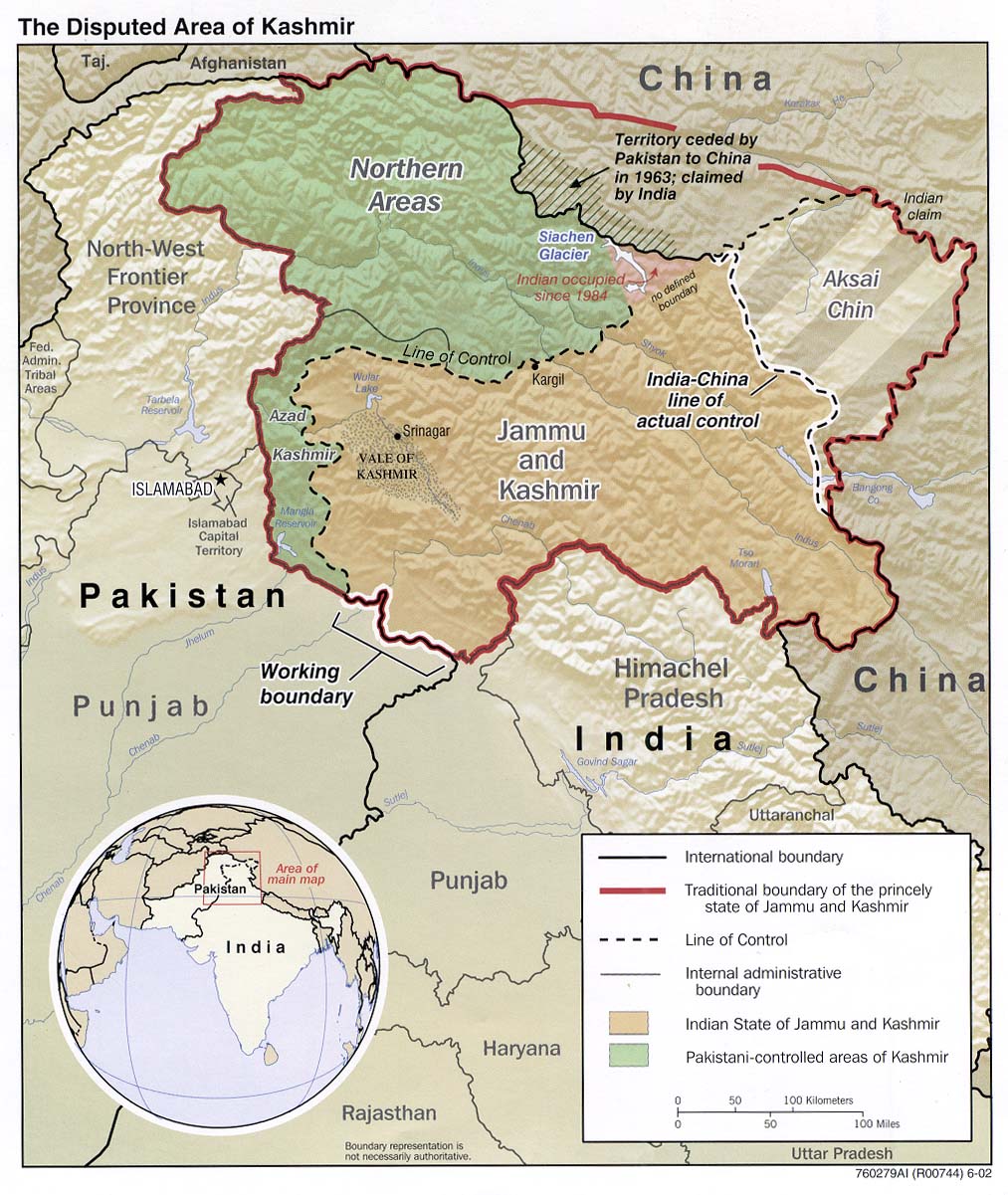
In August 1947, Kashmir’s autocratic ruler, His Highness Maharaja Sir Hari Singh Indar Mahindar Bahadur Sir Hari Singh, was faced with a momentous decision. The imperial government in London had always allowed some major landholders on the subcontinent a degree of autonomy and, technically, Kashmir had never been part of British India. The maharaja’s antecedents had secured the right to govern some of their own affairs by recognising the paramountcy of the British Crown. The compact between the British and the maharaja’s family was symbolised by the payment of a tribute: each year Hari Singh had to provide the British government with a horse, twelve goats and six of Kashmir’s famous shawls or pashminas.

When the British left, the maharaja had three options: Kashmir could become independent or join either India or Pakistan. The rulers of over 550 Princely State rulers faced the same decision but in the case of Kashmir the issue was especially sensitive. Its large population and proximity to both China and Russia gave the state considerable strategic importance. The matter was further complicated by religion: Kashmir was one of a handful of Princely States in which the ruler did not practise the same religion as most of his people. While the maharaja was a Hindu, over three-quarters of his subjects were Muslims. The fact that Kashmir was not only predominantly Muslim but also congruous with Pakistan convinced Mohammed Ali Jinnah that the maharaja’s decision would go in his favour. ‘Kashmir’, he said at the time of partition, ‘will fall into our lap like a ripe fruit.’ It was a naive misjudgement of Himalayan proportions.

The maharaja had most of the foibles associated with India’s decadent aristocracy. He was a hedonist and a reactionary whose main interests were food, hunting, sex and, above all else, horse racing. As his own son put it: ‘Quite clearly, my father was much happier racing than administering the State …’ On one occasion, he had been tricked by a prostitute in London’s Savoy Hotel who proceeded to blackmail him. He showed a similar lack of judgement in matters of state. In July 1947, with the transfer of power just weeks away, he took the view that ‘the British are never really going to leave India’!

The maharaja’s ancestors had been blessed with greater political acumen. The State of Jammu and Kashmir had been established in the first half of the nineteenth century by a relatively minor Jammu chieftain, Gulab Singh. A combination of adept military conquests and astute financial deals enabled him to create one of the largest Princely States on the subcontinent. By 1850 he had moved on from Jammu (with its Hindu majority population) and had added Ladakh (Buddhist majority), Baltistan (Muslim majority) and the Kashmir Valley (Muslim majority). In the latter half of the nineteenth century, Gulab Singh’s successors extended their control to another Muslim majority area, Gilgit.

SOURCE: Pakistan: Eye of the Storm, 2nd ed., by Owen Bennett Jones (Yale Nota Bene, 2002), pp. 56-57

1 Comment

Filed under India, Pakistan

Hyderabad and Junagadh at Partition, 1947

Once again, however, Jinnah failed to explore all the options open to him. One possibility was to make compromises over another Princely State, Hyderabad. The Muslim ruler or nizam of Hyderabad faced the same dilemma as Maharaja Hari Singh. He wanted independence but was far from sure he could achieve it. Jinnah understood that it was never realistic to expect the nizam to accede to Pakistan: Hyderabad was entirely surrounded by Indian territory. But he always hoped that the nizam could pull off independence. He considered Hyderabad to be the ‘oldest Muslim dynasty in India’ and hoped that its continued existence as an independent state right in the heart of India would provide a sense of security for those Muslims who didn’t move to Pakistan. Once again, however, Jinnah was thinking in terms of legally possible options rather than political realities. In the long term the independence of Hyderabad, while constitutionally proper, was never going to happen. The new Indian leadership saw the issue clearly enough and when the nizam tried to strike a deal which would allow him to hang on to some degree of autonomy, Delhi flatly refused to consider the idea.

In retrospect most Pakistanis would agree that it would have been worth abandoning the aspiration for an independent Hyderabad if it had meant securing Kashmir’s accession to Pakistan. Furthermore, Jinnah had good reason to believe that such a deal could have been struck. In late November 1947 Nehru and Liaquat Ali Khan met to discuss the situation in Kashmir. To understand their conversation it is first necessary to consider briefly what had happened in yet another Princely State, Junagadh.

The Muslim nawab of Junagadh ruled over a million people, 80 per cent of them Hindus. Junagadh was located in western India and, even though it was not strictly contiguous with Pakistan, its coastline offered the possibility of sea links to the Muslim state that was just 200 miles away. The nawab of Junagadh, guided by his pro-Pakistani chief minister Sir Shah Nawaz Bhutto (the father of Zulfikar Ali Bhutto), decided to ignore the feelings of his Hindu population and acceded to Pakistan. It was the mirror image of the situation in Kashmir. The Indian government did not accept the decision, blockaded Junagadh and then invaded it. Delhi then imposed a plebiscite and secured the result it desired: Junagadh became part of India.

When Liaquat Ali Khan met Nehru at the end of November he exposed the illogicality of India’s position. If Junagadh, despite its Muslim rulers’ accession to Pakistan, belonged to India because of its Hindu majority, then Kashmir surely belonged to Pakistan. When Liaquat Ali Kahn made this incontrovertible point his Indian interlocutor, Sardar Patel, could not contain himself and burst out: ‘Why do you compare Junagadh with Kashmir? Talk of Hyderabad and Kashmir and we could reach agreement.’ Patel was not alone in this view. On 29 October 1947 officials at the American embassy in Delhi had told the US State Department: ‘the obvious solution is for the government leaders in Pakistan and India to agree … [to the] accession of Kashmir to Pakistan and the accession of Hyderabad and Junagadh to India’. British officials in London concurred.

SOURCE: Pakistan: Eye of the Storm, 2nd ed., by Owen Bennett Jones (Yale Nota Bene, 2002), pp. 68-69

7 Comments

Filed under nationalism, Pakistan, religion, South Asia

Russian Perspectives on Ukraine

All About Latvia, who fervently supports democracy but is not keen on either Yanukovich or Yushchenko, offers an interesting roundup of Russian views on the Ukrainian elections, including a translation of a cynical op-ed in Komsomolskaya Pravda.

The gloomiest predictions are about to be proven true. Ukraine once again is divided in half. The president of all-Western and Central Ukraine–Victor Yushchenko and the president of all-Eastern and Southern Ukraine–Victor Yanukovich both demand coronation.

Apart from Russia, the list of firm Yanukovich supporters is not very impressive.

Lenta reports that Belorussian president Lukashenko congratulated Victor Yanukovich with his presidential victory. So, officially or not, three leaders expresed their support for Yanukovich: Russian President Vladimir Putin, Lukashenko and the leader of the Trans-Dienstr breakaway Moldovan Republic Igor Smirnov.

The official status of the Russian-supported Transnistrian portion of the former Moldovan SSR is still unresolved.

Beyond the control of any strong national government, the region has become an international transit center for smuggled goods. A Russian-sponsored peace plan for the region was rejected by Moldova in Nov., 2003, after Moldovan demonstrations against it; the deal would have permitted Russian troops to remain until 2020.

UPDATE: The Head Heeb has an interesting take on the reactions of Ukrainian Jews, in general cautiously favoring ‘the devil you know’. Zackary Sholem Berger elaborates further. Also see the Head Heeb’s earlier post, which opens with a segue I feel sure has never, ever been uttered before:

As most of you are no doubt already aware, French Polynesia is no longer the only country with two presidents.

UPDATE: Now China, Kazakhstan, and Armenia are reported to have joined the list of countries recognizing Yanukovich as president. And Economist.com has an update that concludes on a cautionary note.

International pressure may also have a significant effect on the outcome. As well as the pressure from America and the EU, a key determining factor will be the attitude of Mr Putin. The crisis in Ukraine is bound to overshadow his summit with EU leaders this week (see article [with map!]) and he risks serious difficulties in his relations with both Europe and America if he backs Mr Yanukovich in repressing the protests. Towards the climax of the Georgian revolution last year, Mr Putin seemed to lose patience with Mr Shevardnadze, perhaps contributing to his downfall. Does the Russian leader’s even-handed call for both candidates in Ukraine’s conflict to obey the law suggest he has already begun to hedge his bets?

All along, both Russia and the West have been taking a close interest in Ukraine’s election, not just because it is one of eastern Europe’s largest countries, with 49m people, but because the outcome could have important consequences for the whole region. Mr Yushchenko presented himself as a pro-western, free-market reformer who would clean up corruption and enforce the rule of law. Mr Yanukovich, in contrast, stood for deepening Ukraine’s close links with Russia. If Mr Yushchenko had gained the presidency and led Ukraine towards becoming a westernised democracy with European-style prosperity, voters in Russia and elsewhere in eastern Europe might have begun to demand the same. Thus a win by Mr Yushchenko would have been a huge blow to Mr Putin, whose attempts to exert control over former Soviet states would be greatly diminished.

Though Mr Yushchenko is now hoping for a Georgian-style bloodless revolution to deliver him the presidency, there are also some less promising precedents among the former Soviet states: only two months ago, Belarus’s president, Alexander Lukashenka, “won” a rigged referendum to allow him to run for re-election. The EU decided this week to tighten its sanctions against those in his government it blames for the “fraudulent” ballot. But so far there is no sign that Mr Lukashenka will be dislodged from power. Azerbaijan and Armenia also held flawed elections last year: in Azerbaijan, there were riots after the son of the incumbent president won amid widespread intimidation and bribery, but these were violently put down; and in Armenia, voters reacted with quiet despair at the re-election of their president amid reports of ballot-stuffing. If Ukraine follows these precedents, hopes for change there, and in other parts of the former Soviet Union, may be dashed.

Siberian Light asks Why is Russia afraid of democracy? In his answer he acknowledges:

Russia has plenty of legitimate interests in Ukraine. It has a massive naval base in the Crimea, there is a large ethnic Russian population, and a big chunk of Russia’s oil and gas exports go through Ukraine.

Time and again Russia meddles in the affairs of its neighbours. It almost never supports democratic opposition groups, preferring to prop-up regimes, good or bad (mostly bad). It seems pretty clear that Russia has made the decision that its interests are best served by opposing the spread of democracy through the Former Soviet Union.

And of course this rarely causes even a ripple of protest in the West.

Leave a comment

Filed under Russia, Ukraine

Some Backgrounders on Ukraine

Ukraine-based Le Sabot Post-Moderne explains how the system works there:

You have to understand the situation in Ukraine. The country is run by a series of oligarchic clans that actually found their beginnings in the Soviet Union, and then grew fabulously rich during the early days of “privatization”.

Compare the situation to Russia, where an authoritarian Putin faced off against corrupt oligarchs. In Ukraine, authoritarianism and oligarchy are fused. Yanukovych isn’t just another unscrupulous candidate, he’s the main man of Akhmetov — the duke of Donetsk and the richest man in Ukraine. The current president, Kuchma, is the head of a different clan, Dnepropetrovsk. The presidential administrator is Medvedchuk, who happens to run the Kiev-based Medvedchuk-Surkis clan. He also owns the two biggest Ukrainian TV stations, which is awfully convenient.

While there is jockeying for control among these clans, the overall effect is for them to sustain one another in power. They all depend on the same system for survival, and actively collaborate to keep it in place.

A good example of the clan system in action was the recent privatization of the Kryvorizhstal factory. Western firms offered 2.1 billion dollars. It was sold to the presidents son-in-law for 800 million. His son-in-law is Pinchuk, the head of the Pinchuk-Derkach clan.

Do you start to see how life works here? This isn’t about a few stolen votes. It’s about an entire system of fine control over the political, social and economic life of the people. Economics and politics are incestuously fused here in a way that is difficult to imagine for those in the West.

Ukraine-based TulipGirl quotes an essay by Ukrainian novelist Oksana Zabuzhko in Monday’s print edition of the Wall Street Journal.

Never before — even 13 years ago, on the eve of the collapse of the Soviet Union — has Ukraine witnessed such a massive upsurge of national solidarity. People who’ve always remained politically indifferent and had missed voting in all previous elections, were disseminating self-printed leaflets from the Internet (samizdat is back — any piece of information was voraciously devoured on the spot!) in public places, and volunteering to monitor the elections on behalf of opposition candidate Viktor Yushchenko. At a peasant food market a merchant first asked who you’re voting for — the right answer (with which you could count on a generous discount) was “Yushchenko,” while incumbent Prime Minister’s Viktor Yanukovych’s supporters were more than likely simply refused service. In the playgrounds children were playing a game called “Yushchenko beats Yanukovych.” To quote my seven-year-old neighbor, “in our class Irka alone stands for Yanukovych, and no one wants to play with her.” The slogan chanted by protesting students at demonstrations reads in English as “We’re together! We’re many! We won’t fall!” And just how may of “us” there are, one can easily see in the streets. These days Kiev, as well as other major Ukrainian cities, is defiantly demonstrating its political sympathies by wearing orange, the campaign color of opposition candidate Yushchenko.

A special term has come into use — “The Orange Revolution.” It looks like people have dragged all shades of orange, from yellow to vermilion, out of their wardrobes and adorned themselves with them simultaneously — vests and sweaters, scarves and purses, coats and umbrellas. Orange ribbons flutter everywhere — on trees, fences, lanterns, and cabs. Drivers joyfully beep to each other, and pedestrians (traffic police included!) salute them with smiles and raised fists. It feels like the capital of three million has been transformed into a sea of brotherly love! The windows of shops are lavishly decorated with things orange. Among my favorites is the stunt of my neighborhood coffee shop — its windows glow with pyramids of oranges! …

Here I have to clarify one important point. A widespread cliche used by many Western journalists to describe the major collision of our dramatic elections is that the establishment candidate, Viktor Yanukovych, is “pro-Russian,” and that opposition candidate, Viktor Yushchenko, is “pro-Western.” This version has as little to do with the feelings of an average Ukrainian voter as with those of the belligerents of the Trojan war. Mr. Yanukovych is perceived not so much as being “pro-Russian,” but as, first and foremost, being “pro-criminal” — a Ukrainian Al Capone, who has under his belt two prison sentences for robbery and assault, and publicly uses criminal argot compared to which even the boorish tongue of retiring President Leonid Kuchma sounds as innocuous as a school textbook. A former governor of Donetsk, Mr. Yanukovych in power represents the so-called “Donetsk fellas” — a business clan with a notorious criminal background. That the latter have close ties with similar mafia clans in Russia seems to be the most immediate explanation for the pre-election outburst of a passionate love between Russian and Ukrainian leaders, an affair of which Yanukovych-as-president had been designed as a mutually satisfying offspring.

Chicago-based international relations professor Dan Drezner is more pessimistic:

A few years ago there were sizeable protests in Kiev because of “Kuchmagate,” in which tapes came to light suggesting that President Leonid Kuchma played a role in the disappearance of Ukrainian journalist Georgy Gongadze in September 2000. There was tangible evidence that Kuchma personally ordered Gongadze — who was investigating corruption in Kuchma’s administration — to disappear. Despite months of protests, however, Kuchma stayed in office (click here for an exhaustive World Bank study [PDF] on this case).

Not to put a damper on what’s going on right now in Ukraine, but that example should be kept in mind when speculating whether the protests at the rigged election results in Ukraine will actually cause a change in government a la the Rose Revolution in Georgia [Quickly: opposition leader/reformer/nationalist Viktor Yushchenko led by double digits in Western-run exit polls over Kuchma stalwart/Russophile Viktor Yanukovich. However, the preliminary election results had Yanukovich winning by three percentage points. Outside observers are pretty much unanimous in their belief that there was massive vote fraud].

The two most salient facts in assessing what will happen are that:

a) Leonid Kuchma wants Yanukovich to win;

b) Vladimir Putin really wants Yanukovich to win.

I would love to be wrong about this, but it doesn’t look good for Yushchenko.

Canada-based Randy McDonald weighs in on Ukraine’s Underestimated Strength.

I’m skeptical, in short, that Ukraine is at real risk of splitting apart along ethnolinguistic-cum-political lines. And yet, I can’t help but remember Andrew Wilson’s The Ukrainians: Unexpected Nation, which suggested that the most likely and the most stable course for Ukraine would be a broadly centrist position, relying on slow Ukrainianization and a Ukrainian balancing act between the European Union and Russia. Going to one extreme (a strongly Ukrainianizing regime intent on immediate European integration) or another (a strongly Russophile regime intent on Eurasian integration) could, Wilson suggested, disturb the equilibrium. Mass secessions wouldn’t be the result so much as growing alienation, the formation of more coherent ethnic groups with stricter frontiers. This would be a problem for Ukraine, needless to say.

Leave a comment

Filed under economics, Russia, Ukraine

The Periscope on Ukraine

The Periscope blog has Victor Katolyk live and reporting up a storm in Lviv, Ukraine. Fistful of Euros is also compiling threads from all over.

via The Argus

Leave a comment

Filed under blogging, democracy, Ukraine

The Meanings of Kamikaze

Language Hat has an interesting discussion thread about how kamikaze came to mean ‘suicide attack’. I’ll elevate my comment there to a blogpost here.

I suspect kamikaze ‘divine wind’ was probably first no more than an inscription on the hachimaki ‘headband’ that is still worn by many Japanese on a special mission, whether or not that mission is likely to be fatal. Other hachimaki can have other motivational slogans like ‘Victory’, ‘Success’, or ‘Fighting Spirit’. (Too bad there aren’t old Confucian slogans that literally translate as ‘Exceed Sales Target’ or ‘Constantly Innovate’!)

There is nothing intrinsic in kamikaze that suggests suicide (less than there is in an American slogan like “Remember the Alamo!”), but there is a strong suggestion of a devastating air attack on shipping. I wonder if the suicide submarine Kaiten Tokkoutai (‘Turn Heaven Special Attack Force’) also wore hachimaki with kamikaze written on them. I can’t quite make out the characters on the hachimaki in the photos at the link, but I doubt they say ‘Safety First’. Like the original kamikaze, the suicide submarines and airplanes both aimed to destroy ships at sea.

There were at least two varieties of “special attack” planes: Thunder Gods and Kamikaze. ‘Thunder god’ may translate kaminari ‘thunder’, now written with a single Chinese character but clearly derived from something like ‘god-sound’. The Kaminari Ohka (‘thunder cherry-blossom’) “was a piloted glider bomb released from beneath a mother plane and used in suicide attacks on Allied ships.” Cherry blossoms in samurai culture connote the transience of life–therefore death, and frequently death in battle.

To end off on a lighter note: I’m sorry, but the much rarer Chinese reading of kamikaze–shinpuu–just makes me think of a divine wind of the odiferous (though hardly suicidal) kind!

Leave a comment

Filed under Japan, language

Takeru Kobayashi, All-American Glutton

Tokyo Times blog notes that Takeru Kobayashi, the diminutive 4-time winner of the Coney Island hotdog-eating contest has now conquered another All-American peak, Chattanooga’s hamburger-eating contest.

His pulsating performance of 69 hamburgers in 8 minutes, was so stunning that it prompted David Baer of the International Federation of Competitive Eating to trumpet, “Kobayashi is, without a doubt, the greatest eater ever to live upon planet Earth.”

His T-shirt shows Uncle Sam above the motto “Eat All That You Can Eat” but maybe “A Mess Hall of One” would be just as appropriate.

via Simon World

Leave a comment

Filed under U.S.

New Zealand’s Market Reforms

Tyler Cowen of Marginal Revolution asks Have New Zealand’s Market Reforms Failed?

New Zealand moved from being perhaps the most socialized OECD economy to the freest. The country now has free trade, 0-2 percent inflation, no agricultural subsidies, free labor markets, free capital markets, low marginal tax rates, a reasonable fiscal position, and it conducted substantial privatizations, mostly with success. The reforms started about twenty years ago, but the country is not sweeping the world …

What gives?

First, New Zealand without the reforms would have fallen apart and become insolvent; that is the relevant counterfactual. Second, the country is small. The population is just a bit over 4 million; for purposes of comparison the Philadelphia metropolitan area is over six million.

Michael Porter nailed it over ten years ago. New Zealanders have few if any industries [one being electric fencing] where they control market conditions or lead with innovations. For the most part they are at the mercy of world prices and broader conditions. The country’s earlier crisis was precipitated in the early 1970s, when the UK ended “imperial preference” for New Zealand agricultural exports. Another shock will come if Australia passes its free trade agreement with the U.S.; New Zealand exports will face a new and tough competitor.

Finally, the brain drain has not gone away …

UPDATE: Tyler Cowen posts a response from a Kiwi who maintains that NZ’s domestic economy is laden with a regulatory environment that heavily discourages private capital accumulation and investment, including foreign investment.

Leave a comment

Filed under economics, New Zealand