Author Archives: Joel

Joel's avatar

About Joel

Executive Editor, Journals Dept. University of Hawai‘i Press

Noonan about Rather

As one who was scandalized and disgusted by Rathergate, I was quite impressed by Peggy Noonan’s gracious, illuminating, yet devastating retrospective in the Wall Street Journal (2 December 2004) entitled “The Education of Dan Rather.”

Life is complicated, people are complicated, and most of us are a jumble of virtues, flaws and contradictions. I like to try to understand the past, try to put it together in a way that makes sense to me. This can involve judging not only your own actions and decisions but those of others, which can be hard. I have a friend who once said in the middle of a conversation, “Don’t understand me too quickly.” Don’t categorize me; don’t decide you broke the code. Sit back and watch; it’s more interesting than you may know.

Beldar, on the other hand, isn’t feeling quite so generous.

Leave a comment

Filed under publishing, U.S.

Slate’s Dispatches from Romania

Sarah E. Richards in Slate has a series on Romania that focuses exclusively on the negatives. All that’s missing is Vlad Dracu (Dracula, not Vladimir Putin!).

Nostalgia for communism

“Yes, it was better under communism. You had a job, a house, a car,” said 20-year-old university student George Pascaru. “But you could not have your own thoughts.”

But such talk makes few feel better about the giant elephant making its way east. Romania, a country of 23 million, is lumbering toward entry into the European Union in 2007. Despite robust economic growth and low inflation, corruption is rampant, and the average Romanian makes slightly more than $2,100 a year, or just 30 percent of the EU average in purchasing power….

The mention of the European Union is met with cynical laughs. People tell how Hungarians have been forced to raid Romanian grocery stores because they were priced out of their own when their country joined the union this spring. There are rumors that EU regulations will force polluting old cars off the road, and drivers won’t be able to buy new ones. And how will people buy houses?

Discrimination against Roma

“In Communist times, I worked 30 years in an iron factory,” said Sandu Stana, who is 71 but looks 80. “In capitalism, it’s hard to have a job. When the jobs are open, and they see our face, they say, ‘Sorry, it’s been taken.'”

Activists insist that embracing the Roma identity is the only way to move the community forward. For example, the government recently hired 200 health-outreach workers and set aside 400 university spots for Roma in 2004 compared with 10 earmarked in 1994. About 2,000 have graduated, said Marius Taba of the human rights group Romani Cris. About 80 percent of Roma drop out of the system before high school. For those who do go, there are tales of bus drivers refusing to pick them up and school officials segregating them in separate buildings. Discrimination is everywhere. A French film crew followed Taba and several other clean-cut Roma young men on a night out around Bucharest. Five of eight bars they visited kicked them out.

In an informal ghetto north of Bucharest, Roma residents had more immediate concerns. One woman showed me how they were stealing electricity by attaching wires from the power pole into their apartments because they couldn’t pay their utility bills; they’re worried the police will come soon.

Dysfunctional citizens

Eni Gall has one of the most depressing jobs in Romania. Equipped with a minimal range of social services, a couple of loaves of bread, and an earnest idealism, 25-year-old Gall works as a case manager visiting poor, dysfunctional, and marginalized families. Her assignment is to keep families together so they won’t abandon their children.

Gall is one of a slowly growing number of social workers in a country that, during communism, didn’t recognize it had social problems. Today, Romanians know they have problems, but there is scarce public funding to even begin to address them. They can clean up the orphanage system in an attempt to become a EU–worthy country by 2007, but there’s no mechanism in place to stem the supply of deserted children. “There are no public social services in Romania, only institutionalized ones for the disabled or orphans,” explained Calin Braga, director of Gall’s employer, Arapamesu, a nongovernmental agency founded in 1995 by an American nun and funded by U.S., European, and Romanian donors. It provides counseling, tutoring, support groups, and children’s activities for around 330 at-risk families in the Transylvanian city of Sibiu. “We need services, services, services!” he said….

Two years ago, residents of a gypsy ghetto north of Bucharest didn’t even know contraceptives existed. I met health coordinator Florica Petre, who blushed as she recalled showing a roomful of men how to put on condoms. She said that whenever she gets a new delivery of prophylactics, the men scoop them up for visits to local prostitutes. (Apparently, the equivalent of $6 buys a visit to a French or a Japanese [!?] hooker, the neighborhood favorites.)

And the miseries of adoption

It’s not easy to adopt a child in Romania, and at first the Heiseys thought they were following the law by hiring lawyers to notarize the signing over of the birth rights and applying for her birth certificate. That began a local legal brouhaha that involved more lawyers, social workers, court appearances, abandonment proceedings, commission meetings, and mandated visits of the birth mother to the Heiseys’ home to confirm that she did not want this child.

There’s an old joke that Romania is the land of possibility, where anything can happen—anything bad and anything worse. So, when Peter proudly plopped the file containing every single document carefully copied and collated on the desk of Larissa’s assigned social worker at the local office of the National Authority for Child Protection, he wasn’t surprised when the clerk told him she couldn’t send it on to Bucharest. The Romanian government had passed an emergency ordinance forbidding international adoptions. For the previous three years, the government had imposed a moratorium stopping such adoptions after the European Union criticized the country for selling its babies to foreigners for as much as $50,000 apiece.

Hoping to join the union in 2007, the Romanian government said it would resume international adoptions once it had a chance to straighten out the corrupt child welfare system.

Va rog, Domnule Guvernamint, don’t make me abandon my children! Don’t make me steal electricity! Don’t make me suffer through high school! Don’t force me to find a job in a robust economy! Don’t let me use your condoms on foreign prostitutes! Vai de mine! Jos cu libertate! Bring back Ceausescu! Et cetera.

Beware Ukraine! Life is so much worse for everyone in the West. The painful transition can hardly be worth the effort.

via Arts & Letters Daily

Leave a comment

Filed under Romania

Infralapsarian or Supralapsarian?

Supralapsarians considered God’s ultimate goal to be his own glory in election and reprobation, while infralapsarians considered predestination subordinate to other goals….

Infralapsarians were in the majority at the Synod of Dort. The Arminians tried to depict all the Calvinists as representatives of the “repulsive” supralapsarian doctrine. Four attempts were made at Dort to condemn the supralapsarian view, but the efforts were unsuccessful. Although the Canons of Dort do not deal with the order of the divine decrees, they are infralapsarian in the sense that the elect are “chosen from the whole human race, which had fallen through their own fault from their primitive state of rectitude into sin and destruction” (I,7; cf.I,1). The reprobate “are passed by in the eternal decree” and God “decreed to leave (them) in the common misery into which they have willfully plunged themselves” and “to condemn and punish them forever…for all their sins” (I,15).

Defenders of supralapsarianism continued after Dort. The chairman of the Westminister Assembly, William Twisse, was a supralapsarian but the Westminister standards do not favor either position. Although supralapsarianism never received confessional endorsement within the Reformed churches, it has been tolerated within the confessional boundaries. In 1905 the Reformed churches of the Netherlands and the Christian Reformed Church in 1908 adopted the Conclusions of Utrecht, which stated that “our Confessional Standards admittedly follow the infralapsarian presentation in respect to the doctrine of election, but that it is evident…that this in no wise intended to exclude or condemn the supralapsarian presentation.” Recent defenders of the supralapsarian position have been Gerhardus Vos, Herman Hoeksema, and G H Kersten.

If I had attended the Synod of Dort, I suppose I’d have voted with the infralapsarian majority against the supralapsarians, but the older I get the more I incline toward the antilapsarians over the prolapsarians.

Leave a comment

Filed under religion

Pakistan’s Competing Nationalisms

My description of the partition as the greatest blunder in the history of mankind is an objective assessment based on the bitter experience of the masses … Had the subcontinent not been divided, the 180 million Muslims of Bangladesh, 150 million of Pakistan and about 200 million in India would together have made 530 million people and, as such, they would have been a very powerful force in undivided India. –Muttahida Qaumi Movement (MQM) leader Altaf Hussain, October 2000

‘I have been a Baloch for several centuries. I have been a Muslim for 1,400 years. I have been a Pakistani for just over fifty.’ The tribal chief Nawab Akbar Bugti Khan has little love for Pakistan. Secure in his heavily guarded, mud-walled fort deep in the Baloch desert, he runs a state within a state. Pakistan may have been in existence for over half a century but he still considers any Pakistani troops in his vicinity as part of an occupation army. Other tribal chiefs, feudal leaders and politicians in Balochistan, rural Sindh, NWFP and even some in southern Punjab share his attitude towards Pakistan. Islam was meant to be the binding force–but, for many, ethnic ties have proved to be stronger.

Like Israel, Pakistan was created in the name of religion. In 1948 there were just a few hundred thousand Jews living in their new country’s territory; most Israelis came from elsewhere. When Pakistan was created, by contrast, there were already over 70 million Muslims living in the ‘land of the pure’ and they were by no means united. As well as the Bengalis in East Pakistan, the new state had to integrate five major groups: the Sindhis, the Baloch, the Pukhtoons, the Punjabis and the incoming Mohajirs [refugees from India; h-j-r as in Arabic hijrah ‘flight’]….

Whatever their background, Pakistani leaders have consistently seen expressions of provincial feeling as a threat to the Pakistani state. Nationalist leaders in the provinces have tended to associate such centralist attitudes with Punjabi arrogance. In reality, it has never been as simple as that. After all, [Mohammed Ali] Jinnah was born in Karachi, Ayub Khan was a Pukhtoon [= Pashtun, Pathan] and Zulfikar Ali Bhutto came from Sindh.

SOURCE: Pakistan: Eye of the Storm, 2nd ed., by Owen Bennett Jones (Yale Nota Bene, 2002), pp. 109-111

Leave a comment

Filed under Pakistan

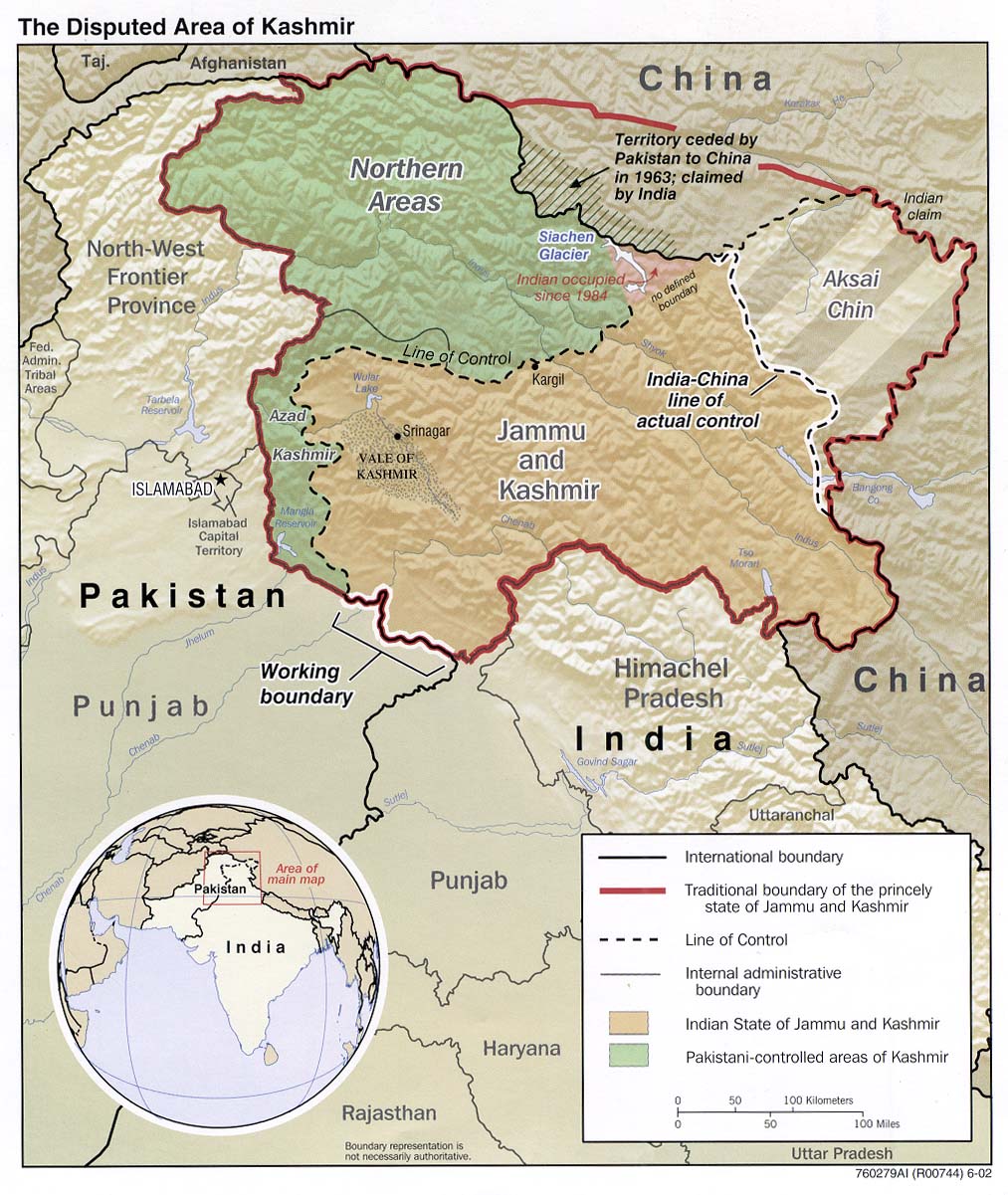
Kashmir Compromise Potential

Musharraf’s speech on 12 January 2002 had clear implications for Kashmir. By announcing bans on Lashkar-e-Toiba and Jaish-e-Mohammed, he increased the chance that the insurgency in Kashmir would be weakened. If it faced a less intense battle in Kashmir, it is likely that the Indians would want to put the issue on the back burner. But it is worth bearing in mind two developments. First, the Kashmiri people are tiring of the struggle. Most informed Pakistanis now accept that, given the chance, most Kashmiris would opt for independence rather than a merger with Pakistan. But above all else the people of Kashmir want peace. That is not to say they will accept any settlement but it does raise the possibility that most would accept a compromise. The second new element is that many Pakistanis are also tiring of the conflict. Before Musharraf’s January speech it was conventional wisdom that no Pakistani leader could confront the religious extremists and remain in office. The lack of any backlash to Musharraf’s speech helped dispel that myth.

Might the same be true of Kashmir? Proponents of the view that no Pakistani leader can afford to back down in Kashmir rely on a number of arguments. First, the Pakistani people, informed by decades of intensive propaganda, are highly mobilised on the issue. Second, the army has made so many sacrifices in Kashmir that a significant climb-down would be seen as unacceptable. Not even an army chief, it is suggested, could compromise on Kashmir and expect to survive. That may be true, but there are counter arguments. Despite all the propaganda, many people in India and Pakistan are not particularly concerned about the Kashmir dispute. Many of those living, for example, in Sindh or Tamil Nadu would be quite happy to see any settlement of a dispute that is quite clearly holding back the subcontinent’s social and economic development. After a decade of insurgency, there is a growing feeling in Pakistan that India will never pull out. Pakistan’s size and economic weakness means it is not in a position to force the hand of a country with a billion people and great power aspirations. If General Musharraf or any subsequent Pakistani leader did make a compromise on Kashmir he or she might receive more support than is generally predicted.

In his account of the Kashmir dispute, the Indian author Sumantra Bose has rejected the idea of splitting up Kashmir because, he argues, none of the political districts are either ethnically or religiously homogeneous. In the Jammu region, for example, one third of the population is Muslim. Indeed, some of its districts have strong Muslim majorities. In Ladakh, meanwhile, the Buddhists may have a clear majority in Leh but the adjoining Ladakhi district of Kargil has a predominantly Shia Muslim population. Whilst Bose undoubtedly has a point, the history of the late twentieth century, for better or for worse, suggests that his objections to the possible partition of Kashmir are far from overwhelming. In the Baltic States and former Yugoslavia, to give just two examples, international boundaries were redrawn without regard to the fact that, in the process, new minority populations were created….

Ever since 1947 the views of the Kashmiris have been obscured by the dispute between India and Pakistan. With the insurgency over a decade old most Kashmiris are sick of the conflict and are desperate for a peaceful settlement. But for both India and Pakistan the symbolic importance of the Kashmir dispute means that they will inevitably follow their own perceived national interests rather than those of the Kashmiri people. If the Kashmiris had been conducring a straightforward fight for independence in the same way as the Chechens or East Timorese they would have had a greater chance of success. The tragedy of Kashmir is that the voices of the Kashmiri people themselves have been drowned out by the Islamists, nationalists and ideologues in Islamabad and Delhi.

SOURCE: Pakistan: Eye of the Storm, 2nd ed., by Owen Bennett Jones (Yale Nota Bene, 2002), pp. 106-108

Leave a comment

Filed under Pakistan

Proto-Modern Czech Nationalism, 15th Century

In 1458, the Czech Diet elected as king of Bohemia the Utraquist leader Jiri z Podebrad (1420-71), who had been regent of the kingdom during Ladislav Pohrobek’s minority since 1453. The “Hussite King” Jiri was the first Czech to sit on the Bohemian throne since the Premyslids over 150 years earlier.

Pope Paul II excommunicated him as a heretic in 1466 and proclaimed a holy war against him. Mathyas Corvinus of Hungary invaded but was defeated in 1468.

The following year there appeared a “Call to Arms in Defense of the Truth,” addressed “to all faithful Czechs and Moravians, genuine lovers of God’s truth and disciples of your own Czech language…. [The pope] inflames and incites all the nations and languages of the surrounding lands against us.” It is a remarkable passage; but one quite typical of its time and place. Virtually all Hussite manifestos since 1420 had struck the same notes. It is evidently medieval in its Christian preoccupations and frame of reference; its fundamentalist certainty is alien, even repellent, to modern sensibilities. But it is no less evidently, and rather disconcertingly, modern–or what we are accustomed, at any rate, to think of as modern–in its identification of truth and virtue with a land, a people, and their language. The Hussites imagined their sacral community in unmistakably national terms and attributed sanctity less to Latin than to their native Czech.

All this happened without the aid of the printing press; the first known book printed in the Czech lands, Guido de Columna’s Trojan Chronicle, appeared in Plzen in 1468. But it is perhaps worth recording that when print capitalism did arrive in Bohemia, it too came predominantly in the Czech vernacular. Of forty-four books known to have been printed in Bohemia before 1500, thirty-nine were in Czech. Over the next hundred years some 4,400 books were printed in the Czech lands. Many were of course religious, among them the magnificent Czech Protestant Bible kralicka of 1579-94. But there were also vernacular histories, geographies, medical works, moral homilies, and (perhaps most tellingly) cookbooks and manuals of household economy. Melantrich, the earliest Czech publishing house (as distinct from individual printer), employed eleven people in 1577. In its thirty-year existence it published at least 223 books–111 of them in Czech, 75 in Latin, and only 3 in German. Pope Pius II, who as papal legate Enea Silvio de Piccolomini visited Bohemia and subsequently wrote Historia Bohemica (1458; first published in Czech in 1510 as Kronika teska), was one who appreciated the importance to Czechs of their native tongue. Writing to Ladislav Pohrobek in 1453, the pope suggests that the Czechs will not let their new boy-king go “until he masters Czech and–beer-drinking.”

SOURCE: The Coasts of Bohemia: A Czech History, by Derek Sayer (Princeton U. Press, 1998), pp. 40-42

Leave a comment

Filed under religion

Moldova’s "Negotiable Nationalism"

The Romanians in Bessarabia awoke in the late 1980s, quipped the writer Ion Druta, but they forgot to get out of bed. The disappointment that many intellectuals felt with the outcome of the national movement was part of a long history of disillusionment experienced by generations of nation-builders. At every turn, Moldova has turned out to be something other than what most observers had either hoped or expected. It was one of the most sovietized of the Soviet republics, with high rates of linguistic assimilation to Russian and marriage across ethnic lines. But it also witnessed a divisive and violent conflict between forces supporting independence and those intent on maintaining the unity of the Soviet state. It was a republic that had no clear historical antecedent within the same borders. But it nevertheless produced a strong movement of national renaissance and eventually independence. It was a republic that Western writers frequently criticized as artificial, the result of Stalin’s redrawing of east European borders during the Second World War, and a territory that if given the chance would surely seek to reunite with its former motherland, Romania. But since 1991 public sentiment has been cool on the idea of unification between the two states.

Most unusual of all was the fact that the Soviet project of building a distinct Moldovan nation yielded a rather ambiguous result. Local political leaders in other national republics came to power in the late 1980s by defending an independent historical and cultural identity, but those in Moldova succeeded by denying theirs. An independent Moldovan state emerged with the breakup of the Soviet federation, but the idea of an independent Moldovan nation seemed to fade with Soviet-style communism. Since then, the legacy of Soviet-era nation-building and the contentious question of the “true” national identity of the Moldovans have remained topics at the center of political life.

Making a Moldovan nation should have been a relatively easy enterprise. The eastern Moldovan lands, both before and after the annexation of Bessarabia, were populated largely by illiterate peasants with few ties to the cosmopolitan cities. They had been politically separate from the closest co-ethnic group–the Romanians–for the past two centuries or more, and had been absent from all the historical turning points in the formation of Romanian national consciousness. They had been the subjects of a variety of contradictory cultural policies: russification in the Russian empire, romanization in interwar Romania, fitful moldovanization in the Moldovan autonomous and union republics, and sovietization in the entire Soviet period. Nation-building also accompanied broader processes of urbanization and industrialization, so that the rhetoric of national identity was linked with other powerful themes of enlightenment and modernity. All this took place among a population that, even before the Soviet Union, still called itself “Moldovan” and within an authoritarian political system that put a premium on ethnonational affiliation and often spared no expense in the effort to engineer it. One can think of plenty of modern nations that have been built under far less propitious conditions.

For all this, though, by the 1990s the Moldovans were still a nation divided over their common identity. For some, they were simply Romanians who, because of the treachery of the Soviets, had not been allowed to say so. For others, they were an independent historical nation, related to but distinct from the Romanians to the west. For still others, they were something in between, part of a general Romanian cultural space but existing as a discrete and sovereign people with its own traditions, aspirations, and communal identity. How one imagines the Moldovans has never been a straightforward issue. In most periods, in fact, the various projects for cultivating a sense of nationhood among them have turned out rather differently from how their designers had planned.

SOURCE: The Moldovans: Romania, Russia, and the Politics of Culture, by Charles King (Hoover Press, 2000), pp. 224-225

See also Randy McDonald’s meaty blogpost on Reunifications Deferred: Romania and Moldova. A sample:

If Moldova joined Romania, whether with or without Transdnestr, it would join the Baltic States on the short list of former Soviet territories managing to escape directly to the European Union. Moldovans would be free to migrate (or, at least, as free as their fellow citizens in old Romania) across the European Union; Moldova would qualify for European Union transfer payments.

This isn’t likely, though, simply because the Moldovan state has acquired despite itself an innate inertia of its own, with mass emigration sapping its work force and its energies, the ethnic conflict dominating its conservative post-Communist political elites’ focus, and little incentive for innovation on any front. Moldova, once a prosperous component of the Soviet Union, is now the poorest country in Europe. Moldova’s now of note as a source of sex slaves and organ sellers, which makes the prospect of Romanian and/or European Union expansion all the more difficult.

Romanian reunification might still be possible, if only in the sense that Romanian-identifying Moldovans might mostly emigrate to Romania, leaving their more Moldova-identified friends and relatives at home. At this point, any true reunification–the establishment of a single state, or of a confederation, or of a union-state–seems massively unlikely.

Leave a comment

Filed under Romania

Origin of the Sumo Championship System

As yokozuna (‘grand champion’) Asashoryu wins his 5th tournament of the year, and ozeki (‘champion’) Kaio falls one win short of his promotion criteria despite besting Asashoryu on the final day, it seems to be an appropriate time to look at the far-from-ancient origins of the championship system in Japanese sumo.

The most interesting and significant aspect of the modernization of sumo is probably the development of the championship system. It has always been obvious, in Japan as elsewhere, that some athletes are better than others. The traditional way to discover who was “the greatest” was for claimants to the title to challenge one another. In chivalric terms, one “threw down the gauntlet.” It was not until the nineteenth century that European and American sports evolved from such more or less impromptu challenges to modernity’s rationalized format of regularly scheduled competitions specifically designed to determine the best athlete or team. Sumo, too, evolved in this way.

From the middle of the eighteenth century, four regularly scheduled tournaments per year, each lasting approximately ten days, were staged in the three cities of Edo, Osaka, and Kyoto. Before the nineteenth century, spectators attending these tournaments apparently had little interest in comparing one wrestler’s past performance with another’s. It was not until the Meiji period that spectators began to evince interest in a wrestler’s performance over the course of an entire tournament. In fact, the word “tournament,” used here to translate the Japanese term basho, should not be taken to mean a series of matches climaxing in a final bout to determine a single winner. In a sumo tournament, wrestlers do not advance through rounds in the manner of tennis players at Wimbledon nor do they wrestle against all the other contestants in round-robin style. Each wrestler has only one match per day and the tournament champion is the winner of the topmost division, the makuuchi.

It is difficult now to imagine sumo without this championship system. Which of the previously most successful wrestlers will win the next tournament is the focus of fan and media interest. Most sumo enthusiasts are surprised, therefore, when they learn that the concept of a tournament championship is a relatively recent innovation. In fact, it did not exist at all until well into the modern period. The long, complicated, and little known development of the championship system is a fascinating case study in the modernization of sumo.

In the Tokugawa period, the focus was still on individual matches. After a particularly thrilling match, excited fans often threw money or articles of clothing into the ring. The winning wrestler kept the cash and sold or pawned the clothes. In the Meiji period, new forms of appreciation and reward appeared, forerunners of today’s championship system. Like the athletes of Europe and North America, wrestlers began to receive trophies and other prizes awarded for their performance over the course of an entire tournament rather than for victory in a single match. These awards were donated by private groups, which makes the precise origins of the practice difficult to document. Newspapers, which regularly sponsored baseball and other modem sports, were often the donors.

At first, there was ambiguity about exactly what it was that the wrestler had done to deserve his reward. Initially, trophies were presented to wrestlers who were undefeated, but undefeated records were not necessarily identical because there were two different kinds of draws and absences were not recorded as losses. It was not uncommon for more than one wrestler to finish a tournament without a defeat, in which case each received a trophy. For example, after a tournament in January 1889, Konishiki [‘little brocade’] (a small fellow not to be confused with his huge twentieth-century namesake) was awarded a trophy by the Tokyo newspaper Jiji shinpo despite the fact that he had not won all of his matches. He had seven victories, a draw, and a match for which the decision had been deferred. Two undefeated lower-division contestants were also awarded trophies after they wrestled to a draw on the last day of the tournament. According to the newspaper, if no wrestler went undefeated, no trophy was awarded.

A shift in the criteria for awarding trophies occurred in 1900, producing the kind of tournament champion that we now take for granted. In January of that year, Osaka’s Mainichi Shimbun offered to award a keshomawashi (ornamental apron) to an undefeated wrestler of the makuuchi division. If no wrestler survived the tournament undefeated, the apron was to be awarded to the wrestler with the fewest losses. If two or more men tied for the fewest losses, then the prize was to be given to the man who defeated the greatest number of higher-ranked opponents. These new criteria provided for a single champion.

SOURCE: Japanese Sports: A History, by Allen Guttmann and Lee Thompson (U. Hawai‘i Press, 2001), pp. 109-111

Leave a comment

Filed under baseball, sumo

Tarik Amar at John Quiggin on Ukraine

John Quiggin hosts a richly detailed account by Tarik Amar of recent developments in Ukraine. Quiggin’s introduction follows.

Following up the post from Tom Oates last week, reader Dan Hardie sends another (long) piece, by Tarik Amar, who, Dan says, is doing a PhD on Soviet history and speaks Ukranian, German and Russian, among other languages, and knows the place very well. Lacking any of these qualifications, I can only pass his analysis on to you with the observation that it’s well worth reading, and gives lots of detail on the machinations of the incumbent president.

From what I’ve read, including Tarik’s piece, this all seems very similar to Marcos in the Phillipines and Milosevic in Serbia, and hopefully will be resolved in a similar fashion.

Set aside some time to read the whole thing.

Leave a comment

Filed under democracy, Ukraine

The Myth of Ethnic Warfare

Charles King reviews Modern Hatreds: The Symbolic Politics of Ethnic War, by Stuart J. Kaufman (Cornell U. Press, 2001) in the November/December 2001 issue of Foreign Affairs.

The deadly clashes that erupted between Russians and ethnic Tatars in the early 1990s were utterly predictable. Having invaded the Russian steppes alongside the Mongols in the thirteenth century, the Tatars were seen by medieval Russian chroniclers as the epitome of Oriental barbarism. Although the power of the Tatars eventually waned, the Russians did not forget their misery at the hands of these Muslim invaders. In the sixteenth century, Ivan the Terrible razed the Tatar capital. Two centuries later, Tatar nomads were brutally driven as far as China. And during the Second World War, Stalin deported thousands of Tatar families to Central Asia. Once the Soviet Union began to falter, Tatars in several regions began to call for greater rights and eventual independence. Those demands set off a spiral of fear and loathing that drew fuel from the memory of bloodshed on both sides.

The only problem with this story is that there were no such deadly clashes in the 1990s. Russia devolved sovereignty to Tatarstan, one of the federation’s constituent republics, without any violence. So successful was the process, in fact, that the “Tatar model” is now touted as a template for how Russia’s relations with its other ethnic minorities should work.

Had modern Tatar autonomy not come about so painlessly, it would have been easy to read the bloodshed as yet another case of the inevitable clash of civilizations. Just such an impulse explains why Russia’s ongoing war against Chechnya still sends observers scrambling for their Lermontov and Tolstoy: to search for historical allusions to Moscow’s long-standing entanglement in the same zone. But as Stuart J. Kaufman shows in his ambitious new book, Modern Hatreds, explaining contemporary wars with reference to ancient troubles is not only a terrible cliche — it is also fundamentally wrong.

The Seeds of Conflict

In years to come, what looks today like a disconnected string of small, brutish wars across southeastern Europe and Eurasia — five in the former Yugoslavia and six in the former Soviet Union — is more likely to be considered by historians to be part of one process: the wars of communist succession. Most of these battles pitted newly independent governments against territorial separatists, but all sprang from a range of disparate causes: the collapse of federations, the end of authoritarianism, the reemergence of old quarrels, the meddling of outside powers, political demagoguery, and — a major catalyst of organized violence everywhere — plain old thuggery….

The Organization for Security and Cooperation in Europe and the U.N. have spent the better part of a decade “mediating” these various disputes, and the organizations’ main strategy has been to address precisely those beliefs and insecurities that Kaufman identifies. That approach has led nowhere, however, and for one simple reason: Ethnic myths and fears have become largely irrelevant to most of the actors in these dramas. In fact, the current status quo — no fighting but no final peace accord, either — suits most folks just fine. The separatists get a de facto country. Corrupt officials in the central governments get a transit route for illegal commerce. Foreign governments get relative peace and, therefore, no Christiane Amanpour on the scene to raise concerns at home. International organizations get multiple rounds of “negotiations” and willing recipients for their good offices.

In the long run, however, everyone ends up a loser. The unresolved disputes have had cancerous effects on the regions where they occurred, feeding corruption, weakening governance, and gnawing away at what little democracy exists in Georgia, Moldova, and Azerbaijan. They have created havens for international criminals and conduits for the smuggling of drugs, weapons, and people into Europe and beyond. None of that, incidentally, has much to do with ethnicity.

The Way to War

What does all of this mean for policy? Kaufman rightly calls on outside powers to pay greater attention to potential conflict areas before war erupts. Some of his recommendations are supremely reasonable …. Others … cannot possibly be meant seriously. And no form of outside intervention, however early, can guarantee success. After all, it would be difficult to find a more concerted recent effort at peace-building than occurred in Macedonia, a case that Kaufman cites approvingly. (The book was published too early to take full account of the recent violence there between the government and Albanian guerrillas.) Long before the shooting started, school curricula were reformed under the eyes of the U.N. and major nongovernmental organizations. Internationally mediated talks were held. There was even a Macedonian version of Sesame Street, created and funded by foreigners, that featured cast members from all of Macedonia’s ethnic groups living in harmony. The show became wildly popular with local children. But as for the results, consult CNN.

The real lesson to be learned from the postcommunist conflicts, including the latest one in Macedonia, is probably different from the one Kaufman intended. Myths, fears, and opportunities might be a good recipe for a pogrom, but they rarely lead to large-scale, sustained violence. For that, you need the same kinds of forces that sustain any war, whether “ethnic” or otherwise: entrepreneurs who benefit from the violence, arms supplied by foreign powers, charismatic leadership, and plenty of bored young men. And these are the same factors that external governments and international organizations are most useful at counteracting — that is, in the rare instances when they have both the will and the wherewithal to get involved. Outsiders can, as Kaufman recommends, try to ban books, shut down radio transmissions, rewrite school curricula, and enforce an internationally acceptable standard of ethnic correctness on historians and teachers. But silencing every bigot in the world would require a monumental effort — one for which afflicted states do not have the cash, nor Western governments the fortitude.

Leave a comment

Filed under China