Author Archives: Joel

Joel's avatar

About Joel

Executive Editor, Journals Dept. University of Hawai‘i Press

Tibetan Red Guards vs. Tibetan Muslims, 1969

At first, the idea of a Tibetan Muslim had surprised me; a Tibetan seemed, almost by definition, to be a Buddhist, a follower of the Dharma, although on consideration the notion was no odder than a Tibetan being a Christian, which had happened, or an Italian being a Buddhist, a prevalent conversion. The Habaling Khache [= ‘Kashmiri‘] were part of traditional Lhasa society and the economic life of the city, a minority in an outwardly uniform land. According to one writer, “Unmolested by natives to initiate whatever trade they desired, and inspired by incentive, the Muslims became commonplace features in the major cities of Lhasa, Shigatse, Gyantse and Tsethang.” They were renowned for speaking in chaste, courtly Lhasa dialect, even if they did sometimes eat dishes from Central Asia, which gave rise to the Tibetan warning not to be taken in by sweet words: “Do not listen to a Muslim’s voice, look at what he is eating.”

Most of the Habaling Khache were indistinguishable, physically, from other Tibetans. Only the names were different: Hamid, Abu Bakr, Salima, Fatima. In the past, most of them were merchants, but some had been given posts in the Dalai Lama’s government as writers or translators, and been allowed to wear a special court uniform. A second group of Lhasa Muslims lived beyond the Potala, having been given a plot of land by the Fifth Dalai Lama. Their imam, Abdul Ghalib, told me that most of his small community had fled in the 1950s, and there were now only a few dozen of them left. Abdul Ghalib, with his Central Asian face, lived by an orchard with chickens and cows and apple trees and an old water-pump. It was an idyll, but he knew his world would soon disappear.

Mariam’s uncle, the imam of the Habaling Khache, had known the history. He was responsible for the documents, going back to the twelfth century, which recorded the important marriages in their community, how the traditions had begun, what lands and privileges were granted to them in Lhasa by previous Dalai Lamas, and how their ancestors, merchants and traders, had made their way up from coastal China through the mountains to Tibet. There were about two thousand indigenous Tibetan Muslims left in Lhasa now, trying to preserve something that had been nearly washed away, their position undermined by the arrival of ambitious new Hui and Chinese Muslims from the east.

When the Red Guards—all of them Tibetan—came to purge Lhasa’s main Muslim quarter, Thelpung Khang, in 1969, there was a moment of bafflement. The Habaling Khache, being Muslims, had no idols or statues that could be smashed, no painted frescoes that could be defaced, no sacred pictures that could be ripped. There was nothing to destroy. So, after retreating to discuss this problem, the Red Guards sought out the ledgers, the old legal papers, the name-books, the dustar or ceremonial prayer caps, the maps, an ancient decree granting Muslims an exclusive graveyard on the edge of the city (Buddhists do not bury their dead), and every copy of the Holy Quran, including the imam’s own, which was several centuries old, and made them into a great bonfire in the courtyard in front of the mosque. The history of the Habaling Khache went up in flames.

The mosque was made into a cinema, for the watching of propaganda films; farmers and their animals were sent to live in the precincts and in the madrasa. The imam, Yahya, aged about eighty, was paraded through the streets to the east of the Barkhor wearing a conical white paper hat with the word “ghost” written across it. Later he was slapped and pushed and told that he was an exploiter of the people.

“But he was a purely religious man,” Mariam kept repeating, tugging at the straps of her black lace headdress, “a purely religious man.” He died soon afterwards, she said, of grief.

Mariam tried to describe the effects of this destruction. There were no words for it. For much of the Cultural Revolution, she had “just felt like dying.” Finally, she compared the Habaling Khache to a person who has eyes but is unable to see. There was a problem translating exactly what she meant. She seemed to be saying, miming, that they were like someone whose vision was blocked by a cataract. They had the capacity for sight, but they could not see.

The Habaling Khache were deracinated. They no longer had any way of knowing what had made them what they were. And so, in this way, another part of Lhasa was destroyed.

SOURCE: Tibet, Tibet: A Personal History of a Lost Land, by Patrick French (Vintage, 2004), pp. 155-157

UPDATE: Wow. I’ve never had an Instalanche, nor ever expect to get one, but a reddit.com/rec is pretty impressive by my low-crawling standards.

Leave a comment

Filed under China

The Economist on Japan’s Economic Recovery

“As Japan emerges from an era of a zero interest rate,” the Economist recaps its long economic downturn and its rising prospects for recovery. Here are a few excerpts.

Japan’s experience is unique. The country’s decade and a half of stagnation stands in bleak contrast to the blistering growth that preceded it and that enjoyed more recently by many other rich economies, notably America. Japan is not alone in having had a banking crisis brought on when an asset bubble burst. America had its “savings-and-loan” mess in the 1980s. Sweden had a crisis like Japan’s in the early 1990s. And in 1997-98, a financial typhoon tore through most of Asia. Yet in all these instances, action was, on the whole, fairly swiftly taken to write off bad debts, clean up banking systems and restore economies to growth. By contrast, Japan was mesmerised. For too long, instead of seeking to bring its financial system back to health, it appeared to place its hopes in great dollops of spending on public works to get the economy moving….

Japan was lucky. It began its long malaise as one of the richest societies on earth. But its subsequent performance was abysmal. Between 1990 and 2005, real growth averaged just 1.3% a year. Without the malaise, Japan’s GDP would have been about 25% higher in real terms than it is now. In nominal terms, Japanese GDP remains below its 1997 level, thanks to deflation (see chart 1). Over that same period from 1997, the nominal GDP of neighbouring South Korea, which bore the full brunt of the Asian financial crisis, has risen by 65%; America’s is up by 50%. Japan’s stagnation, then, represents a great squandering of wealth and opportunity….

Why did the recovery not arrive earlier? One reason must be that, with the real level of non-performing loans in the banking system undeclared for so long, huge provisioning by the banks merely aggravated a state of financial disruption: banks could not afford to make fresh loans, even to good prospects. Another related reason is that until the banks had cause to deal with their loans, the troubled companies that had taken the loans out had little incentive to restructure. Japanese companies are now in much ruder health, but that is largely because of measures taken only in the past few years.

At the policy level, the government made two huge blunders. The first was to raise the consumption tax in 1997, which wrecked economic confidence. Just as confidence appeared to be recovering in August 2000, the BoJ declared an end to deflation and raised rates. The economy again went into a tailspin and the bank decided to retreat to zero six months later. But with prices falling, the expansionary effect even of a zero rate was lost, since real interest rates remained positive. A radical new measure was tried by the BoJ: in effect, printing money by stuffing the accounts that banks hold at the central bank with free cash. That super-loose liquidity, known as “quantitative easing”, was withdrawn this spring.

Leave a comment

Filed under Japan

Ho-hum: Asashoryu Wins Again

The Nagoya Grand Sumo Tournament this year started out with many hopeful contenders, from the giant Estonian rookie Baruto to the veteran Japanese ozeki Tochiazuma, but each began to fade during the second week while the sole yokozuna Asashoryu cruised to his 17th victory, clinching it on the second-to-last day with a record of 14-0. His nearest rival, newly promoted ozeki and fellow Mongolian Hakuho stood at 12-2 when he faced Asashoryu in the final bout of the tournament, which turned out to be the most exciting bout of all. Hakuho won it, finishing just one loss behind the grand champion at 13-2. Barring injuries, there is a very good chance that the Sumo Association will promote another Mongolian to yokozuna by the end of the year.

Leave a comment

Filed under Japan, sumo

Ode to English Majors

The Chronicle recently carried a column entitled “Goodbye Mr. Keating [the teacher in Dead Poets’ Society]: To succeed as a Ph.D. in English, you have to give up all of the things that attracted you to the subject in the first place.” It appealed to me for two reasons. (1) I thoroughly enjoyed my graduate work in linguistics because it involved a lot of fieldwork and language-learning, two achievements that proved unfortunately of no great consequence in pursuing an academic career in linguistics, for which I believe I lacked the necessary temperament. (2) My daughter is scheduled to graduate with a B.A. in English next year and is pondering what to do after that. The pseudonymous author of the Chronicle article, an English professor at a midwestern university, waxes romantic about the qualities of undergraduate English majors, many of which ring true.

In a course I taught last spring, after three months of tracing the development of literary theory from humanism to structuralism to poststructuralism to the dilemmas of the present, I finally asked my students the question: “So, why do you want to study literature, knowing what you now know?” I wondered if studying a century of cynicism had altered their motives in the slightest.

They were all considering graduate school, but their answers had little to do with what I knew they would need to write in their application essays. Sitting in a circle in the grass, backed by purple hydrangeas, they offered the following motives:

  • Formative experiences with reading as a child: being read to by beloved parents and siblings, discovering the world of books and solitude at a young age.
  • Feelings of alienation from one’s peers in adolescence, turning to books as a form of escapism and as a search for a sympathetic connection to other people in other places and times.
  • A love for books themselves, and libraries, as sites of memory and comfort.
  • A “geeky” attraction to intricate alternate worlds such as those created by Tolkien, C.S. Lewis, and George Lucas.
  • Contact with inspirational teachers who recognized and affirmed one’s special gifts in reading and writing, often combined with negative experiences in other subjects like math and chemistry.
  • A transference of spiritual longings — perhaps cultivated in a strict religious upbringing — toward more secular literary forms that inspired “transcendence.”
  • A fascination with history or science that is not grounded in a desire for rigorous data collection or strict interpretive methodologies.
  • A desire for freedom and independence from authority figures; a love for the free play of ideas. English includes everything, and all approaches are welcome, they believe.
  • A recognition of mortality combined with a desire to live fully, to have multiple lives through the mediation of literary works.
  • A desire to express oneself through language and, in so doing, to make a bid for immortality.
  • A love for the beauty of words and ideas, often expressed in a desire to read out loud and perform the text.
  • An attraction to the cultural aura of being a creative artist, sometimes linked to aristocratic and bohemian notions of the good life.
  • A desire for wisdom, an understanding of the big picture rather than the details that obsess specialists.

Those answers defied everything they had been taught in my theory seminar. Nevertheless, they were all, in different degrees, the answers I would have given as an undergraduate. They reflected the drive toward imaginative freedom expressed by Keating, but they also reflected a deep traditionalism that is equally crucial to English as a discipline. Both impulses, however, are intractably emotional, irrational, and romantic.

Not one student said, I am studying English “because I want to make a lot of money” or “because my parents made me.”

English is, almost always, a freely chosen major — and sometimes it is chosen in spite of parental and material resistance. English is a rebellious major, even as it draws on a tradition deeper than the contemporary American dream of success.

It surprised me that none of my students mentioned a commitment to social justice or to some specific political ideology as a motive. Nearly all of them would have skewed to the left on most of the usual subjects.

When I asked about that, one said, “If I wanted to be a politician, I’d major in political science. If I wanted to be a social worker, I’d major in sociology.” English is, among my undergraduates at least, one of the last refuges of the classical notion of a liberal-arts education.

via Arts & Letters Daily

Leave a comment

Filed under education

In Memory of Joe Stanka, Jr.

This blogpost illustrates the small world phenomenon. Japan-based blogger White Peril recently posted about Japan’s latest, long-running consumer safety scandal.

Manufacturer Paloma Industries has produced on-demand water heaters (the usual type in housing here in Japan) that have been linked to several carbon monoxide poisonings over the years. You know the script for these things by now, don’t you?

We had a similar water-heater installed in our drafty apartment in south China in 1987-88, but we put the heater in the toilet behind a separate wall rather than in the room with the bath, partly because I remembered that a former fellow high schooler in Japan had died from gas poisoning in Kobe in 1965-66 (though it may not have been a water heater). His name was Joe Stanka, the son of Nankai Hawks pitcher Joe Stanka, a major reason my brother and I were ardent Hawks fans at the time. (I’m no longer a Hawks fan. My current Pacific League favorite is Bobby Valentine’s Chiba Lotte Marines.)

Joe Jr. was in my brother’s class. Here’s a poignant follow-up from the spring 2004 issue of the alumni magazine, Canadian Academy Review (PDF).

Foad Katirai ‘68 [Columbia ‘72] felt that he was meant to join this field trip [to the former site of Canadian Academy on Nagamine-dai hillside in Nada-ku, Kobe, Japan] as he came across something of special significance to his class. Upon entering Matsushita Gymnasium, Foad saw a plaque in memory of his classmate, Joseph Stanka Jr., still hanging on the wall above a trophy case. Joe, who died in a gas poisoning accident during their sophomore year [1965-66], was the son of Joe Stanka Sr., a pitcher for the Nankai Hawks, formerly of the Chicago White Sox. While at CA, he followed in his father’s footsteps as a pitcher for the [CA] Falcons. When the Matsushita Gymnasium opened in 1966, the trophy case was dedicated to him. Unfortunately, during the move to the new campus [on Rokko Island], the plaque was left behind. Upon its discovery by Foad, the plaque was returned to Canadian Academy.

I didn’t really know that much about Joe Sr. at the time, but he is profiled in baseball-reference.com.

Stanka went to Nippon Pro Baseball in 1960; playing for the Nankai Hawks, he went 17-12 with a 2.48 ERA in 38 games, finishing sixth in ERA and making the Pacific League All-Star team. In 1961, he went 15-11 with a 3.30 ERA in 41 games. Joe fell to 8-10 with a 3.61 ERA in 1962. He rebounded in 1963, going 14-7 with a 2.55 ERA in 34 games. He was part of a three-way tie for the PL lead with four shutouts.

Stanka had his best year in 1964, as he posted a 26-7 record with a 2.40 ERA in 47 games. As a result Stanka became the first American pitcher of non-Japanese descent to win an MVP award in NPB. His six shutouts led the league, he was second to reliever Yoshiro Tsumajima (2.15) among the ERA leaders and was four wins behind PL leader Masaaki Koyama. Despite winning the MVP award, he lost the Sawamura Award to the only American to win it as of 2005, Gene Bacque of the Central League Hanshin Tigers. Stanka also was the MVP of the Japan Series that season. After shutting out Hanshin in the opener and beating Minoru Murayama by a 2-0 score, he dropped game three 5-4 to Midori Ishikawa. In game six, with the Hawks on the ropes and trailing three games to two, Joe came back to beat Bacque 4-0 with his second shutout. When Nankai skipper Kazuto Tsuruoka asked him if he would be willing to work game seven the next day, Stanka agreed. Despite his fatigue, he threw nothing but goose eggs again, with a 3-0 shutout win over Murayama. He had gone 3-1 with a 1.23 ERA and 0.65 WHIP in the Series.

During Stanka’s final year with Nankai, he went 14-12 with a 3.28 ERA in 34 games. Stanka joined the Taiyo Whales in 1966, where he slipped to 6-13 with a 4.16 ERA in 32 games. Stanka was the first American pitcher to win 100 games in the NPB. His record overall there was 100-72 with a 3.03 ERA.

You have to wonder how much his son’s untimely death during the 1965-66 school year ruined his concentration during the 1966 baseball season. Not a hint of family trauma appears in a retrospective SABR-Zine interview last year entitled Joe Stanka, First American All-Star in Japanese Baseball.

5 Comments

Filed under baseball, Japan

Indonesia Received Tsunami Warnings

Officials in the Indonesian capital, Jakarta, failed to issue a tsunami warning despite receiving data about Monday’s earthquake 20 minutes before the first wave struck the island of Java.

One official told the Guardian they were too busy monitoring the aftershocks of the 7.7-magnitude quake that triggered the tsunami to raise the alarm. The government’s science and technology minister, Kusmayanto Kadiman, confirmed last night that Indonesia had received bulletins from the Pacific Tsunami Warning Centre in Hawaii and Japan’s meteorological agency after the quake, but “we did not announce them”….

Aerial television footage showed that virtually all the wooden buildings hit by the tsunami were swept away, along with about half the brick structures. Buildings up to half a mile inland were damaged. Some 30,000 people are thought to have fled their homes.

Leave a comment

Filed under Indonesia

Who’s Indigenous in Indonesia?

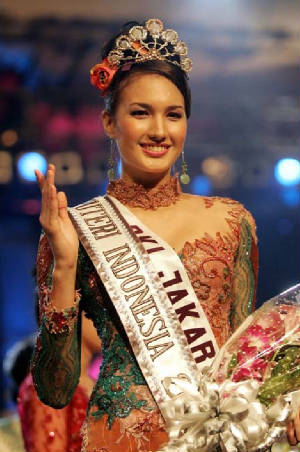
On 17 July, the Jakarta Post ran an interesting opinion piece by Endy M. Bayumi on what it means to be indigenous in Indonesia. The question arose because Miss Indonesia, Nadine Chandrawinata, doesn’t look sufficiently “indigenous.”

It was a coincidence that around the time she gave this interview, the House of Representatives last week unanimously endorsed the new citizenship bill that cleared up the legal definition of “indigenous”.

The bill defines citizens of this republic as Indonesia asli, or indigenous Indonesians, and it goes on to define “indigenous” not by one’s race or ethnicity, but rather by one’s being born on Indonesian soil, and never having taken up any foreign citizenship….

Prior to this law, Indonesians of Chinese descent — and to a lesser extent those of Arab, European and Indian blood — have had to put up with discriminatory treatment because they were not considered indigenous, although they may have been born here or their families may have been here for many generations….

The term “indigenous” itself is a misnomer.

The Malays in Indonesia may lay claim to being the indigenous people in the western part of the country, but the Melanesians (with a darker complexion) dominate the eastern part of the archipelago. So we have two indigenous groups in this country.

But can the Malays in Sumatra, Java, Kalimantan and Sulawesi truly claim to be Indonesia asli? Shouldn’t that claim belong more to the aborigines, like the Suku Anak Dalam in Jambi and others whose existence is on the verge of extinction?

One theory has it that the Malays currently inhabiting much of mainland Southeast Asia and the archipelago are descendants of people who migrated south down the Mekong River many thousand years ago. [Or ancestral Austronesian speakers came off the south coast of China, or out of Taiwan, down through the Philippines. So what? Malay dialects spread throughout the Indonesian archipelago much more recently—hundreds, not thousands, of years ago—probably spreading with Muslim traders along the coasts and up the major rivers of island Southeast Asia.–J.]

The Malays therefore are not Indonesia asli. But they can claim to be “more indigenous” by being here first, long before the Indians, Arabs, Chinese and Europeans came to this part of the world.

Malaysia, being a federation of sultanates, claims that all land belongs to the rulers, and thus to the indigenous Malay and Muslims. Non-Malays (the Chinese and Indians) are guests of the land and treated as second-class citizens with fewer rights.

Thankfully, Indonesia was a republic from its inception, and the land (and the water between the islands) belongs to the republic and its people, and not to any exclusive race or religious group.

The new citizenship law thus essentially recognizes that we are all indigenous, irrespective of the color of our skin, the language we speak, or the religion we follow.

This land is our land. If some of us want to claim to be more indigenous than others, let them be, but don’t expect the law to treat them differently.

And as for Nadine, she has as much right to represent Indonesia at Miss Universe 2006 as anyone else who is an Indonesian by blood and by law.

I don’t care at all about Miss Indonesia, but the new citizenship law sounds like a good thing.

via Colby Cosh

My favorite restaurant in Indonesia’s Ambon City during my academic junket in 1991 was named Pondok Asli, a place fancy enough to be translated Maison d’Indigènes rather than Native Hut. It was destroyed, like most of urban Ambon, after the Laskar Jihad invaded in 2000. Our Fulbright group tour was housed with host families in Poka and Rumah Tiga, near Pattimura University, which was also utterly destroyed by foreign jihadis. I’m not sure how many of our host families were slaughtered in the process. I have fond memories of eastern Indonesia, whether Muslim or Christian, but I scorn anyone who tries to make excuses for the jihadis.

Leave a comment

Filed under China, Indonesia

Hollywood Tibetophilia

The impasse over Tibet’s future has increased the volubility of foreign support for the Dalai Lama. When he visited the USA in the summer of 2000, for instance, he had meetings with the National Security Adviser and eminent Washington politicians, and thirty-five minutes with the President. Encased by a huge entourage of State Department security people, he promoted a peaceful solution for Tibet to the American people. His supporters put him on Larry King Live on CNN. He had been on the show six months earlier for a Millennium Special, when King had asked the Dalai Lama, as a leading Muslim, what he thought about the new year celebrations.

This time, the host knew that his guest was a Buddhist, but it was a sorry spectacle, the Dalai Lama, the bodhisattva of compassion, being forced by the exigencies of global politics and celebrity culture to compete for airtime with the passing flotsam of high-speed television …

American Tibetophilia even provoked a two-week happening at the Smithsonian Folklife Festival, including a public speech by the Dalai Lama which drew a crowd of tens of thousands. The Monlam Chenmo, the great prayer festival founded in 1409 by Tsongkhapa, was plucked from its regular home among the exile community in India and incorporated into the commotion. Dozens of monks from Drepung Loseling and Namgyal monasteries were flown into Washington DC to chant in suitably guttural tones and look impressive in maroon and saffron robes. Nobody seemed to notice that the Monlam Chenmo was a central date in the Tibetan state calendar, which had never been hijacked in this way before, and that its cancellation in Dharamsala that year led to acute religious and financial tribulation for the many Tibetan refugees who depend on it.

Meanwhile, at the Forest Lawn Memorial Park in Los Angeles, the Dalai Lama blessed a new Shi-Tro mandala (a three-dimensional religious sculpture) in front of a large, paying audience. The mandala had been created by a Tibetan monk who ran a local Buddhist centre, assisted by his American wife, who worked in creative marketing for Warner Brothers Records Inc. She had generated volumes of publicity, using the slogan “Shi-Tro Happens.” The Los Angeles Times described this as “marketing the mandala in a hip and humorous way.” So, there was the Dalai Lama, up on stage, Shi-Tro happening, the ceremony compered by the requisite Hollywood star, in this case the actress Sharon Stone, famous for lacking underwear in the movie Basic Instinct, but this time wearing a feather boa and bare feet. After musing aloud for a while about how she might introduce the Dalai Lama, she finally settled for, “The hardest-working man in spirituality … Mr. Please, Please, Please let me back into China!” The fact that the Dalai Lama came from Tibet was momentarily lost….

This is what is so curious about the phenomenon of his fame: devoid of egotism, committed to his religious vocation, the Dalai Lama has little interest in the way in which he is re-created by the world. The side-effect of his celebrity, and the way it is projected by his apparent backers, is that the battle over the future of Tibet has become curiously apolitical. We are left with the cry of longing, the repeating slogan of the foreign campaigner, the plaintive call of the refugee, the emphatic claim of the born exile, “Tibet! Tibet!”

SOURCE: Tibet, Tibet: A Personal History of a Lost Land, by Patrick French (Vintage, 2004), pp. 115-117

Get your Free Tibet bumper sticker. Just US$2.95. Or $0.75 on eBay, plus $3.00 shipping worldwide. Or buy the T-shirt from CafePress.com.

Leave a comment

Filed under China, cinema

Gandhi Has No Message for the Tibetans

The China specialists Frederick Teiwes and Warren Sun have argued that “Westerners think of politics in certain ways which make it difficult to accept Chinese realities,” presuming that “politics is about policy, that a great country has a large policy agenda which naturally preoccupies the politicians,” and that “political power flows to people with certain skills and capabilities.”

In a nationalist dictatorship founded on blood, like the one which gained power in China in October 1949, the assumptions that are taken for granted in a democracy do not hold true. Leaders are selected not for their ability to do a job or to represent the nation, but for their willingness to uphold the Party’s authority and suppress dissent. Vocal popular pressure does not cause a change in policy. Institutions do not act as a check on those in power. Only when the Chinese system starts to fracture from within will it be vulnerable to methods of open defiance, such as street protests and non-cooperation. Mohandas Gandhi, often invoked by the Dalai Lama and his supporters as an exemplar, has no message for the Tibetans. (Mao’s student years might be contrasted with those of Gandhi’s heir, Jawaharlal Nehru: while Mao joined a revolutionary militia in Changsha, where people were hacked to death and a head was paraded outside the governor’s residence on a stick, Nehru studied at Cambridge University, where he joined the college boat club and played plenty of tennis.) Gandhi’s strategy of mass civil resistance was a tactical response to the British political system; had he tried it against Mao or Stalin, he and his followers would have been rounded up and shot.

SOURCE: Tibet, Tibet: A Personal History of a Lost Land, by Patrick French (Vintage, 2004), pp. 114-115

Leave a comment

Filed under China

Roots of Tibet’s Modern Military Incompetence

The optimistic view of [Tibet’s] military incompetence would be that it came from instinctive pacifism. Martin Scorsese’s 1997 movie Kundun, a beautifully crafted piece of Dalaidolatry, opens with the claim that “Tibetans have practised non-violence for over a thousand years.” The Jey Tsong Khapa Professor of Indo-Tibetan Buddhist Studies at Columbia University, Robert Thurman, has similarly depicted Tibet as a land of “psychonauts,” where “the cool-revolutionary counter-culture” entered the mainstream. Tibet was “a laboratory for the enlightenment movement to create its model society,” replete with “pacifist monks and nuns spending their days in learning, meditation, and creativity.” Helped by the teachings of the Buddha, the country had developed “industrial-strength mass monasteries in which individuals conquered their innermost energies and transformed their world into a buddhaverse.”

The idea is appealing, but unreal. The Dalai Lamas rode to political power on the back of the military might of the Mongols. Tibet’s history, like the history of any country, is full of war, gore and male domination, even if revenge slaughter never became as popular as in neighbouring lands. As late as May 1947, the footballer Reting Rinpoche was punished for insurrection by having a silk scarf stuffed down his throat, or his testicles crushed, or being poisoned with yellow pills, depending on which version you prefer. Tibet’s lack of initiative in the 1930s came from the loss of focus and ambition caused by extended reliance on the mediation and patronage of outsiders. As the historian Owen Lattimore has written, “the tributary or feudatory status of Tibet” began when the Sakya sect submitted to Kublai Khan in the thirteenth century: “Politically, the supreme pontiffs of Tibet have from the beginning acted as the agents of one or another alien overlord.”

So, while the newly discovered Fourteenth Dalai Lama grew to adulthood and Mao’s Communist rebels edged closer to victory in China’s civil war, the Tibetan government remained rudderless, unsure how to proceed. The three great monasteries—Drepung, Sera and Ganden—continued to be a powerful bulwark of tradition, opposing the very idea of change and progress. As an unnamed British diplomat noted in 1940, “Tibet’s military weakness is a danger to her continued independence, if ever the Chinese should have time and energy to spare to attempt once more to establish their domination over the country.”

Most of the reforms attempted by the Thirteenth Dalai Lama during his lifetime had failed. Ambitious modernising initiatives such as the creation of paramilitary units and secular schools, where football might be played, were overturned by the entrenched conservatism of the monastic establishment. When the army did turn out on parade, it was not for rifle-shooting or machine-gun practice; rather, the soldiers concentrated on the maintenance of decorum, tradition and precedent. Each year, on the penultimate day of the Monlam Chenmo, the Great Prayer Festival, a military review was held at Drabchi.

This was Tibet, alone, reliving its glorious past. Symbolically, it was the days of empire that counted. During the Monlam Chenmo, a pair of Tibetan aristocrats would be temporarily awarded the Mongol title of Yaso, making them commanders of the two wings of the ancient army. Dressed in stupendous brocade robes trimmed with fur, supported by noble attendants, in the decade in which Salvador Dali gave a lecture in a diving-suit in London, they would watch the cavalry turn out in scraps of ancient chain-mail and peacock feathers, each horseman carrying a quiver of five plumed arrows. At their head rode two standard bearers holding tall lances and painted banners, wearing cherished helmets, possibly dating to the eighth century, with the name of Allah inscribed on the front in gold filigree.

The Arab influence, from the days long before Tibet became the forbidden land of European invention, was not forgotten by Tibetans. The past lived. During the early ninth century, soldiers of the Tibetan empire had harassed Muslim forces in Central Asia, and laid siege to Samarkand. Correspondingly, Arab troops, stirred by the spread of Islam, had captured parts of Kashmir and Wakhan, and taken the Tibetan general (“the commander of the cavalry of al-Tubbat,” they recorded) and his horsemen back to Baghdad where they could be paraded in triumph, like downed airmen during the Gulf War.

Martial influence travelled in all directions, with Chinese and Arab sources reporting the superiority of early Tibetan armour. A Tang historian noted the quality of the weaponry of a joint Turkic-Tibetan army in the early eighth century.

SOURCE: Tibet, Tibet: A Personal History of a Lost Land, by Patrick French (Vintage, 2004), pp. 101-102

Leave a comment

Filed under Tibet