Author Archives: Joel

Joel's avatar

About Joel

Executive Editor, Journals Dept. University of Hawai‘i Press

Cambodian Americans on the Fourth of July

Santepheap, the Cambodia Weblog, offers the following compilation for the Fourth of July.

Americans were paying attention to Cambodian-Americans this Fourth of July.

Chantra Gooch talks about her life before, during and after the Khmer Rouge regime Utah’s The Spectrum

Timothy Chhim (second item) talks about his life in New York’s Journal News.

Vanna Phim told her story in The Lowell Sun.

Leave a comment

Filed under Cambodia, U.S.

Naipaul on the Revolutionary Blame Game

No one I met spoke of any kind of revolution as a possibility. That idea, so loved by Iranians of an earlier generation, had been spoilt now, as in the old USSR; revolution was a word that had been taken over by the religious state. No one ever spoke of the possibility of political action. There were no means, and no leaders in sight. No new ideas could be floated. The apparatus of control was complete. The actual rulers, though their photographs appeared everywhere, were far away; government here, as someone said, was “occult.” And still, in the general inanition, there was a feeling that something was about to happen. It made people nervous.

One afternoon, as we were driving up into the mountains above Tehran, Mehrdad, after seeming to say that people had learned how to live with the restrictions, abruptly said the opposite. He said, “Everybody is frightened. I am frightened. My father and mother are frightened.” (Poor father, again.) “They are not sure what the future will bring for them or for us, their children. They are not so worried for me. I am an adult now and can look after myself. But my brother is very young. The eight years or so he has to live before he becomes an adult are going to be very dangerous years.”

With this insecurity, certain fantasies had taken hold. The most extraordinary was that Khomeini had been a British or European agent. I had heard it first from Mr. Parvez, and had thought it part of his paranoia. But then I had heard it from many other people. There had been a meeting in the French West Indian island of Guadeloupe, according to this story, and the Powers had decided to foist Khomeini on the Iranian people. The Iranians were simple people; they could be persuaded by skilled propaganda to demonstrate for anything; people had joined the demonstrations against the Shah not out of conviction, but simply to do what everybody else was doing. The establishing of an Islamic state in Iran was an anti-Islamic plot by the Powers, to teach Muslims a lesson, and especially to punish the people of Iran. And, as if answering those fantasies, there were even signs of the faith being questioned in certain aspects.

Mr. Parvez had said, “The war [against Iraq] was fought in the name of Islam. It was a blessing in disguise. Without the war people wouldn’t have got so fed up with Islam.” That had seemed extreme. But then I had detected wisps and shadows of religious uncertainty in some people’s conversation. Just as–in these fantasies issuing out of a people stretched to the limit by revolution, war, financial stringency, and the religious state–it was said that Iranians were not really responsible for the Iranian revolution, so I heard that Iranians were not really responsible for the more dramatic aspects of the Shia faith. The bloody scourgings of Mohurram, the mourning month: the idea was really imported from Europe, from the Catholics; it had nothing to do with the original faith.

I talked about this to Mehrdad. He said, “It’s something habitual. Our enemies are always responsible. Blaming others, not ourselves.”

SOURCE: Beyond Belief: Islamic Excursions Among the Converted Peoples (Vintage, 1998), pp. 226-227

Leave a comment

Filed under Iran

Romania’s "Big Dig" Turns 20

Transitions Online translates a recent story from Evenimentul Zilei [‘The Daily Happening’?].

On 26 May, Romania marked the 20th anniversary of the inauguration of the Danube-Black Sea canal. A dream of the then-communist authorities, the canal became a symbol of the nightmare of communist repression, at least during the first part of its construction between 1949 and 1951. After a break of 25 years, [former Romanian dictator] Nicolae Ceausescu resumed the construction process. It took another eight years of work–a huge national labor project followed by years of glorification of what the communists called “the Blue Thoroughfare,” and it was celebrated again and again during communist national festivities in the “Song of Romania.”

The construction of “the dustless road” [as the canal was called in a novel by Romanian writer Petru Dumitriu, an proponent of the social realism movement in the 1950s] required studies by more than 1,000 experts in construction and more than 33,500 execution reports. During its construction, 300 million cubic meters of soil were excavated, and some 3.6 million cubic meters of concrete were used. The result was a navigable canal 64.4 kilometers long with two, 310-meter-long double locks at each end.

Built on the backs of the country’s political detainees, with blood, effort, and maybe too much sacrifice, the Danube-Black Sea canal remains the biggest project ever carried out in Romania. But 20 years after it was opened, the canal works at only 40 percent of its capacity.

The idea for a canal linking the Danube River with the Black Sea reportedly originated in a Soviet “suggestion,” when Stalin sent a stern order to Gheorghe Gheorghiu-Dej [the Romanian communist leader until 1965] to liquidate the opposition in Romania. “I will give you the technical equipment, and you can solve two problems at the same time: You get rid of the kulaks and the landed gentry and irrigate Dobrogea [the territory between the lower Danube River and the Black Sea],” Stalin is said to have told the Romanian communist leader sometime in the late 1940s in Moscow….

Construction on the canal officially started on 15 July 1949. The labor force came from three sources: paid workers, forced labor, and military conscripts. The political detainees were euphemistically called “forces from the Interior Ministry.” […]

Ceausescu had the idea of resuming construction after a 1972 visit to Antwerp, Belgium, and a 1973 trip to Amsterdam and Rotterdam, where he learned about a project called “the Canal of Europe,” which aimed to link the Rhine with the Danube–a 3,500 kilometer, transcontinental river route….

On 26 May 1984, with tens of thousands of people lining the two sides, Nicolae Ceausescu inaugurated the canal in festive style. The project at the time was estimated to be worth 10 trillion lei [approximately 3.3 billion average monthly salaries in Romania at the time]….

The canal today links the Danube with the Black Sea and can be used in both directions. With the opening to traffic in 1992 of the Main-Danube canal in Germany, a direct link between the Black Sea and the North Sea (through the ports of Constanta and Rotterdam) was established. It has a capacity of 10 million tons of traffic a year.

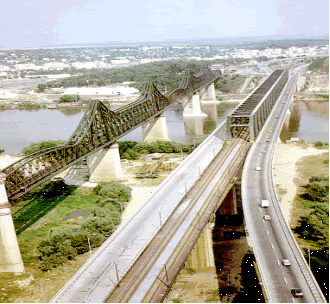
On 26 May 1984, Mr. and Mrs. Far Outliers were close to finishing a grim but fascinating year in Romania. We took a day trip by train from Bucharest to Constanta and back in the spring of 1984, crossing the Danube bridge and looking for the traces of the shortcut canal that so many Romanian dissidents spent their last years digging. The train was jam-packed, with people standing a handspan away from our heads blowing smoke into our hair. I finally tried to open a window. What an uproar that caused! Real springtime air on uncovered heads was deemed far more deadly than cigarette smoke in our lungs. In Constanta, we visited an impressive (but empty) mosque and the history museum, had lunch at a faded rococo casino, and were forbidden to take photos of the picturesque Port Tomis, lest it betray secrets to the U.S. (or Turkish?) navy.

Halfway Down the Danube has more.

Leave a comment

Filed under Romania

Naipaul on Revolutionary Fashion

Mehrdad’s sister was unmarried, and had little chance of getting married, since too many men of suitable age had been killed in the eight-year war [with Iraq]. She simply stayed at home when she came home from work: silent, full of inward rage, her unhappiness a shadow over the house and a source of worry for her parents, who couldn’t work out a future for her. It was too difficult for her to go out; and now she had lost the will. In this she was like the fifteen-year-old daughter of a teacher I had got to know. This girl had already learned that she could be stopped by the Guards and questioned if she was alone on the street. She hated the humiliation, and now she didn’t like to go out. The world had narrowed for her just when it should have opened out.

In February 1980 I had seen young women in guerrilla garb among the students camped outside the seized U.S. embassy: Che Guevara gear, the theater of revolution. I remembered one plump young woman, in her khakis, coming out of a low tent on this freezing afternoon with a mug of steaming tea for one of the men: her face bright with the idea of serving the revolution and the warriors of the revolution. Most of those young people, “Muslim Students Following the Line of Ayatollah Khomeini,” would now have been dead or neutered, like all the other communist or left-wing groups. I don’t think that young woman with the mug could have dreamed that the revolution to which she was contributing–posters on the embassy wall and on trees were comparing the Iranian revolution with the Nicaraguan, making both appear part of a universal movement forward–would have ended in this way, with an old-fashioned tormenting of women, and with the helicopters in the sky looking for satellite dishes.

The very gear and style of revolution now had another meaning. The beards were not Che Guevara beards, but good Islamic beards, not cut by razors; and the green guerrilla outfits were now the uniform of the enforcers of the religious law.

SOURCE: Beyond Belief: Islamic Excursions Among the Converted Peoples (Vintage, 1998), pp. 225-226

Leave a comment

Filed under Iran, Islam

A Foxhole View of the Korean War

In June 1950, Pfc. Susumu Shinagawa of Able Company, 34th Infantry, found himself heading north from Pusan, at the southern end of Korea, to stop the North Korean troops advancing south.

The train chugged to a stop just before daylight at Pyongtaek. There was a light, steady drizzle as we got off the train and waited in the muddy streets for our orders. Without a poncho, I was soaked to the skin. When the orders came, Able and Baker Companies were to set up blocking positions on two hills about 2 miles north of the town. Charlie Company was designated the reserve company somewhere behind us.

The rain stopped when we started the 2-mile hike to our objective. When we got to the hills Able Company veered left and occupied the hill to the left of the road and Baker Company peeled off to the right of the road. Separating us were rice paddies, a rail line, and the road. I could see a small bridge several hundred yards farther north. Five hundred yards separated our company from Baker Company.

We paired off and dug our foxholes. I can’t remember who my foxhole buddy was at the time. About this time we were sloshing around on the hillside, slipping and falling, which made it difficult to dig our holes.

The 3d Platoon was on our left and the 1st Platoon was in the rice paddies to our right. My platoon, the 2d, was in the middle. There were no friendly units to the left of the 3d Platoon.

From my position I could see refugees moving south on a road to the left of the 3d Platoon. My squad leader came by and told my buddy and me to camouflage our position with some branches and leaves. Then it began to rain. It rained for about an hour. I was already soaking wet from the earlier rainfall when we first arrived at Pyongtaek.

Nothing happened that night except that it rained all night. My steel helmet kept my head dry—the only part of my body that wasn’t wet. Within a couple of hours there was more than a foot of water in our foxhole. My feet were sloshing in my oversize boots. In July the weather was very, very warm and, despite being soaking wet, I wasn’t cold. I got out of the foxhole and sat on the edge of the foxhole. My buddy was asleep, curled up in over a foot of water. When I gazed north into the darkness I asked myself, What am I doing here? How can events turn so drastically in such a short time from one of ease and comfort to this miserable situation that I am now in?

Sometime after midnight I was startled by several explosions coming from the north. I didn’t know what caused them but later someone explained that a patrol from one of the other companies had gone to destroy the small bridge just north of our positions.

Just before daylight, a light morning fog settled on the hill but did not affect our visibility. Then I heard a loud bang. I peered through the fog and saw three tanks making their way toward us on the road near the blown-up bridge. We knew that Task Force Smith, which was north of us, didn’t have tanks so we knew the tanks were North Korean. Then puffs of smoke appeared from the enemy tanks and a split second later we could hear the sharp blast of their guns.

To the back and left of the tanks I could see more tanks, followed by North Korean infantry. Then another line of tanks and more infantry came into view on the right side of the road. Our mortars located in the rear started firing and I could see the rounds exploding among the North Korean tanks and infantry. Our mortars had no effect on the tanks. When the line of tanks was about 300 yards away, a few of the men opened fire. I fired my M-1 rifle for the first time in more than a year. My right shoulder got sore after emptying a few clips at the North Koreans.

Then enemy tanks turned their big guns on our hill, the bursting shells showering the area with shrapnel, dirt, and rocks. The fog had now dissipated and I could clearly see the North Korean infantrymen as they ran past the blown-up bridge and fanned out on both flanks. We were in danger of being surrounded.

“Pull out! Pull out!” came frantic shouts from the top of the hill. I was only too damn happy to obey the order. I grabbed my gear and hauled ass with several other men to the top of the hill and down the reverse slope. We headed for the village behind the hill. There were no officers around to give us any instructions.

While we were retreating, several shots rang out. No one knew where the shots came from but this meant the North Koreans were probably very close. Before we got to the village, we were fired on by North Koreans who somehow got abreast of us on our left about 200 yards away. Not only were they behind us, but they were in a position to surround us. We dove to the ground and fired back. I emptied a clip, firing blindly, when my rifle jammed. I tried kicking the bolt free but it wouldn’t budge. The North Koreans stopped firing, so we decided to move again.

We came to a granary that was just outside the village and stopped to rest. While we were deciding what to do, a Korean civilian ran toward us and told us the North Korean soldiers were coming. We hurried inside the granary and hid behind some bundled rice straws.

The North Koreans knew where we were and threw hand grenades into the granary. They also just shot it full of holes with their burp guns. Wood splinters and rice straws filled the air above us. My rifle was still jammed so I couldn’t return fire. All of a sudden, I felt my right arm being thrown back. I tried to move it but could not feel a thing. I thought, Good God, my right arm is blown off! I turned my head and reached out with my left arm to find out what was wrong and saw my right arm bent back in an awkward position. Instinctively, I pulled my right arm back in place. Through all of this I don’t remember feeling any pain. I was relieved to know that I had not lost my arm and stuck it in my shirt like a sling. We didn’t have a chance to fire back. Someone yelled, “We may as well surrender or we’ll all be killed. Okay?”

For a brief moment no one said anything. Finally, during a lull in the firing, one of the guys yelled, “We surrender! We surrender!” The firing from the outside stopped, and he got up and walked to the door. We all followed him out of the granary.

For the first time I came face to face with North Korean soldiers. Man, they looked mean. One had a uniform different from the others and I guessed he must have been an officer because he had red epaulets on his uniform. Gesturing with their weapons and blabbering in Korean, which none of us understood, they herded us in a single file on the road and pointed north.

I really felt terrible having to surrender and I thought this day would be the last day of my life.

As we were walking out, I realized that I was also shot in the thigh just above the right knee. It was a clean wound where the bullet passed through and I felt little pain. With wounds on my right arm and right leg, I wondered what was going to happen to me. But both wounds bled very little so I was lucky in a way. While our captors were deciding what to do with us, one of our guys opened up my first aid kit and helped me apply sulfur and bandages to my wounds. For the next five or six days, that was all the treatment I had.

We were taken to a village, where we joined about a dozen captured Americans, including a couple of ROK soldiers and a lieutenant from our company. There were now a couple dozen of us and about a dozen North Korean soldiers.

They questioned us and wanted to know why we had come to Korea and all that bull. After they were done, we were marched to the rail line, where we thought we were going to be shot. At this point I really didn’t care much and accepted whatever they were going to do with us. No one cried or complained. I guess we were too numb to realize the seriousness of the situation. Instead, they lined us up by the color of our hair. Those with red, blond, and brown hair were put in one column and those with black hair in another column. “You are all Japanese,” a North Korean said, pointing to us with black hair, “and you are all Americans,” he said, pointing to the light-color-haired men. No one tried to explain we were all Americans. It wasn’t funny then, but recalling that incident later in the prison camps made me laugh.

Except for me, because of my injured right arm, all the prisoners’ hands were tied behind their backs with commo wire. I was allowed to keep my hands under my shirt to support my injured arm. We were then marched north along the rail line. It was dark when we arrived at a small village after about four hours of walking. We were all crowded into a jail house that had wooden bars, just like the ones I saw in Japanese movies back home. My arm and leg didn’t hurt too much that night and I was grateful for that.

SOURCE: A Foxhole View: Personal Accounts of Hawai‘i’s Korean War Veterans, edited by Louis Baldovi (U. Hawai‘i Press, 2002).

Leave a comment

Filed under Hawai'i

Sumo Onomastics

Among other things, July Fourth this year marks the beginning of sumo’s Nagoya Basho. Former #1 maegashira (“leading” rank, the lowest ranking in the highest division) Hokutoriki, who forced the sole yokozuna (grand champion) Asashoryu into a playoff on the final day of the Natsu Basho in May, has been promoted two ranks, to sekiwake (junior champion), right below ozeki (champion, formerly the top rank). The Georgian Kokkai, who made his “big league” (makuuchi) debut in January, is now ranked a #2 maegashira.

As a backgrounder, I’ll offer a glimpse into the onomastics of sumo, focusing mostly on the foreign rikishi. Corrections from experts in either the language or the sport would be most welcome.

The Mongolians Asashoryu (‘Morning Green Dragon’) and Asasekiryu (‘Morning Red Dragon’) belong to the illustrious Takasago-beya (‘stable‘), whose current master’s ring name was Asashio (‘Morning Tide’), a name that dates back beyond the 46th yokozuna (1959) Asashio, whom I used to watch as a kid, as he fought the 45th yokozuna (1958) Wakanohana and the later 48th yokozuna (1961) Taiho.

The Mongolians Kyokutenho (‘RisingSun Heaven Roc/Phoenix’) and Kyokushuzan (‘RisingSun Eagle Mountain’) belong to the smaller Oshima-beya, whose master fought under the name Asahikuni (‘Morning Sun Land’).

The Mongolian Tokitenku (‘Time Heaven Sky’) and his Japanese stablemate Tokitsuumi (‘Time Harbor Sea’) belong to the Tokitsukaze-beya (probably ‘Time Harbor Wind’), which is reputed to be foreign visitor-friendly. The gloss ‘harbor’ doesn’t really do justice to tsu, which is the first character of tsunami, literally ‘harbor wave’, which would sound no more fearsome than “tidal wave” would in English if we didn’t know better.

The Georgian Kokkai (‘Black Sea’ in its “Chinese” pronunciation) and his Japanese stablemate Hayateumi (‘Tailwind/Gale Sea’ in its tricky native Japanese reading) belong to the fairly new Oitekaze-beya (probably ‘Chasing Wind = Tailwind’).

The Korean Kasugao (‘Spring Sun King’) belongs to the small Kasugayama-beya (‘Spring Sun Mountain’), whose master fought as Kasugafuji (probably ‘Spring Sun Wisteria’).

Although they belong to different stables (Miyagino and Otake, respectively), makuuchi-division Mongolian rikishi Hakuho (‘White Roc’) and juryo-division Russian rikishi Roho (‘Dew Roc’) share the character ho ‘large mythical bird’ (hence ‘roc, phoenix’).

Leave a comment

Filed under sumo

Naipaul on Punishing the Bourgeoisie

Ali was arrested by the revolutionary court in Kerman. A number of charges were made against him: strengthening the royal régime, grabbing millions of square meters of people’s land, exporting billions of U.S. dollars, directing a failed coup d’état against the government, directing an antirevolutionary organization. The accusations were not specific; they were formal, standard accusations, and they were made against many people.

Ali said, “In the Kerman area, if you are a little active everybody knows you. I was very active before the revolution. I was known. I was a little Shah, the symbol of power there. When they set up a branch of the revolutionary court in that city they came after people like me. The Guards were all from rural backgrounds. They have their own special accent. They were very young, and happy with their trigger. Many of them later died in the war. I would say that there was a mixture of forty percent mujahidin, and sixty percent Muslim groups. The mujahidin, Marxists, had infiltrated the revolutionary courts from the very beginning. They didn’t identify themselves; they pretended to be Muslim.”

Ali could identify the mujahidin and the Muslims, because he, too, was pretending: he was pretending to be a Muslim revolutionary. “My life was in danger, and I had to make friendship with them regardless.” Very soon Ali discovered a third group who had infiltrated both the mujahidin and the Muslims. “They were people who simply wanted to grab some money for themselves. But they acted Islamic.” And they in their turn soon understood that Ali was also acting, and he was not a Muslim revolutionary. “These people became friends of mine because they knew I had money, and they told me gradually what is going on in the court, and who is who.”

Ali was arrested many times and held for four or five days. Once he was held for six months. The revolutionary prison was an old factory shed that had been divided up. There were a few cells for people being kept in solitary confinement; two big compounds for social prisoners, people like opium smugglers and thieves; and a big cell for political prisoners. Ali was put at first in a solitary cell, one yard wide by two and a half yards long, with only half an hour a day outside to go to the toilet and wash. The first day he read a sentence on the wall written by somebody before him: The prisoner will eventually be released, but the prison-keeper will be forever in the prison.

“And that was an encouraging sentence because it told me that the man before me had been released. Even now, after fifteen years, though I have been released for so many years, and have been so free to go on so many journeys anywhere in the world, and I have gone and enjoyed myself, even now, when I have certain things to do, and I go to the prison in that area, although the place has changed, and the prison is not the factory shed, I still see some of the prison-keepers there. So they are the prisoners. Not us. They were the prisoners.”

Some of the Revolutionary Guards in the factory-shed prison introduced themselves to Ali. He found out that they were the sons of laborers who had worked for him in his building projects.

They said to him, “In the past you wouldn’t look at us. You were so proud. Now you are behind bars here and we have to feed you. Allah ho akbar! God is so great!”

They went and told their fathers about Ali, and to their surprise their fathers said that they should do everything in their power to help Ali, because in the past Ali had helped them by giving them jobs.

“And those boys helped me a lot. They didn’t have a lot of power, but they could tell me things. They could post letters and bring letters from my wife. They would give me the best quarters in the prison and give me the best food.”

SOURCE: Beyond Belief: Islamic Excursions Among the Converted Peoples (Vintage, 1998), pp. 175-176

Leave a comment

Filed under Iran, Islam

Kurdish Rights Improve in Erdogan’s Turkey

Stephen Kinzer reports in the New York Review of Books on developments in Turkey since the electoral triumph of Recep Tayyip Erdogan’s Justice and Development Party last March.

In little more than a year as prime minister, Erdogan has proven himself more committed to democracy than any of the self-proclaimed “secular” leaders who misruled Turkey during the 1990s. He has secured passage of laws and constitutional amendments abolishing the death penalty and army-dominated security courts; he repealed curbs on free speech, and brought the military budget under civilian control for the first time in Turkish history. He authorized Kurdish-language broadcasting, swept aside thirty years of Turkish intransigence on the Cyprus issue, and eased Greek–Turkish tension so effectively that when he visited Athens in May, Prime Minister Costas Karamanlis proclaimed that the two countries now enjoyed “a relation of cooperation based on mutual trust.” …

No longer is it considered a crime to assert one’s Kurdish identity. Kurdish language courses have begun in three cities, and more are to open soon. On June 9 a court ordered the release of Leyla Zana, a fiery advocate of Kurdish rights, and three other former members of Parliament who had been imprisoned since 1994 on charges of supporting Kurdish terror. “I believe that a new period has started in this country,” Zana said as she emerged from prison in Ankara, “and a new page is opened.” On June 9, too, apparently by coincidence, the state-owned TRT television network broadcast its first Kurdish-language program, a thirty-minute mix of news and features called “Our Cultural Riches.” After watching it, Mayor Osman Baydemir of Diyarbakir, the main Kurdish city, said it was “very important that an eighty-year taboo, a phobia, has been overcome.” Like most Turkish Kurds, Mr. Baydemir strongly favors his government’s campaign to join the EU, and he is planning to tour European capitals later this year to lobby for it. He will argue that by admitting Turkey, the EU would be bringing Kurds into Europe, a step that would secure their rights in Turkey and help stabilize volatile Kurdish politics throughout the Middle East.

However, Kinzer does note a few warning signs on the horizon.

What struck me most about Erdogan during our forty-minute conversation was his burning sense of his own authority. He sees himself personally, not his party or his government, as the force driving Turkey today. When we talked about what has happened in the city of Bingol since it was shaken by an earthquake last year, for example, he told me, “I built a new town for four thousand people who lost their homes,” and “I built new schools right away, much better than the old ones.” Regarding conditions in the former Kurdish war zone, he said, “I am cleaning up all the mines that were planted along the Syrian border.” This is not a self-effacing man, not one who is unsure of his mission.

via Gary Farber of Amygdala on Winds of Change

Leave a comment

Filed under Turkey

Naipaul on Revolutionary Disillusionment

PAYDAR, GROWING UP in poverty in the poor northwest, was possessed by the idea of revolution From an early age, he was tormented by what he saw every day and every night of the suffering of his widowed mother. She stitched clothes and made socks and stockings for a living. and often sat at her machine until two in the morning.

In time Paydar joined the Tudeh communist party. The Tudeh hoped to ride to power on the back of the religious movement, and in the early days of the revolution it was the policy of the party to adopt an Islamic camouflage. That was easy enough: the themes of justice and punishment and the wickedness of rulers were common to both ideologies. But the Tudeh party destroyed itself. It gave a Soviet-style apparatus to the Islamic revolution. and then it was destroyed by that apparatus.

Ali, in his provincial factory-shed jail in 1980 and 1981, had seen the beginning of the roundup of the left. Though the enraged communists in the political section of Ali’s jail were still threatening to hang Ali outside his house when they came to power, their day in Iran was really over. Two years later, in 1983, the Tudeh party was formally outlawed by the government. And two years after that. Paydar, who was in hiding, like the surviving members of the party, was hunted down and taken away to a jail outside Tehran.

Paydar didn’t know then in what part of the country the jail was; he didn’t know now. For two months, as he calculated, he was kept in something like a hole, without a window, “without a speck of light,” and questioned. And it was in that darkness and intense solitude, that disconnectedness from things–at first in the hole, and then in a cell with fourteen others, where he spent a further year–that he began to think dispassionately about the idea of revolution that had driven him for so much of his adult life. And he arrived at an understanding–especially painful in the circumstances–of why he had been wrong, and “why revolutions are doomed to fail.”

“I thought that people are much too complicated in their nature to be led in a simple fashion, with a few slogans. Inside ourselves we are full of greed, love, fear, hatred. We all carry our own history and past. So when we come to make a revolution we bring with ourselves all these factors in different proportions. Revolutions have always disregarded all these individual differences.”

So, in the jail, he had rejected the idea of revolution. It had been his great support, the equivalent of religion; and no other idea quite so vital had come to him afterwards. He was like a man in whom something had been extinguished. He was a big man from the northwest. It was possible to imagine him full of fire. Now he was strangely pacific; his suffering, old and new, was always there to make him watch his moods, consider his words, and make him take the edge off passion or complaint. He was trying now–exposed as he was, and liable to be picked up again at any time–to make a cause out of his privacy, his family life; though day-to-day life was hard, and in the economic mess of revolutionary Iran, and with the decline of the currency, the value of his earnings as a teacher went down and down.

SOURCE: Beyond Belief: Islamic Excursions Among the Converted Peoples (Vintage, 1998), pp. 179-180

Leave a comment

Filed under Iran

Stormy Seas in Mongolia

James Brooke reports on Landlocked Mongolia’s Seafaring Tradition

Mongolia, the world’s largest landlocked country, with its capital almost 1,000 miles from an ocean beach, is the latest entry in the business of flags of convenience. With Mongolia’s red, yellow and blue colors now flying on 260 ships at sea, this unlikely venture is part business, part comedy and part international intrigue.

“We earned the treasury about $200,000 last year,” Bazarragchaa Altan-Od, head of the Maritime Administration, said, slightly tense for his first interview with the world press. “We have 20 to 30 new registrations every month. The number is increasing.” …

Mongolia’s maritime niche may be North Korea, which has revived relations in recent months with the ruling Mongolian People’s Revolutionary Party, the former Communist party here. (On June 27, after a parliamentary election campaign that included corruption accusations against the government, the opposition Motherland Democratic Coalition unexpectedly won 36 of 76 seats. A final outcome is not expected until early July.)

North Korea flag vessels increasingly are watched around the world. Under the Proliferation Security Initiative, the United States and a dozen nations started to monitor North Korean vessels in 2003 for illicit cargos, like drugs, missiles or nuclear weapon fuel.

via The Argus

Let’s hope the Mongolia-flagged merchant fleet fares better than Kublai Khan’s invasion fleet in 13th-century Japan, which fell victim to the kamikaze. (The ships and sailors were mostly Koreans.)

Although noted for his administrative skill and policy of religious tolerance, Mongol Emperor Kublai Khan continued the trend of Mongol territorial expansion. Though he met with success in southern China, the conquest of Japan proved to be a difficult, and ultimately disastrous, endeavour. In 1274 the Mongols landed a large expeditionary force on the Japanese island of Kyushu, but this force was eventually driven off by skilled Japanese warriors. In 1281, the Mongols made another attempt, this time with an even larger force. Approximately 40,000 troops from North China and 100,000 troops from South China were transported in two huge invasion fleets that met and converged off Kyushu. But, unfortunately for the invaders and most fortunately for the Japanese, a colossal typhoon hit the coast, sinking many of the Mongol vessels. About one half of the troops perished or were captured, while those who managed to survive fled back to the Chinese mainland. It was as if the typhoon had appeared at the behest of Japan’s religious leaders, who had been fervently praying for deliverance as the invasion fleet approached. It is little wonder that the grateful Japanese termed this particular tempest Kamikaze or “divine wind.”

The Marmot’s (Final) Hole has more on Mongolia’s recent elections, in which the governing “Mongolian People’s Revolutionary Party — the former Communist Party” lost its majority, thanks to a surprisingly strong showing by the Motherland Democratic Coalition.

Leave a comment

Filed under China, Mongolia