
Monthly Archives: June 2023

Missouri River Travelogue: ND

The first stops in North Dakota on our 4250-mile road trip up the Missouri River and back were the tiny towns of Hague and Strasburg, not because the latter was the hometown of Lawrence Welk (another German via Odessa), but because it contained one of several cemeteries in Emmons County that contained distinctive wrought-iron crosses, whose National Register of Historic Places listing in Wikipedia had no photos. The crosses were made by German-Russian blacksmiths in central North Dakota who developed individual styles and whose work was known for miles around.

Our next stop was in Bismarck at the North Dakota Heritage Center and State Museum, which had a special exhibit on Native American storytellers in addition to its many exhibits on natural history, including lots of dinosaurs whose fossils are abundant in the Dakotas.

On our way to Minot the next day, we stopped to photograph (for Wikipedia) historic (1885) Ingersoll School in Underwood and later to view the Garrison Dam and Lake Sakakawea, the largest water storage reservoir in the U.S. (Lake Oahe in SD is the second largest.) In Minot, where Ms. Outlier spent her college years, we visited the attractive Scandinavian Heritage Center.

The next day we drove US2 west to Williston, stopping at Stanley and Ross in Mountrail County to photograph two NRHP sites for Wikipedia: the (1937) Great Northern Railway Underpass (very helpful when long freight trains are passing) and the unexpected (1929) Assyrian Muslim Cemetery. The Great Northern Railway (now merged into BNSF) was extended from Minot as far as Tioga, ND, in 1887, thanks primarily to Japanese immigrant labor. (US2 follows the railroad.) It brought many immigrant settlers onto the northern plains and carried enormous quantities of grain out. In 1951, Amerada Petroleum Corporation (now Hess Corp) discovered oil near Tioga and the resulting oil boom has made Mountrail and Williams counties the richest in North Dakota. Nearly every large farm has an oil well on it.

That afternoon, we took ND1804 (named for the year Lewis and Clark went upriver) to Fort Buford Historical Site at the confluence of the Yellowstone and Missouri Rivers, then drove farther to Fort Union Trading Post National Historic Site right at the state line. (The parking lot is in Montana.) For dinner, we enjoyed big servings of northern pike at the Williston Brewing Company in the old but renovated El Rancho Hotel.

On our way back to Bismarck the next day, we drove through the north unit of Theodore Roosevelt National Park, with lovely vistas of the North Dakota Badlands, the Little Missouri River, and herds of bison. After a long drive on I-94, we had fish again for dinner that night with one of Ms. Outlier’s old school friends, and lunch with another on our way south on US83 the next day.

Halibut en papillote
Leave a comment

Filed under education, energy, family, food, labor, migration, travel, U.S.

Missouri River Travelogue: SD

Back on the Lewis and Clark National Historic Trail, we followed the Missouri River into South Dakota, stopping first at Vermillion to photograph the fine architecture of the University of South Dakota. We made another stop in downtown Yankton to visit the waterfront before driving across Gavins Point Dam to see the hydroelectric plant and the visitor center on the Nebraska side of the river. After many attempts, I managed to get a clean shot of one of the many pelicans fishing and basking there.

From there, we headed north to visit the Corn Palace and eat lunch at the Cattleman’s Club Steakhouse in Mitchell before stopping for the night at Huron, where Ms. Outlier was born. In Huron, we photographed the world’s largest pheasant and visited the State Fair Grounds, where we found a monument to La Société de Quarante Hommes et Huit Chevaux Grand du South Dakota (a.k.a. French Boxcar), whose history was entirely new to me. After our meaty lunch, we were not very hungry that evening, but the rich aroma of South Asian spices coming from the motel owner’s suite enticed us to walk to a neighboring steakhouse where we ordered salads and wine.

The next day, we drove up to Aberdeen, where we visited the Dakota Prairie Museum and other historic sites downtown, including a building that had collapsed under heavy snowfall in March. We had dinner with cousins and lunch the next day with Ms. Outlier’s last remaining aunt. Our convention-oriented Ramkota Motel was hosting several high school graduation parties. (The Super 8 motel chain originated in Aberdeen, but we were not impressed with it on an earlier visit there.)

On our way to Bismarck, ND, we passed through Leola, SD (Rhubarb Capital of the World), and Eureka, SD (Kuchen Capital), once filled with Germans from Bessarabia. Ms. Outlier’s German ancestors had a farm in Eureka but there was no sign of it now. They immigrated to the Dakotas from Neudorf, now called Carmanova in Transnistria. There is a Neudorf cemetery outside Eureka, but it is not accessible to the public.

On our way back downriver several days later, we overnighted at another, much emptier Ramkota Motel in pleasant little Pierre, SD, the second least populous state capital in the U.S. (Montpelier, VT, is smaller.) Its capitol building is modeled on the one in Helena, MT. We drove across the river to Fort Pierre to visit Oahe Dam, which generates power for Minnesota, Montana, and Nebraska, as well as the Dakotas. The Missouri River usually marks the boundary between the Central and Mountain time zones in the Dakotas, but all businesses in Fort Pierre observe Central time—except the bars, which allow patrons to enjoy another hour of drinking before Mountain closing time.

Leave a comment

Filed under energy, food, industry, labor, migration, travel, U.S.

Missouri River Travelogue: NE & IA

We detoured from our flexible Lewis and Clark National Historic Trail itinerary to visit Lincoln, NE, on our way from St. Joseph, MO, to Sioux City, IA, for the night. Here are a few highlights of our long midday break in Lincoln.

We parked in a public parking garage and took a walking tour of downtown, heading first to the impressive State Capitol building, then strolling down Centennial Mall full of memorials toward the university, where we stopped in at the Nebraska History Museum because it had a special exhibit on Japanese Americans (sponsored by Kawasaki). Nebraska had several POW camps during World War II, but no Japanese internment camps. Ben Kuroki, a nisei Boy from Nebraska, became a war hero, flying bombing missions over Europe, North Africa, and Japan, and writing a book about it published in 1946. In the Museum’s gift shop we bought the book about Nebraska POW Camps that I blogged a bit about, and I browsed enough of Homesteading the Plains to buy a Kindle version so I could blog passages from it. I’ve blogged many passages from University of Nebraska Press books over the years, including several about baseball in Asia and Australia and a few in their Bison Books (general interest) series.

We were late getting out of Lincoln because we lost our car! We first looked in the wrong one of two similarly configured parking structures within two blocks of each other. When, after walking by each stall in all 6 floors, we asked about whether our car might have been towed, the attendants pointed us to the other structure two blocks away, where we found our car just where we had left it. After consoling ourselves with a late lunch, we lit out on I-80 and I-29 into Sioux City, IA, where we checked into Stoney Creek Hotel, a rustic, cowboy-themed midwestern chain we had never heard of before. It was pleasant enough, and convenient enough that we spent another night there on the way back down river. That night, we ate at Famous Dave’s barbecue restaurant nearby, our last major overindulgence in meat on this trip.

Leave a comment

Filed under baseball, democracy, Japan, migration, publishing, travel, U.S.

Missouri River Travelogue: MO

Last month the Far Outliers took a long road trip up the Missouri River and back to visit a few of the old friends, family, and stomping grounds of Ms. Outlier’s youth. We roughly followed the Lewis and Clark National Historic Trail. Our new Honda CR-V hybrid recorded 90 hours of driving time over 4230 miles between the time we picked it up at Nashville airport and the time we turned it back in. Here are a few notes about Missouri, with links mostly to photos on my Flickr site.

From Paducah, KY, we drive I-24, I-64, and I-44 right through St. Louis until we reached the scenic route along the Missouri River, MO100 and MO94, with stops at the well-maintained German  town of Hermann and the once bustling riverboat port of New Haven. We stopped for the night in Jefferson City. The next day we explored historic Arrow Rock, where the Santa Fe Trail crossed the Missouri River, then took I-70 and I-29 right through Kansas City up to the faded glory of St. Joseph, where we had drinks at The Angry Swede and spent the night at the (1885) Whiskey Mansion B&B. Missouri’s many wooded roadsides generated an enormous number of roadkills: not just the occasional deer, but lots of raccoons, opossums, and armadillos!

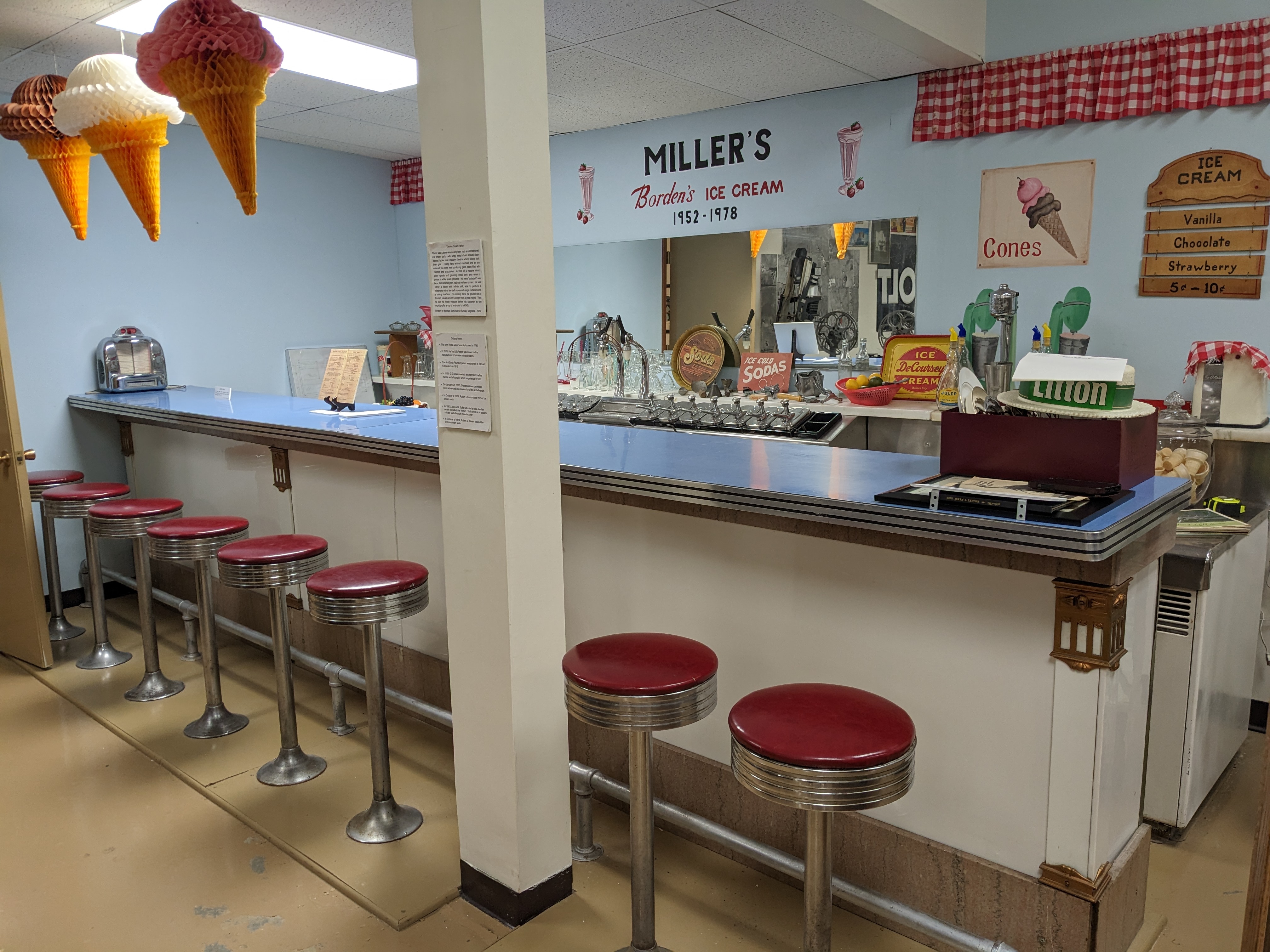
On the way back through Missouri on the Saturday of Memorial Day weekend, ladies at the first Visitor Center on I-29 warned us about traffic through Kansas City, which was hosting a Royals game, and advised us to take US36 from St. Joe across to Macon, then US63 down to Columbia, where we were booked for the night. The drive was far more pleasant than the Interstates, and we very much enjoyed exploring the quirky Grand River Historical Society Museum in Chillicothe, MO, where Otto Rohwedder invented the first automated bread-slicing machine for commercial use. A 1928 model of the Breadslicer was on display, on long-term loan from the Smithsonian. They also had a full display of an old-style ice cream and soda fountain.

Miller's ice cream and soda fountain, 1952-1978Miller’s ice cream and soda fountain, 1952-1978

Leave a comment

Filed under food, industry, migration, travel, U.S.

Homesteader Community Building

From Homesteading the Plains: Toward a New History, by Richard Edwards, Jacob K. Friefeld, and Rebecca S. Wingo (University of Nebraska Press, 2017), Kindle pp. 199-202:

4. Community policing of homestead claims was an effective mechanism to deter fraud. Homesteading scholars focused on what they assumed must have been paltry enforcement by overworked land office clerks and the miniscule force of GLO field investigators. In these conditions, they concluded, homestead claims must have been shot through with fraud; indeed, this conclusion buttressed the larger narrative to which they had already committed.

But it turns out that the Homestead Act also created a local network of watchful eyes. Mapping community relationships in the study area shows the emergence of keystone individuals in homesteading communities who helped create a local-community policing structure when no other existed. Neighbors, extended family members, would-be settlers in nearby towns, and others knew the ground, may have wanted it for themselves or their children, and didn’t want it stolen by swindlers and cheats. Just as in farming country today, where neighbors, family members, and others watch closely when ground in their vicinity becomes available due to the owner’s death or bankruptcy, so too it was in the homesteading regions. Indeed, [William G.] Comstock’s and [Bartlett] Richards’s attempted fraud came to disaster precisely because there were too many countervailing watchful eyes. What might have seemed anonymous and beyond scrutiny and hence ripe for fraud when viewed from Washington or New York or New Haven, or even from central Nebraska in the Comstock-Richards case, was in fact far more closely policed than expected.

6. The Homestead Act was not only a “single women’s law”; widows also participated at a high rate. In our study area, nearly as many widows filed initial entry claims as single women. But what greatly increased widows’ solitary participation—their unintended solitary participation—in homesteading was the deaths of their husbands. Women homesteaders succeeded by forming reciprocal socioeconomic relationships through employment and witness testimony between themselves and males in the wider community; they also created networks with other women that were crucial to their success. Our analysis highlights the need for scholars to further enrich this field.

7. Homesteading was not a solitary activity; it was a process of Americans from different backgrounds and regions mixing together to settle and form communities. They depended deeply on each other for survival and success. In our communities, keystone individuals emerged to provide economic, social, and political leadership in their neighborhoods. Immigrants from northwestern Europe tended to stake claims alongside native-born citizens, entering the social order of their new land. Central European immigrants, by contrast, more frequently created their own communities with their own leadership, thereby reproducing cultural landscapes more reminiscent of their homelands.

Settlement patterns and cultural differences thus separated communities of homesteaders. Different languages, religions, civic customs, community expectations, and patterns of family life all served to create distinctions. As Eric Foner noted, “In the late nineteenth century the most multicultural state in the Union was North Dakota,” but modern scholars have tended retrospectively to recategorize these varied peoples simply as “white,” thereby washing away their diversity. And while the walls between them were never as impermeable as those of race, these groups often required decades to overcome their differences and for diverse communities to become integrated. Even today we are left with certain communities that continue to proudly reflect their ethnic heritage in significant ways.

Leave a comment

Filed under democracy, economics, labor, migration, nationalism, U.S.

How Indian Territory Became Oklahoma

From Homesteading the Plains: Toward a New History, by Richard Edwards, Jacob K. Friefeld, and Rebecca S. Wingo (University of Nebraska Press, 2017), Kindle pp. 123-127:

In ongoing research we have been able to find comparable data for six other states. California, Kansas, and Minnesota appear to follow the Nebraska pattern; in southwestern Minnesota, the U.S.-Dakota War in 1862, with its tragic aftermath of the Mankato hangings, extinguished Indian land titles before the Homestead law became effective. New Mexico and Wyoming follow the Colorado pattern. Thus of the eleven states analyzed (counting North and South Dakota), in eight of them homesteading appears to have played little role in dispossession.

By contrast Indian Territory (Oklahoma) generally followed the Dakota pattern. Its particular history as the depository for Indian tribes from elsewhere, including the Five Civilized Tribes, imparted peculiar circumstances to the dispossession process, but clearly would-be homesteaders played a central role in dispossession.

The original inhabitants of what became Indian Territory were the Osage, Plains Apache, and to some extent the Comanche. Early in the nineteenth century their land titles were effectively extinguished to make way for other Indians, that is, to create Indian Territory (fig. 5.15). This original dispossession was unrelated to homesteading and predated it by several decades. There was, however, a second dispossession in Indian Territory that occurred when homesteaders and other whites desired the land of the resettled Indians.

As Rennard Strickland observed, “Oklahoma Indian tribes in a real sense were still sovereign—‘domestic dependent nations,’ in the words of Chief Justice John Marshall. Until that fateful year [1889], although subject to many federal regulations, Indians owned all the land that was to become Oklahoma. Whites within their domain were there on Indian sufferance or were government or military officials. Illegal intruders were subject to expulsion.”

Between 1870 and 1890 the population of Texas nearly tripled and the population of Kansas nearly quadrupled, and the land lying between them became increasingly alluring to whites. Cattle drives north through Indian Territory brought whites into the region. Railroads, land agents, and others, including Elias Boudinot, member of a distinguished Cherokee family, agitated for opening unoccupied Indian Territory lands. C. C. Carpenter, a “Boomer” (homesteader) leader, assembled a group of farmers in 1879 on the Kansas border with the intention of settling in the so-called Unassigned Lands in the middle of the territory (fig. 5.15); only the stationing of federal troops in nearby Kansas towns prevented the threatened invasion. Other expeditions of settlers organized and entered the territory with varying success. Meanwhile advocates for opening parts of Indian Territory organized a national publicity campaign to change federal policy, and it soon had success. By 1885 President Chester A. Arthur had declared in favor of opening Indian lands, and on March 23, 1889, President Benjamin Harrison, during his third week in office, issued a proclamation authorizing eligible persons to enter identified lands for the purpose of making homestead claims.

In a relatively brief span from late 1889 to roughly 1906, these by-then-well-established resident tribes were given allotments or otherwise moved to small reservations and their “surplus” lands opened to white settlement (fig. 5.16). The most common method of opening Indian Territory lands was by “runs”: homesteaders were excluded from the opened tracts until a specific date and time, at which point the settlers literally raced to their desired plots, with the first to arrive winning the claim [hence “Sooners“]. Figure 5.17 shows the great increase in homesteaded acreage that was unleashed by the second dispossession, represented (approximately) in the figure by the dashed line.

Would-be homesteaders had repeatedly organized illegal and provocative white intrusions onto Indian lands and lobbied Congress and the national executive to extinguish Indian land titles. They succeeded.

Leave a comment

Filed under democracy, economics, labor, migration, nationalism, U.S.

Did Homesteading Cause Dispossession of Indian Lands?

From Homesteading the Plains: Toward a New History, by Richard Edwards, Jacob K. Friefeld, and Rebecca S. Wingo (University of Nebraska Press, 2017), Kindle pp. 127-128:

Although homesteading occurred in thirty states, this chapter has focused on the process in the Great Plains, its center of gravity. As we have seen, the relationship between homesteading and dispossession [of Indian lands] differed depending on place and time.

In the Nebraska pattern, which held for eastern and central Nebraska, the federal government had largely cleared Indian land titles even before passage of the Homestead Act [in 1862], and homesteading mainly served as an equalizing corrective to other federal land policies that had grossly favored speculators and other large operators. California, Kansas, and Minnesota appear to mostly follow the Nebraska pattern, though more detailed studies would likely reveal more nuanced local patterns.

In Colorado [which quickly became a territory in the wake of the Pike’s Peak Gold Rush in 1858], dispossession preceded homesteading by several decades, and homesteading simply came too late to have been a significant cause of dispossession. Montana followed the Colorado pattern, as did the northwest corner of Nebraska and seemingly New Mexico and Wyoming as well.

The Dakota pattern, by contrast, which characterized both Dakota Territory and Indian Territory, was driven by land seekers and their advocates becoming noisy and powerful advocates pressuring their federal representatives to open Indian lands to white settlement. In Dakota Territory and Indian Territory, homesteaders were not the only ones working to “restore” Indian lands, but their actions speeded up dispossession and emboldened federal leaders to open larger tracts of Indian lands for white settlement [in the wake of the Dawes Act in 1887].

This concludes our reexamination of the four stylized facts adopted by the scholarly consensus on homesteading. In analyzing the first three stylized facts, we find the consensus wrong or deeply flawed. In examining the fourth stylized fact, which links homesteading to dispossession, we arrive at a more nuanced conclusion than its simple statement allows. It is both wrong and right. Taken together, the consensus facts provide an altogether misleading interpretation of homesteading.

Leave a comment

Filed under democracy, economics, labor, migration, nationalism, U.S.

Calculating Homestead Fraud Rates

From Homesteading the Plains: Toward a New History, by Richard Edwards, Jacob K. Friefeld, and Rebecca S. Wingo (University of Nebraska Press, 2017), Kindle pp. 89-90:

After careful analysis, our most conservative (i.e., highest) estimate is that in the study area, 8.5 percent of proved-up homesteads may have been gained through fraud, and we derived plausible estimates of roughly half that rate. In these ten townships in the last decades of the nineteenth century, it appears that more than 91 percent of homesteads went to bona fide or “actual” settlers.

The evidence from Dawes and Custer Counties requires us to take a second look at the scholarly consensus regarding fraudulent homestead claims. Fred Shannon asserted an implicit fraud rate of between 22 percent and 37 percent; later scholars have contended that half of all homestead entries before 1900 were fraudulent or even that half of all homestead entries were fraudulent.

Our evidence makes those conjectures appear absurdly high. Rather than the homesteading process being rife with corruption and fraud, the results reported here suggest that the overwhelming majority of homestead patents on claims filed in the nineteenth century were probably valid; perhaps as many as 8.5 percent of patents issued may have been based on some form of fraud. The government granted a total of 80,103,409 acres as homesteads during the period 1868–1900. If we assume our estimated fraud rate of 8.5 percent applies to all these homesteads, then fraudulent claimants wrongly obtained approximately 6.8 million acres; alternatively, more than 73 of the 80 million acres were obtained by bona fide homesteaders.

So was homesteading more like the railroad giveaways or the modern Medicare program? The government gave 131.2 million acres to the railroads, and as Richard White has so eloquently demonstrated, much of this subsidy was unneeded and corrupt, simply a transfer of public assets to private individuals and corporations. Indeed, concerning just one transaction involving one railroad, and by no means the greatest fraud, financier Jay Cooke boasted that he gained “at once over 5 million acres between the Red River and the Missouri intact, not an acre of it lost. This of itself is worth a good deal more than the cost of the [rail]road on both coasts all the expenditures up to this date to say nothing of our other larger grant on the Pacific and in Minnesota & the completed railroad.” Cooke’s one land grab of 5 million acres was only slightly less than the 6.8 million acres that would have been lost to all fraudulent homestead claims (at the 8.5 percent rate) over the entire forty-year period.

By contrast, recent studies of improper payments and fraud in Medicare put the swindle rate at about 8.3 percent—extremely close to our most conservative estimate, 8.5 percent, of fraud in homesteading. Any loss of public land (or Medicare funds) to fraud is of course regrettable and wrong, but the exaggerated claims of Shannon and others of “an astonishing number” or “half were fraudulent” appear to have no basis in fact.

Leave a comment

Filed under democracy, economics, labor, migration, scholarship, U.S.

Nebraska Homesteader Demographics

From Homesteading the Plains: Toward a New History, by Richard Edwards, Jacob K. Friefeld, and Rebecca S. Wingo (University of Nebraska Press, 2017), Kindle pp. 71-72:

Custer County homesteaders in our townships ranged from 25 to 83 years of age, with 55.6 percent filing their final claims between the ages of 25 and 39. There were 292 men and 32 women who filed claims. A majority, 253 of the 324, or 78.1 percent, had been U.S. citizens before making their claim. Of these 253 citizens, 85, or 33.6 percent, migrated to Custer County from Iowa and other parts of Nebraska with the rest coming from the other states. Of the 71 noncitizens, 38, or 53.5 percent, came from central European areas of Austria, Bohemia, Poland, and Moravia.

In our five Dawes County townships, farther west than Custer County, the 297 successful homesteaders found flat grasslands cut by erosion and geological curiosities and bordered on the north by the pine ridge. A mosaic of mixed grasses covered a blend of sand, clay, and silt earth. These soils, along with the county’s 18 to 20 inches of rain per year and long periods of drought, made farming even more difficult than in Custer County, though it clearly did not stop homesteaders—domestic and foreign—from trying.

Homesteaders settled the area between 1887 and 1908, and 80.8 percent came during the 1890s alone. Their ages ranged from 21 to 87, with 54.5 percent of them proving up when they were between the ages of 25 and 39. There were 265 men and 32 women, the same number of women as in Custer County. Of the 297 homesteaders, 238, or 80.2 percent, were citizens; the remaining 59, or 19.8 percent, were noncitizens. Citizen claimants in Dawes County came predominantly from states stretching from the interior to the east coast, including 168, or 70.6 percent, of the 238 coming from Illinois, Iowa, New York, Ohio, Pennsylvania, and Wisconsin; and 33, or 55.9 percent, of the 59 immigrant claimants came from Germany and England.

Homesteaders in both counties faced environmental disasters that complicated their progress. Grasshoppers plagued the state between 1874 and 1877. Hot winds scorched the crops. Drought hit the region for a hard twelve years between 1884 and 1895 and again between 1906 and 1913. The ten-year reprieve lured more settlers into the region; 197 individuals homesteaded in the study area between 1895 and 1904, demonstrating the enduring hope and short-term memory of those who dreamed of owning their own land.

Leave a comment

Filed under democracy, economics, labor, migration, nationalism, scholarship, U.S.

Database of Nebraska Homesteading

From Homesteading the Plains: Toward a New History, by Richard Edwards, Jacob K. Friefeld, and Rebecca S. Wingo (University of Nebraska Press, 2017), Kindle pp. 67-70:

To examine the extent of homesteading fraud more closely, we developed a database using the recently digitized homestead records; this chapter and chapters 6 and 7 report results obtained from this new data. Most previous studies of homesteading have been severely limited because researchers found it difficult to access the physical homestead records. Short of traveling to the National Archives or ordering costly paper copies of individual case files, scholars lacked easy access to the documents, and obtaining paper copies to construct a large database has often not been feasible. As a result scholarship has primarily employed anecdotes or the poor quality homesteading data reported in the General Land Office’s (GLO) annual reports, assembled by severely overworked land office clerks.

We use the digitized homestead records for Nebraska made available through a consortium that is digitizing all the case files of finalized homestead claims that are currently housed in paper form at the National Archives and Records Administration (NARA). Nebraska, the state with the first homestead claim, was also the first to be digitized. The consortium includes NARA, the Homestead National Monument of America, University of Nebraska, Fold3.com (later Ancestry.com), and FamilySearch.com. Fold3.com and Ancestry.com are making these records available (for a subscription fee) to the public for the first time; the University of Nebraska is providing additional metadata for scholarly research on the Nebraska records. We developed a study area of five townships each in Custer County (central Nebraska) and Dawes County (western Nebraska). The bulk of homesteading in the Custer County townships occurred between 1885 and 1904, whereas in Dawes County homesteading occurred mainly between 1890 and 1899, both with their last claims occurring in 1908 (fig. 4.1).

At the time we began our research in the summer of 2013, the digitization of the main land offices servicing these counties, Broken Bow for Custer County and Chadron for Dawes County, was complete. During our processing, we realized that the Broken Bow office, which was open from 1890 to 1908, and the Chadron office, open from 1887 to 1894, did not in fact process all the records for our counties. The Grand Island office, open from 1869 to 1893, and the Alliance office, open from 1890 to 1908, also served homesteaders in our townships. The Broken Bow office opened in response to regional demand, while the Alliance office eventually replaced the more remotely located Chadron office to serve the sparse western Nebraska population better.

Independent scholar Russell Lang from Craig, Nebraska, meticulously classified all Nebraska townships based on the “methods of land transfers from the public domain to private and governmental entities.” Using his map, we identified five townships each in Custer and Dawes Counties in which the majority of the land was transferred via the Homestead Act. We defined these ten townships as our study area; five in Custer County … with 324 claims, and five in Dawes County … with 297 claims.

We created a database of all 621 successful homesteaders in these townships, recording application number and date, name, legal description of land, acreage claimed, gender, country of origin and citizenship application date (if applicable), state of origin (if applicable), age, and other information included in affidavits such as acreage broken, improvements made, and any absences from the land. Our database is thus not a sample but rather a full census of these townships. Where relevant, we also collected information outside the records on claimants’ land transfer, military, and census records. The military and census records are available through Fold3 and Ancestry.com; the land transfer records required us to go to the historical societies for both counties. In addition to collecting demographic data, we mapped the homestead claims. To fully explore the particulars of the homesteaded lands, we tracked down original survey maps for each township and overlaid them with modern geospatial data. We also recorded all four witness names included in each Proof of Posting for every homesteader in order to generate sociolegal networks of the community within each township.

Leave a comment

Filed under democracy, economics, labor, migration, scholarship, U.S.