
Monthly Archives: April 2006

Speaking German in Moscow, 1941

Vova must have been frightened, bearing a German name [Knipper] at this moment of pitiless struggle [as the Wehrmacht closed in on Moscow]. Daily bulletins from Informburo were attached to trees and walls. On one of them he was shaken to see an excerpt from a letter taken off the body of a German soldier called Hans Knipper. And a schoolfriend of his, a Volga German about to be transported to Siberia, came to see them in despair. Vova’s father, Vladimir, advised him to volunteer for the army to save himself from an exile of forced labour which would be as bad as the Gulag, but Vova’s friend replied that the description ‘German’ was stamped on his papers and they would not accept him in the army. Those of German origin were implicitly categorized as potential enemies of the state. The NKVD had not wasted time assembling records on every Soviet citizen of German descent, some 1.5 million people. Local NKVD departments ‘from Leningrad to the Far East’ began a programme of arrests immediately after the Wehrmacht invasion. Yet no member of the Knipper family was touched [presumably because Vova’s cousin Lev Knipper worked for the NKVD].

Other Germans in Moscow were also in a strange position, but for different reasons. In the same building as the Knippers lived the family of Friedrich Wolf, the famous German Communist playwright, who had left Germany soon after Hitler came to power in 1933. They were part of the so-called ‘Moscow emigration’ of foreign Communists seeking sanctuary and would have faced instant execution at Nazi hands if the city fell. Vova used to act a roof-top fire-watcher, ready to deal with incendiary bombs, along with Wolf’s two sons, Markus and Koni. Markus later became the chief of East German intelligence and the original of Karla in John Le Carré’s novels, and his younger brother, Koni, became a film-maker, writer and the president of East Germany’s academy of arts. During air raids, Vladimir Knipper and Friedrich Wolf sat in the cellar, chatting together in German. ‘People sitting around us,’ wrote Vova, ‘turned to look at the two of them with anger and fear. There they were in the centre of Moscow arguing about something in the enemy’s language.’

SOURCE: The Mystery of Olga Chekhova: The true story of a family torn apart by revolution and war, by Antony Beevor (Penguin, 2005), pp. 173-174
Leave a comment

Filed under Germany, USSR, war

Barber for the Lubyanka Night Shift, 1930s

Lev’s first cousin Vova Knipper had a friend who was a barber in the proezd Serova near the Lubyanka [during the Soviet Great Terror of the 1930s]. Most of his clients were NKVD officers. When the barber’s shop opened at eight in the morning, NKVD interrogators, in a nervous state with heavy stubble, turned up in either military uniform or civilian clothes. They wanted a shave and a face massage to freshen up after a hard night’s work beating confessions out of their prisoners. They asked for bloodstains to be daubed from their tunics and trousers with eau-de-Cologne. Some were so exhausted that they would fall asleep in the chair, and the barber found it hard to wake them up afterwards. But those who stayed awake talked compulsively about their work. The hairdresser warned Vova about the need to keep his mouth shut at all times. ‘We’re in a trap,’ he warned.

SOURCE: The Mystery of Olga Chekhova: The true story of a family torn apart by revolution and war, by Antony Beevor (Penguin, 2005), p. 148

Leave a comment

Filed under USSR

Mound Tombs in Northern Japan

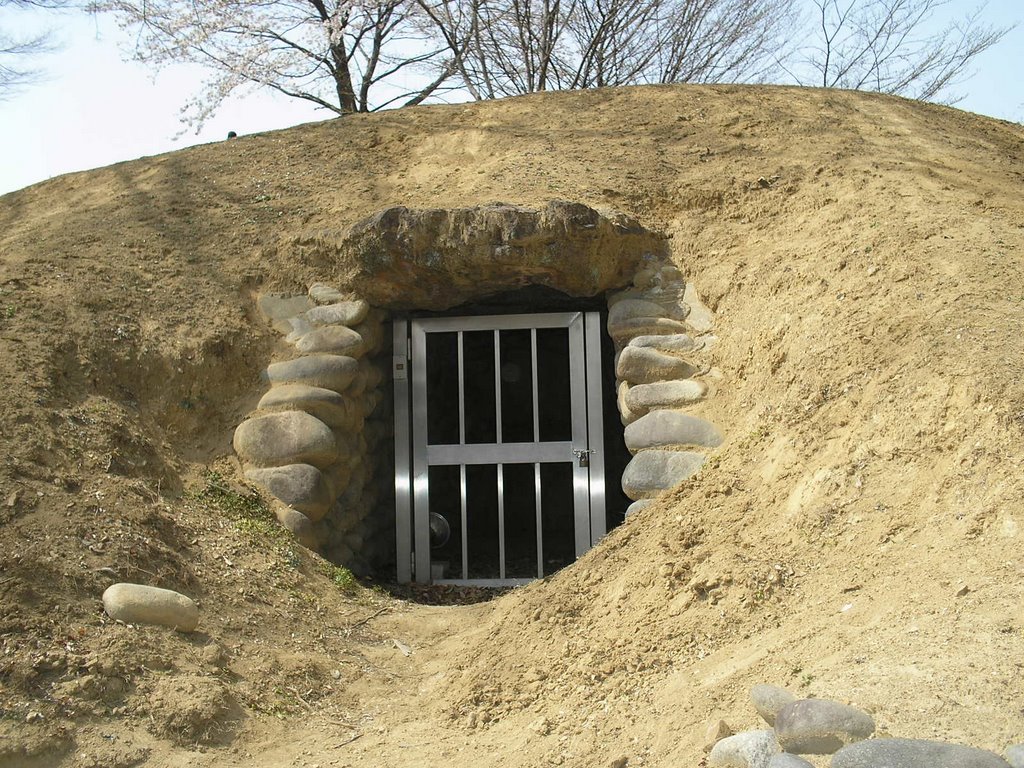
Before spending time in Ashikaga, I had not been aware how widespread in Japan were the mound tombs known as 古墳 kofun lit. ‘ancient grave’. When we walked over to Ashikaga Park to see the cherry blossoms there two weeks ago, we found that the hillside park includes 12 kofun, two of which have small, blocked-off, stone passageways facing east. (You would enter facing west.) I had always associated kofun with western Japan, where the largest imperial tombs were built, but an article on the Kofun Period (A.D. 300–700) by Sophia University archaeology professor Charles T. Keally set me straight.

  • The first excavation of a mound tomb in Japan was conducted my Mito (Tokugawa) Mitsukuni in 1692, the 5th year of the Genroku era. Mitsukuni (1628-1701) was the grandson of Tokugawa Ieyasu, founder of the Tokugawa Shogunate. The tomb he excavated is called the Samuraizuka Kofun, located in Ohtawara City, Tochigi Prefecture, just north of Tokyo. This excavation is considered the first academic, or scientific, excavation conducted in Japan.

Origins:
The origins of the Kofun Period mound tombs is clearly in the Yayoi Period, although ultimately continental influence might well be a factor, too. The most common Yayoi burials were in the ground in a square area delimited by a ditch or moat. The burial in the middle had a low mound over it. Toward the end of Yayoi, some of these ditches or moats became round. With higher mounds, these were the most common kofun tomb in the Kofun Period, but the burial was on top of the mound instead of under it. The square mounds, too, continued from Yayoi into Kofun, but these later ones also had the burial in the top of the mound instead of under it.

Forms:
The most distinctive mounds of the Kofun Period are the keyhole-shaped mounds, thought to be associated with the Imperial Family. This shape is uniquely Japanese and its origins are unknown. But Korean archaeologists recently have identified a few contemporary mound tombs in southeastern Korea that they say are also keyhole-shaped. Some people try to use these recent Korean finds to argue for a Korean origin of the keyhole-shaped mound tombs. But this fails to explain why this shape is rare in Korea and only recently recognized there through excavation, whereas this shape is common in Japan, obvious without excavation, and has been known for centuries….

Regions:
Mound tombs, especially the larger ones, tend to be located in clearly defined regions. Mound tombs are common in Kyushu only in the northwest, especially in the Chikugo River plain in Saga and southern Fukuoka prefectures. There is another such concentration of tombs in the eastern part of the Inland Sea in Okayama Prefecture on Honshu island and just across the water in Kagawa and Tokushima prefectures on Shikoku island. Similar concentrations are found in eastern Shimane Prefecture from Izumo to Matsue City on the Sea of Japan, in Nara and Kyoto prefectures, along the shores of Ise Bay from Nagoya to Ise, in Ishikawa Prefecture on the Sea of Japan, on the Kanto Plain in eastern Japan (especially in North Kanto), and on the Sendai Plain in northern Japan. There are smaller concentrations of tombs in Shizuoka Prefecture, and in the intermontane basins around Nagano, Yamagata and Kofu cities.

Archaeologists identify these concentrations with regional power centers, and they identify small clusters of tombs within these concentrations with the various clans known from later documents. In the north, keyhole-shaped mounds appeared in the Sendai Plain as early as the 5th century; the northern-most such tomb is in southern Iwate Prefecture. But most tombs in the northern regions are later. This northern region was the frontier with the Emishi barbarians who lived in northern Tohoku. Keyhole-shaped mound tombs are extremely rare in southern Kyushu, the home of the Hayato barbarians.

Ashikaga has always struck me as a city of Old Money, but I never thought it went back quite that far.

Leave a comment

Filed under Japan, Korea

Wordcatcher Tales: Udo no Taiboku

うどの大木 udo no taiboku ‘all hat, no cattle’ – We tried out a new restaurant in Ashikaga the other night, after a long circuit to view the many lovely shidare-zakura ‘weeping cherry trees’ that line a long, curving, landscaped ditch that borders the city’s huge civic center athletic complex.

The seafood restaurant Yanagi-ya [柳屋 ‘willow shop’] turned out to be a haven for Hanshin Tiger and sumo fans in the area. It caught my eye last month when it advertised the sumo wrestler’s special chanko nabe on the first day of the Osaka Grand Sumo Tournament. Unfortunately, the chanko nabe season is over now that the weather has started to get warmer, but the various dishes we ordered were all nicely presented, and tasty to boot. Each glass of sake had the name of a sumo wrestler on it.

At one point, the waitress brought over a complimentary dish of tempura vegetables that looked like celery tops, but tasted less bitter than celery, more like asparagus. She identified it as うど, which my electronic dictionary identified only as ‘an udo (a plant of the ginseng family cultivated for its edible shoots)’. The University of Virginia Library’s Japanese Haiku Topical Dictionary page for spring plants is more helpful.

独活 【うど】 udo, udo [a wild asparagus-like plant, Aralia cordata, sometimes cultivated and noted for its edible young shoots] (late spring).
山独活 【やまうど】 yamaudo, mountain udo [a wild variety, noted for its pungency]
深山独活 【みやまうど】 miyama-udo, high-mountain udo [Aralia glabra, rare]
芽独活 【めうど】 meudo, sprouting udo / udo shoots

The Anime Companion Supplement U offers a different context.

udo うど or 独活 Aralia cordata. The leaves and stalks of this plant are eaten either raw or cooked. The flavor is similar to asparagus. The cultivated type is grown in the dark to blanch it. Wild udo is used in sansai ryôri (mountain vegetable cooking), as the flavor is stronger it must be blanched before it is used in dishes.
Anime:
Udo salad is one of the foods cherry mentions in the Urusei Yatsura TV series (Episode 36 story 59)
Maho buys udo from Tachikawa in MahoRomatic (ep.3) and pickles it.

Wikipedia includes udo in its surprisingly long list of English words of Japanese origin, defining it as ‘an edible plant found on the slopes of wooded embankments, also known as the Japanese Spikenard’.

Well, “Japanese spikenard” is not likely to be any more intelligible to most English speakers than the term “udo” itself, but here’s a derivative expression that has more familiar English parallels: うどの大木 udo no taiboku lit. ‘huge tree of udo’. (I had expected the pronunciation for 大木 to be daimoku but it seems to be taiboku in all contexts.) The Hoita Kokoro Center in Canada explains its meaning:

Just big man with nothing (lit. A huge udo tree) All bark and no bite or All hat and no cattle in English

Wikipedia explains further.

Despite its size, it is not a woody plant, as demonstrated in the popular saying Udo no taiboku (独活の大木), literally “great wood of udo”, meaning roughly useless as udo has a very soft stem.

1 Comment

Filed under Japan, language, sumo

Japanese Zen’s Return to Shinto Aesthetics

Many commentators associate the Japanese emphasis on naturalness and simplicity with Zen Buddhism rather than Shinto. In such books as Zen and Japanese Culture, D. T. Suzuki popularized this view in Japan as well as in the West. Suzuki was correct to point out that many arts associated with Japan have a close association with Zen Buddhism, especially through the tea ceremony and all its accoutrements including ikebana, calligraphy, poetry, gardens, and pottery. Suzuki accurately portrayed Zen’s historical significance in the development and institutionalization of these arts. At times, though, he seemed to imply more—namely, that Zen Buddhism introduced the aesthetic of simplicity and naturalness to Japan. This claim, if he indeed meant to make it, is wrong.

Simplicity and naturalness were part of Japanese culture and represented in Shinto practices centuries before Zen’s emergence in the thirteenth century. The kind of grand simplicity found in many Shinto shrines such as that of the sun kami at Ise is an obvious example. Zen prospered through its connection with the Japanese arts, not so much because it was introducing something totally new to the culture, but because it resonated with something old. The so-called Zen simplicity in many drinking bowls used in the tea ceremony, for example, can also be seen as far back as some of the unglazed pottery of the Yayoi period, a millennium before Japanese Zen developed and tea plants were cultivated in Japan.

One can argue, therefore, that the Zen aesthetic was similarly a return to a simplicity predating the Heian court’s aesthetic of elegance. This aesthetic of courtly elegance predominated among the aristocrats of the Heian period (794–1185) and reflected the high arts from China, including those from esoteric Buddhism, rather than Shinto. The power of the nobles had waned, however, by the time Zen blossomed in Japan. Zen melded the Kamakura period‘s (1185–1333) tendency to go back to the ideals of a simpler, less refined, sometimes even rustic, lifestyle. This aesthetic fit the military mentality of the new political leaders, many of whom had come from the outlands distant from the cultural capital of Kyoto [like Ashikaga]. By this process, Zen values and practices became the center of aesthetic development in the thirteenth through sixteenth centuries [during the Ashikaga shogunate].

SOURCE: Shinto: The Way Home, by Thomas P. Kasulis (U. Hawai‘i Press, 2004), pp. 45-46

Leave a comment

Filed under China, Japan

Targeting Russian Émigrés, 1920s

This period [the early 1920s] was one of intense secret operations abroad mounted by INO (Inostrannyi Otdel), the Foreign Intelligence Department of the OGPU. Even after the destruction of the White armies, Lenin was determined to pursue counter-revolution abroad. In December 1920, Feliks Dzerzhinsky, the founder of the Cheka, had begun to organize operations against émigré groups in France and Germany. Berlin alone contained 200,000 White Russian refugees.

Relatives of prominent émigrés were seized as hostages at home and agents were rapidly recruited for operations abroad to infiltrate émigré organizations and arrange the kidnapping of their leaders. A sophisticated development was to create fake White Guard organizations within Russia to trap the regime’s enemies. These activities were given the highest priority. For the first dozen years of its life, INO’s ‘main foreign target remained the White Guard movement’.

The White Guard movement was directed from Paris by the Russian combined Services Union (ROVS), led by General Kutepov, who was kidnapped in Paris by OGPU agents in January 1930. A successor, General Miller, was also kidnapped in December 1936. He was taken back to the Soviet Union drugged inside a trunk, interrogated, tortured and then shot. The émigré world of White Russians in the early 1920s was a political demi-monde of agents and double agents, mostly working for the OGPU. Homesick White Russians in Paris and Berlin, many of them well-born officers working at night as taxi drivers, were prepared to betray their closest friends for the chance of what they thought was a guarantee of safe conduct home….

The Russian émigré community in Berlin was more like a colony, largely because it was so concentrated on the western centre of the city. Berliners jokingly called the Kurfürstendamm the Nöpski Prospekt’, and Charlottenburg was known as ‘Charlottengrad’. Writers including Vladimir Nabokov, Ilya Ehrenburg and Boris Pasternak treated the cafés of the area, such as the Prager Diele, in the same way as French existentialists later used the cafés of Saint-Germain. There were around 200 Russian-language newspapers, magazines and journals in Berlin, a number of publishing houses and even a Russian high school. But this already precarious community was to be devastated and scattered within a decade by the economic crisis and unemployment triggered by the Wall Street Crash.

SOURCE: The Mystery of Olga Chekhova: The true story of a family torn apart by revolution and war, by Antony Beevor (Penguin, 2005), pp. 95-97

Leave a comment

Filed under Germany, USSR

Shinto: Practices vs. Doctrines

From ancient times, the Japanese (indeed East Asians generally) had not missed the point that many of what we call “religious traditions” of East Asia were alike in some fundamental way. In general, the Japanese grouped together the Asian spiritual traditions by giving them names (usually borrowed from Chinese) sharing one of two suffixes: kyō ([教] broadly meaning “teachings”) or ([道] broadly meaning “path,” “way,” or “course”). The convention was to precede this suffix with the name of the spiritual inspiration behind the tradition. Thus jukyō indicated Confucianism ([儒教] “Confucian scholar” plus kyō), butsudō or (later) bukkyō indicated Buddhism ([仏道/仏教] Buddha” plus or kyō), and dōkyō indicated Daoism ([道教] “dao” plus kyō). The name “Shinto” itself consists of the character for kami ([神] in such compounds pronounced shin) and dō ([道] in this case mutated into ). In referring to Christianity today in Japan, the common term is kirisutokyō ([キリスト教] “Christ” plus kyō).

As we see in the two terms for Buddhism (butsudō and bukkyō), the suffixes and kyō may be interchangeable. There is, however, a difference in their etymologies: has the nuance of praxis and kyō of doctrines. Hence the Japanese arts as well as religions may have the suffix dō: budō ([武道] “way of the warrior” or martial arts), chadō ([茶道] “way of tea” or tea ceremony), shodō ([書道] “way of writing” or calligraphy). In self-consciously creating a word to translate the Western term “religion,” this difference in nuance between kyō and is relevant. The use kyō in shukyō suggests a Japanese impression that the concept of “religion” is more about doctrine or creed than practice.

What about the first part of the word, the shū of shūkyō [宗教]? The term shū suggests a discrete religious community with common practices and teachings. In fact, the term shūkyō was not truly a neologism. There was a rather arcane Buddhist use of the term to mean specifically the doctrines of any particular Buddhist sect or school. Given this etymological context, to inquire in Japanese whether someone is “religious” (shūkyōteki) may seem a little like asking them if they are “sectarian” or “dogmatic.” In choosing such a word to designate “religion,” the scholars who created the neologism might have been thinking of the evangelical and exclusivist aspects of the Western religions they had encountered (especially through Christian missionaries). This exclusivity in Japanese Christianity continues today, incidentally: the large majority of the 1 percent of Japanese who designate “Christian” as their religious affiliation do not, unlike many of their Buddhist or Shinto compatriots, also select another tradition.

SOURCE: Shinto: The Way Home, by Thomas P. Kasulis (U. Hawai‘i Press, 2004), pp. 30-31

NOTE: Some quotes around italics eliminated. Kanji characters added.

Leave a comment

Filed under Japan, religion

Hiroshima Carp’s Manager Marty Brown

Last night, I was watching the only Pro Baseball game in Japan that wasn’t rained out. My old underdog favorite Hiroshima Carp lost to the newly revitalized Yomiuri Giants and their superb, three-hit shutout pitching of Jeremy Powell. I was shocked to see that the super-traditional Carp had a foreign manager, former Carp player Marty Brown. The funniest part of the game for me was watching Brown’s translator while Brown was flashing signs to his outfield after the Giants broke the game open with a series of hits in the 7th inning. Brown’s translator was repeating, sign for sign, what his manager was signing. That surely must be the easiest translation task one could ask for.

It sounds like Brown has a much harder job, judging from a recent report by Jim Allen in the Daily Yomiuri.

Marty Brown is a firm believer in tradition, and traditionally no team has exerted more energy in practice than the Hiroshima Carp. Yet after finishing fifth or worse for four straight seasons, the fish lured their former outfielder back to Hiroshima Citizens Stadium to turn that energy into results….

The club’s spring training camp was like going to a living history museum, an homage to pro baseball’s past. Other clubs go through pre-programmed drills in small groups until noon when individuals go off to work on specific skills, but Hiroshima’s habit was old-school regimentation–working in groups from morning to late afternoon.

“Something had to be changed and I think it took a lot of guts to hire me to do this job, this being Hiroshima and [me] a foreign manager,” Brown said. “I respect that. I think it is good that I played in Hiroshima and I know the city and I still have a lot of friends there….

Brown has instructed all the players to plan their own skill workouts–instead of simply following programs planned out by coaches–and to have a focus and rationale for their work.

“Until now, the Carp have had very tough workouts. Just amazing,” said Arai. “But Marty has said we’ll finish group workouts earlier … [and] with the time remaining, players should … work individually on their weak points.”

This is nothing new in Japan.

The Chunichi Dragons won the CL in 2002 after rookie manager Hiromitsu Ochiai told veteran players to plan their own spring routines. But for the tradition-bound Carp this was a radical departure.

“Up to now, camp had the feeling of, ‘Do this.’ Now it is, ‘Let’s go.’ That’s really a significant difference,” Arai said.

Asked if players could confidently do their own thing after years of conformity, Arai insisted it was no problem.

“Essentially, action must originate with a player. When coaches are telling you ‘do it, do it,’ it is about their expectations,” Arai said. “But every action depends on the ability of the player, himself.

“Marty said, ‘You are professionals and I expect you to take responsibility.’ To take responsibility and think for yourself, and turn that into action, that is part of being a professional ball player.”

1 Comment

Filed under baseball

Amateur vs. Professional Revolutionaries, 1917

The final downfall of the Romanov dynasty came on 3 March [1917], with the renunciation of the throne by the Grand Duke Mikhail, who had been nominated to be the Tsar’s successor…. The sudden collapse of the aristocracy took professional revolutionaries, such as Lenin and Trotsky, completely by surprise. They were exasperated to find themselves so far from the centre of events. But as things turned out, they had not missed their opportunity. The leaders of the Provisional Government, acting out of high-minded liberal naïvety in the case of Prince Lvov, and theatrical vanity in the case of his successor, Aleksandr Kerensky, proved easy to outmanoeuvre. The neck of the new freedom was exposed to the unscrupulous Leninists.

Kerensky was a lawyer. He was small and his starting eyes and curved nose made him look like a very intelligent frog, yet with ringing rhetoric and bursts of emotional energy he could dominate huge crowds. (Olga Chekhova later observed that whenever she saw Dr Goebbels speak, she could not help thinking of Kerensky.) Kerensky managed to convince many highly educated people – Stanislavsky and Nemirovich-Danchenko among them – that he was a political genius, the Napoleon who would bring revolutionary excesses back under control and produce human justice. But historical parallels, especially in times of revolution and war, are often dangerously misleading. The balancing act which he had to undertake between reassuring the bourgeoisie and Russia’s Western allies on one hand, while at the same time appeasing the impatience of workers and peasants to take over factories and farmland, would have undermined the credibility of even the greatest leader.

Stanislavsky’s family business, the Alekseiev factories, were seized by the workers, and his house, as he admitted to a friend, had been ‘done over’. Respect for private property had collapsed with the elastic notion of ‘revolutionary expropriation’. Stanislavsky now had nothing more than a salary from the Moscow Art Theatre. Yet his enthusiasm for this new world of freedom did not diminish. He was certain it would lead not only to a fairer world, but to a more beautiful one. On the other hand, he also admitted that he was politically illiterate.

SOURCE: The Mystery of Olga Chekhova: The true story of a family torn apart by revolution and war, by Antony Beevor (Penguin, 2005), pp. 43-44

Leave a comment

Filed under Russia, USSR

The Shinto Torii: A Reminder to Purify the Heart

[The torii (鳥居)] does not demarcate something external into which I can simply tap. To function properly, the mysterious power beyond the torii must be in an internal relation with the person passing through it. If your mind is befuddled and clouded, if your heart is defiled and disingenuous, passage through the gateway will only return you to that. A symbol sacred to Shinto is the mirror. In fact, in many shrines, large and small, major and minor, the altar contains nothing other than a mirror. Along with the sword and comma-shaped jewel [magatama], the mirror is part of the official regalia of the emperor as chief priest of the tradition. A mirror’s capacity to reflect depends on its cleanliness. Hence Shinto sites usually have a water trough for purification near the entrance. As people enter the heart of the shrine, they are expected to wash their hands and mouth, cleansing themselves of any pollution from physical or verbal misdeeds. Washing away dirt from the journey, they are ready to be a home in the kami-filled, tama-empowered shrine. Their hearts and minds are pure. Even the torii along the path on Mount Fuji serves a similar function. The torii reminds pilgrims to cleanse their inner self in preparation for approaching the peak.

SOURCE: Shinto: The Way Home, by Thomas P. Kasulis (U. Hawai‘i Press, 2004), p. 23

I’ve never climbed Mt. Fuji, but I can well imagine the female voice recording familiar to every train passenger in Japan telling the pilgrims as they approach the torii of their impending arrival at the summit, thanking them for having climbed up, and asking them to mind their magokoro ‘truehearts’ instead of their ashimoto ‘footsteps’ as they pass through the torii: 間もなく山頂に到着いたします。ご乗山真にありがとうございました。鳥居を通るとき真心にご注意願います。(Mamonaku sanchou ni touchaku itashimasu. Gojousan makoto ni arigatou gozaimashita. Torii o tooru toki, magokoro ni gochuui negaimasu.)

And then telling them where to find the toilets and vending machines.

Leave a comment

Filed under Japan