Monthly Archives: July 2005

Is Live 8 an Insult to Africa?

Jean-Claude Shanda Tonme, a consultant on international law and a columnist for Le Messager, a Cameroonian daily, has published his reaction to the Live 8 concert in the New York Times.

LIVE 8, that extraordinary media event that some people of good intentions in the West just orchestrated, would have left us Africans indifferent if we hadn’t realized that it was an insult both to us and to common sense….

Don’t insult Africa, this continent so rich yet so badly led. Instead, insult its leaders, who have ruined everything. Our anger is all the greater because despite all the presidents for life, despite all the evidence of genocide, we didn’t hear anyone at Live 8 raise a cry for democracy in Africa.

Don’t the organizers of the concerts realize that Africa lives under the oppression of rulers like Yoweri Museveni (who just eliminated term limits in Uganda so he can be president indefinitely) and Omar Bongo (who has become immensely rich in his three decades of running Gabon)? Don’t they know what is happening in Cameroon, Chad, Togo and the Central African Republic? Don’t they understand that fighting poverty is fruitless if dictatorships remain in place?…

In Africa, our leaders have led us into misery, and we need to rid ourselves of these cancers. We would have preferred for the musicians in Philadelphia and London to have marched and sung for political revolution. Instead, they mourned a corpse while forgetting to denounce the murderer….

But the truth is that it was not for us, for Africa, that the musicians at Live 8 were singing; it was to amuse the crowds and to clear their own consciences, and whether they realized it or not, to reinforce dictatorships. They still believe us to be like children that they must save, as if we don’t realize ourselves what the source of our problems is.

Well, big-name musicians know a whole lot more about money than they do about democracy. And what do the UN, EU, or most national bureaucracies know about ending corruption? Ending dictatorships by military force is the easy part. Nation-building is nowhere close to being an Olympic sport yet. Not even an exhibition sport.

Leave a comment

Filed under Africa, NGOs

Child Labor Trends in Vietnam

Dynamist blogger Virginia Postrel has a column in the New York Times on evolving research about child labor.

WHEN Americans think about child labor in poor countries, they rarely picture girls fetching water or boys tending livestock. Yet most of the 211 million children, ages 5 to 14, who work worldwide are not in factories. They are working in agriculture – from 92 percent in Vietnam to 63 percent in Guatemala – and most are not paid directly.

“Contrary to popular perception in high-income countries, most working children are employed by their parents rather than in manufacturing establishments or other forms of wage employment,” two Dartmouth economists, Eric V. Edmonds and Nina Pavcnik, wrote in “Child Labor in the Global Economy,” published in the Winter 2005 Journal of Economic Perspectives….

Some of the best data, and the most noteworthy results, come from Vietnam, which tracked about 3,000 households from 1993 to 1998. This was a period of rapid economic growth, in which gross domestic product rose about 9 percent a year….

The effects were greatest for families escaping poverty. For those who crossed the official poverty line, earning enough to pay for adequate food and basic necessities, higher incomes accounted for 80 percent of the drop in child labor. In 1993, 58 percent of the population fell below the poverty line, compared with 33 percent five years later….

The results from Vietnam suggest that families do not want their children to work. Parents pull their children out of work when they can afford to, even when the wages children could earn are rising. Poverty, not culture, appears to be the fundamental problem.

Rather than simply banning child labor, then, policy makers should concentrate on alleviating poverty. That includes not only encouraging economic growth but also improving access to schools and to credit markets. Borrowing could allow families to buy equipment to substitute for child labor, to weather short-term declines in income and to pay school fees….

“Most child labor policy even today is directed at trying to get kids into unemployment – to limit working opportunities for kids,” he said in the interview. But, “if households are already in a situation where they don’t want their children to be working, but they’re forced to because of their circumstance, taking additional steps to prevent the kids from working is punishing the poorest for being poor.”

I suspect most child labor policy is designed to protect child laborers in one region from competing against adult laborers in another. Concentrating instead on economic growth in the poorer region would in the longer run be more likely to create new wealth, new markets, and therefore new jobs in other regions as well.

Leave a comment

Filed under Vietnam

Sea Trade under the Pax Mongolica

The failed invasions of Japan and Java taught the Mongols much about shipbuilding, and when their military efforts failed, they turned that knowledge to peaceful pursuits of commerce. Khubilai Khan made the strategic decision to transport food within his empire primarily by ship because he realized how much cheaper and more efficient water transportation, which was dependent on wind and current, was than the much slower land transport, which was dependent on the labor of humans and animals that required constant feeding. In the first years, the Mongols moved some 3,000 tons by ship, but by 1329 it had grown to 210,000 tons. Marco Polo, who sailed from China to Persia on his return home, described the Mongol ships as large four-masted junks with up to three hundred crewmen and as many as sixty cabins for merchants carrying various wares. According to Ibn Battuta, some of the ships even carried plants growing in wooden tubs in order to supply fresh food for the sailors. Khubilai Khan promoted the building of ever larger seagoing junks to carry heavy loads of cargo and ports to handle them. They improved the use of the compass in navigation and learned to produce more accurate nautical charts. The route from the port of Zaytun in southern China to Hormuz in the Persian Gulf became the main sea link between the Far East and the Middle East, and was used by both Marco Polo and Ibn Battuta, among others.

En route, the ships also called at the ports of Vietnam, Java, Ceylon, and India, and in each place the Mongol representatives encountered more goods, such as sugar, ivory, cinnamon, and cotton, that were not easily produced in their own lands. From the Persian Gulf, the ships continued outside of the areas under Mongol influence to include regular trade for a still greater variety of goods from Arabia, Egypt, and Somalia. Rulers and merchants in these other areas outside the Mongol system of influence did not operate within the system of shares in the Mongol goods; instead, the Mongol authorities created long-term trading relations with them. Under Mongol protection, their vassals proved as worthy competitors in commerce as the Mongols had been in conquest and they began to dominate trade on the Indian Ocean.

To expand the trade into new areas beyond Mongol political control, they encouraged some of their vassals, particularly the South Chinese, to emigrate and set up trading stations in foreign ports. Throughout the rule of the Mongol dynasty, thousands of Chinese left home and sailed off to settle along the coastal communities of Vietnam, Cambodia, the Malay Peninsula, Borneo, Java, and Sumatra. They worked mostly in shipping and trade and as merchants up and down the rivers leading to the ports, but they gradually expanded into other professions as well.

To reach the markets of Europe more directly, without the lengthy detour through the southern Muslim countries, the Mongols encouraged foreigners to create trading posts on the edges of the empire along the Black Sea. Although the Mongols had initially raided the trading posts, as early as 1226, during the reign of Genghis Khan, they allowed the Genoese to maintain a trading station at the port of Kaffa in the Crimea, and later added another at Tana. To protect these stations on land and sea, the Mongols hunted down pirates and robbers. In the Pratica della mercatura (Practice of Marketing), a commercial handbook published in 1340, the Florentine merchant Francesco Balducci Pegolotti stressed that the routes to Mongol Cathay were “perfectly safe, whether by day or by night.”

SOURCE: Genghis Khan and the Remaking of the Modern World, by Jack Weatherford (Three Rivers Press, 2004), pp. 223-224

Leave a comment

Filed under China, Vietnam

Mandarin, Merchant, …, Prostitute, Scholar, Beggar

The Mongol elite’s intimate involvement with trade represented a marked break with tradition. From China to Europe, traditional aristocrats generally disdained commercial enterprise as undignified, dirty, and, often, immoral; it ranked with the manual trades beneath the interests of either the powerful or the pious. Furthermore, the economic ideal in feudal Europe of this time was not merely that each country should be self-sufficient, but that each manor estate should strive to be as self-supporting as practical. Any goods that left the estate should not be going to trade for other goods for the peasants on the land but to buy jewelry, religious relics, and other luxury goods for the aristocratic family or church. The feudal rulers sought to have their peasants supply all their own needs–to produce their food, grow their timber, make their tools, and weave their cloth–and to trade for as little as possible. In a feudal system, reliance on imported goods represented a failure at home.

The traditional Chinese kingdoms operated under centuries of constraints on commerce. The building of walls on their borders had been a way of limiting such trade and literally keeping the wealth of the nation intact and inside the walls. For such administrators, giving up trade goods was the same as paying tribute to their neighbors, and they sought to avoid it as much as they could. The Mongols directly attacked the Chinese cultural prejudice that ranked merchants as merely a step above robbers by officially elevating their status ahead of all religions and professions, second only to government officials. In a further degradation of Confucian scholars, the Mongols reduced them from the highest level of traditional Chinese society to the ninth level, just below prostitutes but above beggars.

SOURCE: Genghis Khan and the Remaking of the Modern World, by Jack Weatherford (Three Rivers Press, 2004), p. 225

Leave a comment

Filed under China

Pearsall’s Books on a Roll

The blog Pearsall’s Books has been on a roll lately, with demographic studies, editorial analyses, and its trademark book reviews. Here, for instance, is a perceptive column Pearsall analyzes by Jason Burke in Sunday’s Guardian Observer about the lifecycle of terrorist movements.

Historically, this first attack usually prompts the state security machine, after a short delay or period of indecision, to swing into action. Repressive legislation is introduced, intelligence agencies boosted and key militant leaders are killed or imprisoned. This results in more indiscriminate, brutal violence as the terrorist movement, leaderless and rudderless, mutates and fragments. With resources scarce and security high, soft targets are favoured.

What follows is crucial. Egypt and Algeria suffered Islamic militancies in the early 1990s that followed the above pattern. After nearly a decade of increasing horror, they peaked in grotesque violence. In Algeria, more than 100,000 died. But rather than boost the militants, this had the opposite effect. Public support for extremists collapsed; the ‘martyrs’ became ‘murderers’. Reviled by former supporters, the militants became easy prey for security agencies. Now, only a criminalised rump of violent men remains in both countries. Movements that once threatened the existence of the state are effectively finished. And the critical factor throughout was the support of the bombers’ own constituency.

The insurgency labelled ‘al-Qaeda’ fits this paradigm in many respects. The spectacular attack (9/11), then the response (the Patriot and anti-terrorist Acts, Guantánamo Bay). The degrading of the leadership (the invasion of Afghanistan, thousands of arrests ), now a brutal, indiscriminate phase as individuals buy into a hate-filled ideology (Madrid, the Beslan school massacre, London) and conduct freelance operations.

It may be argued that, as Algeria and Egypt (and Northern Ireland and the Basques) were on a national scale and the ‘al-Qaeda insurgency’ spans the globe, we are in untrodden territory. But I believe the basic conclusions drawn from smaller-scale examples remain valid. No one can claim, given the diversity of this attack’s victims, that they were striking simply at the West. The casualties, in our wonderfully varied city, are as globalised as the ideology that caused them. This is a global militant movement working to an agenda that can inspire or repel anywhere on the planet.

Leave a comment

Filed under Afghanistan

Naadam: Mongolia’s Three Manly Games

Mongolia’s 3-day Naadam period of traditional summer games ended today, but fans of Mongolian wrestling can console themselves for another ten days by watching Mongolian yokozuna Dolgorsuren Dagvadorj (aka Asashoryu) thrash Japanese, Russian, Bulgarian, Georgian, and fellow Mongolian opponents in the Nagoya Grand Sumo Tournament that started Sunday.

via Ulaan Ken Baatar and The Marmot’s Hole

Intrepid book reviewer Danny Yee is now in Mongolia. Pathologically polymathic though he be, I didn’t realize he was into archery, wrestling, and horse-racing! Be sure to look for his travelogue. It’s sure to be a treat.

1 Comment

Filed under Mongolia, sumo

A Steppe Inside the Forbidden City

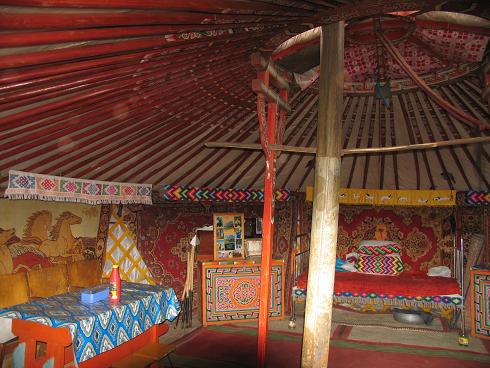
Ultimately, at the heart of [Khanbalik], Khubilai created a Mongol haven where few foreigners, including Chinese, could enter. Behind high walls and guarded by Mongol warriors, the royal family and court continued to live as Mongols. The large open areas for animals in the middle of the city had no precedent in Chinese culture. This Forbidden City constituted a miniature steppe created in the middle of the Mongol capital. During the Mongol era, the whole complex of the Forbidden City was filled with gers [yurts] where members of the court often preferred to live, eat, and sleep. Pregnant wives of the khan made sure that their children were born in a ger, and the children received their school lessons in the ger as they grew up. While Khubilai and his successors maintained public lives as Chinese emperors, behind the high walls of their Forbidden City, they continued to live as steppe Mongols.

When the Franciscan friar Odoric of Pordenone visited the Mongol territories in the 1320s, he described the Forbidden City in Khanbalik: “Within the precincts of the said palace imperial, there is a most beautiful mount, set and replenished with trees, for which cause it is called the Green Mount, having a most royal and sumptuous palace standing thereupon, in which, for the most part, the great Can is resident.” In a passage that sounds very close to earlier descriptions of Karakorum, he wrote, “Upon the one side of the said mount there is a great lake, whereupon a most stately bridge is built, in which lake is great abundance of geese, ducks, and all kinds of water-fowl; and in the wood growing upon the mount there is a great store of all birds, and wild beasts.” …

Inside the confines of their Forbidden City, Khubilai and his family continued to act as Mongols in dress, speech, food, sports, and entertainment. This meant that they consumed large amounts of alcohol, loudly slurped their soup, and they cut meat with knives at the table, thereby disgusting the Chinese who confined such acts to the kitchen during preparation. With the emphasis on alcohol and rituals of drinking and drunkenness, the scenes at court must have been somewhat chaotic as the free-roaming, individualistic Mongols tried to imitate the complex and highly orchestrated rituals and ceremonies of the Chinese court. In contrast to the Chinese imperial tradition of courtiers lining up according to rank, the Mongols tended to swarm chaotically, and, perhaps most disturbing to the Chinese, the Mongol women mingled freely among the men on even the most important occasions. The ceremonies in the Mongol court became so disorganized that sometimes the khan’s bodyguards had to beat back the crowds of officials and guests with batons.

SOURCE: Genghis Khan and the Remaking of the Modern World, by Jack Weatherford (Three Rivers Press, 2004), pp. 199-200

Leave a comment

Filed under China, Mongolia

Khubilai’s Move from Xanadu to Khanbalik

To appear as a powerful Chinese leader, Khubilai needed an impressive court located in a real city, not a peripatetic tent court nor the ad hoc structures erected at Shangdu (Xanadu), in modern Inner Mongolia. The place held special importance for him because he had first been proclaimed Great Khan at the khuriltai there, but it had no obvious advantages. Not only was that capital located in a nomadic zone, which the Chinese found quite alien and barbaric, but it had also been the traditional staging area used by his grandfather in the raiding and looting of Chinese cities. Khubilai sought to disassociate himself from the less desirable aspects of that history.

While keeping Shangdu as a summer home and a hunting preserve, he commissioned the building of another city, a real Chinese-style imperial capital, farther south at a place better situated to exploit the agricultural wealth of the lands along the Yellow River. He chose the site of the former Jurched capital of Zhongdu, which had been conquered by Genghis Khan in 1215, the year of Khubilai’s birth. In 1272, Khubilai ordered the building of his new capital, and he connected it by canal to the Yellow River. The Mongols called the place Khanbalik, the City of the Khan. His Chinese subjects called it Dadu, the Great Capital, and it grew into the modern capital of Beijing [‘North Capital’]. Khubilai brought in Muslim architects and Central Asian craftsmen to design his city in a new style that offered more of a compromise between the tastes of the nomadic steppe dwellers and the sedentary civilization.

In contrast to the maze of winding alleys in most Chinese cities of the era, Khubilai’s capital had broad, straight streets run on a north-south axis with east-west streets perpendicular to them; the guards at one gate could see straight through the city to the guards at the opposite gate. From the imperial palace, they built boulevards, more to accommodate the horses and military maneuvers of the Mongols than the wheelbarrows or handcarts of the Chinese laborers. The boulevards stretched wide enough for nine horsemen to gallop abreast through the city in case the native people rose up against their foreign rulers.

Furthering the Mongol interest in profits from international trade, Khubilai Khan designated sections of the city for Middle Eastern and Mongol populations as well as for people from all over what is today China. The city was host to merchants from as far away as Italy, India, and North Africa. Where so many men lingered, as Marco Polo pointed out in great detail, large numbers of prostitutes gathered in their own districts to serve them. Scholars and doctors came from the Middle East to practice their trades. Roman Catholic, Nestorian, and Buddhist priests joined their Taoist and Confucian counterparts already practicing in China. Muslim clerics, Indian mystics, and, in some parts of Mongol China, Jewish rabbis added to the mixture of people and ideas that thronged the empire. Far larger than Karakorum, but with many of the same internationalist principles, the city was a true world capital and fit to be capital of the world.

SOURCE: Genghis Khan and the Remaking of the Modern World, by Jack Weatherford (Three Rivers Press, 2004), pp. 197-199

Leave a comment

Filed under China, Mongolia

Some Fire and Brimstone on Srebrenica

The Wall Street Journal has a harsh editorial today.

Ten years ago today, Bosnian Serb forces under the command of General Ratko Mladic entered the Bosnian Muslim town of Srebrenica, then being defended by Dutch peacekeepers. General Mladic made three demands: that the townsmen surrender their weapons; that all males between the ages of 12 and 77 be separated out for “questioning”; and that the rest of the population be expelled to Muslim areas. Within two days, 23,000 women and children had been deported. Another 5,000 Muslim men and boys who had taken refuge on a nearby Dutch base were also delivered to the Mladic forces.

As we now know, most of the people surrendered by the Dutch to the Serbs were slaughtered, as were more than 2,000 others, bringing the estimated tally of the Srebrenica massacre to 7,200. Yet the scale of the atrocity alone is not why we remember it. We remember because the men of Srebrenica were betrayed by their ostensible protectors, and that carries some lessons for today.

But Christopher Hitchens is far more brutal.

We still have to endure the disgrace (and the victims and survivors have to endure the humiliation) of knowing that Mladic and his psychopathic political boss Radovan Karadzic are still cheerfully at large. They are not hiding in some dingy cave in the unmapped hinterlands of Waziristan. They are in mainland Europe. Last Friday, when the New York Times covered both the London atrocities and the coming anniversary of Srebrenica, it ran an editorial that smugly inquired “why the wealthy nations have not done enough about the root causes of terrorism and why Al Qaeda and Osama bin Laden continue to function after almost four years of the so-called war on terrorism. Many will wonder why the United States is mired in Iraq while Al Qaeda’s leader still roams free.”

Prettily phrased, you have to admit. Others might wonder why the wealthy nations took so long to address the “root cause” of Serbian terrorism-­-the root cause being Serbian fascism and irredentism­–and why it is that Mladic and Karadzic are still gloatingly free after 10 years, not four. The “hunt” for the latter two gentlemen began during the Clinton administration, and on the turf of the sophisticated and multilateral Europeans, as the writer of the above words might have had the grace to admit.

Aljazeera.com also weighs in–and attracts a lot of reader comments.

People in the West who lazily look back on the 1990s as the good old days fail to realize just how much diplomatic, economic, military, and moral credibility the West–the UN, EU, US, NATO–squandered during that halcyon decade before the end of history reversed itself so abruptly at the end of the millennium.

In the summer of 1984, I remember the great relief of returning to normalcy, to the tolerably functional societies of the West after spending a year in Ceausescu’s Romania, the bleakest and most dysfunctional society I have yet encountered. (I know there are, have been, and will be worse.) We could easily endure Romania because we knew that we would eventually escape to a better place. The Romanians, however, remained trapped in their hell, whose brimstone has taken a long time to lose its potency even after the fall of Ceausescu.

Since the beginning of the 1990s, one safe area after another has been attacked from either the inside or the outside, until normalcy has come to include the possibility of yet another outbreak of savage barbarism any place, any time. As last week’s attacks in London reminded us yet again, there is nowhere left to hide. We can only meet those threats head on, anywhere and everywhere, with violent warnings where necessary, as we should have done in Bosnia and Rwanda, while steadily destroying the attraction of the noxious ideologies that feed the barbarism.

Here’s more from David Aaronovitch in The Times Online: ‘If we don’t provoke them, maybe they will leave us alone.’ You reckon so?

Leave a comment

Filed under Romania

PTSD in UN Peacekeepers

Among the many retrospectives published today, on the 10th anniversary of the massacre at Srebrenica, is an article in the Washington Post focusing on the Post-Traumatic Stress Disorders suffered by the Dutch troops under UN command who were charged with preventing such atrocities.

For days, the [Dutch] battalion had waited for reinforcements and air support. None came. One soldier already had been killed by Muslim forces. By the time the Serb attack started on July 11, the soldiers’ nerves were shot.

“All those people … screaming and crying. A truck, normally fit for 18 people, was packed with 200 refugees. We helped them from the truck and gave them a place in the factory hall,” Poortinga recalled in the book.

“It was hell. I did my best, but after a while I collapsed. The shouting became louder and louder. The shooting came close, grenades fell, dust came from the ceiling. I found myself crying like a baby. I am not a baby at all, but then I was like a child.”

Co-author Hendrina Praamsma said 40 percent of those interviewed had needed psychological treatment at some point. Some had attempted suicide. “Most of them feel abandoned, rejected, falsely accused,” she said.

A 1999 report by the United Nations said Yugoslavia’s then president, Slobodan Milosevic, bore primary responsibility. Milosevic is now on trial in The Hague.

Nonetheless, Holland remained traumatized.

In 2002, an exhaustive study by the Netherlands Institute for War Documentation concluded the government of Prime Minister Wim Kok had sent ill-prepared troops on an impossible mission because it wanted to boost its international prestige. The report prompted the government, still headed by Kok, to resign.

A subsequent parliamentary inquiry also cleared the troops of blame. But Srebrenica isn’t over for Holland.

A district court in The Hague is hearing a civil suit by Bosnian Srebrenica survivors seeking $2.6 billion in compensation from the state for its troops’ failure to protect them.

One of them is Hassan Nuhanovic, a U.N. translator whose brother and father were forced off the U.N. base by Dutch troops and haven’t been seen since.

Their accusations reawakened the shame among some veterans, said Jan Burger, head of the Veterans Institute’s social services. In the past two months, with the approach of the 10th anniversary, another half dozen Srebrenica veterans have sought help.

Back in April, the Canada-resident Dutch blogger Peaktalk compared Karremans, the Dutch commander at Srebrenica, with Dallaire, the Canadian commander at Kigali.

If you google Karremans you will find lots more, but I think you get it: the Dutch commander not only failed to do anything to sa[v]e Bosnian Muslim lives, he couldn’t even bring himself to make a moral distinction between the warring parties. Of all people, Robert Fisk has a good summary with this sobering observation:

The Dutch published their own miserable, chilling account of Srebrenica. But Karremans was packed off to become Dutch military attaché in Washington, under orders not to talk. And silent he was, to the great relief of the Dutch.

We can’t accuse Dallaire of failing to see the difference between right and wrong, or, for remaining quiet. His book and the documentary of his return to Rwanda are getting ample attention and rightly so. Cynics may argue that Dallaire learned from the Karremans experience and went on a media blitz to defend his record, but having studied the man and the mandate he had, the Canadian commander comes out far cleaner than some of his critics now argue. Sure, he made mistakes and there may be braver people who would have been willing to die to take a stand against the terror in front of them. We can even entertain the notion that the post-war military of left-liberal nations like Canada and Holland has failed to produce the battle-hardened moral men that we like to see when we think of war, or when we watch an epic Hollywood rendition of some historic struggle. Heroes like that are in short supply, reality is different.

Leave a comment

Filed under military