Monthly Archives: December 2004

The Argus on Uzbek Elections

The Argus notes that Uzbek President Islam Karimov’s unusual criticism of Russia for interfering in Ukraine’s elections appears to be part of a more general warning to all outside parties not to interfere in Uzbekistan’s parliamentary elections on 8 December.

The warning comes just one day after an outlawed Uzbek opposition party staged a public protest in front of the U.S. embassy in Tashkent to ask for the U.S. president’s support.

Leave a comment

Filed under Central Asia, democracy

Nepal as a Failed State

The Acorn quotes The Economist (subscription) about the need for intervention in Nepal.

Like a severely disturbed individual, a failed state is a danger not just to itself but to those around it and beyond.

… there is no chance that the government can defeat the rebels; there is, however, a small but growing possibility that the rebels could defeat the government.

If this were purely an internal matter, the world could afford to look shamefacedly away. But it isn’t. Nepal’s Maoists have formed links with India’s own Maoist insurgents, who go by the local name of Naxalites, and, says India, with some of the vicious groups fighting secessionist wars in its north-east.

The Acorn‘s prescription follows.

It does not take much to take the wind out of the Maoists’ (already flagging) sail — usurp their agenda, especially the one calling for a new constituent assembly. Even in the absence of the Maoist threat, King Gyanendra has sufficiently distorted Nepal’s politics that a return to the 1990-system is next to impossible. Clearly, Nepal needs reconciliation, but the Maoists are the worst possible agents to provide it.

The constituent assembly can then decide whether Nepal becomes a republic, or ends up with a Japanese-style constitutional monarchy. India should intervene to bring about this outcome by bearing down on the king and his prime minister. Should the Maoists continue their armed struggle even after this, India would have no alternative left but to intervene militarily. In that case it must take up the responsibility, preferably but not necessarily with the sanction of the UN Security Council.

Leave a comment

Filed under Nepal

Staying in the Closet in Japan

The White Peril posts an interesting take on gay life in relatively constrained Japanese society.

Still and all, there are benefits to Japan’s tradition-mindedness that I think a lot of gays in America have been too willing to cast off. The lack of gay ghettos means that it’s pretty much impossible to wall yourself into a queer-positive echo chamber and start seeing rank-and-file straight people as an enemy arrayed against you. It also means that very few people see their homosexuality as their entire identity, with anti-gayness blamed for every disappointment, setback, depressive episode, and failed relationship. You never hear Japanese gays getting into princessy snits about not being approved of or officially sanctioned exactly like straight people in every last finicking little detail. At ordinary gay bars, you meet brittle, desperate guys who are obviously using a constant stream of sex partners to avoid dealing with their issues much, much less frequently than you do here in the States. (Even here, they’re a minority, of course; their attention-whoring just makes them disproportionately noticeable. But the Japanese in general don’t put the burden of self-definition on sex to the point that we do in the US.)

The bad side, obviously, is that it can be hard for people coming out to find resources, and that people have to keep their most meaningful relationships hidden. It’s not uncommon for employees at the stodgier companies to be informed that they will not be promoted up the usual management-track escalator until they marry and start producing future contributors to the Social Insurance kitty. So many guys use pseudonyms in their gay lives that I only know the real first and last names of, I’d say, my ten or so closest friends. Japan’s shame culture puts pressure on vulnerable gay kids as much as our guilt culture–there’s no finessing that, and it sucks–but most adults who have come out to themselves seem pretty content.

via Simon World

Leave a comment

Filed under Japan

Tim Burke on Academic Groupthink

Tim Burke, a history professor at Swarthmore, weighs in on the groupthink controversy in what I regard as a judiciously balanced manner.

Academics are not motivated to groupthink out of a loyalty to liberal causes, left-wing politics or registration in the Democratic Party, though in many disciplines at the moment, they may end up predominantly having those affiliations in a smug, uninterrogated manner. They’re motivated to groupthink by the institutional organization of academic life. The same forces that help academics to produce knowledge and scholarship are the forces which produce unwholesome close-mindedness and inbred self-satisfied attitudes. These forces would act on conservatives as well were we to magically remove the current professoriate and replace them with registered Republicans. They do act already on academics who operate in disciplines where certain kinds of political conservatism are more orthodox, or in institutional contexts, like religious universities, where conservative values are expressly connected to institutional missions.

When I was briefly at Emory many years ago, I helped organize a one-day event about “interdisciplinarity”. After about six or seven helpings of young snot-nosed punks like myself rattle on about how cool and interdisciplinary we all were, a wise senior scholar named David Hesla finally intervened. “Virtually everybody’s interdisciplinary in some way”, he said. “You guys are unhappy with departments, not disciplines.”

What Hesla was pointing was that most of the constraints, both hidden and obvious, that produce forms of “groupthink” or suppression of innovation and debate within academia are the consequence of the administrative organization of academic institutions. Groupthink isn’t enforced by partisan plotters: it happens invisibly, cumulatively, pervasively, in the space in between scholars. It happens in department or faculty meetings, in peer reviews. It lives in what has been called “the invisible college”, the pattern of normative judgements that all academics make (including yours truly) about what is cogent, what is original, what is canonical, what is important. Those judgement are formed out all the things you know already, including those you scarcely consciously know that you know, and the heuristics you use to guide yourself to further knowledge.

That is the heart of the problem. It is one thing to talk about breaking down groupthink, to attack the insularity of academic life, and another thing to figure out how to do that without destroying the productivity and usefulness of scholarship and research altogether. The administrative constraints on my life as a scholar are not just noxious restrictions on what I can and cannot do, should or should not say. They’re also necessary in both practical and philosophical ways.

via Cliopatria

Leave a comment

Filed under education, scholarship

Regions of Mind on Ukraine

In case you missed it, Regions of Mind has a series of meaty posts on Ukraine, with unique contributions from an old friend who is a Ukraine specialist:

For more on the complexities of the language picture, see Language Log (via Language Hat).

Leave a comment

Filed under language, Ukraine

Noonan about Rather

As one who was scandalized and disgusted by Rathergate, I was quite impressed by Peggy Noonan’s gracious, illuminating, yet devastating retrospective in the Wall Street Journal (2 December 2004) entitled “The Education of Dan Rather.”

Life is complicated, people are complicated, and most of us are a jumble of virtues, flaws and contradictions. I like to try to understand the past, try to put it together in a way that makes sense to me. This can involve judging not only your own actions and decisions but those of others, which can be hard. I have a friend who once said in the middle of a conversation, “Don’t understand me too quickly.” Don’t categorize me; don’t decide you broke the code. Sit back and watch; it’s more interesting than you may know.

Beldar, on the other hand, isn’t feeling quite so generous.

Leave a comment

Filed under publishing, U.S.

Slate’s Dispatches from Romania

Sarah E. Richards in Slate has a series on Romania that focuses exclusively on the negatives. All that’s missing is Vlad Dracu (Dracula, not Vladimir Putin!).

Nostalgia for communism

“Yes, it was better under communism. You had a job, a house, a car,” said 20-year-old university student George Pascaru. “But you could not have your own thoughts.”

But such talk makes few feel better about the giant elephant making its way east. Romania, a country of 23 million, is lumbering toward entry into the European Union in 2007. Despite robust economic growth and low inflation, corruption is rampant, and the average Romanian makes slightly more than $2,100 a year, or just 30 percent of the EU average in purchasing power….

The mention of the European Union is met with cynical laughs. People tell how Hungarians have been forced to raid Romanian grocery stores because they were priced out of their own when their country joined the union this spring. There are rumors that EU regulations will force polluting old cars off the road, and drivers won’t be able to buy new ones. And how will people buy houses?

Discrimination against Roma

“In Communist times, I worked 30 years in an iron factory,” said Sandu Stana, who is 71 but looks 80. “In capitalism, it’s hard to have a job. When the jobs are open, and they see our face, they say, ‘Sorry, it’s been taken.'”

Activists insist that embracing the Roma identity is the only way to move the community forward. For example, the government recently hired 200 health-outreach workers and set aside 400 university spots for Roma in 2004 compared with 10 earmarked in 1994. About 2,000 have graduated, said Marius Taba of the human rights group Romani Cris. About 80 percent of Roma drop out of the system before high school. For those who do go, there are tales of bus drivers refusing to pick them up and school officials segregating them in separate buildings. Discrimination is everywhere. A French film crew followed Taba and several other clean-cut Roma young men on a night out around Bucharest. Five of eight bars they visited kicked them out.

In an informal ghetto north of Bucharest, Roma residents had more immediate concerns. One woman showed me how they were stealing electricity by attaching wires from the power pole into their apartments because they couldn’t pay their utility bills; they’re worried the police will come soon.

Dysfunctional citizens

Eni Gall has one of the most depressing jobs in Romania. Equipped with a minimal range of social services, a couple of loaves of bread, and an earnest idealism, 25-year-old Gall works as a case manager visiting poor, dysfunctional, and marginalized families. Her assignment is to keep families together so they won’t abandon their children.

Gall is one of a slowly growing number of social workers in a country that, during communism, didn’t recognize it had social problems. Today, Romanians know they have problems, but there is scarce public funding to even begin to address them. They can clean up the orphanage system in an attempt to become a EU–worthy country by 2007, but there’s no mechanism in place to stem the supply of deserted children. “There are no public social services in Romania, only institutionalized ones for the disabled or orphans,” explained Calin Braga, director of Gall’s employer, Arapamesu, a nongovernmental agency founded in 1995 by an American nun and funded by U.S., European, and Romanian donors. It provides counseling, tutoring, support groups, and children’s activities for around 330 at-risk families in the Transylvanian city of Sibiu. “We need services, services, services!” he said….

Two years ago, residents of a gypsy ghetto north of Bucharest didn’t even know contraceptives existed. I met health coordinator Florica Petre, who blushed as she recalled showing a roomful of men how to put on condoms. She said that whenever she gets a new delivery of prophylactics, the men scoop them up for visits to local prostitutes. (Apparently, the equivalent of $6 buys a visit to a French or a Japanese [!?] hooker, the neighborhood favorites.)

And the miseries of adoption

It’s not easy to adopt a child in Romania, and at first the Heiseys thought they were following the law by hiring lawyers to notarize the signing over of the birth rights and applying for her birth certificate. That began a local legal brouhaha that involved more lawyers, social workers, court appearances, abandonment proceedings, commission meetings, and mandated visits of the birth mother to the Heiseys’ home to confirm that she did not want this child.

There’s an old joke that Romania is the land of possibility, where anything can happen—anything bad and anything worse. So, when Peter proudly plopped the file containing every single document carefully copied and collated on the desk of Larissa’s assigned social worker at the local office of the National Authority for Child Protection, he wasn’t surprised when the clerk told him she couldn’t send it on to Bucharest. The Romanian government had passed an emergency ordinance forbidding international adoptions. For the previous three years, the government had imposed a moratorium stopping such adoptions after the European Union criticized the country for selling its babies to foreigners for as much as $50,000 apiece.

Hoping to join the union in 2007, the Romanian government said it would resume international adoptions once it had a chance to straighten out the corrupt child welfare system.

Va rog, Domnule Guvernamint, don’t make me abandon my children! Don’t make me steal electricity! Don’t make me suffer through high school! Don’t force me to find a job in a robust economy! Don’t let me use your condoms on foreign prostitutes! Vai de mine! Jos cu libertate! Bring back Ceausescu! Et cetera.

Beware Ukraine! Life is so much worse for everyone in the West. The painful transition can hardly be worth the effort.

via Arts & Letters Daily

Leave a comment

Filed under Romania

Infralapsarian or Supralapsarian?

Supralapsarians considered God’s ultimate goal to be his own glory in election and reprobation, while infralapsarians considered predestination subordinate to other goals….

Infralapsarians were in the majority at the Synod of Dort. The Arminians tried to depict all the Calvinists as representatives of the “repulsive” supralapsarian doctrine. Four attempts were made at Dort to condemn the supralapsarian view, but the efforts were unsuccessful. Although the Canons of Dort do not deal with the order of the divine decrees, they are infralapsarian in the sense that the elect are “chosen from the whole human race, which had fallen through their own fault from their primitive state of rectitude into sin and destruction” (I,7; cf.I,1). The reprobate “are passed by in the eternal decree” and God “decreed to leave (them) in the common misery into which they have willfully plunged themselves” and “to condemn and punish them forever…for all their sins” (I,15).

Defenders of supralapsarianism continued after Dort. The chairman of the Westminister Assembly, William Twisse, was a supralapsarian but the Westminister standards do not favor either position. Although supralapsarianism never received confessional endorsement within the Reformed churches, it has been tolerated within the confessional boundaries. In 1905 the Reformed churches of the Netherlands and the Christian Reformed Church in 1908 adopted the Conclusions of Utrecht, which stated that “our Confessional Standards admittedly follow the infralapsarian presentation in respect to the doctrine of election, but that it is evident…that this in no wise intended to exclude or condemn the supralapsarian presentation.” Recent defenders of the supralapsarian position have been Gerhardus Vos, Herman Hoeksema, and G H Kersten.

If I had attended the Synod of Dort, I suppose I’d have voted with the infralapsarian majority against the supralapsarians, but the older I get the more I incline toward the antilapsarians over the prolapsarians.

Leave a comment

Filed under religion

Pakistan’s Competing Nationalisms

My description of the partition as the greatest blunder in the history of mankind is an objective assessment based on the bitter experience of the masses … Had the subcontinent not been divided, the 180 million Muslims of Bangladesh, 150 million of Pakistan and about 200 million in India would together have made 530 million people and, as such, they would have been a very powerful force in undivided India. –Muttahida Qaumi Movement (MQM) leader Altaf Hussain, October 2000

‘I have been a Baloch for several centuries. I have been a Muslim for 1,400 years. I have been a Pakistani for just over fifty.’ The tribal chief Nawab Akbar Bugti Khan has little love for Pakistan. Secure in his heavily guarded, mud-walled fort deep in the Baloch desert, he runs a state within a state. Pakistan may have been in existence for over half a century but he still considers any Pakistani troops in his vicinity as part of an occupation army. Other tribal chiefs, feudal leaders and politicians in Balochistan, rural Sindh, NWFP and even some in southern Punjab share his attitude towards Pakistan. Islam was meant to be the binding force–but, for many, ethnic ties have proved to be stronger.

Like Israel, Pakistan was created in the name of religion. In 1948 there were just a few hundred thousand Jews living in their new country’s territory; most Israelis came from elsewhere. When Pakistan was created, by contrast, there were already over 70 million Muslims living in the ‘land of the pure’ and they were by no means united. As well as the Bengalis in East Pakistan, the new state had to integrate five major groups: the Sindhis, the Baloch, the Pukhtoons, the Punjabis and the incoming Mohajirs [refugees from India; h-j-r as in Arabic hijrah ‘flight’]….

Whatever their background, Pakistani leaders have consistently seen expressions of provincial feeling as a threat to the Pakistani state. Nationalist leaders in the provinces have tended to associate such centralist attitudes with Punjabi arrogance. In reality, it has never been as simple as that. After all, [Mohammed Ali] Jinnah was born in Karachi, Ayub Khan was a Pukhtoon [= Pashtun, Pathan] and Zulfikar Ali Bhutto came from Sindh.

SOURCE: Pakistan: Eye of the Storm, 2nd ed., by Owen Bennett Jones (Yale Nota Bene, 2002), pp. 109-111

Leave a comment

Filed under Pakistan

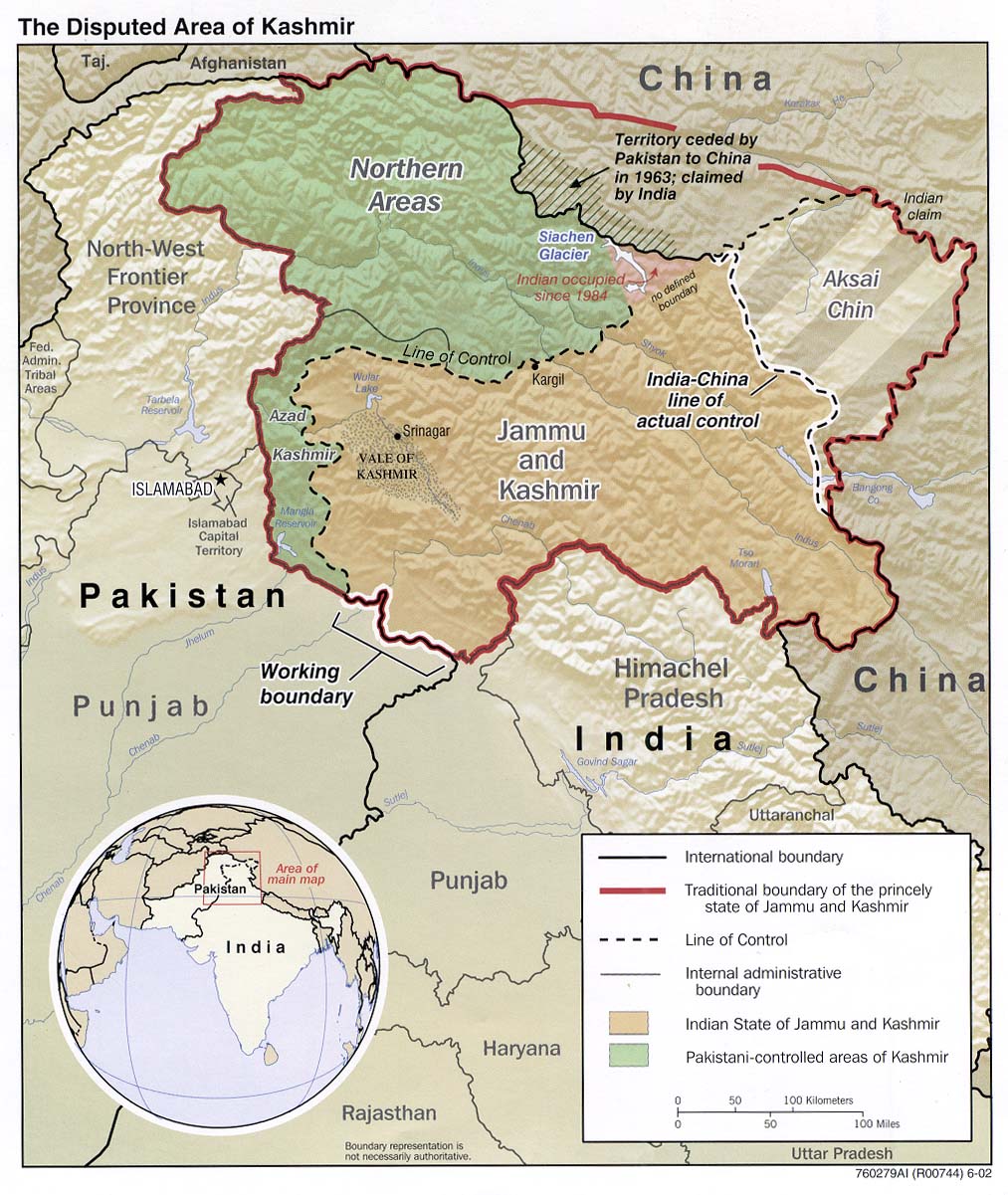
Kashmir Compromise Potential

Musharraf’s speech on 12 January 2002 had clear implications for Kashmir. By announcing bans on Lashkar-e-Toiba and Jaish-e-Mohammed, he increased the chance that the insurgency in Kashmir would be weakened. If it faced a less intense battle in Kashmir, it is likely that the Indians would want to put the issue on the back burner. But it is worth bearing in mind two developments. First, the Kashmiri people are tiring of the struggle. Most informed Pakistanis now accept that, given the chance, most Kashmiris would opt for independence rather than a merger with Pakistan. But above all else the people of Kashmir want peace. That is not to say they will accept any settlement but it does raise the possibility that most would accept a compromise. The second new element is that many Pakistanis are also tiring of the conflict. Before Musharraf’s January speech it was conventional wisdom that no Pakistani leader could confront the religious extremists and remain in office. The lack of any backlash to Musharraf’s speech helped dispel that myth.

Might the same be true of Kashmir? Proponents of the view that no Pakistani leader can afford to back down in Kashmir rely on a number of arguments. First, the Pakistani people, informed by decades of intensive propaganda, are highly mobilised on the issue. Second, the army has made so many sacrifices in Kashmir that a significant climb-down would be seen as unacceptable. Not even an army chief, it is suggested, could compromise on Kashmir and expect to survive. That may be true, but there are counter arguments. Despite all the propaganda, many people in India and Pakistan are not particularly concerned about the Kashmir dispute. Many of those living, for example, in Sindh or Tamil Nadu would be quite happy to see any settlement of a dispute that is quite clearly holding back the subcontinent’s social and economic development. After a decade of insurgency, there is a growing feeling in Pakistan that India will never pull out. Pakistan’s size and economic weakness means it is not in a position to force the hand of a country with a billion people and great power aspirations. If General Musharraf or any subsequent Pakistani leader did make a compromise on Kashmir he or she might receive more support than is generally predicted.

In his account of the Kashmir dispute, the Indian author Sumantra Bose has rejected the idea of splitting up Kashmir because, he argues, none of the political districts are either ethnically or religiously homogeneous. In the Jammu region, for example, one third of the population is Muslim. Indeed, some of its districts have strong Muslim majorities. In Ladakh, meanwhile, the Buddhists may have a clear majority in Leh but the adjoining Ladakhi district of Kargil has a predominantly Shia Muslim population. Whilst Bose undoubtedly has a point, the history of the late twentieth century, for better or for worse, suggests that his objections to the possible partition of Kashmir are far from overwhelming. In the Baltic States and former Yugoslavia, to give just two examples, international boundaries were redrawn without regard to the fact that, in the process, new minority populations were created….

Ever since 1947 the views of the Kashmiris have been obscured by the dispute between India and Pakistan. With the insurgency over a decade old most Kashmiris are sick of the conflict and are desperate for a peaceful settlement. But for both India and Pakistan the symbolic importance of the Kashmir dispute means that they will inevitably follow their own perceived national interests rather than those of the Kashmiri people. If the Kashmiris had been conducring a straightforward fight for independence in the same way as the Chechens or East Timorese they would have had a greater chance of success. The tragedy of Kashmir is that the voices of the Kashmiri people themselves have been drowned out by the Islamists, nationalists and ideologues in Islamabad and Delhi.

SOURCE: Pakistan: Eye of the Storm, 2nd ed., by Owen Bennett Jones (Yale Nota Bene, 2002), pp. 106-108

Leave a comment

Filed under Pakistan