Daily Archives: 5 July 2004

Naipaul on the Revolutionary Blame Game

No one I met spoke of any kind of revolution as a possibility. That idea, so loved by Iranians of an earlier generation, had been spoilt now, as in the old USSR; revolution was a word that had been taken over by the religious state. No one ever spoke of the possibility of political action. There were no means, and no leaders in sight. No new ideas could be floated. The apparatus of control was complete. The actual rulers, though their photographs appeared everywhere, were far away; government here, as someone said, was “occult.” And still, in the general inanition, there was a feeling that something was about to happen. It made people nervous.

One afternoon, as we were driving up into the mountains above Tehran, Mehrdad, after seeming to say that people had learned how to live with the restrictions, abruptly said the opposite. He said, “Everybody is frightened. I am frightened. My father and mother are frightened.” (Poor father, again.) “They are not sure what the future will bring for them or for us, their children. They are not so worried for me. I am an adult now and can look after myself. But my brother is very young. The eight years or so he has to live before he becomes an adult are going to be very dangerous years.”

With this insecurity, certain fantasies had taken hold. The most extraordinary was that Khomeini had been a British or European agent. I had heard it first from Mr. Parvez, and had thought it part of his paranoia. But then I had heard it from many other people. There had been a meeting in the French West Indian island of Guadeloupe, according to this story, and the Powers had decided to foist Khomeini on the Iranian people. The Iranians were simple people; they could be persuaded by skilled propaganda to demonstrate for anything; people had joined the demonstrations against the Shah not out of conviction, but simply to do what everybody else was doing. The establishing of an Islamic state in Iran was an anti-Islamic plot by the Powers, to teach Muslims a lesson, and especially to punish the people of Iran. And, as if answering those fantasies, there were even signs of the faith being questioned in certain aspects.

Mr. Parvez had said, “The war [against Iraq] was fought in the name of Islam. It was a blessing in disguise. Without the war people wouldn’t have got so fed up with Islam.” That had seemed extreme. But then I had detected wisps and shadows of religious uncertainty in some people’s conversation. Just as–in these fantasies issuing out of a people stretched to the limit by revolution, war, financial stringency, and the religious state–it was said that Iranians were not really responsible for the Iranian revolution, so I heard that Iranians were not really responsible for the more dramatic aspects of the Shia faith. The bloody scourgings of Mohurram, the mourning month: the idea was really imported from Europe, from the Catholics; it had nothing to do with the original faith.

I talked about this to Mehrdad. He said, “It’s something habitual. Our enemies are always responsible. Blaming others, not ourselves.”

SOURCE: Beyond Belief: Islamic Excursions Among the Converted Peoples (Vintage, 1998), pp. 226-227

Leave a comment

Filed under Iran

Romania’s "Big Dig" Turns 20

Transitions Online translates a recent story from Evenimentul Zilei [‘The Daily Happening’?].

On 26 May, Romania marked the 20th anniversary of the inauguration of the Danube-Black Sea canal. A dream of the then-communist authorities, the canal became a symbol of the nightmare of communist repression, at least during the first part of its construction between 1949 and 1951. After a break of 25 years, [former Romanian dictator] Nicolae Ceausescu resumed the construction process. It took another eight years of work–a huge national labor project followed by years of glorification of what the communists called “the Blue Thoroughfare,” and it was celebrated again and again during communist national festivities in the “Song of Romania.”

The construction of “the dustless road” [as the canal was called in a novel by Romanian writer Petru Dumitriu, an proponent of the social realism movement in the 1950s] required studies by more than 1,000 experts in construction and more than 33,500 execution reports. During its construction, 300 million cubic meters of soil were excavated, and some 3.6 million cubic meters of concrete were used. The result was a navigable canal 64.4 kilometers long with two, 310-meter-long double locks at each end.

Built on the backs of the country’s political detainees, with blood, effort, and maybe too much sacrifice, the Danube-Black Sea canal remains the biggest project ever carried out in Romania. But 20 years after it was opened, the canal works at only 40 percent of its capacity.

The idea for a canal linking the Danube River with the Black Sea reportedly originated in a Soviet “suggestion,” when Stalin sent a stern order to Gheorghe Gheorghiu-Dej [the Romanian communist leader until 1965] to liquidate the opposition in Romania. “I will give you the technical equipment, and you can solve two problems at the same time: You get rid of the kulaks and the landed gentry and irrigate Dobrogea [the territory between the lower Danube River and the Black Sea],” Stalin is said to have told the Romanian communist leader sometime in the late 1940s in Moscow….

Construction on the canal officially started on 15 July 1949. The labor force came from three sources: paid workers, forced labor, and military conscripts. The political detainees were euphemistically called “forces from the Interior Ministry.” […]

Ceausescu had the idea of resuming construction after a 1972 visit to Antwerp, Belgium, and a 1973 trip to Amsterdam and Rotterdam, where he learned about a project called “the Canal of Europe,” which aimed to link the Rhine with the Danube–a 3,500 kilometer, transcontinental river route….

On 26 May 1984, with tens of thousands of people lining the two sides, Nicolae Ceausescu inaugurated the canal in festive style. The project at the time was estimated to be worth 10 trillion lei [approximately 3.3 billion average monthly salaries in Romania at the time]….

The canal today links the Danube with the Black Sea and can be used in both directions. With the opening to traffic in 1992 of the Main-Danube canal in Germany, a direct link between the Black Sea and the North Sea (through the ports of Constanta and Rotterdam) was established. It has a capacity of 10 million tons of traffic a year.

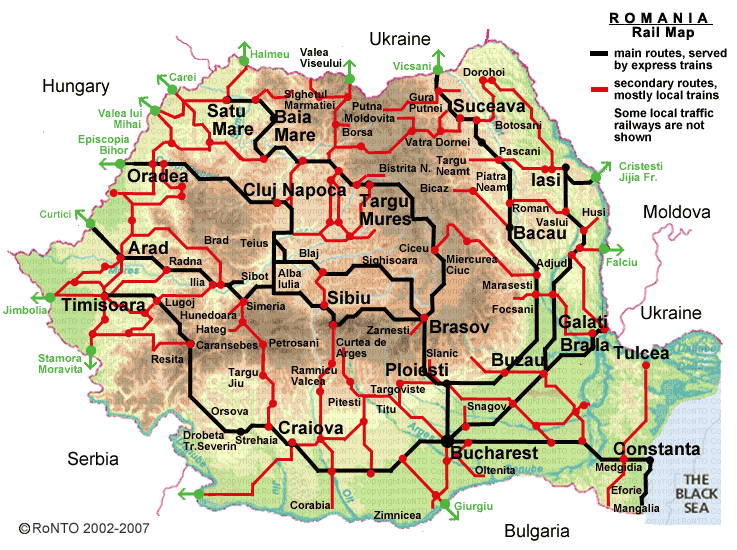
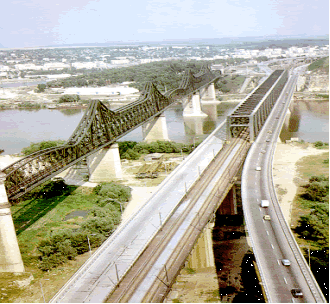
On 26 May 1984, Mr. and Mrs. Far Outliers were close to finishing a grim but fascinating year in Romania. We took a day trip by train from Bucharest to Constanta and back in the spring of 1984, crossing the Danube bridge and looking for the traces of the shortcut canal that so many Romanian dissidents spent their last years digging. The train was jam-packed, with people standing a handspan away from our heads blowing smoke into our hair. I finally tried to open a window. What an uproar that caused! Real springtime air on uncovered heads was deemed far more deadly than cigarette smoke in our lungs. In Constanta, we visited an impressive (but empty) mosque and the history museum, had lunch at a faded rococo casino, and were forbidden to take photos of the picturesque Port Tomis, lest it betray secrets to the U.S. (or Turkish?) navy.

Halfway Down the Danube has more.

Leave a comment

Filed under Romania