Monthly Archives: February 2004

Muslims and Hindus in South China, 10th-13th Centuries

In 1995, Hugh R. Clark published an exploratory essay in the Journal of World History about China during the Song Dynasty (960-1279), arguing

that China’s maritime frontier, especially the coastline south of the Yangzi River, was an important site for the shaping of Chinese culture during the later imperial era. This frontier therefore deserves attention alongside the better known and more frequently studied “inner Asian” frontier of the north. Archaeological evidence demonstrates the presence of communities of Muslims from west Asia and Hindus from south and southeast Asia in the port city of Quanzhou throughout the Song dynasty. Those communities and the trade ties they represented influenced a range of cultural innovations, including the introduction of the Champa strain of rice, which transformed Chinese agronomy, and the conception of the monkey god popularized as Sun Wukong in the Chinese novel Journey to the West.

SOURCE: Journal of World History 6 (1995): 49-74.

Leave a comment

Filed under China

Visited States Map

Here are the states I’ve visited, not counting an airport touchdown in Salt Lake City. “Visited” means at least an overnight stay, except for maybe NH, RI, NJ, DE, IA, and MI (where we stayed on the Canadian side at Sarnia and Sault Ste. Marie). On second thought, I’ve removed OK. When I was 6 we drove west through MO, KS, CO, NM, AZ, CA. We may have driven into northern VT during a summer in ME, but I can’t be sure.
Create your own visited states map.

Leave a comment

Filed under travel

Visited Countries Map

Okay, these are the countries I’ve visited. Extra points if you can see Micronesia.

Create your own visited country map.

Leave a comment

Filed under travel

Recap of Three Years of Violence in Maluku, Indonesia, 1999-2002

In January 2002, two reporters for the Jakarta Post, Edith Hartanto in Jakarta and Oktavianus Pinontoan in Ambon, published a special report entitled “Three years of bloody Maluku conflicts leave nothing but disaster.”

AMBON, Maluku (JP): Three years ago, a petty dispute between a local and two migrants in the Ambon capital of Maluku degenerated into a full-scale sectarian riot which up to this year has killed 9,000 people and forced more than 500,000 people out of their homes.

The involvement of outsiders and provocateurs in the ensuing violence worsened the tension among what was once a harmonious community of various races and religions. The community became divided by blood, rage and deceit.

It all began on Jan. 19, 1999 at 3 p.m. local time when local public minivan driver Jopi Leuhery, from Ahuru, Central Maluku, became involved in a quarrel with two male migrants from Bugis-Makassar [Sulawesi], named Nursalim and Tahang.

The two men apparently tried to extort money from Jopi at the Batu Merah bus terminal and threatened to slash him with sickle.

Upset by their action, Jopi ran back to his house, picked up a machete and along with several friends went after the two extortionists.

In their account before the court, where they were being tried for a purely criminal offense, both Nursalim and Tahang said they fled to the predominantly Muslim Batu Merah Kampung area near the bus terminal and yelled: “There is a Christian who wants to kill us”….

Nursalim’s action on that fateful day led to a fierce communal brawl, in which a group of angry Batu Merah residents went after Jopi, but failed to find him. The mass then burned a welding shop and a house belonging to a Christian in the border town of Batu Merah and the predominantly Christian Mardika [‘Independence’] area. [See map, photos.]

At around 5 p.m. local time on Jan. 19, 1999, the first place of worship, the Sinar Kasih Church in Waihaong, was set alight by rioters.

Rumors spread and tension began to take hold in the area, and unidentified people roamed the streets, spreading rumors of attacks. Who they were and what their roles were in the riots are still unknown.

Angered by the attacks, Mardika people with the rest of the Christian community conducted retaliation assaults on mosques in the area.

On the morning of Jan. 20, 1999 a false rumor spread that the Grand Al-Fatah Mosque was on fire. By this time people were already divided in their own respective areas according to their religion. People donned bandannas to signify their religion: red for Christian, white for Muslim….

Analysts have said that if the security forces and the intelligence units had been quick to respond to the situation in the early stages of unrest in 1999, widespread communal conflicts could have been avoided.

From a criminal dispute, the Maluku riots developed into sectarian conflict that was loaded with economic and political interests, while the players in the conflict freely roamed the islands.

The involvement of outsiders such as the Jihad Force, which pledged to wage a holy war in Maluku, and small elements of the outlawed South Maluku Republic (RMS) separatist movement, have also contributed to the already complex strife.

(The reference to the RMS is a lame attempt at moral equivalence. The RMS was supported by Muslims as well as Christians, but some of the jihadis have rechristened it Republik Maluku Serani [‘Christian Maluku Republic’].)

Frustrated by the prolonged violence and losses in both Maluku and North Maluku, in a desperate effort the central government imposed a state of civil emergency in the territory on June 27, 2000….

The implementation of the state of emergency, if not too late, was undermined by the fall of the police base in Maluku during the Tantui incident on June 23, 2000, by which time security forces on duty in the province were already divided by religion.

What undermined the state of emergency was not some chance incident. Instead, it was (in the words of area specialist Dieter Bartels) the “massive arrival of non-Ambonese, mostly Javanese, Moslem vigilante group, called Laskar Jihad (‘Holy War Forces’). They brought with them sophisticated modern weaponry and allied themselves with the Moslem personnel of the military which constitutes about eighty percent of the troops. These developments totally destroyed the previous balance, tipping the scale in favor of the Moslems.”

Having built up their forces since May, the Laskar Jihad entered the fray in force on June 23, mounting a combined land and sea attack on the elite Police Mobile Brigade (Brimob) base in Tantui, a few kilometers from downtown Ambon. They attacked the police station to make sure the Christians were disarmed.

The assailants went on a rampage and burned the whole compound, including police housing complex, arsenal, hospital, provincial and high-ranking officers residences.

They assassinated the Brimob deputy commander in Maluku Maj. Edi Susanto (whose name is Javanese) and looted the police arsenal for weapons and ammunition. On July 1, with some wearing white robes and others in military-style uniforms, the thugs went on to attack three predominantly Christian communities, Poka, Rumah Tiga, and Waai, and to destroy the whole campus of Pattimura University.

The state of civil emergency was finally lifted in September 2003, by which time the Laskar Jihad militia had moved on to West Papua.

In the last few months there have been only a few minor incidents which can be attributed to the small number of militants still in the area. However, given that the investigation into the Bali bombing unearthed evidence of terrorists from Jemaah Islamiah and other organisations using Maluku as a training and recruitment area, the authorities need to remain vigilant for any renewed militant activity….

The Maluku conflict, which began in 1999, has left some 10,000 dead and over half a million displaced. Many areas remain segregated along religious lines. [See map.]

A Muslim-Christian interfaith council is slowly trying to piece the shattered community back together.

Leave a comment

Filed under Indonesia

Royal Dutch Marines vs. South Moluccan Terrorists, 1977

Most baby boomers (scroll to the bottom at the link) should have a vague memory of this incident.

One bright May morning in 1977, the children of Bovendsmilde were settling down for their lessons when four South Moluccan terrorists stormed the school. Armed with submachine guns and grenades, they took 105 children and 4 teachers hostage. A short time later, just outside of town, nine heavily armed South Moluccans boarded a commuter train, taking 60 hostages. After 14 long hours, the terrorists begin issuing their political demands. As negotiations dragged on for an interminable two weeks, the Royal Dutch Marines were taking action. See how the elite counter-terrorism and commando squad used thermal imaging and listening devices to formulate a rescue plan. This double siege is the most famous mission of the Royal Dutch Marines and is still studied by counter-terrorism units worldwide as a textbook example of how to handle a hostage crisis.

This was just one of many, many terrorist incidents during the 1970s. And the number of such incidents seems to have grown with each passing decade.

What were the South Moluccans on about, anyway? Well, according to the UNPO (Unrepresented Nations and People’s Organization, whose membership includes East Turkestan, Kurdistan, the Hungarian minority in Romania, and Ka Lähui Hawai‘i), they were very unhappy when the Dutch ceded sovereignty to Sukarno’s Federal Republic of Indonesia in 1949, and more unhappy when Sukarno then began to turn the federal republic into a unitary state under tight Javanese control. The European Academy continues the story.

In 1950, a rebellion against the Indonesian central government broke out in the South Moluccas, calling for an independent republic. In the same year, however, the revolt was struck down. Many South Moluccans emigrated to the Netherlands, and in the 1970s tried to compel the government there to petition the Indonesian government to allow south Moluccan independence using terrorist methods.

Unfortunately for them, such methods backfired badly. In 1978, the Dutch parliament ceased to recognize the Republik Maluku Selatan (RMS) government in exile.

For a fuller understanding of the history of the South Moluccan exiles in the Netherlands, read “From Black Dutchmen to White Moluccans: Ethnic Metamorphosis of an East Indonesian Minority in the Netherlands,” by Dieter Bartels. It begins thus:

After returning to Indonesia after World War II, the Dutch employed 25,000 Moluccan soldiers in their attempt to foil the movement for Indonesian Independence. With the transfer of sovereignty in 1949, 12,000 of these troops were demobilized, 6,000 were discharged, and 1,000 entered the Indonesian army (TNI). Circa 2,000 soldiers stationed in the South Moluccas became the core forces of a movement to establish an independent South Moluccan Republic, the RMS. About 4,000 others, mostly stationed on western islands, mainly on Java, refused to be mobilized or discharged anywhere but in the Moluccas or (then still) Dutch New Guinea ….

The problem was solved by “temporarily” moving the troops, and about 8,500 family members, to the Netherlands in 1951. Over 75 percent of them were Protestant Christian ethnic Ambonese from the Central Moluccan islands who were dominating the political actions of this minority. Fanatically anti-Indonesian, they were never allowed back and over the next two decades their population increased to approximately 40,000. In the late 1960s and 1970s, the Moluccan youth became restless and shocked the world with a number of spectacular acts of terrorism in futile attempts to force the Dutch to help them to return to their homeland to be freed of Indonesian rule.

Leave a comment

Filed under Indonesia

Micronesia: Clean Gov’t, Corrupt Gov’t Tied at 1-1

Anticorruption forces have managed to convince the Congress of the Federated States of Micronesia not to pass Resolution 13-76, a blanket amnesty for both indicted and unindicted officials accused of corruption.

According to an FSM Congress press release, the measure seeks to “forgive all those who wronged the FSM government” since the beginning of the Compacts of Free Association, a treaty with the United States, from Nov. 3, 1986, to Nov. 3, 2002, who “are not yet convicted.”

However, the forces of corruption prevailed earlier, with Resolution 13-69, which discontinued the services of retired judge Richard E. Benson, who had been appointed by the FSM Supreme Court as a Special Justice on a corruption case involving congressmen from Chuuk [Truk] state. (A total of 14 defendants have been named, and as much as $25 million is said to have gone missing.)

FSM President Joseph J. Urusemal has filed a Writ of Prohibition with the FSM Supreme Court seeking to prevent the enforcement of the Benson resolution, on the grounds that it violates constitutional separation of powers. Justice Benson had previously served on the FSM Supreme Court.

Leave a comment

Filed under Micronesia

Five Nigerians Charged in $242 Million ‘419’ Fraud

Abiola of Foreign Dispatches reports that five more Nigerians have been charged in ‘419’ scams of truly obscene proportions.

ABUJA, Nigeria (AP) — Nigerian prosecutors leveled 86 counts of fraud and conspiracy against five people Thursday for allegedly swindling a Brazilian bank of $242 million, in the biggest crackdown yet on the West African nation’s advance-fee fraud or “419” scams.

The five are accused of luring an employee of Sao Paulo’s Banco Noroeste into siphoning off the funds from his employer, persuading him he could land a share in a lucrative Nigerian construction contract if he just paid enough handling fees up front.

Me, I’m still waiting for a Magadan gold heiress to deposit her savings into my bank account. Who needs Madame Abacha?

Leave a comment

Filed under Africa

Tiny Sumotori Mainoumi Declines Public Office

The Japan Times Online of 7 February 2004 reports:

AOMORI (Kyodo) Former sumo wrestler Mainoumi on Friday declined an offer by the Liberal Democratic Party to run as its candidate in the summer House of Councilors election in his native Aomori Prefecture.

In a press statement, the sports commentator said he refused the offer from the LDP’s Aomori prefectural chapter because he does not believe the work he does on behalf of his hometown would be furthered if he became a lawmaker.

His management office said the 35-year-old Mainoumi, whose real name is Shuhei Nagao, has repeatedly turned down LDP requests since late last year.

Thank goodness. He was one of my favorite sumo wrestlers. (The perfect match was him against giant Konishiki.) I can’t name a favorite LDP politician.

Here’s a comment on the diminutive Mainoumi’s style, with an aside about Kyokushuzan–the Mongolian “Supermarket of Tricks”–from sumo commentator Mike Wesemann:

And as much as I harp on Kyokushuzan and Asanowaka, it’s true. If you’re dumb enough to charge straight ahead against these guys, I guess you deserve to lose. Whatever happened to the good ‘ol Mainoumi-Tomonohana tachiai days where both guys stood straight up and egged each other on with their hands just daring the other to make the first move. You’d be five seconds into a bout before anyone made contact.

“Despite being short and having a pint-size build, [Mainoumi] rose to become one of Japan’s top five wrestlers. He earned him[self] the nickname, the ‘department store of technique’.” I can hardly wait for the day when Arkansas sends its own “Wal-Mart of Cheap Tricks” to the sumo world.

Leave a comment

Filed under sumo

Japanese Occidentalism, 1942

Via Arts & Letters Daily comes this link to an essay in The Chronicle of 6 February 2004 by the always interesting Ian Buruma on “The Origins of Occidentalism.” It’s a rich topic, but I’d like to highlight a few paragraphs early in the essay.

What, then, is the Occidentalist idea of the West?

That is the problem that vexed a group of prominent Japanese intellectuals who gathered for a conference in Kyoto in 1942. The attack on Pearl Harbor was not the ostensible reason for the conference, but the underlying idea was to find an ideological justification for Japan’s mission to smash, and in effect replace, the Western empires in Asia. The topic of discussion was “how to overcome the modern.” Modernity was associated with the West, and particularly with Western imperialism.

Westernization, one of the scholars said, was like a disease that had infected the Japanese spirit. The “modern thing,” said another, was a “European thing.” Others believed that “Americanism” was the enemy, and that Japan should make common cause with the Europeans to defend old civilizations against the New World (there would certainly have been takers in Europe). There was much talk about unhealthy specialization in knowledge, which had fragmented the wholeness of Oriental spiritual culture. Science was to blame. So were capitalism, the absorption into Japanese society of modern technology, and notions of individual freedom and democracy. These had to be “overcome.”

All agreed that culture — that is, traditional Japanese culture — was spiritual and profound, whereas modern Western civilization was shallow, rootless, and destructive of creative power. The West, particularly the United States, was coldly mechanical, a machine civilization without spirit or soul, a place where people mixed to produce mongrel races. A holistic, traditional Orient united under divine Japanese imperial rule would restore the warm organic Asian community to spiritual health. As one of the participants put it, the struggle was between Japanese blood and Western intellect.

An Occidentalist view of the West seems to require an Orientalist view of the East (or the Rest).

(Filed under Plus ça change)

Leave a comment

Filed under Japan, war

Impressions of Eastern Indonesia, 1991 and 2001

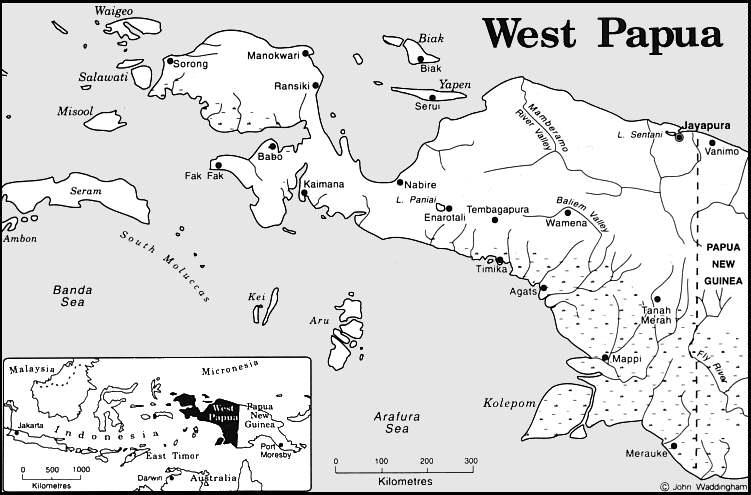
In 1991, I accompanied a Fulbright group research tour to Eastern Indonesia. Our Garuda flight from Honolulu landed first in Biak, West Papua (formerly Irian Jaya), our port of entry into Indonesia. It seemed like many other places in Melanesia, except that Indonesian, not an English- or French-based pidgin, was the national language.

By the time we landed in Ujung Pandang (Makassar) on Sulawesi (Celebes), we were clearly out of Oceania, with its sea breezes, root and tree crops, and easygoing lifestyle, and into Southeast Asia, with its monsoons, endless rice paddies, and hustle-bustle. Ujung Pandang was as far west as we got. We avoided the well-trodden tourist routes of Bali and Java, concentrating instead on booming, Southeast Asian, largely Muslim Sulawesi, and the faded glory of Oceanic, largely Christian Maluku (the Moluccas), the Spice Islands.

We were parceled out to host families at IKIP Ujung Pandang, the local teacher’s college. My host was a professor who had been trained at Manado, perhaps the top teacher-training college on Sulawesi, located in a mixed Christian-Muslim city on the tip of the far northern peninsula near the Philippines. The family was Muslim, very genteel, prosperous, and cosmopolitan. Voices were never raised in that household, at least not during my stay. They had relatives from the countryside living with them and helping with the housework. Neither my host mother nor her very demure and attractive college-age daughter wore head scarves, although the mother affected considerable shock one evening at an immodestly dressed female performer we saw on TV. (Nothing approaching current MTV standards, of course.) I jokingly offered to send her some black lipstick so she could keep up with the latest styles. My generous hosts were also kind enough to take me for an overnight trip to their rustic bungalow in Rappang, where they owned rice fields. The only intrusion of international tensions occurred when the son and daughter were showing me around their campus, Universitas Hasanuddin, where a few students at some distance away started chanting “Saddam, Saddam” when they saw foreign visitors. My hosts quickly moved us on.

Our group next took a scenic bus ride over sometimes dangerous mountain roads up to Rantepao, in Tana Toraja, where the heavily anthropologized highlanders were mostly Christian. The local governor had an American anthropology degree and showed us pictures of the Toraja float that had appeared in a recent Rose Bowl parade. The Toraja are famous for their huge, boat-shaped rice barns and their famously elaborate and gory funeral celebrations, featuring animal sacrifices and often a sizable contingent of foreign funeral tourists. I was one of those who preferred instead to spend a quiet day walking the cool mountain paths between rice fields, through hamlets where the sound of dogs and the smell of pigs served as reminders that we were in Christian territory.

Our next destination was the old Dutch colonial outpost of Ambon (Amboina), Maluku (Moluccas). Again we were parceled out to host families, this time near Universitas Pattimura, where the faculty was mostly Christian. My hostess was a dietician who lived in the Rumah Tiga neighborhood off campus and who cooked meals rather more Dutch than Indonesian. She was Christian and was not amused when I once greeted her with a “Salaam Aleykum.” From Ambon we visited a Christian village far up in the mountains, where we sampled coconut toddy; visited a very rustic resort near a Muslim village on the far side of the island, where baskets of drying sardines and cloves lay outside nearly every house; and made a side trip to an old Portuguese fort on the north side of the island, from where we could gaze across the straits at the huge island of Seram in the distance.

Our last major excursion was to the old sultanates of Ternate and Tidore and their formerly heathen, and now Christian hinterland on Halmahera. Our bus misaligned its rear axle early on, and spent a long time in the middle of nowhere driving over large rocks trying to knock it back into alignment, while we passengers waited beside the road. Finally, the drivers gave up and drove carefully to the next town large enough to have a repair shop, all the while steering against the sideways drift of the back wheels. After repairs, we finally reached Galela at the northern tip of Halmahera. There we spent a day at a small village of only recently converted (Christian) highlanders who had just moved down from the mountains. We enjoyed their betelnut and their outdoor cooking, with rice steamed in green bamboo roasted over open fires. Much to our collective relief, we took an airplane back to Ambon.

Indonesia is the most populous Muslim country in the world, and each year sends more pilgrims to Mecca than any other country but Iran, or so they said at the time. But the country is really many nations in one, and the government at that time saw religious intolerance as a threat to unity. I came away impressed with the modernizing influence of Islam in Indonesia, its tradition of learning, egalitarianism, enterprise, and openness to the outside world. But foremost in my mind are memories of warm hospitality, hot weather, wonderful food, boring lectures, vehement discussions, time to think, grueling bus trips, the joy of language-learning, and the sunrise and sunset calls to prayer.

By 2001, Ambon had turned into another Beirut, and the whole area had become another Lebanon.

Pattimura University and the neighborhoods that hosted us in Ambon, Maluku, were all burnt to the ground. My hostess may well have been killed. The whole island has now been carved up into armed enclaves.

The root causes in Ambon may include local Muslim resentment of local Christian dominance, coupled with local Christian fear of being overwhelmed by the huge Muslim majority of Indonesia as a whole. The factors that ignited and fueled that unrestrained outbreak of violence include the Asian economic crisis that hit in 1997; the subsequent collapse of the discredited Suharto regime and its authoritarian commitment to a unified secular state; the brutal, corrupt, and demoralized Indonesian military, which has done little to control the violence and much to worsen it, especially by allowing the influx of thousands of well-armed mujahidin (including foreigners) from the training camps of the Laskar Jihad paramilitary in Java. It is hard to imagine how to address any root causes until these thugs and local militias are disarmed and either detained or deported by some credible peacekeeping force. The Javanese-dominated Indonesian military has unfortunately not been such a force. The sectarian and ethnic violence is beginning to subside in Ambon, as it finally did in East Timor (only after foreign intervention), but it continues to escalate in West Papua, where many of the thuggish militias have reconstituted themselves after leaving Maluku.

In future blogposts, I plan to examine in more detail some of these events and their historical contexts.

1 Comment

Filed under Indonesia, religion, travel