
Category Archives: Latin America

Is Latin America Turning Protestant?

After four Catholic centuries, a new brand of Christianity is catching in the Mission District of San Francisco, in the San Joaquin Valley of California, wherever in the United States there are large populations of Hispanics, and throughout Latin America.

Latin America! The Catholic hemisphere, the last best wine the Church had counted on to see herself through the twenty-first century–Latin America is turning in its jar to Protestantism. At the beginning of this century, there were fewer than two hundred thousand Protestants in all of Latin America. Today there are more than fifty million Protestants. The rate of conversion leads some demographers to predict Latin America will be Protestant before the end of the next century. Not only Protestant but evangelical.

Evangelico: one who evangelizes; the Christian who preaches the gospel. I use the term loosely to convey a spirit abroad, rather than a church or group of churches. There are evangelical dimensions to all Christian denominations, but those I call evangelical would wish to distinguish themselves from mainline Protestantism, most certainly from Roman Catholicism. Catholics may yet be the most communal of Christians; evangelicals are the most protestant of Protestants.

Evangelicals are fundamentalists. They read scripture literally. Most evangelicals in Latin America are also Pentecostals. Pentecostalism is emotional Christianity, trusting most a condition of enrapturement by the Holy Spirit. Pentecostalism is rife with prophecy, charismata, healings, and the babble of sacred tongues. Evangelical spirituality hinges upon an unmediated experience of Jesus Christ.

Protestantism flourished in Europe in the eighteenth century. Protestantism taught Europe to imagine the self according to a new world of cities. Protestantism taught Europe that the central experience of faith was of the individual standing alone before God.

Protestantism increased fivefold in Latin America in the 1940s. Consider what may be a related statistic concerning Mexico during the 1940s. At the start of the decade, 70 percent of Mexico’s population lived in villages of fewer than twenty-five hundred people. Since the 1940s, the population of Mexico has tripled; the countryside has not been able to sustain such life. Seventy percent of the population of Mexico now belongs to the city.

SOURCE: Days of Obligation: An Argument with My Mexican Father, by Richard Rodriguez (Penguin, 1992), pp. 175-177

UPDATE: Lirelou adds some intriguing personal historical perspective in the comments:

Protestantism was in fact part of the underlying reasons for the unrest in Chiapas, where the villages are Mayan. Those who converted to the protestant, usually evangelical, faiths found themselves excluded from their communities. Part of the reason for this exclusion was their refusal to contribute to village religious festivals, which in turn reduced the funds available, and undercut the power of local leaders. In revenge, protestant families were barred from using communal lands, and in some cases physically expelled. I met one pastor who claimed that his two sons had been murdered. Possibly, but I never personally verified that fact. He was also convinced that the catholic church was under the control of a secret order of Freemasons. Latin America may very well go protestant, but the day when other religions, even other versions of christianity, are widely accepted is still a long way off. But then, religious tolerance wasn’t exactly an overnight process in Europe either.
Leave a comment

Filed under Latin America, religion

A Visit to Japan’s "Little Brazil"

Recently, we set out from Ashikaga for 大泉 Ōizumi, Japan’s “Little Brazil” in neighboring Gunma Prefecture’s fanhandle to our southwest. At 太田 Ōta (‘Widefield’), we transferred to a 2-car, 2-stop, infrequent shuttle train running back toward the southeast to Higashi Koizumi (‘East Littlespring’). There we had to transfer to yet another 2-car, 2-stop, infrequent shuttle train running back southwest to the end of the track at Nishi Koizumi (‘West Littlespring’). The fare adjustment official at Ōta described Nishi Koizumi as the most bustling (にぎやか) of the three Littlesprings (East, Middle, and West) that make up Bigspring.

Well, wherever the bustle was, we didn’t see it. The tracks ended where the single platform ended at Nishi Koizumi. We walked straight south from the train station, crossed over a highway busy enough to warrant a pedestrian overpass, past a small fountain (maybe the ‘littlespring’ itself) that marked the beginning of a very long and pleasant walkway and bikepath (the Izumi 緑道 ‘Greenway’) shaded by a great variety of trees and bushes, most of them labeled, so that I repeatedly stopped to punch the katakana names into my little electronic dictionary to find the English equivalents.

To our right ran the kilometer-long fence punctuated by gated driveways enclosing a quiet but huge Sanyo electronics factory. To our left ran sleepy Hanamizuki-dori ‘Dogwood Avenue’, which hosted occasional trucks and vans making deliveries. Hardly anyone but a few stressed-out middle managers was making use of the jogging path. Across the road were a variety of smaller enterprises: a few stores, a few restaurants, and a preschool teacher-training school followed by Santa Clara (聖クララ) preschool.

The name of the school and the distant sounds of Portuguese rather than Japanese coming from its parking lot were among the few signs of the town’s large Brazilian population. Other clues were: a cardboard sign next the train ticket vending machine at the station that listed all the destinations in a Portuguese-friendly transcription; a small shop near the station that sold goods imported from Brazil, Peru, and Bolivia; and the Primavera Restaurant, which we noted for our return. It was nearing lunchtime.

Primavera was an interesting oasis, like a midwestern truck stop in many ways. The kitchen help spoke mostly Japanese, the customers spoke mostly Portuguese, and the menus and wait help were bilingual in Japanese and Portuguese. The music was mostly Country & Western in style, but with the lyrics in Portuguese. The featured buffet (バイキング [Viking] = smorgasbord) was discounted from ¥1600 to ¥1000 because it had run out of most of the grilled meats–and also the feijoada, I discovered after I ordered it. My wife went for just the salad bar portion. At the register, I asked the European-looking owner (in Japanese) how long he had been in Japan. He said 2 years this time, but 5 years in all. (Nikkei Brazilians can easily get work visas for 3-year stints.) His soft-spoken Japanese was even more limited than mine. He estimated the local population was at least 10% Brazilian, maybe 15%.

On our way back to the station, we stopped in at the small import shop, whose owner greeted all his customers with “Tudo bem?”–followed by “Konnichi wa!” if they looked Japanese. He looked to be Nikkei, and his Japanese was very fluent. He said he had been in Japan 7 years in all. He said the local population was 15% Latin American, with 10% from Brazil alone.

When we got back to the sleepy station, we found that we had a 45-minute wait until the next train, so we east headed down the line of shops beside the main highway (National Route 354), finding nothing at all. When we stopped to ask, we were directed to the Mos Burger, with its American southwestern decor, and sipped our tall ice coffees until it was time for the zigzag sequence of short train hops back home.

There are no doubt many North American equivalents of Nishi Koizumi, but it reminded me of the hidden charm and factory-sequestered bustle of an Austin, Minnesota–the Hormel company town that hosts the Spam Museum–especially if Austin had a little larger Hispanic population.

1 Comment

Filed under Brazil, Japan, labor, migration

A Visit to International Ota City

Ota City (太田) in Gunma Prefecture is just two train stops southwest from Ashikaga City on the private Tobu line. Ota English School‘s website brags that

Ota itself is quite an international town. The neighboring town [Ôizumi] has one of the largest Brazilian populations in Japan. Ota itself has one of the largest Asian communities outside of Tokyo. This means that, as well as all the usual non-Japanese restaurants (Italian, French, Chinese) there are many Indian, Pakistani and Brazilian restaurants a short walk or drive from the school.

Purdue University‘s The Exponent Online is rather more modest when it compares Ota City to Lafayette, Indiana.

The populations are almost the same, both cities were changed from agricultural centers to industrial centers, both cities are on a river, and for the most part, both are flat cities.

What moved a Purdue student reporter to compare Lafayette and Ota? Well, West Lafayette, Indiana, is home to Purdue’s main campus as well as to Subaru-Indiana Automotive, Inc. Fuji Heavy Industries and Subaru are among the largest employers in Ota, a commercial cluster development center dating back to the days of textiles and then military aircraft.

So, is Ota really as international a city as these websites suggest? The Far Outliers got a skewed impression when we set out to find a Brazilian restaurant to eat dinner at last Saturday evening. We headed south from Ota train station zigzagging between the two widest streets we could find, asking policemen, passers-by, shopkeepers, and even employees at the main post office (open on Saturdays) if they knew of any Brazilian restaurants in the city. No luck. Even those who took the trouble to look through the restaurant listings in the telephone book couldn’t find any Brazilian restaurant. A few people recommended we go instead to neighboring Ôizumi–Japan’s “Little Brazil.” (Been there. Done that. More later.)

We did find a few tiny Filipino restaurants (none yet open) scattered along one of the longest strips of seedy strip joints, hostess bars, and member clubs that I’ve seen in a while. (I’ve never been to Las Vegas.) It went on for at least a full kilometer. It was still early when we walked its length, encountering no more than a few bouncers loitering outside a few doorways. When we retraced a portion of the strip on our way back to the station later that night, there were a lot more drunken males and leggy females on the sidewalks. Judging from the streetside advertising, some portion of Ota City’s international Asian population would seem to be women from China and the Philippines. (A Japanese customer I was chatting with at a yakitori shop in Ashikaga last week demonstrated his few words of “French” by saying Magandang gabi! That’s Tagalog for ‘Good evening!’)

After the trail went cold in that direction, we headed back for the station on a main drag with more vehicle traffic. It was a much more family-oriented strip mall, with a huge shopping center, and plenty of parking, car dealers, tire shops, and the most amazing site entirely dedicated to weddings that I’ve yet seen, the Royal Chester Ota (for “The Brilliant European Wedding”). (Again, I’ve never been to Las Vegas.) We saw plenty of chain restaurants, but nothing representative of Ota City’s large foreign community.

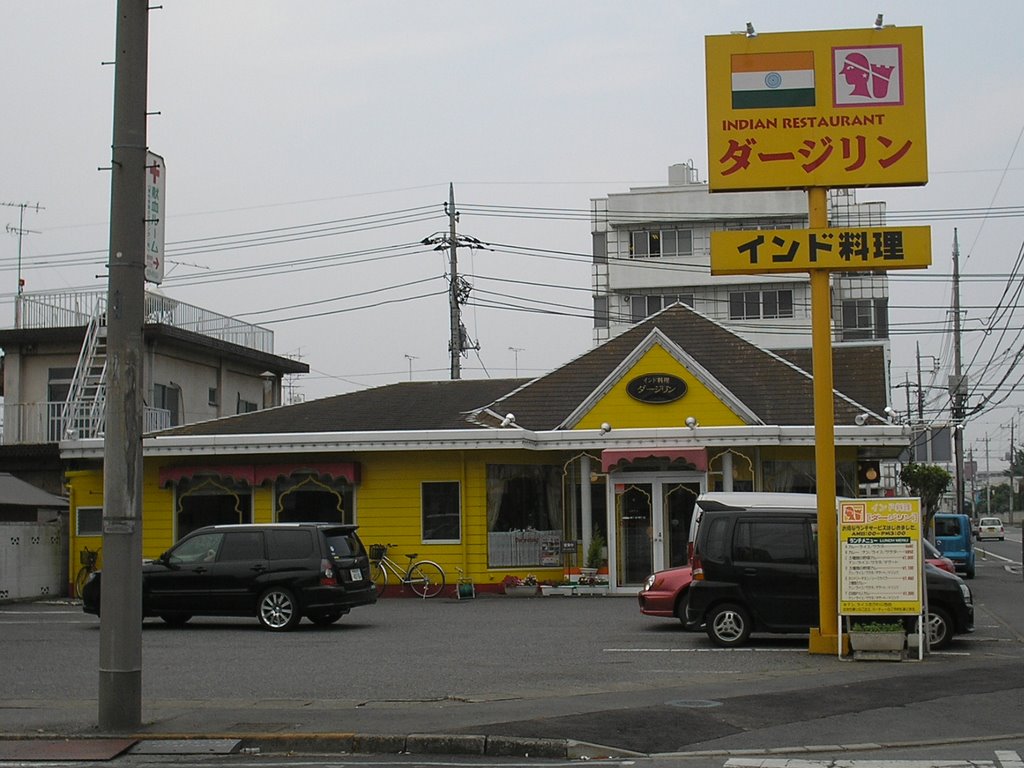
We couldn’t find a clue until a couple hours later when, after circling a few blocks north of the station, we asked at Rana, an “International, Halal” food store run by some Iranians. The only other customer was a Nepali who not only owned an Indian restaurant named Darjeeling, but offered to drive us there, and even to drive us back to the station if his place wasn’t too busy by the time we finished eating. We readily accepted, and had a wonderful meal of chicken tandoori, mutton masala, nan bread, and salad vegetables, washed down with a couple of beers unusual for Japan: Everest and Grolsch. The proprietor came to Japan ten years ago, and his restaurant has been successful enough for his elder brother to open a branch in Tokyo.

Except for a few words of English, he and I communicated entirely in Japanese, quite informally and comfortably. Neither of us had done enough formal study to command formal registers very well anyway. After dinner, we insisted on walking back to the train station, and he came out to the street to confirm his earlier directions and we parted in typical Japanese fashion, with bows and thank yous. On the way back, we passed the Civic Center, with a range of social support facilities for both citizens and foreigners, including an office that handled passports and visas.

The 1 May 2005 issue of Pakistan’s Dawn has more about unskilled foreign workers in Ota.

Kimio Matsudaira, an official at Hello Work, a public labour office in Ota city, Gumma prefecture, 60 kilometres north of Tokyo, said there is now a special programme to help and support foreigners working in the area. Ota has a population of about 200,000 people. The irony is that more than sixty per cent of its people are over 60 years of age, in a city where the economy is dependent on manufacturing. Without doubt, Ota really needs foreign workers badly. To support the city’s automobile and electronic industries, Ota is now host to more than 30,000 Japanese Latin Americans, descendants of Japanese who emigrated to South America in the early 20th century seeking a better future. In the late eighties Japan launched a policy of accepting third and fourth generation Japanese Latin Americans to support a labour shortage in its factories stemming from the bubble economy at that time. More recently, Asians, mostly from South-east Asia, have also arrived to work in factories, comprising a total of 45,000 registered workers in Ota city. Matsudaira said foreign workers are vital to the survival of Ota’s economy.

Leave a comment

Filed under Brazil, China, industry, Japan, migration

Richard Rodriguez on the Protestantization of Latin America

Richard Rodriguez has some interesting observations in an old interview for Reason magazine about the attraction of Protestantism for Latin Americans.

Reason: What do you think about the attraction of Latin Americans. both here and in Latin America, to evangelical Protestantism?

Rodriguez: Catholicism is a religion that stresses to you constantly that you can’t make it on your own, that you need the intercession of the Virgin Mary, and the saints, St. Jude, and your grandmother–candles and rosaries and indulgences and the pope. There are all these intermediaries, because you facing God would be hopeless.

Suddenly, into the village comes this assurance that you don’t need padrecito. You can read the bible yourself–you don’t need someone to tell you what it says. You don’t need the Virgin Mary, you don’t need the saints, you don’t need anybody. God is speaking to you. And just because your father beat your mother, just because your grandfather was poor, doesn’t mean it has to happen to you. You can change your whole life around. This is all based on the Easter promise and not, as the Catholic church has always based it, on some Good Friday suffering.

Reason: Protestants always have empty crosses.

Rodriguez: It is an enormously powerful motif, the notion that Christ just got off the cross and walked away somewhere–went off to L.A.–and you could do it too. I think Protestantism is most successful in those cases where people are beginning to taste and sense discontinuity. And they begin to make sense out of it as providential. Protestantism also establishes, in a time of social change, the memory of the village. Within the storefront church, you can hold hands and remember what it was like in another time.

It will be one of the great changes of Latin America, the Protestantization of Latin America, and I think in some way that it will change the United States. The relationship of the evangelicals in places like Texas where there are rednecks and Mexicans together is really very interesting. The new Mexican who is now appearing in places like police departments–this is a new face of Latin America, and it is not necessarily one that we want.

Reason: How so?

Rodriguez: I think there has always been a charm to Latin America as being sort of morally lazy. We’ve always used it as a place where we could go to after dark and do whatever we wanted that we couldn’t do here. We never really expected that Latin America was going to become a moral Clorox for our society, and maybe there’s a ferocity there that we don’t expect.

Reason: Aside from the desire to have this Latin America of easy virtue, are there bad consequences to that?

Rodriguez: How shall I put this? Mexican cops have never been cops I like to deal with. And there can be this ferocity–you see it in New York now with a lot of Puerto Rican and Hispanic households, the ferocity against the gay movement, the Rainbow Curriculum, for example. I see myself as a homosexual man–much freer in America than in Latin America.

via Marc Cooper

While some Latin American evangelicals are migrating in, other homegrown evangelicals are seeking a way out. ChristianExodus.org is moving thousands of Christians to South Carolina to reestablish constitutionally limited government founded upon Christian principles. This includes the return to South Carolina of all “powers not delegated to the United States by the Constitution, nor prohibited by it to the States.”

Leave a comment

Filed under Latin America, religion

Part Chinese, Part European, Part Latino

MY GRANDMOTHER, my mother’s mother, was born in China. Her name was Lee Chung. She came to Peru in 1905 or 1906, at the age of 18 or 19, to work on the coffee plantation in the jungle of Peru. At that time many people came from Europe and Asia as the government was giving free land to immigrants willing to go to the eastern side of the Andes Mountains. She came with about twenty families, altogether more than a hundred people, from the same province in northern China. They lived together like a family because the government provided housing for people working in agriculture. But they were really not one family, and she was by herself. She told us that she had some brothers, and their families were living in China and Hong Kong. She did not have much education.

She married my grandfather, an Italian. It was funny because my grandfather from Italy did not speak Chinese. She did not speak Italian. But they communicated somehow. They got married in 1907 or 1908….

My grandmother never spoke Spanish. She only spoke Mandarin Chinese to us. When I was small, it was easier to communicate with her. Then when we grew up, we began to speak Spanish. She only spoke Chinese throughout her life, although she understood a lot of Spanish.

My mother speaks some Chinese because she lived with my grandmother all the time. My mother speaks Italian too. My Chinese was not good because I learned it by ear, listening to my grandmother. As a kid of six or seven, I would speak with whoever that was there. In Peru, it was mostly my grandmother. She lived to sixty-four or sixty-five years of age.

In Peru, there are still some old Chinese families that have been there for generations. And the Japanese too. We have many Asians in Peru, Argentina, Brazil, and Chile. In all these countries the Asians and their cultures are very strong. The Asian cultures are very respectable in South America. If you are part of an Asian culture, people respect you more because they think that you are more trustworthy. The Chinese who were born in South America act like Latinos in their manners. They look Asian but they speak Spanish. They are very integrated.

The last time there were Chinese immigrants to Peru was in 1968, I think. They stopped coming because the economic situation in the country was not good. Most Chinese went to Argentina and Venezuela. I have met a distant aunt in Venezuela. Most of the Chinese there came from Hong Kong, from around 1984 to about 1995. Venezuela is the only country you can pay for your residency and work. The people from Hong Kong learned Spanish very fast.

My uncle has been in Australia for forty years. He lives in Sydney now. He is the nephew of my grandmother. I met him several times in the U.S. He did not speak Spanish. We communicated in English, but sometimes he spoke to me in Chinese, and I had a hard time understanding him because I was out of practice and hadn’t spoken Chinese for a long time.

I see myself as part Chinese, part European, and part Latino. I feel that way always. I like Chinese culture, as I do European and Latino cultures. Chinese culture is part of my background. I went to the U.S. for my university education. I made friends with students from Hong Kong and Taiwan. We would get together and play soccer. We discussed about things, and we enjoyed ourselves. We talked about things in Peru and how the Chinese came to Peru. Some of the Latino students from South America who saw me then did not think that I was a Latino because I was always with the Asians. When I am with my friends from Hong Kong or Taiwan, I feel Chinese. I feel I am part of that group. I feel that I belong there.

SOURCE: “San Ramon the Coffee Town,” by Juan Miranda, in Being Chinese: Voices from the Diaspora, by Wei Djao (U. Arizona Press, 2003), pp. 131-134

Leave a comment

Filed under Brazil, China

Sumo in Brazil

On 28 January, the International Herald Tribune ran a NYT story about the increasing popularity of Japanese sumo in Brazil.

Until the mid-1990s, sumo wrestling in Brazil was almost exclusively practiced by Japanese immigrants and their offspring.

Today, however, about 70 percent of all sumo aficionados in the country are Brazilians with no Japanese blood, in large part because of efforts by the local association to popularize the sport.

By holding sumo matches in city squares and other public arenas, “we managed to teach a lot of people to appreciate our sport,” said Oscar Morio Tsuchiya, the vice president of the Brazilian Sumo Confederation.

The group has more than 2,000 members and organizes an annual national championship for amateur wrestlers….

Sumo was brought to Brazil almost a century ago by Japanese immigrants, who started flocking to the South American country in the early 1900s in search of work, initially on coffee plantations and eventually in agriculture in general.

With coffee sacks as mawashis, the traditional loincloths worn by sumo wrestlers, the first matches in Brazil were held to honor the emperor of Japan’s birthday.

And in 1914, the first official Brazilian sumo championship was celebrated in Guatapará, in the interior of the state of São Paulo.

“They did everything they could to cultivate Japanese culture because they intended to return to Japan someday, and practicing sumo was a big part of that, but very few ended up going back,” said Célia Oi, the executive director of the Museum of the History of Japanese Immigration to Brazil in São Paulo.

The same story appeared in the San Francisco Chronicle.

Women’s sumo also seems to be spreading in Brazil, but not everyone is happy about it.

1 Comment

Filed under Brazil, sumo

Meiji Village Museum

I’ve been concentrating a lot on people of ambiguous national or cultural affiliations, but architecture is another rich area to explore. A nice example is the architecture of the Meiji Village Museum in Japan.

Beautifully located on a hillside facing Lake Iruka, it occupies an area of 1,000,000m2, where currently over sixty Meiji buildings have been brought and rebuilt. Meiji was a period in which Japan opened her doors to the outside world and laid the foundation for Modern Japan by absorbing and assimilating Western culture and technology. Along with the Asuka-Nara period (553-793 A.D.) it is a very important era in the history of Japanese culture. Architecture was no exception. In addition to following the accumulation of excellent traditional wooden architecture from the Yedo period (1615-1867), builders adopted styles, techniques and materials of Western style stone and brick achitecture.

I can’t give direct links to the images, but let me recommend a few of the most striking buildings to view. Just click on “Architectures list” and then work your way down the list. Here are a dozen favorites among the 60+ bastard buildings:

  • Saint John’s Church in Kyoto (built 1907): Its brick exterior is a beautiful blend of Romanesque and Gothic design, the interior features distinctively Japanese designs appropriate to Kyoto’s climate, such as the bamboo blind in the ceiling.
  • Reception Hall of Marquis Tsugumichi Saigo House in Tokyo (built 1877): This was built to entertain guests. The interior is decorated with imported French furnishings.
  • Dr. Shimizu’s Office in Nagano (built 1897): Although this is a house built in a godown style with a Kiso white cedar shingle roof, Western designs are also imitated.
  • No. 25, Nagasaki Foreign Settlement (built 1889): The external walls are double boarded for soundproofing and dampproofing.
  • A Foreigner’s House, Kobe Foreign Settlement (built 1887): This building more accurately captures the atmosphere of a westerner’s residence in the cosmopolitan port of Kobe during a period of rapid development.
  • Japanese Immigrant’s House, Registro, Brazil (built 1919): Although it is built from locally grown wood, Japanese carpenters took part in the construction and Japanese methods were used.
  • Japanese Immigrant’s Assembly Hall, Hilo, Hawaii (built 1889): It was originally a church constructed for the Japanese by Japanese minister Jiro Okabe. [Are those cherry blossoms?]
  • Uji-yamada Post Office in Mie Prefecture (built 1909): This one-story wooden building with copper roofing has a conical domed roof at its center, and its facing is in a half-timber style.
  • St. Paul’s Church in Nagasaki (built 1879): In contrast to the farmhouse-style exterior, the interior is Gothic, with a crossing ribbed vault ceiling, called “umbrella ceiling.”
  • Central Guard Station and Ward, Kanazawa Prison (built 1907): Five wards are arranged radially around the octagonal central guard office. [Shades of Bentham’s Panopticon!]
  • Kikunoyo Brewery, Aichi Prefecture (built 1868): This building is a Japanese-style tile-roofed storehouse, and it consists of a two-storied section with a mud-coated outer wall, and an open eaves section.
  • Main Entrance Hall and Lobby, Imperial Hotel, Tokyo (built 1923): The main finish is Greenish tuff (volcanic rock) carved in geometric patterns, and yellow brick, while ferro-concrete is used to provide structural strength. [The Frank Lloyd Wright-designed hotel survived the 1923 Great Kanto Earthquake.]

UPDATE: Here’s another online version of the Museum with more information but muddier images.

Leave a comment

Filed under Brazil

Japanese Brazilians in Japan: Japanese, Brazilians, or …?

Faced with an aging workforce, Japanese firms are hiring foreign workers in ever-increasing numbers. In 1990 Japan’s government began encouraging the migration of Nikkeijin–overseas Japanese–who are presumed to assimilate more easily than are foreign nationals without a Japanese connection. More than 250,000 Nikkeijin, mainly from Brazil, now work in Japan…. Considered both “essentially Japanese” and “foreign,” nikkeijin benefit from preferential immigration policy, yet face economic and political strictures that marginalize them socially and deny them membership in local communities.

Several university presses have recently published books on this phenomenon: Brokered Homeland: Japanese Brazilian Migrants in Japan (whose promo blurb appears above), by Joshua Hotaka Roth (Cornell U. Press, 2002); Strangers in the Ethnic Homeland: Japanese Brazilian Return Migration in Transnational Perspective, by Takeyuki Tsuda (Columbia U. Press, 2003); No One Home: Brazilian Selves Remade in Japan, by Daniel T. Linger (Stanford U. Press, 2001).

Japanese Peruvians are also coming to work in Japan in large numbers. Nikkeijin who work in Japanese factories can earn 5-10 times what they can earn as white-collar workers back in Brazil or Peru. However, rather than assimilate back to their ancestral culture, many appear to react by accentuating their Latin American culture. In the language of these academic studies, they are “negotiating identities” and “constructing discourses.” Identification with Japan is enhanced by emphasizing the “narrative of suffering and overcoming”–a very powerful narrative for both parties. But countervailing tendencies also come into play.

Elderly Japanese immigrants in Brazil have often constructed Japan as an object of nostalgic longing…. Once in Japan, however, [their offspring] soon begin to construct Brazil as the object of their patriotic identification. [Roth, p. 35]

The new, modernizing Meiji government allowed the first Japanese emigrants to leave for work in Hawai‘i, Guam, and California as early as 1868, but the first official emigration to Brazil didn’t happen until 40 years later. Many early emigrants thought of themselves as sojourners, not permanent settlers, and were able to hang on to many aspects of Japanese language and culture.

In the latter 1930s, however, the Vargas government’s assimilationist policies forced the closure of Japanese language schools and newspapers throughout Brazil. Along with the start of the Pacific War and spread of Japanese ultranationalist propaganda, a backlash arose among Japanese propagandists in Brazil …. The restrictions placed on the Japanese community, the spread of nationalist ideology, and the lack of Japanese language media coverage created conditions that fostered a millenarian movement among the Japanese migrants and their children. Many within the Japanese community supported the ultranationalist kachi-gumi [‘win faction’], which refused to acknowledge Japan’s defeat until several years after World War II. Members of this group cowed skeptics into silence by murdering numerous leaders of the realist make-gumi [‘lose faction’]….

At different points before and after the war, however, many first-generation migrants developed a strong sense of themselves as distinct from Japanese in Japan even while continuing to value their ties with Japan…. They no longer thought of themselves negatively as Japanese displaced to Brazil, but positively as the parents and ancestors of Brazilians. Even some who had been Japanese ultranationalists in the 1940s became ardent patriots of Brazil. [Roth, pp. 22-23]

Karen Yamashita’s novel Brazil Maru (Coffee House Press, 1992) vividly portrays this period.

Nikkei Brazilians and Peruvians working in Japan have hung onto the language and culture of their own homelands, helping to make Japan a bit more multicultural. A trilingual news portal illustrates how linguistically diverse this community is. Of course, amid the ups and downs of cross-cultural accommodation, there is always a horror story.

1 Comment

Filed under Brazil, Hawai'i