
Monthly Archives: June 2007

Chicago’s Black Elite

First founded and settled by the black explorer Jean-Baptiste DuSable of [Saint Domingue =] Haiti, in 1773, Chicago was begun as a thirty-acre land parcel. DuSable, working as a fur trapper and trading-post operator, eventually owned in excess of four hundred acres. He and his new Native American wife remained in the area until 1800, when he moved to Missouri.

With an early black population that was much smaller than those of southern cities like Washington, Memphis, Atlanta, and Richmond, Chicago had a small black elite in the mid- and late 1800s—it consisted of only a few families. Most of them lived very integrated lives: They interacted while working together with liberal whites who had been abolitionists when the Underground Railroad moved black southern slaves into the North. The black elite of the period included people like physician Daniel Williams, Pullman Train Company executive Julius Avendorph, caterer Charles Smiley, and attorney Laing Williams. They were all educated people who lived, worked, and socialized among whites. “In fact,” says Travis, who also wrote the book Autobiography of Black Chicago, “at that time, there were blacks living throughout the North Side and elsewhere. Though we were small in numbers, we were represented in every census tract.”

Travis points out, however, that the total black population was still under fifteen thousand people. It was not until around World War I, the time of a major black migration from the South to the North, that a substantial black population arrived in the city. Most of these black southerners came—about seventy thousand of them between 1900 and 1920—as a result of the Chicago Defender, a black newspaper that was read in the South by educated blacks eager to escape their more rural environment. When these blacks arrived in town, the old-guard black families and their social clubs immediately decided who was “in” and who was not. Truman Gibson’s parents and Maudelle Bousfield Evans’s parents were clearly “in” as far as the black old guard was concerned. Interestingly, as old-guard blacks were busy trying to separate the “society blacks” like themselves from the new working-class arrivals, whites were making plans to ghettoize both groups together on the South Side. And they quickly did so by establishing restrictive covenants that moved blacks out of white areas.

In fact, the white community responded quite aggressively to black mobility during the early years of World War I. In the working-class and middle-class white neighborhoods that saw blacks moving in, white residents simply bombed the houses or set them afire. In more upscale neighborhoods like Hyde Park, which surrounds the University of Chicago, white residents organized a full-blown plan to preempt any sales to upwardly mobile blacks who might be able to afford homes in the well-to-do community. My Uncle Telfer, who died before the upscale neighborhood allowed blacks to buy homes there, had saved a copy of Hyde Park’s neighborhood newspaper, published in 1920, which read, “Every colored man who moves into the Hyde Park neighborhood knows that he is damaging his white neighbor’s property. Consequently … he forfeits his right to be employed by the white man…. Employers should adopt a rule of refusing to employ Negroes who persist in residing in Hyde Park.”

Soon after that time, restrictive covenants making it illegal to sell homes to blacks, regardless of their wealth, were strictly enforced.

But regardless of how violently whites reacted to the influx of poor and upwardly mobile blacks, the old-guard blacks of Chicago had their own dismal way of responding to their fellow blacks in this northern city. They were not happy to see them arriving.

“Not surprisingly, elitism was quite evident. But the rules governing black society in Chicago were always slightly different from the rules that were used in the southern cities,” explains former Chicago Defender society columnist Theresa Fambro Hooks. “In the South, black society was determined by the years your family had lived in a particular city and by their ties to one or more of the nearby black colleges like Howard or Fisk or Spelman. But the rules were different in Chicago because almost everybody was new—almost all of them had migrated from the South. There were very few old families and there were no old local black universities to be tied to.”

So the standard for black society in Chicago became, instead, financial success and, to a lesser extent, family ties to a few of the northern white universities. In both regards, the Gibson and Bousfield families were at the top. Acceptance by the right schools, the right churches, and the right clubs proved that.

SOURCE: Our Kind of People: Inside America’s Black Upper Class, by Lawrence Otis Graham (Harper, 2000), pp. 189-190
6 Comments

Filed under travel, U.S.

Paducah’s Men in Quilts

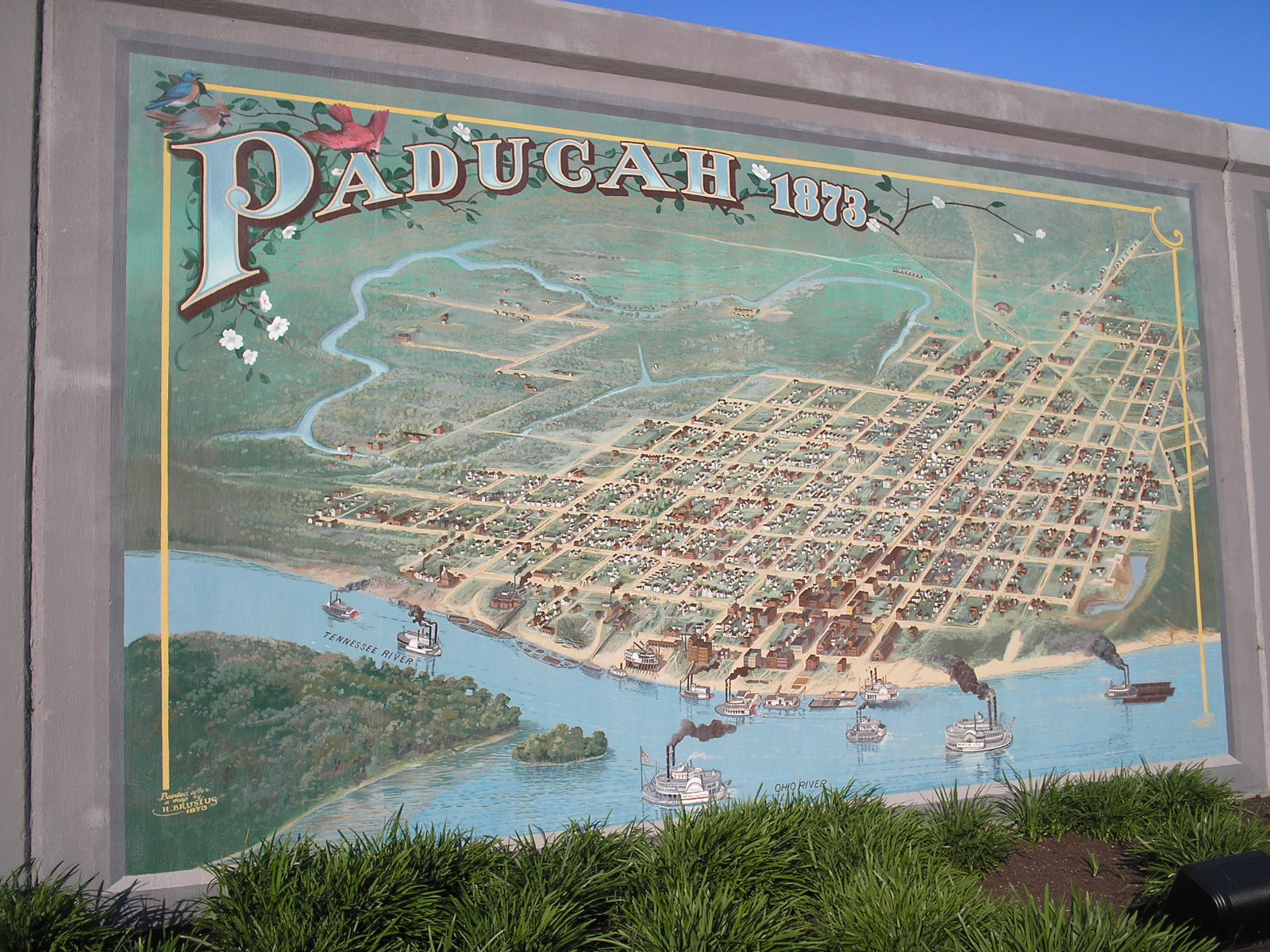
Paducah 1873One of the artistic highlights of our recent Great Square Route around the eastern U.S. (MN – MS – GA – CT – MN) was the stunning Museum of the American Quilting Society in Paducah, Kentucky, which had just opened a special exhibit, 4 Guys & Their Quilts:

On exhibit May 16-August 12, these quilts combine the talents of four male award-winning quilters: John Flynn, Gerald E. Roy, Arturo Alonzo Sandoval and Ricky Tims. MAQS Curator of Collection Judy Schwender is proud to bring lesser known viewpoints from the quilting world to the Museum’s visitors.

“Any quilt reveals the sensibilities of its maker, and men bring perspectives to quilting that are unique to the medium,” Schwender explains. “Within the world of quilting, men are a minority, and the museum is committed to presenting quilting viewpoints of underserved populations.”

My favorite among the 4 Guys was Ricky Tims, whose work ranges from exquisite variations on traditional quilting patterns, like his Bohemian Rhapsody or New World Symphony, to renditions in fabric of depictive art that would not look out of place on a framed canvas or in stained glass, like his South Cheyenne Canyon or Glen Eyrie Castle.

Among the new quilting terms and techniques I learned about at the museum was trapunto (also called “stuffed work”), a texture-enhancing technique that Tims puts to fine use in his Rhapsody in Green.

2 Comments

Filed under art, travel, U.S.

Minnesota’s Canned Corn and Carp

A 1997 Minnesota Historical Society plaque at a rest area near the state line on I-35 tells a bit about the history of Minnesota’s canneries.

Early settlers grew bumper wheat crops on Minnesota’s fertile prairies, land that today supplies produce for a thriving 270-million-dollars-a-year canning industry.

Sweet corn canneries opened in Austin and Mankato in the 1880s, followed soon thereafter by similar factories in Faribault, Owatonna, and LaSueur. Soon Minnesota’s canners were experimenting with new technologies and new products, and in 1903 the automated Big Stone Canning Company founded by F. W. Douthitt changed the industry nationwide. Douthitt’s plant in Ortonville had a conveyor system, mechanical corn husking machines, and a power driven cutter that produced the first whole kernel canned corn. The Green Giant Company, also founded in 1903 as the Minnesota Valley Canning Company, introduced golden cream-style corn in 1924 and the first vacuum packed corn in 1929.

Corn is still the major canning crop in Minnesota. The state’s more than thirty plants also freeze and can peas, beans, carrots, tomatoes, pork, beef, chicken products, and such unusual items as rutabagas. Mankato was the site of the nation’s first carp cannery in 1946.

For more on canned carp, read Dumneazu‘s well-illustrated blogpost on the Odessa Fish Market. In fact, just keep scrolling for an incomparable travelogue series on Dumneazu’s recent adventures in Ukraine.

Leave a comment

Filed under industry, travel, U.S.

Iowa’s Passing Mormons and Utopians

A State Historical Society of Iowa plaque at a pretty little welcome center off Exit 4 on I-35 in Iowa tells two interesting stories, one on each side.

The Mormon Trail

The Mormons of Nauvoo, Illinois, forced from their homes following the murder of their prophet, Joseph Smith, Jr., began their trek across Iowa in 1846 on their way to the Great Salt Lake Valley. From their first permanent campsite on Sugar Creek they travelled across southern Iowa toward Winter Quarters, near present-day Omaha. In addition to Sugar Creek, the Mormons also established permanent camps at Garden Grove in Decatur County, Mount Pisgah in Union County, and Kanesville in Pottawattamie County.

While camped by Locust Creek, near Corydon, William Clayton learned of the birth of his son in Nauvoo. On April 15, 1846, to commemorate this joyous event, he wrote the famous hymn “Come, Come, Ye Saints.” The hymn became a great rallying song of the Mormons.

In 1846, seven Mormon families became separated from the larger body of migrants. They stopped for the winter in present-day Green Bay Township, Clarke County, and established what was known as “Lost Camp.” These families remained in the area until 1854, when they resumed the trek to Utah.

Utopian Experiments in Southern Iowa

Several utopian groups attempted to implement in southern Iowa their dreams of a better social structure. In 1839, Abner Kneeland, a pantheist, started Salubria in Van Buren County. Beset with economic problems, the experiment dissolved after Kneeland died in 1844. In 1843, followers of French socialist Charles Fourier founded Phalanx in Mahaska County, but this communal experiment lasted only two years. Followers of another Frenchman, Etienne Cabet, tried several experiments in the United States, including Icaria in Adams County, which existed from 1860 to 1895.

Led by Ladislaus Ujhazy, a group of Hungarian refugees from the Revolutions of 1848 settled in Decatur County in 1850 and founded the town of New Buda. After experiencing economic difficulties, most of these people moved to Texas in 1853.

In 1851, people from near Farmington formed a communal association called the Hopewell Colony. They moved to Clarke County later that year, and founded the town of Hopeville. Although the communal nature of the colony soon changed, the village survived and for several decades was a thriving community. It is the only one of these southern Iowa utopian experiments whose remnants lasted into the 20th century.

Wisconsin also seems to have attracted more than its share of utopians, these days confined mostly to Madison, I suspect.

The best-known communal experiment in Wisconsin was the Wisconsin Phalanx, a community based on the principles of Charles Fourier, established at Ceresco (Ripon). It was the second largest Fourierist experiment in the country, lasting from 1844 until 1850, and housed around 180 people, most of whom lived communally in the Long House. Although the Phalanx was an economic success and attract[ed] national attention, problems developed and the members agreed to dissolve their community in 1850.

Leave a comment

Filed under religion, travel, U.S.

Wordcatcher Tales: Gum naval, Jump-butt, Stumpage value

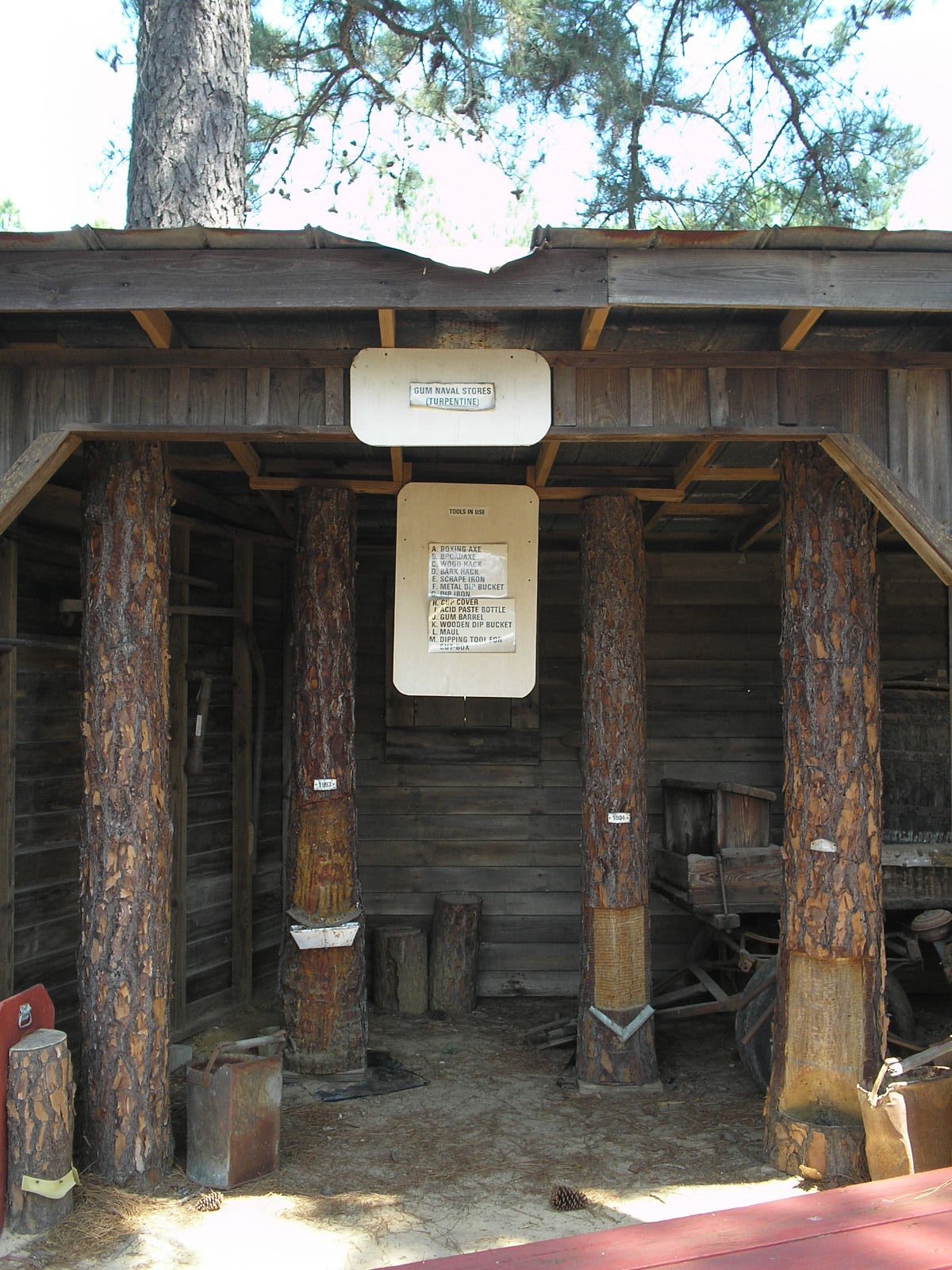
Gum naval stores and toolsOn the road from Columbus to Savannah, Georgia, during our recent Great Square Route around the eastern U.S. (MN – MS – GA – CT – MN), we stopped at the Million Pines Visitor Center off I-16 in Soperton, Georgia. The visitor center includes the Curt Barwick House, built of wood about 1845, which houses the front desk, gift shop, restrooms, and various display items; a one-room wooden house with a tin roof that served as the post office for Blackville, Georgia, from 1888 to 1904; and a wooden shed containing tools used to produce gum naval stores.

The latter term was new to me. It bears no relation to naval jelly (phosphoric acid), which is used on iron ships. Gum naval dates back to the days of wooden ships, when Georgia played an important role in the naval stores industry, as the New Georgia Encyclopedia relates:

In the late nineteenth and early twentieth centuries, Georgia was the world’s leading producer of naval stores, which are materials extracted from southern pine forests and then used in the construction and repair of sailing vessels. Typical naval stores include lumber, railroad ties, rosin, and turpentine.

The naval stores industry in North America originated in the mid-eighteenth century in North Carolina. Before 1800 the major products of the trade were raw gum, pitch, and tar. After the American Revolution (1775-83), processes were developed for distilling spirits of turpentine from gum. By 1850, 96 percent of U.S. naval stores came from North Carolina.

In the early 1870s North Carolina naval stores producers began migrating to southeast Georgia’s sandy coastal plain to take advantage of the untapped virgin pine forests in that region. They brought their equipment and black laborers and established residential villages on large turpentine farms. By the mid-1880s about seven in ten turpentine workers in southeast Georgia had been born in North Carolina.

The industry grew so rapidly that by 1890 Georgia was the national leader in naval stores production, a ranking that lasted until 1905. Florida was the leader from 1905 to 1923, after which Georgia regained its predominance and maintained it until the 1960s.

The USDA Forest Service Southern Research Station Headquarters in Asheville, North Carolina, describes some of the nitty gritty of production. Here are two photo captions from their website:

Photo caption: Improved gum naval stores extraction methods require new tools and techniques. Bark streaks 9 feet from the ground require a special long handled tool for pulling the streak and safely applying the acid. A combination bark-pulling and acid-treating tool was designed to meet this need. The laborer is shown applying 50-percent sulfuric acid to a streak 8 feet from the ground. This tool enables a laborer to stand a safe distance from the tree and reduce the hazard of acid drifting down on his head and clothes.

Photo caption: No more jump-butts and wasted timber as a result of turpentining. A turpentined tree containing both front and back faces and worked for 8 years is shown entering a German gang-saw to produce quality lumber. Developing conservative gu[m] extraction methods for the gum producer represents only half the problem, research must also prove to wood using industries that modern turpentining does not impair the stumpage value of the worked out tree.

The punctuation in the second caption sucks rather badly, but the wonderful collocations make up for it. Jump-butts in this context seems to refer to the discarded lower portion of turpentined trees. Stumpage value is the calculated value of standing timber. The butt log is the often slightly irregular log taken from the base of a tree.

Leave a comment

Filed under industry, language, travel, U.S.